Barry Kidd 2010 1
Thoracic Trauma
Barry Kidd 2010 2
Overview
Major signs and symptoms
• Immediate life-threatening injuries
Pathophysiology and management
• Open pneumothorax
• Tension pneumothorax
• Massive hemothorax
• Flail chest
• Cardiac tamponade
Cardiac involvement with blunt injury
Other thoracic injuries
2Thoracic Trauma -
Barry Kidd 2010 3
Thoracic Trauma
Thoracic injury is common.
• 50% of multiple trauma
• 25% of trauma deaths
Potentially fatal thoracic injuries saved by
rapid recognition and intervention.
• Many require surgical intervention
3Thoracic Trauma -
Barry Kidd 2010 4
Chest Anatomy
4Thoracic Trauma -
Barry Kidd 2010 5
Mechanism of Injury
Blunt
• Direct compression
 Fracture of solid organs
 Blowout of hollow organs
• Deceleration forces
Tearing of organs and blood vessels
• Direct trauma to organ and vasculature
• Energy transmitted from mass and velocity
5Thoracic Trauma -
Barry Kidd 2010 6
Tissue Hypoxia
Inadequate oxygen delivery
Hypovolemia
Ventilation/perfusion mismatch
Pleural pressure changes
Pump failure
6Thoracic Trauma -
Barry Kidd 2010 7
Thoracic Trauma
7
 Shortness of breath
 Chest pain
 Hemoptysis (the
coughing up of blood
from the respiratory
tract)
 Cyanosis
 Neck veins distended
 Tracheal deviation
 Asymmetrical
movement
Signs and symptoms
Thoracic Trauma -
 Chest wall contusion
 Open wounds
 Subcutaneous emphysema
 Shock
 Tenderness, instability,
crepitation (TIC)
 Breath sounds abnormal
Barry Kidd 2010 8
Primary Survey
“Deadly Dozen”
1. Airway obstruction
2. Open pneumothorax
3. Flail chest
4. Tension pneumothorax
5. Massive hemothorax
6. Cardiac tamponade
8Thoracic Trauma -
Barry Kidd 2010 9
Secondary Survey
“Deadly Dozen”
7. Myocardial contusion
8. Traumatic aortic rupture
9. Tracheal or bronchial tree injury
10. Diaphragmatic tears
11. Esophageal injury
12. Pulmonary contusion
9Thoracic Trauma -
Barry Kidd 2010 10
Primary “Deadly Dozen”
Airway obstruction
• Secondary hypoxia
 Common cause of preventable death
 Foreign body, tongue, aspiration
• Always assume cervical spine injury
10Thoracic Trauma -
Barry Kidd 2010 11
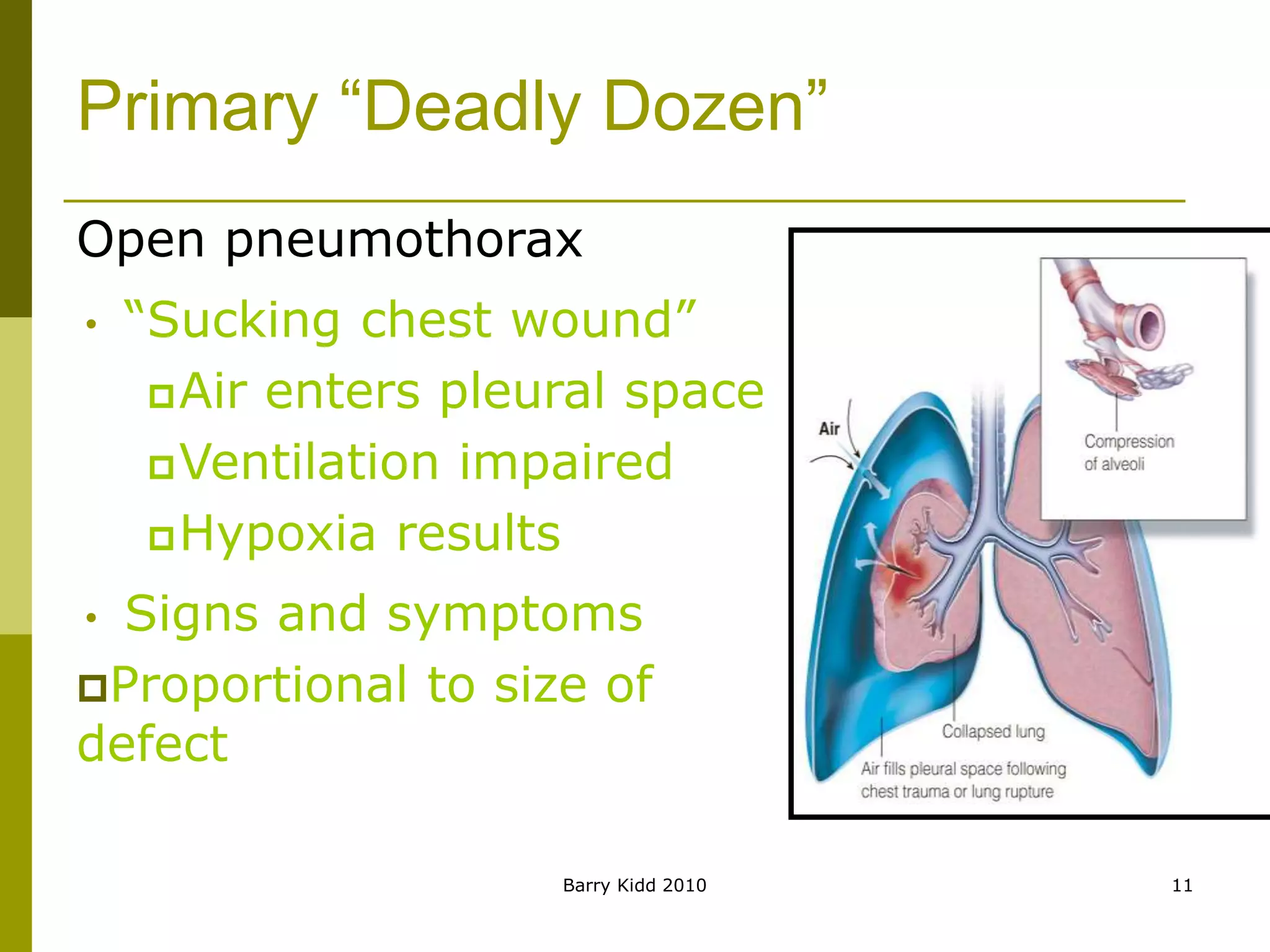
Open pneumothorax
• “Sucking chest wound”
Air enters pleural space
Ventilation impaired
Hypoxia results
• Signs and symptoms
Proportional to size of
defect
11Thoracic Trauma -
Primary “Deadly Dozen”
Barry Kidd 2010 12
Open pneumothorax
• “Sucking chest wound”
 Air enters pleural space
 Ventilation impaired
 Hypoxia results
• Signs and symptoms
 Proportional to size of defect
12Thoracic Trauma -
Primary “Deadly Dozen”
Barry Kidd 2010 13
Open pneumothorax
• Close chest wall defect
• Load-and-go
13Thoracic Trauma -
Primary “Deadly Dozen”
Barry Kidd 2010 14
Flail chest
14Thoracic Trauma -
Primary “Deadly Dozen”
Barry Kidd 2010 15
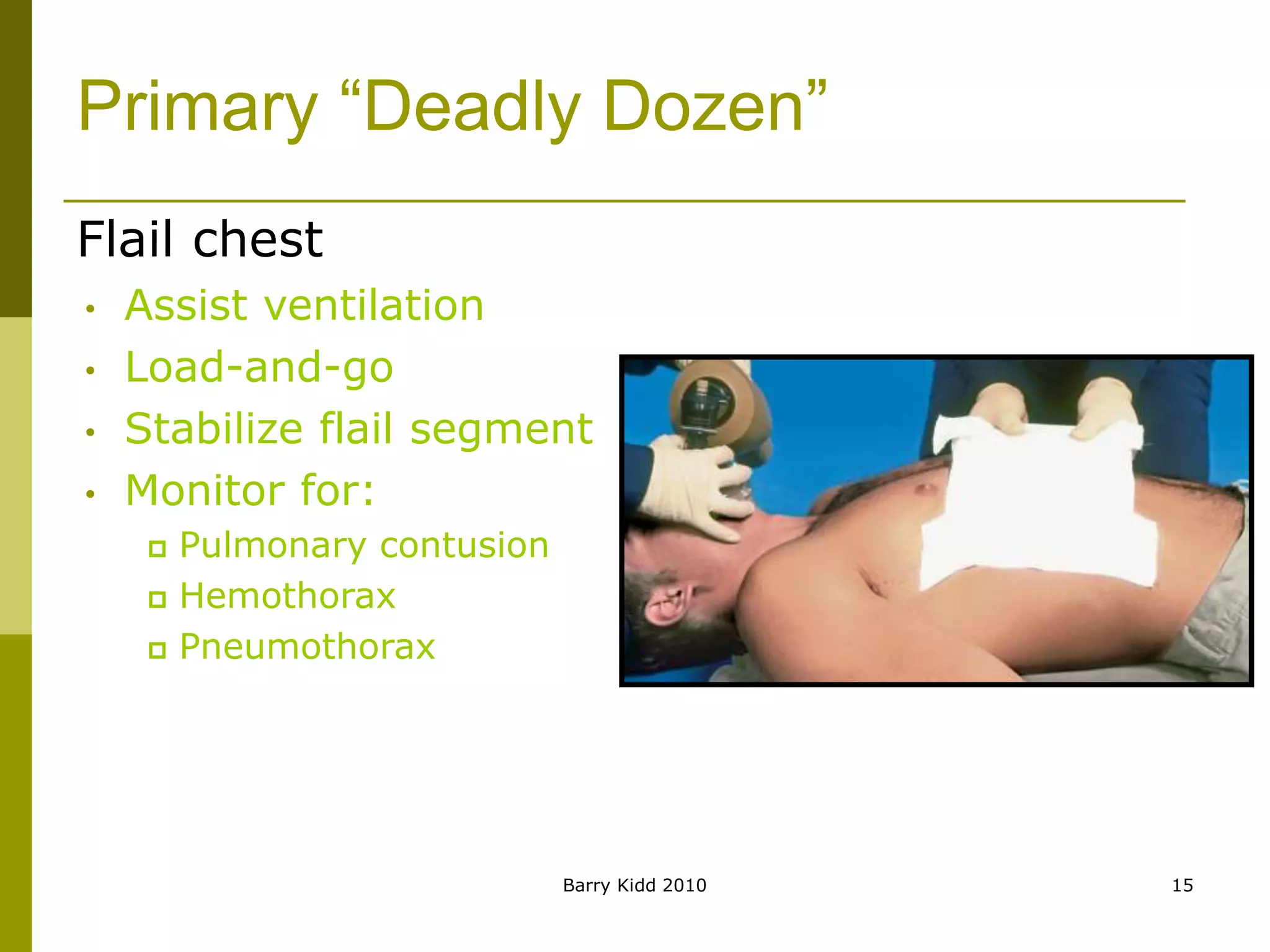
Flail chest
• Assist ventilation
• Load-and-go
• Stabilize flail segment
• Monitor for:
 Pulmonary contusion
 Hemothorax
 Pneumothorax
15Thoracic Trauma -
Primary “Deadly Dozen”
Barry Kidd 2010 16
Tension pneumothorax
• Dyspnea
• Anxiety
• Tachypnea
• Distended neck veins
• Tracheal deviation (rare)
• Breath sounds diminished
 Hypertympany if percussed
• Shock with hypotension
16Thoracic Trauma -
Primary “Deadly Dozen”
Barry Kidd 2010 17
Massive hemothorax
• Anxiety and confusion
• Neck veins
 Flat: hypovolemia
 Distended:
mediastinal compression
• Breath sounds decreased
 Hypotympany if percussed
• Shock
17Thoracic Trauma -
Primary “Deadly Dozen”
Barry Kidd 2010 18
Massive hemothorax
• Load-and-go
• Treat for shock
• Monitor for:
 Hemopneumothorax
18Thoracic Trauma -
Primary “Deadly Dozen”
Barry Kidd 2010 19
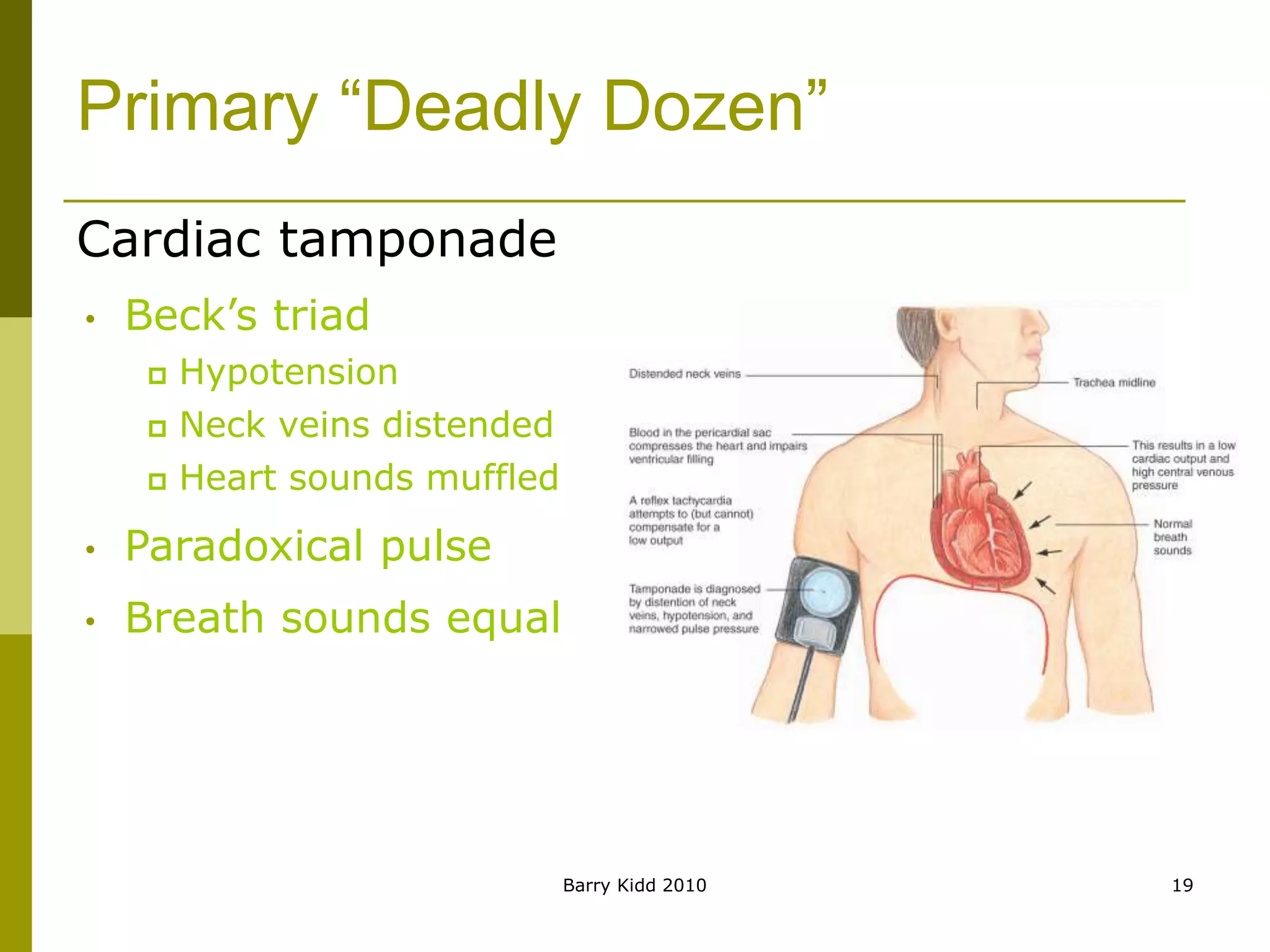
Cardiac tamponade
• Beck’s triad
 Hypotension
 Neck veins distended
 Heart sounds muffled
• Paradoxical pulse
• Breath sounds equal
19Thoracic Trauma -
Primary “Deadly Dozen”
Barry Kidd 2010 20
Cardiac tamponade
• Load-and-go
• Treat for shock
• Monitor
• Monitor for:
 Hemothorax
 Pneumothorax
20Thoracic Trauma -
Primary “Deadly Dozen”
Barry Kidd 2010 21
Secondary “Deadly Dozen”
Myocardial contusion
•Most common cardiac injury
 Blunt anterior chest injury
• Same as myocardial infarction
 Chest pain
 Dysrhythmias
 Cardiogenic shock (rare)
• Treat as cardiac tamponade
21Thoracic Trauma -
Barry Kidd 2010 22
Secondary “Deadly Dozen”
Traumatic aortic rupture
•Most common cause of immediate death
 Motor-vehicle collisions or falls from heights
 90% die immediately
• Scene Size-up and history extremely important
 No obvious sign of chest trauma
 Hypertension in upper extremities
and hypotension in lower extremities (rare)
22Thoracic Trauma -
Barry Kidd 2010 23
Secondary “Deadly Dozen”
Tracheal or bronchial tree injury
•Subcutaneous emphysema (Subcutaneous emphysema can
often be seen as a smooth bulging of the skin. When a medic palpates the skin, an
unusual crackling sensation can be felt as the gas is pushed through the tissue)
 Chest, face, neck
• Ensure adequate airway
• Monitor for:
 Pneumothorax
 Hemothorax
23Thoracic Trauma -
Barry Kidd 2010 24
Secondary “Deadly Dozen”
Diaphragmatic tear (a tear of the diaphragm, the muscle across the
bottom of the ribcage that plays a crucial role in respiration)
• Severe blow to abdomen
• Herniation of abdominal organs
 More common on left
 Breath sounds diminished
 Bowel sounds auscultated in chest (rare)
 Abdomen appears scaphoid
24Thoracic Trauma -
Barry Kidd 2010 25
Secondary “Deadly Dozen”
Esophageal injury
• Penetrating trauma
• Difficult to assess in field
• If unrecognized, may be lethal
25Thoracic Trauma -
Barry Kidd 2010 26
Secondary “Deadly Dozen”
Pulmonary contusion
• Common from blunt trauma
• Hours to develop
• Marked hypoxemia
Impaled object
• Do not remove
• Gently stabilize object
• Avoid movement
26Thoracic Trauma -
Barry Kidd 2010 27
Other Chest Injuries
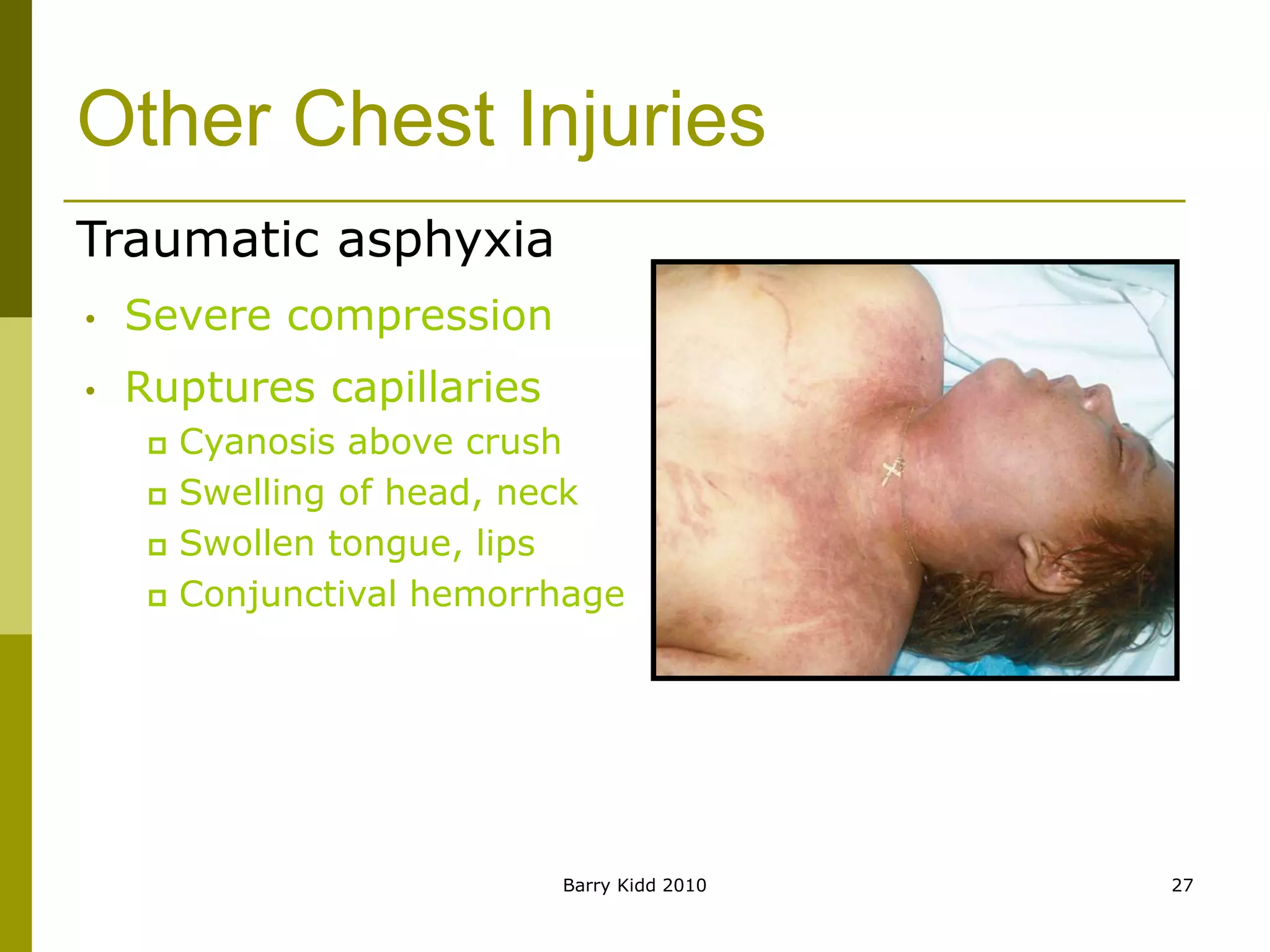
Traumatic asphyxia
• Severe compression
• Ruptures capillaries
 Cyanosis above crush
 Swelling of head, neck
 Swollen tongue, lips
 Conjunctival hemorrhage
27Thoracic Trauma -
Barry Kidd 2010 28
Other Chest Injuries
Simple pneumothorax
• Fractured ribs
• Pleuritic chest pain
• Dyspnea
• Decreased breath sounds
• Hypertympany if percussed
• Monitor for:
 Tension pneumothorax
28Thoracic Trauma -
Barry Kidd 2010 29
Other Chest Injuries
Sternal fracture
• Significant blunt trauma to anterior chest
• Signs of fracture on palpation
• Myocardial contusion presumed
Simple rib fracture
• Most frequent chest injury
• Monitor for:
 Pneumothorax
 Hemothorax
29Thoracic Trauma -
Barry Kidd 2010 30
Summary
Chest injuries common
Often life-threatening
• Require prompt recognition
• Require prompt intervention
• Frequently require load-and-go
Airway and oxygenation always priority
Frequent Ongoing Exams
30Thoracic Trauma -
Barry Kidd 2010 31
Discussion
31Thoracic Trauma -
Barry Kidd 2010 32

Thoracic trauma

  • 1.
    Barry Kidd 20101 Thoracic Trauma
  • 2.
    Barry Kidd 20102 Overview Major signs and symptoms • Immediate life-threatening injuries Pathophysiology and management • Open pneumothorax • Tension pneumothorax • Massive hemothorax • Flail chest • Cardiac tamponade Cardiac involvement with blunt injury Other thoracic injuries 2Thoracic Trauma -
  • 3.
    Barry Kidd 20103 Thoracic Trauma Thoracic injury is common. • 50% of multiple trauma • 25% of trauma deaths Potentially fatal thoracic injuries saved by rapid recognition and intervention. • Many require surgical intervention 3Thoracic Trauma -
  • 4.
    Barry Kidd 20104 Chest Anatomy 4Thoracic Trauma -
  • 5.
    Barry Kidd 20105 Mechanism of Injury Blunt • Direct compression  Fracture of solid organs  Blowout of hollow organs • Deceleration forces Tearing of organs and blood vessels • Direct trauma to organ and vasculature • Energy transmitted from mass and velocity 5Thoracic Trauma -
  • 6.
    Barry Kidd 20106 Tissue Hypoxia Inadequate oxygen delivery Hypovolemia Ventilation/perfusion mismatch Pleural pressure changes Pump failure 6Thoracic Trauma -
  • 7.
    Barry Kidd 20107 Thoracic Trauma 7  Shortness of breath  Chest pain  Hemoptysis (the coughing up of blood from the respiratory tract)  Cyanosis  Neck veins distended  Tracheal deviation  Asymmetrical movement Signs and symptoms Thoracic Trauma -  Chest wall contusion  Open wounds  Subcutaneous emphysema  Shock  Tenderness, instability, crepitation (TIC)  Breath sounds abnormal
  • 8.
    Barry Kidd 20108 Primary Survey “Deadly Dozen” 1. Airway obstruction 2. Open pneumothorax 3. Flail chest 4. Tension pneumothorax 5. Massive hemothorax 6. Cardiac tamponade 8Thoracic Trauma -
  • 9.
    Barry Kidd 20109 Secondary Survey “Deadly Dozen” 7. Myocardial contusion 8. Traumatic aortic rupture 9. Tracheal or bronchial tree injury 10. Diaphragmatic tears 11. Esophageal injury 12. Pulmonary contusion 9Thoracic Trauma -
  • 10.
    Barry Kidd 201010 Primary “Deadly Dozen” Airway obstruction • Secondary hypoxia  Common cause of preventable death  Foreign body, tongue, aspiration • Always assume cervical spine injury 10Thoracic Trauma -
  • 11.
    Barry Kidd 201011 Open pneumothorax • “Sucking chest wound” Air enters pleural space Ventilation impaired Hypoxia results • Signs and symptoms Proportional to size of defect 11Thoracic Trauma - Primary “Deadly Dozen”
  • 12.
    Barry Kidd 201012 Open pneumothorax • “Sucking chest wound”  Air enters pleural space  Ventilation impaired  Hypoxia results • Signs and symptoms  Proportional to size of defect 12Thoracic Trauma - Primary “Deadly Dozen”
  • 13.
    Barry Kidd 201013 Open pneumothorax • Close chest wall defect • Load-and-go 13Thoracic Trauma - Primary “Deadly Dozen”
  • 14.
    Barry Kidd 201014 Flail chest 14Thoracic Trauma - Primary “Deadly Dozen”
  • 15.
    Barry Kidd 201015 Flail chest • Assist ventilation • Load-and-go • Stabilize flail segment • Monitor for:  Pulmonary contusion  Hemothorax  Pneumothorax 15Thoracic Trauma - Primary “Deadly Dozen”
  • 16.
    Barry Kidd 201016 Tension pneumothorax • Dyspnea • Anxiety • Tachypnea • Distended neck veins • Tracheal deviation (rare) • Breath sounds diminished  Hypertympany if percussed • Shock with hypotension 16Thoracic Trauma - Primary “Deadly Dozen”
  • 17.
    Barry Kidd 201017 Massive hemothorax • Anxiety and confusion • Neck veins  Flat: hypovolemia  Distended: mediastinal compression • Breath sounds decreased  Hypotympany if percussed • Shock 17Thoracic Trauma - Primary “Deadly Dozen”
  • 18.
    Barry Kidd 201018 Massive hemothorax • Load-and-go • Treat for shock • Monitor for:  Hemopneumothorax 18Thoracic Trauma - Primary “Deadly Dozen”
  • 19.
    Barry Kidd 201019 Cardiac tamponade • Beck’s triad  Hypotension  Neck veins distended  Heart sounds muffled • Paradoxical pulse • Breath sounds equal 19Thoracic Trauma - Primary “Deadly Dozen”
  • 20.
    Barry Kidd 201020 Cardiac tamponade • Load-and-go • Treat for shock • Monitor • Monitor for:  Hemothorax  Pneumothorax 20Thoracic Trauma - Primary “Deadly Dozen”
  • 21.
    Barry Kidd 201021 Secondary “Deadly Dozen” Myocardial contusion •Most common cardiac injury  Blunt anterior chest injury • Same as myocardial infarction  Chest pain  Dysrhythmias  Cardiogenic shock (rare) • Treat as cardiac tamponade 21Thoracic Trauma -
  • 22.
    Barry Kidd 201022 Secondary “Deadly Dozen” Traumatic aortic rupture •Most common cause of immediate death  Motor-vehicle collisions or falls from heights  90% die immediately • Scene Size-up and history extremely important  No obvious sign of chest trauma  Hypertension in upper extremities and hypotension in lower extremities (rare) 22Thoracic Trauma -
  • 23.
    Barry Kidd 201023 Secondary “Deadly Dozen” Tracheal or bronchial tree injury •Subcutaneous emphysema (Subcutaneous emphysema can often be seen as a smooth bulging of the skin. When a medic palpates the skin, an unusual crackling sensation can be felt as the gas is pushed through the tissue)  Chest, face, neck • Ensure adequate airway • Monitor for:  Pneumothorax  Hemothorax 23Thoracic Trauma -
  • 24.
    Barry Kidd 201024 Secondary “Deadly Dozen” Diaphragmatic tear (a tear of the diaphragm, the muscle across the bottom of the ribcage that plays a crucial role in respiration) • Severe blow to abdomen • Herniation of abdominal organs  More common on left  Breath sounds diminished  Bowel sounds auscultated in chest (rare)  Abdomen appears scaphoid 24Thoracic Trauma -
  • 25.
    Barry Kidd 201025 Secondary “Deadly Dozen” Esophageal injury • Penetrating trauma • Difficult to assess in field • If unrecognized, may be lethal 25Thoracic Trauma -
  • 26.
    Barry Kidd 201026 Secondary “Deadly Dozen” Pulmonary contusion • Common from blunt trauma • Hours to develop • Marked hypoxemia Impaled object • Do not remove • Gently stabilize object • Avoid movement 26Thoracic Trauma -
  • 27.
    Barry Kidd 201027 Other Chest Injuries Traumatic asphyxia • Severe compression • Ruptures capillaries  Cyanosis above crush  Swelling of head, neck  Swollen tongue, lips  Conjunctival hemorrhage 27Thoracic Trauma -
  • 28.
    Barry Kidd 201028 Other Chest Injuries Simple pneumothorax • Fractured ribs • Pleuritic chest pain • Dyspnea • Decreased breath sounds • Hypertympany if percussed • Monitor for:  Tension pneumothorax 28Thoracic Trauma -
  • 29.
    Barry Kidd 201029 Other Chest Injuries Sternal fracture • Significant blunt trauma to anterior chest • Signs of fracture on palpation • Myocardial contusion presumed Simple rib fracture • Most frequent chest injury • Monitor for:  Pneumothorax  Hemothorax 29Thoracic Trauma -
  • 30.
    Barry Kidd 201030 Summary Chest injuries common Often life-threatening • Require prompt recognition • Require prompt intervention • Frequently require load-and-go Airway and oxygenation always priority Frequent Ongoing Exams 30Thoracic Trauma -
  • 31.
    Barry Kidd 201031 Discussion 31Thoracic Trauma -
  • 32.