Lakewood Fire MEDIC ONE
EMD - CE
INTRODUCTION
TO “O.T.C.”
MEDICINE
OBJECTIVE
To familiarize the students
with basic OTC medicines
used to treat minor medical
problems.
OTC MEDICATIONS
 Drugs that can be brought without a
doctor’s prescription.
 Don’t assume that they are safe.
 Carefully read labels and inserts.
 Be aware of drug interactions.
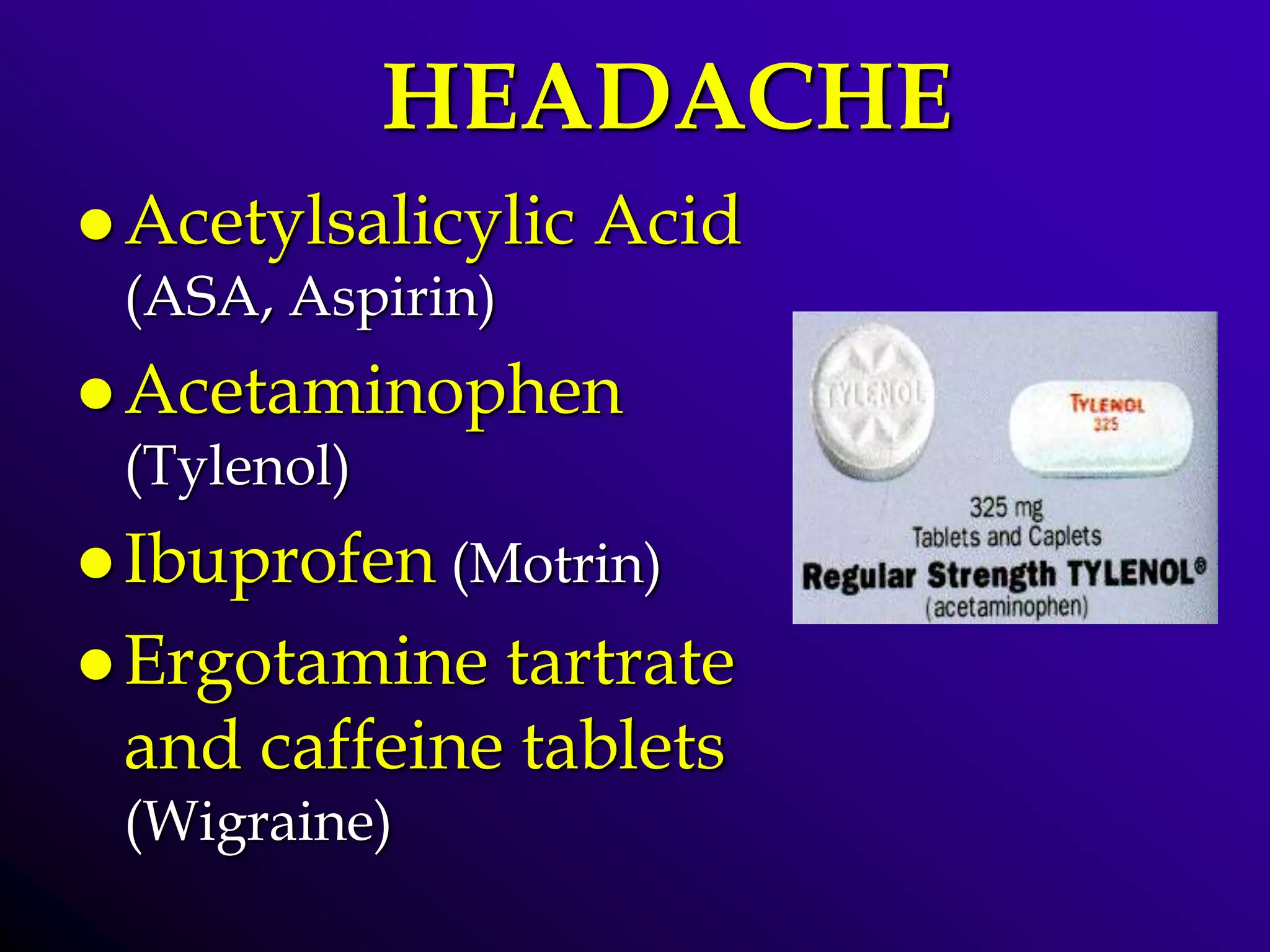
HEADACHE
 Acetylsalicylic Acid
(ASA, Aspirin)
 Acetaminophen
(Tylenol)
 Ibuprofen (Motrin)
 Ergotamine tartrate
and caffeine tablets
(Wigraine)
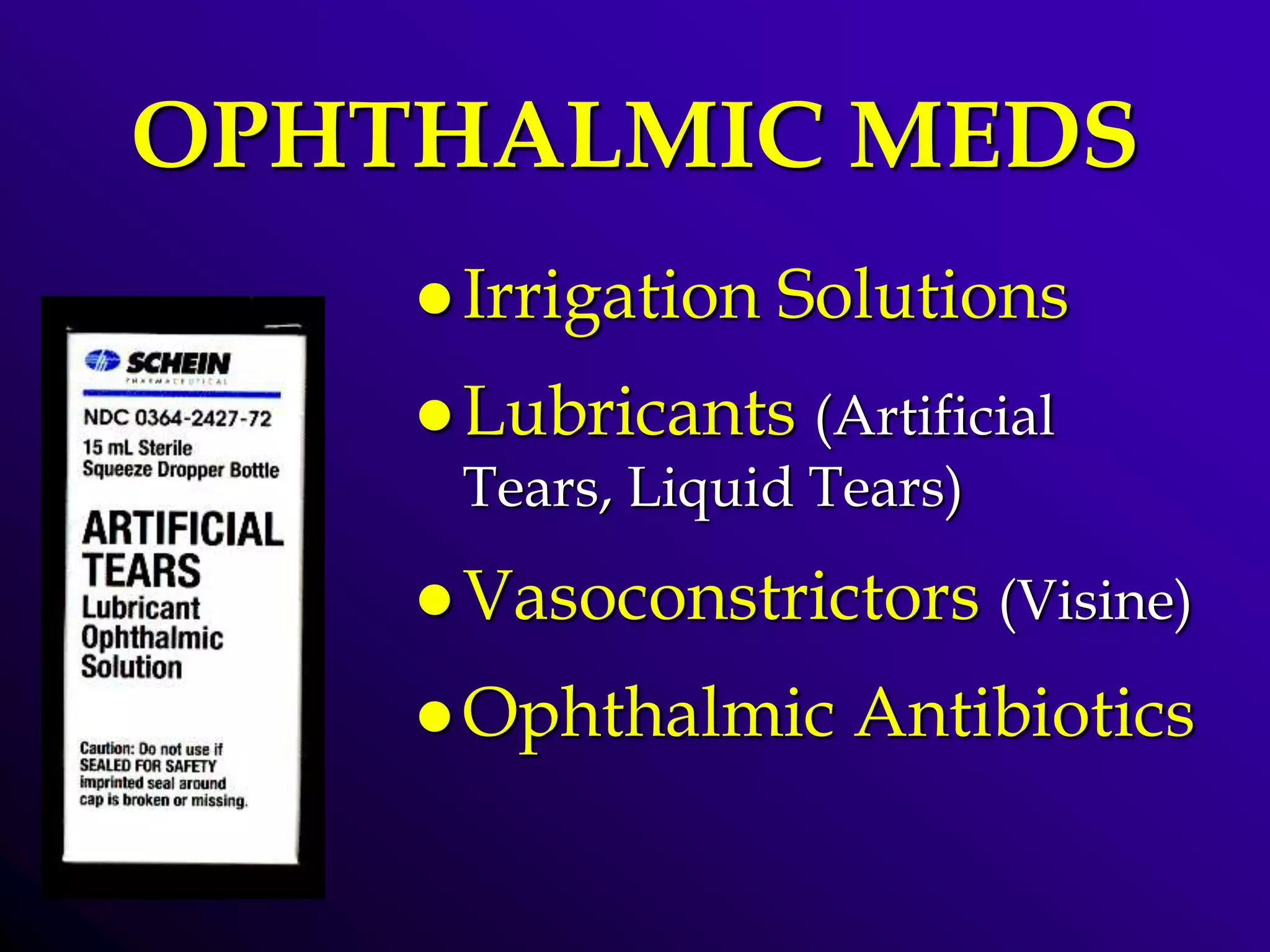
OPHTHALMIC MEDS
 Irrigation Solutions
 Lubricants (Artificial
Tears, Liquid Tears)
 Vasoconstrictors (Visine)
 Ophthalmic Antibiotics
OTTIC MEDS
 Domoborro
 Acetic Acid
 Ear Wax Removal (Debrox)
ANTACIDS
 Taken to relieve heartburn or
indigestion caused by stomach acid.
 Relatively safe for occasional use, but
may cause problems if taken regularly.
 There are several kinds of antacids.
ANTACIDS
 Sodium Bicarbonate (Alka-Seltzer, Bromo
Seltzer) contain baking soda.
 Calcium Carbonate (Tums, Alka-2)
 Aluminum-based (Amphojel)
 Magnesium Compounds (Phillip’s Milk of
Magnesia)
 Aluminum-Magnesium combinations
(Maalox, Di-Gel, Mylanta)
ANTACIDS
PRECAUTIONS
 Try to eliminate the cause instead of
taking antacids regularly.
 Antacids may interfere with the
absorption and action of some drugs,
such as digitalis, antibiotics and
anticoagulants.
ANTIDIARRHEALS
 Two types: Those that thicken the stool and
those that slow intestinal spasms.
 Thickening Mixtures
(Kaopectate)
(Bismuth Subsalicylate
Pepto-Bismol)
ANTIDIARRHEALS
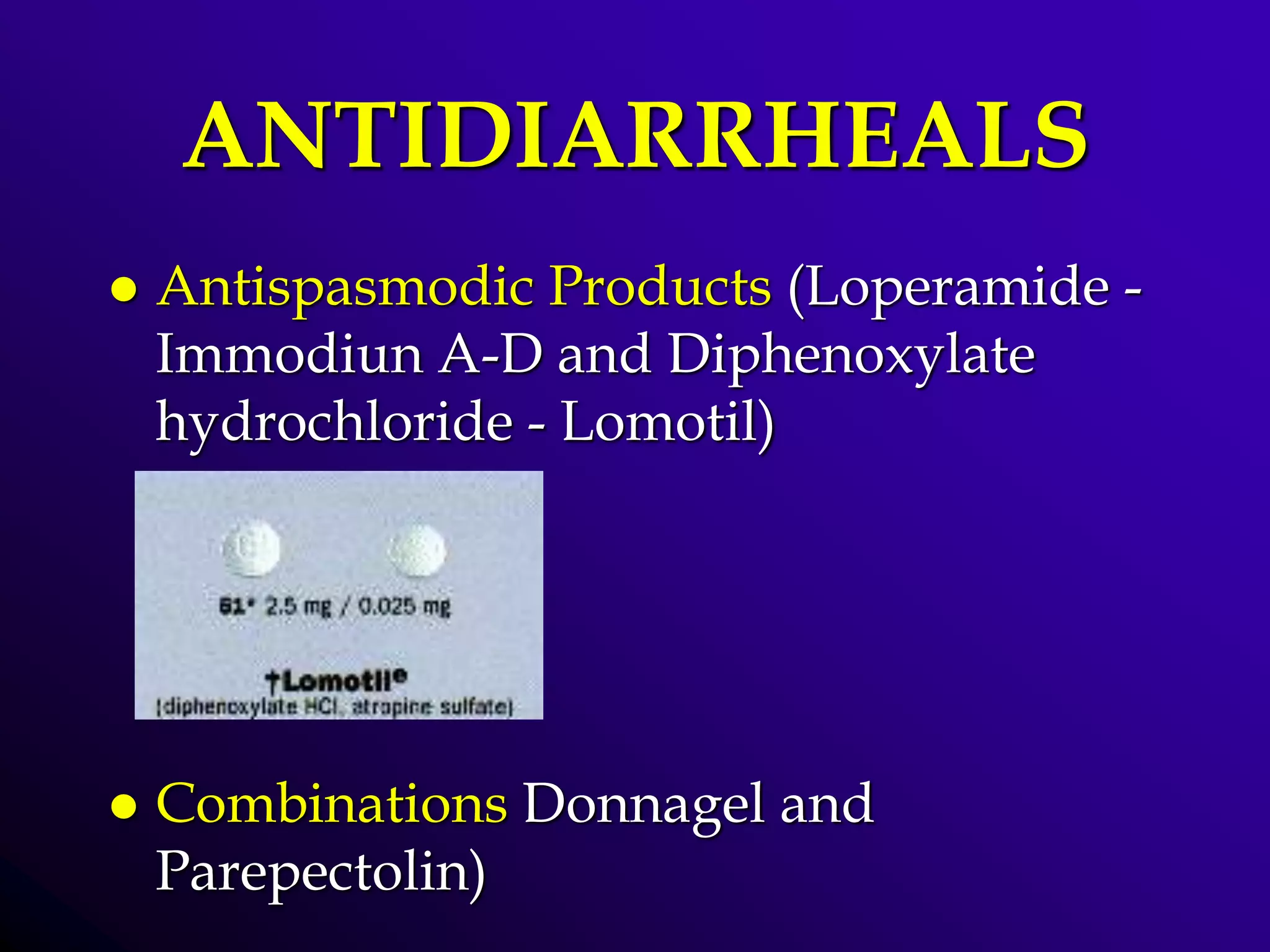
 Antispasmodic Products (Loperamide -
Immodiun A-D and Diphenoxylate
hydrochloride - Lomotil)
 Combinations Donnagel and
Parepectolin)
ANTIDIARRHEALS
PRECAUTIONS
 Diarrhea often helps rid the body of
infection.
 Take preparation until the stool
thickens then stop to avoid
constipation.
 Replace body fluids.
NAUSEA AND
VOMITING
 Best to determine and treat underlying
cause
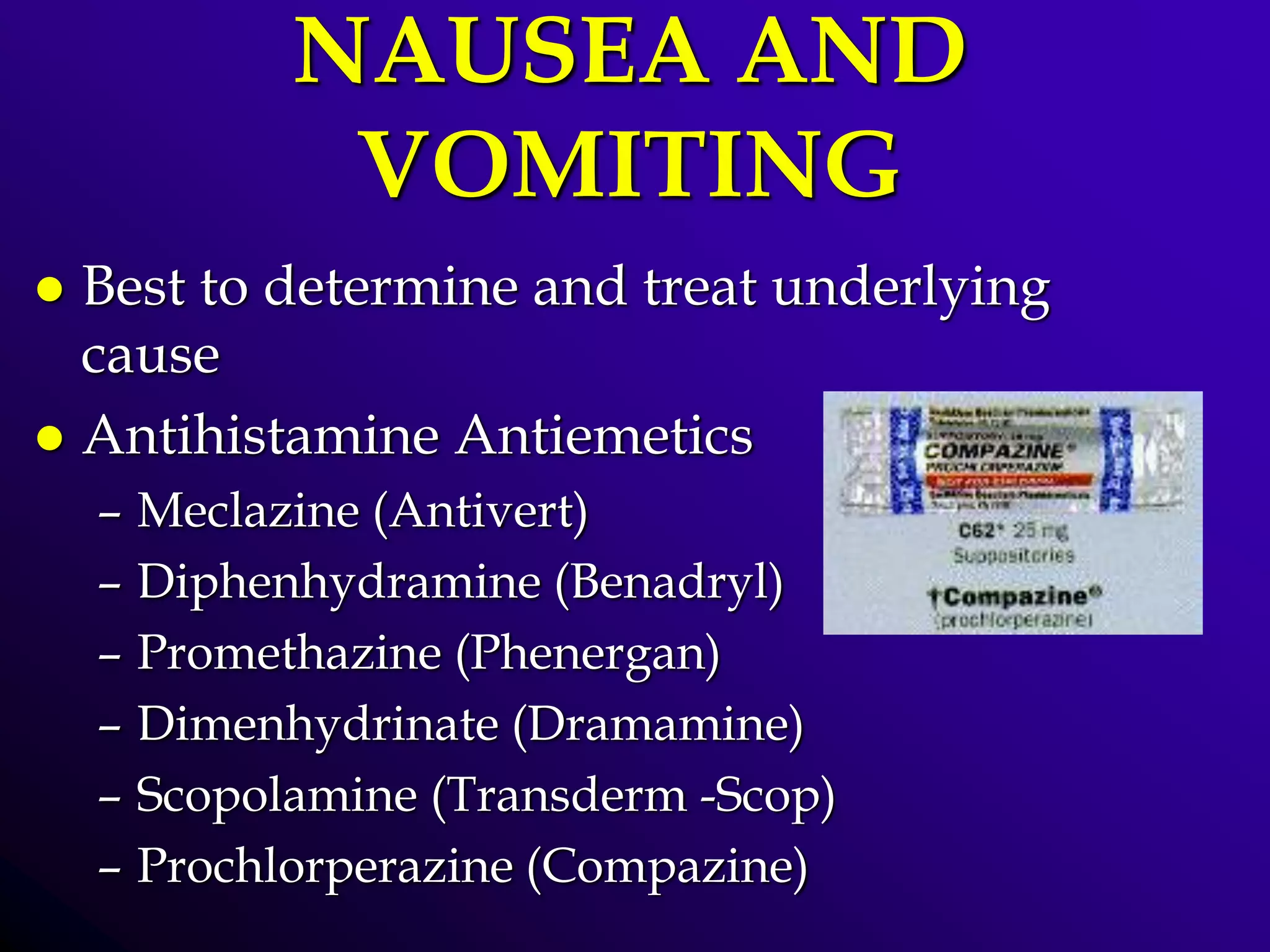
 Antihistamine Antiemetics
– Meclazine (Antivert)
– Diphenhydramine (Benadryl)
– Promethazine (Phenergan)
– Dimenhydrinate (Dramamine)
– Scopolamine (Transderm -Scop)
– Prochlorperazine (Compazine)
COLD REMEDIES
 If you take drugs for a cold
you’ll probably get better in
about a week. If you take
nothing you’ll get better in
about seven days.
COLD REMEDIES
 REST AND LIQUIDS
 ANTIBIOTICS WILL NOT HELP
 Medications help relieve the SYMPTOMS
COLD REMEDIES
ANTIHISTAMINES
 Dries mucous membranes
 Single Ingredient Antihistamines
– Cholrpheniramine (Chlor-Trimiton)
– Diphenhydramine (Benadrly)
 Combinations (Antihistamine
plus a Decongestant)
– Dristan, Triaminic
THE VALUE OF
ANTIHISTAMINE USE IN
THE COMMON COLD IS
UNDER DEBATE
COLD REMEDIES
ANTIHISTAMINE
PRECAUTIONS
 Drink extra fluids when taking cold
medicines
 Antihistamines may interact with other
medications such as antidepressants,
sedatives, and tranquilizers.
DECONGESTANTS
Sympathomimetic amines
which reduce the flow of
blood to the nasal mucosa
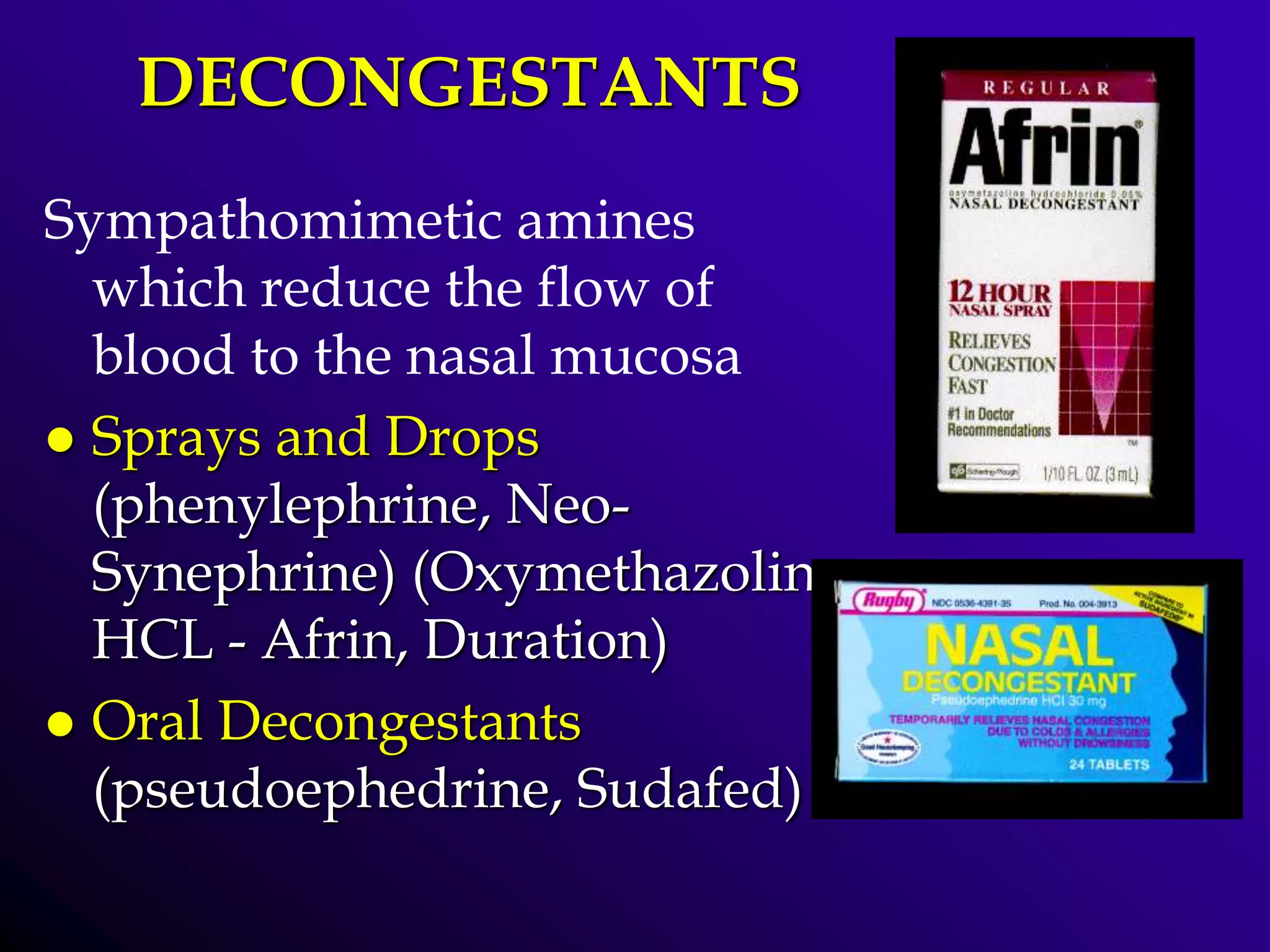
 Sprays and Drops
(phenylephrine, Neo-
Synephrine) (Oxymethazoline
HCL - Afrin, Duration)
 Oral Decongestants
(pseudoephedrine, Sudafed)
COLD REMEDIES
DECONGESTANT PRECAUTIONS
 Can interact with other drugs
 If used for too long a time they can cause a
rebound effect
 SIDE EFFECTS
– Tachycardia, Headache, Dizziness
– USE WITH CAUTION IN PATIENTS WITH
SEVERE HYPERTENSION AND ISCHEMIC
HEART DISEASE
COUGHING
 Protective Reflex action of the
respiratory system to dislodge and eject
foreign materials and excess mucus
from the respiratory tract.
 Congested Productive Cough
 Congested Nonproductive Cough
 Dry Nonproductive cough
 Antitussive
COLD REMEDIES
COUGH PREPARATIONS
 WATER AND FRUIT
 DEMULCENTS
– Honey, Hard Candy, Cough Drops
 CODEINE
– Depresses the cough reflex
– Used for symptomatic relief of dry
nonproductive cough
– Codeine Tablets, Robitussin AC and Codiene
Elixir
COLD REMEDIES
COUGH PREPARATIONS
 DEXTROMETHORPHAN
– Nonnarcotic equivalent to Codeine
– Robitussin DM
 GUAIFENESIN
– Expectorant used in both productive and
nonproductive cough
– Robitussin, 2G, GG Tussin
COLD REMEDIES
COUGH PREPARATIONS
PRECAUTIONS
 Can cause problems for people with certain
health problems, such as asthma, heart
disease and high blood pressure
 Use with caution in patients with respiratory
problems - Cough suppressants can stifle
breathing
 Some preparations contain large amounts of
alcohol; others contain codeine
LAXATIVES
 Two types of products that ease the
passage and elimination of bowel
movements
 Those that speed up the passage of stool by
stimulating the intestines (Correctol, Ex-
Lax, Feen-A-Mint, Biscodyl, Senna Pod)
 Bulking Agents are not laxatives, but ease
constipation by increasing the volume of
the stool and making it easier to pass
(Metamucil)
FECAL SOFTENERS
 Agents Used to maintain a soft stool to
minimize work involved in defecation.
 dioctyl sodium sulfosuccinate (Colace)
 dioctyl calcium sulfosuccinate (Surfak)
 Mineral Oil
– Absorption of lipid soluble vitamins may be
affected
– Lipid Pneumonia is a possible side effect
– Oil leak
BUROW’S
SOLUTION/DOMEBORO
POWDER
 Mild skin irritation from exposure to
soaps, chemicals, diaper rash, acne,
scaly skin, eczema apply PRN
 Skin inflammation, insect bites, poison
ivy, or other contact dermatoses,
swelling, athlete's foot
 Used in wet dressings and soaks
ANTIBACTERIALS AND
ANTIFUNGALS
 Alcohol, ethyl and isopropyl
 Carbol-fuchsin solution
– Tinea, fungal skin infections
 Hydrogen peroxide
– Cleansing wounds
 Salicylic acid
– Warts
 Tolnaftate
– Tinea
 Undecylenic acid
– Tinea
ANTISEPTICS AND
GERMACIDES
 Hexachlorophene
– pHisoHex, pHisoScrub
 Iodine
 Povidone-iodine
ASTRINGENTS
 Calamine
 Witch hazel
 Oatmeal
 Petrolatum
EMOLLIENTS
MISCELLANEOUS AGENTS
 Benzyl benzoate
– Treatment of scabies
 Methyl salicylate (Ben-Gay, Icy Hot etc.)
 Selinium sulfide (Selsun, Selsun Blue )
 Para-aminobenzoic acid PABA
 Zinc oxide
HEMORRHOIDS
 Anusol
 Dibucaine
 Witch Hazel Pads

Over the counter medications

  • 1.
    Lakewood Fire MEDICONE EMD - CE INTRODUCTION TO “O.T.C.” MEDICINE
  • 2.
    OBJECTIVE To familiarize thestudents with basic OTC medicines used to treat minor medical problems.
  • 3.
    OTC MEDICATIONS  Drugsthat can be brought without a doctor’s prescription.  Don’t assume that they are safe.  Carefully read labels and inserts.  Be aware of drug interactions.
  • 4.
    HEADACHE  Acetylsalicylic Acid (ASA,Aspirin)  Acetaminophen (Tylenol)  Ibuprofen (Motrin)  Ergotamine tartrate and caffeine tablets (Wigraine)
  • 5.
    OPHTHALMIC MEDS  IrrigationSolutions  Lubricants (Artificial Tears, Liquid Tears)  Vasoconstrictors (Visine)  Ophthalmic Antibiotics
  • 6.
    OTTIC MEDS  Domoborro Acetic Acid  Ear Wax Removal (Debrox)
  • 7.
    ANTACIDS  Taken torelieve heartburn or indigestion caused by stomach acid.  Relatively safe for occasional use, but may cause problems if taken regularly.  There are several kinds of antacids.
  • 8.
    ANTACIDS  Sodium Bicarbonate(Alka-Seltzer, Bromo Seltzer) contain baking soda.  Calcium Carbonate (Tums, Alka-2)  Aluminum-based (Amphojel)  Magnesium Compounds (Phillip’s Milk of Magnesia)  Aluminum-Magnesium combinations (Maalox, Di-Gel, Mylanta)
  • 9.
    ANTACIDS PRECAUTIONS  Try toeliminate the cause instead of taking antacids regularly.  Antacids may interfere with the absorption and action of some drugs, such as digitalis, antibiotics and anticoagulants.
  • 10.
    ANTIDIARRHEALS  Two types:Those that thicken the stool and those that slow intestinal spasms.  Thickening Mixtures (Kaopectate) (Bismuth Subsalicylate Pepto-Bismol)
  • 11.
    ANTIDIARRHEALS  Antispasmodic Products(Loperamide - Immodiun A-D and Diphenoxylate hydrochloride - Lomotil)  Combinations Donnagel and Parepectolin)
  • 12.
    ANTIDIARRHEALS PRECAUTIONS  Diarrhea oftenhelps rid the body of infection.  Take preparation until the stool thickens then stop to avoid constipation.  Replace body fluids.
  • 13.
    NAUSEA AND VOMITING  Bestto determine and treat underlying cause  Antihistamine Antiemetics – Meclazine (Antivert) – Diphenhydramine (Benadryl) – Promethazine (Phenergan) – Dimenhydrinate (Dramamine) – Scopolamine (Transderm -Scop) – Prochlorperazine (Compazine)
  • 14.
    COLD REMEDIES  Ifyou take drugs for a cold you’ll probably get better in about a week. If you take nothing you’ll get better in about seven days.
  • 15.
    COLD REMEDIES  RESTAND LIQUIDS  ANTIBIOTICS WILL NOT HELP  Medications help relieve the SYMPTOMS
  • 16.
    COLD REMEDIES ANTIHISTAMINES  Driesmucous membranes  Single Ingredient Antihistamines – Cholrpheniramine (Chlor-Trimiton) – Diphenhydramine (Benadrly)  Combinations (Antihistamine plus a Decongestant) – Dristan, Triaminic
  • 17.
    THE VALUE OF ANTIHISTAMINEUSE IN THE COMMON COLD IS UNDER DEBATE
  • 18.
    COLD REMEDIES ANTIHISTAMINE PRECAUTIONS  Drinkextra fluids when taking cold medicines  Antihistamines may interact with other medications such as antidepressants, sedatives, and tranquilizers.
  • 19.
    DECONGESTANTS Sympathomimetic amines which reducethe flow of blood to the nasal mucosa  Sprays and Drops (phenylephrine, Neo- Synephrine) (Oxymethazoline HCL - Afrin, Duration)  Oral Decongestants (pseudoephedrine, Sudafed)
  • 20.
    COLD REMEDIES DECONGESTANT PRECAUTIONS Can interact with other drugs  If used for too long a time they can cause a rebound effect  SIDE EFFECTS – Tachycardia, Headache, Dizziness – USE WITH CAUTION IN PATIENTS WITH SEVERE HYPERTENSION AND ISCHEMIC HEART DISEASE
  • 21.
    COUGHING  Protective Reflexaction of the respiratory system to dislodge and eject foreign materials and excess mucus from the respiratory tract.  Congested Productive Cough  Congested Nonproductive Cough  Dry Nonproductive cough  Antitussive
  • 22.
    COLD REMEDIES COUGH PREPARATIONS WATER AND FRUIT  DEMULCENTS – Honey, Hard Candy, Cough Drops  CODEINE – Depresses the cough reflex – Used for symptomatic relief of dry nonproductive cough – Codeine Tablets, Robitussin AC and Codiene Elixir
  • 23.
    COLD REMEDIES COUGH PREPARATIONS DEXTROMETHORPHAN – Nonnarcotic equivalent to Codeine – Robitussin DM  GUAIFENESIN – Expectorant used in both productive and nonproductive cough – Robitussin, 2G, GG Tussin
  • 24.
    COLD REMEDIES COUGH PREPARATIONS PRECAUTIONS Can cause problems for people with certain health problems, such as asthma, heart disease and high blood pressure  Use with caution in patients with respiratory problems - Cough suppressants can stifle breathing  Some preparations contain large amounts of alcohol; others contain codeine
  • 25.
    LAXATIVES  Two typesof products that ease the passage and elimination of bowel movements  Those that speed up the passage of stool by stimulating the intestines (Correctol, Ex- Lax, Feen-A-Mint, Biscodyl, Senna Pod)  Bulking Agents are not laxatives, but ease constipation by increasing the volume of the stool and making it easier to pass (Metamucil)
  • 26.
    FECAL SOFTENERS  AgentsUsed to maintain a soft stool to minimize work involved in defecation.  dioctyl sodium sulfosuccinate (Colace)  dioctyl calcium sulfosuccinate (Surfak)  Mineral Oil – Absorption of lipid soluble vitamins may be affected – Lipid Pneumonia is a possible side effect – Oil leak
  • 27.
    BUROW’S SOLUTION/DOMEBORO POWDER  Mild skinirritation from exposure to soaps, chemicals, diaper rash, acne, scaly skin, eczema apply PRN  Skin inflammation, insect bites, poison ivy, or other contact dermatoses, swelling, athlete's foot  Used in wet dressings and soaks
  • 28.
    ANTIBACTERIALS AND ANTIFUNGALS  Alcohol,ethyl and isopropyl  Carbol-fuchsin solution – Tinea, fungal skin infections  Hydrogen peroxide – Cleansing wounds  Salicylic acid – Warts  Tolnaftate – Tinea  Undecylenic acid – Tinea
  • 29.
    ANTISEPTICS AND GERMACIDES  Hexachlorophene –pHisoHex, pHisoScrub  Iodine  Povidone-iodine
  • 30.
    ASTRINGENTS  Calamine  Witchhazel  Oatmeal  Petrolatum EMOLLIENTS
  • 31.
    MISCELLANEOUS AGENTS  Benzylbenzoate – Treatment of scabies  Methyl salicylate (Ben-Gay, Icy Hot etc.)  Selinium sulfide (Selsun, Selsun Blue )  Para-aminobenzoic acid PABA  Zinc oxide
  • 32.