Barry kidd 2010 1
Musculoskeletal Injuries
Barry kidd 2010 2
Outline
 Review of the Musculoskeletal System
 Injuries to Muscles and Bones
 Spinal Injuries
 Head Injuries
 Splinting
Barry kidd 2010 3
Musculoskeletal Injuries
 Injuries to muscles, bones, and their
associated ligaments
 Occur frequently
 Can be isolated or one of multiple injuries
 May be quite painful and dramatic
 Don’t forget priorities
 Are not usually life threatening
Barry kidd 2010 4
Musculoskeletal Injuries
The goal of the Emergency Medical
Responder is to manage the
musculoskeletal injuries and to prevent
further damage, which is important in
minimizing permanent disability and
reducing pain.
Barry kidd 2010 5
Review of the
Musculoskeletal System
Barry kidd 2010 6
Function
 Provides shape
 Protection of
internal organs
 Movement
Barry kidd 2010 7
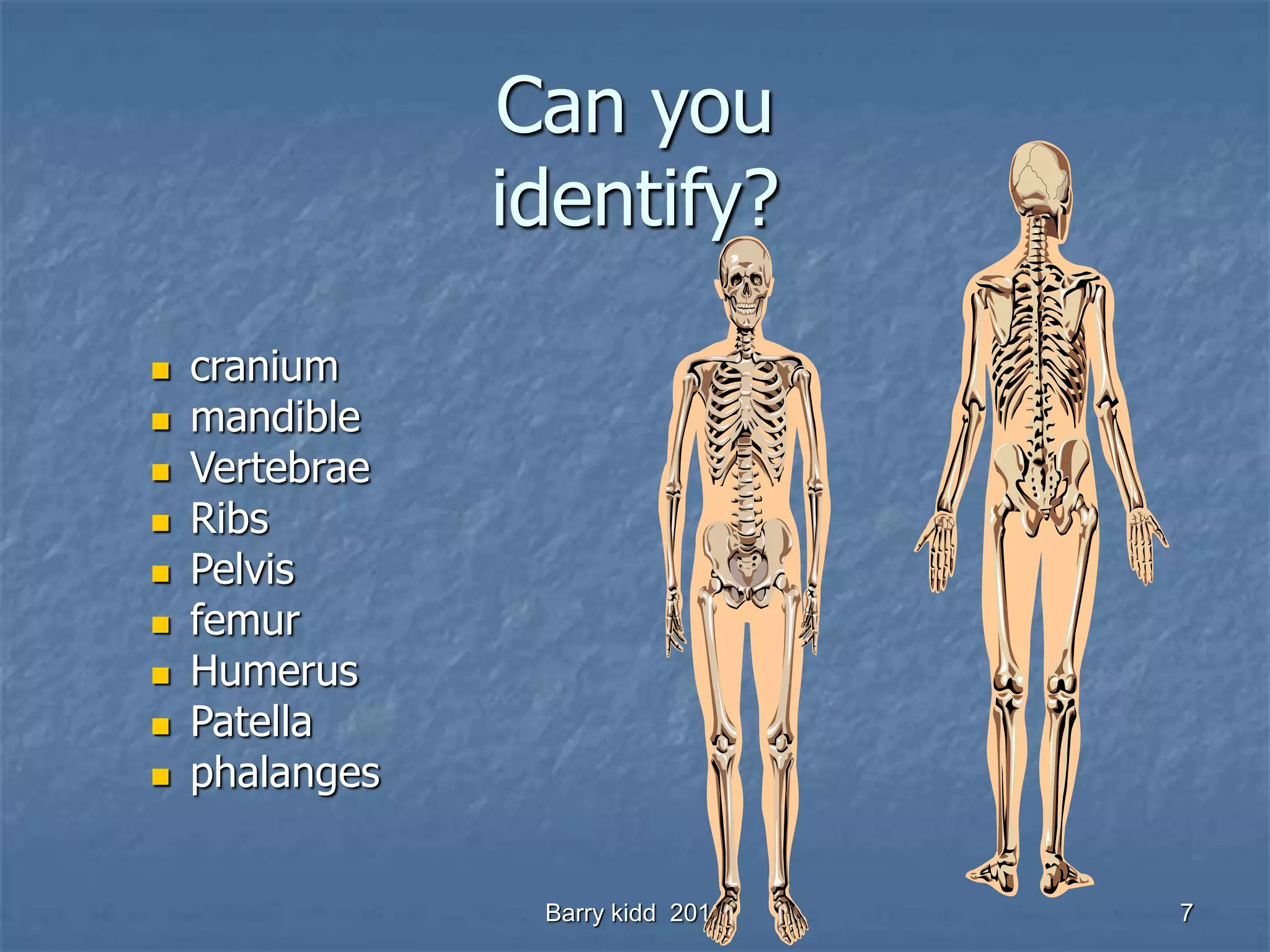
Can you
identify?
 cranium
 mandible
 Vertebrae
 Ribs
 Pelvis
 femur
 Humerus
 Patella
 phalanges
Barry kidd 2010 8
The
Spinal
Column
Cervical (7)
Thoracic (12)
Lumbar (5)
Sacral (5)
Coccyx (4)
Barry kidd 2010 9
The Thorax
Sternum
Xiphoid
process
Manubrium
Ribs
Barry kidd 2010 10
The Pelvis
Ilium
Ischium
Pubic
symphysis
Acetabulum
Barry kidd 2010 11
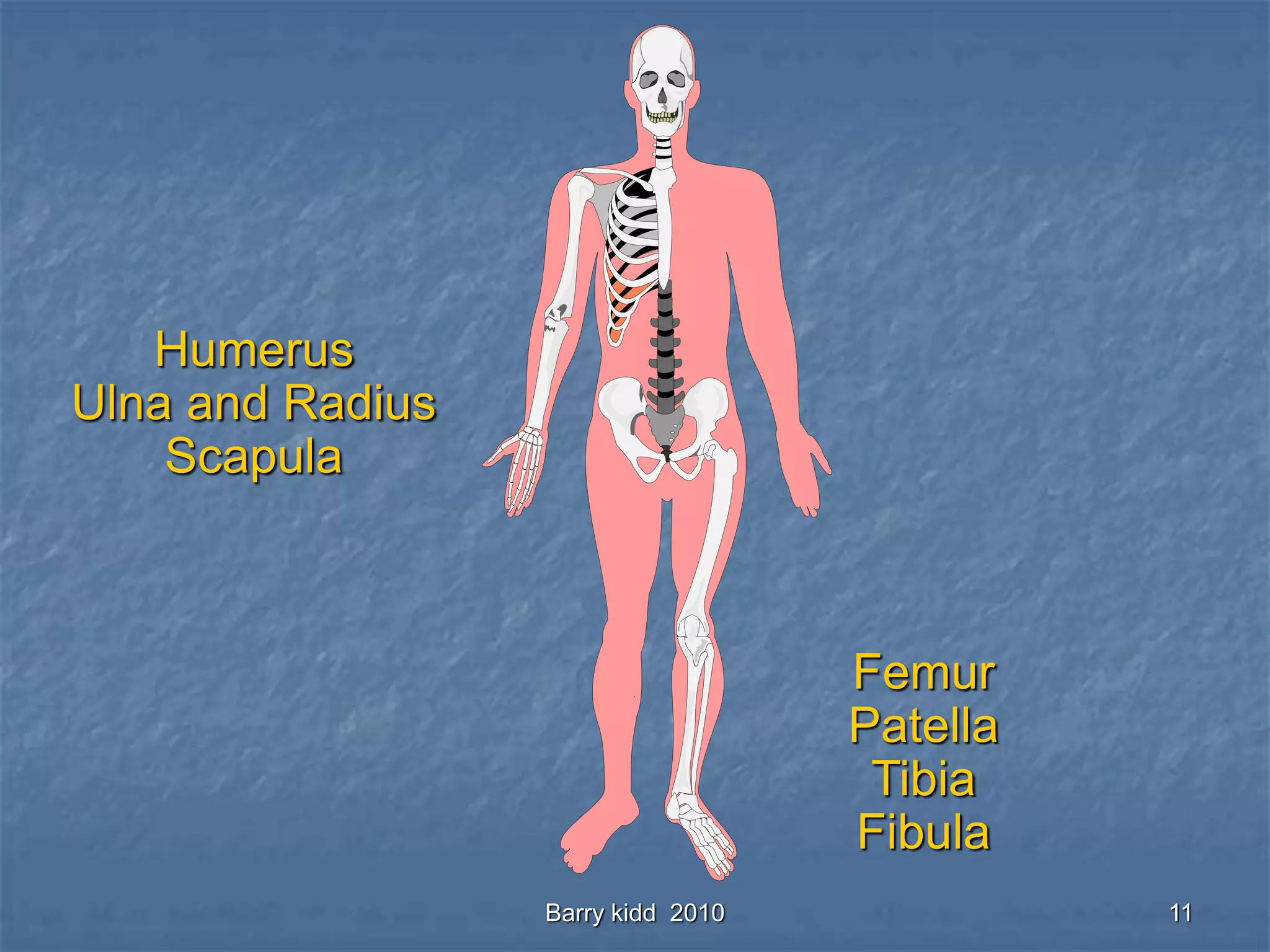
Humerus
Ulna and Radius
Scapula
Femur
Patella
Tibia
Fibula
Barry kidd 2010 12
Barry kidd 2010 13
Muscles
 Voluntary, or skeletal
 Involuntary, or smooth
 Cardiac
Barry kidd 2010 14
Injuries to Muscles and
Bones
Barry kidd 2010 15
Injuries
 Primary mechanisms responsible
 Direct force
 Indirect force
 Torsion, or twisting force
Barry kidd 2010 16
Injuries
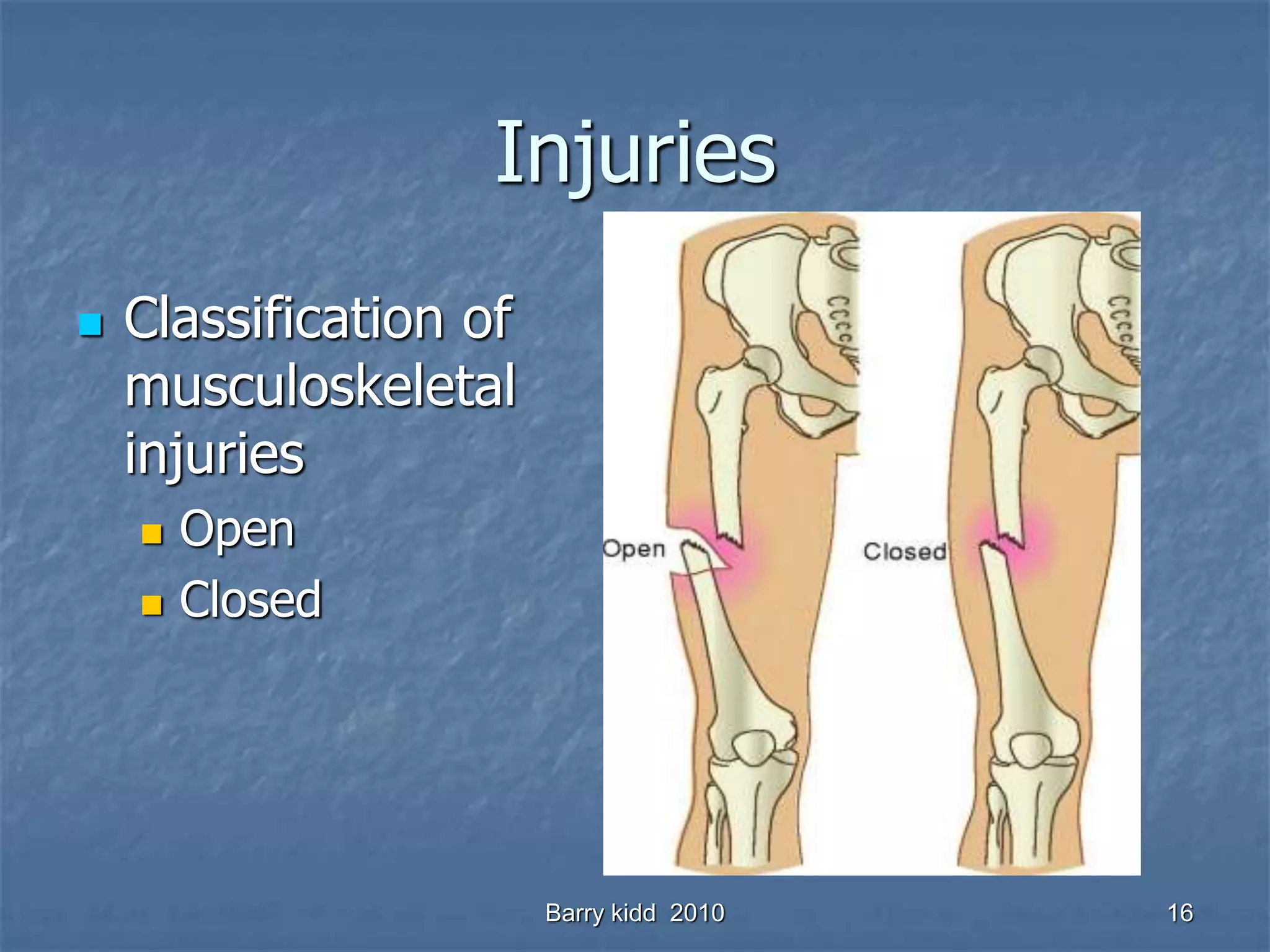
 Classification of
musculoskeletal
injuries
 Open
 Closed
Barry kidd 2010 17
Injuries
 What do you
observe in this
photo?
Barry kidd 2010 18
Injuries
 Swelling can be
seen in the ankle
Barry kidd 2010 19
Signs and Symptoms
• Deformity / Angulation
• Pain/Tenderness
• Grating
• Swelling
• Bruising
• Exposed bone ends
• Locked joint
Barry kidd 2010 20
Open Fracture
Barry kidd 2010 21
Management
 Scene size-up
 Use body substance isolation precautions
 If no threats to life or possibility of spinal injury,
allow the patient to assume a comfortable
position
 Apply a cold pack to the injury site
 Stabilize the extremity
Barry kidd 2010 22
Stabilization
 Provide support
above and below the
site of the injury
 Cover open wounds
with a dry, sterile
dressing
 Pad the area to
prevent pressure
 When in doubt,
stabilize
Barry kidd 2010 23
Musculoskeletal Injuries
Failure to stabilize an injured extremity can
result in increased pain for the patient and
possible additional tissue damage.
Barry kidd 2010 24
Musculoskeletal Injuries
 Do not attempt to straighten an angulated
extremity
 Never replace protruding bone ends back
into wound
 If in doubt…STABILIZE!!
Barry kidd 2010 25
Spinal Injuries
Barry kidd 2010 26
Spinal Injuries
 May cause
permanent
disability or even
death
 It is critical to
recognize
mechanisms of
injury that can
produce spinal
trauma
Barry kidd 2010 27
Mechanisms of Injury
 Any mechanism that
produces violent
impact on head, neck,
torso or pelvis
 Incidents that
produce sudden
forces to neck or
torso
 Any fall
 Ejection or fall from
motorized or
otherwise powered
transportation device
 Shallow-water diving
incidents
 Assume with any
unresponsive trauma
patient
Barry kidd 2010 28
Signs and Symptoms
 Concerning mechanism of injury
 Altered mental status/unresponsive
 Loss of sensation/movement in any extremity
 “Pins and needles” feeling
 Pain/tenderness in neck/back
 Difficulty breathing
 Loss of bowel/bladder control
Barry kidd 2010 29
Assessment
 Consider the MOI
 Maintain manual stabilization of the head and neck
 Ask:
 What happened?
 Does your neck or back hurt?
 Where does it hurt?
 Are you able to move your hands and feet
Barry kidd 2010 30
Unresponsive Patient
 Use jaw-thrust maneuver
 Assist breathing if needed
 Obtain information from witnesses
 The primary complications to which you should
be alert are ineffective breathing and paralysis
Barry kidd 2010 31
Spinal Injuries
 Make sure the scene is safe
 Use body substance isolation
 Establish and maintain
manual control of the head
and neck
Barry kidd 2010 32
Spinal Injuries
 Use jaw-thrust
 Assess all 4 extremities for
pulse, ability to move, and
sensation
Barry kidd 2010 33
Head Injuries
Barry kidd 2010 34
Head Injuries
 Classified as either open or closed
 Open when there is a laceration or
penetrating wound to the forehead or scalp
 May be significant bleeding
 Usually can be controlled
Barry kidd 2010 35
Head Injuries
 Watch for external signs of injury to the
skull
 Can be bleeding within the skull
Barry kidd 2010 36
Scalp Injuries
 Can bleed
significantly
Barry kidd 2010 37
Barry kidd 2010 38
Traumatic Brain Injury (TBI)
 Often immediately life threatening
 May cause
 Altered mental status
 Unresponsiveness with loss of airway control
 Abnormal breathing or respiratory arrest
 Vomiting
 Changes in blood pressure and pulse rate
Barry kidd 2010 39
Management
 Ensure scene safety and take BSI
 Maintain the airway with jaw-thrust maneuver
 Assess breathing and assist ventilations as
needed
 Control bleeding
 Monitor mental status
 Ongoing assessment
 Package as a C-spine patient
 Transfer to advanced care
Barry kidd 2010 40
Splinting
Barry kidd 2010 41
Splinting
 Stabilize
Barry kidd 2010 42
Splinting
 Check distal
circulation,
motion, and
sensation
Barry kidd 2010 43
Splinting
 Apply splint
 Re-check
circulation,
motion, and
sensation after
splint is applied
Barry kidd 2010 44
QUESTIONS
Barry kidd 2010 45
__________ 1. All of the following are part of the
musculoskeletal system except:
A. bones. C. cartilage.
B. joints. D. skin.
Barry kidd 2010 46
__________ 2. The sound or feel of broken
bone fragments
grinding together is referred to as
A. crepitus. C. assonance.
B. stridor. D. dissonance.
Barry kidd 2010 47
__________ 3. There are three kinds of muscle: voluntary,
involuntary, and
A. periosteum. C. cardiac.
B. flexible. D. skeletal.
Barry kidd 2010 48
__________ 4. The bones of the upper extremities include all
of the following except the:
A. radius. C. femur.
B. humerus. D. carpal.
Barry kidd 2010 49
__________ 5. Tissues or fibers that cause
movement of the body parts or organs are called:
A. periosteum. C. cartilage.
B. muscles. D. tendons.
Barry kidd 2010 50
__________ 6. Use of a traction splint is indicated
for a painful, swollen, deformed
A. ankle. C. elbow.
B. hip. D. femur.
Barry kidd 2010 51
_________ 7. The displacement of a bone from its normal
position in a joint is a:
A. fracture. C. dislocation.
B. sprain. D. strain.
Barry kidd 2010 52
__________ 8. The splint best suited for easing pain of
muscle spasm associated with fractures of the femur is a (n)
_____ splint.
A. air-inflatable C. vacuum
B. traction D. none of the above
Barry kidd 2010 53
__________ 9. The term for a prickling or tingling feeling
that indicates some loss of sensation is:
A. paresthesia. C. paraplegia.
B. anesthesia. D. quadriplegia.
Barry kidd 2010 54
__________ 10. The bones of the lower extremities
include all of the following except the:
A. pelvis. C. femur.
B. patella. D. scapula.

Musculoskeletal injuries

  • 1.
    Barry kidd 20101 Musculoskeletal Injuries
  • 2.
    Barry kidd 20102 Outline  Review of the Musculoskeletal System  Injuries to Muscles and Bones  Spinal Injuries  Head Injuries  Splinting
  • 3.
    Barry kidd 20103 Musculoskeletal Injuries  Injuries to muscles, bones, and their associated ligaments  Occur frequently  Can be isolated or one of multiple injuries  May be quite painful and dramatic  Don’t forget priorities  Are not usually life threatening
  • 4.
    Barry kidd 20104 Musculoskeletal Injuries The goal of the Emergency Medical Responder is to manage the musculoskeletal injuries and to prevent further damage, which is important in minimizing permanent disability and reducing pain.
  • 5.
    Barry kidd 20105 Review of the Musculoskeletal System
  • 6.
    Barry kidd 20106 Function  Provides shape  Protection of internal organs  Movement
  • 7.
    Barry kidd 20107 Can you identify?  cranium  mandible  Vertebrae  Ribs  Pelvis  femur  Humerus  Patella  phalanges
  • 8.
    Barry kidd 20108 The Spinal Column Cervical (7) Thoracic (12) Lumbar (5) Sacral (5) Coccyx (4)
  • 9.
    Barry kidd 20109 The Thorax Sternum Xiphoid process Manubrium Ribs
  • 10.
    Barry kidd 201010 The Pelvis Ilium Ischium Pubic symphysis Acetabulum
  • 11.
    Barry kidd 201011 Humerus Ulna and Radius Scapula Femur Patella Tibia Fibula
  • 12.
  • 13.
    Barry kidd 201013 Muscles  Voluntary, or skeletal  Involuntary, or smooth  Cardiac
  • 14.
    Barry kidd 201014 Injuries to Muscles and Bones
  • 15.
    Barry kidd 201015 Injuries  Primary mechanisms responsible  Direct force  Indirect force  Torsion, or twisting force
  • 16.
    Barry kidd 201016 Injuries  Classification of musculoskeletal injuries  Open  Closed
  • 17.
    Barry kidd 201017 Injuries  What do you observe in this photo?
  • 18.
    Barry kidd 201018 Injuries  Swelling can be seen in the ankle
  • 19.
    Barry kidd 201019 Signs and Symptoms • Deformity / Angulation • Pain/Tenderness • Grating • Swelling • Bruising • Exposed bone ends • Locked joint
  • 20.
    Barry kidd 201020 Open Fracture
  • 21.
    Barry kidd 201021 Management  Scene size-up  Use body substance isolation precautions  If no threats to life or possibility of spinal injury, allow the patient to assume a comfortable position  Apply a cold pack to the injury site  Stabilize the extremity
  • 22.
    Barry kidd 201022 Stabilization  Provide support above and below the site of the injury  Cover open wounds with a dry, sterile dressing  Pad the area to prevent pressure  When in doubt, stabilize
  • 23.
    Barry kidd 201023 Musculoskeletal Injuries Failure to stabilize an injured extremity can result in increased pain for the patient and possible additional tissue damage.
  • 24.
    Barry kidd 201024 Musculoskeletal Injuries  Do not attempt to straighten an angulated extremity  Never replace protruding bone ends back into wound  If in doubt…STABILIZE!!
  • 25.
    Barry kidd 201025 Spinal Injuries
  • 26.
    Barry kidd 201026 Spinal Injuries  May cause permanent disability or even death  It is critical to recognize mechanisms of injury that can produce spinal trauma
  • 27.
    Barry kidd 201027 Mechanisms of Injury  Any mechanism that produces violent impact on head, neck, torso or pelvis  Incidents that produce sudden forces to neck or torso  Any fall  Ejection or fall from motorized or otherwise powered transportation device  Shallow-water diving incidents  Assume with any unresponsive trauma patient
  • 28.
    Barry kidd 201028 Signs and Symptoms  Concerning mechanism of injury  Altered mental status/unresponsive  Loss of sensation/movement in any extremity  “Pins and needles” feeling  Pain/tenderness in neck/back  Difficulty breathing  Loss of bowel/bladder control
  • 29.
    Barry kidd 201029 Assessment  Consider the MOI  Maintain manual stabilization of the head and neck  Ask:  What happened?  Does your neck or back hurt?  Where does it hurt?  Are you able to move your hands and feet
  • 30.
    Barry kidd 201030 Unresponsive Patient  Use jaw-thrust maneuver  Assist breathing if needed  Obtain information from witnesses  The primary complications to which you should be alert are ineffective breathing and paralysis
  • 31.
    Barry kidd 201031 Spinal Injuries  Make sure the scene is safe  Use body substance isolation  Establish and maintain manual control of the head and neck
  • 32.
    Barry kidd 201032 Spinal Injuries  Use jaw-thrust  Assess all 4 extremities for pulse, ability to move, and sensation
  • 33.
    Barry kidd 201033 Head Injuries
  • 34.
    Barry kidd 201034 Head Injuries  Classified as either open or closed  Open when there is a laceration or penetrating wound to the forehead or scalp  May be significant bleeding  Usually can be controlled
  • 35.
    Barry kidd 201035 Head Injuries  Watch for external signs of injury to the skull  Can be bleeding within the skull
  • 36.
    Barry kidd 201036 Scalp Injuries  Can bleed significantly
  • 37.
  • 38.
    Barry kidd 201038 Traumatic Brain Injury (TBI)  Often immediately life threatening  May cause  Altered mental status  Unresponsiveness with loss of airway control  Abnormal breathing or respiratory arrest  Vomiting  Changes in blood pressure and pulse rate
  • 39.
    Barry kidd 201039 Management  Ensure scene safety and take BSI  Maintain the airway with jaw-thrust maneuver  Assess breathing and assist ventilations as needed  Control bleeding  Monitor mental status  Ongoing assessment  Package as a C-spine patient  Transfer to advanced care
  • 40.
    Barry kidd 201040 Splinting
  • 41.
    Barry kidd 201041 Splinting  Stabilize
  • 42.
    Barry kidd 201042 Splinting  Check distal circulation, motion, and sensation
  • 43.
    Barry kidd 201043 Splinting  Apply splint  Re-check circulation, motion, and sensation after splint is applied
  • 44.
    Barry kidd 201044 QUESTIONS
  • 45.
    Barry kidd 201045 __________ 1. All of the following are part of the musculoskeletal system except: A. bones. C. cartilage. B. joints. D. skin.
  • 46.
    Barry kidd 201046 __________ 2. The sound or feel of broken bone fragments grinding together is referred to as A. crepitus. C. assonance. B. stridor. D. dissonance.
  • 47.
    Barry kidd 201047 __________ 3. There are three kinds of muscle: voluntary, involuntary, and A. periosteum. C. cardiac. B. flexible. D. skeletal.
  • 48.
    Barry kidd 201048 __________ 4. The bones of the upper extremities include all of the following except the: A. radius. C. femur. B. humerus. D. carpal.
  • 49.
    Barry kidd 201049 __________ 5. Tissues or fibers that cause movement of the body parts or organs are called: A. periosteum. C. cartilage. B. muscles. D. tendons.
  • 50.
    Barry kidd 201050 __________ 6. Use of a traction splint is indicated for a painful, swollen, deformed A. ankle. C. elbow. B. hip. D. femur.
  • 51.
    Barry kidd 201051 _________ 7. The displacement of a bone from its normal position in a joint is a: A. fracture. C. dislocation. B. sprain. D. strain.
  • 52.
    Barry kidd 201052 __________ 8. The splint best suited for easing pain of muscle spasm associated with fractures of the femur is a (n) _____ splint. A. air-inflatable C. vacuum B. traction D. none of the above
  • 53.
    Barry kidd 201053 __________ 9. The term for a prickling or tingling feeling that indicates some loss of sensation is: A. paresthesia. C. paraplegia. B. anesthesia. D. quadriplegia.
  • 54.
    Barry kidd 201054 __________ 10. The bones of the lower extremities include all of the following except the: A. pelvis. C. femur. B. patella. D. scapula.