Barry Kidd 2010 1
The Nervous System
Barry Kidd 2010 2
The Nervous System
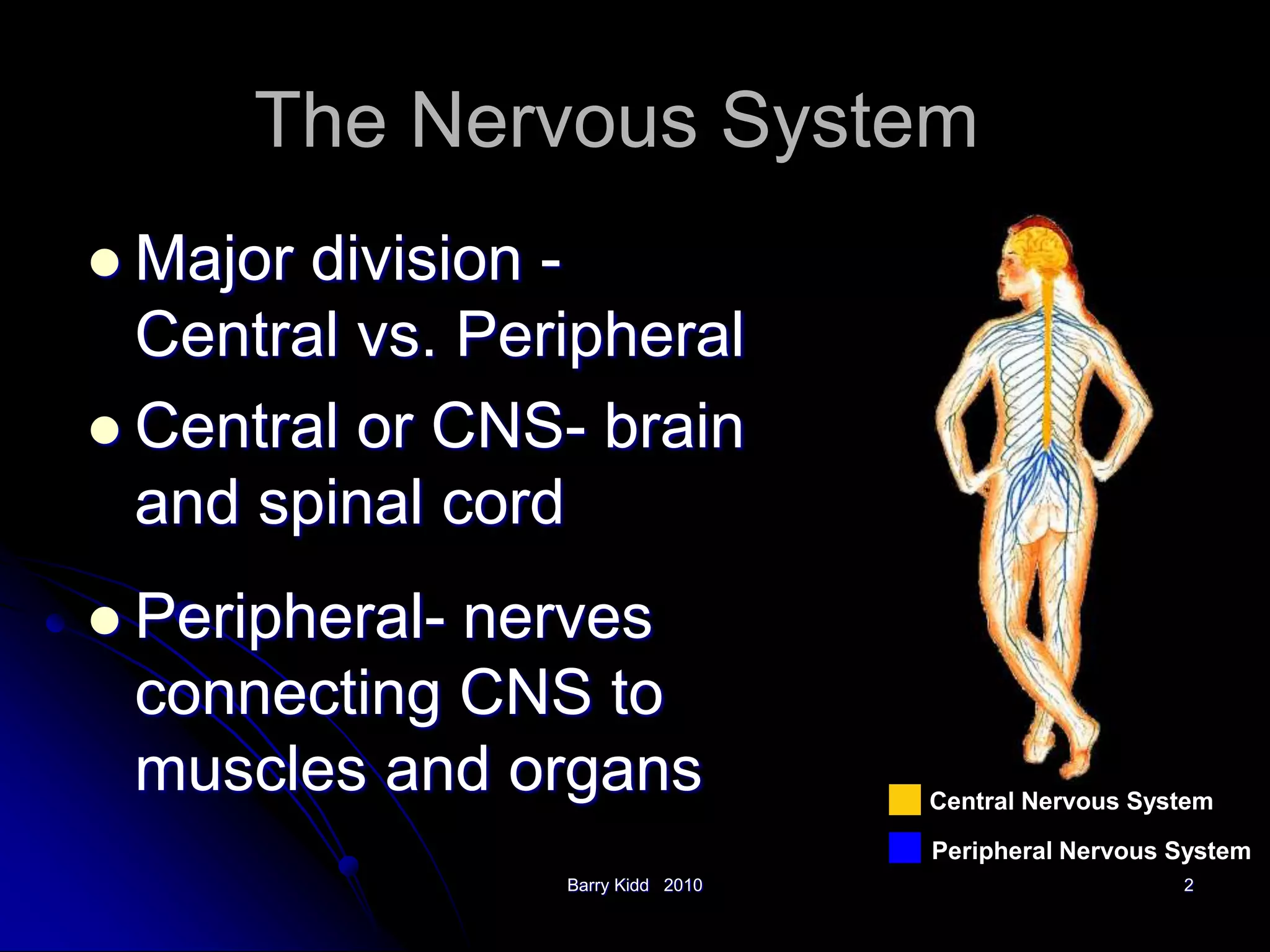
 Major division -
Central vs. Peripheral
 Central or CNS- brain
and spinal cord
 Peripheral- nerves
connecting CNS to
muscles and organs Central Nervous System
Peripheral Nervous System
Barry Kidd 2010 3
Peripheral Nervous System
 3 kinds of neurons
connect CNS to the body
 sensory
 motor
 interneurons
 Motor - CNS to muscles
and organs
 Sensory - sensory
receptors to CNS
 Interneurons:
Connections Within CNS
Spinal
Cord
Brain
Nerves
Barry Kidd 2010 4
Peripheral Nervous System
Skeletal
(Somatic)
Sympathetic Parasympathetic
Autonomic
Peripheral Nervous System
Barry Kidd 2010 5
Somatic System
 Nerves to/from
spinal cord
 control muscle
movements
 somatosensory
inputs
 Both Voluntary and
reflex movements
 Skeletal Reflexes
 simplest is spinal
reflex arc Muscle
Motor
Neuron
Interneuron
Skin receptors
Sensory
Neuron
Brain
Barry Kidd 2010 6
Autonomic System
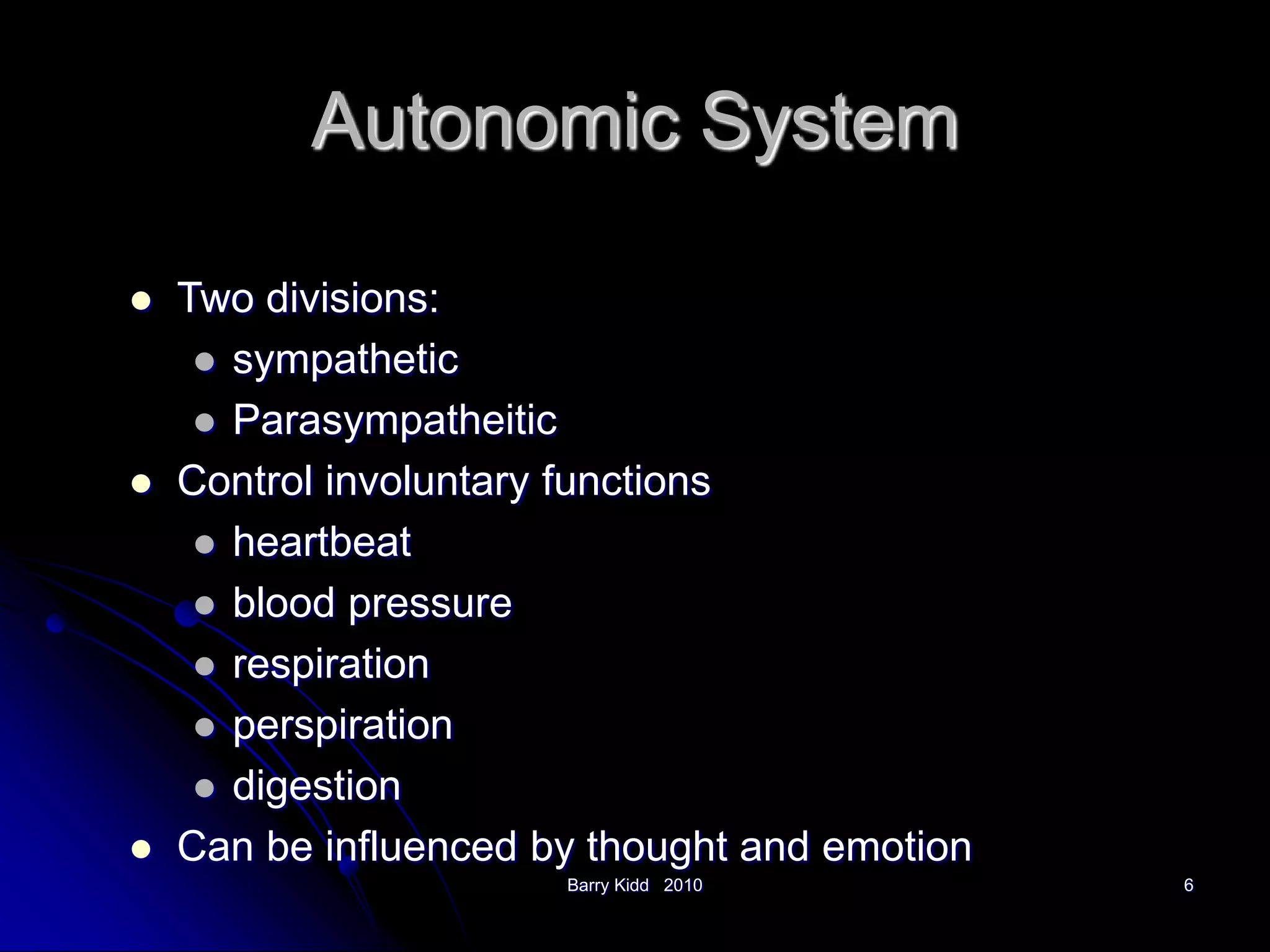
 Two divisions:
 sympathetic
 Parasympatheitic
 Control involuntary functions
 heartbeat
 blood pressure
 respiration
 perspiration
 digestion
 Can be influenced by thought and emotion
Barry Kidd 2010 7
Sympathetic
 “ Fight or flight” response
 Release adrenaline and
noradrenalin
 Increases heart rate and
blood pressure
 Increases blood flow to
skeletal muscles
 Inhibits digestive
functions
CENTRAL NERVOUS SYSTEM
Brain
Spinal
cord
SYMPATHETIC
Dilates pupil
Stimulates salivation
Relaxes bronchi
Accelerates heartbeat
Inhibits activity
Stimulates glucose
Secretion of adrenaline,
noradrenalin
Relaxes bladder
Stimulates ejaculation
in male
Sympathetic
ganglia
Salivary
glands
Lungs
Heart
Stomach
Pancreas
Liver
Adrenal
gland
Kidney
Barry Kidd 2010 8
Parasympathetic
 “ Rest and digest
” system
 Calms body to
conserve and
maintain energy
 Lowers heartbeat,
breathing rate,
blood pressure
CENTRAL NERVOUS SYSTEM
Brain
PARASYMPATHETIC
Spinal
cord
Stimulates salivation
Constricts bronchi
Slows heartbeat
Stimulates activity
Contracts bladder
Stimulates erection
of sex organs
Stimulates gallbladder
Gallbladder
Contracts pupil
Barry Kidd 2010 9
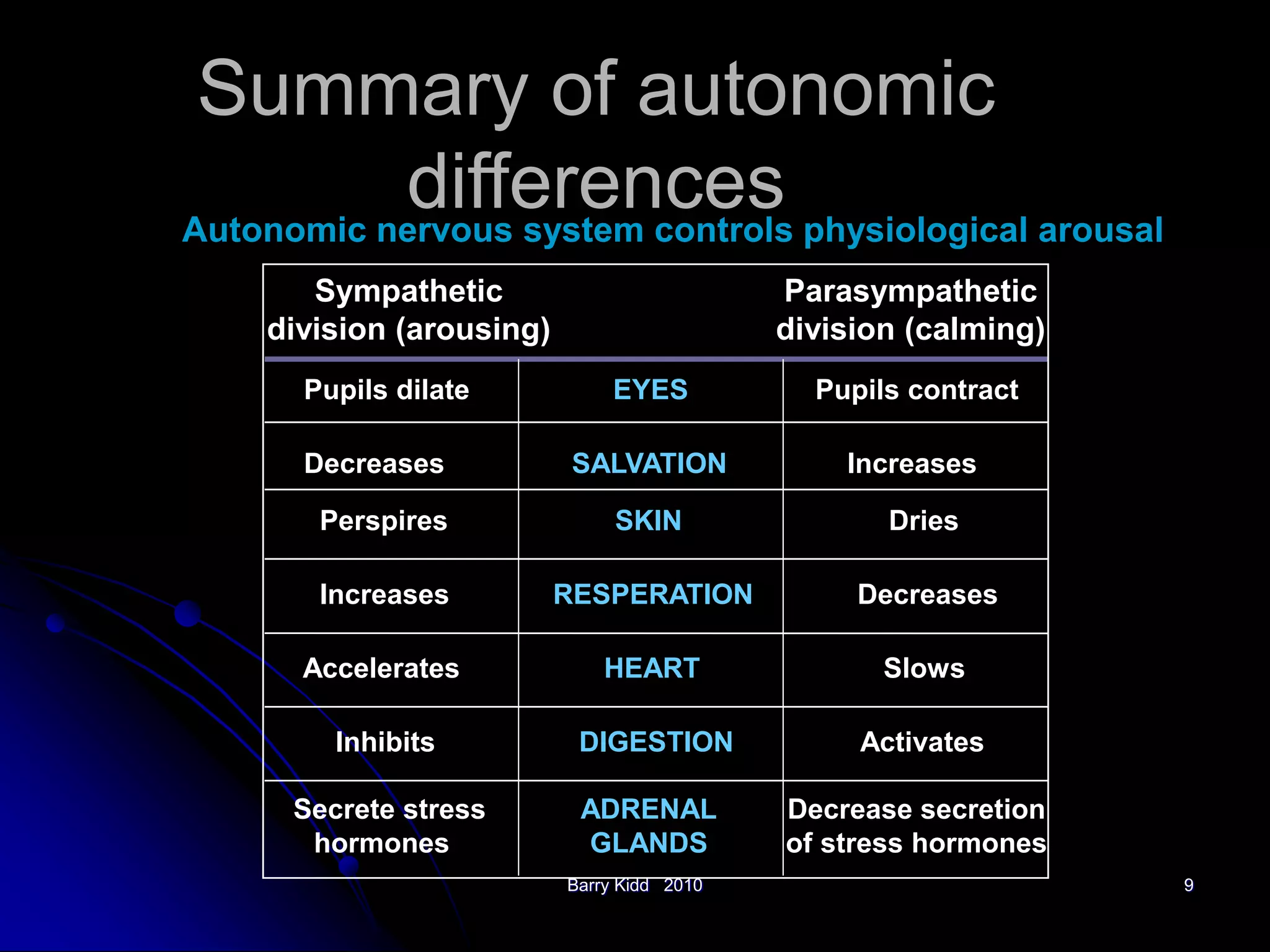
Summary of autonomic
differencesAutonomic nervous system controls physiological arousal
Sympathetic
division (arousing)
Parasympathetic
division (calming)
Pupils dilate EYES Pupils contract
Decreases SALVATION Increases
Perspires SKIN Dries
Increases RESPERATION Decreases
Accelerates HEART Slows
Inhibits DIGESTION Activates
Secrete stress
hormones
ADRENAL
GLANDS
Decrease secretion
of stress hormones
Barry Kidd 2010 10
Central Nervous System
 Brain and Spinal Cord
Spinal
Cord
Brain
Barry Kidd 2010 11
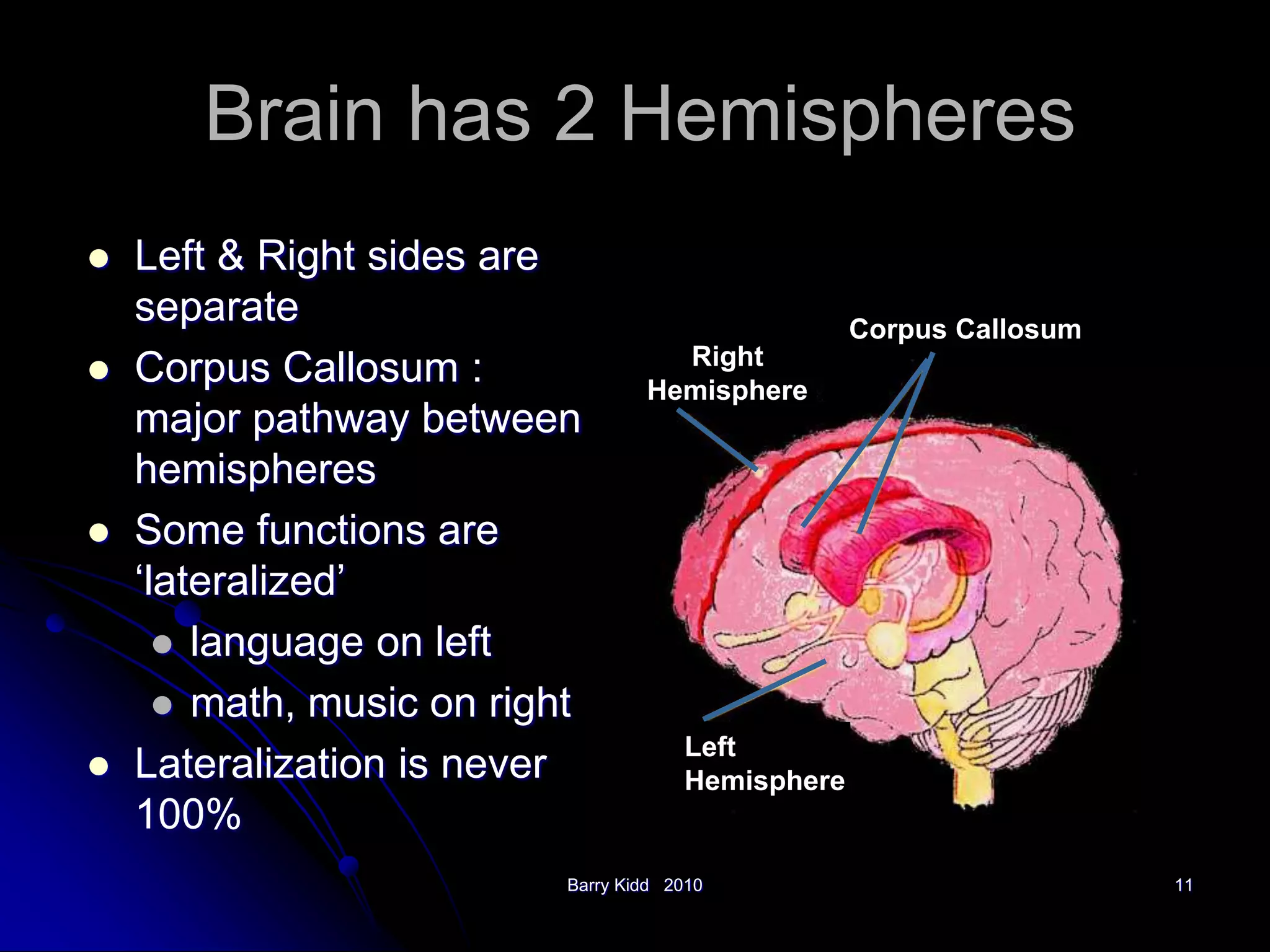
 Left & Right sides are
separate
 Corpus Callosum :
major pathway between
hemispheres
 Some functions are
‘lateralized’
 language on left
 math, music on right
 Lateralization is never
100%
Brain has 2 Hemispheres
Left
Hemisphere
Corpus Callosum
Right
Hemisphere
Barry Kidd 2010 12
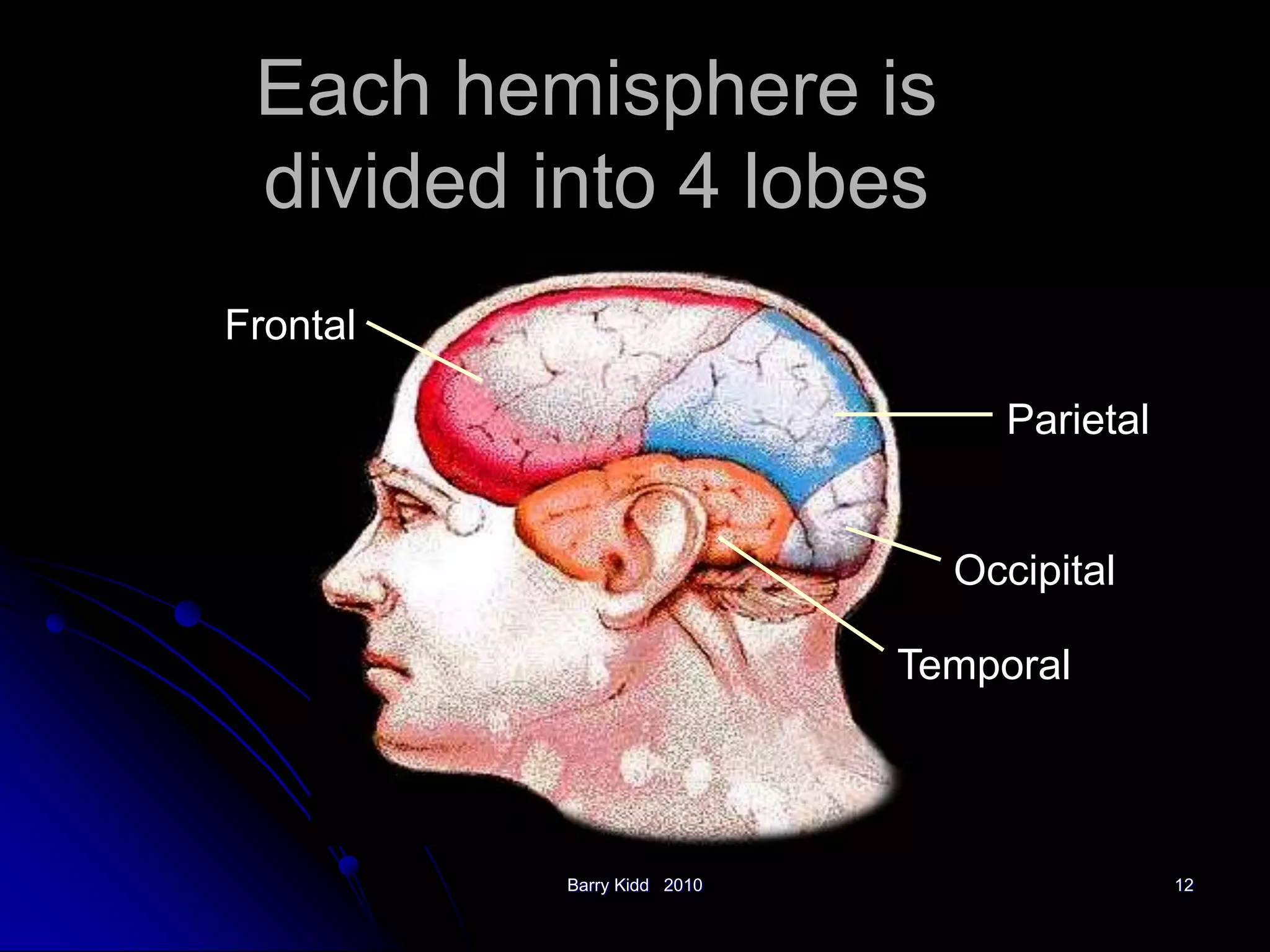
Each hemisphere is
divided into 4 lobes
Frontal
Parietal
Occipital
Temporal
Barry Kidd 2010 13
Sensory Information sent to
opposite hemisphere
 Principle is Contralateral
Organization
 Sensory data crosses over in
pathways leading to the cortex
 Visual Crossover
 left visual field to right
hemisphere
 right field to left
 Other senses similar
Left visual
field
Right visual
field
Optic
nerves
Corpus
Callosum
Left Visual
Cortex
Right Visual
Cortex
Barry Kidd 2010 14
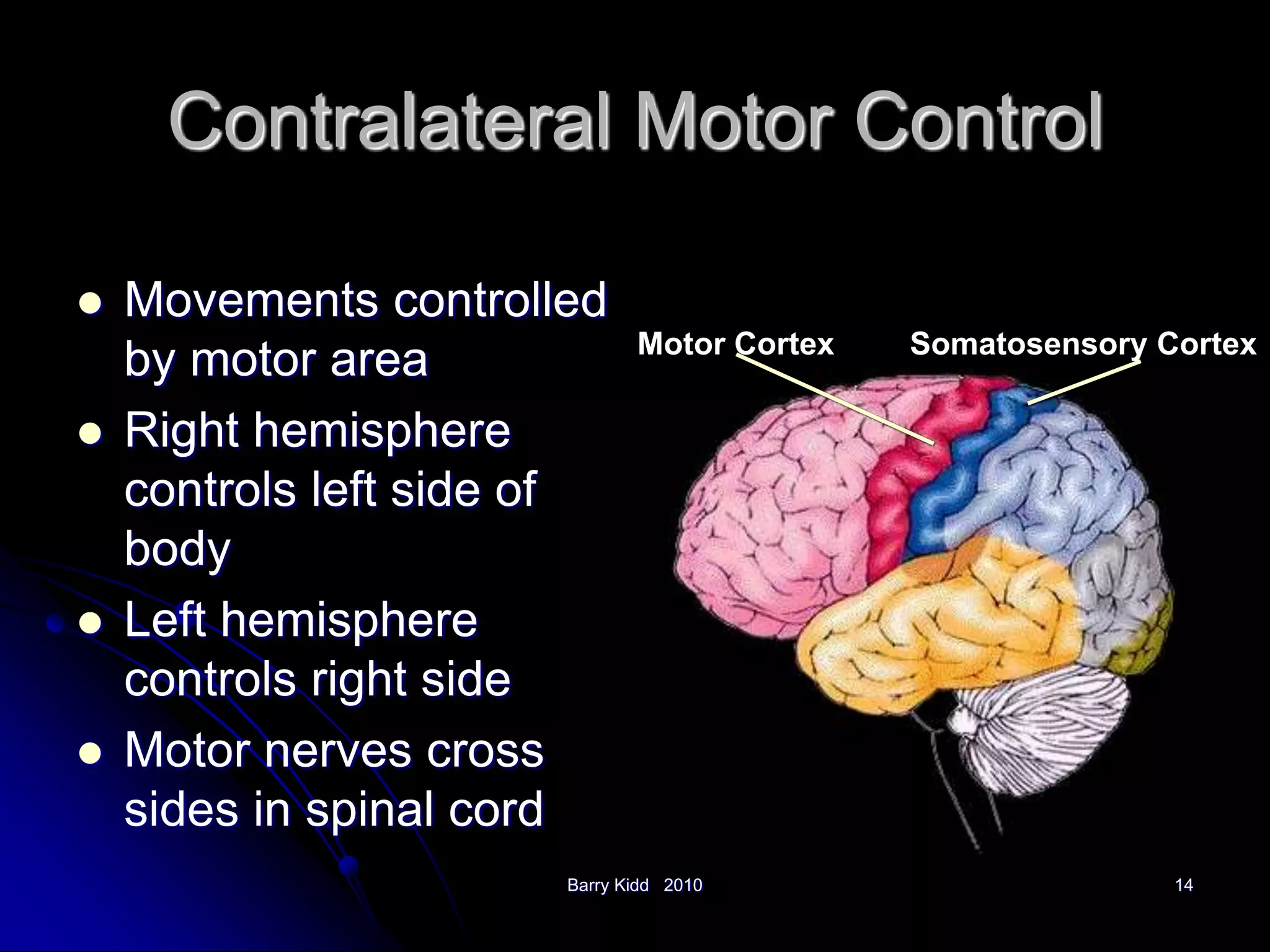
Contralateral Motor Control
 Movements controlled
by motor area
 Right hemisphere
controls left side of
body
 Left hemisphere
controls right side
 Motor nerves cross
sides in spinal cord
Somatosensory CortexMotor Cortex
Barry Kidd 2010 15
Corpus Callosum
 Major ( but not only)
pathway between sides
 Connects comparable
structures on each side
 Permits data received on
one side to be processed
in both hemispheres
 Aids motor coordination
of left and right side
Corpus Callosum
Medial surface of right hemisphere
Barry Kidd 2010 16
Corpus Callosum
 What happens when the corpus
callosum is cut?
 Sensory inputs are still crossed
 Motor outputs are still crossed
 Hemispheres can’t exchange
data
Barry Kidd 2010 17
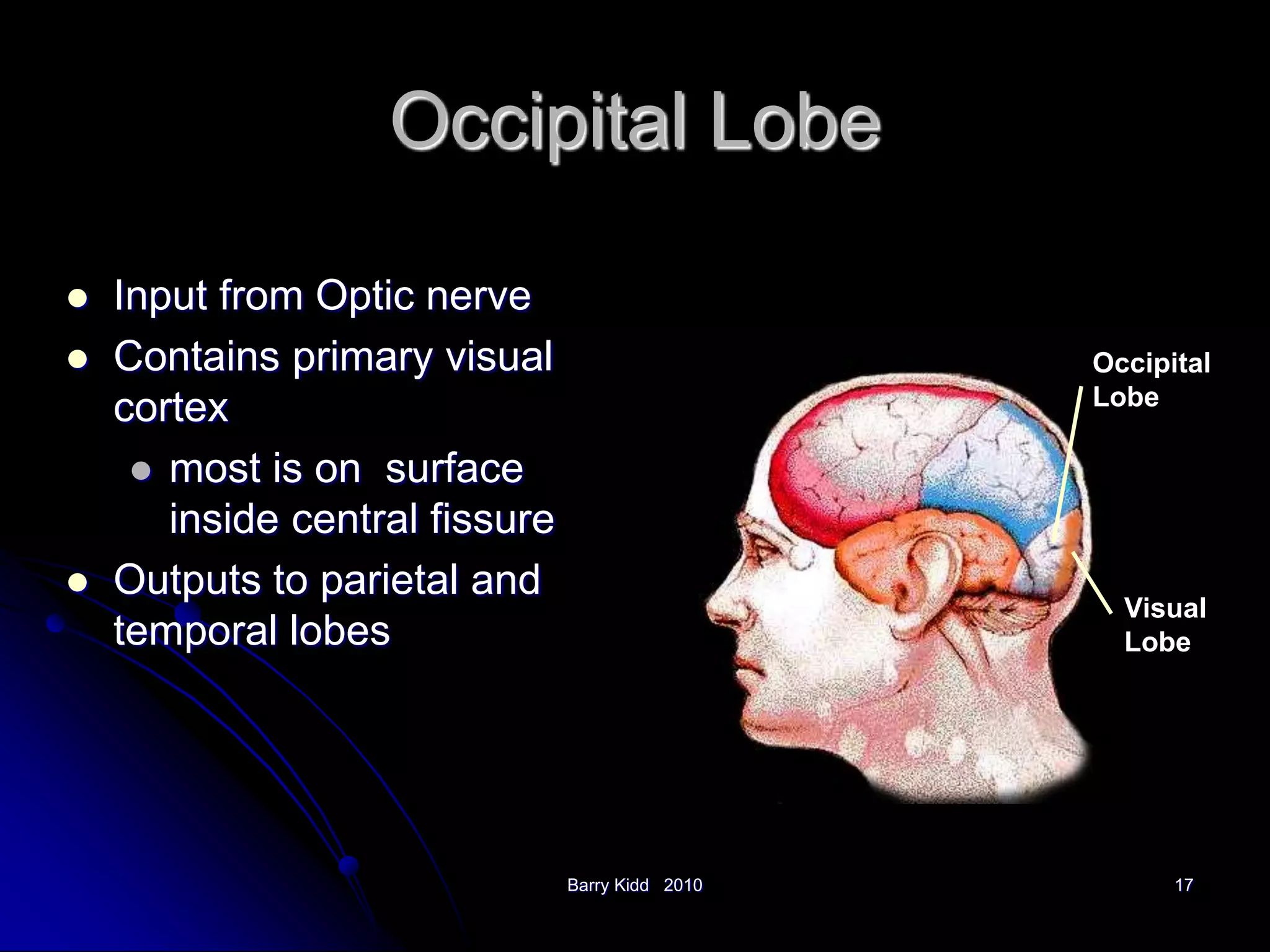
Occipital Lobe
 Input from Optic nerve
 Contains primary visual
cortex
 most is on surface
inside central fissure
 Outputs to parietal and
temporal lobes
Occipital
Lobe
Visual
Lobe
Barry Kidd 2010 18
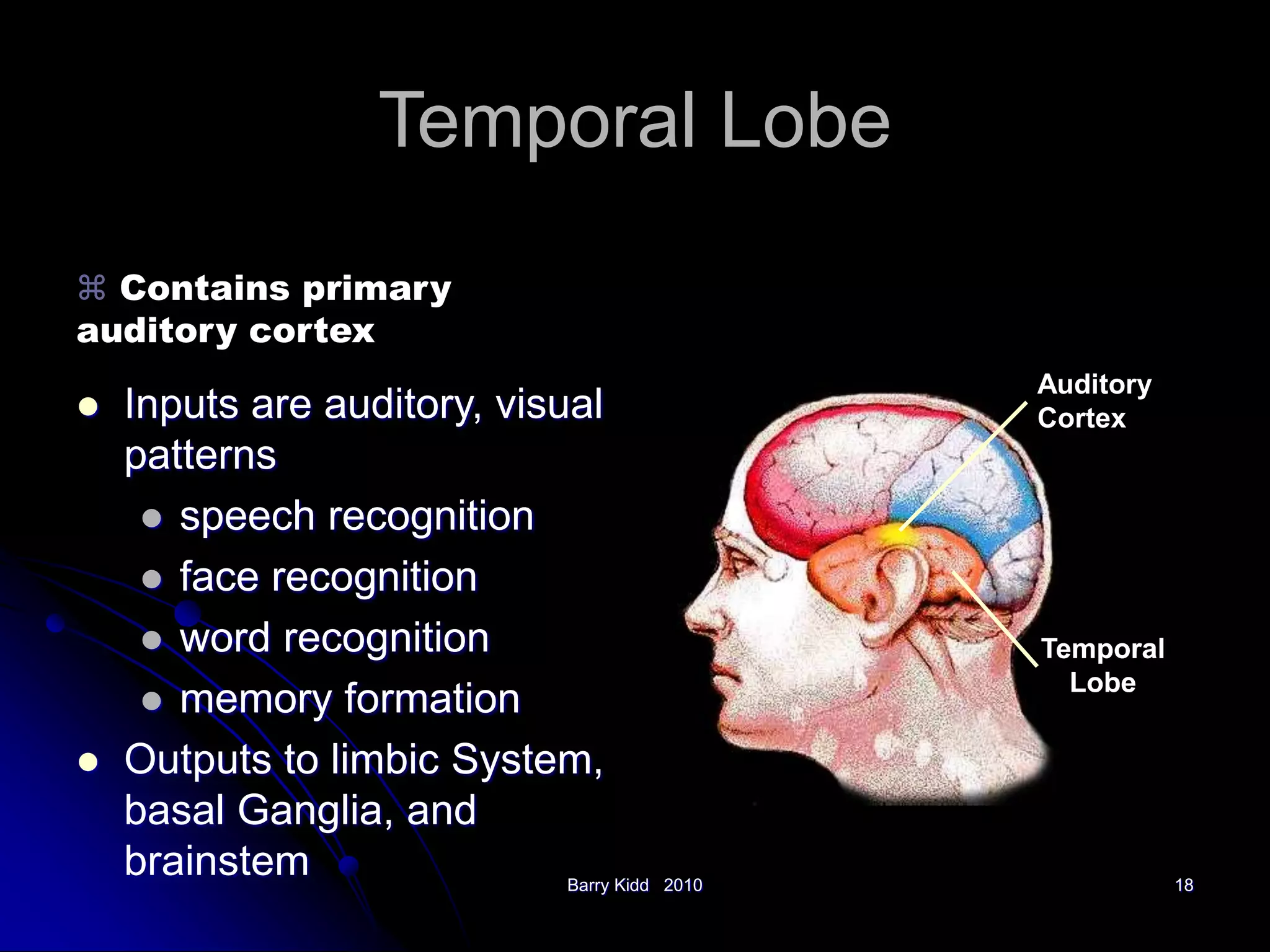
Temporal Lobe
 Inputs are auditory, visual
patterns
 speech recognition
 face recognition
 word recognition
 memory formation
 Outputs to limbic System,
basal Ganglia, and
brainstem
 Contains primary
auditory cortex
Temporal
Lobe
Temporal
Lobe
Auditory
Cortex
Barry Kidd 2010 19
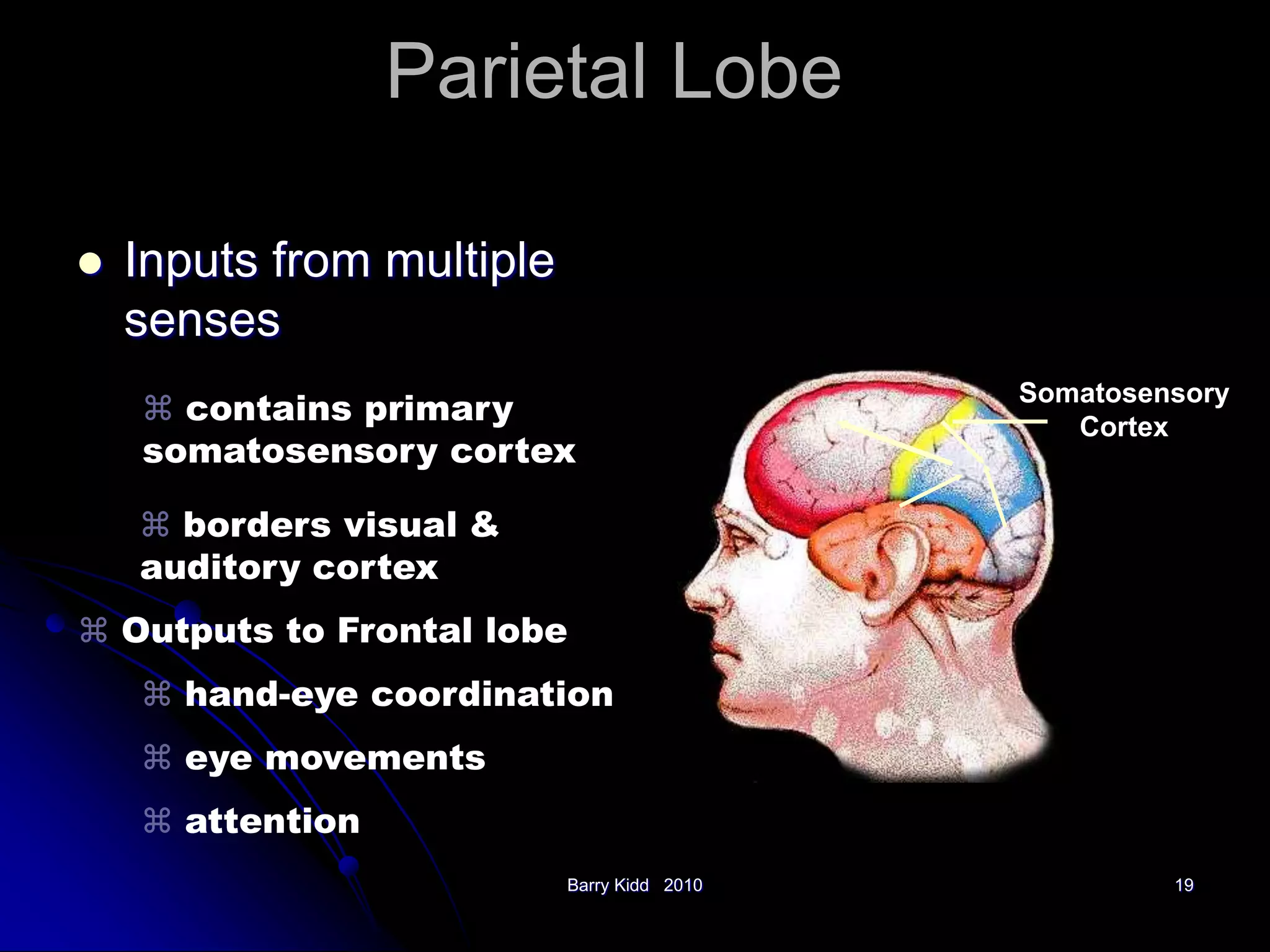
Parietal
Lobe
Somatosensory
Cortex
Parietal Lobe
 Inputs from multiple
senses
 contains primary
somatosensory cortex
 borders visual &
auditory cortex
 Outputs to Frontal lobe
 hand-eye coordination
 eye movements
 attention
Barry Kidd 2010 20
Frontal
Lobe
Frontal Lobe
 Contains primary
motor cortex
Motor
Cortex
Motor
CortexBroca’s
Area
Motor
Cortex
Working
Memory
 No direct sensory input
 Important planning and
sequencing areas
 Broca’s area for
speech
 Working memory
Barry Kidd 2010 21
Frontal Lobe Disorders
 Broca’s area
 productive aphasia
 Prefrontal area
 lose track of ongoing context
 fail to inhibit inappropriate responses
Barry Kidd 2010 22
The Nervous System:
Summary
 Major structures of the nervous
 CNS, Somatic, Autonomic
 Two hemispheres & 4 lobes
 Organization
 contralateral input & output
 primary sensory areas
 motor areas
 Commissure (A line or place at
which two things are joined)
 Localization of functions
Central Nervous System
Peripheral Nervous System
Barry Kidd 2010 23
The Nervous System
QUESTIONS

The nervous system

  • 1.
    Barry Kidd 20101 The Nervous System
  • 2.
    Barry Kidd 20102 The Nervous System  Major division - Central vs. Peripheral  Central or CNS- brain and spinal cord  Peripheral- nerves connecting CNS to muscles and organs Central Nervous System Peripheral Nervous System
  • 3.
    Barry Kidd 20103 Peripheral Nervous System  3 kinds of neurons connect CNS to the body  sensory  motor  interneurons  Motor - CNS to muscles and organs  Sensory - sensory receptors to CNS  Interneurons: Connections Within CNS Spinal Cord Brain Nerves
  • 4.
    Barry Kidd 20104 Peripheral Nervous System Skeletal (Somatic) Sympathetic Parasympathetic Autonomic Peripheral Nervous System
  • 5.
    Barry Kidd 20105 Somatic System  Nerves to/from spinal cord  control muscle movements  somatosensory inputs  Both Voluntary and reflex movements  Skeletal Reflexes  simplest is spinal reflex arc Muscle Motor Neuron Interneuron Skin receptors Sensory Neuron Brain
  • 6.
    Barry Kidd 20106 Autonomic System  Two divisions:  sympathetic  Parasympatheitic  Control involuntary functions  heartbeat  blood pressure  respiration  perspiration  digestion  Can be influenced by thought and emotion
  • 7.
    Barry Kidd 20107 Sympathetic  “ Fight or flight” response  Release adrenaline and noradrenalin  Increases heart rate and blood pressure  Increases blood flow to skeletal muscles  Inhibits digestive functions CENTRAL NERVOUS SYSTEM Brain Spinal cord SYMPATHETIC Dilates pupil Stimulates salivation Relaxes bronchi Accelerates heartbeat Inhibits activity Stimulates glucose Secretion of adrenaline, noradrenalin Relaxes bladder Stimulates ejaculation in male Sympathetic ganglia Salivary glands Lungs Heart Stomach Pancreas Liver Adrenal gland Kidney
  • 8.
    Barry Kidd 20108 Parasympathetic  “ Rest and digest ” system  Calms body to conserve and maintain energy  Lowers heartbeat, breathing rate, blood pressure CENTRAL NERVOUS SYSTEM Brain PARASYMPATHETIC Spinal cord Stimulates salivation Constricts bronchi Slows heartbeat Stimulates activity Contracts bladder Stimulates erection of sex organs Stimulates gallbladder Gallbladder Contracts pupil
  • 9.
    Barry Kidd 20109 Summary of autonomic differencesAutonomic nervous system controls physiological arousal Sympathetic division (arousing) Parasympathetic division (calming) Pupils dilate EYES Pupils contract Decreases SALVATION Increases Perspires SKIN Dries Increases RESPERATION Decreases Accelerates HEART Slows Inhibits DIGESTION Activates Secrete stress hormones ADRENAL GLANDS Decrease secretion of stress hormones
  • 10.
    Barry Kidd 201010 Central Nervous System  Brain and Spinal Cord Spinal Cord Brain
  • 11.
    Barry Kidd 201011  Left & Right sides are separate  Corpus Callosum : major pathway between hemispheres  Some functions are ‘lateralized’  language on left  math, music on right  Lateralization is never 100% Brain has 2 Hemispheres Left Hemisphere Corpus Callosum Right Hemisphere
  • 12.
    Barry Kidd 201012 Each hemisphere is divided into 4 lobes Frontal Parietal Occipital Temporal
  • 13.
    Barry Kidd 201013 Sensory Information sent to opposite hemisphere  Principle is Contralateral Organization  Sensory data crosses over in pathways leading to the cortex  Visual Crossover  left visual field to right hemisphere  right field to left  Other senses similar Left visual field Right visual field Optic nerves Corpus Callosum Left Visual Cortex Right Visual Cortex
  • 14.
    Barry Kidd 201014 Contralateral Motor Control  Movements controlled by motor area  Right hemisphere controls left side of body  Left hemisphere controls right side  Motor nerves cross sides in spinal cord Somatosensory CortexMotor Cortex
  • 15.
    Barry Kidd 201015 Corpus Callosum  Major ( but not only) pathway between sides  Connects comparable structures on each side  Permits data received on one side to be processed in both hemispheres  Aids motor coordination of left and right side Corpus Callosum Medial surface of right hemisphere
  • 16.
    Barry Kidd 201016 Corpus Callosum  What happens when the corpus callosum is cut?  Sensory inputs are still crossed  Motor outputs are still crossed  Hemispheres can’t exchange data
  • 17.
    Barry Kidd 201017 Occipital Lobe  Input from Optic nerve  Contains primary visual cortex  most is on surface inside central fissure  Outputs to parietal and temporal lobes Occipital Lobe Visual Lobe
  • 18.
    Barry Kidd 201018 Temporal Lobe  Inputs are auditory, visual patterns  speech recognition  face recognition  word recognition  memory formation  Outputs to limbic System, basal Ganglia, and brainstem  Contains primary auditory cortex Temporal Lobe Temporal Lobe Auditory Cortex
  • 19.
    Barry Kidd 201019 Parietal Lobe Somatosensory Cortex Parietal Lobe  Inputs from multiple senses  contains primary somatosensory cortex  borders visual & auditory cortex  Outputs to Frontal lobe  hand-eye coordination  eye movements  attention
  • 20.
    Barry Kidd 201020 Frontal Lobe Frontal Lobe  Contains primary motor cortex Motor Cortex Motor CortexBroca’s Area Motor Cortex Working Memory  No direct sensory input  Important planning and sequencing areas  Broca’s area for speech  Working memory
  • 21.
    Barry Kidd 201021 Frontal Lobe Disorders  Broca’s area  productive aphasia  Prefrontal area  lose track of ongoing context  fail to inhibit inappropriate responses
  • 22.
    Barry Kidd 201022 The Nervous System: Summary  Major structures of the nervous  CNS, Somatic, Autonomic  Two hemispheres & 4 lobes  Organization  contralateral input & output  primary sensory areas  motor areas  Commissure (A line or place at which two things are joined)  Localization of functions Central Nervous System Peripheral Nervous System
  • 23.
    Barry Kidd 201023 The Nervous System QUESTIONS