CHEST TRAUMA
Mechanism of Injury
Penetrating Trauma
– Low Energy
• Arrows, knives, handguns
• Injury caused by direct contact
– High Energy
• Military, hunting rifles & high powered hand guns
• Extensive injury due to high pressure
• Either:
– direct blow (e.g. rib fracture)
– deceleration injury
– compression injury
• Rib fracture is the most common sign of blunt thoracic
trauma
• Fracture of scapula, sternum, or first rib suggests
massive force of injury
• Age Factors
• Pediatric Thorax: More cartilage = Absorbs forces
• Geriatric Thorax: Calcification & osteoporosis = More fracture
Blunt injuries
Injuries Associated with
Cardio Thoracic Vascular Trauma
• Airway obstruction
• Closed pneumothorax
• Open pneumothorax
(sucking chest wound)
• Tension pneumothorax
• Pneumomediastinum
• Hemothorax (massive)
• Hemopneumothorax
• Rib fracture (flail chest)
• Tracheobronchial tree
lacerations (rupture)
• Esophageal lacerations
• Penetrating cardiac injuries
• Pericardial tamponade
• Spinal cord injuries
• Diaphragm trauma
• Intra-abdominal trauma
associated organ injury
• Laceration of vascular
structures (central &
peripheral)
Basic management concept
in traumatic patient
Is
ABCDE
Sub Department of Cardio Thoracic & Vascular Surgery
responsible in ABC
Airway obstruction
• Clinical finding
– Shortness of breath (dyspnea)
– Stridor
– Apnea
• Management
– Chin lift
– Jaw thrust
– Triple finger manuever
– Evacuate foreign body
– ET insertion
– Cricothyroidostomy
– Tracheostomy
Tension Pneumothorax
– Ventile phenomenon
– Build up of air under
pressure in the thorax.
– Excessive pressure
reduces effectiveness
of respiration
– Air is unable to escape
from inside the pleural
space
– Progression of Simple
(closed) or Open
Pneumothorax
CXR image
• Anx: Progressive shortness of breath
• PE :
– Respiratory distress
– Tracheal deviation (away)
– Absence of breath sound & percusion: hypersonor
– Jugular Vein Distend
– Hypotension
• Treatment :
– Needle thoracocentesis
– Consult : chest tube insertion
Tension Pneumothorax (simplify)
Needle thoracocentesis
OPEN (SUCKING) CHEST WOUND
SUCKING CHEST WOUND
SUCKING CHEST WOUND
• Upon exhaling, air in
the chest escapes
through the flutter-type
valve created by taping
3 sides only
• With inhaling, the patch
should suck against the
skin, preventing air
entry
– Restriction to cardiac filling caused by blood or
other fluid within the pericardium
– Occurs in <2% of all serious chest trauma
• However, very high mortality
– Results from tear in the coronary artery or
penetration of myocardium
• Blood seeps into pericardium and is unable to escape
• 200-300 ml of blood can restrict effectiveness of
cardiac contractions
– Removing as little as 20 ml can provide relief
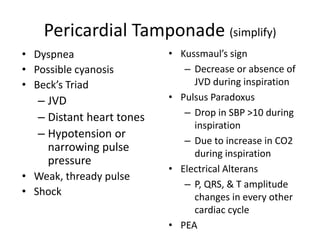
Pericardial Tamponade
• Dyspnea
• Possible cyanosis
• Beck’s Triad
– JVD
– Distant heart tones
– Hypotension or
narrowing pulse
pressure
• Weak, thready pulse
• Shock
Pericardial Tamponade (simplify)
• Kussmaul’s sign
– Decrease or absence of
JVD during inspiration
• Pulsus Paradoxus
– Drop in SBP >10 during
inspiration
– Due to increase in CO2
during inspiration
• Electrical Alterans
– P, QRS, & T amplitude
changes in every other
cardiac cycle
• PEA
CARDIAC TRAUMA
Pericardial or Cardiac tamponade
Cardiac Tamponade
Pericardial Tamponade (ilustrations)
Crucial 1° Survey Differential Dx:
Cardiac Tamponade vs. Tension
Pneumothorax
Clinical Sign Cardiac
Tamponade
Tension
Pneumothorax
Blood Pressure
Cardiac Tones
Breath Sounds
Neck Veins
Respirations
Treatment
Low (PEA) Low
Muffled Normal
Normal Absent - collapsed side
Distended (flat
in hypovolemia)
Flat
± Normal Tachypnea



Needle/drain
pericardium
Needle/tube chest
Hemothorax
• Hemothorax
– Accumulation of blood in the pleural space
– Serious hemorrhage may accumulate 1,500 mL of blood
• Mortality rate of 75%
• Each side of thorax may hold up to 3,000 mL
• MASSIVE (criteria)
– Blood loss in thorax causes a decrease in tidal volume
• Ventilation/Perfusion Mismatch & Shock
– Typically accompanies pneumothorax
• Hemopneumothorax
• Blunt or penetrating chest
trauma
• Shock
– Dyspnea
– Tachycardia
– Tachypnea
– Diaphoresis
– Hypotension  massive
• Dull to percussion over injured
side
• Treatment
Chest tube insertion & consult
Hemothorax (simplify)
Trauma.org
CXR Image
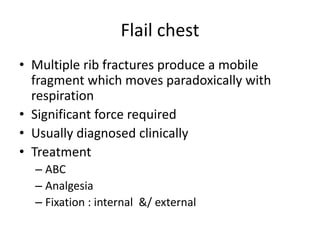
Flail chest
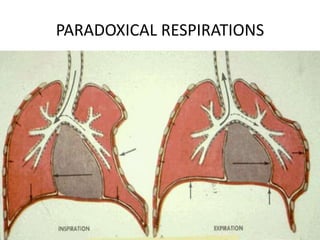
• Multiple rib fractures produce a mobile
fragment which moves paradoxically with
respiration
• Significant force required
• Usually diagnosed clinically
• Treatment
– ABC
– Analgesia
– Fixation : internal &/ external
PARADOXICAL RESPIRATIONS
Flail Chest - detail
Tracheobronchial Injury
– MOI
• Blunt trauma
• Penetrating trauma
– 50% of patients with injury die within 1 hr of injury
– Disruption can occur anywhere in tracheobronchial tree
– Signs & Symptoms
• Dyspnea
• Cyanosis
• Hemoptysis
• Massive subcutaneous emphysema
• Suspect/Evaluate for other closed chest trauma
Tracheal Disruption
Massive subcutaneous
emphysema in chest wall –
displaced trachea
Cervical, facial sub-
cutaneous emphysema
Hemoptysis
Blunt injuries almost always
within 1” carina
Blunt Thoracic Trauma:
Tracheobronchial Injury
• 2° Blunt injury
• Persistent
pneumothorax
• Huge air leak
• Rare injury 2-3% of
survivors MVA
• Definitive repairs
with pleural flap
Tracheal Disruption
Tracheal Disruption
• Blunt or penetrating trauma (extrinsic compression from
hematoma)
– Intra/extra thoracic location (supraglotic, glotic, subglotic
• Presentation
• Massive, sometimes uncontrollable air leak
– Stridor, acute respiratory distress, Δ voice
– Neck, upper chest subcutaneous emphysema – often
– massive and disfiguring
• Acutely manage with deep intubation (beyond injury), scope,
sometimes tracheostomy
Tracheal Disruption
– Restriction to cardiac filling caused by blood or
other fluid within the pericardium
– Occurs in <2% of all serious chest trauma
• However, very high mortality
– Results from tear in the coronary artery or
penetration of myocardium
• Blood seeps into pericardium and is unable to escape
• 200-300 ml of blood can restrict effectiveness of
cardiac contractions
– Removing as little as 20 ml can provide relief
Pericardial Tamponade
• Dyspnea
• Possible cyanosis
• Beck’s Triad
– JVD
– Distant heart tones
– Hypotension or
narrowing pulse
pressure
• Weak, thready pulse
• Shock
Pericardial Tamponade (simplify)
• Kussmaul’s sign
– Decrease or absence of
JVD during inspiration
• Pulsus Paradoxus
– Drop in SBP >10 during
inspiration
– Due to increase in CO2
during inspiration
• Electrical Alterans
– P, QRS, & T amplitude
changes in every other
cardiac cycle
• PEA
Pericardial or Cardiac tamponade
Pericardial Tamponade (ilustrations)
Laceration of vascular structures
• General sign
– Shock Hypovolemia (co morbid cardiogenic)
– Penetrating trauma (mostly)
• Internal bleeding
– Thoracic  Chest XR
– Abdominal  FAST or CT
– Pelvicum  CXR
– Femur  expanding hematoma + XR
• External bleeding  thorough examination &
suturing
Coronary Artery Laceration
Laceration of vascular structures
• Internal bleeding  consult
• External bleeding
Blunt Cardiac Injuries
Blunt Thoracic Trauma: Cardiac
Contusions
• Blunt anterior chest trauma
• Acute injury pattern (anterior wall: ↑ST’s I, aVL, V2-V4, ↓II,III,
aVF), AF, BBB
• W/U & Rx acute myocardial infarction, inotropes
• Watch for & treat PVC’s aggressively (K+,temp)
• Cardiac echo to assess wall motion, valves
Other thoracic cases
• Empyema
• Pleural effusion
• Chylothorax
• Cancer
– Lung
– Mediastinal
Empyema & pleural effusion
• Fluid in pleural cavity
– Empyema  infection material
– Pleural effusion  non infection
– Chylothorax  lymphatic fluid
Thoracic Tumor cases
Clinical finding: dull area not change by positions
Immediate Life Threatening Thoracic
Injuries: Aortic Disruption
• Most common at ligamentum
arteriosum but can be
multiple (pendulum effect)
• ~⅓ fatal on site due to free
rupture (uncontained)
• Hypotension, exsanguination
• MVA, falls from height
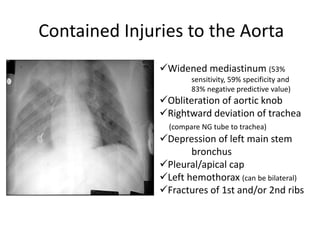
Contained Injuries to the Aorta
Widened mediastinum (53%
sensitivity, 59% specificity and
83% negative predictive value)
Obliteration of aortic knob
Rightward deviation of trachea
(compare NG tube to trachea)
Depression of left main stem
bronchus
Pleural/apical cap
Left hemothorax (can be bilateral)
Fractures of 1st and/or 2nd ribs
Contained Injuries to the Aorta
• Not a source of multiple hypotensive episodes in
survivors - look for other injuries
• Salvageable tear when hematoma contained
• ~⅓ die per 24 hours without treatment
• Widened mediastinum very unreliable sign on
portable x-ray
• TEE, helical contrast CT scan, MRI, aortogram
• Consider percutaneous stent placement
• Address after life threatening injuries stabilized
Summary
• Life ending thoracic injuries are common
• Survival depends on proper and immediate
diagnosis and appropriate management
• ED thoracotomy can save lives but expected
survivorship is <10%
• Don’t forget ABC’s of trauma and damage
control principles

Trauma Thoraks.ppt

  • 1.
  • 2.
    Mechanism of Injury PenetratingTrauma – Low Energy • Arrows, knives, handguns • Injury caused by direct contact – High Energy • Military, hunting rifles & high powered hand guns • Extensive injury due to high pressure
  • 3.
    • Either: – directblow (e.g. rib fracture) – deceleration injury – compression injury • Rib fracture is the most common sign of blunt thoracic trauma • Fracture of scapula, sternum, or first rib suggests massive force of injury • Age Factors • Pediatric Thorax: More cartilage = Absorbs forces • Geriatric Thorax: Calcification & osteoporosis = More fracture Blunt injuries
  • 4.
    Injuries Associated with CardioThoracic Vascular Trauma • Airway obstruction • Closed pneumothorax • Open pneumothorax (sucking chest wound) • Tension pneumothorax • Pneumomediastinum • Hemothorax (massive) • Hemopneumothorax • Rib fracture (flail chest) • Tracheobronchial tree lacerations (rupture) • Esophageal lacerations • Penetrating cardiac injuries • Pericardial tamponade • Spinal cord injuries • Diaphragm trauma • Intra-abdominal trauma associated organ injury • Laceration of vascular structures (central & peripheral)
  • 6.
    Basic management concept intraumatic patient Is ABCDE Sub Department of Cardio Thoracic & Vascular Surgery responsible in ABC
  • 7.
    Airway obstruction • Clinicalfinding – Shortness of breath (dyspnea) – Stridor – Apnea • Management – Chin lift – Jaw thrust – Triple finger manuever – Evacuate foreign body – ET insertion – Cricothyroidostomy – Tracheostomy
  • 8.
    Tension Pneumothorax – Ventilephenomenon – Build up of air under pressure in the thorax. – Excessive pressure reduces effectiveness of respiration – Air is unable to escape from inside the pleural space – Progression of Simple (closed) or Open Pneumothorax
  • 9.
  • 10.
    • Anx: Progressiveshortness of breath • PE : – Respiratory distress – Tracheal deviation (away) – Absence of breath sound & percusion: hypersonor – Jugular Vein Distend – Hypotension • Treatment : – Needle thoracocentesis – Consult : chest tube insertion Tension Pneumothorax (simplify)
  • 11.
  • 12.
  • 13.
  • 14.
    SUCKING CHEST WOUND •Upon exhaling, air in the chest escapes through the flutter-type valve created by taping 3 sides only • With inhaling, the patch should suck against the skin, preventing air entry
  • 15.
    – Restriction tocardiac filling caused by blood or other fluid within the pericardium – Occurs in <2% of all serious chest trauma • However, very high mortality – Results from tear in the coronary artery or penetration of myocardium • Blood seeps into pericardium and is unable to escape • 200-300 ml of blood can restrict effectiveness of cardiac contractions – Removing as little as 20 ml can provide relief Pericardial Tamponade
  • 16.
    • Dyspnea • Possiblecyanosis • Beck’s Triad – JVD – Distant heart tones – Hypotension or narrowing pulse pressure • Weak, thready pulse • Shock Pericardial Tamponade (simplify) • Kussmaul’s sign – Decrease or absence of JVD during inspiration • Pulsus Paradoxus – Drop in SBP >10 during inspiration – Due to increase in CO2 during inspiration • Electrical Alterans – P, QRS, & T amplitude changes in every other cardiac cycle • PEA
  • 17.
  • 18.
  • 19.
  • 20.
  • 21.
    Crucial 1° SurveyDifferential Dx: Cardiac Tamponade vs. Tension Pneumothorax Clinical Sign Cardiac Tamponade Tension Pneumothorax Blood Pressure Cardiac Tones Breath Sounds Neck Veins Respirations Treatment Low (PEA) Low Muffled Normal Normal Absent - collapsed side Distended (flat in hypovolemia) Flat ± Normal Tachypnea    Needle/drain pericardium Needle/tube chest
  • 22.
    Hemothorax • Hemothorax – Accumulationof blood in the pleural space – Serious hemorrhage may accumulate 1,500 mL of blood • Mortality rate of 75% • Each side of thorax may hold up to 3,000 mL • MASSIVE (criteria) – Blood loss in thorax causes a decrease in tidal volume • Ventilation/Perfusion Mismatch & Shock – Typically accompanies pneumothorax • Hemopneumothorax
  • 23.
    • Blunt orpenetrating chest trauma • Shock – Dyspnea – Tachycardia – Tachypnea – Diaphoresis – Hypotension  massive • Dull to percussion over injured side • Treatment Chest tube insertion & consult Hemothorax (simplify)
  • 24.
  • 26.
    Flail chest • Multiplerib fractures produce a mobile fragment which moves paradoxically with respiration • Significant force required • Usually diagnosed clinically • Treatment – ABC – Analgesia – Fixation : internal &/ external
  • 27.
  • 28.
  • 29.
    Tracheobronchial Injury – MOI •Blunt trauma • Penetrating trauma – 50% of patients with injury die within 1 hr of injury – Disruption can occur anywhere in tracheobronchial tree – Signs & Symptoms • Dyspnea • Cyanosis • Hemoptysis • Massive subcutaneous emphysema • Suspect/Evaluate for other closed chest trauma
  • 31.
    Tracheal Disruption Massive subcutaneous emphysemain chest wall – displaced trachea Cervical, facial sub- cutaneous emphysema Hemoptysis Blunt injuries almost always within 1” carina
  • 32.
    Blunt Thoracic Trauma: TracheobronchialInjury • 2° Blunt injury • Persistent pneumothorax • Huge air leak • Rare injury 2-3% of survivors MVA • Definitive repairs with pleural flap
  • 33.
  • 34.
  • 35.
    • Blunt orpenetrating trauma (extrinsic compression from hematoma) – Intra/extra thoracic location (supraglotic, glotic, subglotic • Presentation • Massive, sometimes uncontrollable air leak – Stridor, acute respiratory distress, Δ voice – Neck, upper chest subcutaneous emphysema – often – massive and disfiguring • Acutely manage with deep intubation (beyond injury), scope, sometimes tracheostomy Tracheal Disruption
  • 36.
    – Restriction tocardiac filling caused by blood or other fluid within the pericardium – Occurs in <2% of all serious chest trauma • However, very high mortality – Results from tear in the coronary artery or penetration of myocardium • Blood seeps into pericardium and is unable to escape • 200-300 ml of blood can restrict effectiveness of cardiac contractions – Removing as little as 20 ml can provide relief Pericardial Tamponade
  • 37.
    • Dyspnea • Possiblecyanosis • Beck’s Triad – JVD – Distant heart tones – Hypotension or narrowing pulse pressure • Weak, thready pulse • Shock Pericardial Tamponade (simplify) • Kussmaul’s sign – Decrease or absence of JVD during inspiration • Pulsus Paradoxus – Drop in SBP >10 during inspiration – Due to increase in CO2 during inspiration • Electrical Alterans – P, QRS, & T amplitude changes in every other cardiac cycle • PEA
  • 38.
  • 39.
  • 40.
    Laceration of vascularstructures • General sign – Shock Hypovolemia (co morbid cardiogenic) – Penetrating trauma (mostly) • Internal bleeding – Thoracic  Chest XR – Abdominal  FAST or CT – Pelvicum  CXR – Femur  expanding hematoma + XR • External bleeding  thorough examination & suturing
  • 42.
  • 43.
    Laceration of vascularstructures • Internal bleeding  consult • External bleeding
  • 45.
  • 46.
    Blunt Thoracic Trauma:Cardiac Contusions • Blunt anterior chest trauma • Acute injury pattern (anterior wall: ↑ST’s I, aVL, V2-V4, ↓II,III, aVF), AF, BBB • W/U & Rx acute myocardial infarction, inotropes • Watch for & treat PVC’s aggressively (K+,temp) • Cardiac echo to assess wall motion, valves
  • 47.
    Other thoracic cases •Empyema • Pleural effusion • Chylothorax • Cancer – Lung – Mediastinal
  • 48.
    Empyema & pleuraleffusion • Fluid in pleural cavity – Empyema  infection material – Pleural effusion  non infection – Chylothorax  lymphatic fluid
  • 49.
    Thoracic Tumor cases Clinicalfinding: dull area not change by positions
  • 50.
    Immediate Life ThreateningThoracic Injuries: Aortic Disruption • Most common at ligamentum arteriosum but can be multiple (pendulum effect) • ~⅓ fatal on site due to free rupture (uncontained) • Hypotension, exsanguination • MVA, falls from height
  • 51.
    Contained Injuries tothe Aorta Widened mediastinum (53% sensitivity, 59% specificity and 83% negative predictive value) Obliteration of aortic knob Rightward deviation of trachea (compare NG tube to trachea) Depression of left main stem bronchus Pleural/apical cap Left hemothorax (can be bilateral) Fractures of 1st and/or 2nd ribs
  • 52.
  • 53.
    Contained Injuries tothe Aorta • Not a source of multiple hypotensive episodes in survivors - look for other injuries • Salvageable tear when hematoma contained • ~⅓ die per 24 hours without treatment • Widened mediastinum very unreliable sign on portable x-ray • TEE, helical contrast CT scan, MRI, aortogram • Consider percutaneous stent placement • Address after life threatening injuries stabilized
  • 54.
    Summary • Life endingthoracic injuries are common • Survival depends on proper and immediate diagnosis and appropriate management • ED thoracotomy can save lives but expected survivorship is <10% • Don’t forget ABC’s of trauma and damage control principles