Thinking Errors
Understanding and Addressing Them
Part of the Co-Occurring Disorders Recovery Coaching Series
Presented by: Dr. Dawn-Elise Snipes
Executive Director, AllCEUs
Objectives
 Define Thinking Errors
 Explore the different types of thinking errors
 Cognitive distortions
 Irrational Thoughts
 Evaluate how thinking errors can play into our
basic fears: Rejection, isolation, the unknown,
loss of control, failure
 Identify ways to
 Increase awareness of thinking errors
 Address thinking errors
 Address basic fears
Recovery & Resilience International in partnership with AllCEUs.com
Co-Occurring Disorders Recovery Coaching Curriculum
Why I Care/How It Impacts Recovery
 Thinking errors, or stinkin’ thinkin’ plays a large
part in keeping people miserable
 Addiction, depression, anxiety, anger and guilt
often stem or are made worse by faulty thinking
 Addressing these thought patterns will help you:
 Not make a mountain out of a molehill
 Focus on the things you can change
 Identify and eliminate thought patterns that are
keeping you stuck
Recovery & Resilience International in partnership with AllCEUs.com
Co-Occurring Disorders Recovery Coaching Curriculum
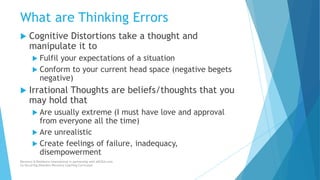
What are Thinking Errors
 Cognitive Distortions take a thought and
manipulate it to
 Fulfil your expectations of a situation
 Conform to your current head space (negative begets
negative)
 Irrational Thoughts are beliefs/thoughts that you
may hold that
 Are usually extreme (I must have love and approval
from everyone all the time)
 Are unrealistic
 Create feelings of failure, inadequacy,
disempowerment
Recovery & Resilience International in partnership with AllCEUs.com
Co-Occurring Disorders Recovery Coaching Curriculum
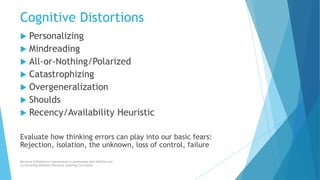
Cognitive Distortions
 Personalizing
 Mindreading
 All-or-Nothing/Polarized
 Catastrophizing
 Overgeneralization
 Shoulds
 Recency/Availability Heuristic
Evaluate how thinking errors can play into our basic fears:
Rejection, isolation, the unknown, loss of control, failure
Recovery & Resilience International in partnership with AllCEUs.com
Co-Occurring Disorders Recovery Coaching Curriculum
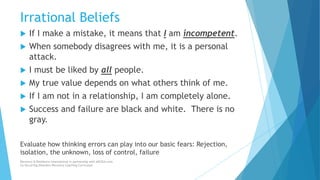
Irrational Beliefs
 If I make a mistake, it means that I am incompetent.
 When somebody disagrees with me, it is a personal
attack.
 I must be liked by all people.
 My true value depends on what others think of me.
 If I am not in a relationship, I am completely alone.
 Success and failure are black and white. There is no
gray.
Evaluate how thinking errors can play into our basic fears: Rejection,
isolation, the unknown, loss of control, failure
Recovery & Resilience International in partnership with AllCEUs.com
Co-Occurring Disorders Recovery Coaching Curriculum
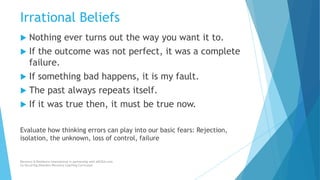
Irrational Beliefs
 Nothing ever turns out the way you want it to.
 If the outcome was not perfect, it was a complete
failure.
 If something bad happens, it is my fault.
 The past always repeats itself.
 If it was true then, it must be true now.
Evaluate how thinking errors can play into our basic fears: Rejection,
isolation, the unknown, loss of control, failure
Recovery & Resilience International in partnership with AllCEUs.com
Co-Occurring Disorders Recovery Coaching Curriculum
Irrational Thoughts Quick Help
 What is upsetting me?
 Why is this upsetting me?
 What are the FACTS for and against this belief
 Am I reacting based on facts or feelings?
 What cognitive distortions am I using?
 What irrational thoughts am I using?
Recovery & Resilience International in partnership with AllCEUs.com
Co-Occurring Disorders Recovery Coaching Curriculum
ABC-DEF
 Activating Event (What happened)
 Beliefs
 Obvious
 Negative self-talk//Past tapes
 Consequences
 Dispute Irrational Thoughts
 Evaluate the Most Productive Outcome
 Is this worth my energy?
 How can I best use my energy to deal with or let go of
the situation?
Recovery & Resilience International in partnership with AllCEUs.com
Co-Occurring Disorders Recovery Coaching Curriculum
Triggers—Coping Skills
 Distract don’t react
 Talk it through
 Urge surf
 Notice how you are feeling
 Remind yourself it increases and decreases like a wave
 Notice changes as the urge goes out
 Change and Challenge thoughts
 You CAN do it
 Don’t romanticize the use
Recovery & Resilience International in partnership with AllCEUs.com
Co-Occurring Disorders Recovery Coaching Curriculum
Constructive Self Talk
 Pinpoint what you tell yourself about an urge that
makes it harder to cope with the urge
 Use self-talk constructively to challenge that
statement. An effective challenge will make you
feel better (less tense, anxious, panicky)
 What is the evidence
 What is so awful about that
 You are a regular human being and have a right to
make mistakes
Recovery & Resilience International in partnership with AllCEUs.com
Co-Occurring Disorders Recovery Coaching Curriculum
Distressing Thoughts Worksheet
 What is the evidence
 Am I assuming causation where no exists?
 Am I confusing thought or feeling with fact?
 Am I close enough to really know what is going on?
 Am I thinking in all-or-none?
 Am I using extreme words like always or never
 Is the source of the information credible
 Am I confusing low with high probability
 Am I focusing on irrelevant factors?
 Is this thinking getting me closer to what I want?
 What are the advantages/disadvantages to thinking this way
 What difference will this make in a month/year.
Recovery & Resilience International in partnership with AllCEUs.com
Co-Occurring Disorders Recovery Coaching Curriculum
Other CBT Interventions
 Recognize how
 Thoughts can cause feelings
 Feelings can cause thoughts
 Activity scheduling to increase positive emotion and
mastery
 Exposure with Response Prevention
 Recognize Negative Thoughts
 Problem-Solving Skills
Recovery & Resilience International in partnership with AllCEUs.com
Co-Occurring Disorders Recovery Coaching Curriculum
Group Activity
 List thinking errors and discuss how those patterns
protected you until now
 Example: Prevented you from being disappointed if you
expected to fail or expected people to leave
 Identify thinking errors that you can, currently, eliminate
and a countering mantra
 I need to be loved by everybody all the time
 I need to love myself all the time and not everybody is
capable of loving. It is about them, not me.
 Identify thinking errors that you still hold onto and why,
then develop a plan to start addressing them.
Recovery & Resilience International in partnership with AllCEUs.com
Co-Occurring Disorders Recovery Coaching Curriculum
Decisional Balance
 This thought pattern was learned over a long
period of time
 It served a purpose and was more beneficial than
the alternative
 Changing your outlook means seeing how this
thought pattern is destructive, and alternate
thought patterns may (now) be more helpful.
 Example: In an addicted home the mantra is don’t talk,
don’t trust, don’t feel. For a child from an addicted
home negative thinking helped you align with the
primary caregiver and provided safety. As an adult, you
no longer require that safety.
Recovery & Resilience International in partnership with AllCEUs.com
Co-Occurring Disorders Recovery Coaching Curriculum
Apply It
 Identify 3 ways you could have used this information in
the past week.
 What was the situation?
 What did you do?
 How effective was that for you?
 Short term
 Long Term
 If you would have had this new information, what could you
have done differently?
 How would that have changed the outcome?
 How can you start integrating this knowledge into your routine
Recovery & Resilience International in partnership with AllCEUs.com
Co-Occurring Disorders Recovery Coaching Curriculum
Summary
 Cognitive Behavioral Therapy is a technique that
helps people:
 Understand how thoughts create feelings and vice versa
 Identify and address negative self talk
 Issues and events from the past do not need to
continue to negatively impact a person
 Thinking errors are learned and can be unlearned
 These thought patterns help to form and maintain
a negative or vulnerable self image.
 Healthy thought patterns can help people feel
more empowered and worthy of love.
Recovery & Resilience International in partnership with AllCEUs.com
Co-Occurring Disorders Recovery Coaching Curriculum

Thinking Errors: Understanding and Addressing Them to Improve Recovery

  • 1.
    Thinking Errors Understanding andAddressing Them Part of the Co-Occurring Disorders Recovery Coaching Series Presented by: Dr. Dawn-Elise Snipes Executive Director, AllCEUs
  • 2.
    Objectives  Define ThinkingErrors  Explore the different types of thinking errors  Cognitive distortions  Irrational Thoughts  Evaluate how thinking errors can play into our basic fears: Rejection, isolation, the unknown, loss of control, failure  Identify ways to  Increase awareness of thinking errors  Address thinking errors  Address basic fears Recovery & Resilience International in partnership with AllCEUs.com Co-Occurring Disorders Recovery Coaching Curriculum
  • 3.
    Why I Care/HowIt Impacts Recovery  Thinking errors, or stinkin’ thinkin’ plays a large part in keeping people miserable  Addiction, depression, anxiety, anger and guilt often stem or are made worse by faulty thinking  Addressing these thought patterns will help you:  Not make a mountain out of a molehill  Focus on the things you can change  Identify and eliminate thought patterns that are keeping you stuck Recovery & Resilience International in partnership with AllCEUs.com Co-Occurring Disorders Recovery Coaching Curriculum
  • 4.
    What are ThinkingErrors  Cognitive Distortions take a thought and manipulate it to  Fulfil your expectations of a situation  Conform to your current head space (negative begets negative)  Irrational Thoughts are beliefs/thoughts that you may hold that  Are usually extreme (I must have love and approval from everyone all the time)  Are unrealistic  Create feelings of failure, inadequacy, disempowerment Recovery & Resilience International in partnership with AllCEUs.com Co-Occurring Disorders Recovery Coaching Curriculum
  • 5.
    Cognitive Distortions  Personalizing Mindreading  All-or-Nothing/Polarized  Catastrophizing  Overgeneralization  Shoulds  Recency/Availability Heuristic Evaluate how thinking errors can play into our basic fears: Rejection, isolation, the unknown, loss of control, failure Recovery & Resilience International in partnership with AllCEUs.com Co-Occurring Disorders Recovery Coaching Curriculum
  • 6.
    Irrational Beliefs  IfI make a mistake, it means that I am incompetent.  When somebody disagrees with me, it is a personal attack.  I must be liked by all people.  My true value depends on what others think of me.  If I am not in a relationship, I am completely alone.  Success and failure are black and white. There is no gray. Evaluate how thinking errors can play into our basic fears: Rejection, isolation, the unknown, loss of control, failure Recovery & Resilience International in partnership with AllCEUs.com Co-Occurring Disorders Recovery Coaching Curriculum
  • 7.
    Irrational Beliefs  Nothingever turns out the way you want it to.  If the outcome was not perfect, it was a complete failure.  If something bad happens, it is my fault.  The past always repeats itself.  If it was true then, it must be true now. Evaluate how thinking errors can play into our basic fears: Rejection, isolation, the unknown, loss of control, failure Recovery & Resilience International in partnership with AllCEUs.com Co-Occurring Disorders Recovery Coaching Curriculum
  • 8.
    Irrational Thoughts QuickHelp  What is upsetting me?  Why is this upsetting me?  What are the FACTS for and against this belief  Am I reacting based on facts or feelings?  What cognitive distortions am I using?  What irrational thoughts am I using? Recovery & Resilience International in partnership with AllCEUs.com Co-Occurring Disorders Recovery Coaching Curriculum
  • 9.
    ABC-DEF  Activating Event(What happened)  Beliefs  Obvious  Negative self-talk//Past tapes  Consequences  Dispute Irrational Thoughts  Evaluate the Most Productive Outcome  Is this worth my energy?  How can I best use my energy to deal with or let go of the situation? Recovery & Resilience International in partnership with AllCEUs.com Co-Occurring Disorders Recovery Coaching Curriculum
  • 10.
    Triggers—Coping Skills  Distractdon’t react  Talk it through  Urge surf  Notice how you are feeling  Remind yourself it increases and decreases like a wave  Notice changes as the urge goes out  Change and Challenge thoughts  You CAN do it  Don’t romanticize the use Recovery & Resilience International in partnership with AllCEUs.com Co-Occurring Disorders Recovery Coaching Curriculum
  • 11.
    Constructive Self Talk Pinpoint what you tell yourself about an urge that makes it harder to cope with the urge  Use self-talk constructively to challenge that statement. An effective challenge will make you feel better (less tense, anxious, panicky)  What is the evidence  What is so awful about that  You are a regular human being and have a right to make mistakes Recovery & Resilience International in partnership with AllCEUs.com Co-Occurring Disorders Recovery Coaching Curriculum
  • 12.
    Distressing Thoughts Worksheet What is the evidence  Am I assuming causation where no exists?  Am I confusing thought or feeling with fact?  Am I close enough to really know what is going on?  Am I thinking in all-or-none?  Am I using extreme words like always or never  Is the source of the information credible  Am I confusing low with high probability  Am I focusing on irrelevant factors?  Is this thinking getting me closer to what I want?  What are the advantages/disadvantages to thinking this way  What difference will this make in a month/year. Recovery & Resilience International in partnership with AllCEUs.com Co-Occurring Disorders Recovery Coaching Curriculum
  • 13.
    Other CBT Interventions Recognize how  Thoughts can cause feelings  Feelings can cause thoughts  Activity scheduling to increase positive emotion and mastery  Exposure with Response Prevention  Recognize Negative Thoughts  Problem-Solving Skills Recovery & Resilience International in partnership with AllCEUs.com Co-Occurring Disorders Recovery Coaching Curriculum
  • 14.
    Group Activity  Listthinking errors and discuss how those patterns protected you until now  Example: Prevented you from being disappointed if you expected to fail or expected people to leave  Identify thinking errors that you can, currently, eliminate and a countering mantra  I need to be loved by everybody all the time  I need to love myself all the time and not everybody is capable of loving. It is about them, not me.  Identify thinking errors that you still hold onto and why, then develop a plan to start addressing them. Recovery & Resilience International in partnership with AllCEUs.com Co-Occurring Disorders Recovery Coaching Curriculum
  • 15.
    Decisional Balance  Thisthought pattern was learned over a long period of time  It served a purpose and was more beneficial than the alternative  Changing your outlook means seeing how this thought pattern is destructive, and alternate thought patterns may (now) be more helpful.  Example: In an addicted home the mantra is don’t talk, don’t trust, don’t feel. For a child from an addicted home negative thinking helped you align with the primary caregiver and provided safety. As an adult, you no longer require that safety. Recovery & Resilience International in partnership with AllCEUs.com Co-Occurring Disorders Recovery Coaching Curriculum
  • 16.
    Apply It  Identify3 ways you could have used this information in the past week.  What was the situation?  What did you do?  How effective was that for you?  Short term  Long Term  If you would have had this new information, what could you have done differently?  How would that have changed the outcome?  How can you start integrating this knowledge into your routine Recovery & Resilience International in partnership with AllCEUs.com Co-Occurring Disorders Recovery Coaching Curriculum
  • 17.
    Summary  Cognitive BehavioralTherapy is a technique that helps people:  Understand how thoughts create feelings and vice versa  Identify and address negative self talk  Issues and events from the past do not need to continue to negatively impact a person  Thinking errors are learned and can be unlearned  These thought patterns help to form and maintain a negative or vulnerable self image.  Healthy thought patterns can help people feel more empowered and worthy of love. Recovery & Resilience International in partnership with AllCEUs.com Co-Occurring Disorders Recovery Coaching Curriculum