INTELLIGENCE
DEFINITION Intelligence is goal directed and adaptive behavior.   A property of the  mind  that encompasses many related abilities, such as the capacities to  reason , to  plan , to  solve problems , to think  abstractly , to comprehend ideas, to use  language , and to  learn .
THEORIES OF INTELLIGENCE Charles Spearman - General Intelligence Louis L. Thurstone - Primary Mental Abilities Robert Sternberg - Triarchic Theory of  Intelligence Daniel Goleman-Emotional intelligence model
Charles Spearman - General Intelligence:   Spearman proposed that two factors could account for individual differences in scores on mental tests. He called the first factor  general intelligence  or the  general factor , represented as  g.  According to Spearman,  g  underlies all intellectual tasks and mental abilities. The  g  factor represented what all of the mental tests had in common. Scores on all of the tests were positively correlated, Spearman believed, because all of the tests drew on  g . The second factor Spearman identified was the  specific factor,  or  s.  The specific factor related to whatever unique abilities a particular test required, so it differed from test to test.
Louis L. Thurstone - Primary Mental Abilities:  Psychologist Louis L. Thurstone (1887-1955) offered a differing theory of intelligence. Instead of viewing intelligence as a single, general ability, Thurstone's theory focused on seven different "primary mental abilities" (Thurstone, 1938). The abilities that he described were:  Verbal comprehension  Reasoning  Perceptual speed  Numerical ability  Word fluency  Associative memory  Spatial visualization
Robert Sternberg - Triarchic Theory of  Intelligence:   Psychologist Robert Sternberg defined intelligence as "mental activity directed toward purposive adaptation to, selection and shaping of, real-world environments relevant to one’s life". Sternberg proposed what he refers to as 'successful intelligence,' which is comprised of three different factors: Analytical intelligence : This component refers to problem-solving abilities.  Creative intelligence : This aspect of intelligence involves the ability to deal with new situations using past experiences and current skills.  Practical intelligence : This element refers to the ability to adapt to a changing environment.
EMOTIONAL INTELLIGENCE The Emotional Competencies (Goleman) model The model introduced by  Daniel Goleman  focuses on EI as a wide array of competencies and skills that drive leadership performance. Goleman's model outlines four main EI constructs: Self-awareness — the ability to read one's emotions and recognize their impact while using  gut feelings  to guide decisions.  Self-management — involves controlling one's emotions and impulses and adapting to changing circumstances.  Social awareness — the ability to sense, understand, and react to others' emotions while comprehending  social networks .  Relationship management  — the ability to inspire, influence, and develop others while  managing conflict .
Concept of Mental Age (Alfred Binet) Alfred Binet was a psychologist.  His greatest accomplishment in the field of psychology lead to what we now call the Intelligence Quotient or IQ.  He developed a test to measure the 'mental age' (MA) of children entering school.   Mental age  refers to the child's current ability compared to other children of different ages.  In other words, if a child responded to questions at about the same correctness as an eight year old, the child would be said to have a mental age of eight.
Major Approaches to Intelligence I.Q Tests (General measures of intelligence) Fluid and Crystallized Intelligence (Fluid intelligence relate to reasoning, memory. Crystallized relates to information, skills and past experiences) Gardener’s multiple intelligence.  Practical intelligence (intelligence in terms of non academic and personal success). Emotional intelligence (understanding of emotions)
Gardner’s multiple intelligence.  The intelligence types were: Linguistic and verbal intelligence: good with words  Logical intelligence: good with math and logic  Spatial intelligence: good with pictures  Body/movement intelligence: good with activities  Musical intelligence: good with rhythm  Interpersonal intelligence: good with communication  Intrapersonal intelligence: good with analyzing things  Naturalist intelligence: good with understanding natural world.
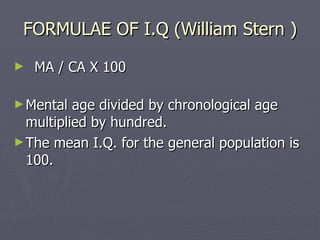
FORMULAE OF I.Q (William Stern ) MA / CA X 100 Mental age divided by chronological age multiplied by hundred.  The mean I.Q. for the general population is 100.
MENTAL RETARDATION Mental retardation/intellectual disability is significantly sub average intellectual functioning present from birth or early infancy, causing limitations in the ability to conduct normal activities of daily living.
Ranges of Mental Retardation Class IQ Profound mental retardation  I.Q Below 20(Below 3 years)  Severe mental retardation  I.Q 20–34 (3-6yr) Moderate mental retardation  I.Q 35–49 (6-8yrs) Mild mental retardation  I.Q 50–69 (8-10yrs) Borderline intellectual functioning  I.Q 70–79(8-11yrs) Average  I.Q  85-109 Bright Normal  I.Q  110-119 Very Superior  I.Q 130 above
Some Causes of Mental Retardation/Intellectual Disability Before or At Conception  Inherited disorders Chromosome abnormalities (such as Down syndrome)  During Pregnancy  Severe maternal malnutrition  Infections with HIV  Toxins (such as alcohol, lead, and methylmercury)  Drugs (such as, cancer chemotherapy)  multiple births  During Birth   Insufficient oxygen (hypoxia)  Extreme prematurity After Birth   Brain infections (such as meningitis and encephalitis)  Severe head injury  Malnutrition of the child  Severe emotional neglect or abuse  Toxins (such as lead and mercury)  Brain tumors and their treatments
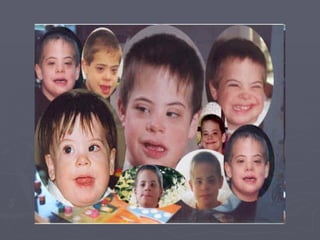
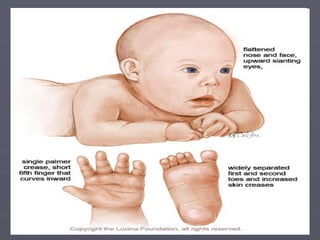
Down Syndrome The human body is made up of billions of cells. Each cell contains 46 thread-like structures called chromosomes. In Downs syndrome, because of a biological error around the time of conception, the cells come to have one extra chromosome i.e, 47 instead of 46 chromosomes. It is often possible to recognize people with Downs syndrome by their facial appearance, characterized by up-slanting eyes and flat bridge of the nose. Even though it is a genetic disorder, Downs syndrome is most often not inherited and can occur in any child. However, it is more likely to occur when the age of the mother at the time of the birth of the child is over 35 years. Even though persons with Downs syndrome have mental retardation, they possess good social and interactional skills.
 
 
Factors affecting intelligence Biological  Environmental.
TESTS Aptitude Tests predict a person’s ability in specific area. (SAT and GRE) Achievement Test determine the specific level of knowledge in an area. (F.SC or  A-Levels)
Types of TESTS Individual Test & Group Test: The criterion for any test is Reliability, Validity and Standardization.  INDIVIDUAL TEST: WAIS III (Wechsler Adult Intelligence Scale) WISC (Wechsler Intelligence Scale For Children)
GROUP TEST Army Alpha Intelligence Test:  During World War I (1914-1918) the United States Army asked educational psychologists to develop an intelligence test for recruits. Paper pencil test. Army Beta: During World War I (1914-1918) the United States Army administered intelligence tests. The Army Beta exam, which posed nonverbal problems, was given to non-English speakers and illiterate recruits.
Intelligence depends not only on I.Q but many factors such as motivation, skills personal and emotional maturity and environmental factors.

Intelligence

  • 1.
  • 2.
    DEFINITION Intelligence isgoal directed and adaptive behavior. A property of the mind that encompasses many related abilities, such as the capacities to reason , to plan , to solve problems , to think abstractly , to comprehend ideas, to use language , and to learn .
  • 3.
    THEORIES OF INTELLIGENCECharles Spearman - General Intelligence Louis L. Thurstone - Primary Mental Abilities Robert Sternberg - Triarchic Theory of Intelligence Daniel Goleman-Emotional intelligence model
  • 4.
    Charles Spearman -General Intelligence: Spearman proposed that two factors could account for individual differences in scores on mental tests. He called the first factor general intelligence or the general factor , represented as g. According to Spearman, g underlies all intellectual tasks and mental abilities. The g factor represented what all of the mental tests had in common. Scores on all of the tests were positively correlated, Spearman believed, because all of the tests drew on g . The second factor Spearman identified was the specific factor, or s. The specific factor related to whatever unique abilities a particular test required, so it differed from test to test.
  • 5.
    Louis L. Thurstone- Primary Mental Abilities: Psychologist Louis L. Thurstone (1887-1955) offered a differing theory of intelligence. Instead of viewing intelligence as a single, general ability, Thurstone's theory focused on seven different "primary mental abilities" (Thurstone, 1938). The abilities that he described were: Verbal comprehension Reasoning Perceptual speed Numerical ability Word fluency Associative memory Spatial visualization
  • 6.
    Robert Sternberg -Triarchic Theory of Intelligence: Psychologist Robert Sternberg defined intelligence as "mental activity directed toward purposive adaptation to, selection and shaping of, real-world environments relevant to one’s life". Sternberg proposed what he refers to as 'successful intelligence,' which is comprised of three different factors: Analytical intelligence : This component refers to problem-solving abilities. Creative intelligence : This aspect of intelligence involves the ability to deal with new situations using past experiences and current skills. Practical intelligence : This element refers to the ability to adapt to a changing environment.
  • 7.
    EMOTIONAL INTELLIGENCE TheEmotional Competencies (Goleman) model The model introduced by Daniel Goleman focuses on EI as a wide array of competencies and skills that drive leadership performance. Goleman's model outlines four main EI constructs: Self-awareness — the ability to read one's emotions and recognize their impact while using gut feelings to guide decisions. Self-management — involves controlling one's emotions and impulses and adapting to changing circumstances. Social awareness — the ability to sense, understand, and react to others' emotions while comprehending social networks . Relationship management  — the ability to inspire, influence, and develop others while managing conflict .
  • 8.
    Concept of MentalAge (Alfred Binet) Alfred Binet was a psychologist.  His greatest accomplishment in the field of psychology lead to what we now call the Intelligence Quotient or IQ.  He developed a test to measure the 'mental age' (MA) of children entering school.  Mental age refers to the child's current ability compared to other children of different ages.  In other words, if a child responded to questions at about the same correctness as an eight year old, the child would be said to have a mental age of eight.
  • 9.
    Major Approaches toIntelligence I.Q Tests (General measures of intelligence) Fluid and Crystallized Intelligence (Fluid intelligence relate to reasoning, memory. Crystallized relates to information, skills and past experiences) Gardener’s multiple intelligence. Practical intelligence (intelligence in terms of non academic and personal success). Emotional intelligence (understanding of emotions)
  • 10.
    Gardner’s multiple intelligence. The intelligence types were: Linguistic and verbal intelligence: good with words Logical intelligence: good with math and logic Spatial intelligence: good with pictures Body/movement intelligence: good with activities Musical intelligence: good with rhythm Interpersonal intelligence: good with communication Intrapersonal intelligence: good with analyzing things Naturalist intelligence: good with understanding natural world.
  • 11.
    FORMULAE OF I.Q(William Stern ) MA / CA X 100 Mental age divided by chronological age multiplied by hundred. The mean I.Q. for the general population is 100.
  • 12.
    MENTAL RETARDATION Mentalretardation/intellectual disability is significantly sub average intellectual functioning present from birth or early infancy, causing limitations in the ability to conduct normal activities of daily living.
  • 13.
    Ranges of MentalRetardation Class IQ Profound mental retardation I.Q Below 20(Below 3 years) Severe mental retardation I.Q 20–34 (3-6yr) Moderate mental retardation I.Q 35–49 (6-8yrs) Mild mental retardation I.Q 50–69 (8-10yrs) Borderline intellectual functioning I.Q 70–79(8-11yrs) Average I.Q 85-109 Bright Normal I.Q 110-119 Very Superior I.Q 130 above
  • 14.
    Some Causes ofMental Retardation/Intellectual Disability Before or At Conception Inherited disorders Chromosome abnormalities (such as Down syndrome) During Pregnancy Severe maternal malnutrition Infections with HIV Toxins (such as alcohol, lead, and methylmercury) Drugs (such as, cancer chemotherapy) multiple births During Birth Insufficient oxygen (hypoxia) Extreme prematurity After Birth Brain infections (such as meningitis and encephalitis) Severe head injury Malnutrition of the child Severe emotional neglect or abuse Toxins (such as lead and mercury) Brain tumors and their treatments
  • 15.
    Down Syndrome Thehuman body is made up of billions of cells. Each cell contains 46 thread-like structures called chromosomes. In Downs syndrome, because of a biological error around the time of conception, the cells come to have one extra chromosome i.e, 47 instead of 46 chromosomes. It is often possible to recognize people with Downs syndrome by their facial appearance, characterized by up-slanting eyes and flat bridge of the nose. Even though it is a genetic disorder, Downs syndrome is most often not inherited and can occur in any child. However, it is more likely to occur when the age of the mother at the time of the birth of the child is over 35 years. Even though persons with Downs syndrome have mental retardation, they possess good social and interactional skills.
  • 16.
  • 17.
  • 18.
    Factors affecting intelligenceBiological Environmental.
  • 19.
    TESTS Aptitude Testspredict a person’s ability in specific area. (SAT and GRE) Achievement Test determine the specific level of knowledge in an area. (F.SC or A-Levels)
  • 20.
    Types of TESTSIndividual Test & Group Test: The criterion for any test is Reliability, Validity and Standardization. INDIVIDUAL TEST: WAIS III (Wechsler Adult Intelligence Scale) WISC (Wechsler Intelligence Scale For Children)
  • 21.
    GROUP TEST ArmyAlpha Intelligence Test: During World War I (1914-1918) the United States Army asked educational psychologists to develop an intelligence test for recruits. Paper pencil test. Army Beta: During World War I (1914-1918) the United States Army administered intelligence tests. The Army Beta exam, which posed nonverbal problems, was given to non-English speakers and illiterate recruits.
  • 22.
    Intelligence depends notonly on I.Q but many factors such as motivation, skills personal and emotional maturity and environmental factors.