





What
if?
there
were no
numbers?
there is
no time?
Ancient Numeration
System
Primitive Numeration System
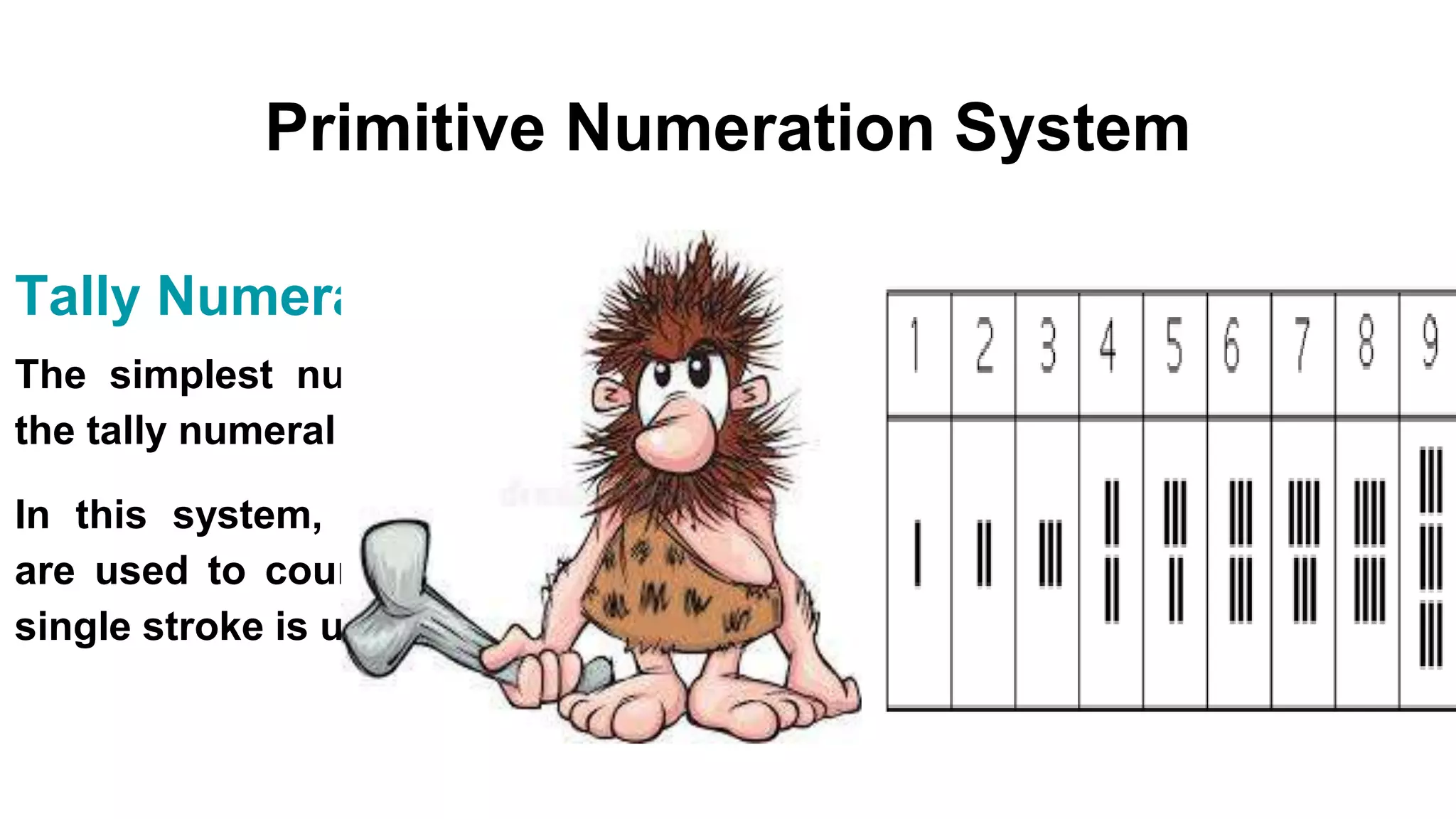
Tally Numeral System
The simplest numeral system is called
the tally numeral system.
In this system, strokes (straight lines)
are used to count the objects, and one
single stroke is used for each object.
Babylonian Numeration System
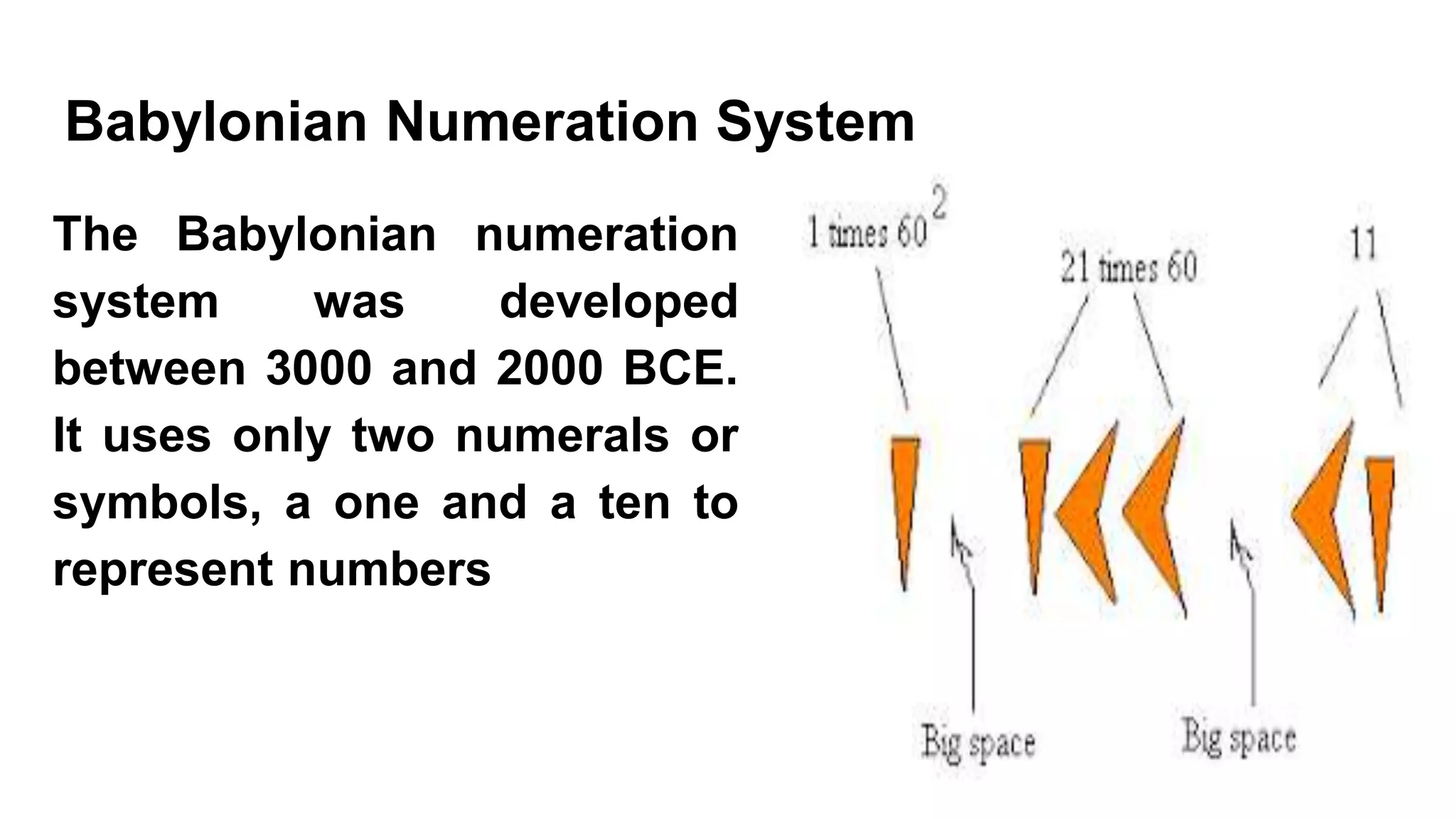
The Babylonian numeration
system was developed
between 3000 and 2000 BCE.
It uses only two numerals or
symbols, a one and a ten to
represent numbers
Egyptian Numeration System
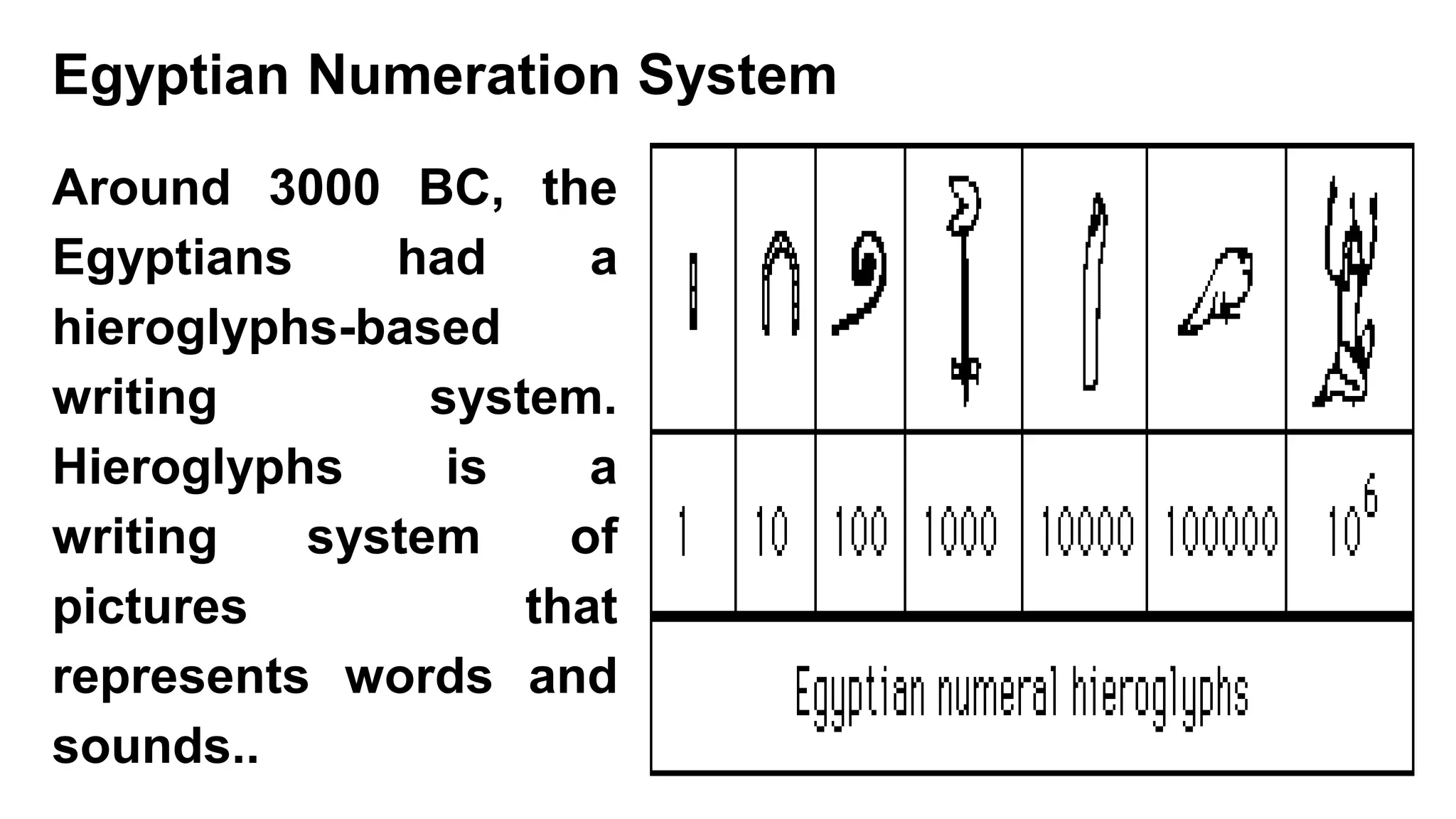
Around 3000 BC, the
Egyptians had a
hieroglyphs-based
writing system.
Hieroglyphs is a
writing system of
pictures that
represents words and
sounds..
Chinese Numeration System
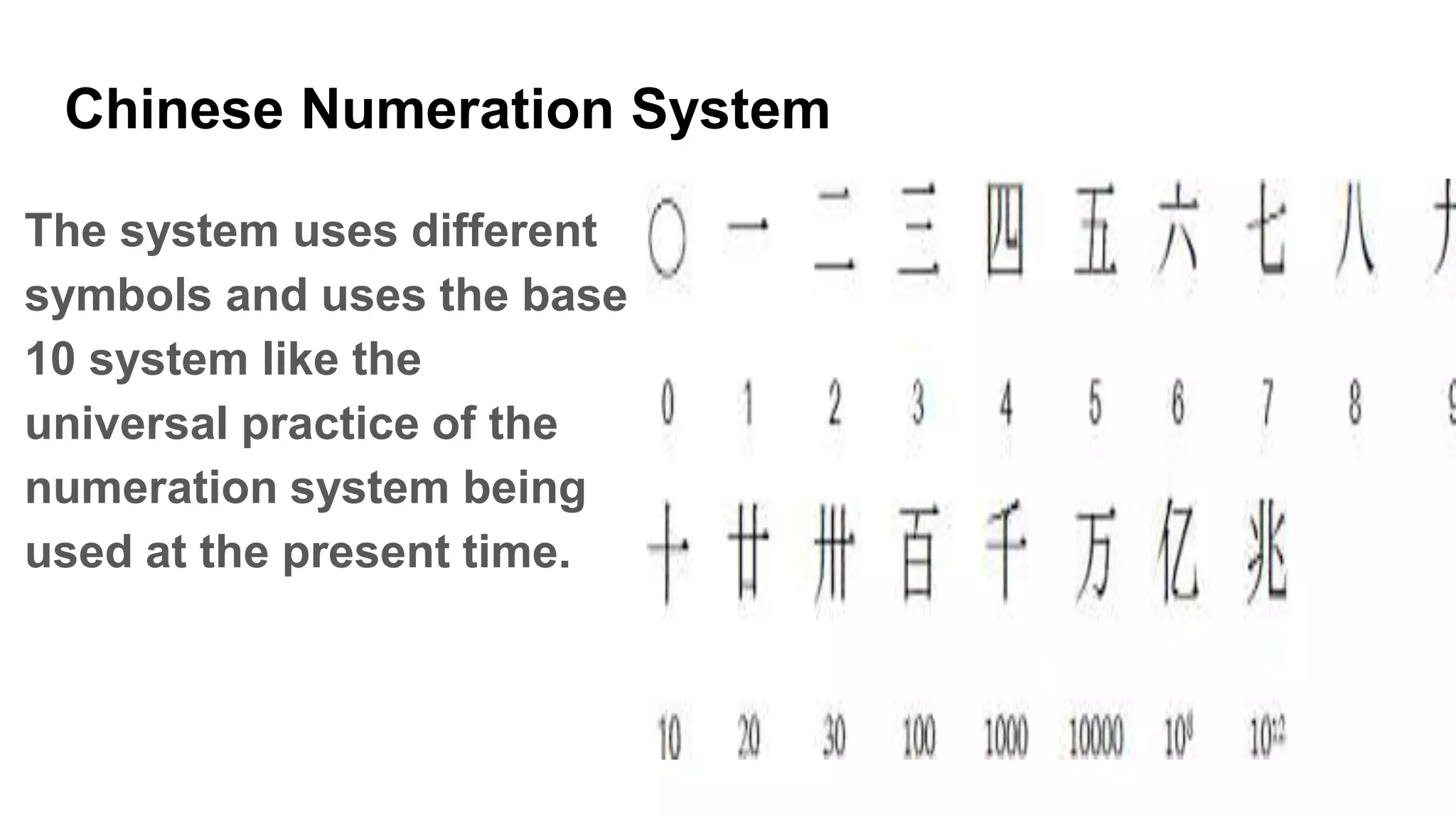
The system uses different
symbols and uses the base
10 system like the
universal practice of the
numeration system being
used at the present time.
Roman Numerals
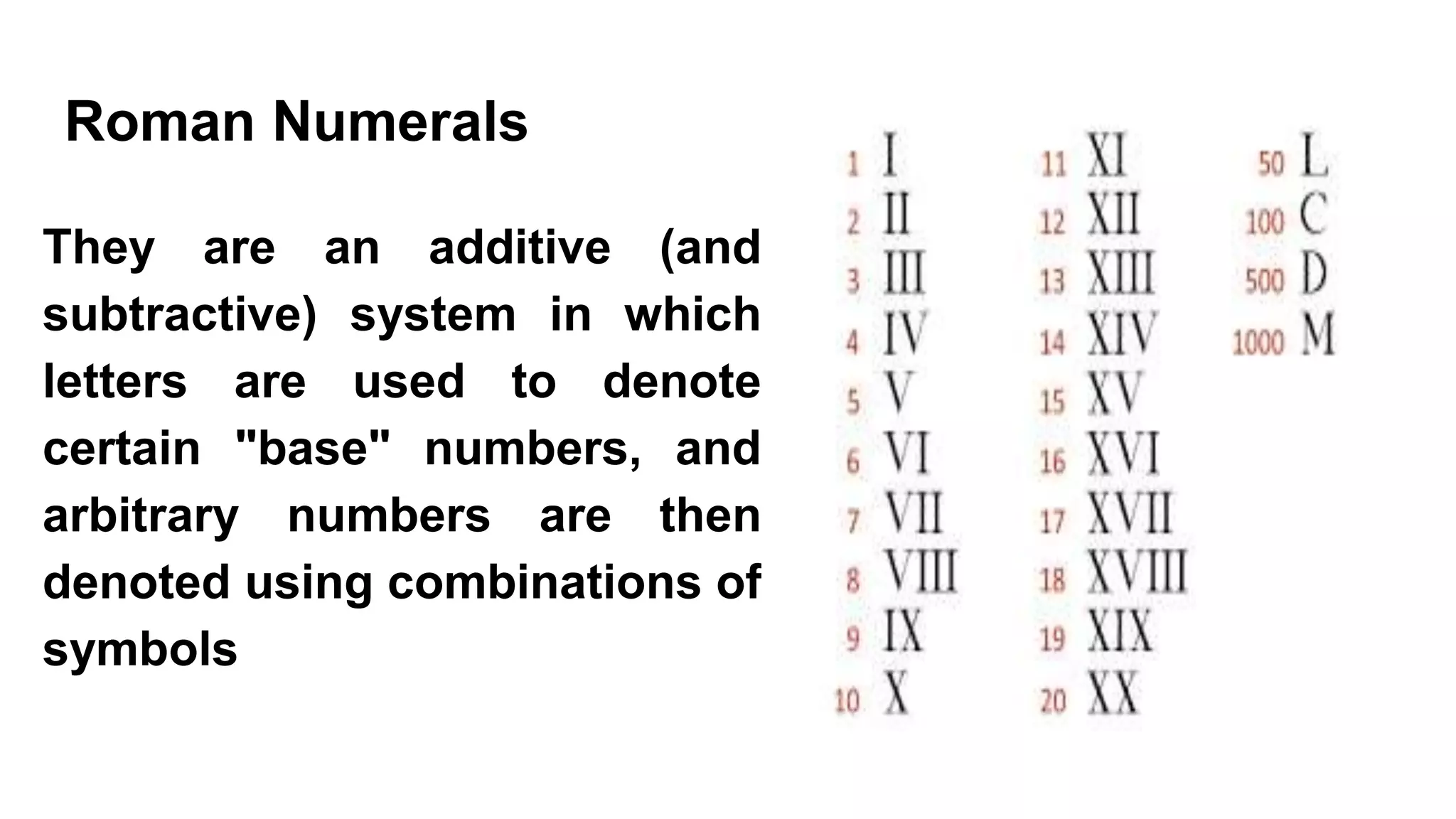
They are an additive (and
subtractive) system in which
letters are used to denote
certain "base" numbers, and
arbitrary numbers are then
denoted using combinations of
symbols
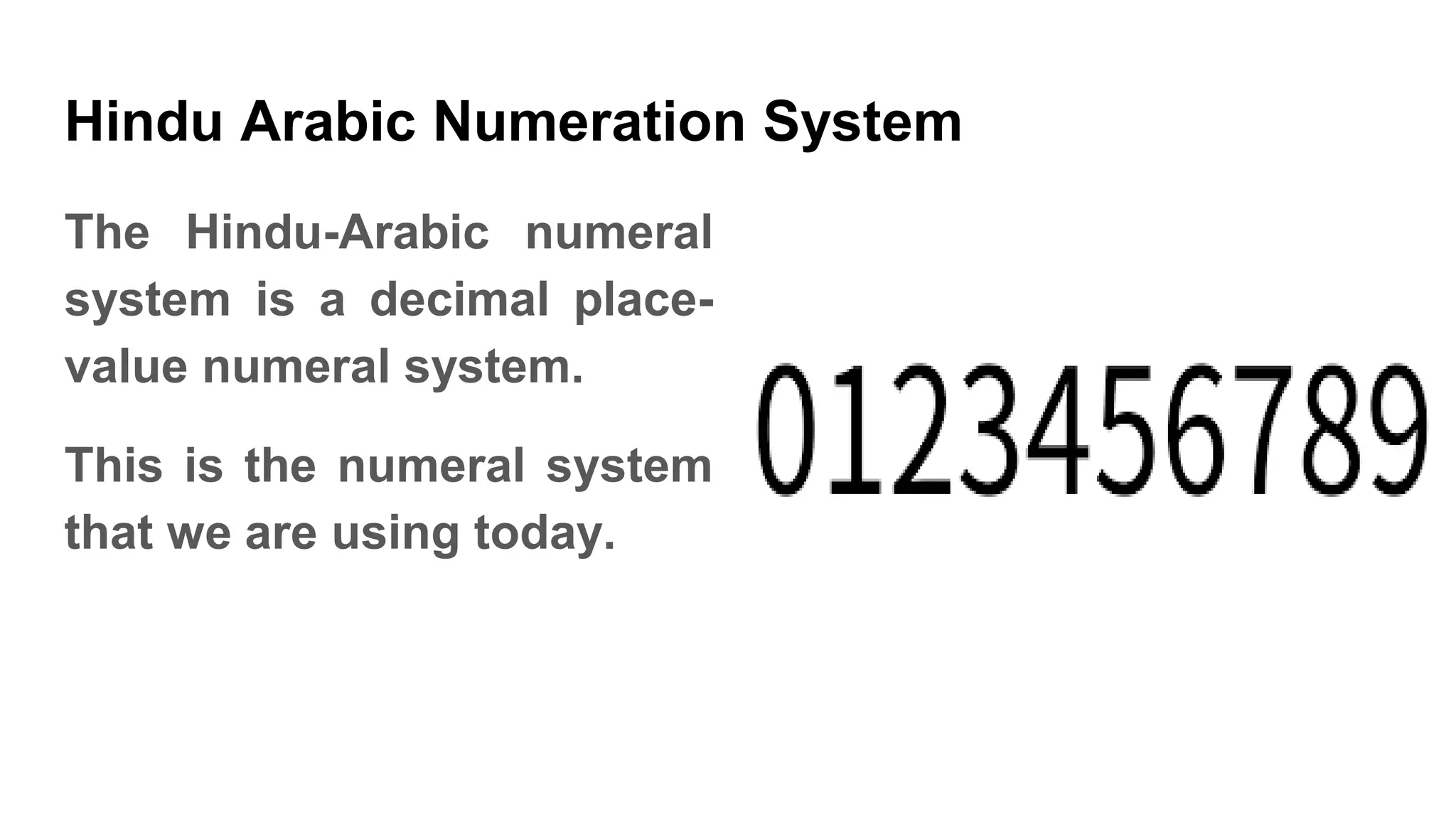
Hindu Arabic Numeration System
The Hindu-Arabic numeral
system is a decimal place-
value numeral system.
This is the numeral system
that we are using today.
Roman Numerals Rule
Roman numbers follow certain rules, which helps determine how the number is written.
It will also help us in reading or recognizing roman numbers. Let us take a look.
● If a symbol is repeated, its value is added as many times as it occurs. For example,
II=2, XX=20 etc.
● The symbols V, L and D are never repeated.
● A symbol is not repeated more than three times.
● If a smaller symbol is written to the right of a symbol with greater value, then its
value gets added to the value of the greater symbol. For example, VI=5+1=6,
XI=11 and so on.
● If a smaller symbol is written on the left of a symbol with greater value,
then its value is subtracted from the value of the greater symbol. IV= 5-
1=4, IX=9 etc.
● The symbols V, L and D are never written to the left of a symbol of greater
value i.e. V, L and D are never subtracted. The symbol I can be subtracted
from V and X only. The symbol X can be subtracted from L, M, and C
only.
● A symbol cannot be subtracted more than once from a particular symbol of
greater value. In other words, we cannot repeat a symbol on the left side of
a symbol. Eg, 98 is written as XCVIII and not as IIC.
Ancient numeration system

Ancient numeration system

  • 1.
  • 2.
  • 3.
  • 4.
  • 5.
    Primitive Numeration System TallyNumeral System The simplest numeral system is called the tally numeral system. In this system, strokes (straight lines) are used to count the objects, and one single stroke is used for each object.
  • 6.
    Babylonian Numeration System TheBabylonian numeration system was developed between 3000 and 2000 BCE. It uses only two numerals or symbols, a one and a ten to represent numbers
  • 7.
    Egyptian Numeration System Around3000 BC, the Egyptians had a hieroglyphs-based writing system. Hieroglyphs is a writing system of pictures that represents words and sounds..
  • 8.
    Chinese Numeration System Thesystem uses different symbols and uses the base 10 system like the universal practice of the numeration system being used at the present time.
  • 10.
    Roman Numerals They arean additive (and subtractive) system in which letters are used to denote certain "base" numbers, and arbitrary numbers are then denoted using combinations of symbols
  • 11.
    Hindu Arabic NumerationSystem The Hindu-Arabic numeral system is a decimal place- value numeral system. This is the numeral system that we are using today.
  • 12.
    Roman Numerals Rule Romannumbers follow certain rules, which helps determine how the number is written. It will also help us in reading or recognizing roman numbers. Let us take a look. ● If a symbol is repeated, its value is added as many times as it occurs. For example, II=2, XX=20 etc. ● The symbols V, L and D are never repeated. ● A symbol is not repeated more than three times. ● If a smaller symbol is written to the right of a symbol with greater value, then its value gets added to the value of the greater symbol. For example, VI=5+1=6, XI=11 and so on.
  • 13.
    ● If asmaller symbol is written on the left of a symbol with greater value, then its value is subtracted from the value of the greater symbol. IV= 5- 1=4, IX=9 etc. ● The symbols V, L and D are never written to the left of a symbol of greater value i.e. V, L and D are never subtracted. The symbol I can be subtracted from V and X only. The symbol X can be subtracted from L, M, and C only. ● A symbol cannot be subtracted more than once from a particular symbol of greater value. In other words, we cannot repeat a symbol on the left side of a symbol. Eg, 98 is written as XCVIII and not as IIC.