Direct
Current
Circuits
How well do you know these?
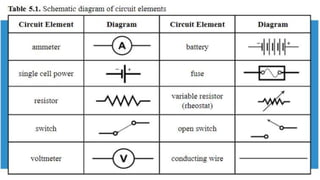
1. How do we illustrate circuit diagrams, using circuit elements such as power
sources (cell or battery), switches, lamps, resistors (fixed and variable),
fuses, ammeters, and voltmeters?
2. How do we evaluate the equivalent resistance, current, and voltage in a given
network of resistors connected in series or parallel?
3. How do we calculate the current and voltage through and across circuit
elements using Kirchhoff’s loop and junction rules?
4. How do we describe the initial, transient, and steady state behavior of
current, potential , and charge in a capacitor that is either charging or
discharging?
5. How do we solve problems involving the calculation of currents and potential
differences in circuits consisting of batteries, resistors and capacitors?
6. How do we plan and perform an experiment/s involving batteries and
resistors in one or more electric circuits?
Electronic Circuit
is a composite of wires, voltage sources, resistances
and other electronic components with provision for
current
An important concept related to thi is Circuit
Diagraming
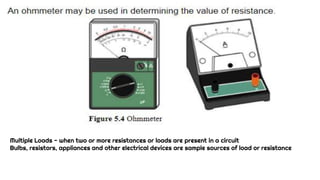
Multiple Loads - when two or more resistances or loads are present in a circuit
Bulbs, resistors, appliances and other electrical devices are sample sources of load or resistance
Series Circuit
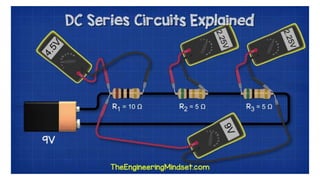
A series Circuit Connection is a type of multiple load
connection that allows a single path for charges to flow
Parallel Circuit
A connection that has atleast two complete paths or loops for
flowing charges.
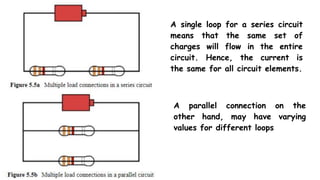
A single loop for a series circuit
means that the same set of
charges will flow in the entire
circuit. Hence, the current is
the same for all circuit elements.
A parallel connection on the
other hand, may have varying
values for different loops
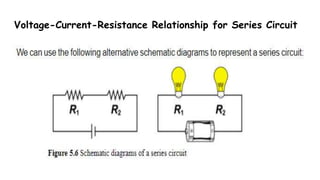
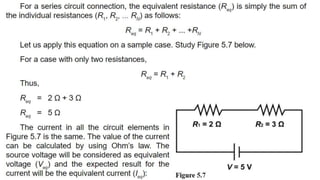
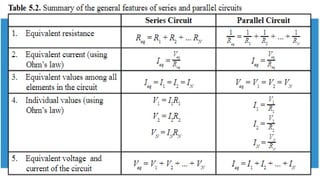
Voltage-Current-Resistance Relationship for Series Circuit
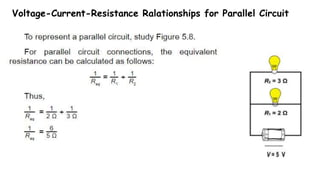
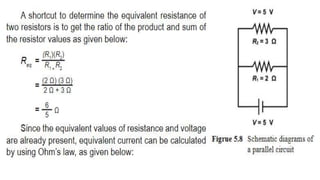
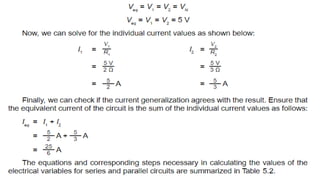
Voltage-Current-Resistance Ralationships for Parallel Circuit
Direct current circuits

Direct current circuits

  • 1.
  • 3.
    How well doyou know these? 1. How do we illustrate circuit diagrams, using circuit elements such as power sources (cell or battery), switches, lamps, resistors (fixed and variable), fuses, ammeters, and voltmeters? 2. How do we evaluate the equivalent resistance, current, and voltage in a given network of resistors connected in series or parallel? 3. How do we calculate the current and voltage through and across circuit elements using Kirchhoff’s loop and junction rules? 4. How do we describe the initial, transient, and steady state behavior of current, potential , and charge in a capacitor that is either charging or discharging? 5. How do we solve problems involving the calculation of currents and potential differences in circuits consisting of batteries, resistors and capacitors? 6. How do we plan and perform an experiment/s involving batteries and resistors in one or more electric circuits?
  • 4.
    Electronic Circuit is acomposite of wires, voltage sources, resistances and other electronic components with provision for current An important concept related to thi is Circuit Diagraming
  • 11.
    Multiple Loads -when two or more resistances or loads are present in a circuit Bulbs, resistors, appliances and other electrical devices are sample sources of load or resistance
  • 13.
    Series Circuit A seriesCircuit Connection is a type of multiple load connection that allows a single path for charges to flow Parallel Circuit A connection that has atleast two complete paths or loops for flowing charges.
  • 14.
    A single loopfor a series circuit means that the same set of charges will flow in the entire circuit. Hence, the current is the same for all circuit elements. A parallel connection on the other hand, may have varying values for different loops
  • 15.
  • 20.