Welcome to General
Physics Course!
Have you ever wonder Why?
All of it works because of Physics…….
What is Physics?
Physics is a branch of Science that deals
with the nature and properties of matter and
energy.
It includes the concepts of heat, light,
mechanics (motion) waves (sounds) electricity and
magnetism and atomic structure (nuclear physics)
Introductory Concepts in
Physics
Physical Quantities
PHYSICAL QUANTITIES have a numerical value
and a unit of measurement, which is a specific
magnitude of a physical quantity that has been
adopted by convention.
What Is SI?
SI is the abbreviation of International System
of Units, which is the most widely used set of
units by scientist that defines a measurement.
SI is an acronym of Le Système
Internationale d’Unités in French
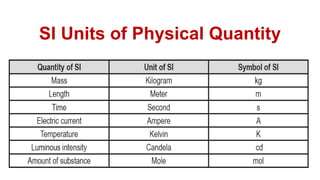
SI Units of Physical Quantity
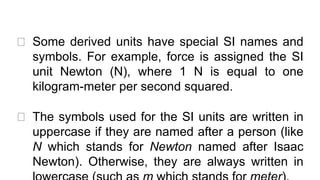
⮚ Some derived units have special SI names and
symbols. For example, force is assigned the SI
unit Newton (N), where 1 N is equal to one
kilogram-meter per second squared.
⮚ The symbols used for the SI units are written in
uppercase if they are named after a person (like
N which stands for Newton named after Isaac
Newton). Otherwise, they are always written in
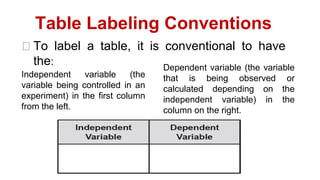
Table Labeling Conventions
⮚ To label a table, it is conventional to have
the:
Independent variable (the
variable being controlled in an
experiment) in the first column
from the left.
Dependent variable (the variable
that is being observed or
calculated depending on the
independent variable) in the
column on the right.
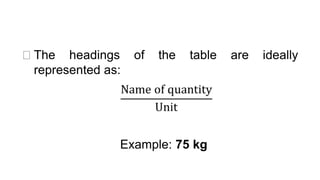
Example: 75 kg
⮚ The headings of the table are ideally
represented as:
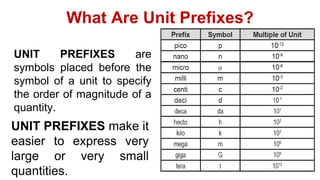
What Are Unit Prefixes?
UNIT PREFIXES are
symbols placed before the
symbol of a unit to specify
the order of magnitude of a
quantity.
UNIT PREFIXES make it
easier to express very
large or very small
quantities.
Estimation of Common Physical Quantities
ESTIMATION
• Involves looking for a value that is
approximately close to the true value of a
physical quantity without measurement
• Used to verify any measurement or
reported value
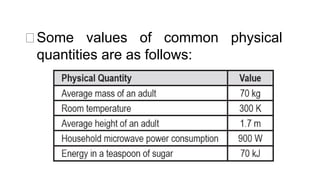
⮚Some values of common physical
quantities are as follows:
⮚ Instead of giving a precise numerical value,
it is often sufficient to estimate the order of
magnitude of a quantity, which involves
stating the value of ten raise to the
appropriate power.
Examples:
• The diameter of an atomic nucleus is
around 10-12 m.
• The sun has a mass of roughly 1030 kg.
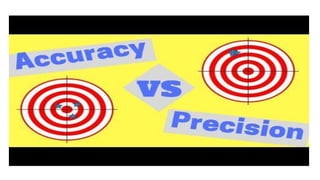
Accuracy and Precision
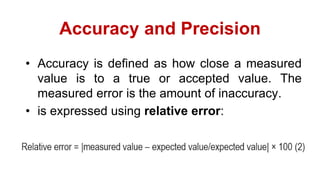
• Accuracy is defined as how close a measured
value is to a true or accepted value. The
measured error is the amount of inaccuracy.
• is expressed using relative error:
PRECISION
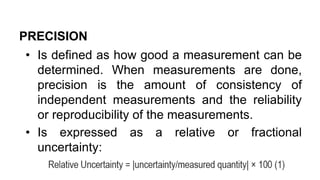
• Is defined as how good a measurement can be
determined. When measurements are done,
precision is the amount of consistency of
independent measurements and the reliability
or reproducibility of the measurements.
• Is expressed as a relative or fractional
uncertainty:
PRECISION VS. ACCURACY
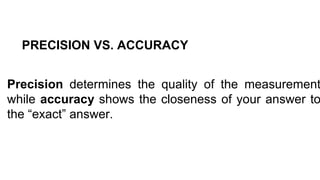
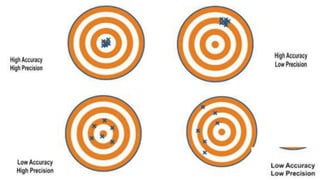
Precision determines the quality of the measurement
while accuracy shows the closeness of your answer to
the “exact” answer.
PRECISION VS. ACCURACY
Precision determines the quality of the
measurement while accuracy shows the
closeness of your answer to the “exact”
answer.
RANDOM ERRORS
Forms of Errors
• Are defined as variations in the measured data brought by
the limitations of the measuring device
• Use statistical analysis
SYSTEMATIC ERRORS
Are defined as reproducible inaccurate data that are
constantly in the same direction
Causes of Error in Doing Physics
Laboratory Experiments
1. Inadequate definition (either systematic or
random)
2. Unable to include a factor (systematic)
3. Factors due to the environment (either
systematic or random)
4. Limited scale of the instrument (random)
5. Unable to calibrate or check zero scale of
the instrument (systematic)
5. Unable to calibrate or check zero scale of
the instrument (systematic)
6. Variations in the physical measurement
(random)
7. Parallax (either systematic or random)
8. Personal errors

Introductory concepts in physics

  • 2.
  • 3.
    Have you everwonder Why?
  • 5.
    All of itworks because of Physics…….
  • 6.
    What is Physics? Physicsis a branch of Science that deals with the nature and properties of matter and energy. It includes the concepts of heat, light, mechanics (motion) waves (sounds) electricity and magnetism and atomic structure (nuclear physics)
  • 10.
  • 11.
    Physical Quantities PHYSICAL QUANTITIEShave a numerical value and a unit of measurement, which is a specific magnitude of a physical quantity that has been adopted by convention.
  • 12.
    What Is SI? SIis the abbreviation of International System of Units, which is the most widely used set of units by scientist that defines a measurement. SI is an acronym of Le Système Internationale d’Unités in French
  • 13.
    SI Units ofPhysical Quantity
  • 14.
    ⮚ Some derivedunits have special SI names and symbols. For example, force is assigned the SI unit Newton (N), where 1 N is equal to one kilogram-meter per second squared. ⮚ The symbols used for the SI units are written in uppercase if they are named after a person (like N which stands for Newton named after Isaac Newton). Otherwise, they are always written in
  • 15.
    Table Labeling Conventions ⮚To label a table, it is conventional to have the: Independent variable (the variable being controlled in an experiment) in the first column from the left. Dependent variable (the variable that is being observed or calculated depending on the independent variable) in the column on the right.
  • 17.
    Example: 75 kg ⮚The headings of the table are ideally represented as:
  • 18.
    What Are UnitPrefixes? UNIT PREFIXES are symbols placed before the symbol of a unit to specify the order of magnitude of a quantity. UNIT PREFIXES make it easier to express very large or very small quantities.
  • 19.
    Estimation of CommonPhysical Quantities ESTIMATION • Involves looking for a value that is approximately close to the true value of a physical quantity without measurement • Used to verify any measurement or reported value
  • 20.
    ⮚Some values ofcommon physical quantities are as follows:
  • 21.
    ⮚ Instead ofgiving a precise numerical value, it is often sufficient to estimate the order of magnitude of a quantity, which involves stating the value of ten raise to the appropriate power. Examples: • The diameter of an atomic nucleus is around 10-12 m. • The sun has a mass of roughly 1030 kg.
  • 22.
    Accuracy and Precision •Accuracy is defined as how close a measured value is to a true or accepted value. The measured error is the amount of inaccuracy. • is expressed using relative error:
  • 23.
    PRECISION • Is definedas how good a measurement can be determined. When measurements are done, precision is the amount of consistency of independent measurements and the reliability or reproducibility of the measurements. • Is expressed as a relative or fractional uncertainty:
  • 24.
    PRECISION VS. ACCURACY Precisiondetermines the quality of the measurement while accuracy shows the closeness of your answer to the “exact” answer.
  • 27.
    PRECISION VS. ACCURACY Precisiondetermines the quality of the measurement while accuracy shows the closeness of your answer to the “exact” answer.
  • 28.
    RANDOM ERRORS Forms ofErrors • Are defined as variations in the measured data brought by the limitations of the measuring device • Use statistical analysis SYSTEMATIC ERRORS Are defined as reproducible inaccurate data that are constantly in the same direction
  • 29.
    Causes of Errorin Doing Physics Laboratory Experiments 1. Inadequate definition (either systematic or random) 2. Unable to include a factor (systematic) 3. Factors due to the environment (either systematic or random) 4. Limited scale of the instrument (random)
  • 30.
    5. Unable tocalibrate or check zero scale of the instrument (systematic) 5. Unable to calibrate or check zero scale of the instrument (systematic) 6. Variations in the physical measurement (random) 7. Parallax (either systematic or random) 8. Personal errors