

Classical
Mechanics
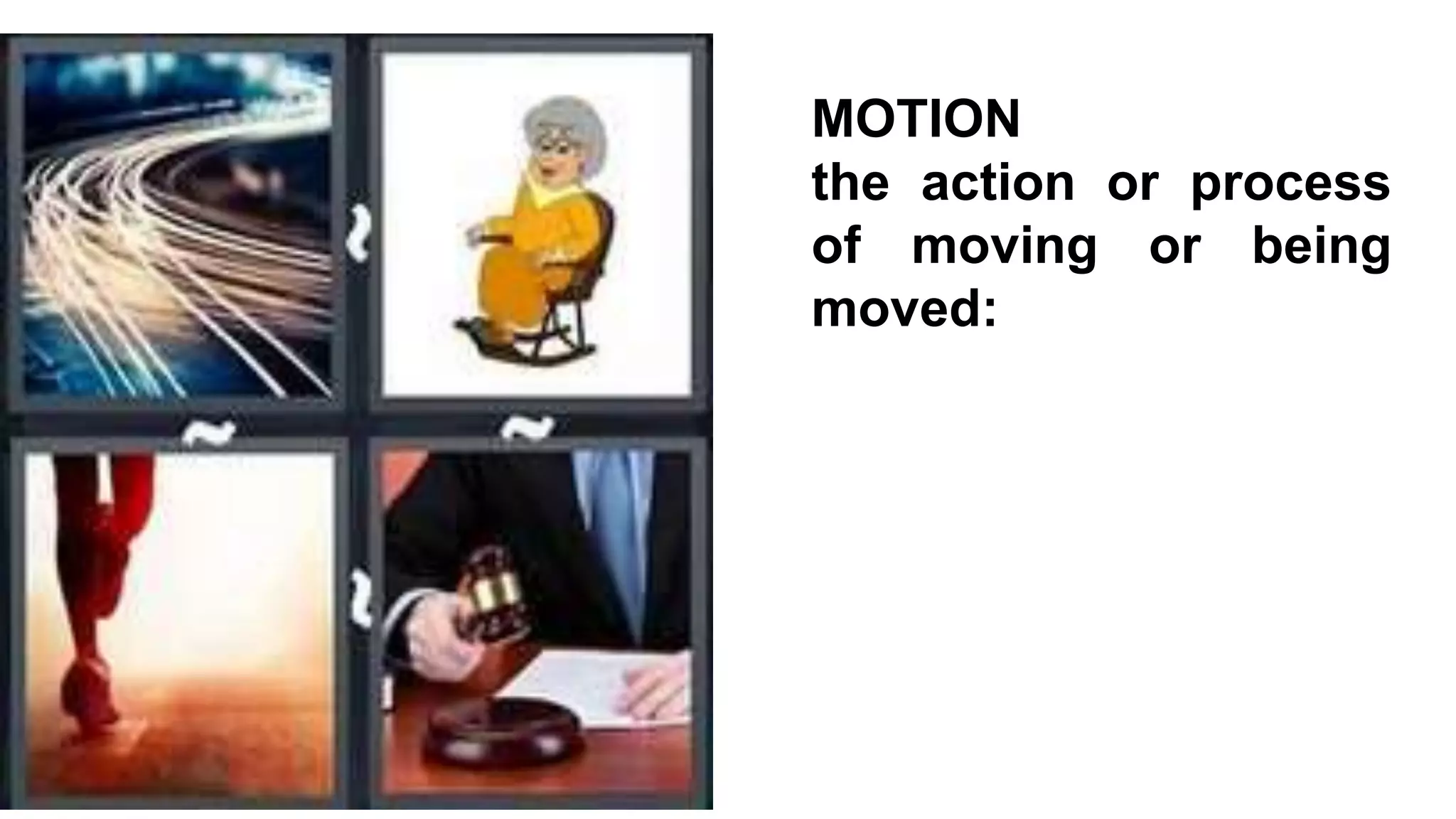
MOTION
the action or process
of moving or being
moved:
Aristotelian Motion
The ancient Greeks had the earliest recorded studies about
motion. Many Greeks tried to explain the physical phenomena
in the universe but it was Aristotle’s ideas that prevailed for
2000 years
Aristotle’s (384-322 BC) came up with the theories about
motion and the universe, based on his literal observations and
assumptions.
He categorized motion into two types:
NATURAL and VIOLENT Motion
Natural Motion also called vertical motion, on Earth was
explained as the natural tendency of an object to go to its
natural place
Examples of this type are the falling of the boulder towards
the ground and the rising of smoke up in the air
According to Aristotle, it was natural for heavy things to fall
and for every light materials to rise
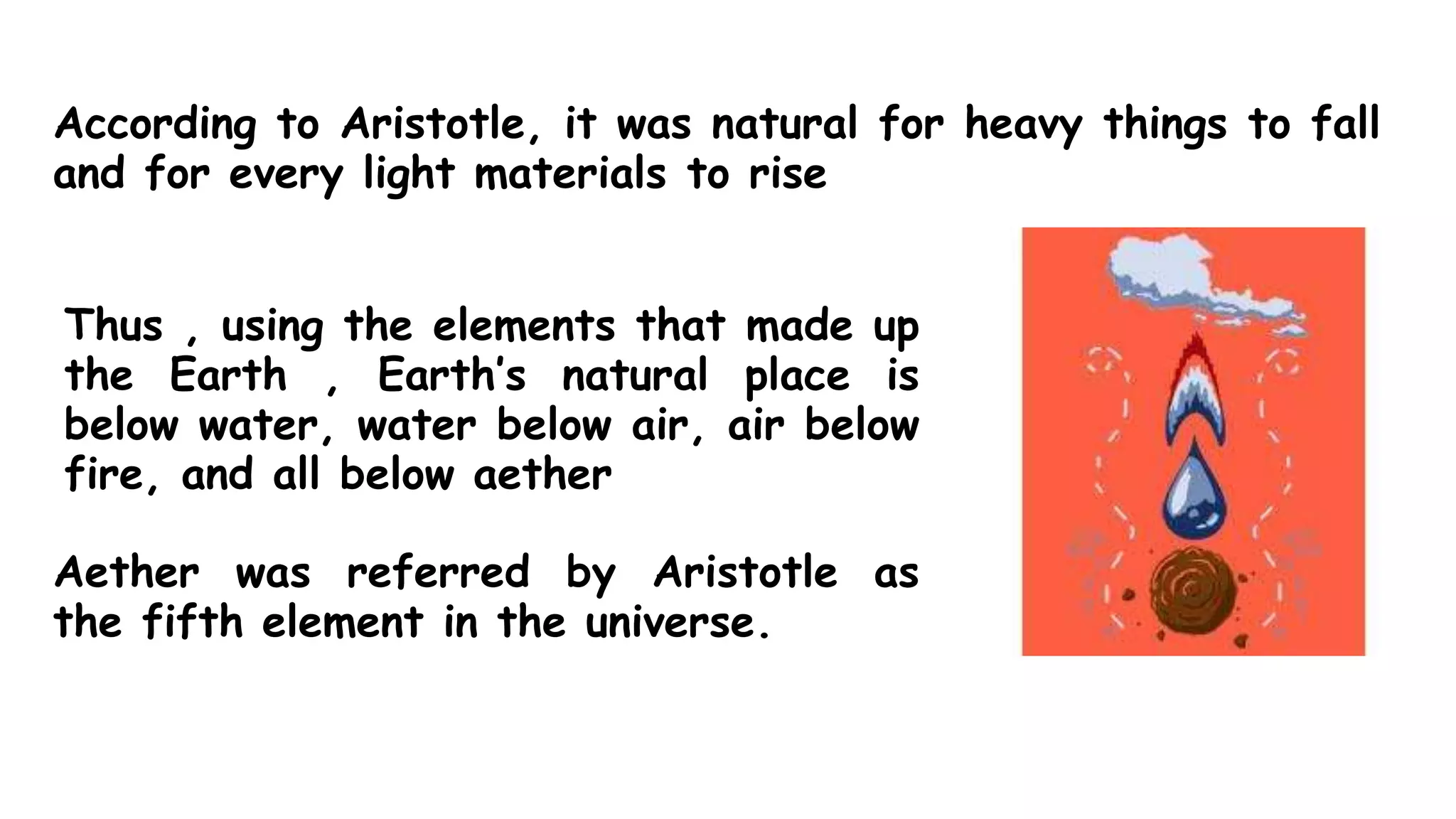
Thus , using the elements that made up
the Earth , Earth’s natural place is
below water, water below air, air below
fire, and all below aether
Aether was referred by Aristotle as
the fifth element in the universe.
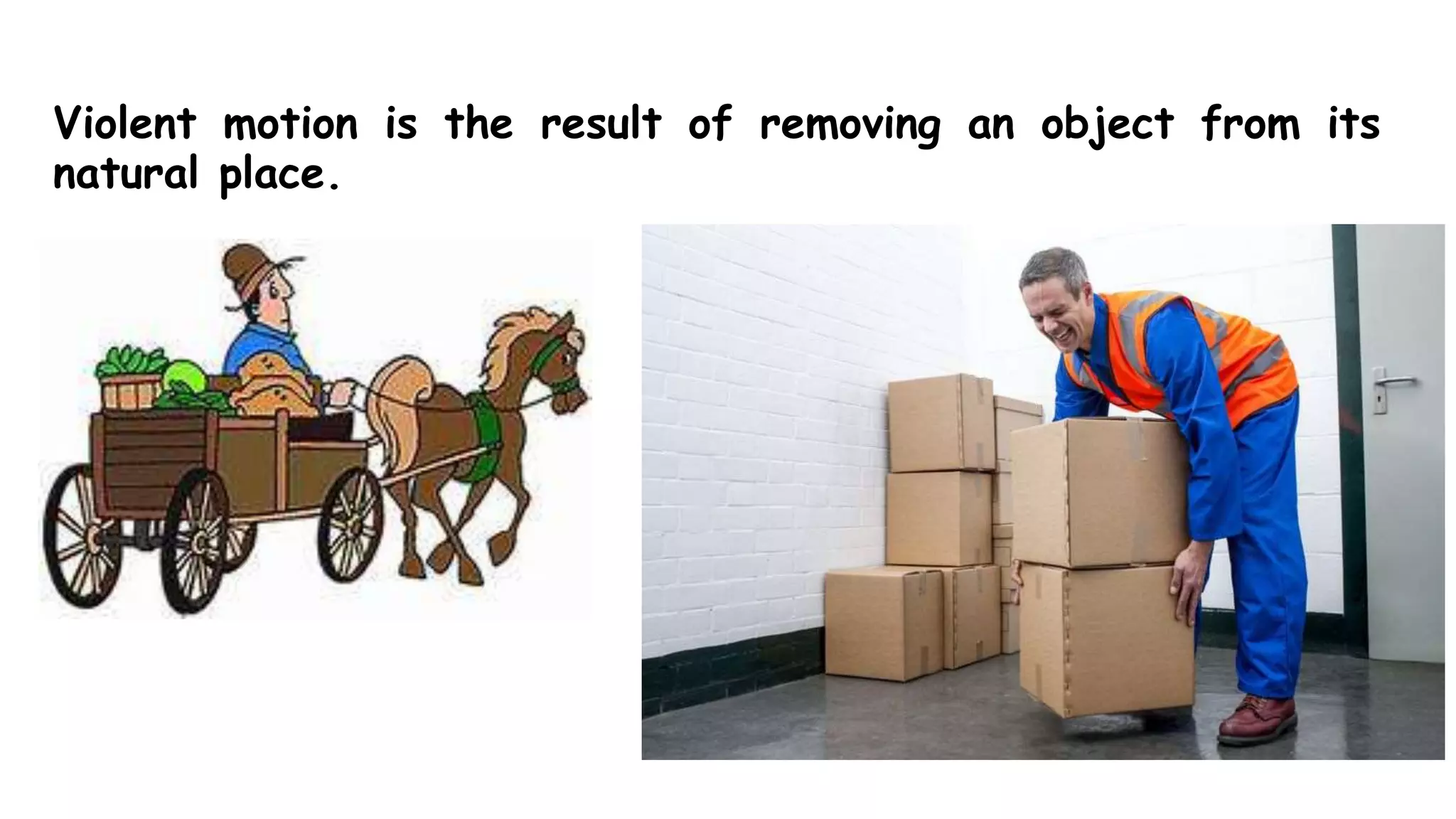
Violent motion is the result of removing an object from its
natural place.
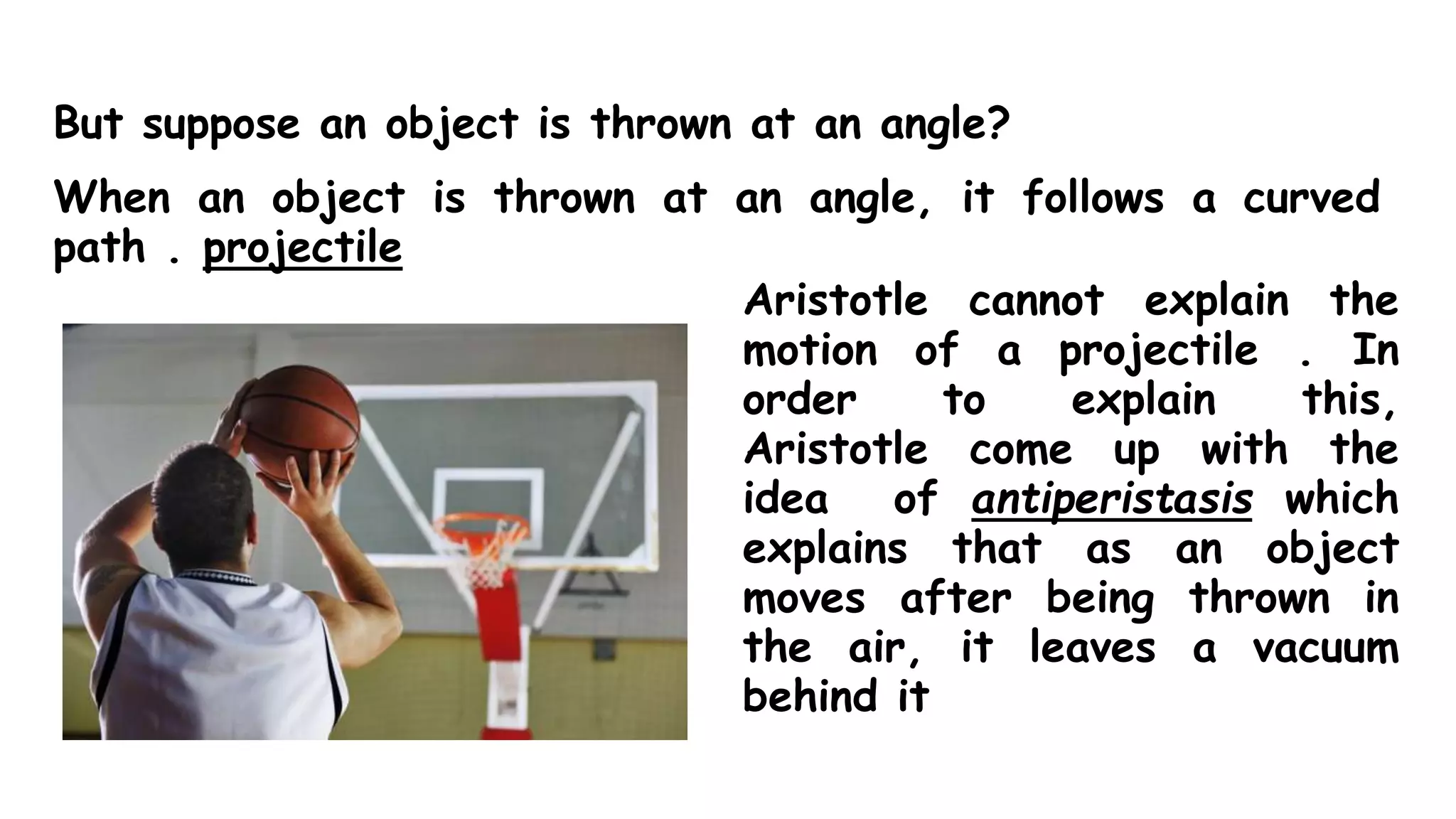
But suppose an object is thrown at an angle?
When an object is thrown at an angle, it follows a curved
path . projectile
Aristotle cannot explain the
motion of a projectile . In
order to explain this,
Aristotle come up with the
idea of antiperistasis which
explains that as an object
moves after being thrown in
the air, it leaves a vacuum
behind it
Galilean Motion
It was not until the time of Galileo Galilei (1564 -
1642) that Aristotle’s idea was challenged
Aristotle capitalized on the idea that force is needed to
sustain the motion of an object. However, Galileo’s
observations of everyday objects were not in accord with this
idea.
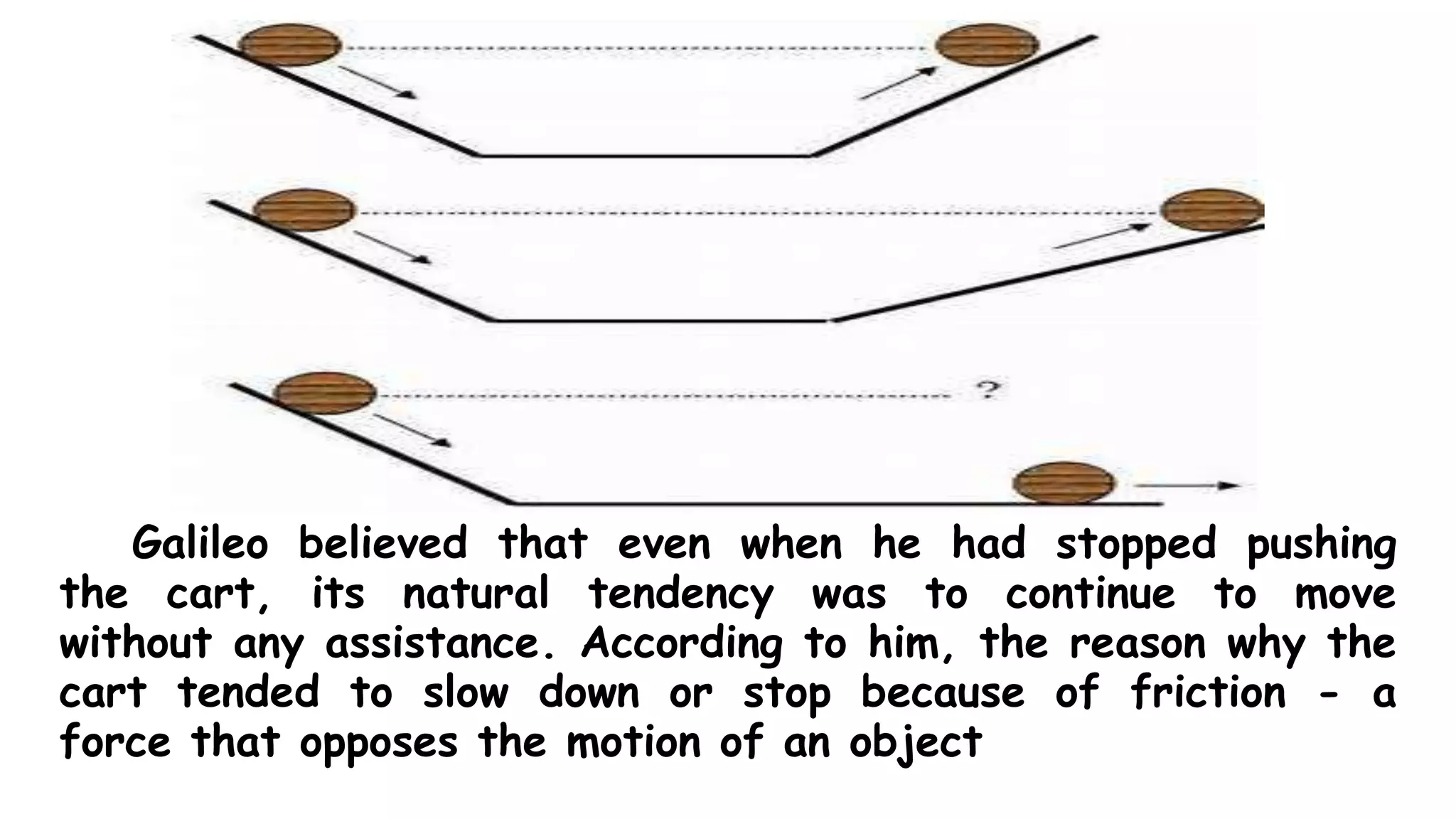
Galileo believed that even when he had stopped pushing
the cart, its natural tendency was to continue to move
without any assistance. According to him, the reason why the
cart tended to slow down or stop because of friction - a
force that opposes the motion of an object
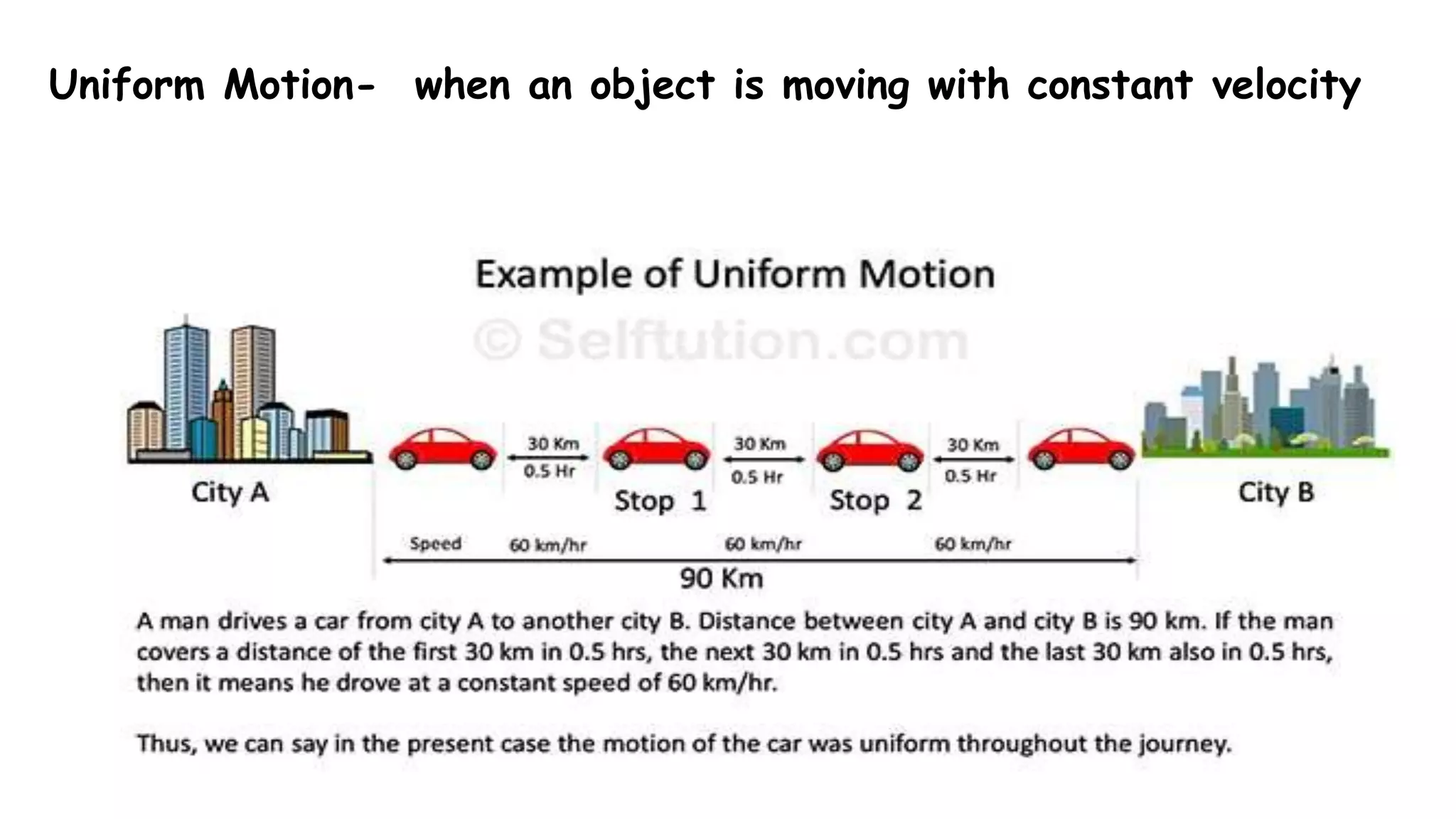
Uniform Motion- when an object is moving with constant velocity
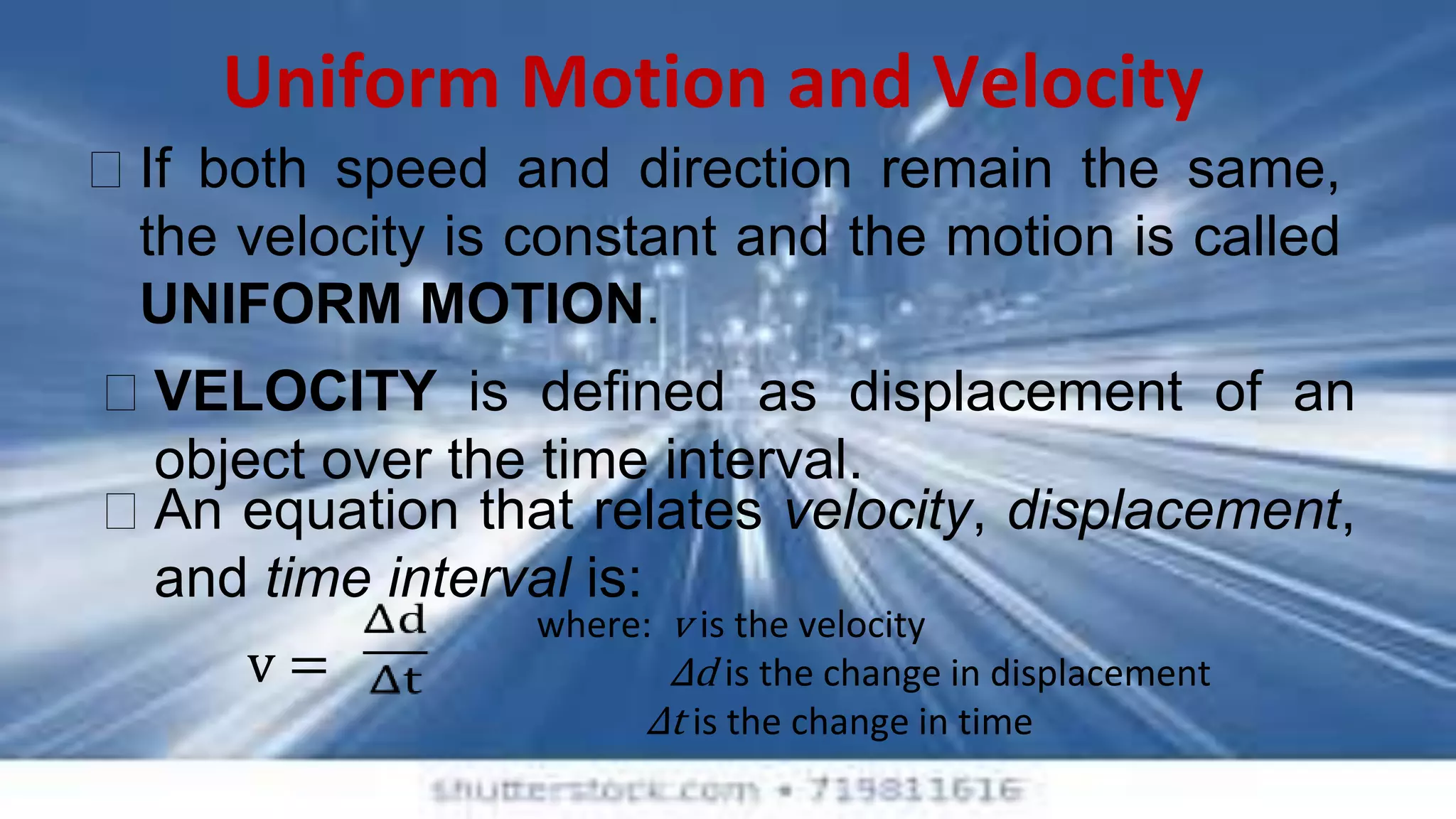
Uniform Motion and Velocity
⮚ If both speed and direction remain the same,
the velocity is constant and the motion is called
UNIFORM MOTION.
⮚ VELOCITY is defined as displacement of an
object over the time interval.
v =
where: v is the velocity
Δd is the change in displacement
Δt is the change in time
⮚ An equation that relates velocity, displacement,
and time interval is:
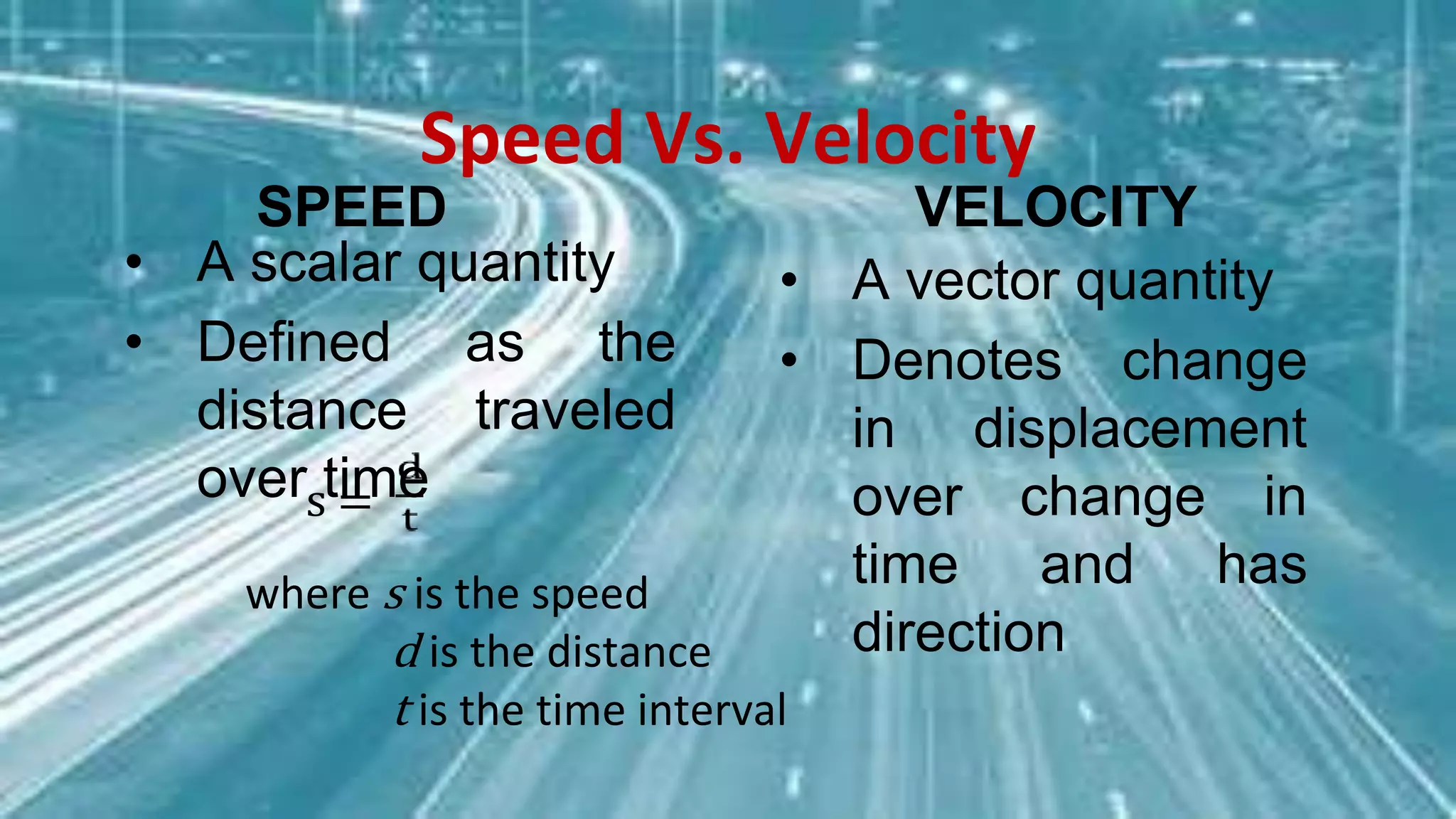
Speed Vs. Velocity
SPEED
• A scalar quantity
• Defined as the
distance traveled
over time
VELOCITY
• A vector quantity
• Denotes change
in displacement
over change in
time and has
direction
where s is the speed
d is the distance
t is the time interval
s =
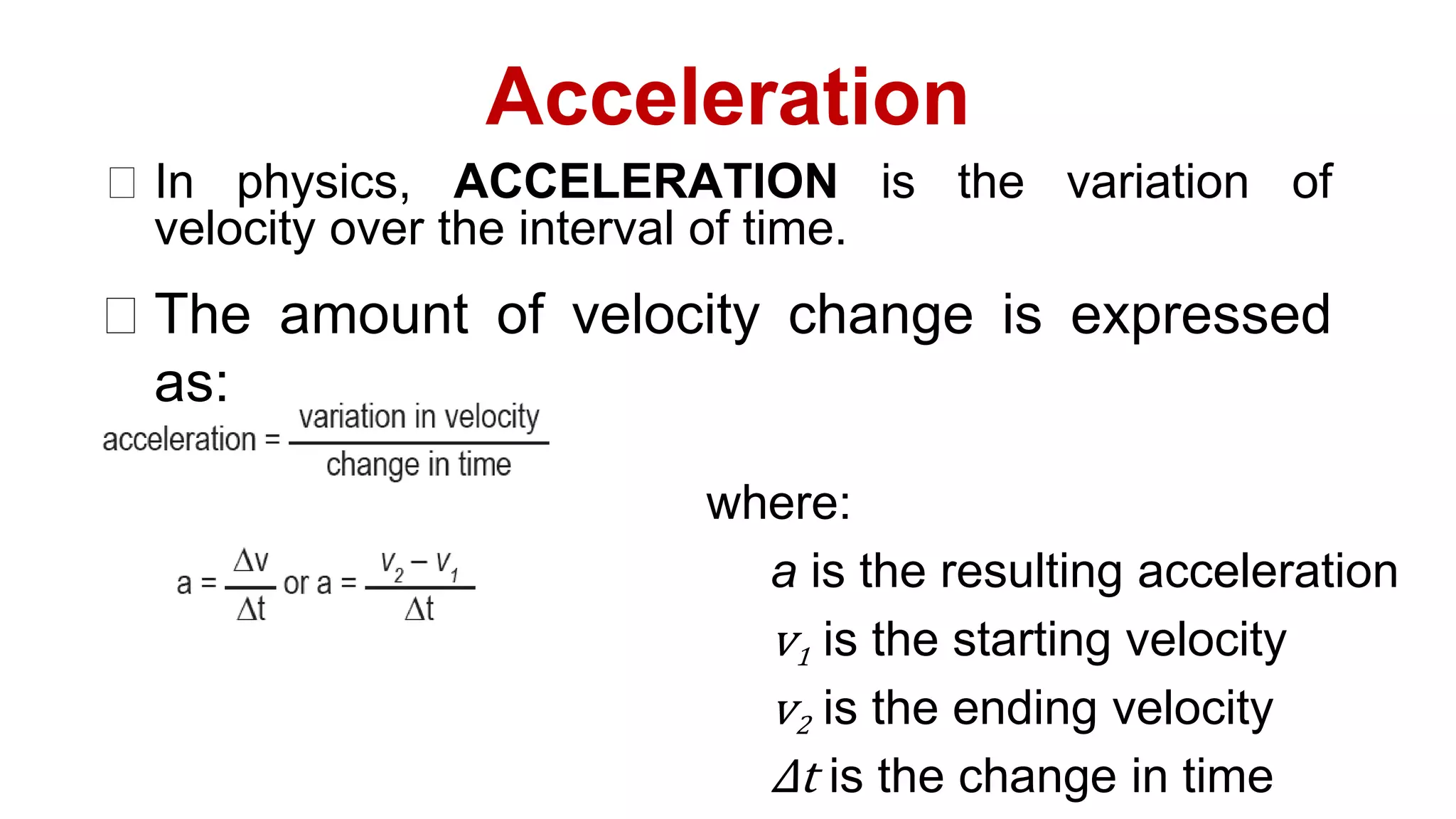
Acceleration
⮚ In physics, ACCELERATION is the variation of
velocity over the interval of time.
where:
a is the resulting acceleration
v1 is the starting velocity
v2 is the ending velocity
Δt is the change in time
⮚ The amount of velocity change is expressed
as:
Velocity-Time Graph
A VELOCITY-TIME GRAPH best represents the
motion of objects whose velocity is constantly
changing.
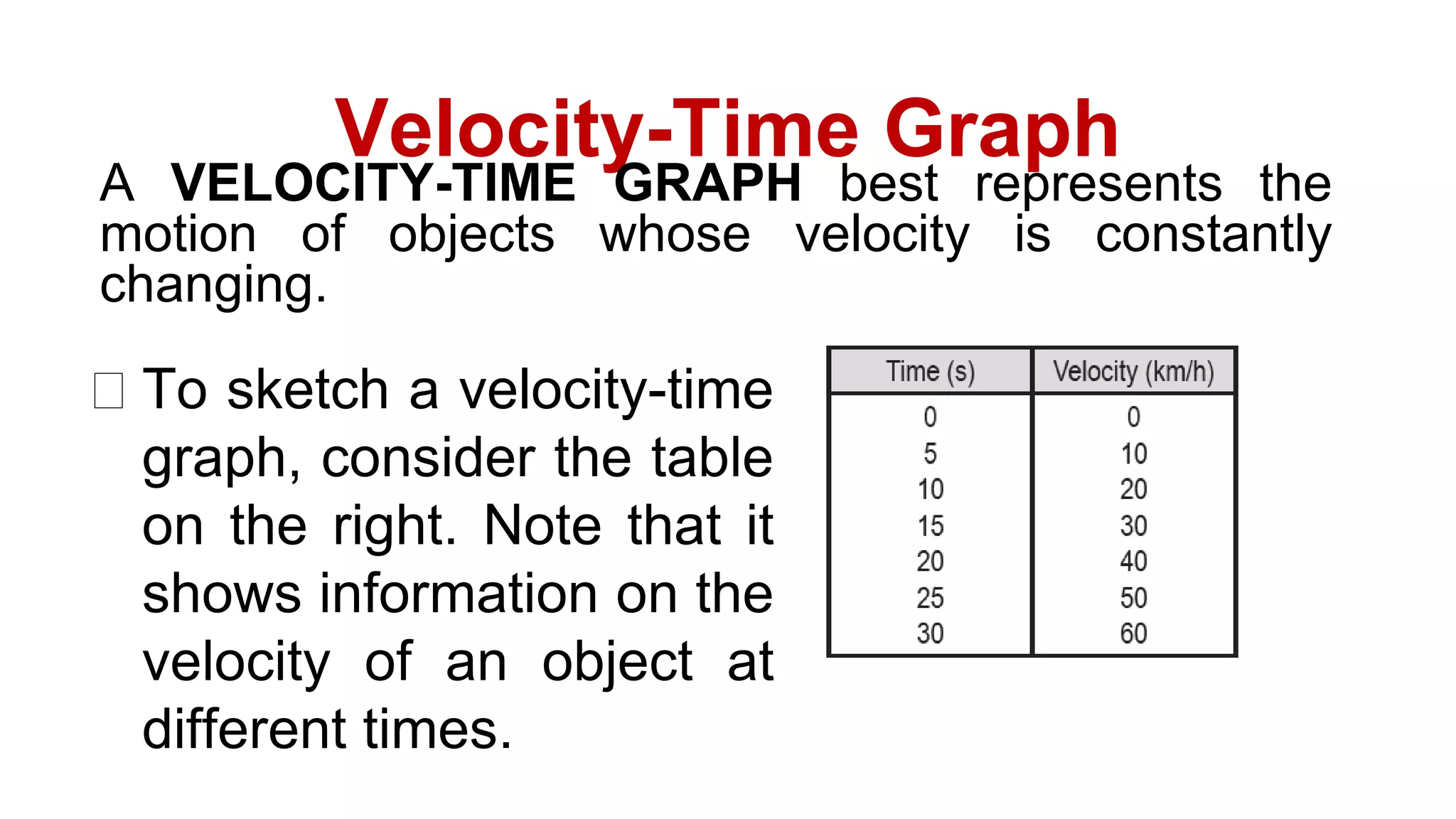
⮚ To sketch a velocity-time
graph, consider the table
on the right. Note that it
shows information on the
velocity of an object at
different times.
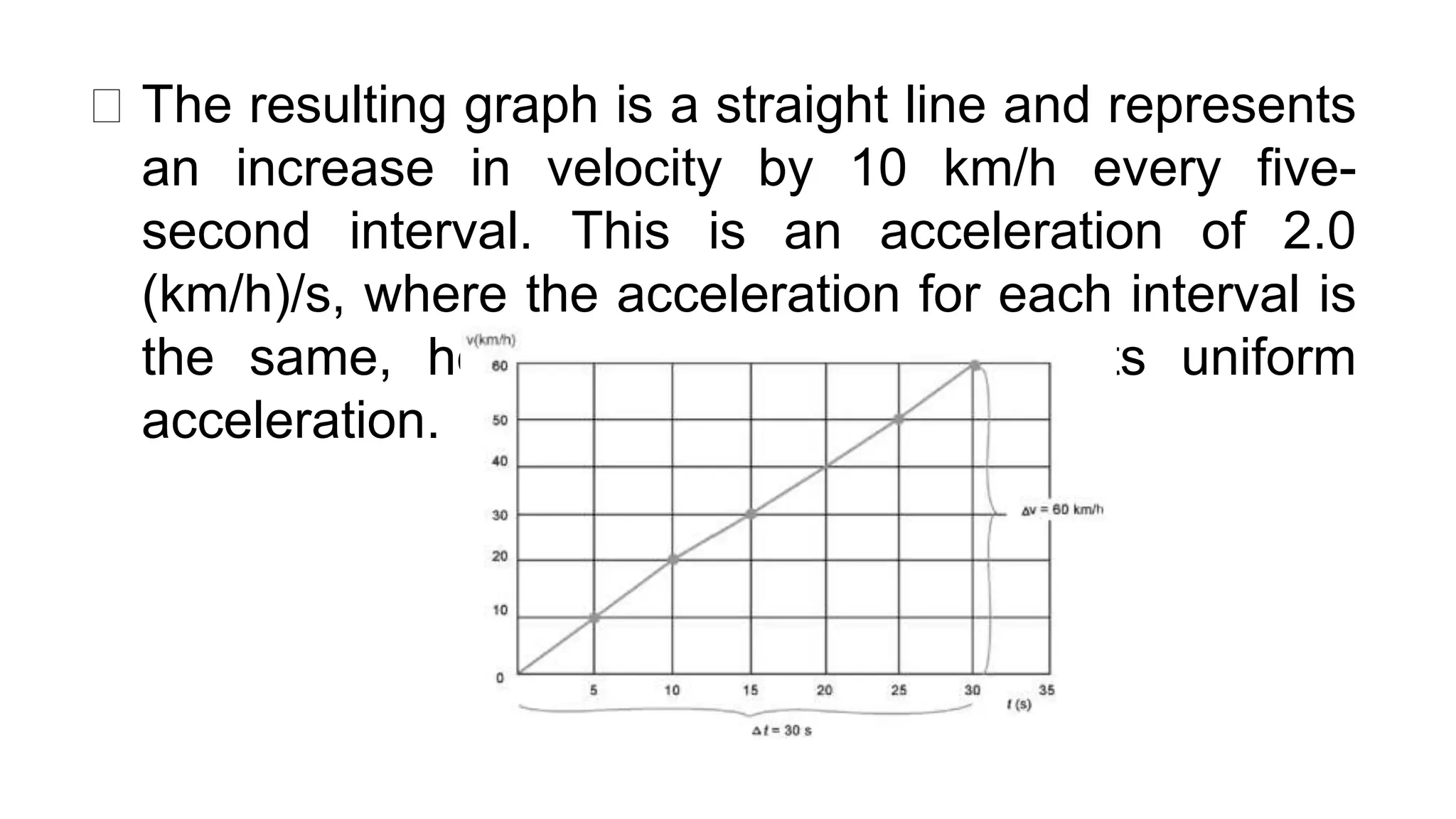
⮚ The resulting graph is a straight line and represents
an increase in velocity by 10 km/h every five-
second interval. This is an acceleration of 2.0
(km/h)/s, where the acceleration for each interval is
the same, hence, the graph represents uniform
acceleration.
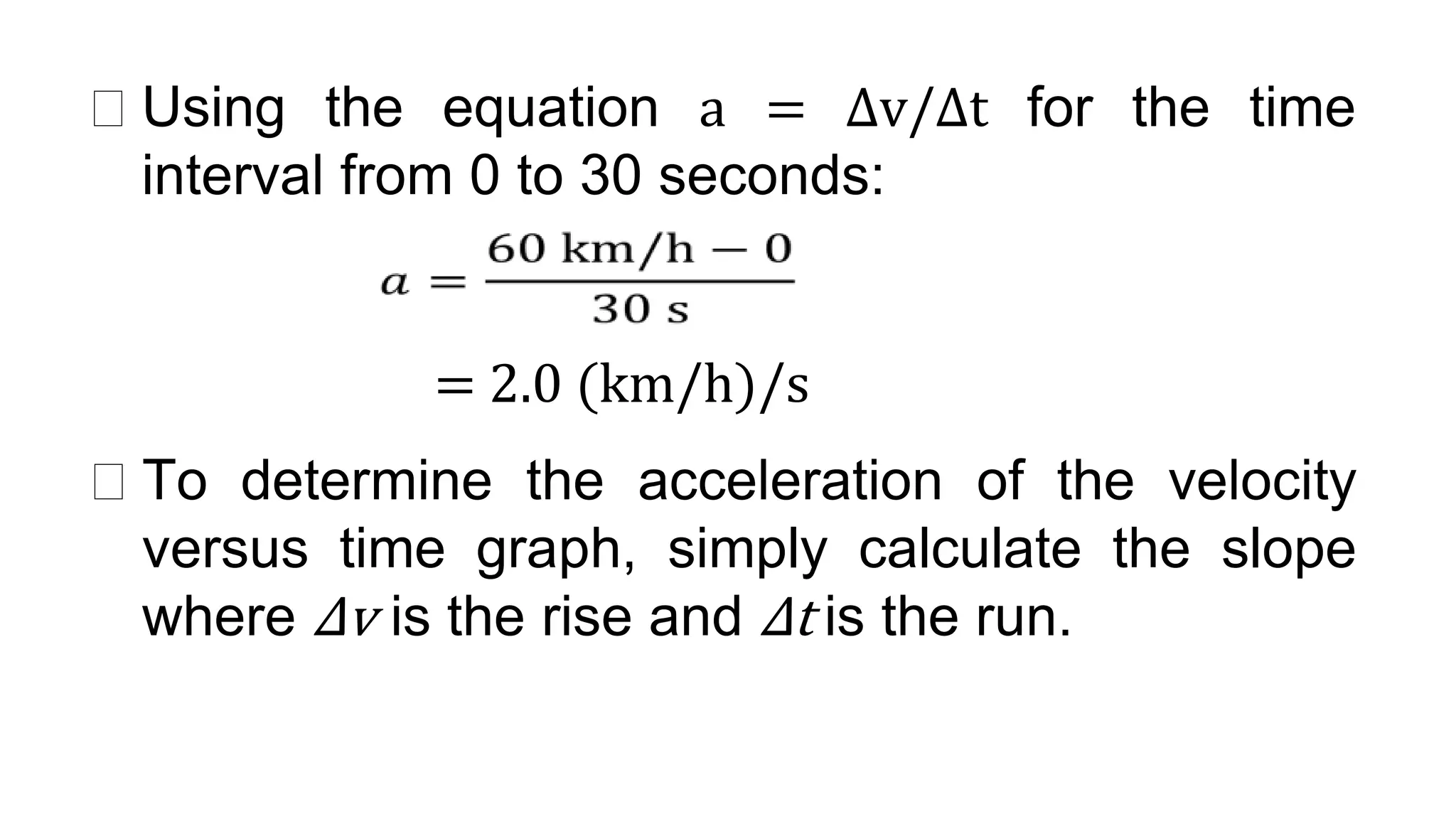
⮚ Using the equation a = Δv/Δt for the time
interval from 0 to 30 seconds:
= 2.0 (km/h)/s
⮚ To determine the acceleration of the velocity
versus time graph, simply calculate the slope
where Δv is the rise and Δt is the run.
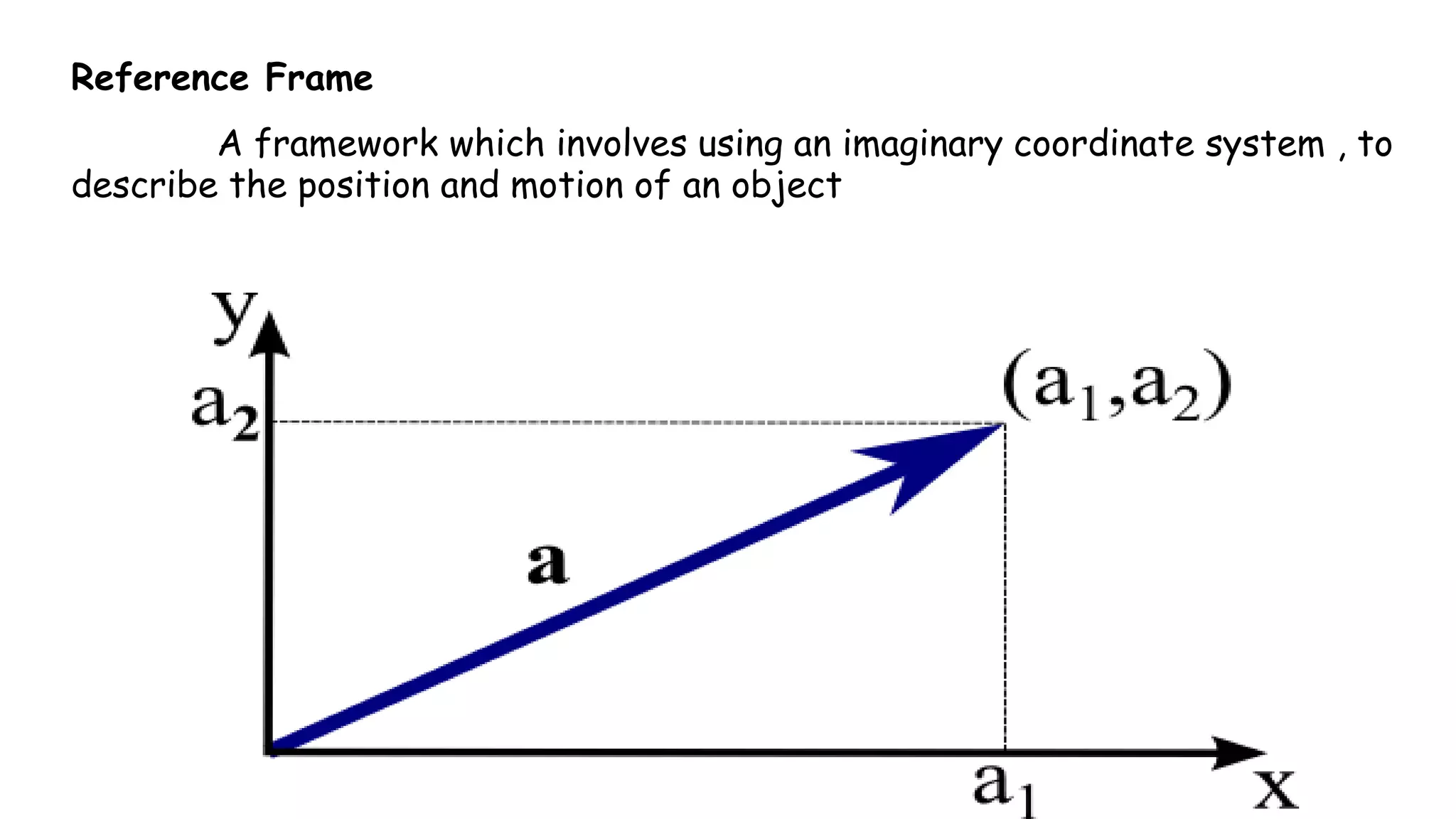
Reference Frame
A framework which involves using an imaginary coordinate system , to
describe the position and motion of an object
Inertial Frames of reference have the
following characteristics
1. Constant velocity with respect to each other.
2. Zero acceleration with respect to each other
3. No net force acting on each other
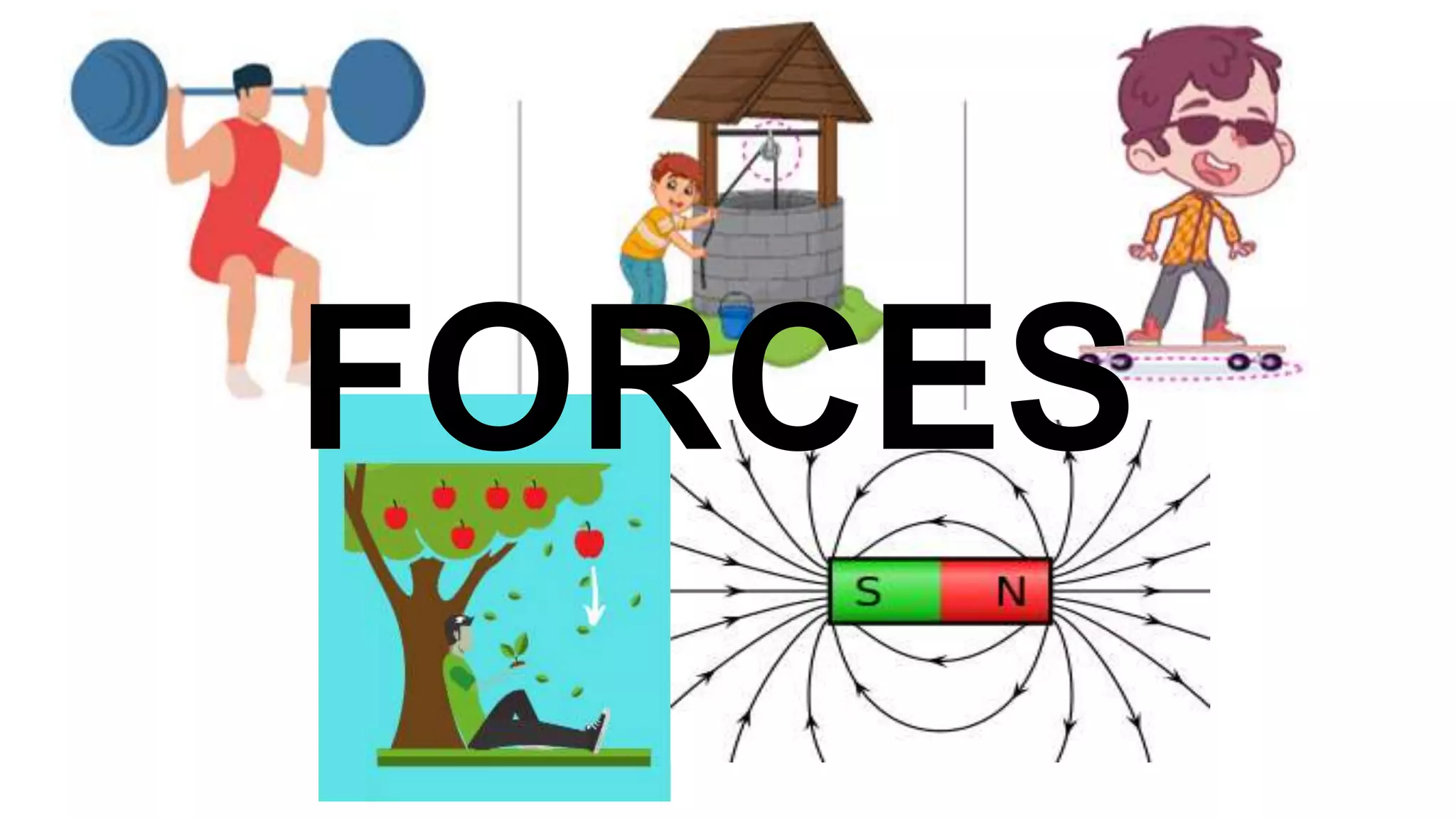
FORCES
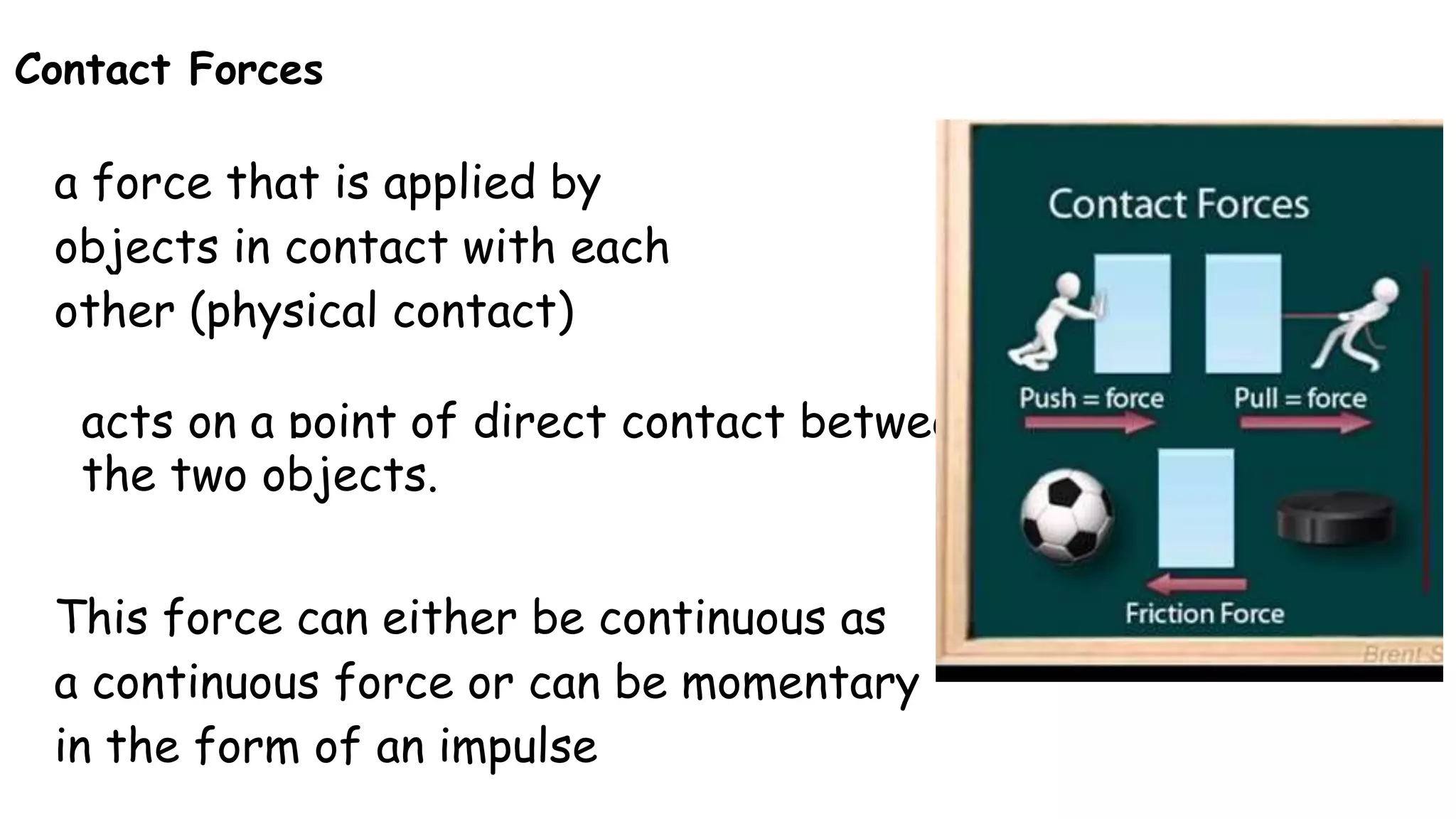
Contact Forces
a force that is applied by
objects in contact with each
other (physical contact)
acts on a point of direct contact between
the two objects.
This force can either be continuous as
a continuous force or can be momentary
in the form of an impulse
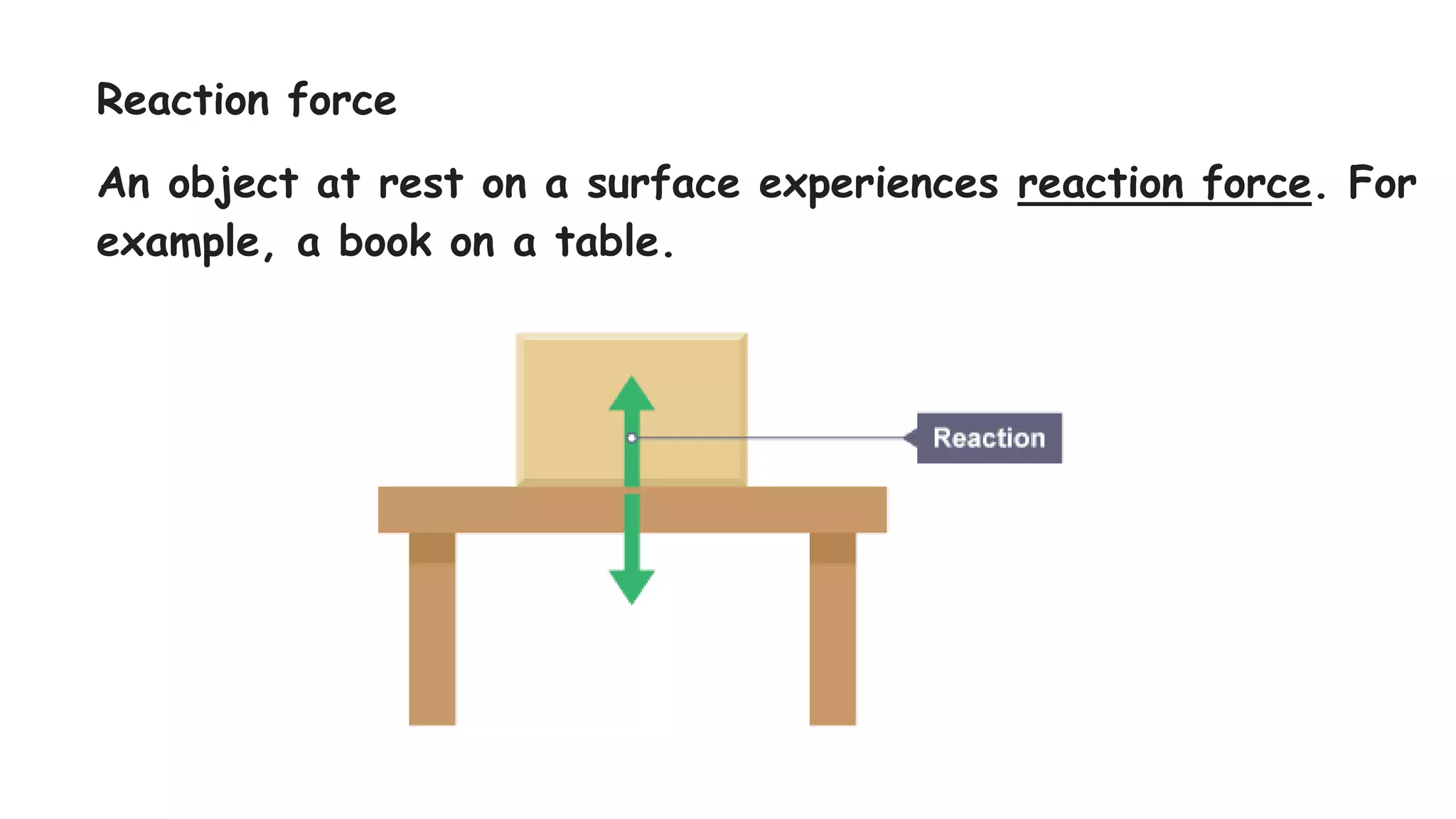
Reaction force
An object at rest on a surface experiences reaction force. For
example, a book on a table.
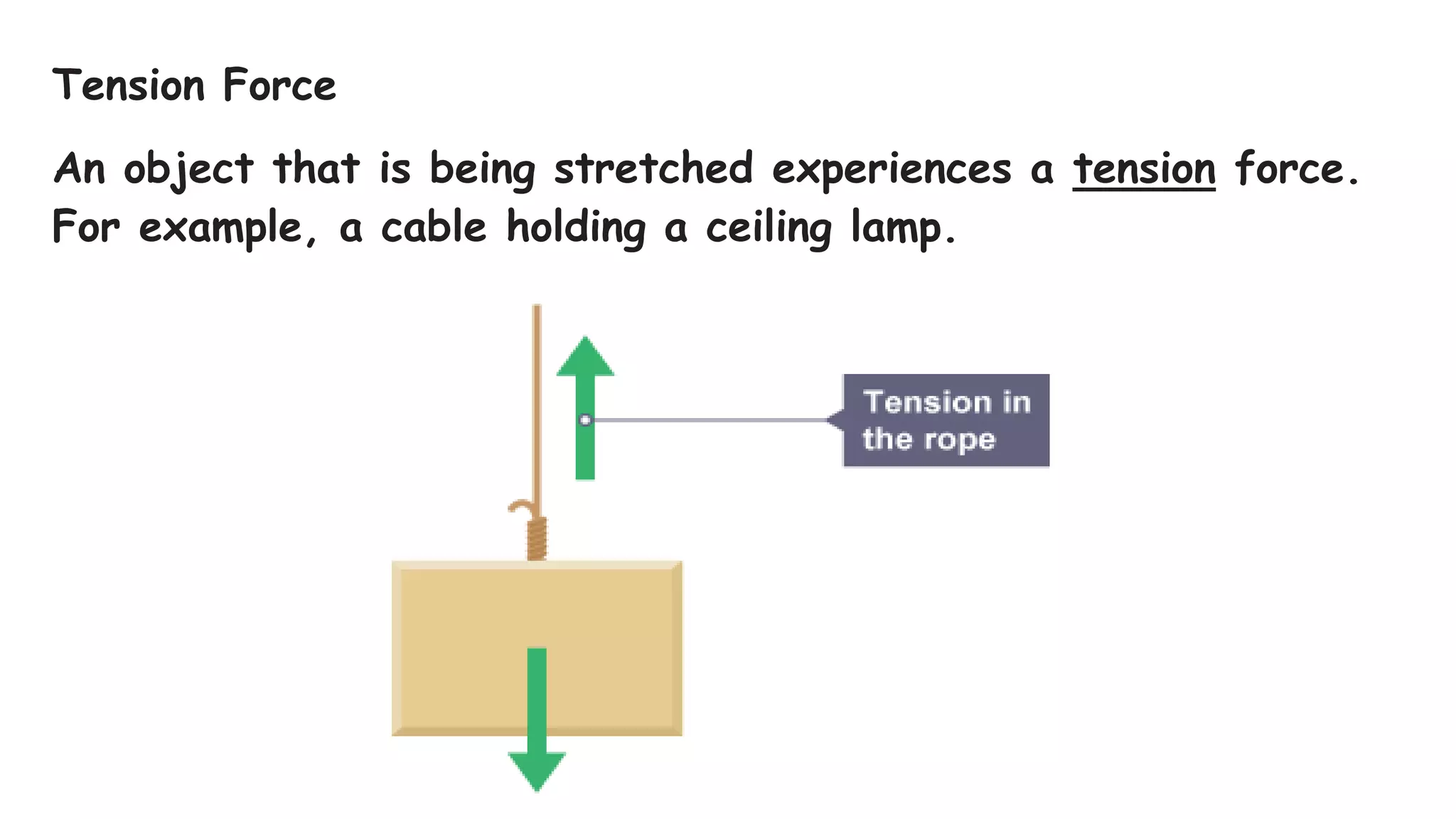
Tension Force
An object that is being stretched experiences a tension force.
For example, a cable holding a ceiling lamp.
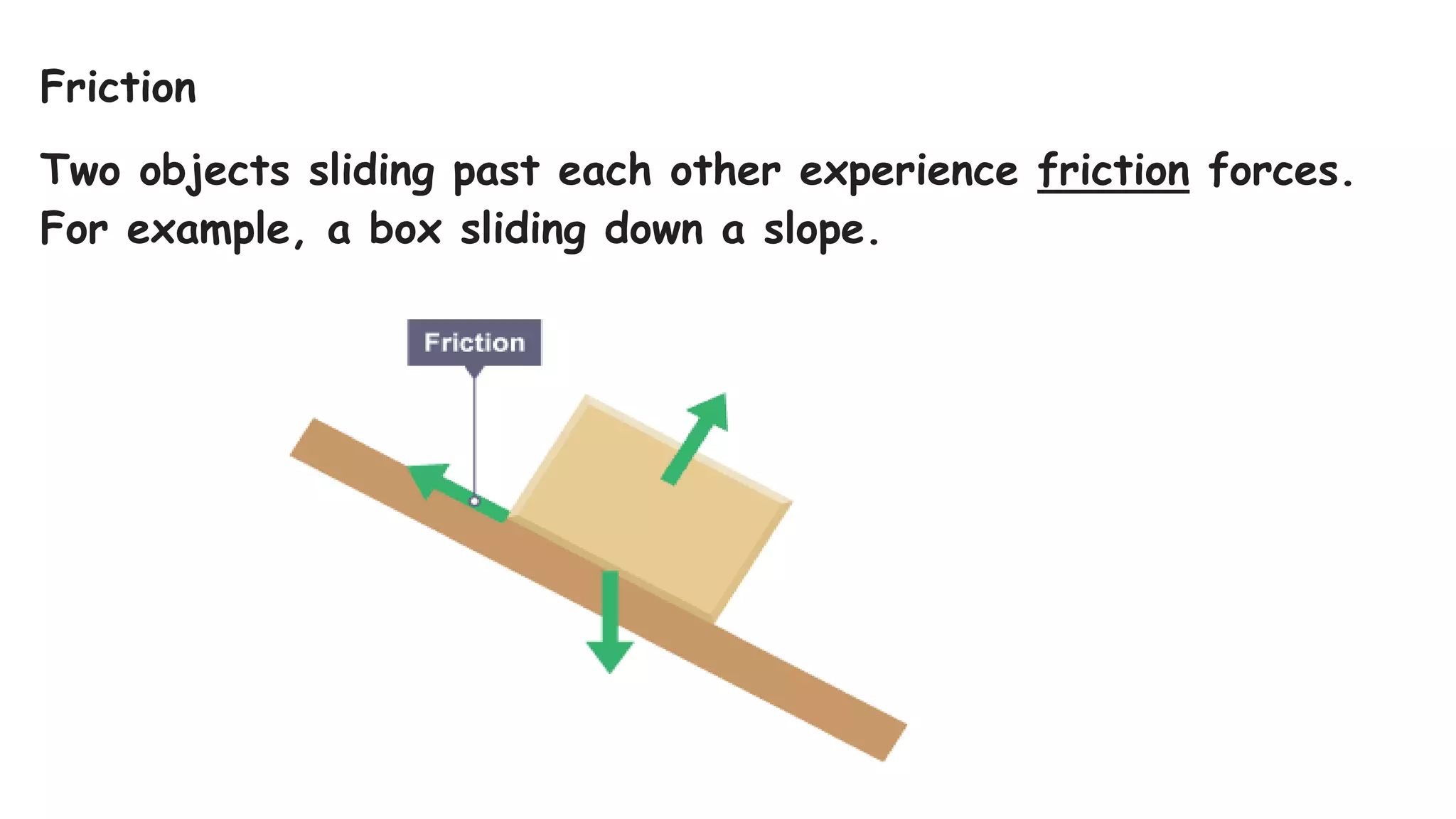
Friction
Two objects sliding past each other experience friction forces.
For example, a box sliding down a slope.
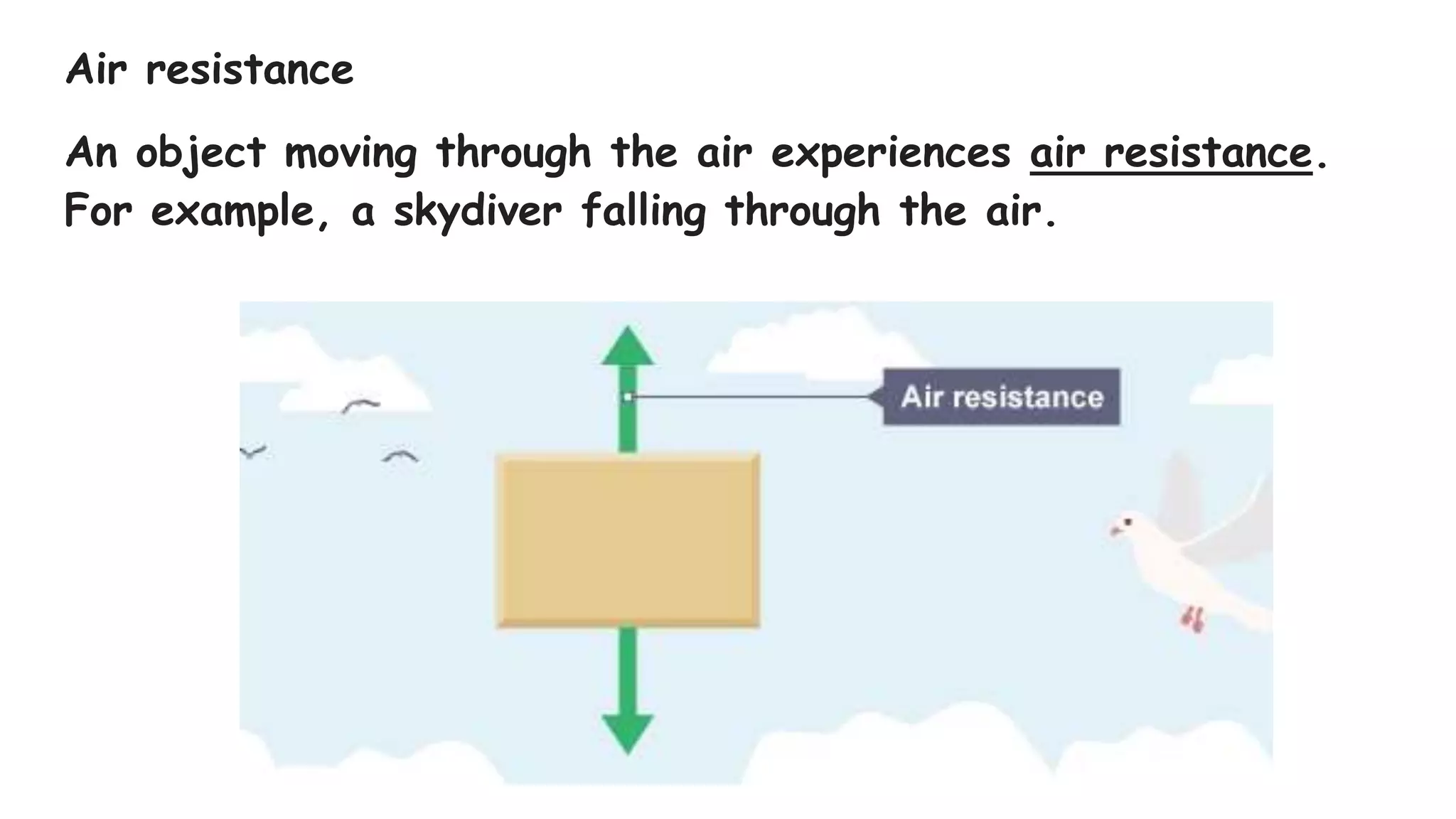
Air resistance
An object moving through the air experiences air resistance.
For example, a skydiver falling through the air.
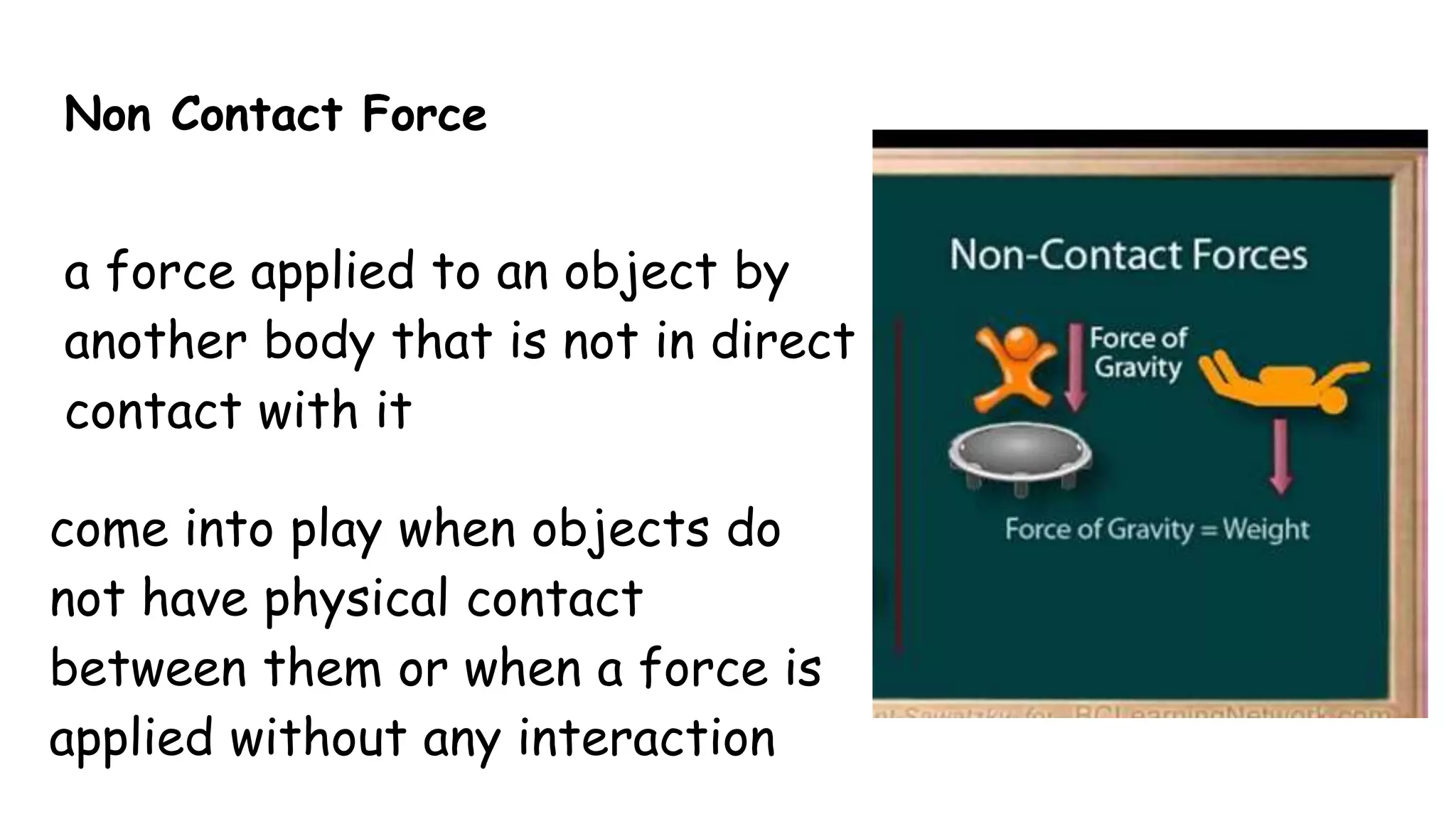
Non Contact Force
a force applied to an object by
another body that is not in direct
contact with it
come into play when objects do
not have physical contact
between them or when a force is
applied without any interaction
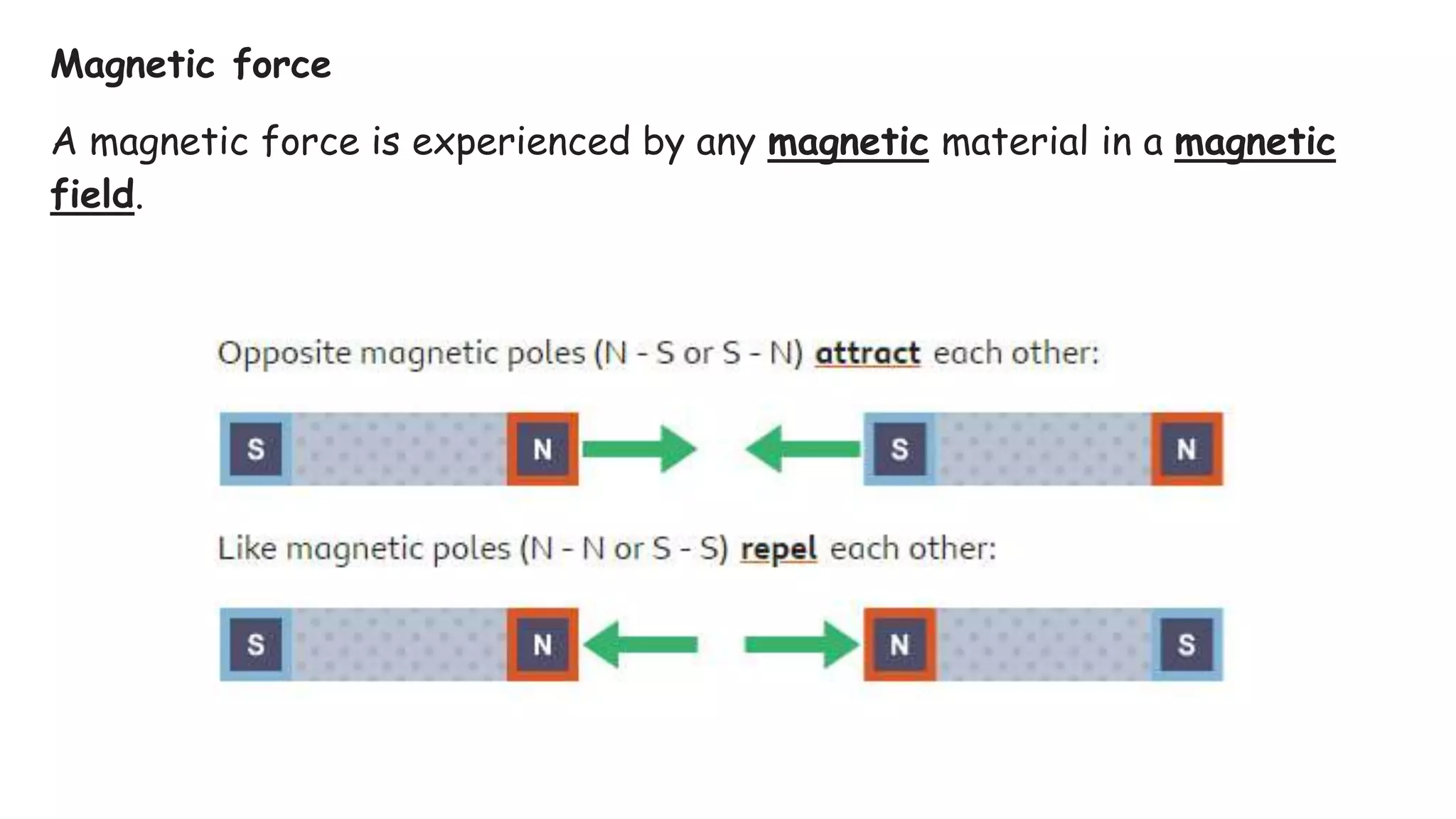
Magnetic force
A magnetic force is experienced by any magnetic material in a magnetic
field.
Electrostatic force
An electrostatic force is experienced by any charged particle in an
electric field.
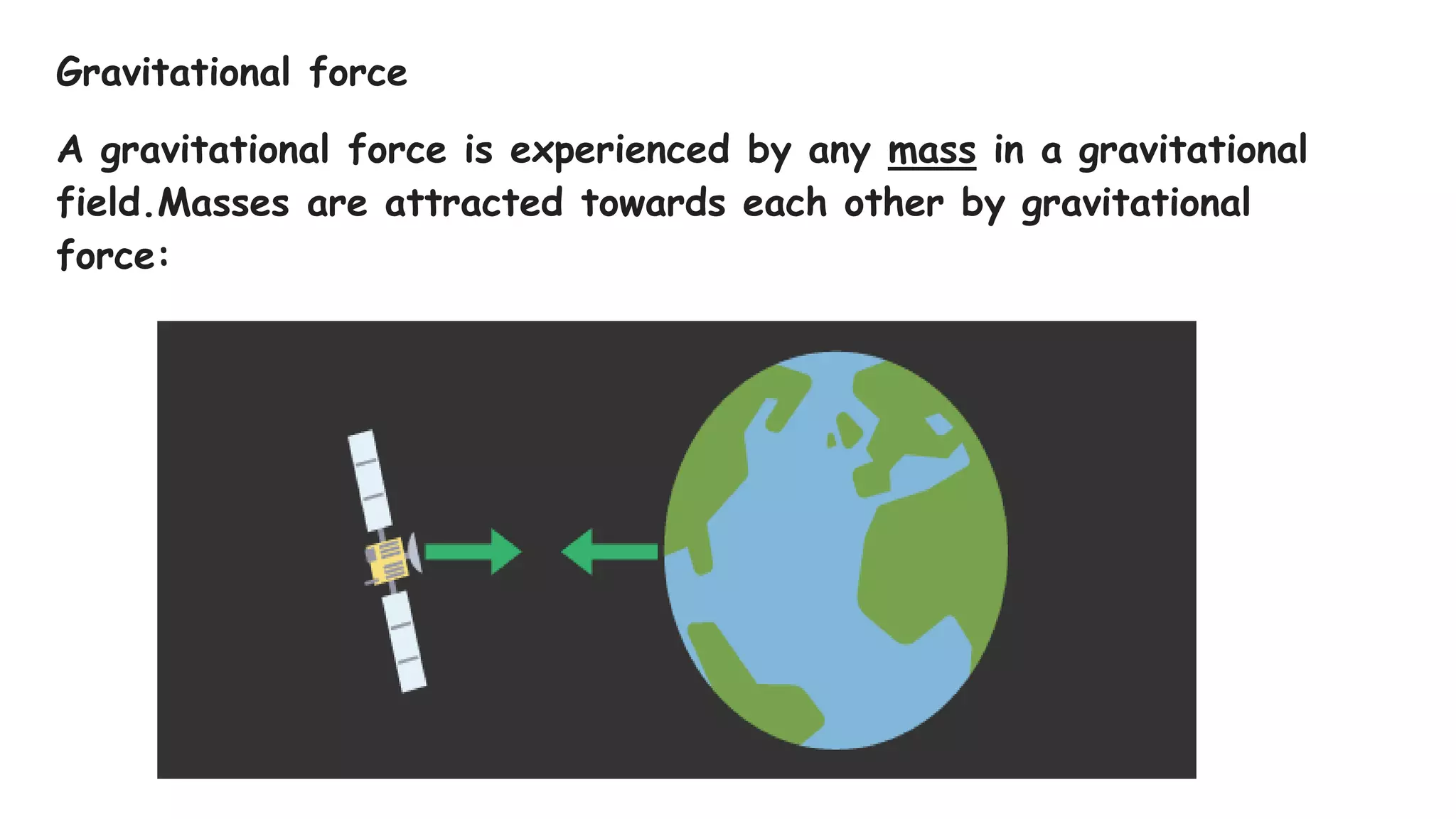
Gravitational force
A gravitational force is experienced by any mass in a gravitational
field.Masses are attracted towards each other by gravitational
force:
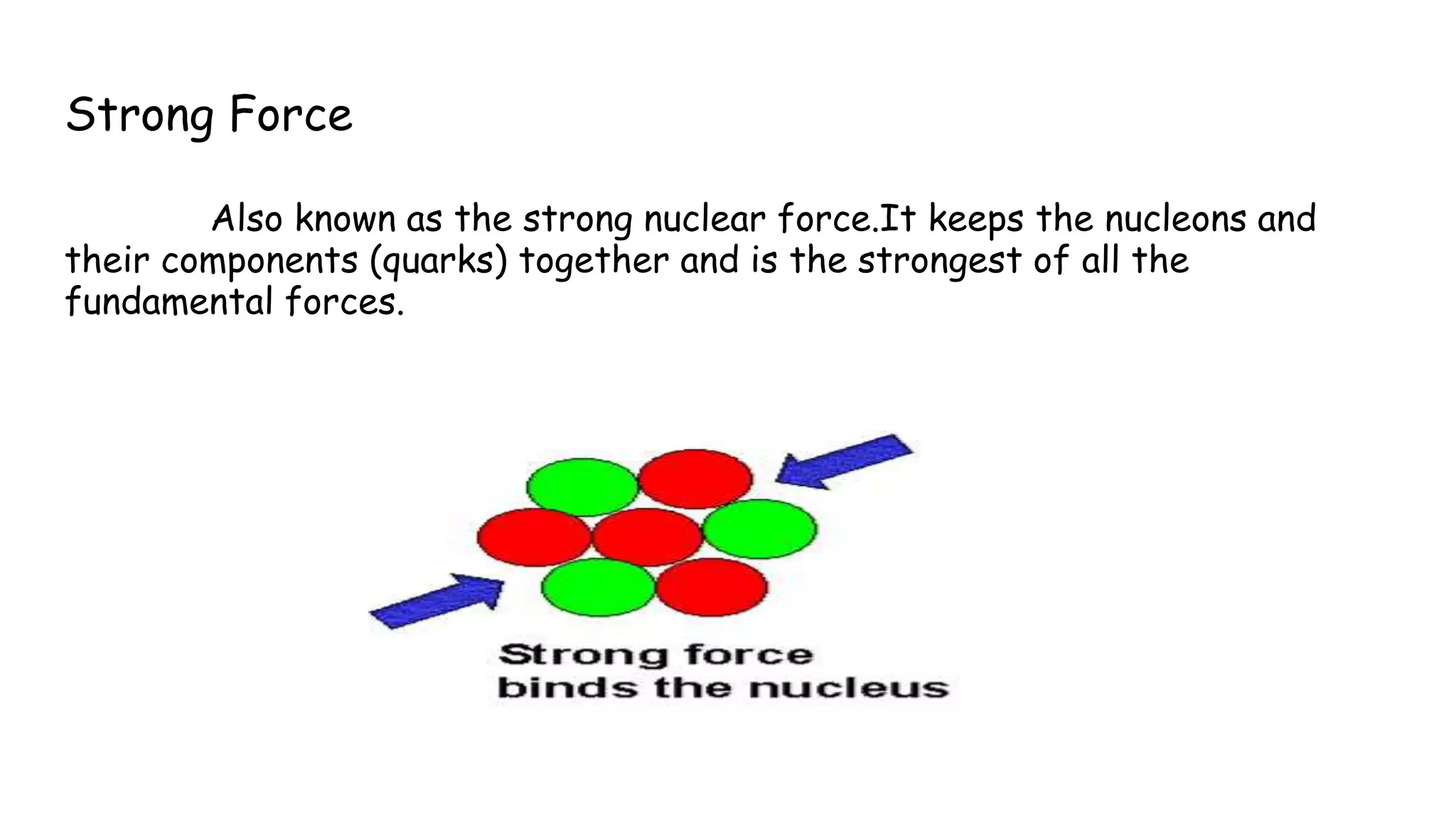
Strong Force
Also known as the strong nuclear force.It keeps the nucleons and
their components (quarks) together and is the strongest of all the
fundamental forces.
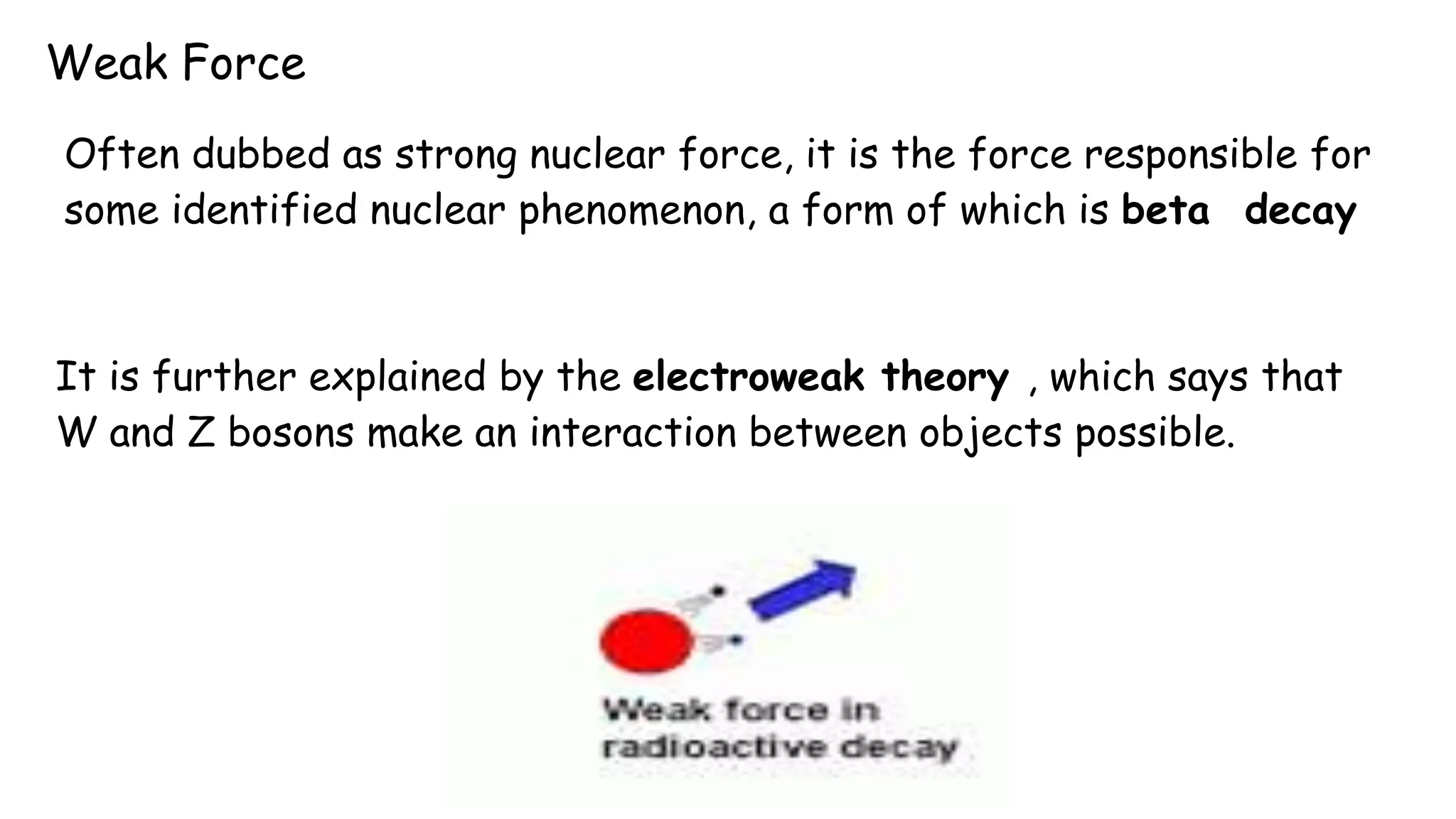
Weak Force
Often dubbed as strong nuclear force, it is the force responsible for
some identified nuclear phenomenon, a form of which is beta decay
It is further explained by the electroweak theory , which says that
W and Z bosons make an interaction between objects possible.
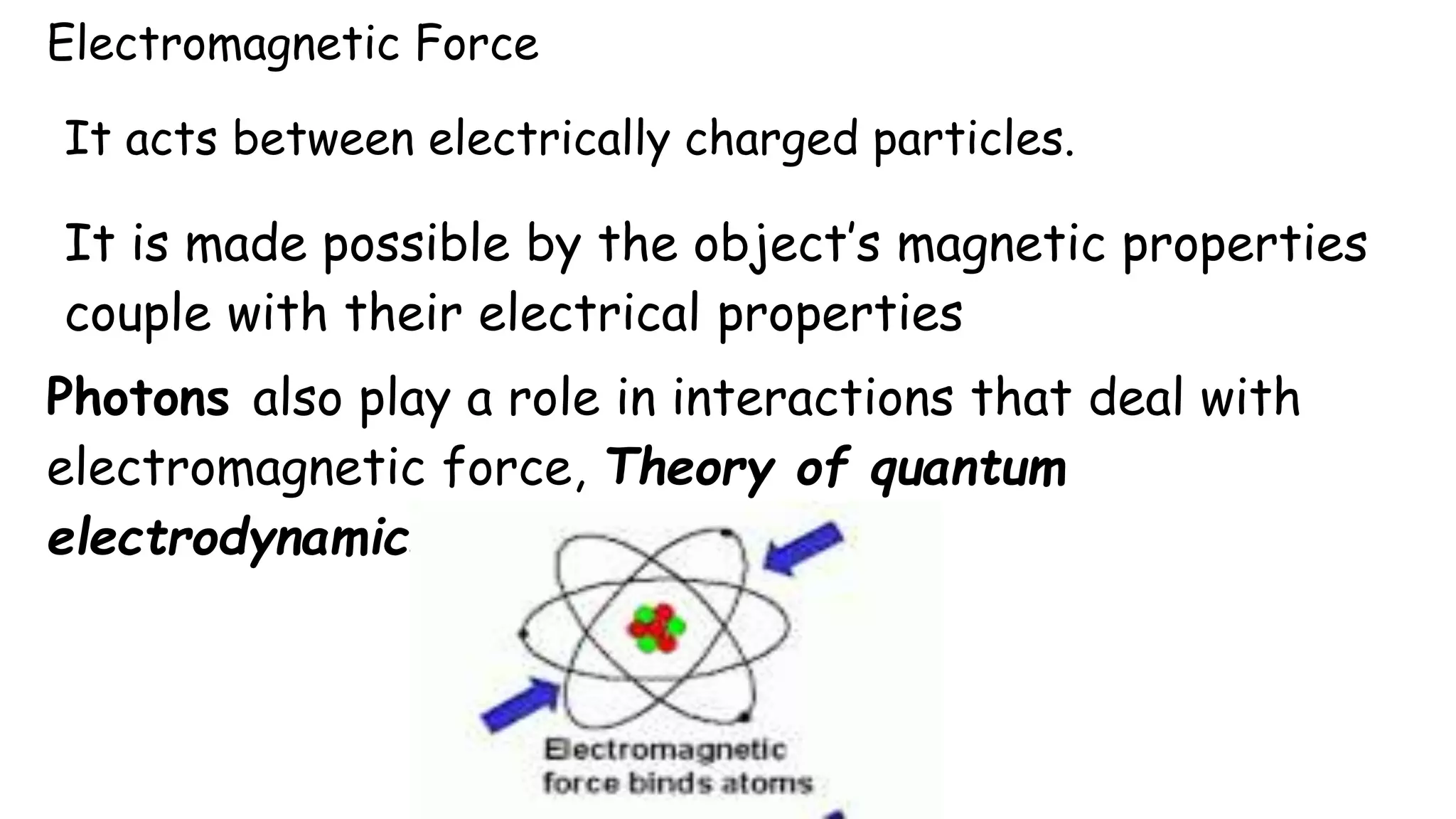
Electromagnetic Force
It acts between electrically charged particles.
It is made possible by the object’s magnetic properties
couple with their electrical properties
Photons also play a role in interactions that deal with
electromagnetic force, Theory of quantum
electrodynamics
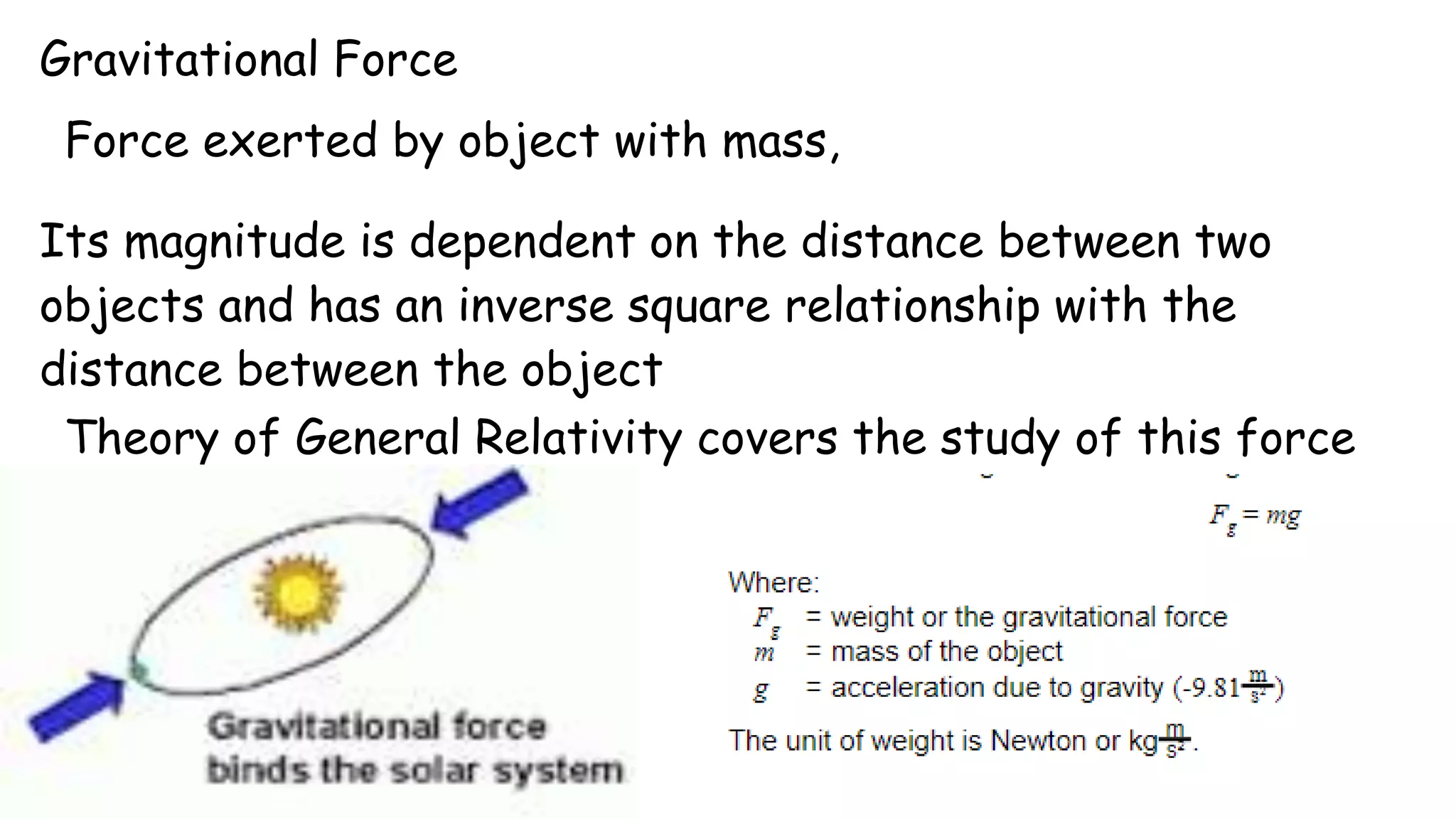
Gravitational Force
Force exerted by object with mass,
Its magnitude is dependent on the distance between two
objects and has an inverse square relationship with the
distance between the object
Theory of General Relativity covers the study of this force
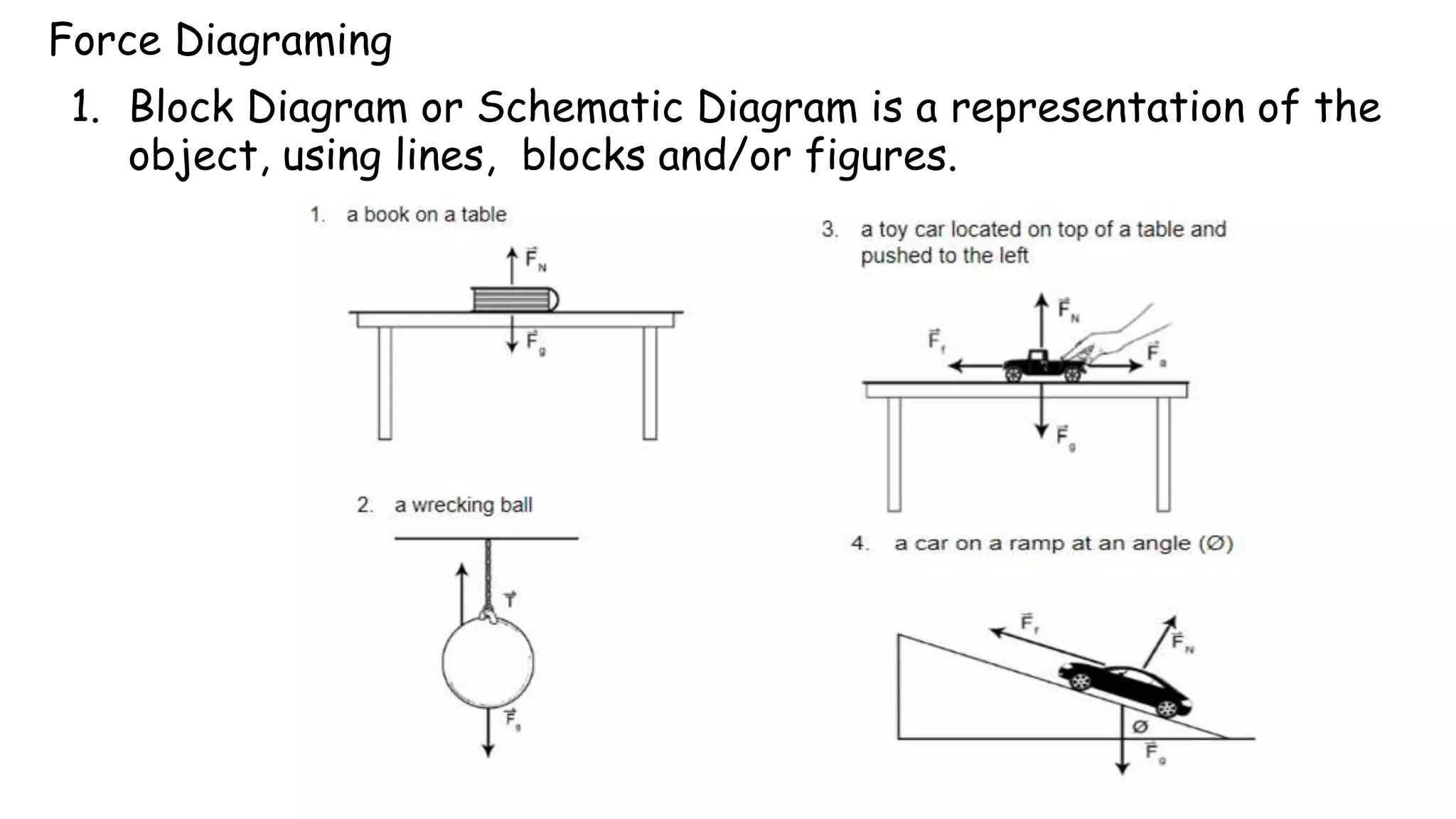
Force Diagraming
1. Block Diagram or Schematic Diagram is a representation of the
object, using lines, blocks and/or figures.
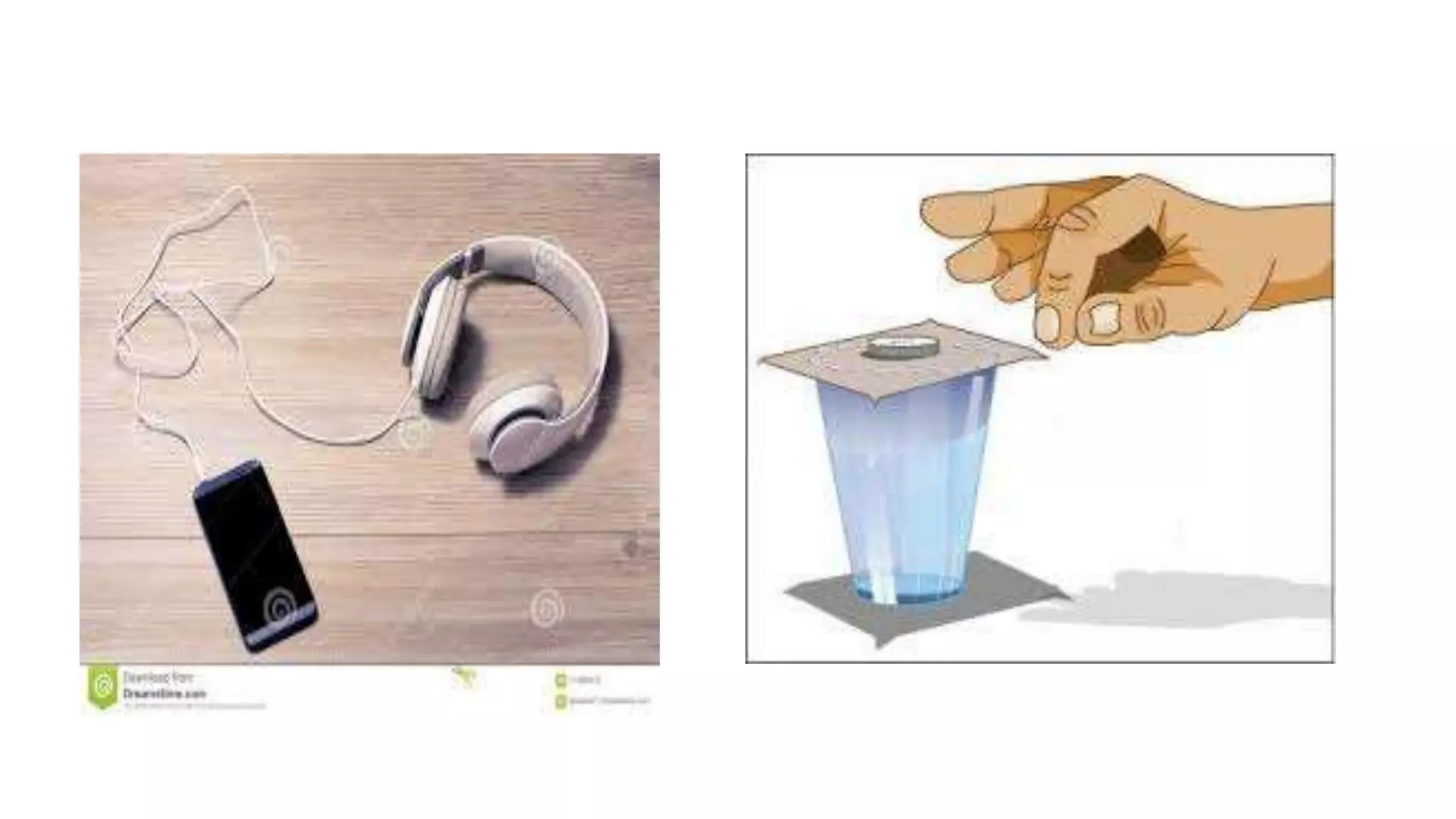
Newton’s First Law
An object at rest stays at rest and an
object in motion stays in motion with the
same speed and in the same direction
unless acted upon by an unbalanced
force.
Suppose you are helping a friend transfer from
one residence to another. Your friend asks you
to stand in the rear of a truck to hold a piano
from an inclined plane. Explain why you should
decline the request of your friend. The answer
should indicate your understanding of Galileo
and the First Law of Newton.
Sample Problem:
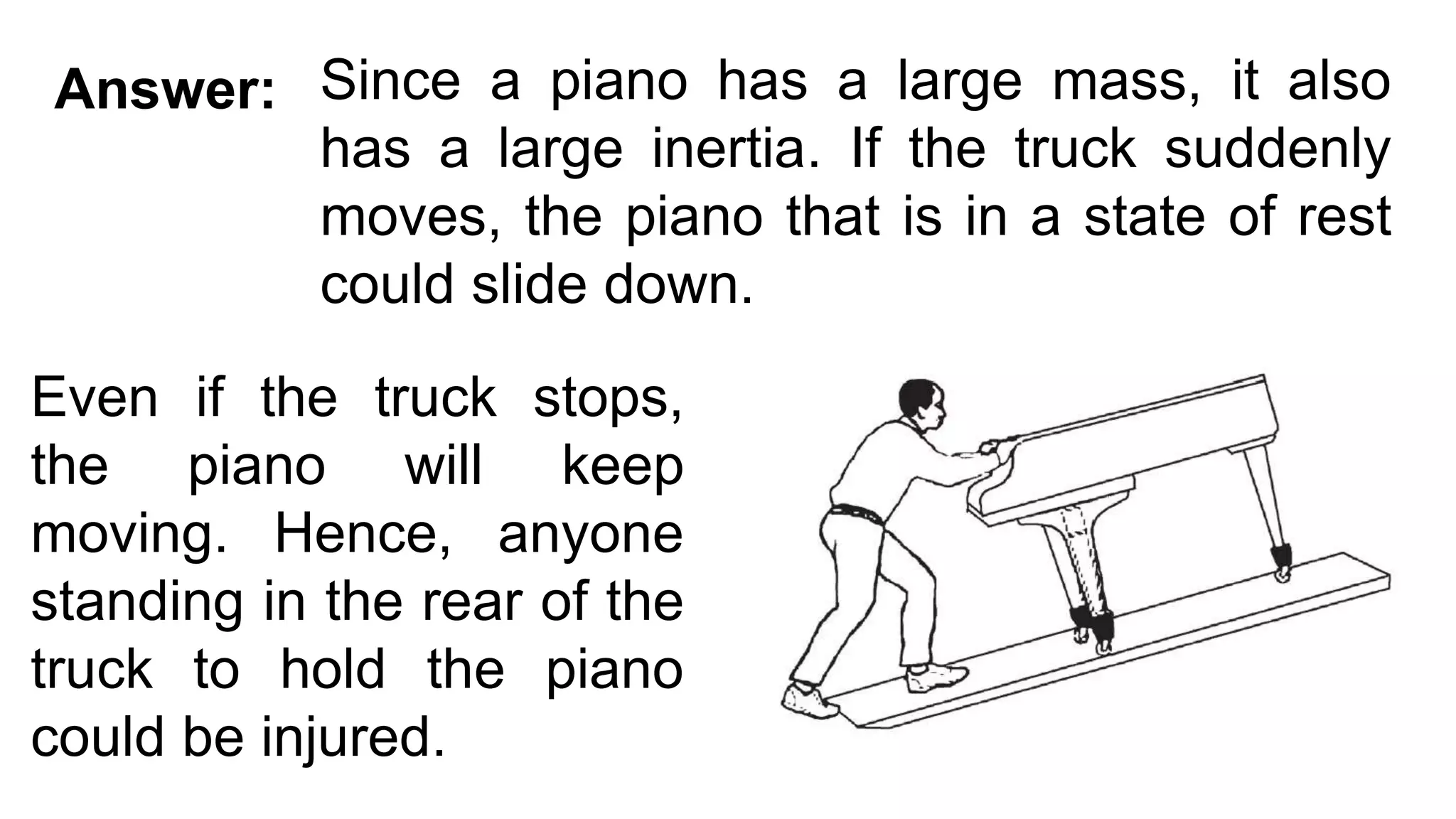
Since a piano has a large mass, it also
has a large inertia. If the truck suddenly
moves, the piano that is in a state of rest
could slide down.
Answer:
Even if the truck stops,
the piano will keep
moving. Hence, anyone
standing in the rear of the
truck to hold the piano
could be injured.
DIRECTION: Give what is asked in the problem.
A man, who is on an upper floor of a building, is
observing a boy looping a ball in a cord. If the cord
breaks, what path will the ball take? Explain your
answer.
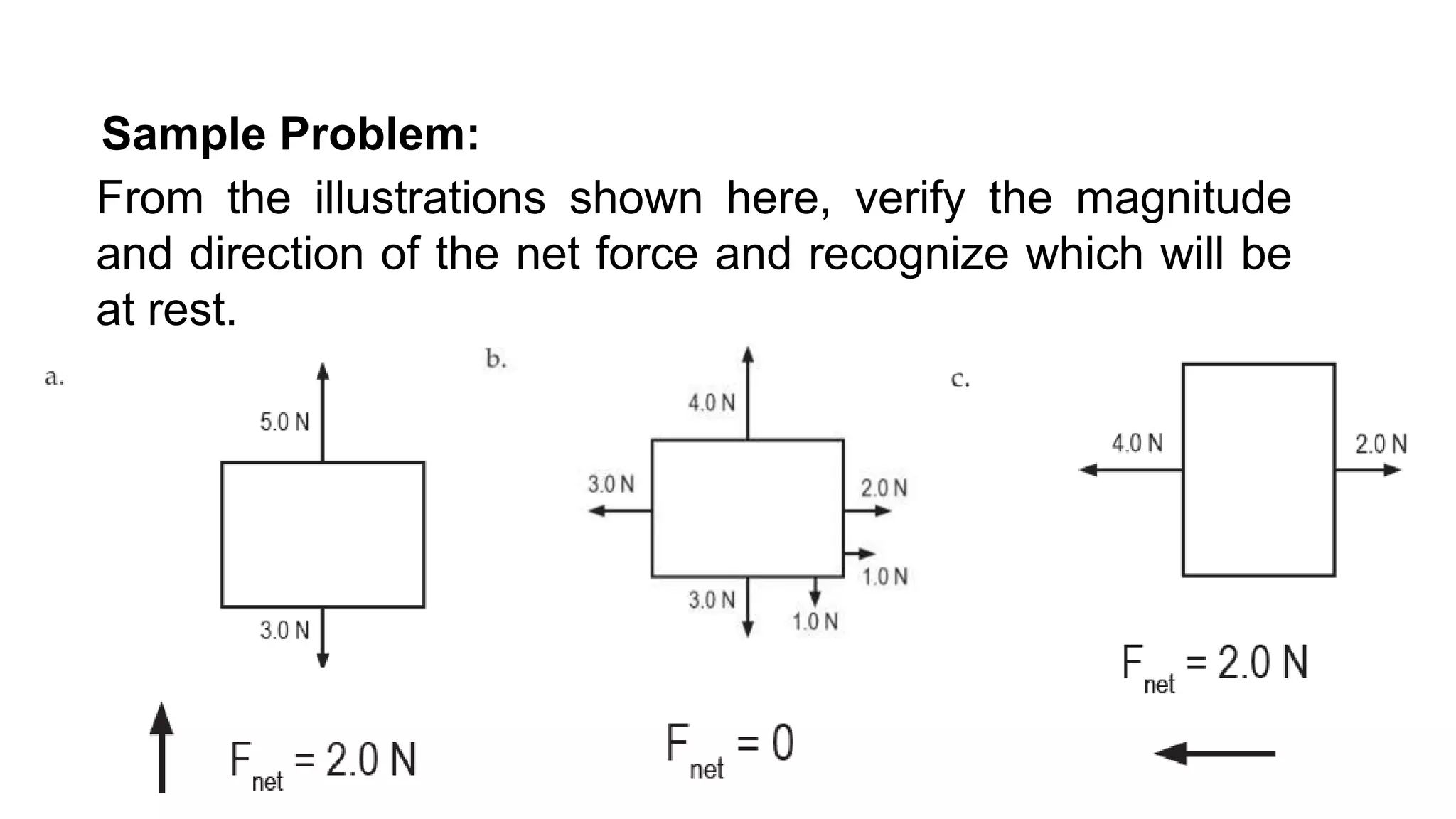
From the illustrations shown here, verify the magnitude
and direction of the net force and recognize which will be
at rest.
Sample Problem:
Object “b” is at rest because the net force is 0.
Answer:
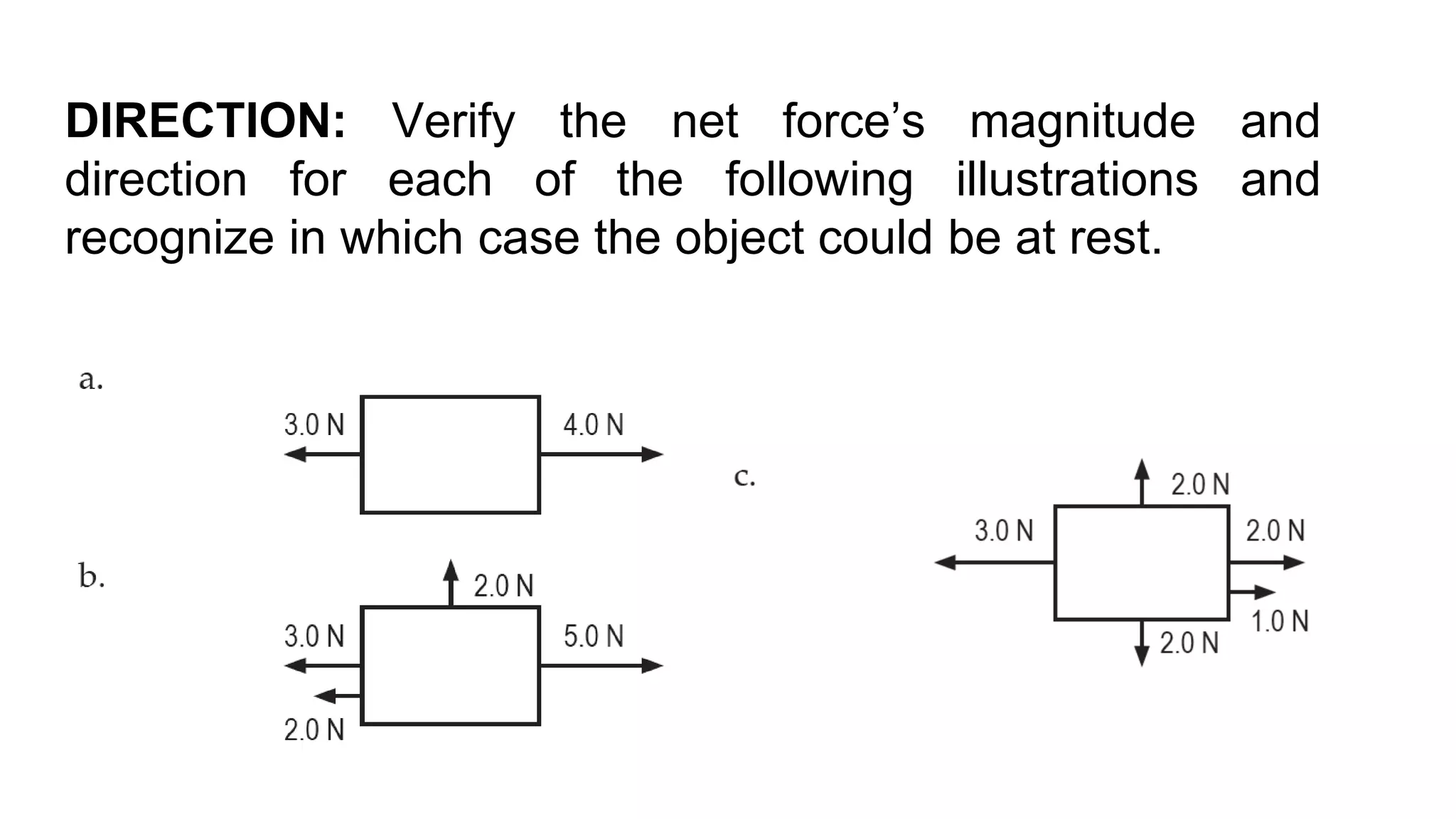
DIRECTION: Verify the net force’s magnitude and
direction for each of the following illustrations and
recognize in which case the object could be at rest.
Newton’s Second Law
The following ideas can be summarized to create
the second law of Newton:
• Once a force that acts on an object is
unbalanced, it will accelerate in the same
direction as the force.
• The acceleration of the object varies with its
unbalanced force.
• The acceleration of the object varies inversely
with its mass.
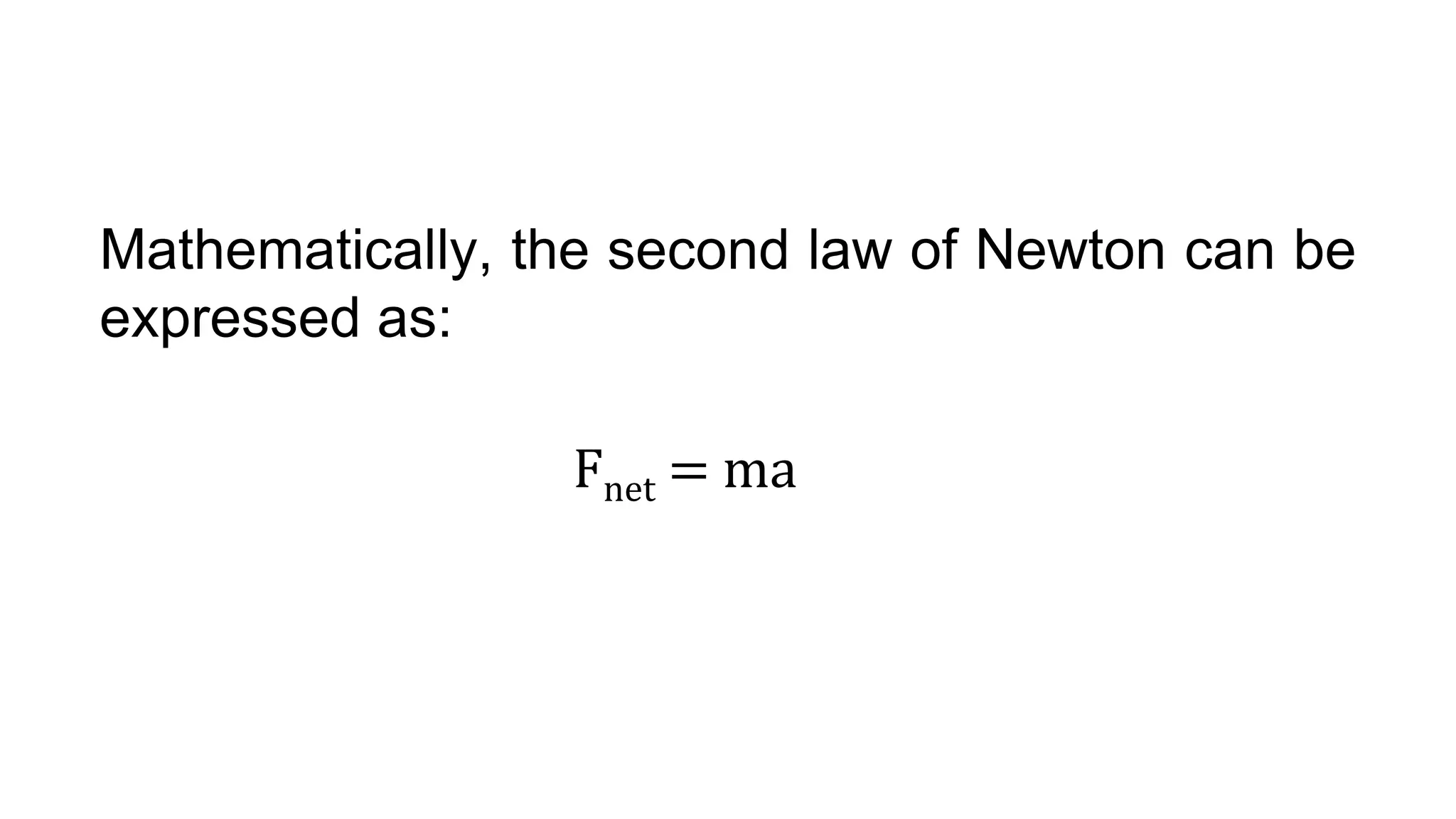
Mathematically, the second law of Newton can be
expressed as:
Fnet = ma
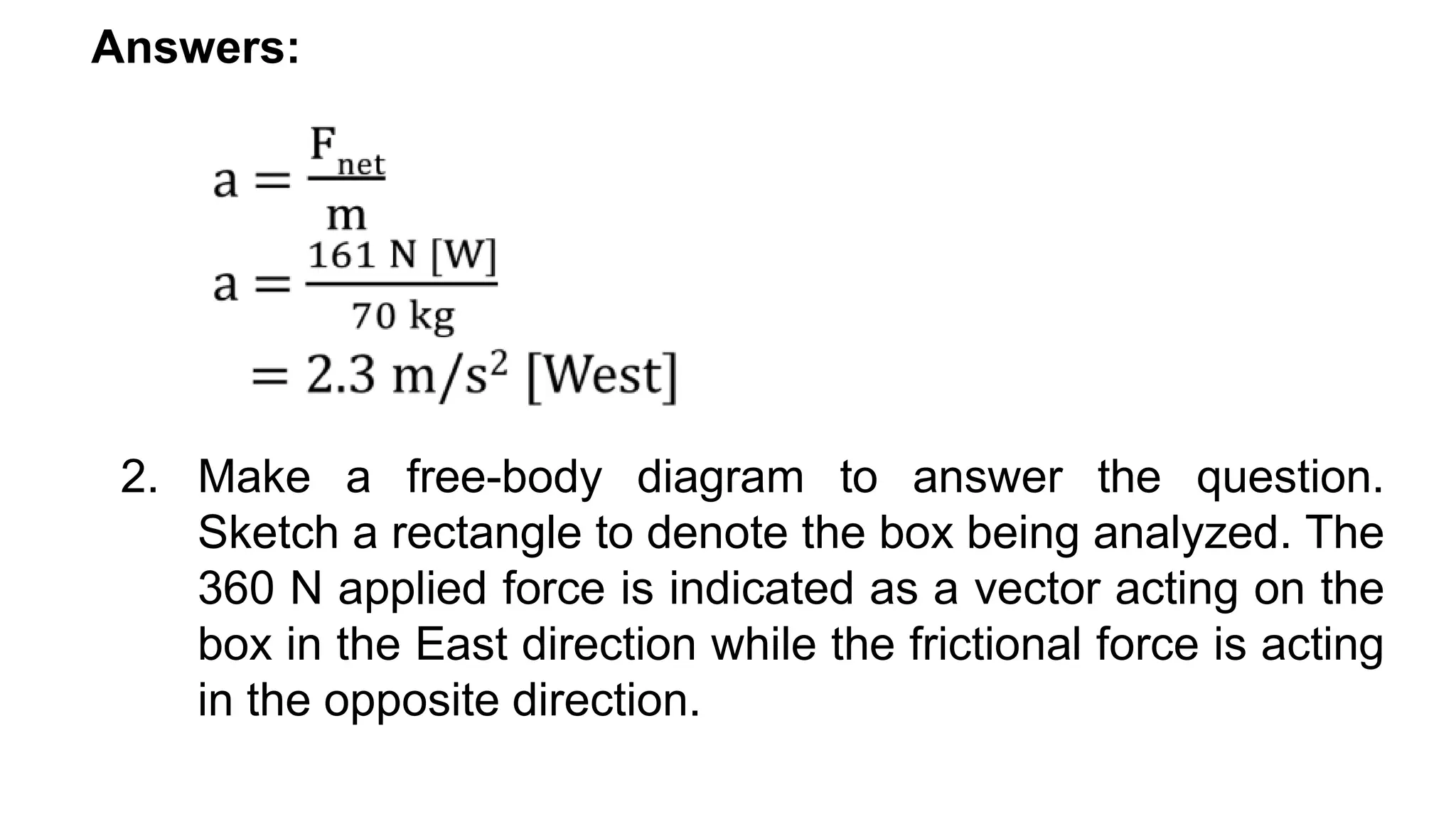
1. If a 70 kg skater acted upon by an
unbalanced force of 161 N [West], what is
its acceleration?
Sample Problems:
2. A force of 360 N [East] was applied by a
student on a box with a mass of 50 kg.
What is the acceleration of the box if a
frictional force of 340 N acts in the opposite
direction?
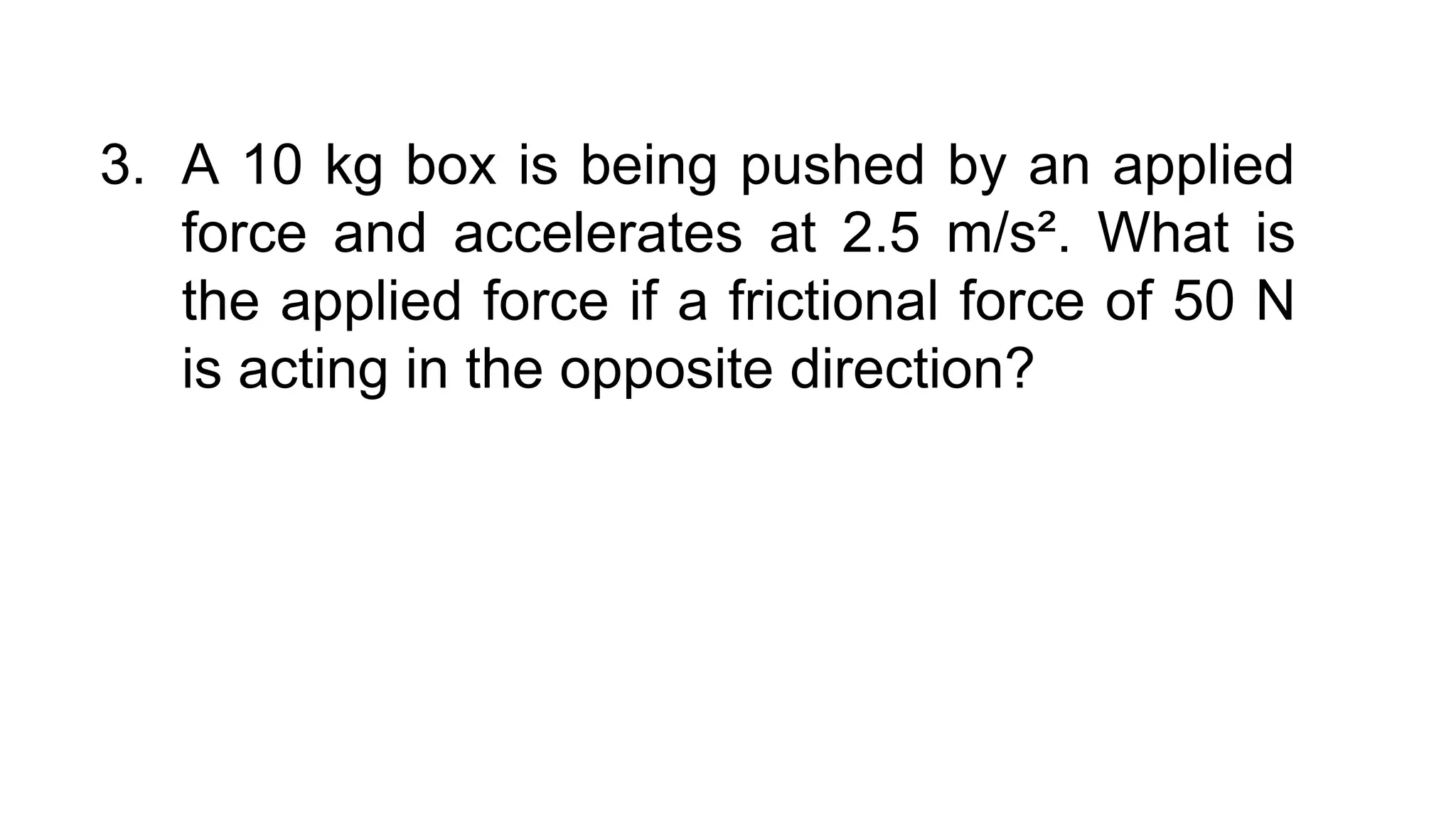
3. A 10 kg box is being pushed by an applied
force and accelerates at 2.5 m/s². What is
the applied force if a frictional force of 50 N
is acting in the opposite direction?
Answers:
2. Make a free-body diagram to answer the question.
Sketch a rectangle to denote the box being analyzed. The
360 N applied force is indicated as a vector acting on the
box in the East direction while the frictional force is acting
in the opposite direction.
Fnet = 20 N
Ff = 340 N
Fnet = 20 N[E]
m = 50 kg
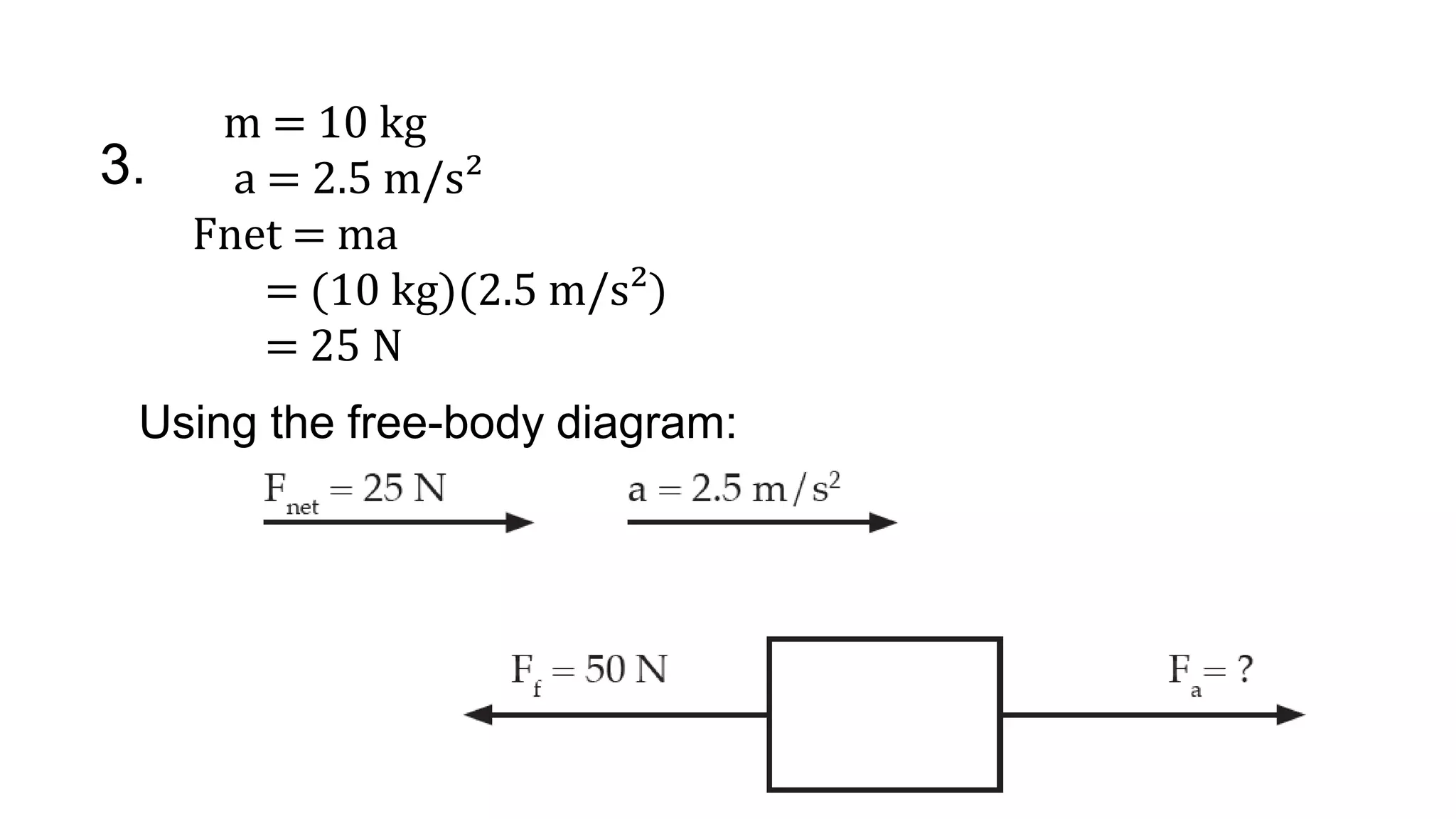
3.
m = 10 kg
a = 2.5 m/s²
Fnet = ma
= (10 kg)(2.5 m/s²)
= 25 N
Using the free-body diagram:
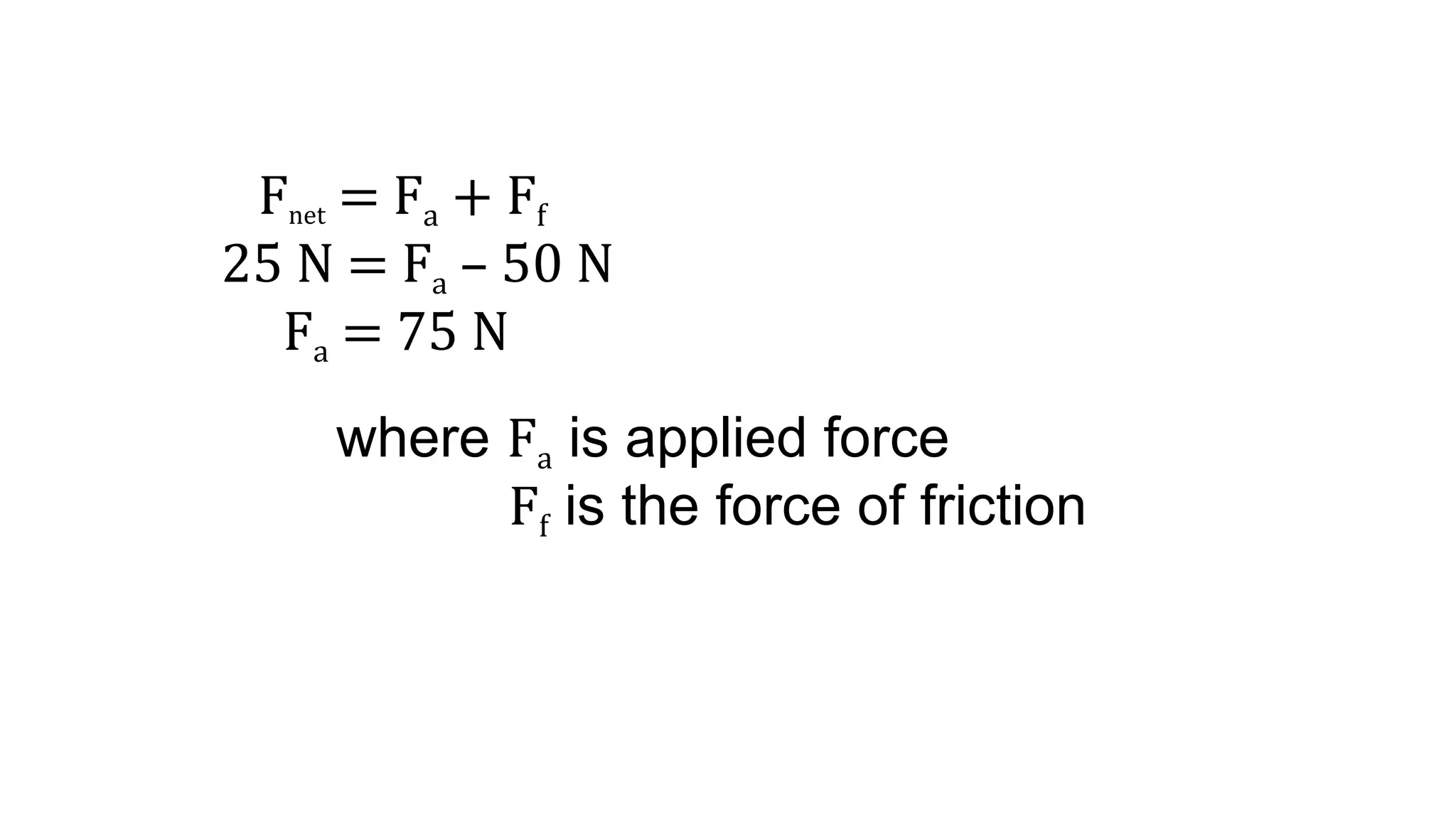
Fnet = Fa + Ff
25 N = Fa – 50 N
Fa = 75 N
where Fa is applied force
Ff is the force of friction
DIRECTION: Answer the following questions.
1.What is the acceleration of a bowling ball
with a mass of 50.0 kg if a net force of 20 N
is acting on it?
2.What is the applied force needed on a 2.0
kg block of wood accelerating at 4.0 m/s²
along a rough table with a 10 N force of
friction acting in the opposite direction?
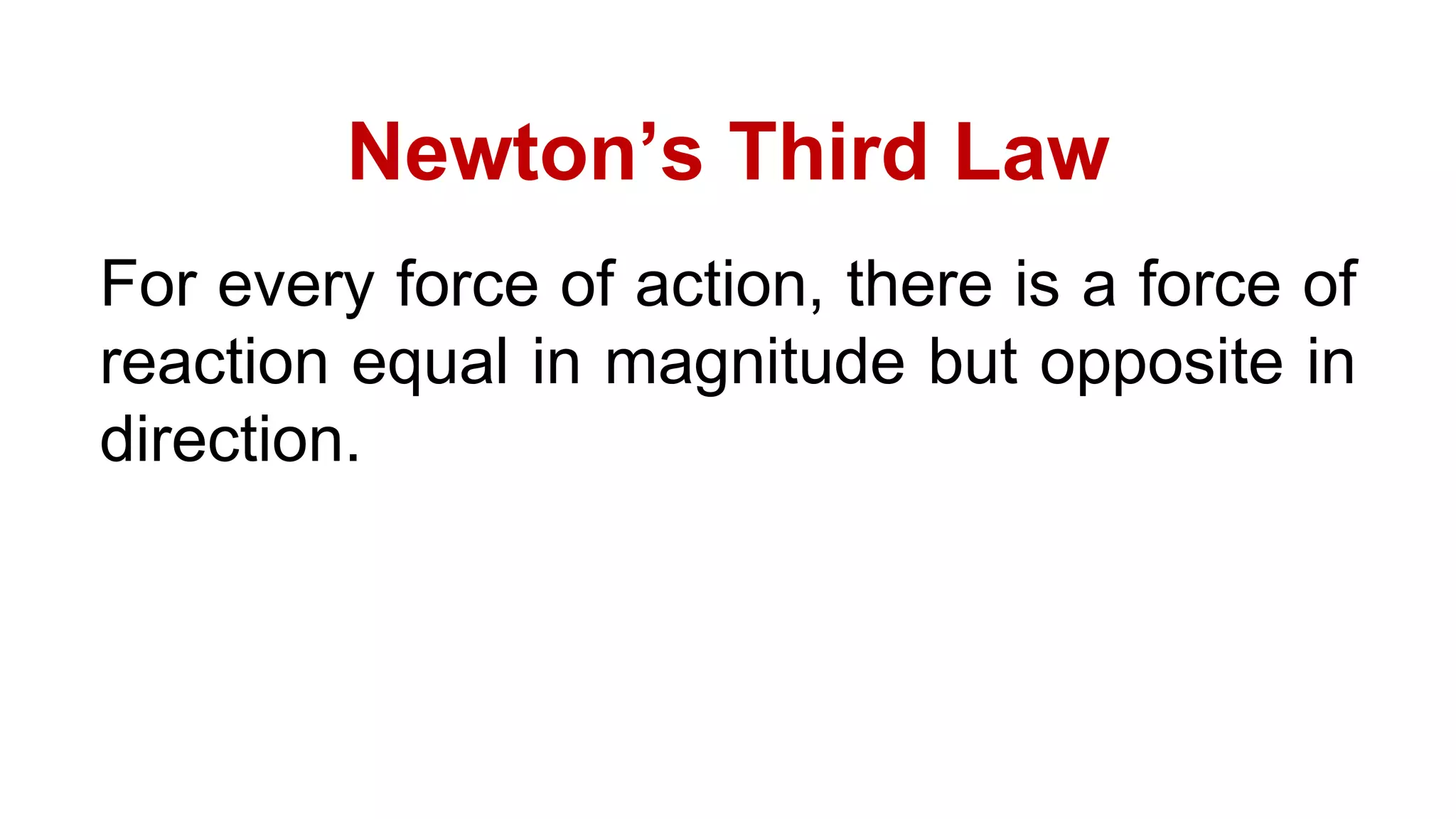
Newton’s Third Law
For every force of action, there is a force of
reaction equal in magnitude but opposite in
direction.
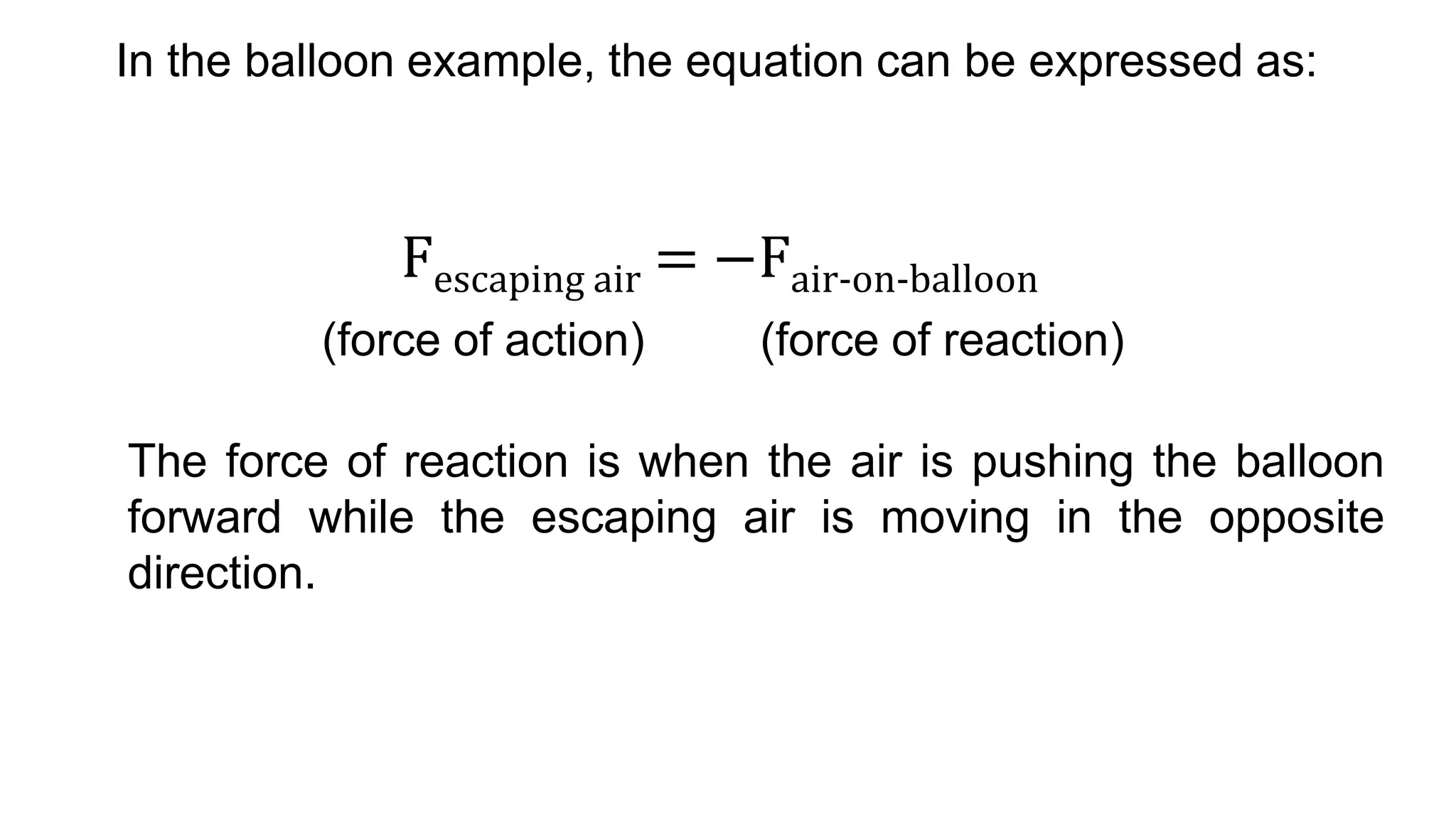
In the balloon example, the equation can be expressed as:
The force of reaction is when the air is pushing the balloon
forward while the escaping air is moving in the opposite
direction.
Fescaping air = −Fair-on-balloon
(force of action) (force of reaction)
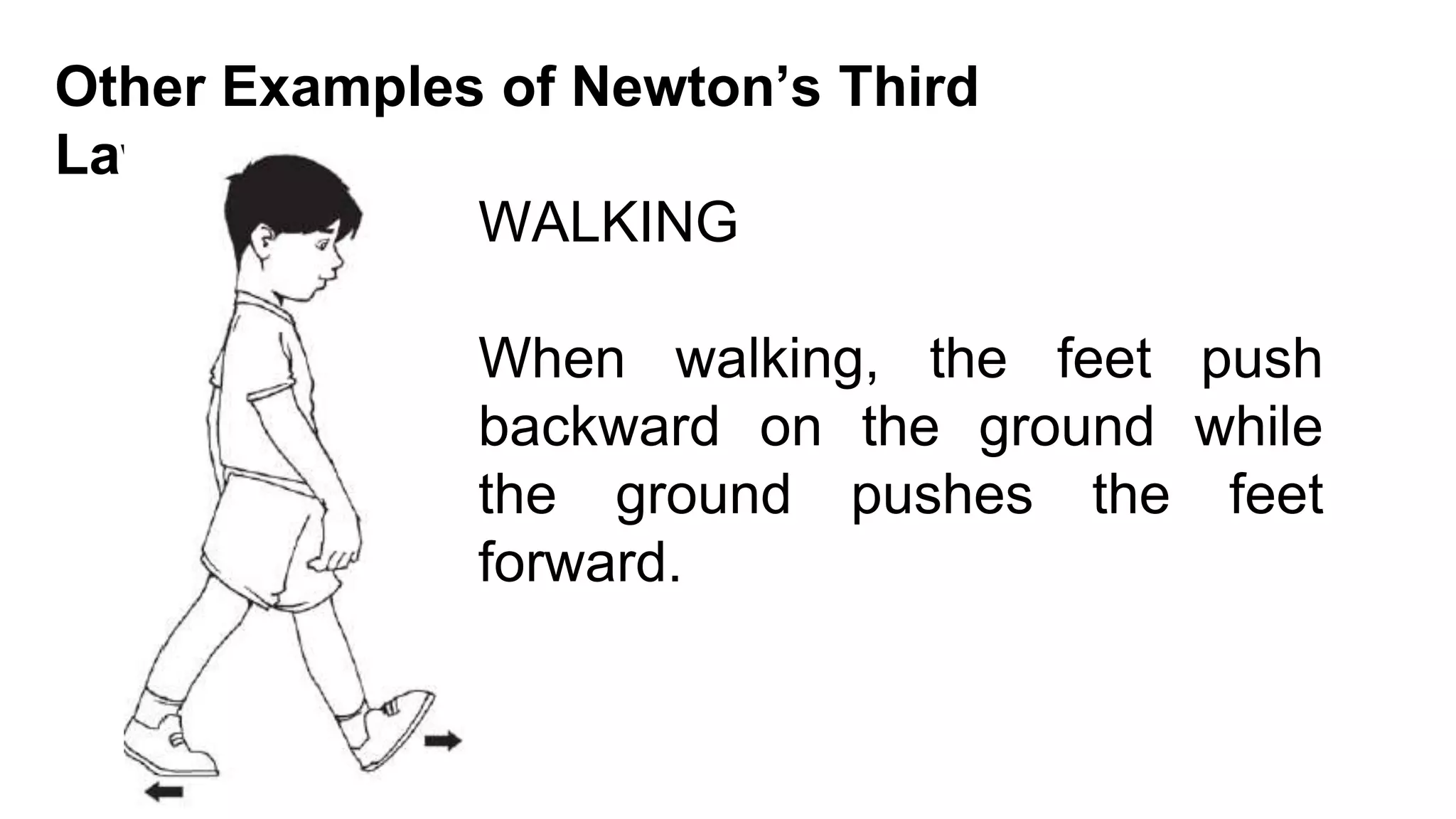
WALKING
When walking, the feet push
backward on the ground while
the ground pushes the feet
forward.
Other Examples of Newton’s Third
Law
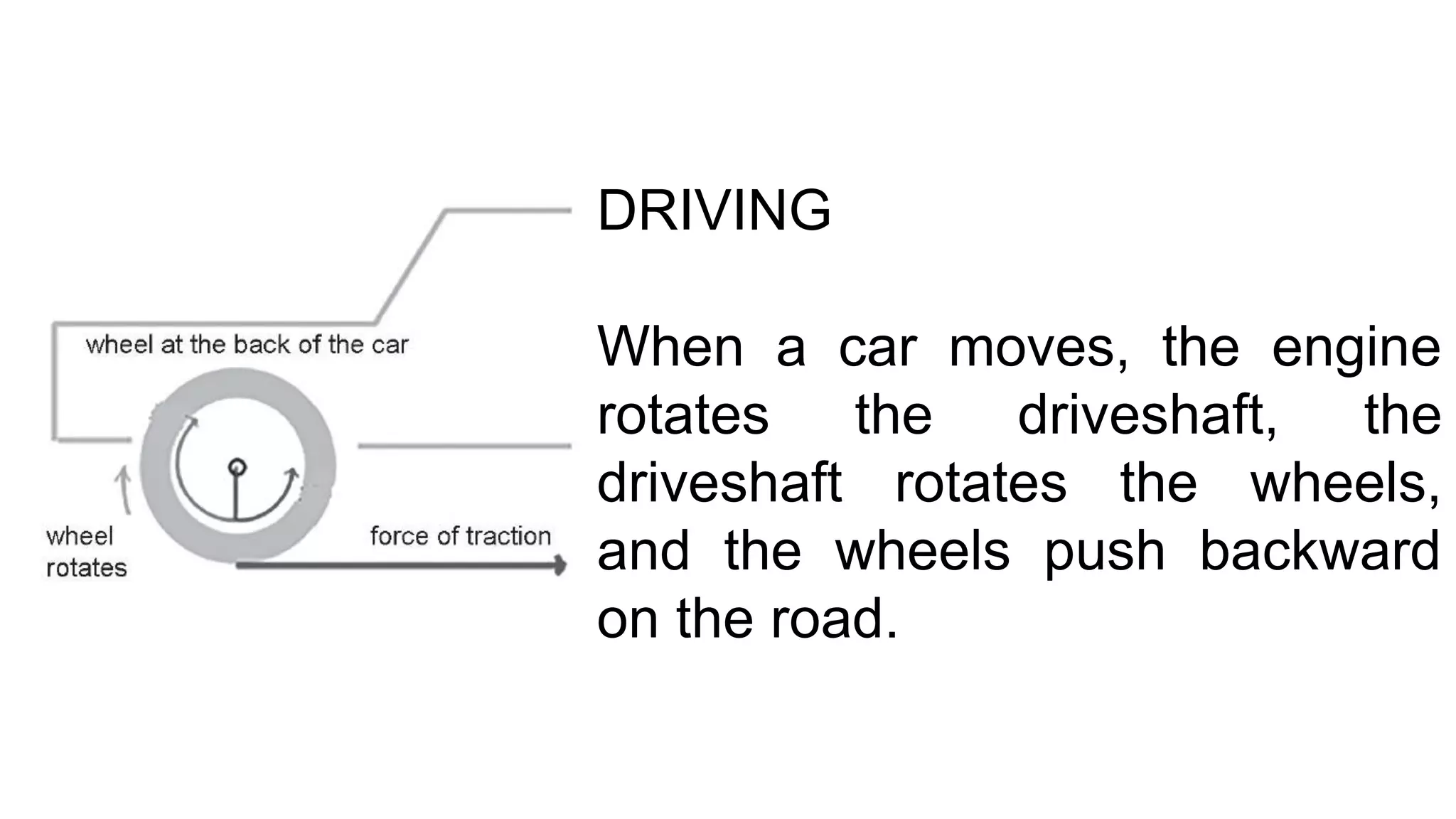
DRIVING
When a car moves, the engine
rotates the driveshaft, the
driveshaft rotates the wheels,
and the wheels push backward
on the road.
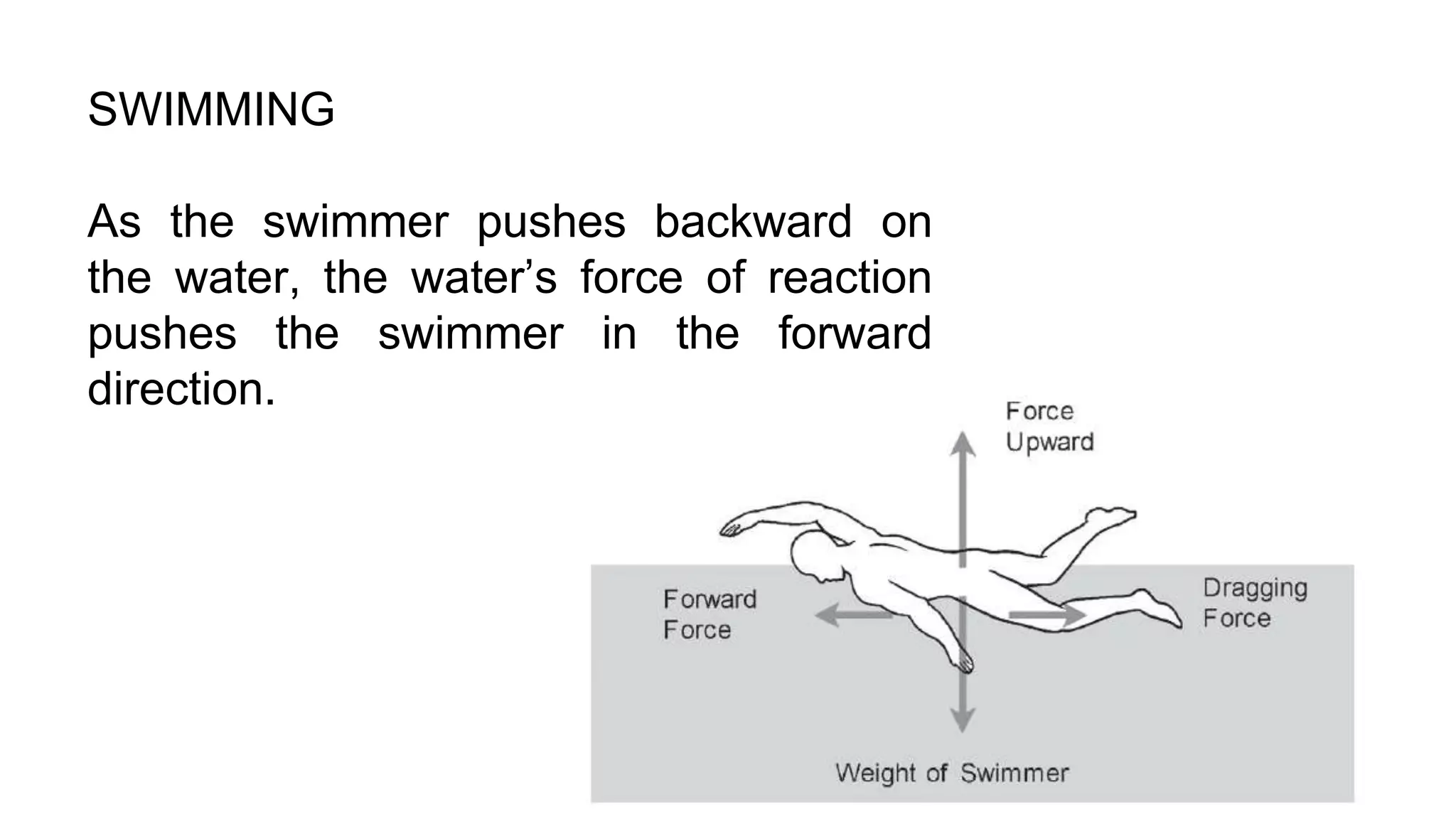
SWIMMING
As the swimmer pushes backward on
the water, the water’s force of reaction
pushes the swimmer in the forward
direction.
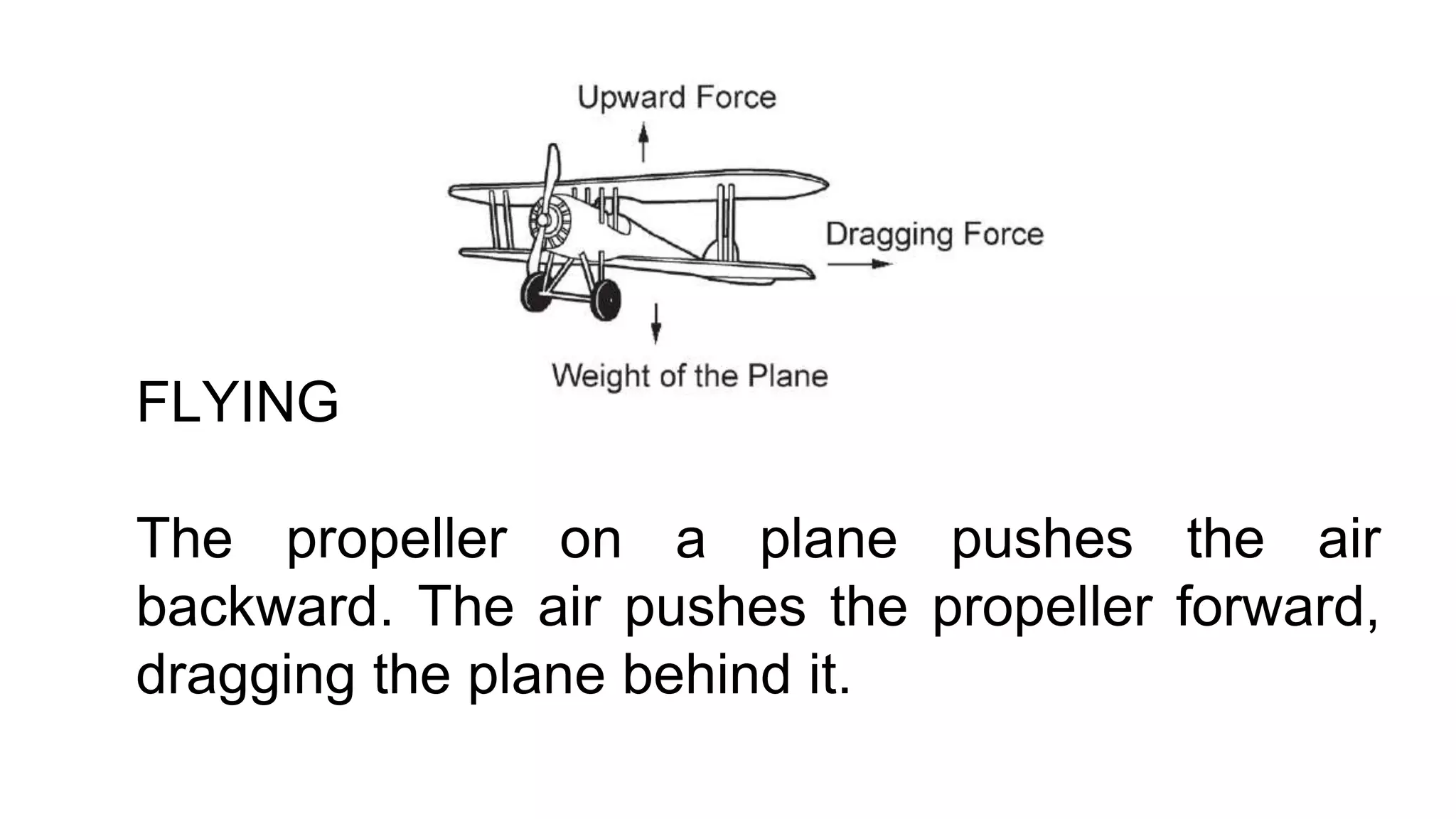
FLYING
The propeller on a plane pushes the air
backward. The air pushes the propeller forward,
dragging the plane behind it.
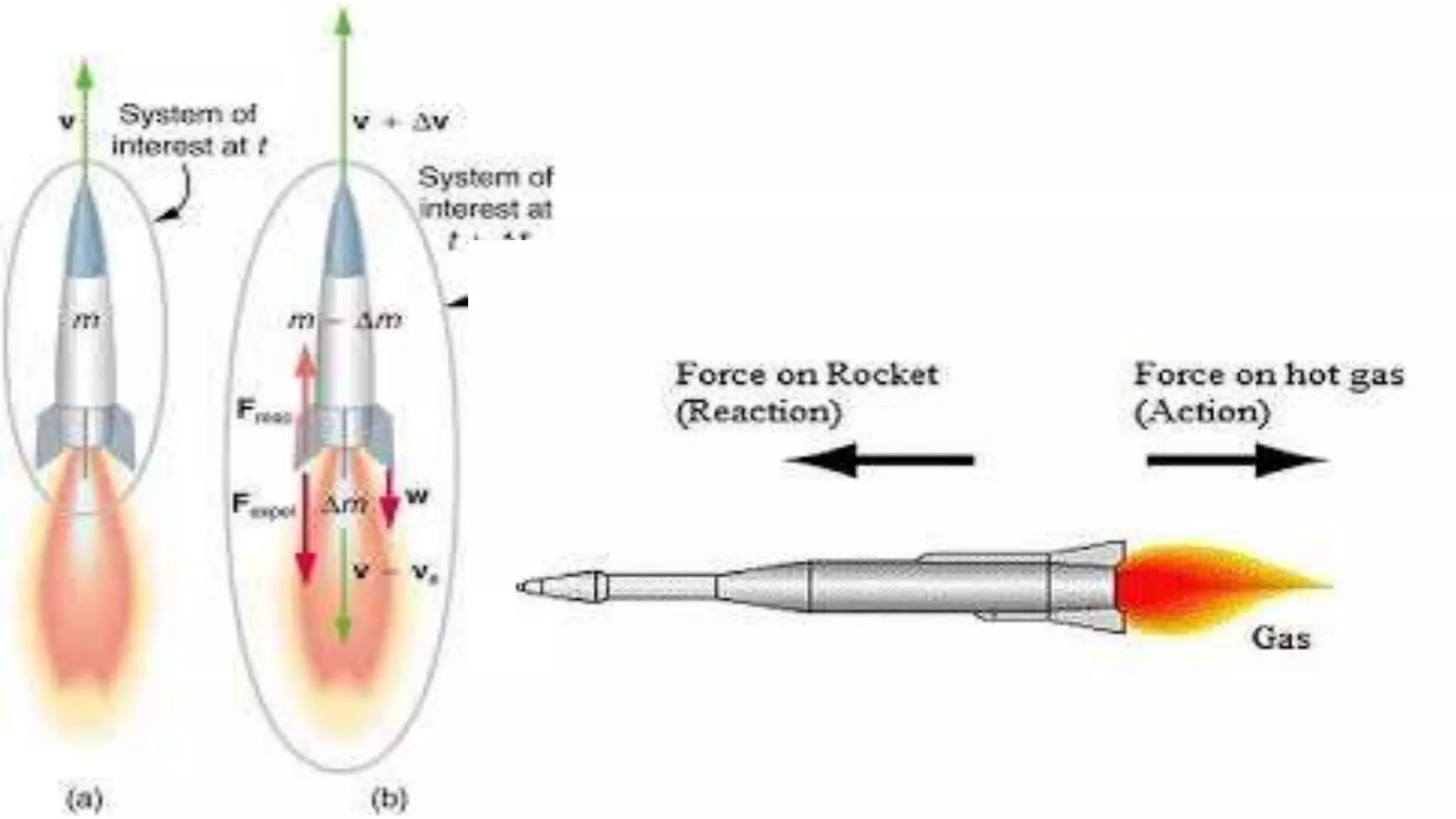
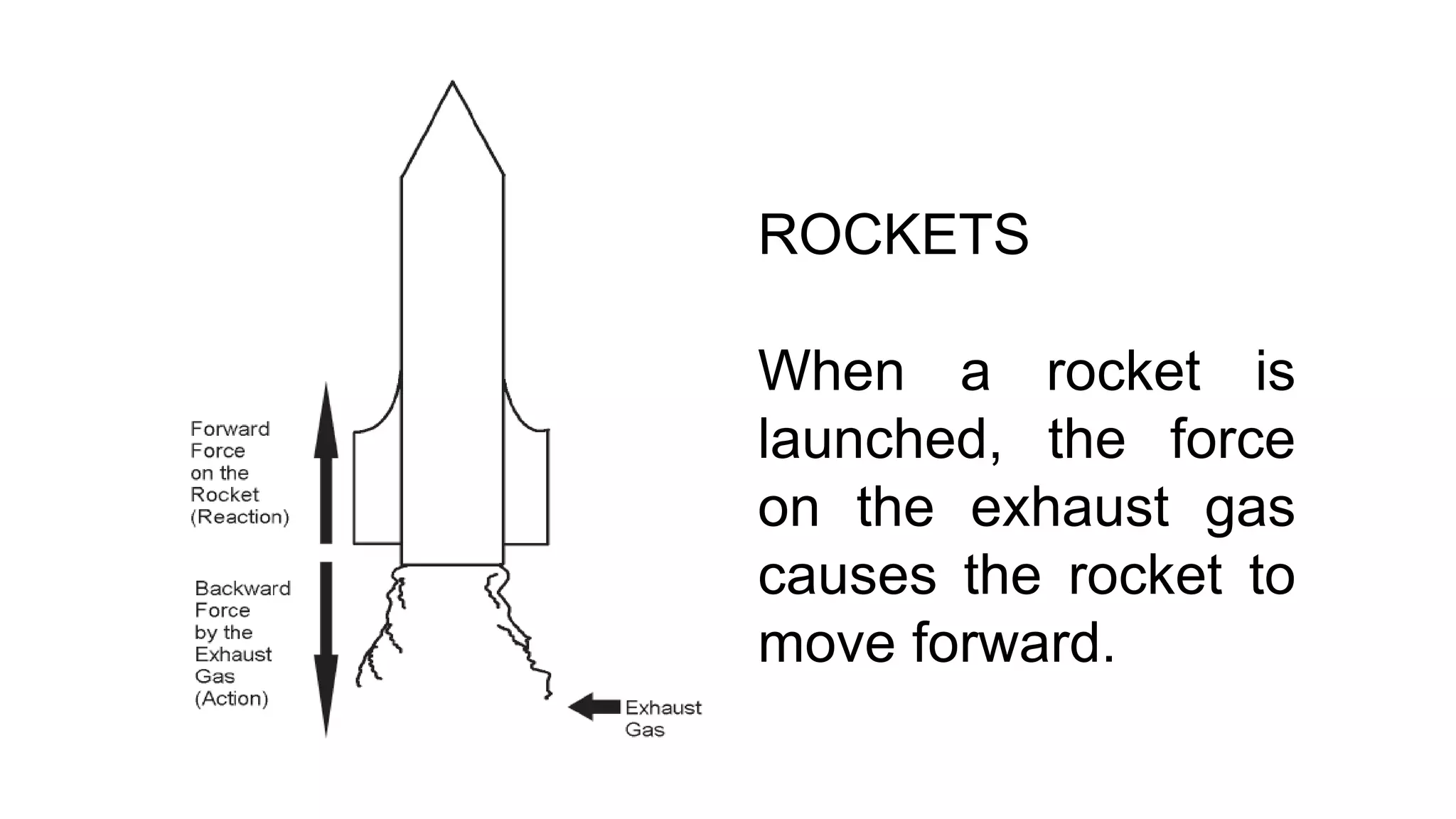
ROCKETS
When a rocket is
launched, the force
on the exhaust gas
causes the rocket to
move forward.
DIRECTION: Write a description of the reaction force for
each of the forces stated below.
a. A football player kicks a ball with a force of
500 N [North].
b. A book is pushed down on a table with a
force of 25 N.
c. A gun exerts a force of 1,000 N [East] on
the bullet when it is fired.
d. An apple is pulled down by gravity with a
force of 5 N.
Classical mechanics
Classical mechanics

Classical mechanics

  • 1.
  • 2.
    MOTION the action orprocess of moving or being moved:
  • 3.
    Aristotelian Motion The ancientGreeks had the earliest recorded studies about motion. Many Greeks tried to explain the physical phenomena in the universe but it was Aristotle’s ideas that prevailed for 2000 years Aristotle’s (384-322 BC) came up with the theories about motion and the universe, based on his literal observations and assumptions.
  • 4.
    He categorized motioninto two types: NATURAL and VIOLENT Motion Natural Motion also called vertical motion, on Earth was explained as the natural tendency of an object to go to its natural place Examples of this type are the falling of the boulder towards the ground and the rising of smoke up in the air
  • 5.
    According to Aristotle,it was natural for heavy things to fall and for every light materials to rise Thus , using the elements that made up the Earth , Earth’s natural place is below water, water below air, air below fire, and all below aether Aether was referred by Aristotle as the fifth element in the universe.
  • 6.
    Violent motion isthe result of removing an object from its natural place.
  • 7.
    But suppose anobject is thrown at an angle? When an object is thrown at an angle, it follows a curved path . projectile Aristotle cannot explain the motion of a projectile . In order to explain this, Aristotle come up with the idea of antiperistasis which explains that as an object moves after being thrown in the air, it leaves a vacuum behind it
  • 8.
    Galilean Motion It wasnot until the time of Galileo Galilei (1564 - 1642) that Aristotle’s idea was challenged Aristotle capitalized on the idea that force is needed to sustain the motion of an object. However, Galileo’s observations of everyday objects were not in accord with this idea.
  • 9.
    Galileo believed thateven when he had stopped pushing the cart, its natural tendency was to continue to move without any assistance. According to him, the reason why the cart tended to slow down or stop because of friction - a force that opposes the motion of an object
  • 11.
    Uniform Motion- whenan object is moving with constant velocity
  • 12.
    Uniform Motion andVelocity ⮚ If both speed and direction remain the same, the velocity is constant and the motion is called UNIFORM MOTION. ⮚ VELOCITY is defined as displacement of an object over the time interval. v = where: v is the velocity Δd is the change in displacement Δt is the change in time ⮚ An equation that relates velocity, displacement, and time interval is:
  • 13.
    Speed Vs. Velocity SPEED •A scalar quantity • Defined as the distance traveled over time VELOCITY • A vector quantity • Denotes change in displacement over change in time and has direction where s is the speed d is the distance t is the time interval s =
  • 14.
    Acceleration ⮚ In physics,ACCELERATION is the variation of velocity over the interval of time. where: a is the resulting acceleration v1 is the starting velocity v2 is the ending velocity Δt is the change in time ⮚ The amount of velocity change is expressed as:
  • 15.
    Velocity-Time Graph A VELOCITY-TIMEGRAPH best represents the motion of objects whose velocity is constantly changing. ⮚ To sketch a velocity-time graph, consider the table on the right. Note that it shows information on the velocity of an object at different times.
  • 16.
    ⮚ The resultinggraph is a straight line and represents an increase in velocity by 10 km/h every five- second interval. This is an acceleration of 2.0 (km/h)/s, where the acceleration for each interval is the same, hence, the graph represents uniform acceleration.
  • 17.
    ⮚ Using theequation a = Δv/Δt for the time interval from 0 to 30 seconds: = 2.0 (km/h)/s ⮚ To determine the acceleration of the velocity versus time graph, simply calculate the slope where Δv is the rise and Δt is the run.
  • 20.
    Reference Frame A frameworkwhich involves using an imaginary coordinate system , to describe the position and motion of an object
  • 21.
    Inertial Frames ofreference have the following characteristics 1. Constant velocity with respect to each other. 2. Zero acceleration with respect to each other 3. No net force acting on each other
  • 22.
  • 23.
    Contact Forces a forcethat is applied by objects in contact with each other (physical contact) acts on a point of direct contact between the two objects. This force can either be continuous as a continuous force or can be momentary in the form of an impulse
  • 24.
    Reaction force An objectat rest on a surface experiences reaction force. For example, a book on a table.
  • 25.
    Tension Force An objectthat is being stretched experiences a tension force. For example, a cable holding a ceiling lamp.
  • 26.
    Friction Two objects slidingpast each other experience friction forces. For example, a box sliding down a slope.
  • 27.
    Air resistance An objectmoving through the air experiences air resistance. For example, a skydiver falling through the air.
  • 28.
    Non Contact Force aforce applied to an object by another body that is not in direct contact with it come into play when objects do not have physical contact between them or when a force is applied without any interaction
  • 29.
    Magnetic force A magneticforce is experienced by any magnetic material in a magnetic field.
  • 30.
    Electrostatic force An electrostaticforce is experienced by any charged particle in an electric field.
  • 31.
    Gravitational force A gravitationalforce is experienced by any mass in a gravitational field.Masses are attracted towards each other by gravitational force:
  • 34.
    Strong Force Also knownas the strong nuclear force.It keeps the nucleons and their components (quarks) together and is the strongest of all the fundamental forces.
  • 35.
    Weak Force Often dubbedas strong nuclear force, it is the force responsible for some identified nuclear phenomenon, a form of which is beta decay It is further explained by the electroweak theory , which says that W and Z bosons make an interaction between objects possible.
  • 36.
    Electromagnetic Force It actsbetween electrically charged particles. It is made possible by the object’s magnetic properties couple with their electrical properties Photons also play a role in interactions that deal with electromagnetic force, Theory of quantum electrodynamics
  • 37.
    Gravitational Force Force exertedby object with mass, Its magnitude is dependent on the distance between two objects and has an inverse square relationship with the distance between the object Theory of General Relativity covers the study of this force
  • 38.
    Force Diagraming 1. BlockDiagram or Schematic Diagram is a representation of the object, using lines, blocks and/or figures.
  • 39.
    Newton’s First Law Anobject at rest stays at rest and an object in motion stays in motion with the same speed and in the same direction unless acted upon by an unbalanced force.
  • 41.
    Suppose you arehelping a friend transfer from one residence to another. Your friend asks you to stand in the rear of a truck to hold a piano from an inclined plane. Explain why you should decline the request of your friend. The answer should indicate your understanding of Galileo and the First Law of Newton. Sample Problem:
  • 42.
    Since a pianohas a large mass, it also has a large inertia. If the truck suddenly moves, the piano that is in a state of rest could slide down. Answer: Even if the truck stops, the piano will keep moving. Hence, anyone standing in the rear of the truck to hold the piano could be injured.
  • 43.
    DIRECTION: Give whatis asked in the problem. A man, who is on an upper floor of a building, is observing a boy looping a ball in a cord. If the cord breaks, what path will the ball take? Explain your answer.
  • 44.
    From the illustrationsshown here, verify the magnitude and direction of the net force and recognize which will be at rest. Sample Problem:
  • 45.
    Object “b” isat rest because the net force is 0. Answer:
  • 46.
    DIRECTION: Verify thenet force’s magnitude and direction for each of the following illustrations and recognize in which case the object could be at rest.
  • 47.
    Newton’s Second Law Thefollowing ideas can be summarized to create the second law of Newton: • Once a force that acts on an object is unbalanced, it will accelerate in the same direction as the force. • The acceleration of the object varies with its unbalanced force. • The acceleration of the object varies inversely with its mass.
  • 48.
    Mathematically, the secondlaw of Newton can be expressed as: Fnet = ma
  • 49.
    1. If a70 kg skater acted upon by an unbalanced force of 161 N [West], what is its acceleration? Sample Problems: 2. A force of 360 N [East] was applied by a student on a box with a mass of 50 kg. What is the acceleration of the box if a frictional force of 340 N acts in the opposite direction?
  • 50.
    3. A 10kg box is being pushed by an applied force and accelerates at 2.5 m/s². What is the applied force if a frictional force of 50 N is acting in the opposite direction?
  • 51.
    Answers: 2. Make afree-body diagram to answer the question. Sketch a rectangle to denote the box being analyzed. The 360 N applied force is indicated as a vector acting on the box in the East direction while the frictional force is acting in the opposite direction.
  • 52.
    Fnet = 20N Ff = 340 N Fnet = 20 N[E] m = 50 kg
  • 53.
    3. m = 10kg a = 2.5 m/s² Fnet = ma = (10 kg)(2.5 m/s²) = 25 N Using the free-body diagram:
  • 54.
    Fnet = Fa+ Ff 25 N = Fa – 50 N Fa = 75 N where Fa is applied force Ff is the force of friction
  • 55.
    DIRECTION: Answer thefollowing questions. 1.What is the acceleration of a bowling ball with a mass of 50.0 kg if a net force of 20 N is acting on it? 2.What is the applied force needed on a 2.0 kg block of wood accelerating at 4.0 m/s² along a rough table with a 10 N force of friction acting in the opposite direction?
  • 56.
    Newton’s Third Law Forevery force of action, there is a force of reaction equal in magnitude but opposite in direction.
  • 57.
    In the balloonexample, the equation can be expressed as: The force of reaction is when the air is pushing the balloon forward while the escaping air is moving in the opposite direction. Fescaping air = −Fair-on-balloon (force of action) (force of reaction)
  • 59.
    WALKING When walking, thefeet push backward on the ground while the ground pushes the feet forward. Other Examples of Newton’s Third Law
  • 60.
    DRIVING When a carmoves, the engine rotates the driveshaft, the driveshaft rotates the wheels, and the wheels push backward on the road.
  • 61.
    SWIMMING As the swimmerpushes backward on the water, the water’s force of reaction pushes the swimmer in the forward direction.
  • 62.
    FLYING The propeller ona plane pushes the air backward. The air pushes the propeller forward, dragging the plane behind it.
  • 63.
    ROCKETS When a rocketis launched, the force on the exhaust gas causes the rocket to move forward.
  • 64.
    DIRECTION: Write adescription of the reaction force for each of the forces stated below. a. A football player kicks a ball with a force of 500 N [North]. b. A book is pushed down on a table with a force of 25 N. c. A gun exerts a force of 1,000 N [East] on the bullet when it is fired. d. An apple is pulled down by gravity with a force of 5 N.