


Current, Resistance and
Electromotive Force
How well do you know these?
1. How does conventional current differ from non-conventional current?
2. How do we explain the description that current is the flow of charges per
time?
3. How does then drift velocity of a collection of charges relate to current?
4. Which properties can affect the flow of charges in a material?
5. How do the characteristics of conductors affect the rate of flow of
charges?
6. How do we explain the difference between ohmic and non-ohmic
materials?
7. How does potential difference different from electromotive force?
8. How do we relate emf, resistance, current and power and their use in
calculation?
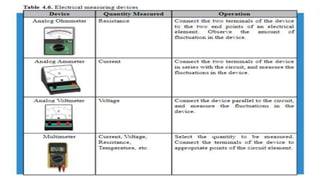
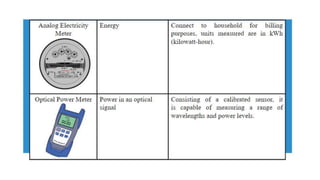
9. How do we measure current and voltage?
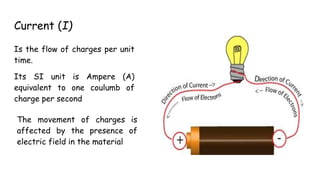
Current (I)
Is the flow of charges per unit
time.
Its SI unit is Ampere (A)
equivalent to one coulumb of
charge per second
The movement of charges is
affected by the presence of
electric field in the material
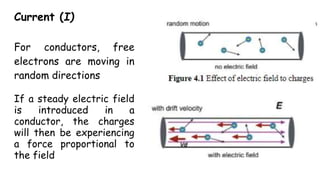
Current (I)
For conductors, free
electrons are moving in
random directions
If a steady electric field
is introduced in a
conductor, the charges
will then be experiencing
a force proportional to
the field
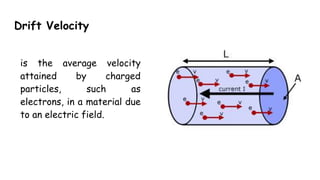
Drift Velocity
is the average velocity
attained by charged
particles, such as
electrons, in a material due
to an electric field.
Drift Velocity Explained
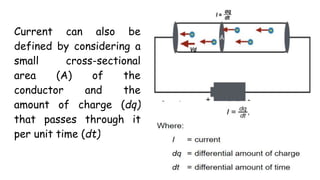
Current can also be
defined by considering a
small cross-sectional
area (A) of the
conductor and the
amount of charge (dq)
that passes through it
per unit time (dt)
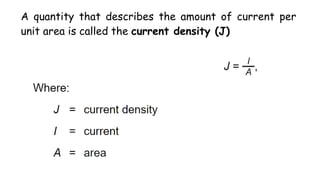
A quantity that describes the amount of current per
unit area is called the current density (J)
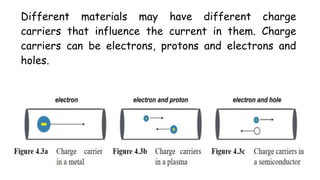
Different materials may have different charge
carriers that influence the current in them. Charge
carriers can be electrons, protons and electrons and
holes.
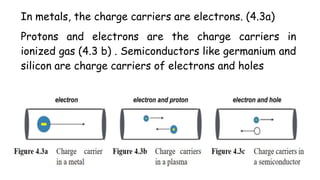
In metals, the charge carriers are electrons. (4.3a)
Protons and electrons are the charge carriers in
ionized gas (4.3 b) . Semiconductors like germanium and
silicon are charge carriers of electrons and holes
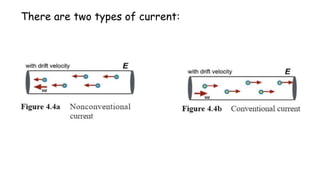
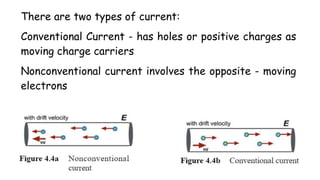
There are two types of current:
Conventional Current - has holes or positive charges as
moving charge carriers
Nonconventional current involves the opposite - moving
electrons
Current may also be classified, based on the
consistency of its direction:
Direct Current : is the one directional flow of electric charge.
An electrochemical cell is a prime example of DC power. Direct
current may flow through a conductor such as a wire, but can
also flow through semiconductors, insulators, or even through
a vacuum as in electron or ion beams.
Current may also be classified, based on the
consistency of its direction:
Alternating Current; is an electric current which periodically
reverses direction and changes its magnitude continuously with
time in contrast to direct current which flows only in one
direction.
Alternating current is the form in which electric power is
delivered to businesses and residences, and it is the form of
electrical energy that consumers typically use when they plug
kitchen appliances, televisions, fans and electric lamps into a wall
socket. A common source of DC power is a battery cell
Sample Problem
A 10-coulumb charge flows through a headlamp’s
filament in 5 seconds. What is the current in the
filament?
Sample Problem
You have built a small electric motor. Upon testing,
you find out that it operates with a current of 1 A
for 10 s. How much charge has passed during
testing?
Sample Problem
A small flashlight operates with a current of 0.5 A.
Upon measurement, you realize that the charge
that has passed is 100 C. How long has the
measurement been done?
Resistor
A resistor is a passive two-terminal electrical component
that implements electrical resistance as a circuit element.
In electronic circuits, resistors are used to reduce
current flow, adjust signal levels, to divide voltages, bias
active elements, and terminate transmission lines, among
other uses.
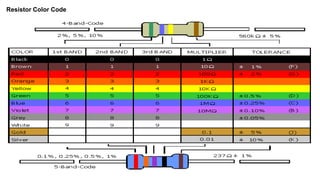
Resistor Color Code
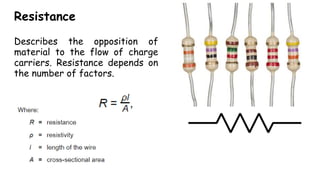
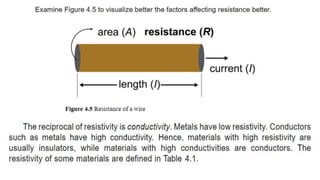
Resistance
Describes the opposition of
material to the flow of charge
carriers. Resistance depends on
the number of factors.
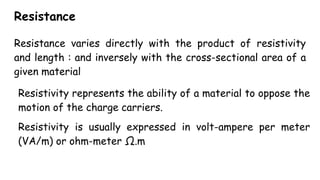
Resistance
Resistance varies directly with the product of resistivity
and length : and inversely with the cross-sectional area of a
given material
Resistivity represents the ability of a material to oppose the
motion of the charge carriers.
Resistivity is usually expressed in volt-ampere per meter
(VA/m) or ohm-meter Ω.m
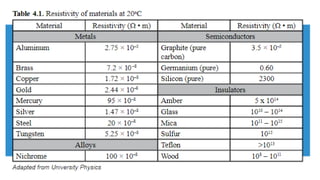
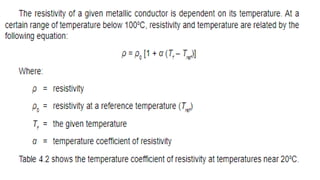
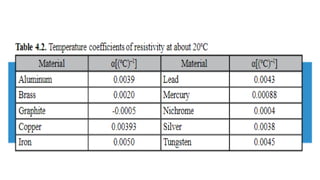
Resistance and Resistivity
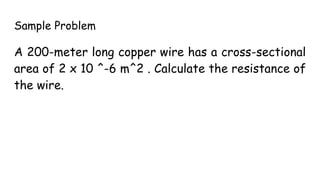
Sample Problem
A 200-meter long copper wire has a cross-sectional
area of 2 x 10 ^-6 m^2 . Calculate the resistance of
the wire.
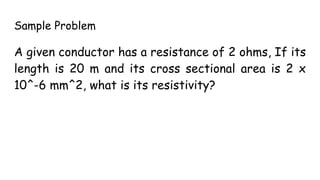
Sample Problem
A given conductor has a resistance of 2 ohms, If its
length is 20 m and its cross sectional area is 2 x
10^-6 mm^2, what is its resistivity?
Sample Problem
An oven toaster has a 5-m long nichrome wire as
its heating element. Determine the wire’s
resistivity if its operating temperature is 300
degrees celsius.
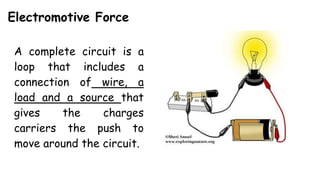
Electromotive Force
A complete circuit is a
loop that includes a
connection of wire, a
load and a source that
gives the charges
carriers the push to
move around the circuit.
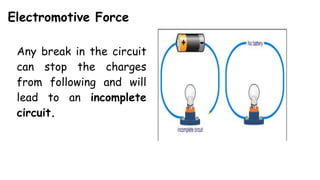
Electromotive Force
Any break in the circuit
can stop the charges
from following and will
lead to an incomplete
circuit.
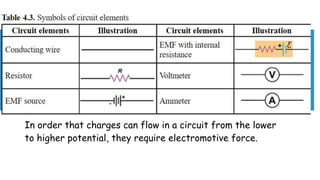
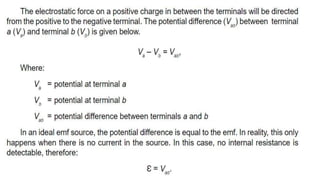
In order that charges can flow in a circuit from the lower
to higher potential, they require electromotive force.
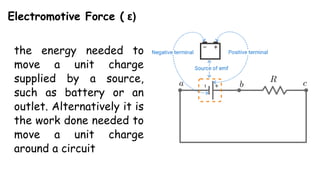
Electromotive Force ( ε)
the energy needed to
move a unit charge
supplied by a source,
such as battery or an
outlet. Alternatively it is
the work done needed to
move a unit charge
around a circuit
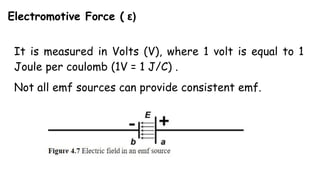
Electromotive Force ( ε)
It is measured in Volts (V), where 1 volt is equal to 1
Joule per coulomb (1V = 1 J/C) .
Not all emf sources can provide consistent emf.
How Electromotive Force works?
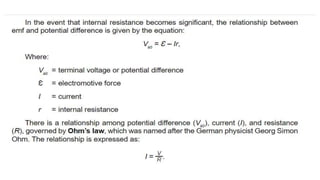
Ohm’s Law
States that in a complete circuit, the current is directly
proportional to the potential difference and inversely
proportional to the resistance.
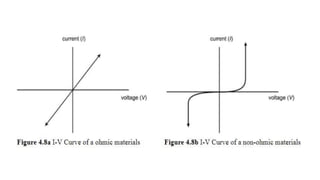
Ohmic Material, materials that follows Ohm’s Law while others
that do not are Non-Ohmic
One way to differentiate the two is by using a graph relating
current and voltage, called curve characteristics
Sample Problem
An emf source of 6V is connected to a radio, and a
current of 1.0A. If the wires are assumed to be
resistance-free, what is the resistance of the radio?
Sample Problem
A refrigerator, rated at 50 ohms, is connected to a
12-V DC source. Calculate the current in the
refrigerator, assuming that other sources of
resistance are negligible
Physiological Effects of Current
Why is it important to know about these Electrical concepts?
In the Philippines, the standard single phase voltage of electrical
sockets is 220 V, hence, devices made in the country are made to be powered by
this much voltage
However, if we plug a 220-V in Japan, whose standard is 100 V
without considering appropriate AC frequencies,then we may encounter a
possible electrical hazards
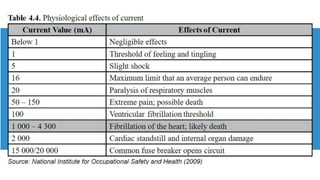
Electrical hazards should not be taken lightly. The effects of current vary
from case to case, depending on the value of current and the material it
comes contact with
Physiological Effects of Current
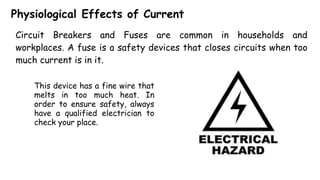
Circuit Breakers and Fuses are common in households and
workplaces. A fuse is a safety devices that closes circuits when too
much current is in it.
This device has a fine wire that
melts in too much heat. In
order to ensure safety, always
have a qualified electrician to
check your place.
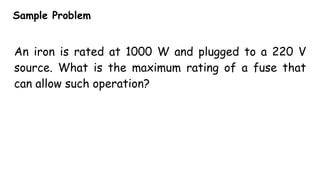
Sample Problem
An iron is rated at 1000 W and plugged to a 220 V
source. What is the maximum rating of a fuse that
can allow such operation?
Current, resistance and electromotive force

Current, resistance and electromotive force

  • 1.
  • 2.
    How well doyou know these? 1. How does conventional current differ from non-conventional current? 2. How do we explain the description that current is the flow of charges per time? 3. How does then drift velocity of a collection of charges relate to current? 4. Which properties can affect the flow of charges in a material? 5. How do the characteristics of conductors affect the rate of flow of charges? 6. How do we explain the difference between ohmic and non-ohmic materials? 7. How does potential difference different from electromotive force? 8. How do we relate emf, resistance, current and power and their use in calculation? 9. How do we measure current and voltage?
  • 3.
    Current (I) Is theflow of charges per unit time. Its SI unit is Ampere (A) equivalent to one coulumb of charge per second The movement of charges is affected by the presence of electric field in the material
  • 4.
    Current (I) For conductors,free electrons are moving in random directions If a steady electric field is introduced in a conductor, the charges will then be experiencing a force proportional to the field
  • 5.
    Drift Velocity is theaverage velocity attained by charged particles, such as electrons, in a material due to an electric field.
  • 6.
  • 7.
    Current can alsobe defined by considering a small cross-sectional area (A) of the conductor and the amount of charge (dq) that passes through it per unit time (dt)
  • 8.
    A quantity thatdescribes the amount of current per unit area is called the current density (J)
  • 9.
    Different materials mayhave different charge carriers that influence the current in them. Charge carriers can be electrons, protons and electrons and holes.
  • 10.
    In metals, thecharge carriers are electrons. (4.3a) Protons and electrons are the charge carriers in ionized gas (4.3 b) . Semiconductors like germanium and silicon are charge carriers of electrons and holes
  • 11.
    There are twotypes of current:
  • 12.
    There are twotypes of current: Conventional Current - has holes or positive charges as moving charge carriers Nonconventional current involves the opposite - moving electrons
  • 13.
    Current may alsobe classified, based on the consistency of its direction: Direct Current : is the one directional flow of electric charge. An electrochemical cell is a prime example of DC power. Direct current may flow through a conductor such as a wire, but can also flow through semiconductors, insulators, or even through a vacuum as in electron or ion beams.
  • 14.
    Current may alsobe classified, based on the consistency of its direction: Alternating Current; is an electric current which periodically reverses direction and changes its magnitude continuously with time in contrast to direct current which flows only in one direction. Alternating current is the form in which electric power is delivered to businesses and residences, and it is the form of electrical energy that consumers typically use when they plug kitchen appliances, televisions, fans and electric lamps into a wall socket. A common source of DC power is a battery cell
  • 16.
    Sample Problem A 10-coulumbcharge flows through a headlamp’s filament in 5 seconds. What is the current in the filament?
  • 17.
    Sample Problem You havebuilt a small electric motor. Upon testing, you find out that it operates with a current of 1 A for 10 s. How much charge has passed during testing?
  • 18.
    Sample Problem A smallflashlight operates with a current of 0.5 A. Upon measurement, you realize that the charge that has passed is 100 C. How long has the measurement been done?
  • 19.
    Resistor A resistor isa passive two-terminal electrical component that implements electrical resistance as a circuit element. In electronic circuits, resistors are used to reduce current flow, adjust signal levels, to divide voltages, bias active elements, and terminate transmission lines, among other uses.
  • 20.
  • 21.
    Resistance Describes the oppositionof material to the flow of charge carriers. Resistance depends on the number of factors.
  • 22.
    Resistance Resistance varies directlywith the product of resistivity and length : and inversely with the cross-sectional area of a given material Resistivity represents the ability of a material to oppose the motion of the charge carriers. Resistivity is usually expressed in volt-ampere per meter (VA/m) or ohm-meter Ω.m
  • 27.
  • 28.
    Sample Problem A 200-meterlong copper wire has a cross-sectional area of 2 x 10 ^-6 m^2 . Calculate the resistance of the wire.
  • 29.
    Sample Problem A givenconductor has a resistance of 2 ohms, If its length is 20 m and its cross sectional area is 2 x 10^-6 mm^2, what is its resistivity?
  • 30.
    Sample Problem An oventoaster has a 5-m long nichrome wire as its heating element. Determine the wire’s resistivity if its operating temperature is 300 degrees celsius.
  • 31.
    Electromotive Force A completecircuit is a loop that includes a connection of wire, a load and a source that gives the charges carriers the push to move around the circuit.
  • 32.
    Electromotive Force Any breakin the circuit can stop the charges from following and will lead to an incomplete circuit.
  • 33.
    In order thatcharges can flow in a circuit from the lower to higher potential, they require electromotive force.
  • 34.
    Electromotive Force (ε) the energy needed to move a unit charge supplied by a source, such as battery or an outlet. Alternatively it is the work done needed to move a unit charge around a circuit
  • 35.
    Electromotive Force (ε) It is measured in Volts (V), where 1 volt is equal to 1 Joule per coulomb (1V = 1 J/C) . Not all emf sources can provide consistent emf.
  • 38.
  • 39.
    Ohm’s Law States thatin a complete circuit, the current is directly proportional to the potential difference and inversely proportional to the resistance. Ohmic Material, materials that follows Ohm’s Law while others that do not are Non-Ohmic One way to differentiate the two is by using a graph relating current and voltage, called curve characteristics
  • 42.
    Sample Problem An emfsource of 6V is connected to a radio, and a current of 1.0A. If the wires are assumed to be resistance-free, what is the resistance of the radio?
  • 43.
    Sample Problem A refrigerator,rated at 50 ohms, is connected to a 12-V DC source. Calculate the current in the refrigerator, assuming that other sources of resistance are negligible
  • 44.
    Physiological Effects ofCurrent Why is it important to know about these Electrical concepts? In the Philippines, the standard single phase voltage of electrical sockets is 220 V, hence, devices made in the country are made to be powered by this much voltage However, if we plug a 220-V in Japan, whose standard is 100 V without considering appropriate AC frequencies,then we may encounter a possible electrical hazards Electrical hazards should not be taken lightly. The effects of current vary from case to case, depending on the value of current and the material it comes contact with
  • 46.
    Physiological Effects ofCurrent Circuit Breakers and Fuses are common in households and workplaces. A fuse is a safety devices that closes circuits when too much current is in it. This device has a fine wire that melts in too much heat. In order to ensure safety, always have a qualified electrician to check your place.
  • 47.
    Sample Problem An ironis rated at 1000 W and plugged to a 220 V source. What is the maximum rating of a fuse that can allow such operation?