
THORNDIKE’S BOND THEORY
PREPARED BY:
NISHAT ANJUM
MJPRU, BAREILLY.
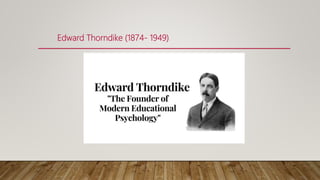
Edward Thorndike (1874- 1949)
INTRODUCTION
• . Edward Lee Thorndike was an American psychologist who spent his
entire career at Teachers college, Columbia University.
• He was born on 31 August 1874 .
• Thorndike is famous in psychology for his work on Learning Theory that
lead to the development of Operant conditioning with in Behaviorism.
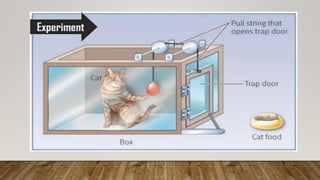
• Thorndike studied learning in animals (usually cats) . He devised a
classic experiment in which he used a puzzle box to empirically test the
laws of learning.
EXPERIMENT:-
• He placed a cat in the puzzle box, which was encourage to escape to
reach a scrap of fish placed outside. Thorndike would put a cat into the
box and time how long it took to escape. The cats experimented with
different to escape the puzzle box and reach the fish.
• Eventually they would stumble upon the lever which opened the cage.
When it had escaped it was put in again and once more the time it took
to escape was noted. In successive trials the cats would have favourable
consequences and they would adopt this behaviour becoming
increasingly quick at pressing the lever.
• Thorndike (1905) introduced the concept of reinforcement and was
the first to apply psychological principles to the ares of learning.
• His research led to many theories and laws of learning such as
Operant conditioning.
• Thorndike, put animals in boxes and observed them to see what
they were able to learn.
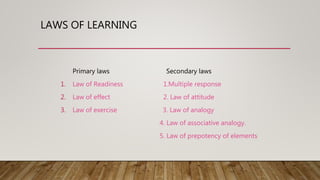
LAWS OF LEARNING
Primary laws Secondary laws
1. Law of Readiness 1.Multiple response
2. Law of effect 2. Law of attitude
3. Law of exercise 3. Law of analogy
4. Law of associative analogy.
5. Law of prepotency of elements
PRIMARY LAWS
• 1.Law of readiness or Trial and error theory :- This law is indicative law of response of learner aspects of
learning process. Readiness according to Thorndike is preparation to action, it is essential for learning. If
a child ready to learn he learns it more interest and effectively than when he is not ready to learn.
• 2. Law of Effect:-- Pleasure and Punishment
• Learning can be set to have taken place properly when it results in satisfaction and the learner drives
pleasure from it. In the situation when child meets failure or dissatisfied the progress of learning is
stopped. All the pleasent experiment have last influence are remember for long time while the
unpleasent once are soon forgotten. Therefore, satisfaction and dissatisfaction, pleasure and
displeasure resulting from learning experience decides it’s effectiveness.
CONTD…
• 3)Law of exercise:- Use and Disuse
• Law of use:- It refers to strengthing of connection with practice.
• Law of disuse:- It refers to the weekning of a connection or
coordinating when the practice is discontinued.
SECONDARY LAWS
• 1.Multiple response:- This law employed that when an individual is confronted
with new situation. He response in a variety of ways starting from first response
and then another one before arriving at the correct one.
• 2. Law of attitude:--learning os guided by total attitude and “set” of organism.
The learner performs the sets properly if he has develop healthy attitude towards
the task.
• 3. Law of Analogy:- An individual response to new situation on the basis of
responses made by him in similar situation made by him in the past that is he
makes responses by comprehensive and analogy.
CONTD…
• 4. Law of Association shifting:- This law state that any response may be from the
learner of which he is capable, in association with any situation to which he is
sensitive. In other words, any response which is possible can be link with stimulus.
• 5. Law of Propotency of Element’s:--To solve any problem a person chooses
essentials items and response accordingly. Under this law process of learning is
link with experience of life.
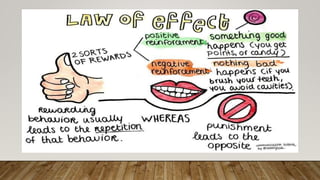
• “Edward Thorndike put forward a “Law of effect” Which stated that any
behaviour that is followed by pleasant consequences is likely to be repeated and
any behaviour followed by unpleasant consequences is like to be stopped”
ANY QUERY?
Thank you.
By:
Nishat Anjum
MJPRU, Bareilly

Thorndike's bond theory

  • 1.
    THORNDIKE’S BOND THEORY PREPAREDBY: NISHAT ANJUM MJPRU, BAREILLY.
  • 2.
  • 3.
    INTRODUCTION • . EdwardLee Thorndike was an American psychologist who spent his entire career at Teachers college, Columbia University. • He was born on 31 August 1874 . • Thorndike is famous in psychology for his work on Learning Theory that lead to the development of Operant conditioning with in Behaviorism. • Thorndike studied learning in animals (usually cats) . He devised a classic experiment in which he used a puzzle box to empirically test the laws of learning.
  • 4.
    EXPERIMENT:- • He placeda cat in the puzzle box, which was encourage to escape to reach a scrap of fish placed outside. Thorndike would put a cat into the box and time how long it took to escape. The cats experimented with different to escape the puzzle box and reach the fish. • Eventually they would stumble upon the lever which opened the cage. When it had escaped it was put in again and once more the time it took to escape was noted. In successive trials the cats would have favourable consequences and they would adopt this behaviour becoming increasingly quick at pressing the lever.
  • 6.
    • Thorndike (1905)introduced the concept of reinforcement and was the first to apply psychological principles to the ares of learning. • His research led to many theories and laws of learning such as Operant conditioning. • Thorndike, put animals in boxes and observed them to see what they were able to learn.
  • 7.
    LAWS OF LEARNING Primarylaws Secondary laws 1. Law of Readiness 1.Multiple response 2. Law of effect 2. Law of attitude 3. Law of exercise 3. Law of analogy 4. Law of associative analogy. 5. Law of prepotency of elements
  • 8.
    PRIMARY LAWS • 1.Lawof readiness or Trial and error theory :- This law is indicative law of response of learner aspects of learning process. Readiness according to Thorndike is preparation to action, it is essential for learning. If a child ready to learn he learns it more interest and effectively than when he is not ready to learn. • 2. Law of Effect:-- Pleasure and Punishment • Learning can be set to have taken place properly when it results in satisfaction and the learner drives pleasure from it. In the situation when child meets failure or dissatisfied the progress of learning is stopped. All the pleasent experiment have last influence are remember for long time while the unpleasent once are soon forgotten. Therefore, satisfaction and dissatisfaction, pleasure and displeasure resulting from learning experience decides it’s effectiveness.
  • 9.
    CONTD… • 3)Law ofexercise:- Use and Disuse • Law of use:- It refers to strengthing of connection with practice. • Law of disuse:- It refers to the weekning of a connection or coordinating when the practice is discontinued.
  • 10.
    SECONDARY LAWS • 1.Multipleresponse:- This law employed that when an individual is confronted with new situation. He response in a variety of ways starting from first response and then another one before arriving at the correct one. • 2. Law of attitude:--learning os guided by total attitude and “set” of organism. The learner performs the sets properly if he has develop healthy attitude towards the task. • 3. Law of Analogy:- An individual response to new situation on the basis of responses made by him in similar situation made by him in the past that is he makes responses by comprehensive and analogy.
  • 11.
    CONTD… • 4. Lawof Association shifting:- This law state that any response may be from the learner of which he is capable, in association with any situation to which he is sensitive. In other words, any response which is possible can be link with stimulus. • 5. Law of Propotency of Element’s:--To solve any problem a person chooses essentials items and response accordingly. Under this law process of learning is link with experience of life. • “Edward Thorndike put forward a “Law of effect” Which stated that any behaviour that is followed by pleasant consequences is likely to be repeated and any behaviour followed by unpleasant consequences is like to be stopped”
  • 13.
    ANY QUERY? Thank you. By: NishatAnjum MJPRU, Bareilly