THE SECOND
INDUSTRIAL REVOLUTION
coal, iron, steam 
oil, steel, internal combustion, electricity, rapid communication
The Second Industrial Revolution, 1870s-1910s
run by:
• oil = joins coal as a fuel source
• steel = stronger than iron  better machines, etc.; skyscrapers
• internal combustion engine = automobiles, airplanes
• electricity = power source, lighting, 24/7 factories
• rapid communication = telegraph, telephone, radio
The Second Industrial Revolution—
Research and Development
• Corporate research and
development labs and technical
university education emphasized
chemistry and engineering.
• Germany spent as much on
education as on the military.
• U.S. patents tripled, and German
patents quadrupled from 1875
to 1905.
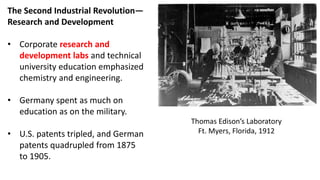
Thomas Edison’s Laboratory
Ft. Myers, Florida, 1912
The Second
Industrial
Revolution—Biology
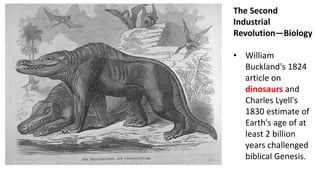
• William
Buckland's 1824
article on
dinosaurs and
Charles Lyell's
1830 estimate of
Earth's age of at
least 2 billion
years challenged
biblical Genesis.
The Second
Industrial
Revolution—
Biology
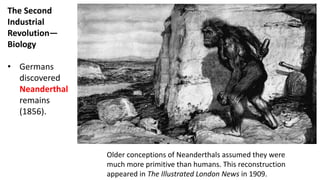
• Germans
discovered
Neanderthal
remains
(1856).
Older conceptions of Neanderthals assumed they were
much more primitive than humans. This reconstruction
appeared in The Illustrated London News in 1909.
The Second Industrial Revolution—Biology
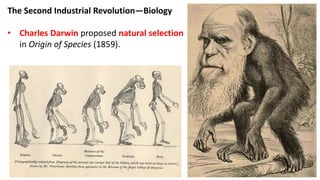
• Charles Darwin proposed natural selection
in Origin of Species (1859).
The Second Industrial Revolution—Biology
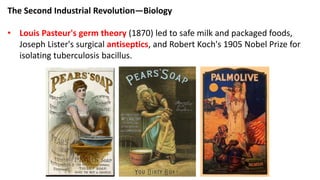
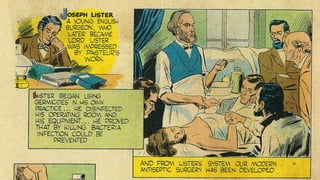
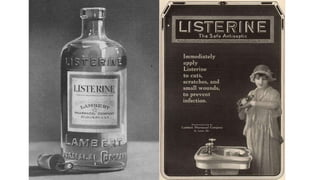
• Louis Pasteur's germ theory (1870) led to safe milk and packaged foods,
Joseph Lister's surgical antiseptics, and Robert Koch's 1905 Nobel Prize for
isolating tuberculosis bacillus.
The Second Industrial Revolution—Chemistry
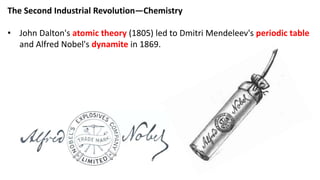
• John Dalton's atomic theory (1805) led to Dmitri Mendeleev's periodic table
and Alfred Nobel's dynamite in 1869.
The Second Industrial Revolution—
Chemistry
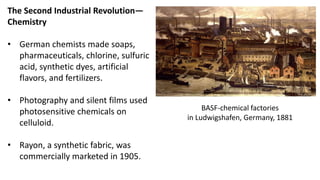
• German chemists made soaps,
pharmaceuticals, chlorine, sulfuric
acid, synthetic dyes, artificial
flavors, and fertilizers.
• Photography and silent films used
photosensitive chemicals on
celluloid.
• Rayon, a synthetic fabric, was
commercially marketed in 1905.
BASF-chemical factories
in Ludwigshafen, Germany, 1881
The Second
Industrial
Revolution—
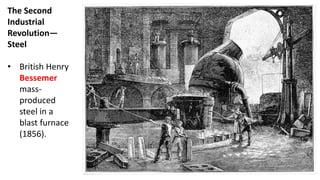
Steel
• British Henry
Bessemer
mass-
produced
steel in a
blast furnace
(1856).
The Second Industrial
Revolution—Steel
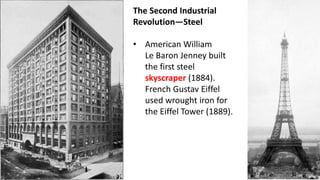
• American William
Le Baron Jenney built
the first steel
skyscraper (1884).
French Gustav Eiffel
used wrought iron for
the Eiffel Tower (1889).
The Second Industrial
Revolution—Steel
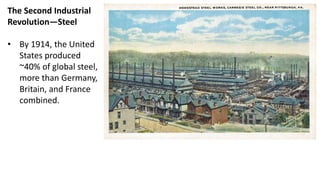
• By 1914, the United
States produced
~40% of global steel,
more than Germany,
Britain, and France
combined.
The Second Industrial Revolution—
Land Transportation
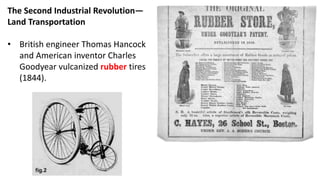
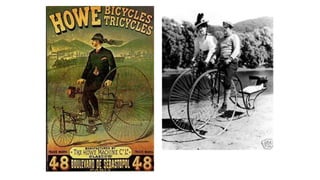
• British engineer Thomas Hancock
and American inventor Charles
Goodyear vulcanized rubber tires
(1844).
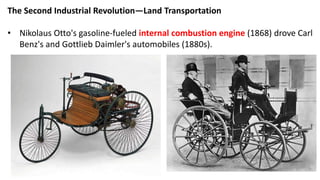
The Second Industrial Revolution—Land Transportation
• Nikolaus Otto's gasoline-fueled internal combustion engine (1868) drove Carl
Benz's and Gottlieb Daimler's automobiles (1880s).
The Second
Industrial
Revolution—
Land
Transportation
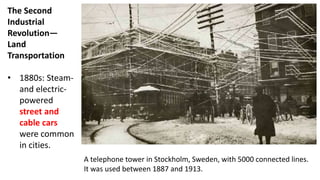
• 1880s: Steam-
and electric-
powered
street and
cable cars
were common
in cities.
A telephone tower in Stockholm, Sweden, with 5000 connected lines.
It was used between 1887 and 1913.
The Second Industrial
Revolution—Land
Transportation
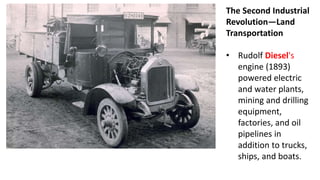
• Rudolf Diesel's
engine (1893)
powered electric
and water plants,
mining and drilling
equipment,
factories, and oil
pipelines in
addition to trucks,
ships, and boats.
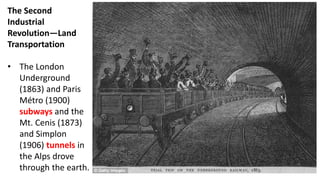
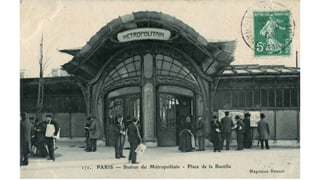
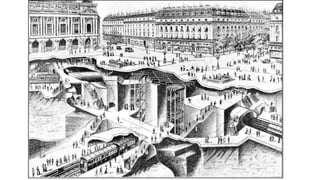
The Second
Industrial
Revolution—Land
Transportation
• The London
Underground
(1863) and Paris
Métro (1900)
subways and the
Mt. Cenis (1873)
and Simplon
(1906) tunnels in
the Alps drove
through the earth.
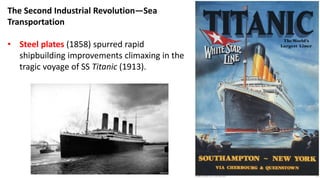
The Second Industrial Revolution—Sea
Transportation
• Steel plates (1858) spurred rapid
shipbuilding improvements climaxing in the
tragic voyage of SS Titanic (1913).
The Second
Industrial
Revolution—
Sea
Transportation
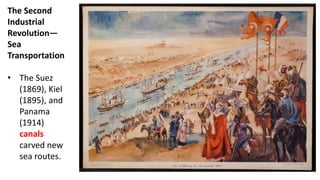
• The Suez
(1869), Kiel
(1895), and
Panama
(1914)
canals
carved new
sea routes.
The Second
Industrial
Revolution—
Sea Transportation
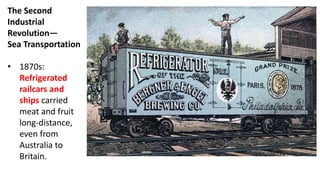
• 1870s:
Refrigerated
railcars and
ships carried
meat and fruit
long-distance,
even from
Australia to
Britain.
The Second Industrial Revolution—Sea Transportation
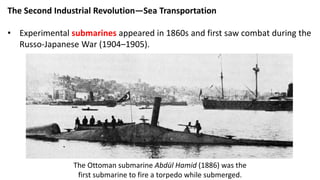
• Experimental submarines appeared in 1860s and first saw combat during the
Russo-Japanese War (1904–1905).
The Ottoman submarine Abdül Hamid (1886) was the
first submarine to fire a torpedo while submerged.
The Second
Industrial
Revolution—Sea
Transportation
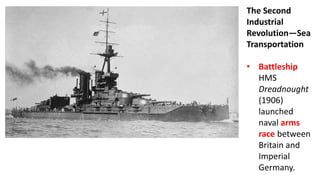
• Battleship
HMS
Dreadnought
(1906)
launched
naval arms
race between
Britain and
Imperial
Germany.
The Second
Industrial
Revolution—Air
Transportation
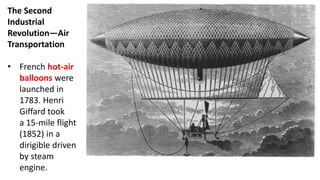
• French hot-air
balloons were
launched in
1783. Henri
Giffard took
a 15-mile flight
(1852) in a
dirigible driven
by steam
engine.
The Second
Industrial
Revolution—Air
Transportation
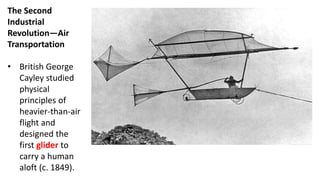
• British George
Cayley studied
physical
principles of
heavier-than-air
flight and
designed the
first glider to
carry a human
aloft (c. 1849).
The Second
Industrial
Revolution—Air
Transportation
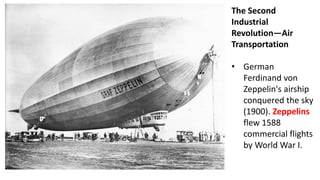
• German
Ferdinand von
Zeppelin's airship
conquered the sky
(1900). Zeppelins
flew 1588
commercial flights
by World War I.
The Second Industrial Revolution—Air Transportation
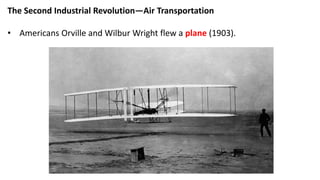
• Americans Orville and Wilbur Wright flew a plane (1903).
The Second Industrial Revolution—Electricity
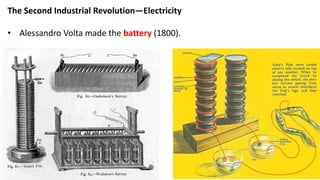
• Alessandro Volta made the battery (1800).
The Second Industrial Revolution—Electricity
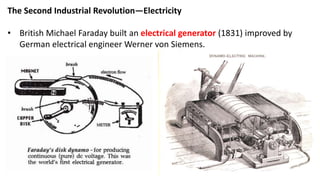
• British Michael Faraday built an electrical generator (1831) improved by
German electrical engineer Werner von Siemens.
The Second Industrial Revolution—
Electricity
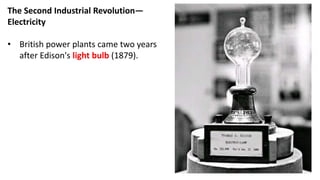
• British power plants came two years
after Edison's light bulb (1879).
The Second Industrial Revolution—Electricity
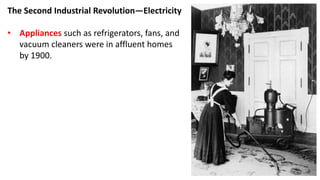
• Appliances such as refrigerators, fans, and
vacuum cleaners were in affluent homes
by 1900.
The Second Industrial Revolution—
Newspapers
• London Times was able to printed 1100
newspaper copies per hour by 1814.
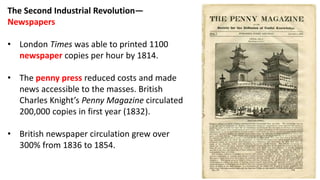
• The penny press reduced costs and made
news accessible to the masses. British
Charles Knight’s Penny Magazine circulated
200,000 copies in first year (1832).
• British newspaper circulation grew over
300% from 1836 to 1854.
The Second Industrial
Revolution—Newspapers
• Newspapers moved from
elitist to popular tones
and adopted political
biases.
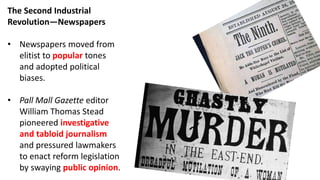
• Pall Mall Gazette editor
William Thomas Stead
pioneered investigative
and tabloid journalism
and pressured lawmakers
to enact reform legislation
by swaying public opinion.
The Second Industrial Revolution—
High-speed Communication
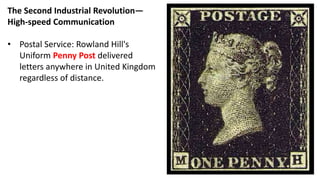
• Postal Service: Rowland Hill's
Uniform Penny Post delivered
letters anywhere in United Kingdom
regardless of distance.
The Second Industrial Revolution—High-speed Communication
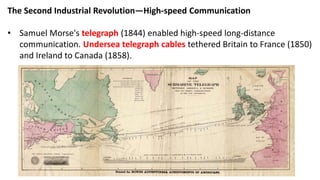
• Samuel Morse's telegraph (1844) enabled high-speed long-distance
communication. Undersea telegraph cables tethered Britain to France (1850)
and Ireland to Canada (1858).
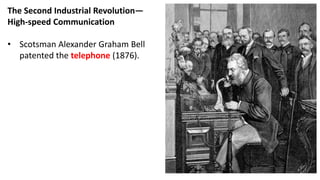
The Second Industrial Revolution—
High-speed Communication
• Scotsman Alexander Graham Bell
patented the telephone (1876).
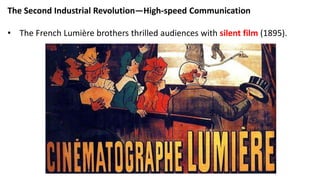
The Second Industrial Revolution—High-speed Communication
• The French Lumière brothers thrilled audiences with silent film (1895).
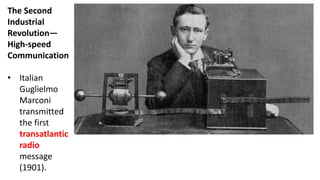
The Second
Industrial
Revolution—
High-speed
Communication
• Italian
Guglielmo
Marconi
transmitted
the first
transatlantic
radio
message
(1901).

The second industrial revolution