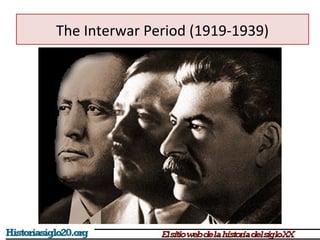
The Interwar Period (1919-1939)
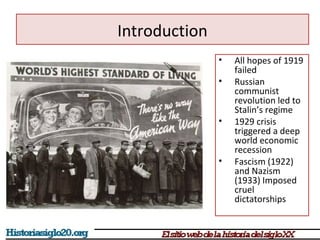
• All hopes of 1919 
failed 
• Russian 
communist 
revolution led to 
Stalin’s regime 
• 1929 crisis 
triggered a deep 
world economic 
recession 
• Fascism (1922) 
and Nazism 
(1933) Imposed 
cruel 
dictatorships 
Introduction
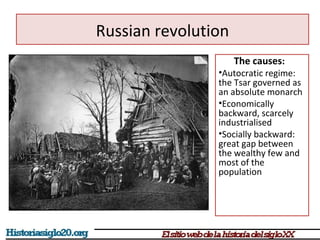
The causes: 
Russian revolution 
•Autocratic regime: 
the Tsar governed as 
an absolute monarch 
•Economically 
backward, scarcely 
industrialised 
•Socially backward: 
great gap between 
the wealthy few and 
most of the 
population
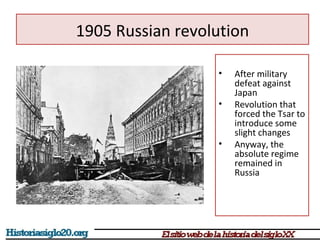
1905 Russian revolution 
• After military 
defeat against 
Japan 
• Revolution that 
forced the Tsar to 
introduce some 
slight changes 
• Anyway, the 
absolute regime 
remained in 
Russia
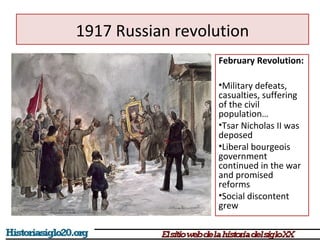
1917 Russian revolution 
February Revolution: 
•Military defeats, 
casualties, suffering 
of the civil 
population… 
•Tsar Nicholas II was 
deposed 
•Liberal bourgeois 
government 
continued in the war 
and promised 
reforms 
•Social discontent 
grew
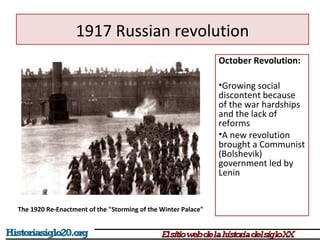
1917 Russian revolution 
October Revolution: 
•Growing social 
discontent because 
of the war hardships 
and the lack of 
reforms 
•A new revolution 
brought a Communist 
(Bolshevik) 
government led by 
Lenin 
The 1920 Re-Enactment of the "Storming of the Winter Palace"
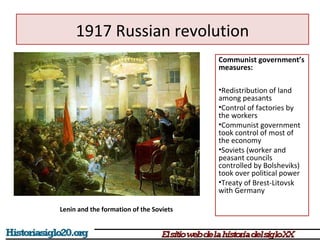
1917 Russian revolution 
Communist government’s 
measures: 
•Redistribution of land 
among peasants 
•Control of factories by 
the workers 
•Communist government 
took control of most of 
the economy 
•Soviets (worker and 
peasant councils 
controlled by Bolsheviks) 
took over political power 
•Treaty of Brest-Litovsk 
with Germany 
Lenin and the formation of the Soviets
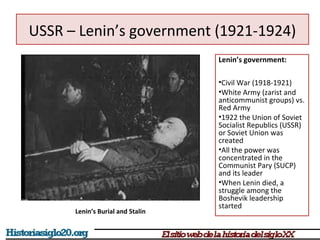
USSR – Lenin’s government (1921-1924) 
Lenin’s government: 
•Civil War (1918-1921) 
•White Army (zarist and 
anticommunist groups) vs. 
Red Army 
•1922 the Union of Soviet 
Socialist Republics (USSR) 
or Soviet Union was 
created 
•All the power was 
concentrated in the 
Communist Pary (SUCP) 
and its leader 
•When Lenin died, a 
struggle among the 
Boshevik leadership 
started 
Lenin’s Burial and Stalin
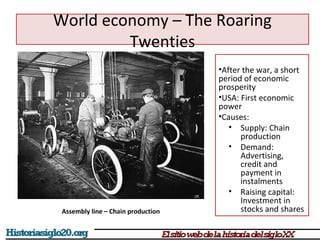
World economy – The Roaring 
•After the war, a short 
period of economic 
prosperity 
•USA: First economic 
power 
•Causes: 
• Supply: Chain 
production 
• Demand: 
Advertising, 
credit and 
payment in 
instalments 
• Raising capital: 
Investment in 
stocks and shares 
Twenties 
Assembly line – Chain production
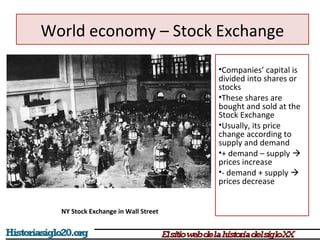
World economy – Stock Exchange 
•Companies’ capital is 
divided into shares or 
stocks 
•These shares are 
bought and sold at the 
Stock Exchange 
•Usually, its price 
change according to 
supply and demand 
•+ demand – supply  
prices increase 
•- demand + supply  
prices decrease 
NY Stock Exchange in Wall Street
World economy – Wall Street Crash 
•24 October 1929 (“Black 
Thursday”) stock prices 
plummeted 
•Why? Artificial prices of 
the shares 
•Meanwhile, 
overproduction (produce 
more than demand) 
plagued the American 
industry, shares raised 
and raised 
•Speculation (Engagement 
in risky business 
transactions on the 
chance of quick or 
considerable profit) 
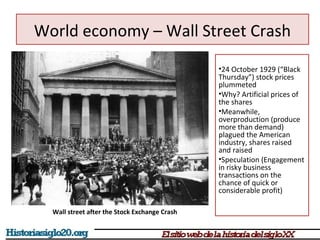
Wall street after the Stock Exchange Crash
World economy – Wall Street Crash 
•High price of the stocks 
did not correspond with 
its real value 
•Markets were growingly 
aware of this situation and 
finally stock exchange 
euphoria was substituted 
by “stock exchange 
panic”) 
•Investors tried to sell and 
sell their stocks and as a 
consequence its price fell 
and fell 
•Wall Street Crash 
triggered the 1930s 
economic depression 
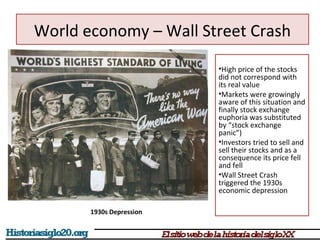
1930s Depression
World economy – 1930s Depression 
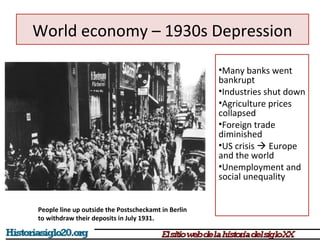
•Many banks went 
bankrupt 
•Industries shut down 
•Agriculture prices 
collapsed 
•Foreign trade 
diminished 
•US crisis  Europe 
and the world 
•Unemployment and 
social unequality 
People line up outside the Postscheckamt in Berlin 
to withdraw their deposits in July 1931.
World economy – 1930s Depression 
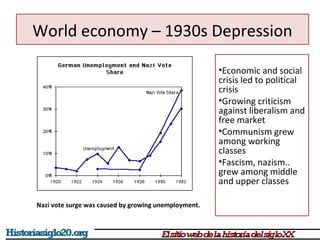
•Economic and social 
crisis led to political 
crisis 
•Growing criticism 
against liberalism and 
free market 
•Communism grew 
among working 
classes 
•Fascism, nazism.. 
grew among middle 
and upper classes 
Nazi vote surge was caused by growing unemployment.
World economy – Solutions 
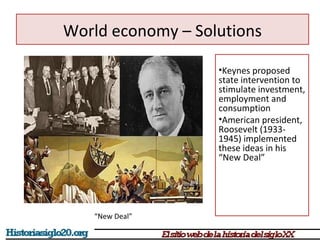
•Keynes proposed 
state intervention to 
stimulate investment, 
employment and 
consumption 
•American president, 
Roosevelt (1933- 
1945) implemented 
these ideas in his 
“New Deal” 
“New Deal”
World economy – Solutions 
American government 
intervened: 
•Banks lowered interest 
•Subsidies to farmers 
•Working hours 
reduced 
•Minimum wage 
•Unemployment 
benefits 
•Public investment in 
infrastructure 
Other (democratic or 
non democratic) 
countries intervened in 
the economy
Totalitarian regimes: Fascism and Nazism 
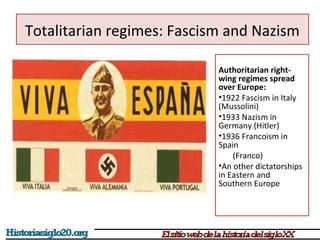
Authoritarian right-wing 
regimes spread 
over Europe: 
•1922 Fascism in Italy 
(Mussolini) 
•1933 Nazism in 
Germany (Hitler) 
•1936 Francoism in 
Spain 
(Franco) 
•An other dictatorships 
in Eastern and 
Southern Europe
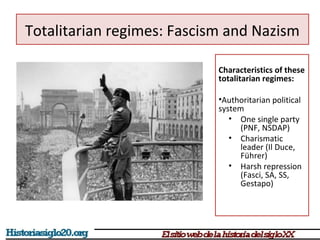
Totalitarian regimes: Fascism and Nazism 
Characteristics of these 
totalitarian regimes: 
•Authoritarian political 
system 
• One single party 
(PNF, NSDAP) 
• Charismatic 
leader (Il Duce, 
Führer) 
• Harsh repression 
(Fasci, SA, SS, 
Gestapo)
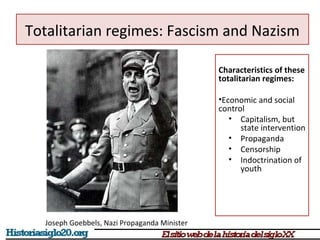
Totalitarian regimes: Fascism and Nazism 
Characteristics of these 
totalitarian regimes: 
•Economic and social 
control 
• Capitalism, but 
state intervention 
• Propaganda 
• Censorship 
• Indoctrination of 
youth 
Joseph Goebbels, Nazi Propaganda Minister
Totalitarian regimes: Fascism and Nazism 
Characteristics of these 
totalitarian regimes: 
•Ideology based on 
inequality and 
fanaticism 
• Race, Gender, 
Nation… 
Inequality 
• Irrationalism: 
symbols, 
uniforms, 
parades, songs, 
slogans…
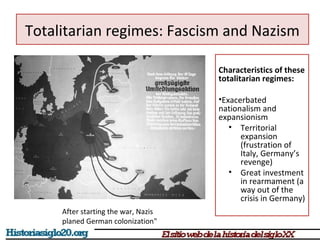
Totalitarian regimes: Fascism and Nazism 
Characteristics of these 
totalitarian regimes: 
•Exacerbated 
nationalism and 
expansionism 
• Territorial 
expansion 
(frustration of 
Italy, Germany’s 
revenge) 
• Great investment 
in rearmament (a 
way out of the 
crisis in Germany) 
After starting the war, Nazis 
planed German colonization"
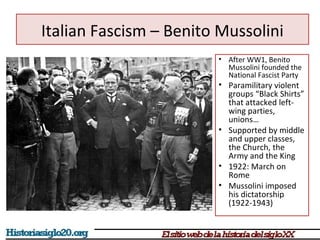
Italian Fascism – Benito Mussolini 
• After WW1, Benito 
Mussolini founded the 
National Fascist Party 
• Paramilitary violent 
groups “Black Shirts” 
that attacked left-wing 
parties, 
unions… 
• Supported by middle 
and upper classes, 
the Church, the 
Army and the King 
• 1922: March on 
Rome 
• Mussolini imposed 
his dictatorship 
(1922-1943)
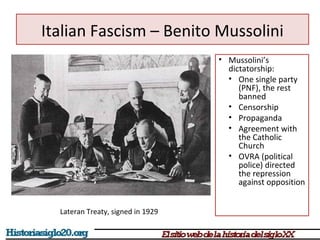
Italian Fascism – Benito Mussolini 
• Mussolini’s 
dictatorship: 
• One single party 
(PNF), the rest 
banned 
• Censorship 
• Propaganda 
• Agreement with 
the Catholic 
Church 
• OVRA (political 
police) directed 
the repression 
against opposition 
Lateran Treaty, signed in 1929
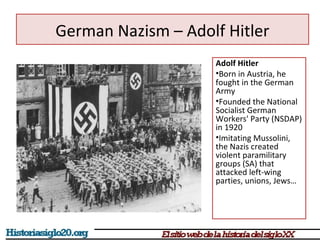
German Nazism – Adolf Hitler 
Adolf Hitler 
•Born in Austria, he 
fought in the German 
Army 
•Founded the National 
Socialist German 
Workers' Party (NSDAP) 
in 1920 
•Imitating Mussolini, 
the Nazis created 
violent paramilitary 
groups (SA) that 
attacked left-wing 
parties, unions, Jews…
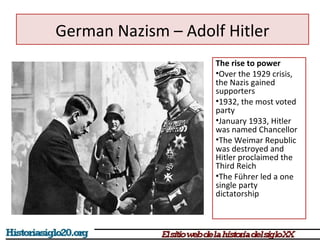
German Nazism – Adolf Hitler 
The rise to power 
•Over the 1929 crisis, 
the Nazis gained 
supporters 
•1932, the most voted 
party 
•January 1933, Hitler 
was named Chancellor 
•The Weimar Republic 
was destroyed and 
Hitler proclaimed the 
Third Reich 
•The Führer led a one 
single party 
dictatorship
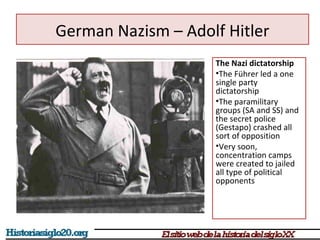
German Nazism – Adolf Hitler 
The Nazi dictatorship 
•The Führer led a one 
single party 
dictatorship 
•The paramilitary 
groups (SA and SS) and 
the secret police 
(Gestapo) crashed all 
sort of opposition 
•Very soon, 
concentration camps 
were created to jailed 
all type of political 
opponents
German Nazism – Adolf Hitler 
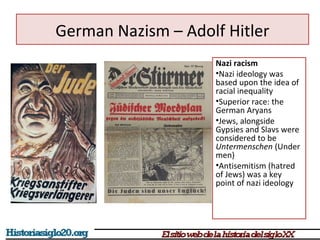
Nazi racism 
•Nazi ideology was 
based upon the idea of 
racial inequality 
•Superior race: the 
German Aryans 
•Jews, alongside 
Gypsies and Slavs were 
considered to be 
Untermenschen (Under 
men) 
•Antisemitism (hatred 
of Jews) was a key 
point of nazi ideology
German Nazism – Adolf Hitler 
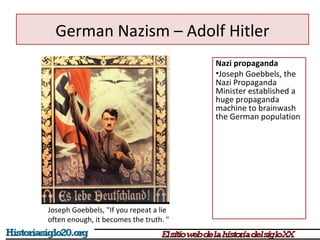
Nazi propaganda 
•Joseph Goebbels, the 
Nazi Propaganda 
Minister established a 
huge propaganda 
machine to brainwash 
the German population 
Joseph Goebbels, "If you repeat a lie 
often enough, it becomes the truth. "
German Nazism – Adolf Hitler 
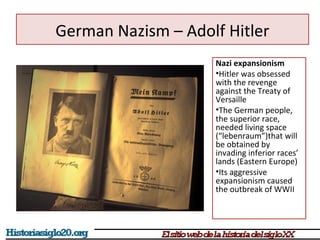
Nazi expansionism 
•Hitler was obsessed 
with the revenge 
against the Treaty of 
Versaille 
•The German people, 
the superior race, 
needed living space 
(“lebenraum”)that will 
be obtained by 
invading inferior races’ 
lands (Eastern Europe) 
•Its aggressive 
expansionism caused 
the outbreak of WWII

Interwar period

  • 1.
  • 2.
    • All hopesof 1919 failed • Russian communist revolution led to Stalin’s regime • 1929 crisis triggered a deep world economic recession • Fascism (1922) and Nazism (1933) Imposed cruel dictatorships Introduction
  • 3.
    The causes: Russianrevolution •Autocratic regime: the Tsar governed as an absolute monarch •Economically backward, scarcely industrialised •Socially backward: great gap between the wealthy few and most of the population
  • 4.
    1905 Russian revolution • After military defeat against Japan • Revolution that forced the Tsar to introduce some slight changes • Anyway, the absolute regime remained in Russia
  • 5.
    1917 Russian revolution February Revolution: •Military defeats, casualties, suffering of the civil population… •Tsar Nicholas II was deposed •Liberal bourgeois government continued in the war and promised reforms •Social discontent grew
  • 6.
    1917 Russian revolution October Revolution: •Growing social discontent because of the war hardships and the lack of reforms •A new revolution brought a Communist (Bolshevik) government led by Lenin The 1920 Re-Enactment of the "Storming of the Winter Palace"
  • 7.
    1917 Russian revolution Communist government’s measures: •Redistribution of land among peasants •Control of factories by the workers •Communist government took control of most of the economy •Soviets (worker and peasant councils controlled by Bolsheviks) took over political power •Treaty of Brest-Litovsk with Germany Lenin and the formation of the Soviets
  • 8.
    USSR – Lenin’sgovernment (1921-1924) Lenin’s government: •Civil War (1918-1921) •White Army (zarist and anticommunist groups) vs. Red Army •1922 the Union of Soviet Socialist Republics (USSR) or Soviet Union was created •All the power was concentrated in the Communist Pary (SUCP) and its leader •When Lenin died, a struggle among the Boshevik leadership started Lenin’s Burial and Stalin
  • 9.
    World economy –The Roaring •After the war, a short period of economic prosperity •USA: First economic power •Causes: • Supply: Chain production • Demand: Advertising, credit and payment in instalments • Raising capital: Investment in stocks and shares Twenties Assembly line – Chain production
  • 10.
    World economy –Stock Exchange •Companies’ capital is divided into shares or stocks •These shares are bought and sold at the Stock Exchange •Usually, its price change according to supply and demand •+ demand – supply  prices increase •- demand + supply  prices decrease NY Stock Exchange in Wall Street
  • 11.
    World economy –Wall Street Crash •24 October 1929 (“Black Thursday”) stock prices plummeted •Why? Artificial prices of the shares •Meanwhile, overproduction (produce more than demand) plagued the American industry, shares raised and raised •Speculation (Engagement in risky business transactions on the chance of quick or considerable profit) Wall street after the Stock Exchange Crash
  • 12.
    World economy –Wall Street Crash •High price of the stocks did not correspond with its real value •Markets were growingly aware of this situation and finally stock exchange euphoria was substituted by “stock exchange panic”) •Investors tried to sell and sell their stocks and as a consequence its price fell and fell •Wall Street Crash triggered the 1930s economic depression 1930s Depression
  • 13.
    World economy –1930s Depression •Many banks went bankrupt •Industries shut down •Agriculture prices collapsed •Foreign trade diminished •US crisis  Europe and the world •Unemployment and social unequality People line up outside the Postscheckamt in Berlin to withdraw their deposits in July 1931.
  • 14.
    World economy –1930s Depression •Economic and social crisis led to political crisis •Growing criticism against liberalism and free market •Communism grew among working classes •Fascism, nazism.. grew among middle and upper classes Nazi vote surge was caused by growing unemployment.
  • 15.
    World economy –Solutions •Keynes proposed state intervention to stimulate investment, employment and consumption •American president, Roosevelt (1933- 1945) implemented these ideas in his “New Deal” “New Deal”
  • 16.
    World economy –Solutions American government intervened: •Banks lowered interest •Subsidies to farmers •Working hours reduced •Minimum wage •Unemployment benefits •Public investment in infrastructure Other (democratic or non democratic) countries intervened in the economy
  • 17.
    Totalitarian regimes: Fascismand Nazism Authoritarian right-wing regimes spread over Europe: •1922 Fascism in Italy (Mussolini) •1933 Nazism in Germany (Hitler) •1936 Francoism in Spain (Franco) •An other dictatorships in Eastern and Southern Europe
  • 18.
    Totalitarian regimes: Fascismand Nazism Characteristics of these totalitarian regimes: •Authoritarian political system • One single party (PNF, NSDAP) • Charismatic leader (Il Duce, Führer) • Harsh repression (Fasci, SA, SS, Gestapo)
  • 19.
    Totalitarian regimes: Fascismand Nazism Characteristics of these totalitarian regimes: •Economic and social control • Capitalism, but state intervention • Propaganda • Censorship • Indoctrination of youth Joseph Goebbels, Nazi Propaganda Minister
  • 20.
    Totalitarian regimes: Fascismand Nazism Characteristics of these totalitarian regimes: •Ideology based on inequality and fanaticism • Race, Gender, Nation… Inequality • Irrationalism: symbols, uniforms, parades, songs, slogans…
  • 21.
    Totalitarian regimes: Fascismand Nazism Characteristics of these totalitarian regimes: •Exacerbated nationalism and expansionism • Territorial expansion (frustration of Italy, Germany’s revenge) • Great investment in rearmament (a way out of the crisis in Germany) After starting the war, Nazis planed German colonization"
  • 22.
    Italian Fascism –Benito Mussolini • After WW1, Benito Mussolini founded the National Fascist Party • Paramilitary violent groups “Black Shirts” that attacked left-wing parties, unions… • Supported by middle and upper classes, the Church, the Army and the King • 1922: March on Rome • Mussolini imposed his dictatorship (1922-1943)
  • 23.
    Italian Fascism –Benito Mussolini • Mussolini’s dictatorship: • One single party (PNF), the rest banned • Censorship • Propaganda • Agreement with the Catholic Church • OVRA (political police) directed the repression against opposition Lateran Treaty, signed in 1929
  • 24.
    German Nazism –Adolf Hitler Adolf Hitler •Born in Austria, he fought in the German Army •Founded the National Socialist German Workers' Party (NSDAP) in 1920 •Imitating Mussolini, the Nazis created violent paramilitary groups (SA) that attacked left-wing parties, unions, Jews…
  • 25.
    German Nazism –Adolf Hitler The rise to power •Over the 1929 crisis, the Nazis gained supporters •1932, the most voted party •January 1933, Hitler was named Chancellor •The Weimar Republic was destroyed and Hitler proclaimed the Third Reich •The Führer led a one single party dictatorship
  • 26.
    German Nazism –Adolf Hitler The Nazi dictatorship •The Führer led a one single party dictatorship •The paramilitary groups (SA and SS) and the secret police (Gestapo) crashed all sort of opposition •Very soon, concentration camps were created to jailed all type of political opponents
  • 27.
    German Nazism –Adolf Hitler Nazi racism •Nazi ideology was based upon the idea of racial inequality •Superior race: the German Aryans •Jews, alongside Gypsies and Slavs were considered to be Untermenschen (Under men) •Antisemitism (hatred of Jews) was a key point of nazi ideology
  • 28.
    German Nazism –Adolf Hitler Nazi propaganda •Joseph Goebbels, the Nazi Propaganda Minister established a huge propaganda machine to brainwash the German population Joseph Goebbels, "If you repeat a lie often enough, it becomes the truth. "
  • 29.
    German Nazism –Adolf Hitler Nazi expansionism •Hitler was obsessed with the revenge against the Treaty of Versaille •The German people, the superior race, needed living space (“lebenraum”)that will be obtained by invading inferior races’ lands (Eastern Europe) •Its aggressive expansionism caused the outbreak of WWII