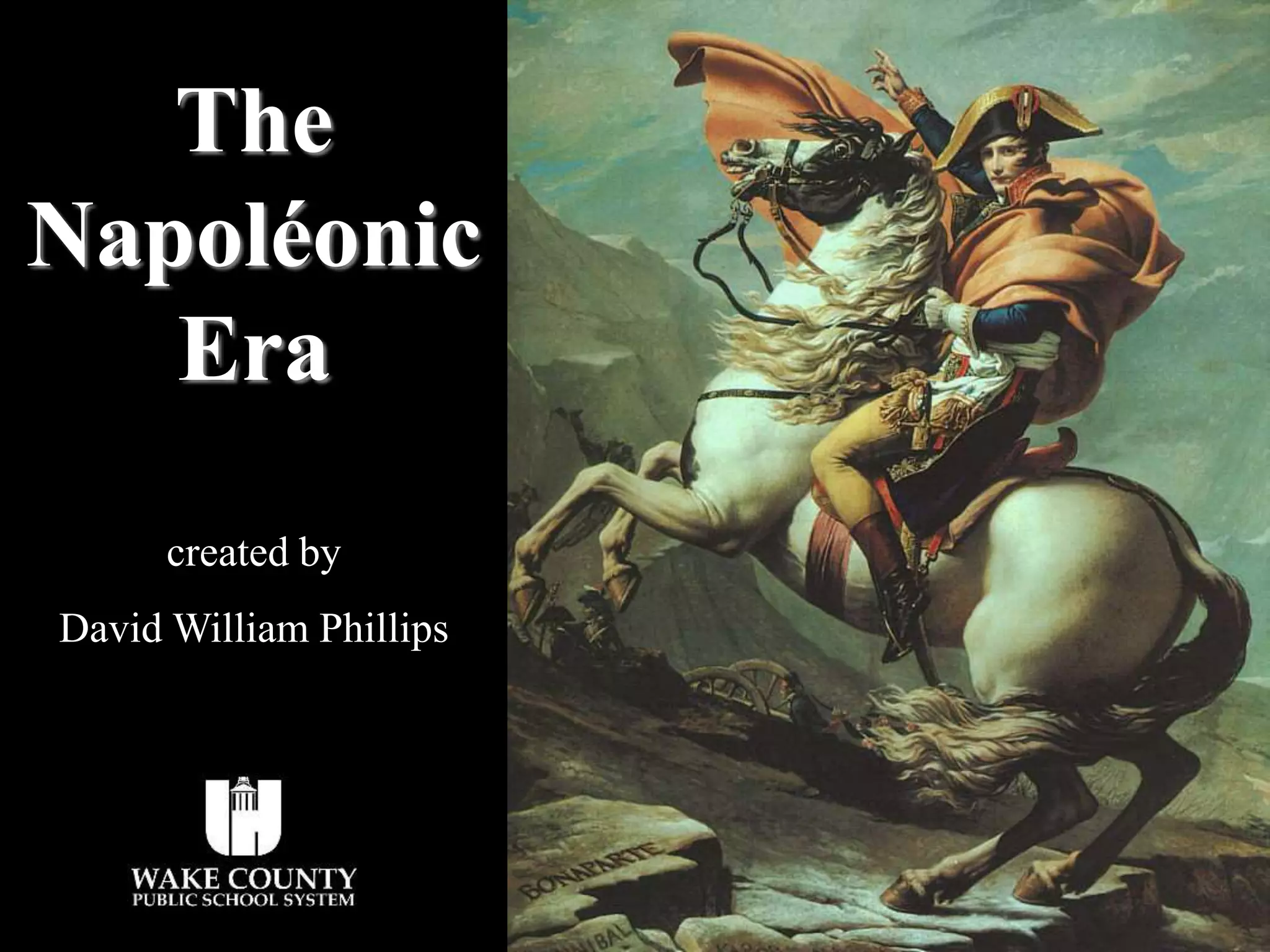
The
Napoléonic
Era
created by
David William Phillips
France, 1789
January 21, 1793
King Louis XVI …
The French Republic is born.
The young Republic faces many foes.
It is in imminent danger of defeat.
The port city of Toulon
is besieged by British forces.
As the French fight to retake the city,
their commanding general is wounded.
A young
officer
named
Napoleo
Bonapart
takes
command.
The man who
would later
become Emperor
of France and
of Europe was
on the poor
Mediterranean
Island of Corsica.
Napoleon was a brilliant,
young, untested artillery
officer when the Revolution
erupted.
1793
The Siege of Toulon
Napoleon drove the
British fleet from the
harbor and liberated
the important port.
At the age of 24,
Napoleon is a
national hero.
He is raised to
the rank of
brigadier
general.
Napoleon was
given command
of the French
forces fighting
in
1796
The Italian
Campaign
Italy.
There, through a series of
victories, he forced Austria to
surrender.
He negotiated the peace treaty
himself. It allowed France to keep
its conquests.
Napoleon’s
fame grew.
Rumors of a
military
began but his
time has not
yet arrived.
To disrupt British trade with India,
Napoleon invaded and conquered Egypt.
The British
naval
commander,
Horatio
pursued the
French fleet to
the mouth of
the Nile River.
1798
The Battle of the Nile
After Napoleon landed his troops,
Nelson destroyed the French ships
transporting his army.
The French forces were stranded in Egypt.
French troops
made a great
discovery: the
Rosetta Stone.
Scholars with
Napoleon’s
expedition
began to unravel
the mysteries of
ancient Egypt’s
history.
In 1799, Napoleon left his
army and returned to Paris.
There, he joined a
conspiracy to
conduct a coup
d’etat
- a plot to overthrow
the leaders of the
Revolutionary
government,
seize power, and
establish a new
government.
1799
First Consul
Napoleon was named
First Consul and held
dictatorial powers.
He declared:
“ The Revolution is
over.
I am the Revolution. ”
1800
The Battle of
Marengo
Napoleon secured
his power by
crossing the Alps
and defeating the
Austrians once
more.
1800
The Battle of
Marengo
Napoleon secured
his power by
crossing the Alps
and defeating the
Austrians once
more.
In 1802, he negotiated a peace
with the other nations of Europe
ending the long wars of the
Revolution.
1804
Napoleon
crowned himself
Emperor of the
French.
French law was standardized in
the Napoléonic Code.
It guaranted the rights and
liberties won during the
Revolution.
Napoleon assembled 200,000
battle-hardened veterans to
invade Britain, his greatest rival.
But before the French could launch
Admiral Nelson engaged the
French fleet off the coast of Spain.
1805
The Battle of Trafalgar
Nelson defeated the French fleet.
However, he was mortally wounded
and died as the battle drew to a close.
This
British
victory
ended
Napoleon's
plans for
invading
Britain.
But Napoleon
marched his army
1000 miles, defeated
Austria, and occupied
Vienna!
Striking Napoleon
at a weak moment,
Austria and
Russia declared
war
on France!
Vastly outnumbered, Napoleon
defeated a combined Austrian
and Russian army using superior
tactics. It was his finest victory.
1805
The Battle of Austerlitz
Fearing Napoleon’s growing
power, Prussia declared war
against France after Austria’s
fall. Napoleon easily
captured Berlin and forced
Prussia’s surrender..
1806
Capture of
Berlin
Napoleon then negotiated peace
with Tsar Alexander of Russia and
became Master of Continental
Europe.
The Third of May 1808, Francisco Goya
Napoleon ordered
a complete stop to
trade with Britain
by all European
nations in order to
starve the island
nation.
The embargo was
called the
Continental
1812
Russia
Tsar Alexander refused
to stop trade with Britain.
Napoleon invaded Russia
with his 500,000 man Grand Army.
The campaign was a disaster.
After a long, deadly retreat,
Napoleon escaped Russia with just 10,000
men.
April,
1814
Facing
overwhelming
odds,
Napoleon’s
commanding
officers
refused to
fight on.
Napoleon was arrested by
Britain, Austria, Prussia,
and Russia and exiled to
the Mediterranean island
of Elba.
The Allies
restored the
French monarchy
by the placing the
younger brother
of the executed
Louis XVI on the
throne as King
Louis XVIII.
March, 1815
When he reached
France, Louis
XVIII sent an
army to capture
Napoleon.
But in an
impassioned speech
Napoleon persuaded
the troops sent to
arrest him to instead
follow him.
Napoleon
triumphantly
returned to Paris and
reigned for 100
Days.
June 18,
1815
The Battle of
Waterloo
Napoleon fought his
last, desperate battle.
Arthur
Wellesley, the
British Duke of
Wellington,
coalition of
European forces
against
Napoleon.
Napoleon was delivered a final defeat.
Napoleon was exiled to Saint Helena,
a remote island in the South Atlantic.
He died May 5, 1821.
Napoleon believed
he had preserved
the achievements
of the French
Revolution and
shared the benefits
with Europe.
His goal, he said,
was to create a
European state - a
“federation of
free peoples.”
Napoleon’s remains were returned to
France.
He is
honored as a
great hero.
1814-1815
The Congress of
Vienna
An international
peace conference
was held to restore
traditional
monarchs to power
and re-draw
Europe’s borders.
For thirty years
after the
Napoleonic Wars,
the Austrian
prince
Metternich
dominated
European
politics.
He was a
conservative who
worked to crush the
liberal ideas of the
French Revolution
and restore power to
kings and traditional
nobles.
But Metternich only
delayed Europe’s
The Revolution’s ideas
had taken root.
By 1848, Europe
erupted in revolutionary
chaos.

The napoleonic era