The Multiplier
Lower 6th Macro
National Income
Intro to the
Multiplier
The Multiplier
Mr O’Grady
Intro to the Multiplier
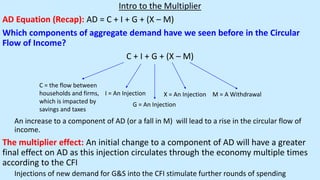
AD Equation (Recap): AD = C + I + G + (X – M)
Which components of aggregate demand have we seen before in the Circular
Flow of Income?
C + I + G + (X – M)
An increase to a component of AD (or a fall in M) will lead to a rise in the circular flow of
income.
The multiplier effect: An initial change to a component of AD will have a greater
final effect on AD as this injection circulates through the economy multiple times
according to the CFI
Injections of new demand for G&S into the CFI stimulate further rounds of spending
C = the flow between
households and firms,
which is impacted by
savings and taxes
I = An Injection
G = An Injection
X = An Injection M = A Withdrawal
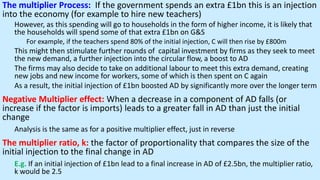
The multiplier Process: If the government spends an extra £1bn this is an injection
into the economy (for example to hire new teachers)
However, as this spending will go to households in the form of higher income, it is likely that
the households will spend some of that extra £1bn on G&S
For example, if the teachers spend 80% of the initial injection, C will then rise by £800m
This might then stimulate further rounds of capital investment by firms as they seek to meet
the new demand, a further injection into the circular flow, a boost to AD
The firms may also decide to take on additional labour to meet this extra demand, creating
new jobs and new income for workers, some of which is then spent on C again
As a result, the initial injection of £1bn boosted AD by significantly more over the longer term
Negative Multiplier effect: When a decrease in a component of AD falls (or
increase if the factor is imports) leads to a greater fall in AD than just the initial
change
Analysis is the same as for a positive multiplier effect, just in reverse
The multiplier ratio, k: the factor of proportionality that compares the size of the
initial injection to the final change in AD
E.g. If an initial injection of £1bn lead to a final increase in AD of £2.5bn, the multiplier ratio,
k would be 2.5
Calculating
the Multiplier
Ratio
The Multiplier
Mr O’Grady
Calculating the Multiplier Ratio
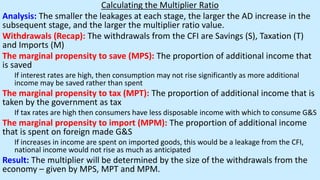
Analysis: The smaller the leakages at each stage, the larger the AD increase in the
subsequent stage, and the larger the multiplier ratio value.
Withdrawals (Recap): The withdrawals from the CFI are Savings (S), Taxation (T)
and Imports (M)
The marginal propensity to save (MPS): The proportion of additional income that
is saved
If interest rates are high, then consumption may not rise significantly as more additional
income may be saved rather than spent
The marginal propensity to tax (MPT): The proportion of additional income that is
taken by the government as tax
If tax rates are high then consumers have less disposable income with which to consume G&S
The marginal propensity to import (MPM): The proportion of additional income
that is spent on foreign made G&S
If increases in income are spent on imported goods, this would be a leakage from the CFI,
national income would not rise as much as anticipated
Result: The multiplier will be determined by the size of the withdrawals from the
economy – given by MPS, MPT and MPM.
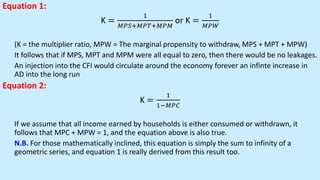
Equation 1:
K =
1
𝑀𝑃𝑆+𝑀𝑃𝑇+𝑀𝑃𝑀
or K =
1
𝑀𝑃𝑊
(K = the multiplier ratio, MPW = The marginal propensity to withdraw, MPS + MPT + MPW)
It follows that if MPS, MPT and MPM were all equal to zero, then there would be no leakages.
An injection into the CFI would circulate around the economy forever an infinte increase in
AD into the long run
Equation 2:
K =
1
1−𝑀𝑃𝐶
If we assume that all income earned by households is either consumed or withdrawn, it
follows that MPC + MPW = 1, and the equation above is also true.
N.B. For those mathematically inclined, this equation is simply the sum to infinity of a
geometric series, and equation 1 is really derived from this result too.
Factors
Affecting the
Multiplier
The Multiplier
Mr O’Grady
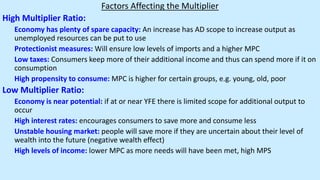
Factors Affecting the Multiplier
High Multiplier Ratio:
Economy has plenty of spare capacity: An increase has AD scope to increase output as
unemployed resources can be put to use
Protectionist measures: Will ensure low levels of imports and a higher MPC
Low taxes: Consumers keep more of their additional income and thus can spend more if it on
consumption
High propensity to consume: MPC is higher for certain groups, e.g. young, old, poor
Low Multiplier Ratio:
Economy is near potential: if at or near YFE there is limited scope for additional output to
occur
High interest rates: encourages consumers to save more and consume less
Unstable housing market: people will save more if they are uncertain about their level of
wealth into the future (negative wealth effect)
High levels of income: lower MPC as more needs will have been met, high MPS
Significance of
AD on the
Multiplier
The Multiplier
Mr O’Grady
Price
Level
LRAS
P
AD
Significance of AD on the Multiplier
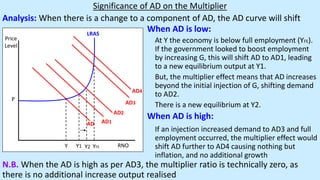
Analysis: When there is a change to a component of AD, the AD curve will shift
YFE
AD3
Y1
AD1
AD4
AD2
Y2
When AD is low:
At Y the economy is below full employment (YFE).
If the government looked to boost employment
by increasing G, this will shift AD to AD1, leading
to a new equilibrium output at Y1.
But, the multiplier effect means that AD increases
beyond the initial injection of G, shifting demand
to AD2.
There is a new equilibrium at Y2.
When AD is high:
If an injection increased demand to AD3 and full
employment occurred, the multiplier effect would
shift AD further to AD4 causing nothing but
inflation, and no additional growth
N.B. When the AD is high as per AD3, the multiplier ratio is technically zero, as
there is no additional increase output realised
RNOY
Where next?
Don’t forget to SUBSCRIBE!
Visit our website: www.smootheconomics.co.uk
Find more resources, extension materials,
details of courses, competitions, and more!
Follow our socials:
Instagram: @smootheconomics
Twitter: @SmoothEconomics
Facebook: @SmoothEconomics

The Multiplier

  • 1.
    The Multiplier Lower 6thMacro National Income
  • 2.
    Intro to the Multiplier TheMultiplier Mr O’Grady
  • 3.
    Intro to theMultiplier AD Equation (Recap): AD = C + I + G + (X – M) Which components of aggregate demand have we seen before in the Circular Flow of Income? C + I + G + (X – M) An increase to a component of AD (or a fall in M) will lead to a rise in the circular flow of income. The multiplier effect: An initial change to a component of AD will have a greater final effect on AD as this injection circulates through the economy multiple times according to the CFI Injections of new demand for G&S into the CFI stimulate further rounds of spending C = the flow between households and firms, which is impacted by savings and taxes I = An Injection G = An Injection X = An Injection M = A Withdrawal
  • 4.
    The multiplier Process:If the government spends an extra £1bn this is an injection into the economy (for example to hire new teachers) However, as this spending will go to households in the form of higher income, it is likely that the households will spend some of that extra £1bn on G&S For example, if the teachers spend 80% of the initial injection, C will then rise by £800m This might then stimulate further rounds of capital investment by firms as they seek to meet the new demand, a further injection into the circular flow, a boost to AD The firms may also decide to take on additional labour to meet this extra demand, creating new jobs and new income for workers, some of which is then spent on C again As a result, the initial injection of £1bn boosted AD by significantly more over the longer term Negative Multiplier effect: When a decrease in a component of AD falls (or increase if the factor is imports) leads to a greater fall in AD than just the initial change Analysis is the same as for a positive multiplier effect, just in reverse The multiplier ratio, k: the factor of proportionality that compares the size of the initial injection to the final change in AD E.g. If an initial injection of £1bn lead to a final increase in AD of £2.5bn, the multiplier ratio, k would be 2.5
  • 5.
  • 6.
    Calculating the MultiplierRatio Analysis: The smaller the leakages at each stage, the larger the AD increase in the subsequent stage, and the larger the multiplier ratio value. Withdrawals (Recap): The withdrawals from the CFI are Savings (S), Taxation (T) and Imports (M) The marginal propensity to save (MPS): The proportion of additional income that is saved If interest rates are high, then consumption may not rise significantly as more additional income may be saved rather than spent The marginal propensity to tax (MPT): The proportion of additional income that is taken by the government as tax If tax rates are high then consumers have less disposable income with which to consume G&S The marginal propensity to import (MPM): The proportion of additional income that is spent on foreign made G&S If increases in income are spent on imported goods, this would be a leakage from the CFI, national income would not rise as much as anticipated Result: The multiplier will be determined by the size of the withdrawals from the economy – given by MPS, MPT and MPM.
  • 7.
    Equation 1: K = 1 𝑀𝑃𝑆+𝑀𝑃𝑇+𝑀𝑃𝑀 orK = 1 𝑀𝑃𝑊 (K = the multiplier ratio, MPW = The marginal propensity to withdraw, MPS + MPT + MPW) It follows that if MPS, MPT and MPM were all equal to zero, then there would be no leakages. An injection into the CFI would circulate around the economy forever an infinte increase in AD into the long run Equation 2: K = 1 1−𝑀𝑃𝐶 If we assume that all income earned by households is either consumed or withdrawn, it follows that MPC + MPW = 1, and the equation above is also true. N.B. For those mathematically inclined, this equation is simply the sum to infinity of a geometric series, and equation 1 is really derived from this result too.
  • 8.
  • 9.
    Factors Affecting theMultiplier High Multiplier Ratio: Economy has plenty of spare capacity: An increase has AD scope to increase output as unemployed resources can be put to use Protectionist measures: Will ensure low levels of imports and a higher MPC Low taxes: Consumers keep more of their additional income and thus can spend more if it on consumption High propensity to consume: MPC is higher for certain groups, e.g. young, old, poor Low Multiplier Ratio: Economy is near potential: if at or near YFE there is limited scope for additional output to occur High interest rates: encourages consumers to save more and consume less Unstable housing market: people will save more if they are uncertain about their level of wealth into the future (negative wealth effect) High levels of income: lower MPC as more needs will have been met, high MPS
  • 10.
    Significance of AD onthe Multiplier The Multiplier Mr O’Grady
  • 11.
    Price Level LRAS P AD Significance of ADon the Multiplier Analysis: When there is a change to a component of AD, the AD curve will shift YFE AD3 Y1 AD1 AD4 AD2 Y2 When AD is low: At Y the economy is below full employment (YFE). If the government looked to boost employment by increasing G, this will shift AD to AD1, leading to a new equilibrium output at Y1. But, the multiplier effect means that AD increases beyond the initial injection of G, shifting demand to AD2. There is a new equilibrium at Y2. When AD is high: If an injection increased demand to AD3 and full employment occurred, the multiplier effect would shift AD further to AD4 causing nothing but inflation, and no additional growth N.B. When the AD is high as per AD3, the multiplier ratio is technically zero, as there is no additional increase output realised RNOY
  • 12.
    Where next? Don’t forgetto SUBSCRIBE! Visit our website: www.smootheconomics.co.uk Find more resources, extension materials, details of courses, competitions, and more! Follow our socials: Instagram: @smootheconomics Twitter: @SmoothEconomics Facebook: @SmoothEconomics