Government
Failure
Lower 6th Micro
Nature of Economics
Intro to
Government
Failure
Government Failure
Mr O’Grady
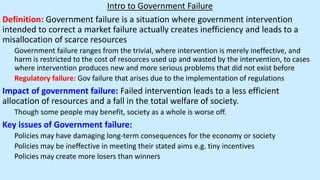
Intro to Government Failure
Definition: Government failure is a situation where government intervention
intended to correct a market failure actually creates inefficiency and leads to a
misallocation of scarce resources
Government failure ranges from the trivial, where intervention is merely ineffective, and
harm is restricted to the cost of resources used up and wasted by the intervention, to cases
where intervention produces new and more serious problems that did not exist before
Regulatory failure: Gov failure that arises due to the implementation of regulations
Impact of government failure: Failed intervention leads to a less efficient
allocation of resources and a fall in the total welfare of society.
Though some people may benefit, society as a whole is worse off.
Key issues of Government failure:
Policies may have damaging long-term consequences for the economy or society
Policies may be ineffective in meeting their stated aims e.g. tiny incentives
Policies may create more losers than winners
Causes of
Government
Failure
Government Failure
Mr O’Grady
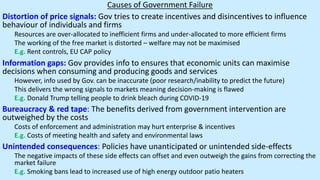
Causes of Government Failure
Distortion of price signals: Gov tries to create incentives and disincentives to influence
behaviour of individuals and firms
Resources are over-allocated to inefficient firms and under-allocated to more efficient firms
The working of the free market is distorted – welfare may not be maximised
E.g. Rent controls, EU CAP policy
Information gaps: Gov provides info to ensures that economic units can maximise
decisions when consuming and producing goods and services
However, info used by Gov. can be inaccurate (poor research/inability to predict the future)
This delivers the wrong signals to markets meaning decision-making is flawed
E.g. Donald Trump telling people to drink bleach during COVID-19
Bureaucracy & red tape: The benefits derived from government intervention are
outweighed by the costs
Costs of enforcement and administration may hurt enterprise & incentives
E.g. Costs of meeting health and safety and environmental laws
Unintended consequences: Policies have unanticipated or unintended side-effects
The negative impacts of these side effects can offset and even outweigh the gains from correcting the
market failure
E.g. Smoking bans lead to increased use of high energy outdoor patio heaters
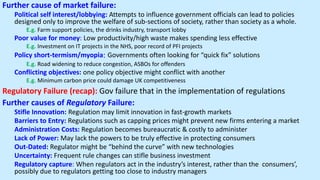
Further cause of market failure:
Political self interest/lobbying: Attempts to influence government officials can lead to policies
designed only to improve the welfare of sub-sections of society, rather than society as a whole.
E.g. Farm support policies, the drinks industry, transport lobby
Poor value for money: Low productivity/high waste makes spending less effective
E.g. Investment on IT projects in the NHS, poor record of PFI projects
Policy short-termism/myopia: Governments often looking for “quick fix” solutions
E.g. Road widening to reduce congestion, ASBOs for offenders
Conflicting objectives: one policy objective might conflict with another
E.g. Minimum carbon price could damage UK competitiveness
Regulatory Failure (recap): Gov failure that in the implementation of regulations
Further causes of Regulatory Failure:
Stifle Innovation: Regulation may limit innovation in fast-growth markets
Barriers to Entry: Regulations such as capping prices might prevent new firms entering a market
Administration Costs: Regulation becomes bureaucratic & costly to administer
Lack of Power: May lack the powers to be truly effective in protecting consumers
Out-Dated: Regulator might be “behind the curve” with new technologies
Uncertainty: Frequent rule changes can stifle business investment
Regulatory capture: When regulators act in the industry’s interest, rather than the consumers’,
possibly due to regulators getting too close to industry managers
Where next?
Don’t forget to SUBSCRIBE!
Visit our website: www.smootheconomics.co.uk
Find more resources, extension materials,
details of courses, competitions, and more!
Follow our socials:
Instagram: @smootheconomics
Twitter: @SmoothEconomics
Facebook: @SmoothEconomics

Government Failure

  • 1.
  • 2.
  • 3.
    Intro to GovernmentFailure Definition: Government failure is a situation where government intervention intended to correct a market failure actually creates inefficiency and leads to a misallocation of scarce resources Government failure ranges from the trivial, where intervention is merely ineffective, and harm is restricted to the cost of resources used up and wasted by the intervention, to cases where intervention produces new and more serious problems that did not exist before Regulatory failure: Gov failure that arises due to the implementation of regulations Impact of government failure: Failed intervention leads to a less efficient allocation of resources and a fall in the total welfare of society. Though some people may benefit, society as a whole is worse off. Key issues of Government failure: Policies may have damaging long-term consequences for the economy or society Policies may be ineffective in meeting their stated aims e.g. tiny incentives Policies may create more losers than winners
  • 4.
  • 5.
    Causes of GovernmentFailure Distortion of price signals: Gov tries to create incentives and disincentives to influence behaviour of individuals and firms Resources are over-allocated to inefficient firms and under-allocated to more efficient firms The working of the free market is distorted – welfare may not be maximised E.g. Rent controls, EU CAP policy Information gaps: Gov provides info to ensures that economic units can maximise decisions when consuming and producing goods and services However, info used by Gov. can be inaccurate (poor research/inability to predict the future) This delivers the wrong signals to markets meaning decision-making is flawed E.g. Donald Trump telling people to drink bleach during COVID-19 Bureaucracy & red tape: The benefits derived from government intervention are outweighed by the costs Costs of enforcement and administration may hurt enterprise & incentives E.g. Costs of meeting health and safety and environmental laws Unintended consequences: Policies have unanticipated or unintended side-effects The negative impacts of these side effects can offset and even outweigh the gains from correcting the market failure E.g. Smoking bans lead to increased use of high energy outdoor patio heaters
  • 6.
    Further cause ofmarket failure: Political self interest/lobbying: Attempts to influence government officials can lead to policies designed only to improve the welfare of sub-sections of society, rather than society as a whole. E.g. Farm support policies, the drinks industry, transport lobby Poor value for money: Low productivity/high waste makes spending less effective E.g. Investment on IT projects in the NHS, poor record of PFI projects Policy short-termism/myopia: Governments often looking for “quick fix” solutions E.g. Road widening to reduce congestion, ASBOs for offenders Conflicting objectives: one policy objective might conflict with another E.g. Minimum carbon price could damage UK competitiveness Regulatory Failure (recap): Gov failure that in the implementation of regulations Further causes of Regulatory Failure: Stifle Innovation: Regulation may limit innovation in fast-growth markets Barriers to Entry: Regulations such as capping prices might prevent new firms entering a market Administration Costs: Regulation becomes bureaucratic & costly to administer Lack of Power: May lack the powers to be truly effective in protecting consumers Out-Dated: Regulator might be “behind the curve” with new technologies Uncertainty: Frequent rule changes can stifle business investment Regulatory capture: When regulators act in the industry’s interest, rather than the consumers’, possibly due to regulators getting too close to industry managers
  • 7.
    Where next? Don’t forgetto SUBSCRIBE! Visit our website: www.smootheconomics.co.uk Find more resources, extension materials, details of courses, competitions, and more! Follow our socials: Instagram: @smootheconomics Twitter: @SmoothEconomics Facebook: @SmoothEconomics