Policies to
Correct Current
Account
Imbalances
Upper 6th Macro
International Economics
Expenditure
Reducing
Policies
Policies to Correct Current Account
Imbalances
Mr O’Grady
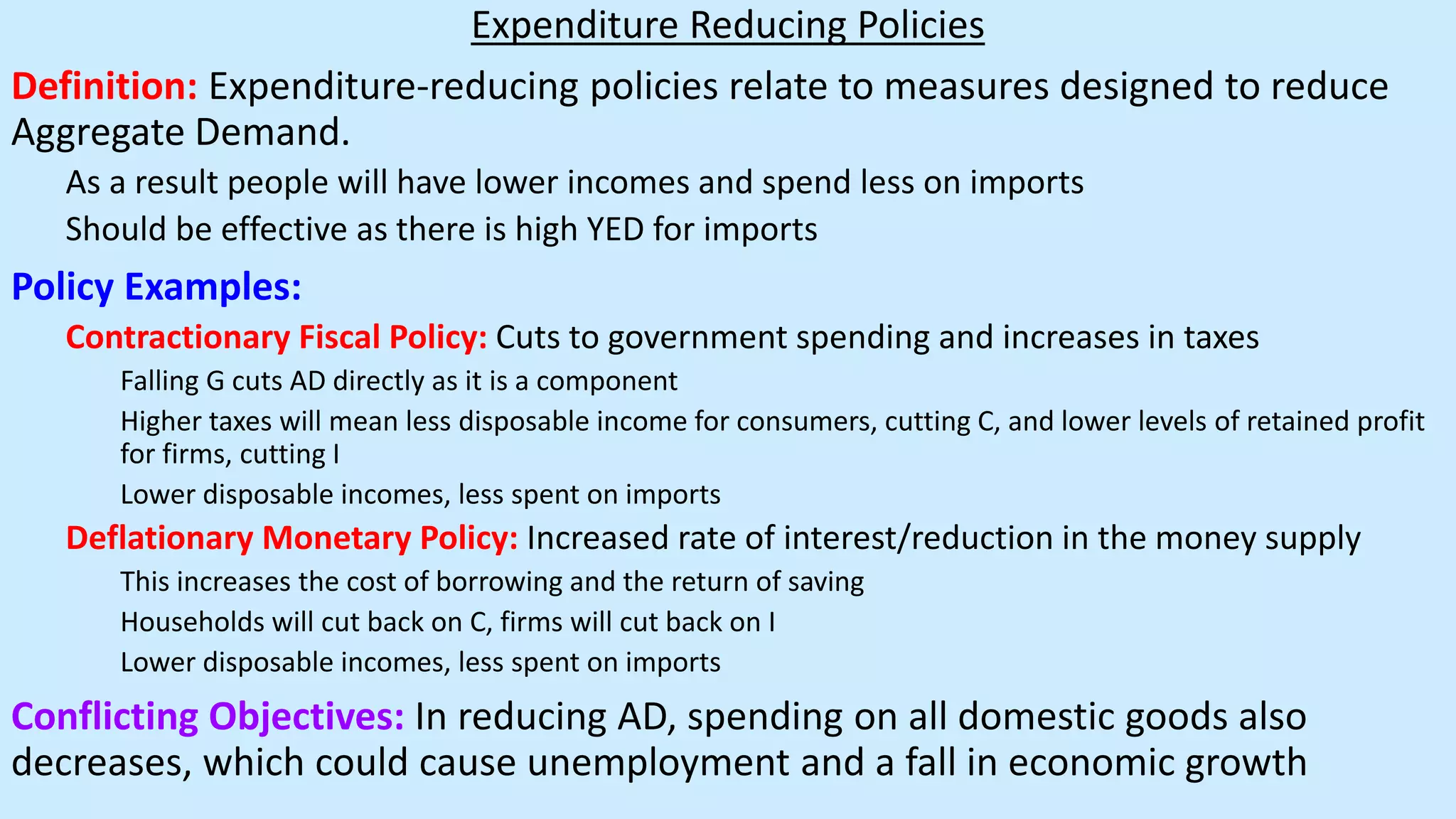
Expenditure Reducing Policies
Definition: Expenditure-reducing policies relate to measures designed to reduce
Aggregate Demand.
As a result people will have lower incomes and spend less on imports
Should be effective as there is high YED for imports
Policy Examples:
Contractionary Fiscal Policy: Cuts to government spending and increases in taxes
Falling G cuts AD directly as it is a component
Higher taxes will mean less disposable income for consumers, cutting C, and lower levels of retained profit
for firms, cutting I
Lower disposable incomes, less spent on imports
Deflationary Monetary Policy: Increased rate of interest/reduction in the money supply
This increases the cost of borrowing and the return of saving
Households will cut back on C, firms will cut back on I
Lower disposable incomes, less spent on imports
Conflicting Objectives: In reducing AD, spending on all domestic goods also
decreases, which could cause unemployment and a fall in economic growth
Expenditure
Switching
Policies
Policies to Correct Current Account
Imbalances
Mr O’Grady
Expenditure Switching Policies
Definition: Expenditure-switching policies are measures to encourage people to
buy domestic goods rather than imports
M should fall whilst X remains constant – improving CA balance
Policy Examples:
Protectionist measures: Implementation of restrictions on trade in G&S between countries
Tariffs: Taxes on imports, making them comparatively more expensive than domestic products
Quotas: Limits on the amount of imports that can come into an economy
Should directly restrict M
Currency Devaluation: The deliberate downward adjustment in the official exchange rate.
This will makes exports cheaper and imports more expensive
M should fall and X should rise
Requires a fixed exchange rate regime
Marshall Lerner Condition: The sum of the price elasticities of imports and exports must be greater than
one, │PEDX│ + │PEDM│ > 1, (i.e. elastic) if a currency devaluation is to have a positive impact on the CA.
Otherwise, the value of (X-M) won’t increase despite the volume of (X-M) rising
Retaliation: These policies may lead to retaliation by foreign governments, causing
exports to also fall so that the current account deficit may not be corrected.
Supply Side
Policies
Policies to Correct Current Account
Imbalances
Mr O’Grady
Supply Side Policies
Definition: Policies to improve the costs/quality of domestic products and
therefore competitiveness, boosting export demand
X will rise, whilst M should fall (or at least remain constant) – improving CA balance
Policy Examples:
Productivity and efficiency: Policies designed to improve the quality and/or price of
domestic goods
The competitiveness of exports rises, boosting export demand.
E.g. Increased education & training, improved competition policy, infrastructure projects
Whilst they can incur an opportunity cost, they contribute positively to economic growth and can be anti-
inflationary in the long run
Refocusing: Policies which identify and encourage industries able to exploit opportunities in
export market overseas
Resources are focussed on industries where the UK has a real comparative advantage, accepting though
that some industries should shrink or even close
However: This will be politically unpopular and will cause job losses in the short term
Where next?
Don’t forget to SUBSCRIBE!
Visit our website: www.smootheconomics.co.uk
Find more resources, extension materials,
details of courses, competitions, and more!
Follow our socials:
Instagram: @smootheconomics
Twitter: @SmoothEconomics
Facebook: @SmoothEconomics

Policies to Correct Current Account Imbalances

  • 1.
  • 2.
    Expenditure Reducing Policies Policies to CorrectCurrent Account Imbalances Mr O’Grady
  • 3.
    Expenditure Reducing Policies Definition:Expenditure-reducing policies relate to measures designed to reduce Aggregate Demand. As a result people will have lower incomes and spend less on imports Should be effective as there is high YED for imports Policy Examples: Contractionary Fiscal Policy: Cuts to government spending and increases in taxes Falling G cuts AD directly as it is a component Higher taxes will mean less disposable income for consumers, cutting C, and lower levels of retained profit for firms, cutting I Lower disposable incomes, less spent on imports Deflationary Monetary Policy: Increased rate of interest/reduction in the money supply This increases the cost of borrowing and the return of saving Households will cut back on C, firms will cut back on I Lower disposable incomes, less spent on imports Conflicting Objectives: In reducing AD, spending on all domestic goods also decreases, which could cause unemployment and a fall in economic growth
  • 4.
    Expenditure Switching Policies Policies to CorrectCurrent Account Imbalances Mr O’Grady
  • 5.
    Expenditure Switching Policies Definition:Expenditure-switching policies are measures to encourage people to buy domestic goods rather than imports M should fall whilst X remains constant – improving CA balance Policy Examples: Protectionist measures: Implementation of restrictions on trade in G&S between countries Tariffs: Taxes on imports, making them comparatively more expensive than domestic products Quotas: Limits on the amount of imports that can come into an economy Should directly restrict M Currency Devaluation: The deliberate downward adjustment in the official exchange rate. This will makes exports cheaper and imports more expensive M should fall and X should rise Requires a fixed exchange rate regime Marshall Lerner Condition: The sum of the price elasticities of imports and exports must be greater than one, │PEDX│ + │PEDM│ > 1, (i.e. elastic) if a currency devaluation is to have a positive impact on the CA. Otherwise, the value of (X-M) won’t increase despite the volume of (X-M) rising Retaliation: These policies may lead to retaliation by foreign governments, causing exports to also fall so that the current account deficit may not be corrected.
  • 6.
    Supply Side Policies Policies toCorrect Current Account Imbalances Mr O’Grady
  • 7.
    Supply Side Policies Definition:Policies to improve the costs/quality of domestic products and therefore competitiveness, boosting export demand X will rise, whilst M should fall (or at least remain constant) – improving CA balance Policy Examples: Productivity and efficiency: Policies designed to improve the quality and/or price of domestic goods The competitiveness of exports rises, boosting export demand. E.g. Increased education & training, improved competition policy, infrastructure projects Whilst they can incur an opportunity cost, they contribute positively to economic growth and can be anti- inflationary in the long run Refocusing: Policies which identify and encourage industries able to exploit opportunities in export market overseas Resources are focussed on industries where the UK has a real comparative advantage, accepting though that some industries should shrink or even close However: This will be politically unpopular and will cause job losses in the short term
  • 8.
    Where next? Don’t forgetto SUBSCRIBE! Visit our website: www.smootheconomics.co.uk Find more resources, extension materials, details of courses, competitions, and more! Follow our socials: Instagram: @smootheconomics Twitter: @SmoothEconomics Facebook: @SmoothEconomics