The Multiplier
EdExcel AS Economics 2.4.4
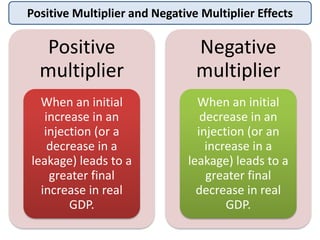
Positive Multiplier and Negative Multiplier Effects
Positive
multiplier
When an initial
increase in an
injection (or a
decrease in a
leakage) leads to a
greater final
increase in real
GDP.
Negative
multiplier
When an initial
decrease in an
injection (or an
increase in a
leakage) leads to a
greater final
decrease in real
GDP.
The Multiplier Effect Process
The government injects
£200m in a project to build
thousands of affordable
new houses
A new house building project injects £200m of
extra demand and output into the economy
Many businesses benefit directly including
building supply industries, architects etc.
Constructing new houses generates a new flow
of factor incomes – including wages and profits
Will the extra incomes stay inside the circular
flow of income and spending? This is key!
If so, the multiplier effect is likely to be strong
and the resultant impact on GDP quite large
If asked to do so, explain the process that lies behind the multiplier
effect – focusing on the extra demand and factor incomes created
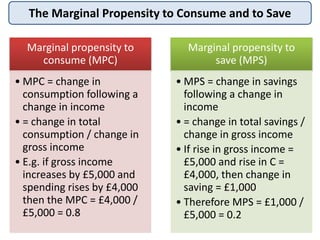
The Marginal Propensity to Consume and to Save
Marginal propensity to
consume (MPC)
• MPC = change in
consumption following a
change in income
• = change in total
consumption / change in
gross income
• E.g. if gross income
increases by £5,000 and
spending rises by £4,000
then the MPC = £4,000 /
£5,000 = 0.8
Marginal propensity to
save (MPS)
• MPS = change in savings
following a change in
income
• = change in total savings /
change in gross income
• If rise in gross income =
£5,000 and rise in C =
£4,000, then change in
saving = £1,000
• Therefore MPS = £1,000 /
£5,000 = 0.2
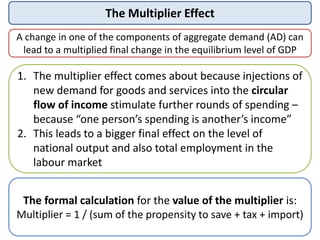
The Multiplier Effect
A change in one of the components of aggregate demand (AD) can
lead to a multiplied final change in the equilibrium level of GDP
1. The multiplier effect comes about because injections of
new demand for goods and services into the circular
flow of income stimulate further rounds of spending –
because “one person’s spending is another’s income”
2. This leads to a bigger final effect on the level of
national output and also total employment in the
labour market
The formal calculation for the value of the multiplier is:
Multiplier = 1 / (sum of the propensity to save + tax + import)
An Example of the Multiplier Effect
The government injects £200m
in a project to build thousands
of new affordable houses
Why is the final increase in
measured GDP likely to be more
than £200m?
If the final rise in GDP is £300m the value of the multiplier = 1.5
If the final rise in GDP is £250m the value of the multiplier = 1.25
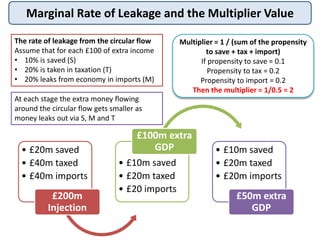
Marginal Rate of Leakage and the Multiplier Value
The rate of leakage from the circular flow
Assume that for each £100 of extra income
• 10% is saved (S)
• 20% is taken in taxation (T)
• 20% leaks from economy in imports (M)
• £20m saved
• £40m taxed
• £40m imports
£200m
Injection
• £10m saved
• £20m taxed
• £20 imports
£100m extra
GDP • £10m saved
• £20m taxed
• £20m imports
£50m extra
GDP
At each stage the extra money flowing
around the circular flow gets smaller as
money leaks out via S, M and T
Multiplier = 1 / (sum of the propensity
to save + tax + import)
If propensity to save = 0.1
Propensity to tax = 0.2
Propensity to import = 0.2
Then the multiplier = 1/0.5 = 2
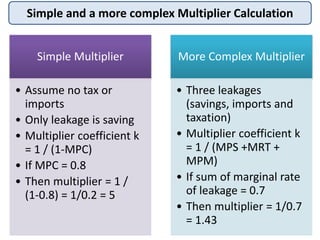
Simple and a more complex Multiplier Calculation
Simple Multiplier
• Assume no tax or
imports
• Only leakage is saving
• Multiplier coefficient k
= 1 / (1-MPC)
• If MPC = 0.8
• Then multiplier = 1 /
(1-0.8) = 1/0.2 = 5
More Complex Multiplier
• Three leakages
(savings, imports and
taxation)
• Multiplier coefficient k
= 1 / (MPS +MRT +
MPM)
• If sum of marginal rate
of leakage = 0.7
• Then multiplier = 1/0.7
= 1.43
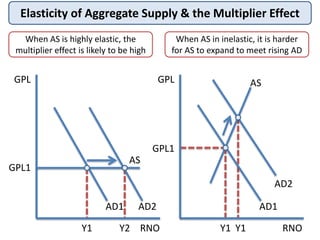
Elasticity of Aggregate Supply & the Multiplier Effect
GPL
RNO
GPL1
AS
Y1
AD1
GPL
RNO
GPL1
AS
Y1
AD1AD2
Y2 Y1
AD2
When AS is highly elastic, the
multiplier effect is likely to be high
When AS in inelastic, it is harder
for AS to expand to meet rising AD
Summary of Factors Affecting Value of the Multiplier
High Multiplier
Value when
Economy has plenty
of spare capacity
(negative output gap)
to meet higher
demand
Marginal propensity
to import and tax is
low
High propensity to
consume any extra
income (i.e. a low
propensity to save)
Low Multiplier
Value when
Economy is close to
it’s capacity limits e.g.
during a boom phase
Propensity to import
goods & services is
high – extra demand
leaks from circular
flow
Higher inflation
causes rising interest
rates which then
dampens other
components of AD
What Determines the
Size of the Fiscal
Multiplier?
Government capital
investment—such as new
infrastructure building—
results in higher
multiplier effects.
Economists at the IMF
have calculated the long-
run multiplier value at
+1.5 for developed
countries and +1.6 for
developing countries.
Source: The Economist
The Multiplier
EdExcel AS Economics 2.4.4

The Multiplier effect explained

  • 1.
  • 2.
    Positive Multiplier andNegative Multiplier Effects Positive multiplier When an initial increase in an injection (or a decrease in a leakage) leads to a greater final increase in real GDP. Negative multiplier When an initial decrease in an injection (or an increase in a leakage) leads to a greater final decrease in real GDP.
  • 3.
    The Multiplier EffectProcess The government injects £200m in a project to build thousands of affordable new houses A new house building project injects £200m of extra demand and output into the economy Many businesses benefit directly including building supply industries, architects etc. Constructing new houses generates a new flow of factor incomes – including wages and profits Will the extra incomes stay inside the circular flow of income and spending? This is key! If so, the multiplier effect is likely to be strong and the resultant impact on GDP quite large If asked to do so, explain the process that lies behind the multiplier effect – focusing on the extra demand and factor incomes created
  • 4.
    The Marginal Propensityto Consume and to Save Marginal propensity to consume (MPC) • MPC = change in consumption following a change in income • = change in total consumption / change in gross income • E.g. if gross income increases by £5,000 and spending rises by £4,000 then the MPC = £4,000 / £5,000 = 0.8 Marginal propensity to save (MPS) • MPS = change in savings following a change in income • = change in total savings / change in gross income • If rise in gross income = £5,000 and rise in C = £4,000, then change in saving = £1,000 • Therefore MPS = £1,000 / £5,000 = 0.2
  • 5.
    The Multiplier Effect Achange in one of the components of aggregate demand (AD) can lead to a multiplied final change in the equilibrium level of GDP 1. The multiplier effect comes about because injections of new demand for goods and services into the circular flow of income stimulate further rounds of spending – because “one person’s spending is another’s income” 2. This leads to a bigger final effect on the level of national output and also total employment in the labour market The formal calculation for the value of the multiplier is: Multiplier = 1 / (sum of the propensity to save + tax + import)
  • 6.
    An Example ofthe Multiplier Effect The government injects £200m in a project to build thousands of new affordable houses Why is the final increase in measured GDP likely to be more than £200m? If the final rise in GDP is £300m the value of the multiplier = 1.5 If the final rise in GDP is £250m the value of the multiplier = 1.25
  • 7.
    Marginal Rate ofLeakage and the Multiplier Value The rate of leakage from the circular flow Assume that for each £100 of extra income • 10% is saved (S) • 20% is taken in taxation (T) • 20% leaks from economy in imports (M) • £20m saved • £40m taxed • £40m imports £200m Injection • £10m saved • £20m taxed • £20 imports £100m extra GDP • £10m saved • £20m taxed • £20m imports £50m extra GDP At each stage the extra money flowing around the circular flow gets smaller as money leaks out via S, M and T Multiplier = 1 / (sum of the propensity to save + tax + import) If propensity to save = 0.1 Propensity to tax = 0.2 Propensity to import = 0.2 Then the multiplier = 1/0.5 = 2
  • 8.
    Simple and amore complex Multiplier Calculation Simple Multiplier • Assume no tax or imports • Only leakage is saving • Multiplier coefficient k = 1 / (1-MPC) • If MPC = 0.8 • Then multiplier = 1 / (1-0.8) = 1/0.2 = 5 More Complex Multiplier • Three leakages (savings, imports and taxation) • Multiplier coefficient k = 1 / (MPS +MRT + MPM) • If sum of marginal rate of leakage = 0.7 • Then multiplier = 1/0.7 = 1.43
  • 9.
    Elasticity of AggregateSupply & the Multiplier Effect GPL RNO GPL1 AS Y1 AD1 GPL RNO GPL1 AS Y1 AD1AD2 Y2 Y1 AD2 When AS is highly elastic, the multiplier effect is likely to be high When AS in inelastic, it is harder for AS to expand to meet rising AD
  • 10.
    Summary of FactorsAffecting Value of the Multiplier High Multiplier Value when Economy has plenty of spare capacity (negative output gap) to meet higher demand Marginal propensity to import and tax is low High propensity to consume any extra income (i.e. a low propensity to save) Low Multiplier Value when Economy is close to it’s capacity limits e.g. during a boom phase Propensity to import goods & services is high – extra demand leaks from circular flow Higher inflation causes rising interest rates which then dampens other components of AD What Determines the Size of the Fiscal Multiplier? Government capital investment—such as new infrastructure building— results in higher multiplier effects. Economists at the IMF have calculated the long- run multiplier value at +1.5 for developed countries and +1.6 for developing countries. Source: The Economist
  • 11.