CHAPTER 11:  FISCAL  &  MONETARY POLICY
11.1 MULTIPLIER EFFECT 11.2  FISCAL POLICY  11.3  MONETARY POLICY  11.4  CROWDING-OUT EFFECT  CHAPTER OUTLINE
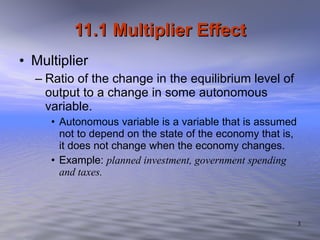
11.1 Multiplier Effect Multiplier  Ratio of the change in the equilibrium level of output to a change in some autonomous variable.  Autonomous variable is a variable that is assumed not to depend on the state of the economy that is, it does not change when the economy changes.  Example:  planned investment, government spending and taxes.
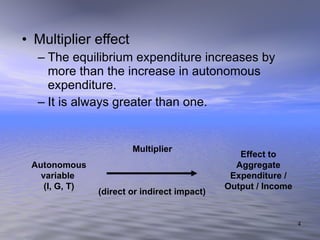
Multiplier effect The equilibrium expenditure increases by more than the increase in autonomous expenditure. It is always greater than one. Autonomous variable  (I, G, T) Multiplier (direct or indirect impact) Effect to Aggregate Expenditure / Output / Income
Basic Multiplier Y = C + I + G Y = (a + bY) + I + G Y (1 – b) = a + I + G Y = (a + I + G) [1/(1 – b)] Since, b = MPC Y = (a + I + G) [1/(1 – MPC)] or Y = (a + I + G) [1/MPS]
Planned Investment Multiplier Definition: The impact of an initial change (increased/decreased) in planned investment (I) on production, income, consumption spending and equilibrium income. The size of the multiplier depends on the slope of the planned aggregate expenditure line (MPC).
Planned Investment Multiplier Y = C + I + G Y = [a + bY] + I + G Y = [a + b(Y- T)] + I + G Y = a + bY – bT + I + G Y (1 – b) = a – bT + I + G Y = (a – bT + I + G) [1/(1 – b)] --- Equation 11.1 ∆ Y/  ∆I = 1/(1 – b)
If planned investment (I) increase by the amount of ∆I, income (Y) will increase by: ∆ Y = ∆I X [1/(1 – b)] Since b = MPC, and MPS = 1 – MPC, the expression become: ∆ Y = ∆I X [1/(1 – MPC)] ∆ Y = ∆I X [1/MPS] Therefore, the multiplier for planned investment is ????
Government Spending Multiplier Definition: The ratio of the change in the equilibrium level of output to a change in government spending. The impact of an initial change (increase/decrease) in government spending (G) on production, income, consumption spending and equilibrium income. The size of multiplier depends on the slope of the planned aggregate expenditure line.
From Equation 11.1: If government spending increase by the amount of ∆G, income (Y) will increase by: ∆ Y = ∆G X [1/(1 – b)] Since b = MPC, and MPS = 1 – MPC, the expression become: ∆ Y = ∆G X [1/(1 – MPC)] ∆ Y = ∆G X [1/MPS] Thus, the multiplier for government spending is ????
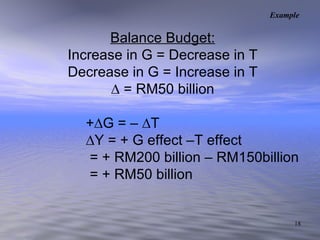
Figure: Government Spending Multiplier Example: ∆ Y = ∆G X [multiplier] = ∆G X [1/(1 – MPC)] = 50 X [1/(1 – 0.75)] = 50 X [4] ∆ Y = RM200 billion
Tax Multiplier Definition: The ratio of change in the equilibrium level of output to a change in taxes. The impact of an initial change (increased/decreased) in taxes on production, income, consumption spending and equilibrium income. The multiplier for a change in taxes is not the same as the multiplier for a change in planned investment, government spending and others.
Y = C + I + G Y = [a + bY] + I + G Y = [a + b(Y- T)] + I + G Y = a + bY – bT + I + G Y (1 – b) = a – bT + I + G Y = (a – bT + I + G) [1/(1 – b)] ∆ Y/ ∆T= -b/(1 – b) Tax Multiplier
If taxes increase by the amount of ∆T, income will increase by: ∆ Y = (-b) (∆T) X [1/(1 – b)] ∆ Y = (∆T) X [-b/(1 – b)] Since b = MPC, and MPS = 1 – MPC, the expression become: ∆ Y = ∆T X [-MPC/(1 – MPC)] ∆ Y = ∆T X [-(MPC/MPS)] Therefore, the multiplier for taxes are: -MPC/(1 – MPC) or -MPC/MPS
Taxes (T) : In an economy with a MPC of 0.75, a RM50 billion of tax cuts magnifies the aggregate expenditure  three  times higher through the multiplier effect. ∆ Y = ∆T X [multiplier] = ∆T X [-MPC/(1 – MPC)] = 50 X [-0.75/(1 – 0.75)] = 50 X [-3] ∆ Y = - RM150 billion Example
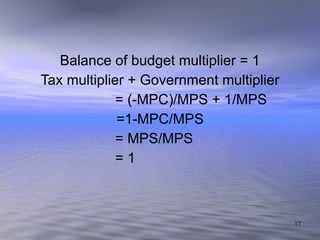
Balanced- Budget Multiplier Definition: The ratio of change in the equilibrium level of output to a change in government spending where the change in government spending is balanced by a change in taxes so as not to create any deficit.  The balanced-budget multiplier is equal to 1:  The change in  Y  resulting from the change in  G  and the equal change in  T  is exactly the same size as the initial change in  G  or  T  itself.
Balance of budget multiplier = 1 Tax multiplier + Government multiplier = (-MPC)/MPS + 1/MPS =1-MPC/MPS = MPS/MPS = 1
Balance Budget: Increase in G = Decrease in T Decrease in G = Increase in T ∆  = RM50 billion +∆G = – ∆T  ∆ Y = + G effect –T effect   = + RM200 billion – RM150billion   = + RM50 billion  Example
11.2 Fiscal Policy Definition: Government policy concerning taxes (T) and expenditure (G). Tools: Government expenditure (G) & taxes (T) Types: Expansionary fiscal policy Contractionary fiscal policy
Expansionary Fiscal Policy Definition: An increase in government spending or a reduction in net taxes aimed at increasing aggregate output (income) ( Y ). Function: To stimulate the economy. Problem:  Could lead to inflation May lead to budget deficit because need debt to finance the deficit, this will burden the next generation.
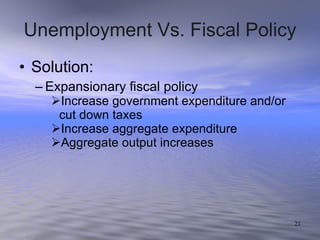
Unemployment Vs. Fiscal Policy Solution: Expansionary fiscal policy Increase government expenditure and/or cut down taxes Increase aggregate expenditure Aggregate output increases
Unemployment Vs. Fiscal Policy
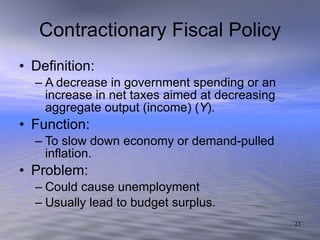
Contractionary Fiscal Policy Definition: A decrease in government spending or an increase in net taxes aimed at decreasing aggregate output (income) ( Y ). Function: To slow down economy or demand-pulled inflation.  Problem: Could cause unemployment Usually lead to budget surplus.
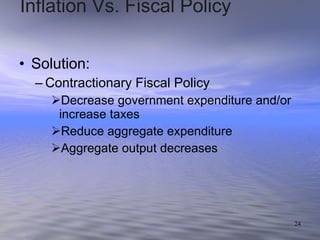
Inflation Vs. Fiscal Policy   Solution: Contractionary Fiscal Policy Decrease government expenditure and/or increase taxes  Reduce aggregate expenditure Aggregate output decreases
Inflation Vs. Fiscal Policy
11.3 Monetary Policy Definition: The behavior of the Federal Reserve concerning the money supply. Tools: Money supply (Ms) and Interest rate (r) by central bank (CB). Types: Expansionary monetary policy Contractionary monetary policy
Expansionary Monetary Policy Definition: An increase in the money supply aimed at increasing aggregate output (income) ( Y ). Function: To stimulating the economy. Problem: Could cause inflation.
Unemployment Vs. Monetary Policy Solution: Easy/Expansionary monetary policy: Increase money supply Interest rate will drop Effect investment Effect local currency and net export
Unemployment Vs. Monetary Policy
Contractionary   Monetary Policy Definition: A decrease in the money supply aimed at decreasing aggregate output (income) (Y). Function: To slow down the economy. Problem: Could cause unemployment.
Inflation Vs. Monetary Policy Solution: Decrease money supply  Interest rate will rise Effect investment Effect local currency and net export
Inflation Vs. Monetary Policy
Tools of Monetary Policy The central bank can affect the equilibrium interest rate by changing the supply of money using one of its three monetary tools: Required reserve ratio (RRR) Discount rate Open market operation (OMO)
Required Reserve Ratio (RRR) Definition: The rule that specifies the amount  of reserved a bank must hold to back up deposits. Amount of a bank’s total reserves that may not be loaned out.
Decreases in the required reserve ratio allow banks to have more deposits with the existing volume of reserves.  As banks create more deposits by making loans, the supply of money (currency + deposits) increases. If the Fed raise the required reserve ratio, in which case banks will find that they have insufficient reserves and must therefore reduce their deposits by “calling in” some of their loans.  The result is a decrease in the money supply.
Discount Rate Definition: Interest rate that banks pay to the FED to borrow from it. The interest rate the FED charges banks that borrow reserves.
The higher the discount rate, the higher the cost of borrowing, and the less borrowing banks will want to do. The lowest discount rate will encourage banks to borrow because of the lower cost of borrowing.
Open Market Operation (OMO) Definition: The purchase and sale by the Fed of government securities in the open market. A tool used to expand or contract the amount of reserves in the system and thus the money supply
An open market purchase of securities by the FED results in an increase in reserves and an increase in the supply of money. An open market sale of securities by the FED results in a decrease in reserves and a decrease in the supply of money.
11.4 CROWDING-OUT EFFECT Definition: The tendency for increases in government spending to cause reductions in private investment spending. Offset in AD that results when an expansionary fiscal policy raises interest rate and thereby reduces the investment spending.
Crowding-out Effect
THANK YOU

Chap11

  • 1.
    CHAPTER 11: FISCAL & MONETARY POLICY
  • 2.
    11.1 MULTIPLIER EFFECT11.2 FISCAL POLICY 11.3 MONETARY POLICY 11.4 CROWDING-OUT EFFECT CHAPTER OUTLINE
  • 3.
    11.1 Multiplier EffectMultiplier Ratio of the change in the equilibrium level of output to a change in some autonomous variable. Autonomous variable is a variable that is assumed not to depend on the state of the economy that is, it does not change when the economy changes. Example: planned investment, government spending and taxes.
  • 4.
    Multiplier effect Theequilibrium expenditure increases by more than the increase in autonomous expenditure. It is always greater than one. Autonomous variable (I, G, T) Multiplier (direct or indirect impact) Effect to Aggregate Expenditure / Output / Income
  • 5.
    Basic Multiplier Y= C + I + G Y = (a + bY) + I + G Y (1 – b) = a + I + G Y = (a + I + G) [1/(1 – b)] Since, b = MPC Y = (a + I + G) [1/(1 – MPC)] or Y = (a + I + G) [1/MPS]
  • 6.
    Planned Investment MultiplierDefinition: The impact of an initial change (increased/decreased) in planned investment (I) on production, income, consumption spending and equilibrium income. The size of the multiplier depends on the slope of the planned aggregate expenditure line (MPC).
  • 7.
    Planned Investment MultiplierY = C + I + G Y = [a + bY] + I + G Y = [a + b(Y- T)] + I + G Y = a + bY – bT + I + G Y (1 – b) = a – bT + I + G Y = (a – bT + I + G) [1/(1 – b)] --- Equation 11.1 ∆ Y/ ∆I = 1/(1 – b)
  • 8.
    If planned investment(I) increase by the amount of ∆I, income (Y) will increase by: ∆ Y = ∆I X [1/(1 – b)] Since b = MPC, and MPS = 1 – MPC, the expression become: ∆ Y = ∆I X [1/(1 – MPC)] ∆ Y = ∆I X [1/MPS] Therefore, the multiplier for planned investment is ????
  • 9.
    Government Spending MultiplierDefinition: The ratio of the change in the equilibrium level of output to a change in government spending. The impact of an initial change (increase/decrease) in government spending (G) on production, income, consumption spending and equilibrium income. The size of multiplier depends on the slope of the planned aggregate expenditure line.
  • 10.
    From Equation 11.1:If government spending increase by the amount of ∆G, income (Y) will increase by: ∆ Y = ∆G X [1/(1 – b)] Since b = MPC, and MPS = 1 – MPC, the expression become: ∆ Y = ∆G X [1/(1 – MPC)] ∆ Y = ∆G X [1/MPS] Thus, the multiplier for government spending is ????
  • 11.
    Figure: Government SpendingMultiplier Example: ∆ Y = ∆G X [multiplier] = ∆G X [1/(1 – MPC)] = 50 X [1/(1 – 0.75)] = 50 X [4] ∆ Y = RM200 billion
  • 12.
    Tax Multiplier Definition:The ratio of change in the equilibrium level of output to a change in taxes. The impact of an initial change (increased/decreased) in taxes on production, income, consumption spending and equilibrium income. The multiplier for a change in taxes is not the same as the multiplier for a change in planned investment, government spending and others.
  • 13.
    Y = C+ I + G Y = [a + bY] + I + G Y = [a + b(Y- T)] + I + G Y = a + bY – bT + I + G Y (1 – b) = a – bT + I + G Y = (a – bT + I + G) [1/(1 – b)] ∆ Y/ ∆T= -b/(1 – b) Tax Multiplier
  • 14.
    If taxes increaseby the amount of ∆T, income will increase by: ∆ Y = (-b) (∆T) X [1/(1 – b)] ∆ Y = (∆T) X [-b/(1 – b)] Since b = MPC, and MPS = 1 – MPC, the expression become: ∆ Y = ∆T X [-MPC/(1 – MPC)] ∆ Y = ∆T X [-(MPC/MPS)] Therefore, the multiplier for taxes are: -MPC/(1 – MPC) or -MPC/MPS
  • 15.
    Taxes (T) :In an economy with a MPC of 0.75, a RM50 billion of tax cuts magnifies the aggregate expenditure three times higher through the multiplier effect. ∆ Y = ∆T X [multiplier] = ∆T X [-MPC/(1 – MPC)] = 50 X [-0.75/(1 – 0.75)] = 50 X [-3] ∆ Y = - RM150 billion Example
  • 16.
    Balanced- Budget MultiplierDefinition: The ratio of change in the equilibrium level of output to a change in government spending where the change in government spending is balanced by a change in taxes so as not to create any deficit. The balanced-budget multiplier is equal to 1: The change in Y resulting from the change in G and the equal change in T is exactly the same size as the initial change in G or T itself.
  • 17.
    Balance of budgetmultiplier = 1 Tax multiplier + Government multiplier = (-MPC)/MPS + 1/MPS =1-MPC/MPS = MPS/MPS = 1
  • 18.
    Balance Budget: Increasein G = Decrease in T Decrease in G = Increase in T ∆ = RM50 billion +∆G = – ∆T ∆ Y = + G effect –T effect = + RM200 billion – RM150billion = + RM50 billion Example
  • 19.
    11.2 Fiscal PolicyDefinition: Government policy concerning taxes (T) and expenditure (G). Tools: Government expenditure (G) & taxes (T) Types: Expansionary fiscal policy Contractionary fiscal policy
  • 20.
    Expansionary Fiscal PolicyDefinition: An increase in government spending or a reduction in net taxes aimed at increasing aggregate output (income) ( Y ). Function: To stimulate the economy. Problem: Could lead to inflation May lead to budget deficit because need debt to finance the deficit, this will burden the next generation.
  • 21.
    Unemployment Vs. FiscalPolicy Solution: Expansionary fiscal policy Increase government expenditure and/or cut down taxes Increase aggregate expenditure Aggregate output increases
  • 22.
  • 23.
    Contractionary Fiscal PolicyDefinition: A decrease in government spending or an increase in net taxes aimed at decreasing aggregate output (income) ( Y ). Function: To slow down economy or demand-pulled inflation. Problem: Could cause unemployment Usually lead to budget surplus.
  • 24.
    Inflation Vs. FiscalPolicy Solution: Contractionary Fiscal Policy Decrease government expenditure and/or increase taxes Reduce aggregate expenditure Aggregate output decreases
  • 25.
  • 26.
    11.3 Monetary PolicyDefinition: The behavior of the Federal Reserve concerning the money supply. Tools: Money supply (Ms) and Interest rate (r) by central bank (CB). Types: Expansionary monetary policy Contractionary monetary policy
  • 27.
    Expansionary Monetary PolicyDefinition: An increase in the money supply aimed at increasing aggregate output (income) ( Y ). Function: To stimulating the economy. Problem: Could cause inflation.
  • 28.
    Unemployment Vs. MonetaryPolicy Solution: Easy/Expansionary monetary policy: Increase money supply Interest rate will drop Effect investment Effect local currency and net export
  • 29.
  • 30.
    Contractionary Monetary Policy Definition: A decrease in the money supply aimed at decreasing aggregate output (income) (Y). Function: To slow down the economy. Problem: Could cause unemployment.
  • 31.
    Inflation Vs. MonetaryPolicy Solution: Decrease money supply Interest rate will rise Effect investment Effect local currency and net export
  • 32.
  • 33.
    Tools of MonetaryPolicy The central bank can affect the equilibrium interest rate by changing the supply of money using one of its three monetary tools: Required reserve ratio (RRR) Discount rate Open market operation (OMO)
  • 34.
    Required Reserve Ratio(RRR) Definition: The rule that specifies the amount of reserved a bank must hold to back up deposits. Amount of a bank’s total reserves that may not be loaned out.
  • 35.
    Decreases in therequired reserve ratio allow banks to have more deposits with the existing volume of reserves. As banks create more deposits by making loans, the supply of money (currency + deposits) increases. If the Fed raise the required reserve ratio, in which case banks will find that they have insufficient reserves and must therefore reduce their deposits by “calling in” some of their loans. The result is a decrease in the money supply.
  • 36.
    Discount Rate Definition:Interest rate that banks pay to the FED to borrow from it. The interest rate the FED charges banks that borrow reserves.
  • 37.
    The higher thediscount rate, the higher the cost of borrowing, and the less borrowing banks will want to do. The lowest discount rate will encourage banks to borrow because of the lower cost of borrowing.
  • 38.
    Open Market Operation(OMO) Definition: The purchase and sale by the Fed of government securities in the open market. A tool used to expand or contract the amount of reserves in the system and thus the money supply
  • 39.
    An open marketpurchase of securities by the FED results in an increase in reserves and an increase in the supply of money. An open market sale of securities by the FED results in a decrease in reserves and a decrease in the supply of money.
  • 40.
    11.4 CROWDING-OUT EFFECTDefinition: The tendency for increases in government spending to cause reductions in private investment spending. Offset in AD that results when an expansionary fiscal policy raises interest rate and thereby reduces the investment spending.
  • 41.
  • 42.