BILATERAL MONOPOLY
MuhammedSuhaibm
Head of the Department,
Department of Economics,
KR’s Sree Narayana College, Thozhuvanoor
BILATERAL MONOPOLY
 Bilateral monopoly refers to a market situation in which a
single producer (monopolist) of a product faces a single
buyer (Monopsonist) of that product.
 We analyse output and profit determination under
bilateral monopoly.
BILATERAL MONOPOLY
Its Assumptions.
This analysis is based on the following assumptions:
 1. There is a single commodity with no close substitutes.
 2. The monopolist is its sole producer or seller.
 3. The monopsonist is its only buyer.
 4. The monopolist and the monopsonist are both free to
maximise their own individual profits.
Price-Output Determination
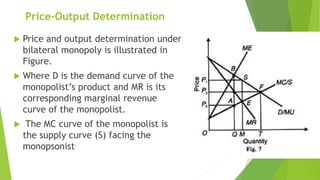
 Price and output determination under
bilateral monopoly is illustrated in
Figure.
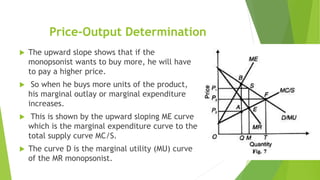
 Where D is the demand curve of the
monopolist’s product and MR is its
corresponding marginal revenue
curve of the monopolist.
 The MC curve of the monopolist is
the supply curve (S) facing the
monopsonist
Price-Output Determination
 The upward slope shows that if the
monopsonist wants to buy more, he will have
to pay a higher price.
 So when he buys more units of the product,
his marginal outlay or marginal expenditure
increases.
 This is shown by the upward sloping ME curve
which is the marginal expenditure curve to the
total supply curve MC/S.
 The curve D is the marginal utility (MU) curve
of the MR monopsonist.
Price-Output Determination
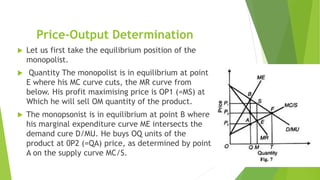
 Let us first take the equilibrium position of the
monopolist.
 Quantity The monopolist is in equilibrium at point
E where his MC curve cuts, the MR curve from
below. His profit maximising price is OP1 (=MS) at
Which he will sell OM quantity of the product.
 The monopsonist is in equilibrium at point B where
his marginal expenditure curve ME intersects the
demand cure D/MU. He buys OQ units of the
product at 0P2 (=QA) price, as determined by point
A on the supply curve MC/S.
Price-Output Determination
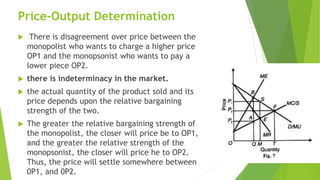
 There is disagreement over price between the
monopolist who wants to charge a higher price
OP1 and the monopsonist who wants to pay a
lower piece OP2.
 there is indeterminacy in the market.
 the actual quantity of the product sold and its
price depends upon the relative bargaining
strength of the two.
 The greater the relative bargaining strength of
the monopolist, the closer will price be to OP1,
and the greater the relative strength of the
monopsonist, the closer will price he to OP2.
Thus, the price will settle somewhere between
0P1, and 0P2.
Bilateral monopoly

Bilateral monopoly

  • 1.
    BILATERAL MONOPOLY MuhammedSuhaibm Head ofthe Department, Department of Economics, KR’s Sree Narayana College, Thozhuvanoor
  • 2.
    BILATERAL MONOPOLY  Bilateralmonopoly refers to a market situation in which a single producer (monopolist) of a product faces a single buyer (Monopsonist) of that product.  We analyse output and profit determination under bilateral monopoly.
  • 3.
    BILATERAL MONOPOLY Its Assumptions. Thisanalysis is based on the following assumptions:  1. There is a single commodity with no close substitutes.  2. The monopolist is its sole producer or seller.  3. The monopsonist is its only buyer.  4. The monopolist and the monopsonist are both free to maximise their own individual profits.
  • 4.
    Price-Output Determination  Priceand output determination under bilateral monopoly is illustrated in Figure.  Where D is the demand curve of the monopolist’s product and MR is its corresponding marginal revenue curve of the monopolist.  The MC curve of the monopolist is the supply curve (S) facing the monopsonist
  • 5.
    Price-Output Determination  Theupward slope shows that if the monopsonist wants to buy more, he will have to pay a higher price.  So when he buys more units of the product, his marginal outlay or marginal expenditure increases.  This is shown by the upward sloping ME curve which is the marginal expenditure curve to the total supply curve MC/S.  The curve D is the marginal utility (MU) curve of the MR monopsonist.
  • 6.
    Price-Output Determination  Letus first take the equilibrium position of the monopolist.  Quantity The monopolist is in equilibrium at point E where his MC curve cuts, the MR curve from below. His profit maximising price is OP1 (=MS) at Which he will sell OM quantity of the product.  The monopsonist is in equilibrium at point B where his marginal expenditure curve ME intersects the demand cure D/MU. He buys OQ units of the product at 0P2 (=QA) price, as determined by point A on the supply curve MC/S.
  • 7.
    Price-Output Determination  Thereis disagreement over price between the monopolist who wants to charge a higher price OP1 and the monopsonist who wants to pay a lower piece OP2.  there is indeterminacy in the market.  the actual quantity of the product sold and its price depends upon the relative bargaining strength of the two.  The greater the relative bargaining strength of the monopolist, the closer will price be to OP1, and the greater the relative strength of the monopsonist, the closer will price he to OP2. Thus, the price will settle somewhere between 0P1, and 0P2.