Nationalisation
Upper 6th Micro
Government Intervention
(U6th)
Intro to
Nationalisation
Nationalisation
Mr O’Grady
Nationalisation
Nationalisation: The transfer of a major branch of industry or commerce from
private to state ownership or control.
Aim of Nationalisation: To remove firms’ market power to exploit consumers by:
1. Removing shareholders and their profit motive
2. Taking control of and subsidising natural monopolies
Notable examples: RBS, Student Loan Company, Network Rail
Advantages of Nationalisation:
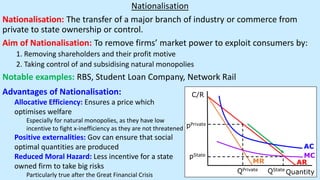
Allocative Efficiency: Ensures a price which
optimises welfare
Especially for natural monopolies, as they have low
incentive to fight x-inefficiency as they are not threatened
Positive externalities: Gov can ensure that social
optimal quantities are produced
Reduced Moral Hazard: Less incentive for a state
owned firm to take big risks
Particularly true after the Great Financial Crisis Quantity
C/R
AR
MR
MC
AC
QPrivate
pPrivate
pState
QState
Disadvantages of Nationalisation
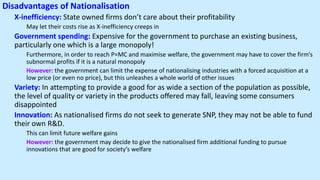
X-inefficiency: State owned firms don’t care about their profitability
May let their costs rise as X-inefficiency creeps in
Government spending: Expensive for the government to purchase an existing business,
particularly one which is a large monopoly!
Furthermore, in order to reach P=MC and maximise welfare, the government may have to cover the firm’s
subnormal profits if it is a natural monopoly
However: the government can limit the expense of nationalising industries with a forced acquisition at a
low price (or even no price), but this unleashes a whole world of other issues
Variety: In attempting to provide a good for as wide a section of the population as possible,
the level of quality or variety in the products offered may fall, leaving some consumers
disappointed
Innovation: As nationalised firms do not seek to generate SNP, they may not be able to fund
their own R&D.
This can limit future welfare gains
However: the government may decide to give the nationalised firm additional funding to pursue
innovations that are good for society’s welfare
Limitations of
Nationalisation
Nationalisation
Mr O’Grady
Limitations of Nationalisation
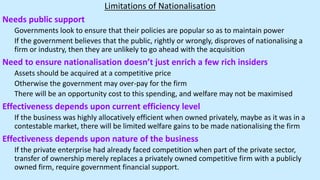
Needs public support
Governments look to ensure that their policies are popular so as to maintain power
If the government believes that the public, rightly or wrongly, disproves of nationalising a
firm or industry, then they are unlikely to go ahead with the acquisition
Need to ensure nationalisation doesn’t just enrich a few rich insiders
Assets should be acquired at a competitive price
Otherwise the government may over-pay for the firm
There will be an opportunity cost to this spending, and welfare may not be maximised
Effectiveness depends upon current efficiency level
If the business was highly allocatively efficient when owned privately, maybe as it was in a
contestable market, there will be limited welfare gains to be made nationalising the firm
Effectiveness depends upon nature of the business
If the private enterprise had already faced competition when part of the private sector,
transfer of ownership merely replaces a privately owned competitive firm with a publicly
owned firm, require government financial support.
Where next?
Visit our website: www.smootheconomics.co.uk
Find more resources, enrichment materials,
details of courses, competitions, and more!
Find Our socials:
YouTube: Smooth Economics
Instagram: @smootheconomics
Twitter: @SmoothEconomics
Facebook: @SmoothEconomics

Nationalisation

  • 1.
  • 2.
  • 3.
    Nationalisation Nationalisation: The transferof a major branch of industry or commerce from private to state ownership or control. Aim of Nationalisation: To remove firms’ market power to exploit consumers by: 1. Removing shareholders and their profit motive 2. Taking control of and subsidising natural monopolies Notable examples: RBS, Student Loan Company, Network Rail Advantages of Nationalisation: Allocative Efficiency: Ensures a price which optimises welfare Especially for natural monopolies, as they have low incentive to fight x-inefficiency as they are not threatened Positive externalities: Gov can ensure that social optimal quantities are produced Reduced Moral Hazard: Less incentive for a state owned firm to take big risks Particularly true after the Great Financial Crisis Quantity C/R AR MR MC AC QPrivate pPrivate pState QState
  • 4.
    Disadvantages of Nationalisation X-inefficiency:State owned firms don’t care about their profitability May let their costs rise as X-inefficiency creeps in Government spending: Expensive for the government to purchase an existing business, particularly one which is a large monopoly! Furthermore, in order to reach P=MC and maximise welfare, the government may have to cover the firm’s subnormal profits if it is a natural monopoly However: the government can limit the expense of nationalising industries with a forced acquisition at a low price (or even no price), but this unleashes a whole world of other issues Variety: In attempting to provide a good for as wide a section of the population as possible, the level of quality or variety in the products offered may fall, leaving some consumers disappointed Innovation: As nationalised firms do not seek to generate SNP, they may not be able to fund their own R&D. This can limit future welfare gains However: the government may decide to give the nationalised firm additional funding to pursue innovations that are good for society’s welfare
  • 5.
  • 6.
    Limitations of Nationalisation Needspublic support Governments look to ensure that their policies are popular so as to maintain power If the government believes that the public, rightly or wrongly, disproves of nationalising a firm or industry, then they are unlikely to go ahead with the acquisition Need to ensure nationalisation doesn’t just enrich a few rich insiders Assets should be acquired at a competitive price Otherwise the government may over-pay for the firm There will be an opportunity cost to this spending, and welfare may not be maximised Effectiveness depends upon current efficiency level If the business was highly allocatively efficient when owned privately, maybe as it was in a contestable market, there will be limited welfare gains to be made nationalising the firm Effectiveness depends upon nature of the business If the private enterprise had already faced competition when part of the private sector, transfer of ownership merely replaces a privately owned competitive firm with a publicly owned firm, require government financial support.
  • 7.
    Where next? Visit ourwebsite: www.smootheconomics.co.uk Find more resources, enrichment materials, details of courses, competitions, and more! Find Our socials: YouTube: Smooth Economics Instagram: @smootheconomics Twitter: @SmoothEconomics Facebook: @SmoothEconomics