 Multiplier means any numeric number which
shows a change in dependent variable due to
one unit change in Independent variable. For
example how much change is required in
consumption to increase 400 million in GNP.
It is based on consumption Multiplier.
Multiplier means a change in autonomous
expenditures (e.g. investment) leads to an even
larger change in aggregate income (GNP).
►An increase in spending by one party
increases the income of others. Thus,
growth in spending can expand output by a
multiple of the original increase.
►The multiplier is the number by which the
initial change in spending is multiplied to
obtain the total amplified increase in
National income.
►The size of the multiplier increases with the
marginal propensity to consume (MPC).
Significance of Multiplier
►In evaluating the importance of the
multiplier, one should remember:
 taxes and spending on imports will
dampen the size of the multiplier;
 it takes time for the multiplier to work;
and,
 the amplified effect on real output will
be valid only when the additional
spending brings idle resources into
production without price changes.
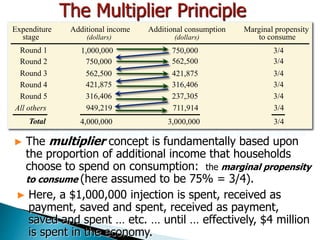
► Here, a $1,000,000 injection is spent, received as
payment, saved and spent, received as payment,
saved and spent … etc. … until … effectively, $4 million
is spent in the economy.
Expenditure
stage
Additional income
(dollars)
Marginal propensity
to consume
Additional consumption
(dollars)
For simplicity (here) it is assumed that all additions to income are either spent domestically or saved.
1,000,000
750,000
562,500
421,875
316,406
949,219
750,000
562,500
421,875
316,406
237,305
711,914
Round 1
Round 2
Round 3
Round 4
Round 5
Total 4,000,000 3,000,000
All others
3/4
3/4
3/4
3/4
3/4
3/4
3/4
The Multiplier Principle
► The multiplier concept is fundamentally based upon
the proportion of additional income that households
choose to spend on consumption: the marginal propensity
to consume (here assumed to be 75% = 3/4).
MPC
Size of
multiplier
9/10
4/5
3/4
2/3
1/2
1/3
10.0
5.0
4.0
3.0
2.0
1.5
A Higher MPC Means a Larger Multiplier
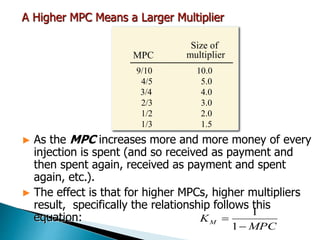
► As the MPC increases more and more money of every
injection is spent (and so received as payment and
then spent again, received as payment and spent
again, etc.).
► The effect is that for higher MPCs, higher multipliers
result, specifically the relationship follows this
equation:
MPC
KM


1
1
 Consumption Multiplier
 Investment Multiplier
 Government Multiplier
 Tax Multiplier
◦ Lump sum Tax Multiplier
◦ Income Tax Multiplier
(Expenditure Multipliers)
 Consumption Multiplier
 Investment Multiplier
 Government Multiplier
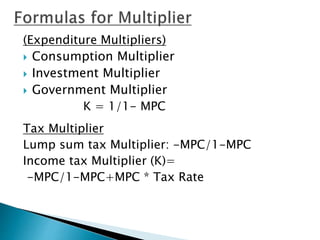
K = 1/1- MPC
Tax Multiplier
Lump sum tax Multiplier: -MPC/1-MPC
Income tax Multiplier (K)=
-MPC/1-MPC+MPC * Tax Rate
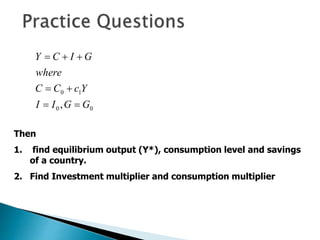
0
0
1
0
, G
G
I
I
Y
c
C
C
where
G
I
C
Y







Then
1. find equilibrium output (Y*), consumption level and savings
of a country.
2. Find Investment multiplier and consumption multiplier
 
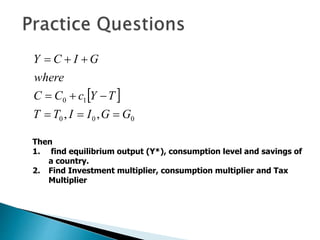
0
0
0
1
0
,
, G
G
I
I
T
T
T
Y
c
C
C
where
G
I
C
Y









Then
1. find equilibrium output (Y*), consumption level and savings of
a country.
2. Find Investment multiplier, consumption multiplier and Tax
Multiplier
 
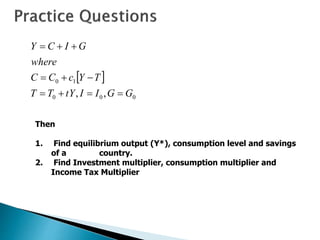
0
0
0
1
0
,
, G
G
I
I
tY
T
T
T
Y
c
C
C
where
G
I
C
Y










Then
1. Find equilibrium output (Y*), consumption level and savings
of a country.
2. Find Investment multiplier, consumption multiplier and
Income Tax Multiplier
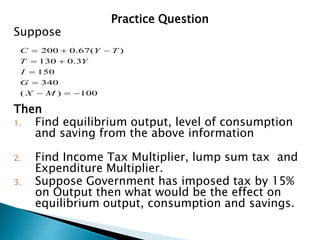
Practice Question
Suppose
Then
1. Find equilibrium output, level of consumption
and saving from the above information
2. Find Income Tax Multiplier, lump sum tax and
Expenditure Multiplier.
3. Suppose Government has imposed tax by 15%
on Output then what would be the effect on
equilibrium output, consumption and savings.
100
)
(
340
150
3
.
0
130
)
(
67
.
0
200










M
X
G
I
Y
T
T
Y
C
 
500
,
1000
,
15
.
0
240
65
.
0
100










G
I
Y
T
T
Y
C
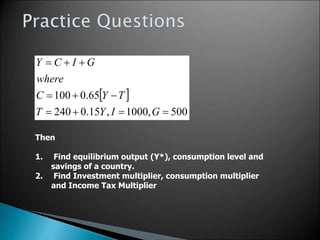
where
G
I
C
Y
Then
1. Find equilibrium output (Y*), consumption level and
savings of a country.
2. Find Investment multiplier, consumption multiplier
and Income Tax Multiplier
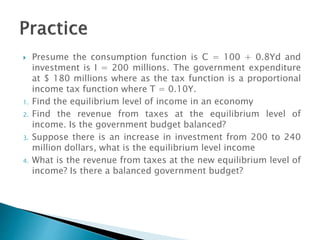
 Presume the consumption function is C = 100 + 0.8Yd and
investment is I = 200 millions. The government expenditure
at $ 180 millions where as the tax function is a proportional
income tax function where T = 0.10Y.
1. Find the equilibrium level of income in an economy
2. Find the revenue from taxes at the equilibrium level of
income. Is the government budget balanced?
3. Suppose there is an increase in investment from 200 to 240
million dollars, what is the equilibrium level income
4. What is the revenue from taxes at the new equilibrium level of
income? Is there a balanced government budget?

CASMAC-Lecture-3 Multiplier Process.ppt

  • 1.
     Multiplier meansany numeric number which shows a change in dependent variable due to one unit change in Independent variable. For example how much change is required in consumption to increase 400 million in GNP. It is based on consumption Multiplier.
  • 2.
    Multiplier means achange in autonomous expenditures (e.g. investment) leads to an even larger change in aggregate income (GNP). ►An increase in spending by one party increases the income of others. Thus, growth in spending can expand output by a multiple of the original increase. ►The multiplier is the number by which the initial change in spending is multiplied to obtain the total amplified increase in National income. ►The size of the multiplier increases with the marginal propensity to consume (MPC).
  • 3.
    Significance of Multiplier ►Inevaluating the importance of the multiplier, one should remember:  taxes and spending on imports will dampen the size of the multiplier;  it takes time for the multiplier to work; and,  the amplified effect on real output will be valid only when the additional spending brings idle resources into production without price changes.
  • 4.
    ► Here, a$1,000,000 injection is spent, received as payment, saved and spent, received as payment, saved and spent … etc. … until … effectively, $4 million is spent in the economy. Expenditure stage Additional income (dollars) Marginal propensity to consume Additional consumption (dollars) For simplicity (here) it is assumed that all additions to income are either spent domestically or saved. 1,000,000 750,000 562,500 421,875 316,406 949,219 750,000 562,500 421,875 316,406 237,305 711,914 Round 1 Round 2 Round 3 Round 4 Round 5 Total 4,000,000 3,000,000 All others 3/4 3/4 3/4 3/4 3/4 3/4 3/4 The Multiplier Principle ► The multiplier concept is fundamentally based upon the proportion of additional income that households choose to spend on consumption: the marginal propensity to consume (here assumed to be 75% = 3/4).
  • 5.
    MPC Size of multiplier 9/10 4/5 3/4 2/3 1/2 1/3 10.0 5.0 4.0 3.0 2.0 1.5 A HigherMPC Means a Larger Multiplier ► As the MPC increases more and more money of every injection is spent (and so received as payment and then spent again, received as payment and spent again, etc.). ► The effect is that for higher MPCs, higher multipliers result, specifically the relationship follows this equation: MPC KM   1 1
  • 6.
     Consumption Multiplier Investment Multiplier  Government Multiplier  Tax Multiplier ◦ Lump sum Tax Multiplier ◦ Income Tax Multiplier
  • 7.
    (Expenditure Multipliers)  ConsumptionMultiplier  Investment Multiplier  Government Multiplier K = 1/1- MPC Tax Multiplier Lump sum tax Multiplier: -MPC/1-MPC Income tax Multiplier (K)= -MPC/1-MPC+MPC * Tax Rate
  • 8.
    0 0 1 0 , G G I I Y c C C where G I C Y        Then 1. findequilibrium output (Y*), consumption level and savings of a country. 2. Find Investment multiplier and consumption multiplier
  • 9.
      0 0 0 1 0 , , G G I I T T T Y c C C where G I C Y          Then 1.find equilibrium output (Y*), consumption level and savings of a country. 2. Find Investment multiplier, consumption multiplier and Tax Multiplier
  • 10.
      0 0 0 1 0 , , G G I I tY T T T Y c C C where G I C Y           Then 1.Find equilibrium output (Y*), consumption level and savings of a country. 2. Find Investment multiplier, consumption multiplier and Income Tax Multiplier
  • 11.
    Practice Question Suppose Then 1. Findequilibrium output, level of consumption and saving from the above information 2. Find Income Tax Multiplier, lump sum tax and Expenditure Multiplier. 3. Suppose Government has imposed tax by 15% on Output then what would be the effect on equilibrium output, consumption and savings. 100 ) ( 340 150 3 . 0 130 ) ( 67 . 0 200           M X G I Y T T Y C
  • 12.
      500 , 1000 , 15 . 0 240 65 . 0 100           G I Y T T Y C where G I C Y Then 1. Findequilibrium output (Y*), consumption level and savings of a country. 2. Find Investment multiplier, consumption multiplier and Income Tax Multiplier
  • 13.
     Presume theconsumption function is C = 100 + 0.8Yd and investment is I = 200 millions. The government expenditure at $ 180 millions where as the tax function is a proportional income tax function where T = 0.10Y. 1. Find the equilibrium level of income in an economy 2. Find the revenue from taxes at the equilibrium level of income. Is the government budget balanced? 3. Suppose there is an increase in investment from 200 to 240 million dollars, what is the equilibrium level income 4. What is the revenue from taxes at the new equilibrium level of income? Is there a balanced government budget?