B.COM SEM-V
UNIT-I
International Economics
COMPARATIVE COSTADVANTAGE
THEORY: ORIGIN
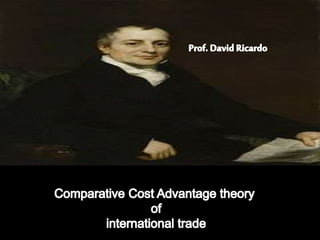
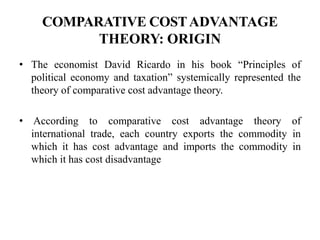
• The economist David Ricardo in his book “Principles of
political economy and taxation” systemically represented the
theory of comparative cost advantage theory.
• According to comparative cost advantage theory of
international trade, each country exports the commodity in
which it has cost advantage and imports the commodity in
which it has cost disadvantage
COMPARATIVE COST ADVANTAGE
THEORY : ASSUMPTIONS
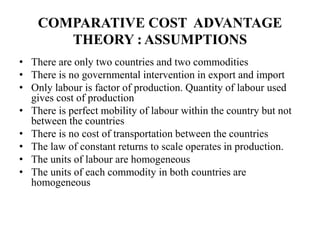
• There are only two countries and two commodities
• There is no governmental intervention in export and import
• Only labour is factor of production. Quantity of labour used
gives cost of production
• There is perfect mobility of labour within the country but not
between the countries
• There is no cost of transportation between the countries
• The law of constant returns to scale operates in production.
• The units of labour are homogeneous
• The units of each commodity in both countries are
homogeneous
COMPARATIVECOST
ADV
ANT
AGE THEORY
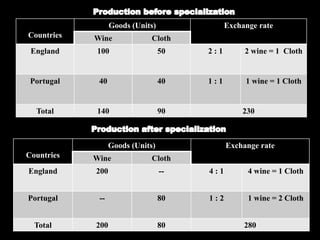
Countries
Goods (Units) Exchange rate
Wine Cloth
England 100 50 2 : 1 2 wine = 1 Cloth
Portugal 40 40 1 : 1 1 wine = 1 Cloth
Total 140 90 230
Countries
Goods (Units) Exchange rate
Wine Cloth
England 200 -- 4 : 1 4 wine = 1 Cloth
Portugal -- 80 1 : 2 1 wine = 2 Cloth
Total 200 80 280
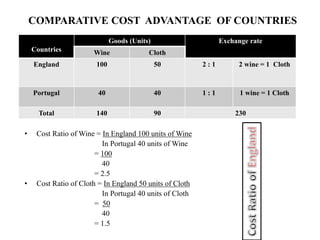
COMPARATIVE COST ADVANTAGE OF COUNTRIES
• Cost Ratio of Wine = In England 100 units of Wine
In Portugal 40 units of Wine
= 100
40
= 2.5
• Cost Ratio of Cloth = In England 50 units of Cloth
In Portugal 40 units of Cloth
= 50
40
= 1.5
Countries
Goods (Units) Exchange rate
Wine Cloth
England 100 50 2 : 1 2 wine = 1 Cloth
Portugal 40 40 1 : 1 1 wine = 1 Cloth
Total 140 90 230
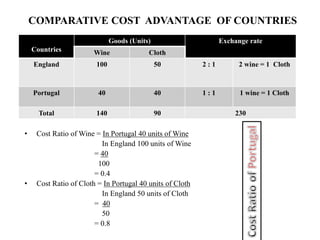
COMPARATIVE COST ADVANTAGE OF COUNTRIES
• Cost Ratio of Wine = In Portugal 40 units of Wine
In England 100 units of Wine
= 40
100
= 0.4
• Cost Ratio of Cloth = In Portugal 40 units of Cloth
In England 50 units of Cloth
= 40
50
= 0.8
Countries
Goods (Units) Exchange rate
Wine Cloth
England 100 50 2 : 1 2 wine = 1 Cloth
Portugal 40 40 1 : 1 1 wine = 1 Cloth
Total 140 90 230
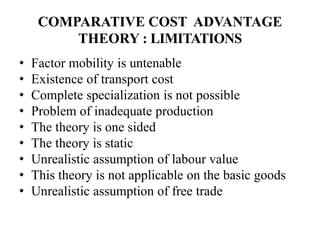
COMPARATIVE COST ADVANTAGE
THEORY : LIMITATIONS
• Factor mobility is untenable
• Existence of transport cost
• Complete specialization is not possible
• Problem of inadequate production
• The theory is one sided
• The theory is static
• Unrealistic assumption of labour value
• This theory is not applicable on the basic goods
• Unrealistic assumption of free trade
Comparative cost advanatge theory

Comparative cost advanatge theory

  • 1.
  • 3.
    COMPARATIVE COSTADVANTAGE THEORY: ORIGIN •The economist David Ricardo in his book “Principles of political economy and taxation” systemically represented the theory of comparative cost advantage theory. • According to comparative cost advantage theory of international trade, each country exports the commodity in which it has cost advantage and imports the commodity in which it has cost disadvantage
  • 4.
    COMPARATIVE COST ADVANTAGE THEORY: ASSUMPTIONS • There are only two countries and two commodities • There is no governmental intervention in export and import • Only labour is factor of production. Quantity of labour used gives cost of production • There is perfect mobility of labour within the country but not between the countries • There is no cost of transportation between the countries • The law of constant returns to scale operates in production. • The units of labour are homogeneous • The units of each commodity in both countries are homogeneous
  • 5.
  • 6.
    Countries Goods (Units) Exchangerate Wine Cloth England 100 50 2 : 1 2 wine = 1 Cloth Portugal 40 40 1 : 1 1 wine = 1 Cloth Total 140 90 230 Countries Goods (Units) Exchange rate Wine Cloth England 200 -- 4 : 1 4 wine = 1 Cloth Portugal -- 80 1 : 2 1 wine = 2 Cloth Total 200 80 280
  • 7.
    COMPARATIVE COST ADVANTAGEOF COUNTRIES • Cost Ratio of Wine = In England 100 units of Wine In Portugal 40 units of Wine = 100 40 = 2.5 • Cost Ratio of Cloth = In England 50 units of Cloth In Portugal 40 units of Cloth = 50 40 = 1.5 Countries Goods (Units) Exchange rate Wine Cloth England 100 50 2 : 1 2 wine = 1 Cloth Portugal 40 40 1 : 1 1 wine = 1 Cloth Total 140 90 230
  • 8.
    COMPARATIVE COST ADVANTAGEOF COUNTRIES • Cost Ratio of Wine = In Portugal 40 units of Wine In England 100 units of Wine = 40 100 = 0.4 • Cost Ratio of Cloth = In Portugal 40 units of Cloth In England 50 units of Cloth = 40 50 = 0.8 Countries Goods (Units) Exchange rate Wine Cloth England 100 50 2 : 1 2 wine = 1 Cloth Portugal 40 40 1 : 1 1 wine = 1 Cloth Total 140 90 230
  • 9.
    COMPARATIVE COST ADVANTAGE THEORY: LIMITATIONS • Factor mobility is untenable • Existence of transport cost • Complete specialization is not possible • Problem of inadequate production • The theory is one sided • The theory is static • Unrealistic assumption of labour value • This theory is not applicable on the basic goods • Unrealistic assumption of free trade