Current Account
Influences &
Impacts
Lower 6th Macro
Macroeconomic Objectives
Factors
Influencing the
Current Account
Current Account Influences & Impacts
Mr O’Grady
Factors Influencing the Current Account
Balance of Payments: A record of all transactions between one country and the
rest of the world
Current Account: A record of all payments for trade in G&S plus income flow.
It is divided into four parts: Trade in goods, trade in services, income, and current transfers
Factors influencing the current account balance:
Exchange rate: the price of a country's currency in terms of another currency
i.e. how much foreign currency an individual can buy with one unit of domestic currency
Appreciation: An increase in the value of a currency compared to another – ‘strong £’
Depreciation: A decrease in the value of a currency compared to another – ‘weak £’
Key Question: Is a stronger pound or a weaker pound better for CA balances?
A stronger pound generally pushes towards/strengthens a current account deficit
£1 can now ‘buy’ more foreign currency, which can then be used to buy more foreign goods. Imports rise.
Similarly, €1 now ‘buys’ less pounds, which can support the purchase of fewer British goods. Exports fall.
SPICED: Strong Pound, Imports Cheaper, Exports Dearer (A pneumonic to remember)
The reverse result, a weak pound, can be remembered by WPIDEC (not quite the same)
Marshall Lerner Condition: For this analysis to hold the sum of the price elasticities of imports and exports
must be greater than one, │PEDX│ + │PEDM│ > 1, (i.e. elastic)
Otherwise, the monetary value of (X-M) won’t move in the same direction as the quantity volume of (X-M)
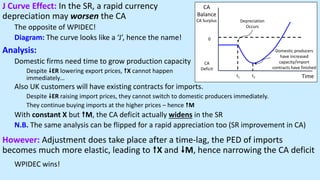
J Curve Effect: In the SR, a rapid currency
depreciation may worsen the CA
The opposite of WPIDEC!
Diagram: The curve looks like a ‘J’, hence the name!
Analysis:
Domestic firms need time to grow production capacity
Despite ER lowering export prices, X cannot happen
immediately…
Also UK customers will have existing contracts for imports.
Despite ER raising import prices, they cannot switch to domestic producers immediately.
They continue buying imports at the higher prices – hence M
With constant X but M, the CA deficit actually widens in the SR
N.B. The same analysis can be flipped for a rapid appreciation too (SR improvement in CA)
However: Adjustment does take place after a time-lag, the PED of imports
becomes much more elastic, leading to X and M, hence narrowing the CA deficit
WPIDEC wins!
Time
CA
Balance
CA
Deficit
0
CA Surplus Depreciation
Occurs
Domestic producers
have increased
capacity/import
contracts have finished
t1 t2
Price competitiveness: The relative strength of a country’s output based on prices/costs
The less price competitive a nation’s exports, the fewer they will sell, whilst imports will be more
greatly demanded instead of expensive domestic G&S
Influences leading to deficit: higher relative inflation rate, access to cheap imports from low-wage
countries, poor productivity, higher floating exchange rate/uncompetitive fixed ER
Non-price competitiveness: The relative strengths of a country’s output based on
product characteristics
The less competitive a nation’s exports are in terms of product characteristics, the fewer they will sell,
whilst imports will be more greatly demanded instead of lower quality domestic G&S
Influences leading to deficit: Poor quality, low innovation, poor branding
Relative stage in the business cycle: Differences in country’s levels of economic activity
will affect their demand for foreign goods
Influences leading to deficit: Domestic booms (increase M), Foreign recessions (reduce X)
Volatile raw material prices: Fluctuations in price greatly affect export revenue and
import expenditure
Countries who export will benefit when prices rise, countries who import will be worse off
Demand is often price inelastic, e.g. oil, iron ore or copper
Hence higher prices lead to increased spending on imports for net importers (like the UK)
Impacts of
Current Account
Deficits
Current Account Influences & Impacts
Mr O’Grady
Impacts of current account Imbalances
Impacts on other macroeconomic objectives: We need to understand the effect of
CA deficits on the economy, particularly in relation to the other macroeconomic
objectives
Unemployment: Likely to rise if the deficit is caused by a loss of price or non-price
competitiveness of UK production.
Caused by X and the suppression of AD.
However: If the deficit is caused by M in a domestic boom, then U/E will be low
Lower short run growth: (X < M) = a loss of potential AD and slower growth. If
sustained into the long run, slower growth will undermine the standard of living.
However: Imports can boost living standards in the SR as there will be more G&S being
consumed by domestic households
Cost-push inflation: will occur if the deficit is caused by M due to rising raw
material prices increasing the value of M (AKA imported inflation).
However: Higher M will suppress AD growth, reducing demand pull inflation
A depreciation of sterling: Due to D£ and S£, causes yet more imported inflation
However: it may also make UK goods price-competitive again, leading to X and M, and a
narrowing of the deficit
Financing a CA deficit: As the BOP must always sum to zero, a deficit on the
current account must be made up by a surplus on the Capital Account and/or
Financial Account
Capital account surplus: Britain is selling more assets to foreign entities than it is buying
foreign assets. British assets are being sold off
Financial account surplus: More investment funds flowing into the country than out of it.
Britain is receiving/borrowing more cash from abroad, than it is investing/lending out.
Issues of financing a CA deficit:
Reduced long run national income: Financing a CA deficit requires a capital and/or financial
account surpluses
Foreign multinationals investing in your country or the purchase your country’s assets
The best assets could be lost to foreigners, reducing long term income as profits flow overseas
Risk of capital flight: Very high CA deficits may lead to a fall in confidence by foreign investors
There is always a risk, that investors will withdraw their capital
This can cause a big drop in the value of your currency, leading to a decline in living standards and lower
confidence for investment
Asian crisis of 1997: A large factor of the crisis was that countries had run up large current account deficits,
financed by attracting capital flows (hot money)
But, when confidence fell, these hot money flows dried up, leading to a rapid devaluation and crisis of confidence
Uncompetitive: A CA deficit may be a signal of poor export competitiveness
This constrains economic growth as countries must rely more on consumption for their incomes
Eurozone: This is particularly a problem for countries in the Euro – who cannot devalue to restore
competitiveness.
Poor price competitiveness caused very large CA deficits and contributed to recessions in 2008-13
Key Question: Why might a CA deficit not be an issue?
FDI: A current account deficit could occur during a period of inward foreign direct investment
(surplus on financial account).
This inward investment can create jobs and investment.
Japan & UK: Not only did the UK economy benefit from increased investment from Japan, but the Japanese
firms also helped bring new working practices in which increased labour productivity
Self-correcting: With a floating exchange rate a large current account deficit should cause a
depreciation
This will help automatically reduce the level of the deficit
This is known as partial auto-correct
Indicator of Growth: A current account deficit may just indicate a strong economy, which is
growing rapidly.
UK 2015-16: the rise in deficit on UK primary incomes was a reflection that investment in the UK was giving
a good return to foreign investors.
Where next?
Don’t forget to SUBSCRIBE!
Visit our website: www.smootheconomics.co.uk
Find more resources, extension materials,
details of courses, competitions, and more!
Follow our socials:
Instagram: @smootheconomics
Twitter: @SmoothEconomics
Facebook: @SmoothEconomics

Current Account Influences and Impacts

  • 1.
    Current Account Influences & Impacts Lower6th Macro Macroeconomic Objectives
  • 2.
    Factors Influencing the Current Account CurrentAccount Influences & Impacts Mr O’Grady
  • 3.
    Factors Influencing theCurrent Account Balance of Payments: A record of all transactions between one country and the rest of the world Current Account: A record of all payments for trade in G&S plus income flow. It is divided into four parts: Trade in goods, trade in services, income, and current transfers Factors influencing the current account balance: Exchange rate: the price of a country's currency in terms of another currency i.e. how much foreign currency an individual can buy with one unit of domestic currency Appreciation: An increase in the value of a currency compared to another – ‘strong £’ Depreciation: A decrease in the value of a currency compared to another – ‘weak £’ Key Question: Is a stronger pound or a weaker pound better for CA balances? A stronger pound generally pushes towards/strengthens a current account deficit £1 can now ‘buy’ more foreign currency, which can then be used to buy more foreign goods. Imports rise. Similarly, €1 now ‘buys’ less pounds, which can support the purchase of fewer British goods. Exports fall. SPICED: Strong Pound, Imports Cheaper, Exports Dearer (A pneumonic to remember) The reverse result, a weak pound, can be remembered by WPIDEC (not quite the same) Marshall Lerner Condition: For this analysis to hold the sum of the price elasticities of imports and exports must be greater than one, │PEDX│ + │PEDM│ > 1, (i.e. elastic) Otherwise, the monetary value of (X-M) won’t move in the same direction as the quantity volume of (X-M)
  • 4.
    J Curve Effect:In the SR, a rapid currency depreciation may worsen the CA The opposite of WPIDEC! Diagram: The curve looks like a ‘J’, hence the name! Analysis: Domestic firms need time to grow production capacity Despite ER lowering export prices, X cannot happen immediately… Also UK customers will have existing contracts for imports. Despite ER raising import prices, they cannot switch to domestic producers immediately. They continue buying imports at the higher prices – hence M With constant X but M, the CA deficit actually widens in the SR N.B. The same analysis can be flipped for a rapid appreciation too (SR improvement in CA) However: Adjustment does take place after a time-lag, the PED of imports becomes much more elastic, leading to X and M, hence narrowing the CA deficit WPIDEC wins! Time CA Balance CA Deficit 0 CA Surplus Depreciation Occurs Domestic producers have increased capacity/import contracts have finished t1 t2
  • 5.
    Price competitiveness: Therelative strength of a country’s output based on prices/costs The less price competitive a nation’s exports, the fewer they will sell, whilst imports will be more greatly demanded instead of expensive domestic G&S Influences leading to deficit: higher relative inflation rate, access to cheap imports from low-wage countries, poor productivity, higher floating exchange rate/uncompetitive fixed ER Non-price competitiveness: The relative strengths of a country’s output based on product characteristics The less competitive a nation’s exports are in terms of product characteristics, the fewer they will sell, whilst imports will be more greatly demanded instead of lower quality domestic G&S Influences leading to deficit: Poor quality, low innovation, poor branding Relative stage in the business cycle: Differences in country’s levels of economic activity will affect their demand for foreign goods Influences leading to deficit: Domestic booms (increase M), Foreign recessions (reduce X) Volatile raw material prices: Fluctuations in price greatly affect export revenue and import expenditure Countries who export will benefit when prices rise, countries who import will be worse off Demand is often price inelastic, e.g. oil, iron ore or copper Hence higher prices lead to increased spending on imports for net importers (like the UK)
  • 6.
    Impacts of Current Account Deficits CurrentAccount Influences & Impacts Mr O’Grady
  • 7.
    Impacts of currentaccount Imbalances Impacts on other macroeconomic objectives: We need to understand the effect of CA deficits on the economy, particularly in relation to the other macroeconomic objectives Unemployment: Likely to rise if the deficit is caused by a loss of price or non-price competitiveness of UK production. Caused by X and the suppression of AD. However: If the deficit is caused by M in a domestic boom, then U/E will be low Lower short run growth: (X < M) = a loss of potential AD and slower growth. If sustained into the long run, slower growth will undermine the standard of living. However: Imports can boost living standards in the SR as there will be more G&S being consumed by domestic households Cost-push inflation: will occur if the deficit is caused by M due to rising raw material prices increasing the value of M (AKA imported inflation). However: Higher M will suppress AD growth, reducing demand pull inflation A depreciation of sterling: Due to D£ and S£, causes yet more imported inflation However: it may also make UK goods price-competitive again, leading to X and M, and a narrowing of the deficit
  • 8.
    Financing a CAdeficit: As the BOP must always sum to zero, a deficit on the current account must be made up by a surplus on the Capital Account and/or Financial Account Capital account surplus: Britain is selling more assets to foreign entities than it is buying foreign assets. British assets are being sold off Financial account surplus: More investment funds flowing into the country than out of it. Britain is receiving/borrowing more cash from abroad, than it is investing/lending out. Issues of financing a CA deficit: Reduced long run national income: Financing a CA deficit requires a capital and/or financial account surpluses Foreign multinationals investing in your country or the purchase your country’s assets The best assets could be lost to foreigners, reducing long term income as profits flow overseas Risk of capital flight: Very high CA deficits may lead to a fall in confidence by foreign investors There is always a risk, that investors will withdraw their capital This can cause a big drop in the value of your currency, leading to a decline in living standards and lower confidence for investment Asian crisis of 1997: A large factor of the crisis was that countries had run up large current account deficits, financed by attracting capital flows (hot money) But, when confidence fell, these hot money flows dried up, leading to a rapid devaluation and crisis of confidence
  • 9.
    Uncompetitive: A CAdeficit may be a signal of poor export competitiveness This constrains economic growth as countries must rely more on consumption for their incomes Eurozone: This is particularly a problem for countries in the Euro – who cannot devalue to restore competitiveness. Poor price competitiveness caused very large CA deficits and contributed to recessions in 2008-13 Key Question: Why might a CA deficit not be an issue? FDI: A current account deficit could occur during a period of inward foreign direct investment (surplus on financial account). This inward investment can create jobs and investment. Japan & UK: Not only did the UK economy benefit from increased investment from Japan, but the Japanese firms also helped bring new working practices in which increased labour productivity Self-correcting: With a floating exchange rate a large current account deficit should cause a depreciation This will help automatically reduce the level of the deficit This is known as partial auto-correct Indicator of Growth: A current account deficit may just indicate a strong economy, which is growing rapidly. UK 2015-16: the rise in deficit on UK primary incomes was a reflection that investment in the UK was giving a good return to foreign investors.
  • 10.
    Where next? Don’t forgetto SUBSCRIBE! Visit our website: www.smootheconomics.co.uk Find more resources, extension materials, details of courses, competitions, and more! Follow our socials: Instagram: @smootheconomics Twitter: @SmoothEconomics Facebook: @SmoothEconomics