Buffer Stock
Schemes
Lower 6th Micro
Government Intervention
Intro to Buffer
Stock
Schemes
Buffer Stock Schemes
Mr O’Grady
Intro to Buffer Stock Schemes
Definition: A scheme whereby a government agency buys or sells a particular commodity
on the open market, in order to maintain a target price
The aim is to reduce price fluctuations and to stabilise producer incomes
E.g. Schemes have been used in the markets for coffee, sugar, natural rubber, tin, wool etc.
P
Q
D
A
Qp QB
P*
PB
PP
SPoor
SBumper
Q1
C
B
Q* Q2
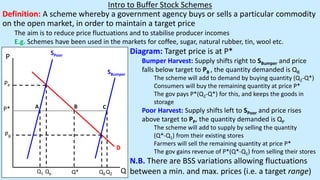
Diagram: Target price is at P*
Bumper Harvest: Supply shifts right to SBumper and price
falls below target to PB , the quantity demanded is QB
The scheme will add to demand by buying quantity (Q2-Q*)
Consumers will buy the remaining quantity at price P*
The gov pays P*(Q2-Q*) for this, and keeps the goods in
storage
Poor Harvest: Supply shifts left to SPoor and price rises
above target to PP, the quantity demanded is QP
The scheme will add to supply by selling the quantity
(Q*-Q1) from their existing stores
Farmers will sell the remaining quantity at price P*
The gov gains revenue of P*(Q*-Q1) from selling their stores
N.B. There are BSS variations allowing fluctuations
between a min. and max. prices (i.e. a target range)
Limitations of
Buffer Stock
Schemes
Buffer Stock Schemes
Mr O’Grady
Limitations of Buffer Stock Schemes
Financial requirements: Need for large financial might of buffer stock agencies to
effect market
Gov. needs to have plenty of cash reserves in order to buy up output when supply is too high
Costly: High cost of storage/refrigeration for perishable goods
There can also be quality impacts when the gov sells items which have been stored for an
extended period
Difficulty in setting target price: If the intervention price is set too high, the
government spends majority of its time buying output (financial losses) & rising
surplus
If the price is too low, the producers won’t be sufficiently protected
Long run alternatives: Other policies may be better for farmers
R&D tax credits could promote capital investment to stabilise supply e.g. technology to
understand weather patterns, encourage branding/processing by farmers
Where next?
Don’t forget to SUBSCRIBE!
Visit our website: www.smootheconomics.co.uk
Find more resources, extension materials,
details of courses, competitions, and more!
Follow our socials:
Instagram: @smootheconomics
Twitter: @SmoothEconomics
Facebook: @SmoothEconomics

Buffer Stock Schemes

  • 1.
    Buffer Stock Schemes Lower 6thMicro Government Intervention
  • 2.
    Intro to Buffer Stock Schemes BufferStock Schemes Mr O’Grady
  • 3.
    Intro to BufferStock Schemes Definition: A scheme whereby a government agency buys or sells a particular commodity on the open market, in order to maintain a target price The aim is to reduce price fluctuations and to stabilise producer incomes E.g. Schemes have been used in the markets for coffee, sugar, natural rubber, tin, wool etc. P Q D A Qp QB P* PB PP SPoor SBumper Q1 C B Q* Q2 Diagram: Target price is at P* Bumper Harvest: Supply shifts right to SBumper and price falls below target to PB , the quantity demanded is QB The scheme will add to demand by buying quantity (Q2-Q*) Consumers will buy the remaining quantity at price P* The gov pays P*(Q2-Q*) for this, and keeps the goods in storage Poor Harvest: Supply shifts left to SPoor and price rises above target to PP, the quantity demanded is QP The scheme will add to supply by selling the quantity (Q*-Q1) from their existing stores Farmers will sell the remaining quantity at price P* The gov gains revenue of P*(Q*-Q1) from selling their stores N.B. There are BSS variations allowing fluctuations between a min. and max. prices (i.e. a target range)
  • 4.
  • 5.
    Limitations of BufferStock Schemes Financial requirements: Need for large financial might of buffer stock agencies to effect market Gov. needs to have plenty of cash reserves in order to buy up output when supply is too high Costly: High cost of storage/refrigeration for perishable goods There can also be quality impacts when the gov sells items which have been stored for an extended period Difficulty in setting target price: If the intervention price is set too high, the government spends majority of its time buying output (financial losses) & rising surplus If the price is too low, the producers won’t be sufficiently protected Long run alternatives: Other policies may be better for farmers R&D tax credits could promote capital investment to stabilise supply e.g. technology to understand weather patterns, encourage branding/processing by farmers
  • 6.
    Where next? Don’t forgetto SUBSCRIBE! Visit our website: www.smootheconomics.co.uk Find more resources, extension materials, details of courses, competitions, and more! Follow our socials: Instagram: @smootheconomics Twitter: @SmoothEconomics Facebook: @SmoothEconomics