Economic
Growth – How
it’s caused
Lower 6th Macro
Macroeconomic Objectives
Actual & Potential
Economic Growth
Economic Growth
Mr O’Grady
Actual & Potential Economic Growth
Actual Economic Growth: An increase in the actual (value of) output of the
economy in the year
AD-AS diagram: actual economic growth is shown by an increase in Y
‘Short run Economic growth’: Actual Economic growth is sometimes referred to as short run
economic growth as there doesn’t necessarily need to be any change to the factors of
production for there to be actual economic growth
Potential Economic Growth: An increase in the value of an economy’s productive
potential
AD-AS diagram: actual economic growth is shown by an increase in YFE, The level of output
that occurs when all resources are fully employed – the economy is operating at capacity
‘Long run Economic growth’: Potential Economic growth is sometimes referred to as long run
economic growth as change to the factors of production is required.
FoP are only fully flexible in the long run
Demand side
Causes of
Economic Growth
Economic Growth
Mr O’Grady
Demand side Causes of Economic Growth
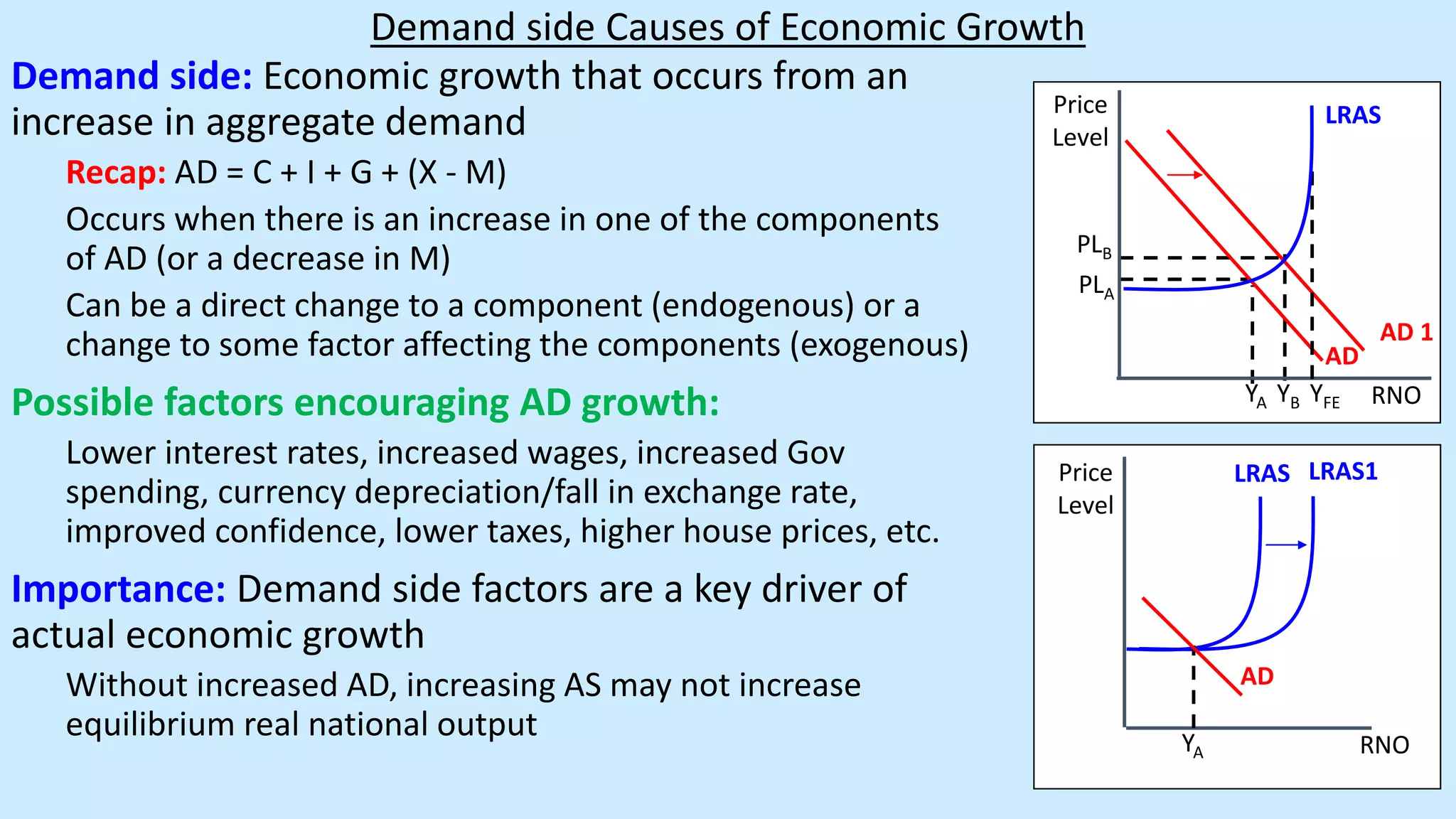
Demand side: Economic growth that occurs from an
increase in aggregate demand
Recap: AD = C + I + G + (X - M)
Occurs when there is an increase in one of the components
of AD (or a decrease in M)
Can be a direct change to a component (endogenous) or a
change to some factor affecting the components (exogenous)
Possible factors encouraging AD growth:
Lower interest rates, increased wages, increased Gov
spending, currency depreciation/fall in exchange rate,
improved confidence, lower taxes, higher house prices, etc.
Importance: Demand side factors are a key driver of
actual economic growth
Without increased AD, increasing AS may not increase
equilibrium real national output
LRAS LRAS1
RNO
Price
Level
YA
AD
LRAS
RNO
Price
Level
YA
PLA
YB
PLB
YFE
AD 1
AD
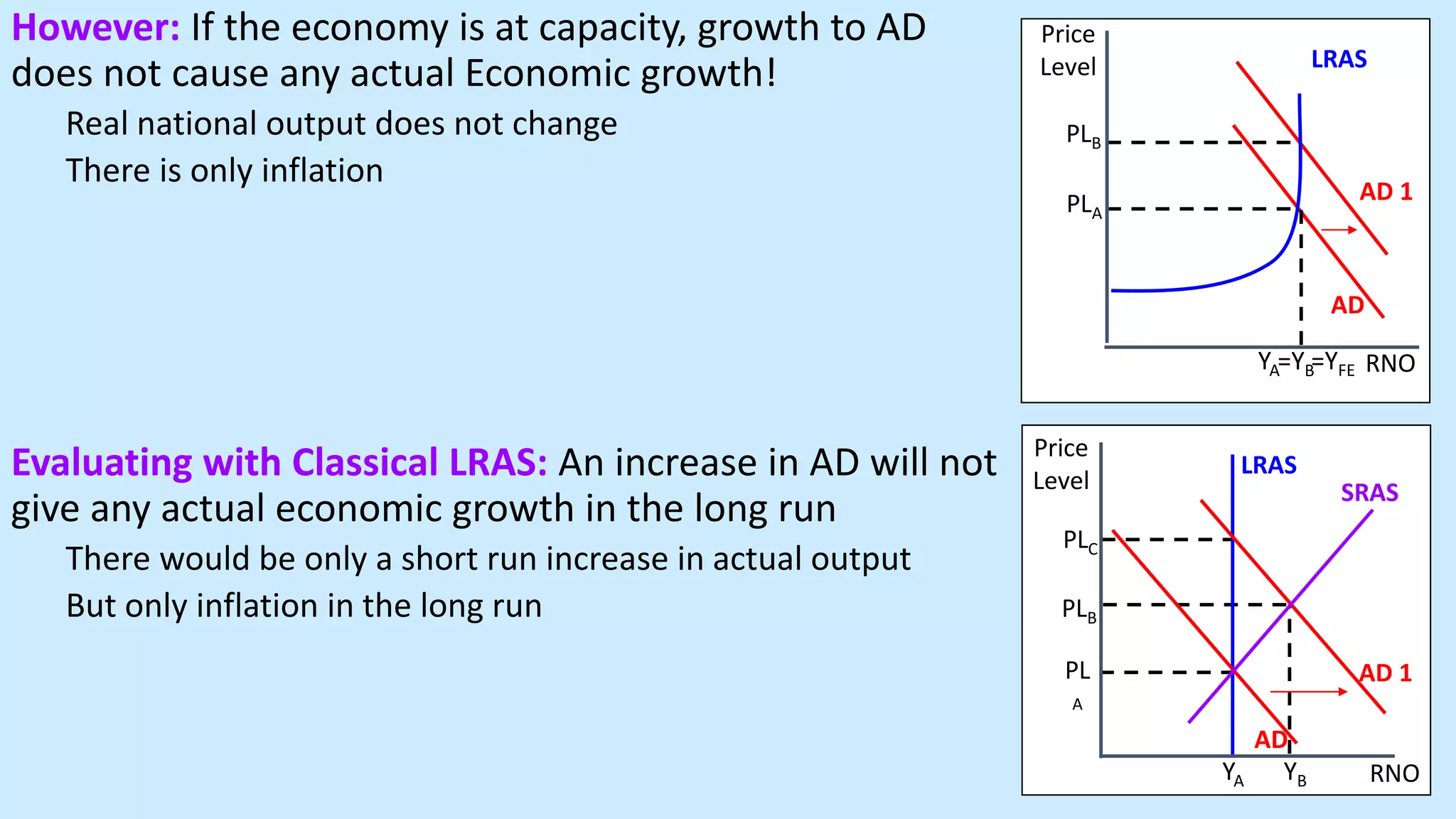
However: If the economy is at capacity, growth to AD
does not cause any actual Economic growth!
Real national output does not change
There is only inflation
Evaluating with Classical LRAS: An increase in AD will not
give any actual economic growth in the long run
There would be only a short run increase in actual output
But only inflation in the long run
LRAS
RNO
Price
Level
YA
PLA
=YB
PLB
=YFE
AD 1
AD
LRAS
SRAS
RNO
Price
Level
PL
A
YB
YA
PLB
PLC
AD 1
AD
Supply side
Causes of
Economic
Growth
Economic Growth
Mr O’Grady
Supply side Causes of Economic Growth
Supply side: Economic growth that occurs from an
increase in (long run) aggregate supply
LRAS will increase if there is an increase in either the quality
or quantity of the factors of production in an economy
Recap: an FOP can increase in quality if there is (factor
affected in brackets):
Money spent on R&D (K)
Improvements in education and skills (L)
Changes in relative productivity (K,L, Land)
Changes in government regulations (E, L, K)
an FOP can increase in quantity if there is:
Investment (K)
Demographic changes and net immigration (L)
Changes in government regulations (E, L, K)
Importance: Supply side factors are a key driver of
Potential economic growth
Without increased AS, increasing AD will not increase the
economy’s productive capacity
LRAS LRAS1
RNO
Price
Level
YFE YFE 1
LRAS LRAS1
RNO
Price
Level
YFE YFE 1
Constraints on
Economic
Growth
Economic Growth
Mr O’Grady
Constraints on Economic Growth
Definition: Anything that impedes growth of either a country’s actual or potential
output
Different constraints:
Absence of capital markets: in some countries poor financial sectors means that it is difficult
to raise the finance required for investment.
This is often cited as a main cause of the lack of economic development in some African countries.
Instability of government: This can lead to myopic decision-making that will impact on
investment, particularly from the government itself.
As regimes change frequently so do their policies.
This does not provide businesses from within, and outside, the country with the confidence to invest.
Labour market problems: A shortage of skilled labour means there is a shortage of a very
important factor input, and this will clearly constrain economic growth.
Export-led
Growth
Economic Growth
Mr O’Grady
Export-led growth
Export led growth: where a significant part of the expansion of real GDP flows from the
successful exporting of goods and services to other countries.
Examples: China, Ireland, S. Korea, Singapore, Hong Kong, Vietnam, and other emerging economies.
Advantages of export-led growth:
Growing export sales grows profit for firms, leading to increases in investment through the
accelerator effect.
Higher investment increases a country’s productive capacity which then increases the potential for exports.
Many industries help facilitate trade such as trade insurance, logistics and port facilities. Countries
with fast-growing export sectors are likely to see growth in these industries too.
Examples: The Netherlands (including the port of Rotterdam), Singapore and Hong Kong have developed
globally-scaled hubs for trade through promoting exports
Drawbacks from export-led growth:
Possible over-dependence on the economic cycles of trade partners and exposure to external shocks
Persistent trade surpluses might incite a protectionist response from other nations
They might feel that the benefits of trade have been unfavourably distributed.
Rapid export-led growth can lead to demand pull inflation.
High relative inflation can then worsen price competitiveness and indeed harm net exports consequently!
Can be unsustainable if it requires extraction of natural resources beyond that required for
maintaining long term balanced growth.
Where next?
Don’t forget to SUBSCRIBE!
Visit our website: www.smootheconomics.co.uk
Find more resources, extension materials,
details of courses, competitions, and more!
Follow our socials:
Instagram: @smootheconomics
Twitter: @SmoothEconomics
Facebook: @SmoothEconomics

Causes of Economic Growth

  • 1.
    Economic Growth – How it’scaused Lower 6th Macro Macroeconomic Objectives
  • 2.
    Actual & Potential EconomicGrowth Economic Growth Mr O’Grady
  • 3.
    Actual & PotentialEconomic Growth Actual Economic Growth: An increase in the actual (value of) output of the economy in the year AD-AS diagram: actual economic growth is shown by an increase in Y ‘Short run Economic growth’: Actual Economic growth is sometimes referred to as short run economic growth as there doesn’t necessarily need to be any change to the factors of production for there to be actual economic growth Potential Economic Growth: An increase in the value of an economy’s productive potential AD-AS diagram: actual economic growth is shown by an increase in YFE, The level of output that occurs when all resources are fully employed – the economy is operating at capacity ‘Long run Economic growth’: Potential Economic growth is sometimes referred to as long run economic growth as change to the factors of production is required. FoP are only fully flexible in the long run
  • 4.
    Demand side Causes of EconomicGrowth Economic Growth Mr O’Grady
  • 5.
    Demand side Causesof Economic Growth Demand side: Economic growth that occurs from an increase in aggregate demand Recap: AD = C + I + G + (X - M) Occurs when there is an increase in one of the components of AD (or a decrease in M) Can be a direct change to a component (endogenous) or a change to some factor affecting the components (exogenous) Possible factors encouraging AD growth: Lower interest rates, increased wages, increased Gov spending, currency depreciation/fall in exchange rate, improved confidence, lower taxes, higher house prices, etc. Importance: Demand side factors are a key driver of actual economic growth Without increased AD, increasing AS may not increase equilibrium real national output LRAS LRAS1 RNO Price Level YA AD LRAS RNO Price Level YA PLA YB PLB YFE AD 1 AD
  • 6.
    However: If theeconomy is at capacity, growth to AD does not cause any actual Economic growth! Real national output does not change There is only inflation Evaluating with Classical LRAS: An increase in AD will not give any actual economic growth in the long run There would be only a short run increase in actual output But only inflation in the long run LRAS RNO Price Level YA PLA =YB PLB =YFE AD 1 AD LRAS SRAS RNO Price Level PL A YB YA PLB PLC AD 1 AD
  • 7.
  • 8.
    Supply side Causesof Economic Growth Supply side: Economic growth that occurs from an increase in (long run) aggregate supply LRAS will increase if there is an increase in either the quality or quantity of the factors of production in an economy Recap: an FOP can increase in quality if there is (factor affected in brackets): Money spent on R&D (K) Improvements in education and skills (L) Changes in relative productivity (K,L, Land) Changes in government regulations (E, L, K) an FOP can increase in quantity if there is: Investment (K) Demographic changes and net immigration (L) Changes in government regulations (E, L, K) Importance: Supply side factors are a key driver of Potential economic growth Without increased AS, increasing AD will not increase the economy’s productive capacity LRAS LRAS1 RNO Price Level YFE YFE 1 LRAS LRAS1 RNO Price Level YFE YFE 1
  • 9.
  • 10.
    Constraints on EconomicGrowth Definition: Anything that impedes growth of either a country’s actual or potential output Different constraints: Absence of capital markets: in some countries poor financial sectors means that it is difficult to raise the finance required for investment. This is often cited as a main cause of the lack of economic development in some African countries. Instability of government: This can lead to myopic decision-making that will impact on investment, particularly from the government itself. As regimes change frequently so do their policies. This does not provide businesses from within, and outside, the country with the confidence to invest. Labour market problems: A shortage of skilled labour means there is a shortage of a very important factor input, and this will clearly constrain economic growth.
  • 11.
  • 12.
    Export-led growth Export ledgrowth: where a significant part of the expansion of real GDP flows from the successful exporting of goods and services to other countries. Examples: China, Ireland, S. Korea, Singapore, Hong Kong, Vietnam, and other emerging economies. Advantages of export-led growth: Growing export sales grows profit for firms, leading to increases in investment through the accelerator effect. Higher investment increases a country’s productive capacity which then increases the potential for exports. Many industries help facilitate trade such as trade insurance, logistics and port facilities. Countries with fast-growing export sectors are likely to see growth in these industries too. Examples: The Netherlands (including the port of Rotterdam), Singapore and Hong Kong have developed globally-scaled hubs for trade through promoting exports Drawbacks from export-led growth: Possible over-dependence on the economic cycles of trade partners and exposure to external shocks Persistent trade surpluses might incite a protectionist response from other nations They might feel that the benefits of trade have been unfavourably distributed. Rapid export-led growth can lead to demand pull inflation. High relative inflation can then worsen price competitiveness and indeed harm net exports consequently! Can be unsustainable if it requires extraction of natural resources beyond that required for maintaining long term balanced growth.
  • 13.
    Where next? Don’t forgetto SUBSCRIBE! Visit our website: www.smootheconomics.co.uk Find more resources, extension materials, details of courses, competitions, and more! Follow our socials: Instagram: @smootheconomics Twitter: @SmoothEconomics Facebook: @SmoothEconomics