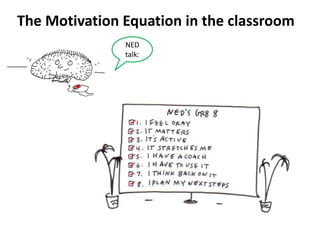
The Motivation Equation in the classroom
NED
talk:
What can we know about the students we
teach?
► Their families and cultures
► Their affinities, temperaments, interests
► Their experiences out of school
► Their previous academic experiences
Ask yourself
► How can you build on what you are
learning about your students?
SUMMARY & REFLECTION
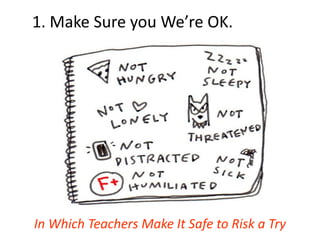
1. Make Sure you We’re OK.
In Which Teachers Make It Safe to Risk a Try
What gives learners a sense of safety and well-being?
► Enough sleep and nourishment
► Good health
► A distraction-free setting
► Group norms of trust and respect
► “Just-right” challenges, not too easy and not too hard
► A culture of learning from mistakes
Ask yourself
► Have you ever stopped yourself before asking a
question you thought might make you look dumb?
SUMMARY & REFLECTION
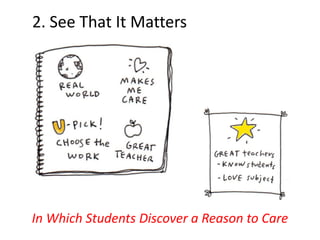
2. See That It Matters
In Which Students Discover a Reason to Care
SUMMARY & REFLECTION
Some reasons to care about a challenge
► The topic connects to our experiences, interests, or deep-seated
affinities.
► We see the subject of study as useful to us, now or in the
future.
► We admire someone who does that thing or we want to be part
of the group that’s involved.
► The challenge helps us build relationships with others.
► We get to choose work and demonstration modes in which we
expect success.
► The interest and commitment of an enthusiastic teacher draws
us in.
Ask yourself
► What kind of things give you a reason to care about learning
something, when otherwise you’re not that interested?
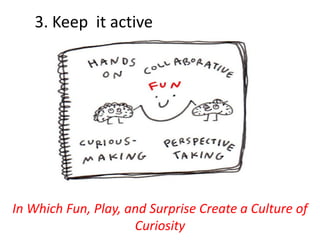
3. Keep it active
In Which Fun, Play, and Surprise Create a Culture of
Curiosity
SUMMARY & REFLECTION
What makes a task fun, playful, or surprising?
► New and novel situations
► Competition
► Games of imagination
► Role-playing
► Puzzles
► Uncertainty
► Unexpected outcomes
Ask yourself
► When has a playful or exciting situation helped draw
you in, spark your curiosity, and keep you learning?
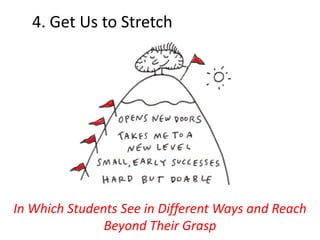
4. Get Us to Stretch
In Which Students See in Different Ways and Reach
Beyond Their Grasp
SUMMARY & REFLECTION
What helps us see in different ways and reach beyond
our grasp?
► Breaking projects down into manageable steps
► Pooling ideas with peers
► Imagining what it would be like to walk in someone
else’s shoes
► Working backward or analyzing a problem from
different vantage points
► Consulting experts
Ask yourself
► How have you learned from your peers, your
students, or those outside your school?
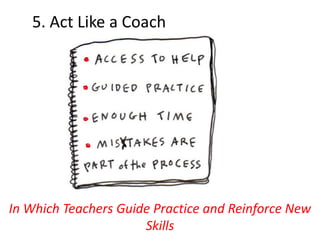
5. Act Like a Coach
In Which Teachers Guide Practice and Reinforce New
Skills
SUMMARY & REFLECTION
How do you guide someone’s practice and reinforce new
knowledge and skills?
► Frequent, low-stakes quizzes
► Sensory associations with new knowledge and skills
► Sorting through and making sense of ill-structured
material
► Action tasks with tangible results, linked to specific
goals
► Timely, user-friendly feedback, including suggestions
for next steps
Ask yourself
► What do you need to do to make sure you internalize
new knowledge and skills?
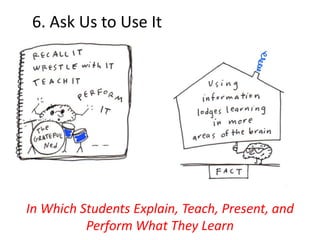
6. Ask Us to Use It
In Which Students Explain, Teach, Present, and
Perform What They Learn
SUMMARY & REFLECTION
What can learners do to apply and use new knowledge
and skills?
► Explain new concepts and teach new skills to others
► Adopt and defend a position based on new
knowledge
► Present or perform material based on new
knowledge or skills
► Publish or exhibit work that requires new knowledge
or skills
Ask yourself
► How do you know you have really taken ownership
of new skills or knowledge?
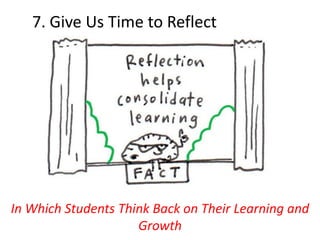
7. Give Us Time to Reflect
In Which Students Think Back on Their Learning and
Growth
SUMMARY & REFLECTION
What should learners reflect upon?
► What they learned and how they might apply it in
their lives
► How they learned, and which strategies worked best
for them
► How new learning is connected with—or built on—
prior learning
► How they have changed after acquiring new skills
and knowledge
Ask yourself
► Have you ever realized something new about
yourself only after looking back upon a learning
experience that had concluded?
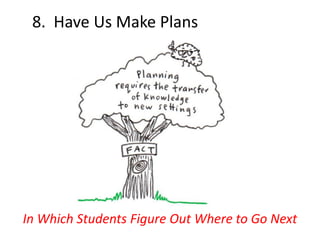
8. Have Us Make Plans
In Which Students Figure Out Where to Go Next
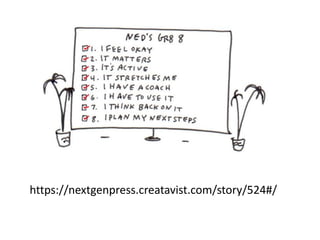
https://nextgenpress.creatavist.com/story/524#/
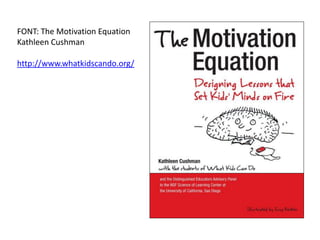
FONT: The Motivation Equation
Kathleen Cushman
http://www.whatkidscando.org/

The Motivation Equation: Ned talk

  • 2.
    The Motivation Equationin the classroom NED talk:
  • 3.
    What can weknow about the students we teach? ► Their families and cultures ► Their affinities, temperaments, interests ► Their experiences out of school ► Their previous academic experiences Ask yourself ► How can you build on what you are learning about your students? SUMMARY & REFLECTION
  • 4.
    1. Make Sureyou We’re OK. In Which Teachers Make It Safe to Risk a Try
  • 5.
    What gives learnersa sense of safety and well-being? ► Enough sleep and nourishment ► Good health ► A distraction-free setting ► Group norms of trust and respect ► “Just-right” challenges, not too easy and not too hard ► A culture of learning from mistakes Ask yourself ► Have you ever stopped yourself before asking a question you thought might make you look dumb? SUMMARY & REFLECTION
  • 6.
    2. See ThatIt Matters In Which Students Discover a Reason to Care
  • 7.
    SUMMARY & REFLECTION Somereasons to care about a challenge ► The topic connects to our experiences, interests, or deep-seated affinities. ► We see the subject of study as useful to us, now or in the future. ► We admire someone who does that thing or we want to be part of the group that’s involved. ► The challenge helps us build relationships with others. ► We get to choose work and demonstration modes in which we expect success. ► The interest and commitment of an enthusiastic teacher draws us in. Ask yourself ► What kind of things give you a reason to care about learning something, when otherwise you’re not that interested?
  • 8.
    3. Keep itactive In Which Fun, Play, and Surprise Create a Culture of Curiosity
  • 9.
    SUMMARY & REFLECTION Whatmakes a task fun, playful, or surprising? ► New and novel situations ► Competition ► Games of imagination ► Role-playing ► Puzzles ► Uncertainty ► Unexpected outcomes Ask yourself ► When has a playful or exciting situation helped draw you in, spark your curiosity, and keep you learning?
  • 10.
    4. Get Usto Stretch In Which Students See in Different Ways and Reach Beyond Their Grasp
  • 11.
    SUMMARY & REFLECTION Whathelps us see in different ways and reach beyond our grasp? ► Breaking projects down into manageable steps ► Pooling ideas with peers ► Imagining what it would be like to walk in someone else’s shoes ► Working backward or analyzing a problem from different vantage points ► Consulting experts Ask yourself ► How have you learned from your peers, your students, or those outside your school?
  • 12.
    5. Act Likea Coach In Which Teachers Guide Practice and Reinforce New Skills
  • 13.
    SUMMARY & REFLECTION Howdo you guide someone’s practice and reinforce new knowledge and skills? ► Frequent, low-stakes quizzes ► Sensory associations with new knowledge and skills ► Sorting through and making sense of ill-structured material ► Action tasks with tangible results, linked to specific goals ► Timely, user-friendly feedback, including suggestions for next steps Ask yourself ► What do you need to do to make sure you internalize new knowledge and skills?
  • 14.
    6. Ask Usto Use It In Which Students Explain, Teach, Present, and Perform What They Learn
  • 15.
    SUMMARY & REFLECTION Whatcan learners do to apply and use new knowledge and skills? ► Explain new concepts and teach new skills to others ► Adopt and defend a position based on new knowledge ► Present or perform material based on new knowledge or skills ► Publish or exhibit work that requires new knowledge or skills Ask yourself ► How do you know you have really taken ownership of new skills or knowledge?
  • 16.
    7. Give UsTime to Reflect In Which Students Think Back on Their Learning and Growth
  • 17.
    SUMMARY & REFLECTION Whatshould learners reflect upon? ► What they learned and how they might apply it in their lives ► How they learned, and which strategies worked best for them ► How new learning is connected with—or built on— prior learning ► How they have changed after acquiring new skills and knowledge Ask yourself ► Have you ever realized something new about yourself only after looking back upon a learning experience that had concluded?
  • 18.
    8. Have UsMake Plans In Which Students Figure Out Where to Go Next
  • 19.
  • 20.
    FONT: The MotivationEquation Kathleen Cushman http://www.whatkidscando.org/