Inquiry at AIS/D 25 February 2009 Parent Workshop
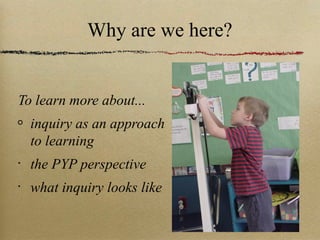
Why are we here? To learn more about... inquiry as an approach to learning the PYP perspective what inquiry looks like
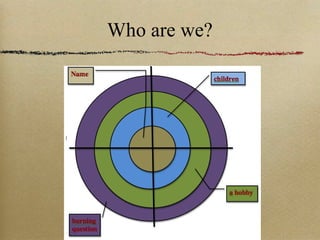
Who are we?
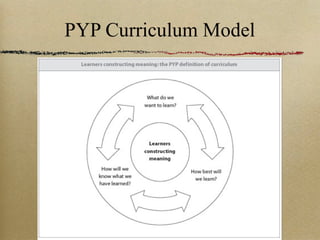
PYP Curriculum Model
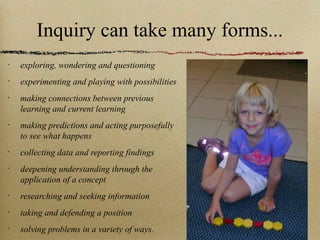
Inquiry can take many forms... exploring, wondering and questioning experimenting and playing with possibilities making connections between previous learning and current learning making predictions and acting purposefully to see what happens collecting data and reporting findings deepening understanding through the application of a concept researching and seeking information taking and defending a position solving problems in a variety of ways.
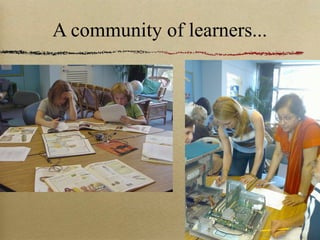
A community of learners...
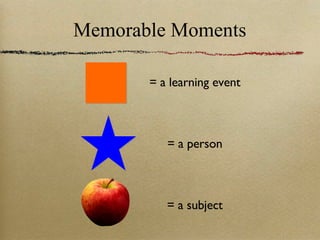
Memorable Moments = a learning event = a person = a subject
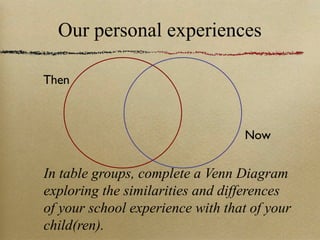
Our personal experiences In table groups, complete a Venn Diagram exploring the similarities and differences of your school experience with that of your child(ren). Then Now
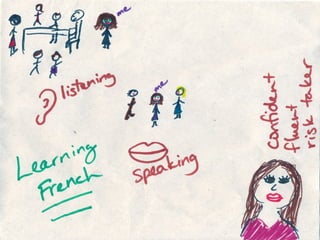
Our personal experiences Think about something you really understand well.  How did you develop this understanding?  What were some characteristics of this experience?  Recreate this experience visually .
Insert scan of example
Our personal experiences Think about something you really understand well.  How did you develop this understanding?  What were some characteristics of this experience?  Recreate this experience visually . 10 minutes
Our personal experiences Show visually something you really understand well.  Share this with your neighbor. In table groups, work together to identify characteristics common to all experiences
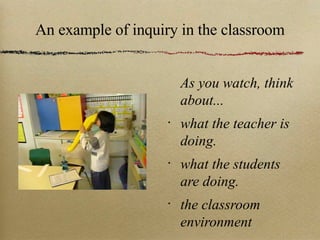
An example of inquiry in the classroom As you watch, think about... what the teacher is doing. what the students are doing. the classroom environment
Coin Sort Given a set of coins, find an interesting way to sort them, then write the way on an index card and turn over. While working, complete an “I See/I Wonder” sheet
Coin Sort – Gallery walk As a group, move  around to other tables and try to figure out how they were sorted, check with the index card, continue to do see/wonder sheets
Thanks for coming!

Inquiry in PYP for parents

  • 1.
    Inquiry at AIS/D25 February 2009 Parent Workshop
  • 2.
    Why are wehere? To learn more about... inquiry as an approach to learning the PYP perspective what inquiry looks like
  • 3.
  • 4.
  • 5.
    Inquiry can takemany forms... exploring, wondering and questioning experimenting and playing with possibilities making connections between previous learning and current learning making predictions and acting purposefully to see what happens collecting data and reporting findings deepening understanding through the application of a concept researching and seeking information taking and defending a position solving problems in a variety of ways.
  • 6.
    A community oflearners...
  • 7.
    Memorable Moments =a learning event = a person = a subject
  • 8.
    Our personal experiencesIn table groups, complete a Venn Diagram exploring the similarities and differences of your school experience with that of your child(ren). Then Now
  • 9.
    Our personal experiencesThink about something you really understand well. How did you develop this understanding? What were some characteristics of this experience? Recreate this experience visually .
  • 10.
  • 11.
    Our personal experiencesThink about something you really understand well. How did you develop this understanding? What were some characteristics of this experience? Recreate this experience visually . 10 minutes
  • 12.
    Our personal experiencesShow visually something you really understand well. Share this with your neighbor. In table groups, work together to identify characteristics common to all experiences
  • 13.
    An example ofinquiry in the classroom As you watch, think about... what the teacher is doing. what the students are doing. the classroom environment
  • 14.
    Coin Sort Givena set of coins, find an interesting way to sort them, then write the way on an index card and turn over. While working, complete an “I See/I Wonder” sheet
  • 15.
    Coin Sort –Gallery walk As a group, move around to other tables and try to figure out how they were sorted, check with the index card, continue to do see/wonder sheets
  • 16.