TEACHING, LEARNING AND
ASSESSMENT
Jon Curtis-Brignell
Assistant Head: Teaching and Learning
Pedagogy and assessment
1. What is great teaching?
2. How do we judge the quality of our teaching?
3. Why are challenge and expectations so
important?
4. How might we build in challenge through
assessment?
What makes great teaching?
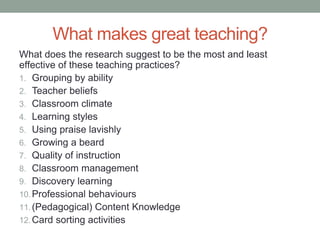
What does the research suggest to be the most and least
effective of these teaching practices?
1. Grouping by ability
2. Teacher beliefs
3. Classroom climate
4. Learning styles
5. Using praise lavishly
6. Growing a beard
7. Quality of instruction
8. Classroom management
9. Discovery learning
10.Professional behaviours
11.(Pedagogical) Content Knowledge
12.Card sorting activities
What makes great teaching?
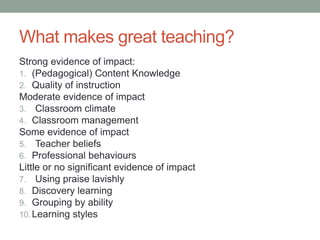
Strong evidence of impact:
1. (Pedagogical) Content Knowledge
2. Quality of instruction
Moderate evidence of impact
3. Classroom climate
4. Classroom management
Some evidence of impact
5. Teacher beliefs
6. Professional behaviours
Little or no significant evidence of impact
7. Using praise lavishly
8. Discovery learning
9. Grouping by ability
10.Learning styles
What makes great teaching?
The two factors with the strongest evidence in improving student
outcomes are:
1. (Pedagogical) content knowledge (Strong evidence of impact)
• Subject knowledge
• Understanding the ways students think about the content, being able to
evaluate the thinking behind students’ own methods, and identifying
students’ common misconceptions.
2. Quality of instruction (Strong evidence of impact)
• Effective questioning
• Formative assessment
• Reviewing previous learning
• Modelling
• Structured deliberate practice
• Scaffolding
What makes great teaching?
The following two elements of effective teaching have
moderate evidence showing a positive impact on
results:
3. Classroom climate (Moderate evidence of impact)
• Quality of interactions between teachers and students
• High expectations
• A Growth mindset (persistence)
4. Classroom management (Moderate evidence of
impact)
• Timing
• Classroom resources and space
• Behaviour management
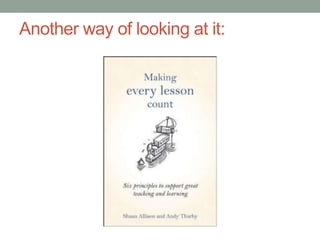
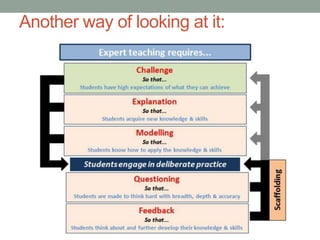
Another way of looking at it:
“Given the complexity of teaching, it is
surprisingly difficult for anyone watching a
teacher to judge how effectively students
are learning. We all think we can do it, but
the research evidence shows that we
can’t. Anyone who wants to judge the
quality of teaching needs to be very
cautious.”
Professor Robert Coe, Durham University.
How do we judge the quality of our
teaching?
Quality of teaching or effectiveness
of teaching?
Great teaching is defined as that which leads to
improved student progress.
We define effective teaching as that which leads to
improved student achievement using outcomes that
matter to their future success. Defining effective
teaching is not easy. The research keeps coming back
to this critical point: student progress is the yardstick by
which teacher quality should be assessed. Ultimately, for
a judgement about whether teaching is effective, to be
seen as trustworthy, it must be checked against the
progress being made by students.
- The Sutton Trust, What makes great teaching?
What does this mean for us?
• No prescribed way of teaching – as long as it’s effective
• No more graded lesson observations
• Formative lesson observations which promote
professional dialogue between the observer and the
observee, supporting reflection and growth for both
• No tick-list approach for observations
• Three simple questions for observation:
1. What is the teacher trying to do?
2. How do the students respond?
3. How could the teaching be even more effective?
4. Observer = critical friend
How do we judge the effectiveness of our
teaching?
A formative teacher evaluation system – based on
continuous assessment and feedback rather than a high-
stakes test - must incorporate a range of measures, from
different sources, using a variety of methods. A key to
suitably cautious and critical use of the different methods is
to triangulate them against each other. A single source of
evidence may suggest the way forward, but when it is
confirmed by another independent source it starts to become
a credible guide.
- The Sutton Trust
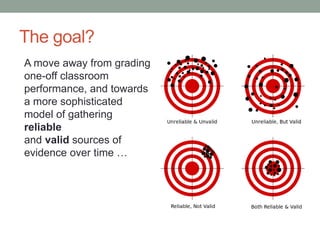
The goal?
A move away from grading
one-off classroom
performance, and towards
a more sophisticated
model of gathering
reliable
and valid sources of
evidence over time …
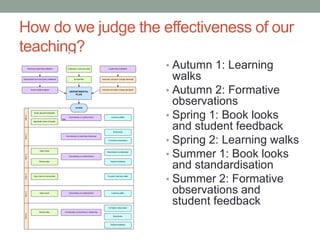
How do we judge the effectiveness of our
teaching?
• Autumn 1: Learning
walks
• Autumn 2: Formative
observations
• Spring 1: Book looks
and student feedback
• Spring 2: Learning walks
• Summer 1: Book looks
and standardisation
• Summer 2: Formative
observations and
student feedback
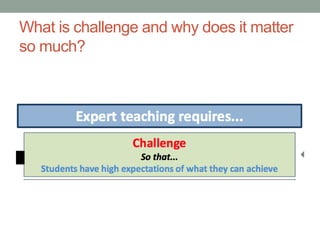
What is challenge and why does it matter
so much?
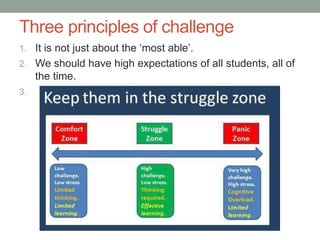
Three principles of challenge
1. It is not just about the ‘most able’.
2. We should have high expectations of all students, all of
the time.
3.
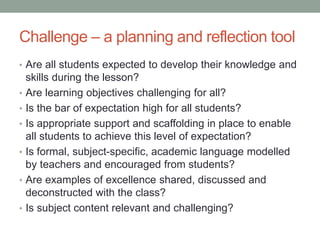
Challenge – a planning and reflection tool
• Are all students expected to develop their knowledge and
skills during the lesson?
• Are learning objectives challenging for all?
• Is the bar of expectation high for all students?
• Is appropriate support and scaffolding in place to enable
all students to achieve this level of expectation?
• Is formal, subject-specific, academic language modelled
by teachers and encouraged from students?
• Are examples of excellence shared, discussed and
deconstructed with the class?
• Is subject content relevant and challenging?
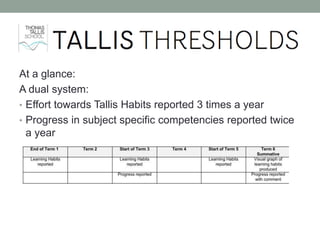
At a glance:
A dual system:
• Effort towards Tallis Habits reported 3 times a year
• Progress in subject specific competencies reported twice
a year
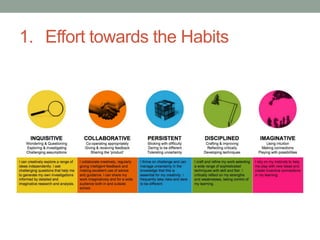
1. Effort towards the Habits
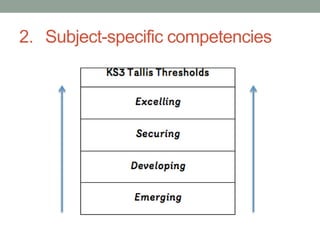
2. Subject-specific competencies
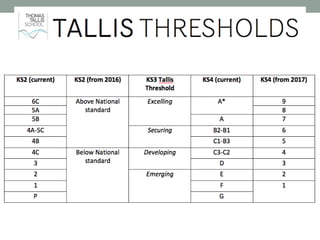
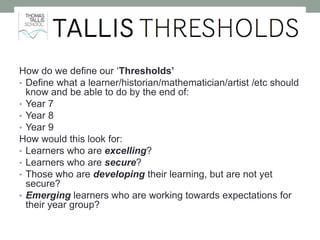
How do we define our ‘Thresholds’
• Define what a learner/historian/mathematician/artist /etc should
know and be able to do by the end of:
• Year 7
• Year 8
• Year 9
How would this look for:
• Learners who are excelling?
• Learners who are secure?
• Those who are developing their learning, but are not yet
secure?
• Emerging learners who are working towards expectations for
their year group?
Tracking progress and reporting to
parents
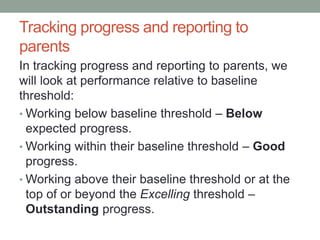
In tracking progress and reporting to parents, we
will look at performance relative to baseline
threshold:
• Working below baseline threshold – Below
expected progress.
• Working within their baseline threshold – Good
progress.
• Working above their baseline threshold or at the
top of or beyond the Excelling threshold –
Outstanding progress.
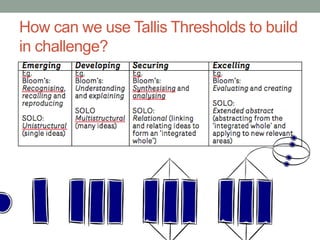
How can we use Tallis Thresholds to build
in challenge?

Teaching, learning and assessment

  • 1.
    TEACHING, LEARNING AND ASSESSMENT JonCurtis-Brignell Assistant Head: Teaching and Learning
  • 2.
    Pedagogy and assessment 1.What is great teaching? 2. How do we judge the quality of our teaching? 3. Why are challenge and expectations so important? 4. How might we build in challenge through assessment?
  • 3.
    What makes greatteaching? What does the research suggest to be the most and least effective of these teaching practices? 1. Grouping by ability 2. Teacher beliefs 3. Classroom climate 4. Learning styles 5. Using praise lavishly 6. Growing a beard 7. Quality of instruction 8. Classroom management 9. Discovery learning 10.Professional behaviours 11.(Pedagogical) Content Knowledge 12.Card sorting activities
  • 4.
    What makes greatteaching? Strong evidence of impact: 1. (Pedagogical) Content Knowledge 2. Quality of instruction Moderate evidence of impact 3. Classroom climate 4. Classroom management Some evidence of impact 5. Teacher beliefs 6. Professional behaviours Little or no significant evidence of impact 7. Using praise lavishly 8. Discovery learning 9. Grouping by ability 10.Learning styles
  • 5.
    What makes greatteaching? The two factors with the strongest evidence in improving student outcomes are: 1. (Pedagogical) content knowledge (Strong evidence of impact) • Subject knowledge • Understanding the ways students think about the content, being able to evaluate the thinking behind students’ own methods, and identifying students’ common misconceptions. 2. Quality of instruction (Strong evidence of impact) • Effective questioning • Formative assessment • Reviewing previous learning • Modelling • Structured deliberate practice • Scaffolding
  • 6.
    What makes greatteaching? The following two elements of effective teaching have moderate evidence showing a positive impact on results: 3. Classroom climate (Moderate evidence of impact) • Quality of interactions between teachers and students • High expectations • A Growth mindset (persistence) 4. Classroom management (Moderate evidence of impact) • Timing • Classroom resources and space • Behaviour management
  • 7.
    Another way oflooking at it:
  • 8.
    Another way oflooking at it:
  • 9.
    “Given the complexityof teaching, it is surprisingly difficult for anyone watching a teacher to judge how effectively students are learning. We all think we can do it, but the research evidence shows that we can’t. Anyone who wants to judge the quality of teaching needs to be very cautious.” Professor Robert Coe, Durham University. How do we judge the quality of our teaching?
  • 10.
    Quality of teachingor effectiveness of teaching? Great teaching is defined as that which leads to improved student progress. We define effective teaching as that which leads to improved student achievement using outcomes that matter to their future success. Defining effective teaching is not easy. The research keeps coming back to this critical point: student progress is the yardstick by which teacher quality should be assessed. Ultimately, for a judgement about whether teaching is effective, to be seen as trustworthy, it must be checked against the progress being made by students. - The Sutton Trust, What makes great teaching?
  • 11.
    What does thismean for us? • No prescribed way of teaching – as long as it’s effective • No more graded lesson observations • Formative lesson observations which promote professional dialogue between the observer and the observee, supporting reflection and growth for both • No tick-list approach for observations • Three simple questions for observation: 1. What is the teacher trying to do? 2. How do the students respond? 3. How could the teaching be even more effective? 4. Observer = critical friend
  • 12.
    How do wejudge the effectiveness of our teaching? A formative teacher evaluation system – based on continuous assessment and feedback rather than a high- stakes test - must incorporate a range of measures, from different sources, using a variety of methods. A key to suitably cautious and critical use of the different methods is to triangulate them against each other. A single source of evidence may suggest the way forward, but when it is confirmed by another independent source it starts to become a credible guide. - The Sutton Trust
  • 13.
    The goal? A moveaway from grading one-off classroom performance, and towards a more sophisticated model of gathering reliable and valid sources of evidence over time …
  • 14.
    How do wejudge the effectiveness of our teaching? • Autumn 1: Learning walks • Autumn 2: Formative observations • Spring 1: Book looks and student feedback • Spring 2: Learning walks • Summer 1: Book looks and standardisation • Summer 2: Formative observations and student feedback
  • 15.
    What is challengeand why does it matter so much?
  • 16.
    Three principles ofchallenge 1. It is not just about the ‘most able’. 2. We should have high expectations of all students, all of the time. 3.
  • 17.
    Challenge – aplanning and reflection tool • Are all students expected to develop their knowledge and skills during the lesson? • Are learning objectives challenging for all? • Is the bar of expectation high for all students? • Is appropriate support and scaffolding in place to enable all students to achieve this level of expectation? • Is formal, subject-specific, academic language modelled by teachers and encouraged from students? • Are examples of excellence shared, discussed and deconstructed with the class? • Is subject content relevant and challenging?
  • 18.
    At a glance: Adual system: • Effort towards Tallis Habits reported 3 times a year • Progress in subject specific competencies reported twice a year
  • 19.
  • 20.
  • 22.
    How do wedefine our ‘Thresholds’ • Define what a learner/historian/mathematician/artist /etc should know and be able to do by the end of: • Year 7 • Year 8 • Year 9 How would this look for: • Learners who are excelling? • Learners who are secure? • Those who are developing their learning, but are not yet secure? • Emerging learners who are working towards expectations for their year group?
  • 23.
    Tracking progress andreporting to parents In tracking progress and reporting to parents, we will look at performance relative to baseline threshold: • Working below baseline threshold – Below expected progress. • Working within their baseline threshold – Good progress. • Working above their baseline threshold or at the top of or beyond the Excelling threshold – Outstanding progress.
  • 24.
    How can weuse Tallis Thresholds to build in challenge?

Editor's Notes

  • #11 This means that no matter if we judge (or not judge) teaching or individual lessons, or even lessons over time, schools will always be held to account on their overall performance. This doesn’t mean that teachers shouldn’t be judged too, but that we should move towards a more reliable and fairer method for doing this.