Effective Educational Practices


✤   for quality teaching and learning
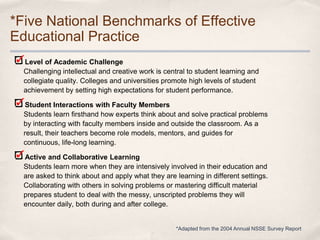
*Five National Benchmarks of Effective
Educational Practice
  Level of Academic Challenge
  Challenging intellectual and creative work is central to student learning and
  collegiate quality. Colleges and universities promote high levels of student
  achievement by setting high expectations for student performance.

   Student Interactions with Faculty Members
  Students learn firsthand how experts think about and solve practical problems
  by interacting with faculty members inside and outside the classroom. As a
  result, their teachers become role models, mentors, and guides for
  continuous, life-long learning.

  Active and Collaborative Learning
  Students learn more when they are intensively involved in their education and
  are asked to think about and apply what they are learning in different settings.
  Collaborating with others in solving problems or mastering difficult material
  prepares student to deal with the messy, unscripted problems they will
  encounter daily, both during and after college.


                                                   *Adapted from the 2004 Annual NSSE Survey Report
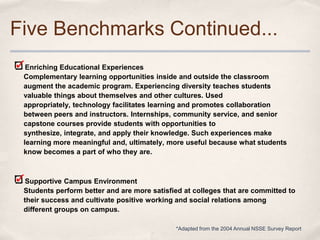
Five Benchmarks Continued...
  Enriching Educational Experiences
 Complementary learning opportunities inside and outside the classroom
 augment the academic program. Experiencing diversity teaches students
 valuable things about themselves and other cultures. Used
 appropriately, technology facilitates learning and promotes collaboration
 between peers and instructors. Internships, community service, and senior
 capstone courses provide students with opportunities to
 synthesize, integrate, and apply their knowledge. Such experiences make
 learning more meaningful and, ultimately, more useful because what students
 know becomes a part of who they are.


  Supportive Campus Environment
 Students perform better and are more satisfied at colleges that are committed to
 their success and cultivate positive working and social relations among
 different groups on campus.

                                             *Adapted from the 2004 Annual NSSE Survey Report
Putting the benchmarks into practice


✤   What are the principles for great teaching and learning
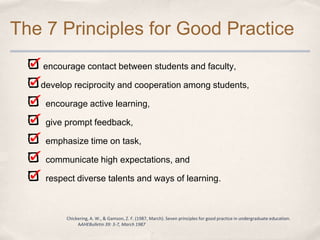
The 7 Principles for Good Practice
   encourage contact between students and faculty,

   develop reciprocity and cooperation among students,

    encourage active learning,

    give prompt feedback,

    emphasize time on task,

    communicate high expectations, and

    respect diverse talents and ways of learning.


         Chickering, A. W., & Gamson, Z. F. (1987, March). Seven principles for good practice in undergraduate education.
              AAHEBulletin 39: 3-7, March 1987
Two thoughts....
1. While these 7 principles can stand on their own, if we put them
   together we arrive at some very powerful forces for effective teaching
   and learning....just think about the following
   words...activity, expectations, cooperation, interaction, diversity, and
   Responsibility.

2. Think of effective teaching and learning like the mechanics of a clock.
   We can picture in our minds the gears, cogs and wheels, and how
   these move together so that time can be represented on the outward
   part of the machine - the clock face. This is a universal
   image, represented and replicated throughout our world...but the
   capturing of time is a profound concept...Just as the mechanics of
   teaching and learning, nebulous and profound requiring symbiotic
   movement, just as in the workings of a clock!
The 7 principles explained...
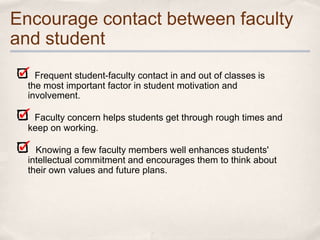
Encourage contact between faculty
and student
    Frequent student-faculty contact in and out of classes is
  the most important factor in student motivation and
  involvement.

   Faculty concern helps students get through rough times and
  keep on working.

    Knowing a few faculty members well enhances students'
  intellectual commitment and encourages them to think about
  their own values and future plans.
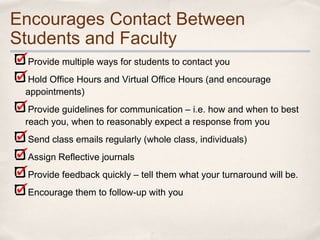
Encourages Contact Between
Students and Faculty
 Provide multiple ways for students to contact you
 Hold Office Hours and Virtual Office Hours (and encourage
 appointments)
  Provide guidelines for communication – i.e. how and when to best
 reach you, when to reasonably expect a response from you
 Send class emails regularly (whole class, individuals)
 Assign Reflective journals
 Provide feedback quickly – tell them what your turnaround will be.
 Encourage them to follow-up with you
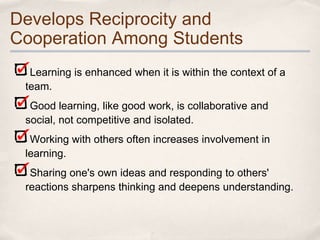
Develops Reciprocity and
Cooperation Among Students
  Learning is enhanced when it is within the context of a
 team.
  Good learning, like good work, is collaborative and
 social, not competitive and isolated.
  Working with others often increases involvement in
 learning.
  Sharing one's own ideas and responding to others'
 reactions sharpens thinking and deepens understanding.
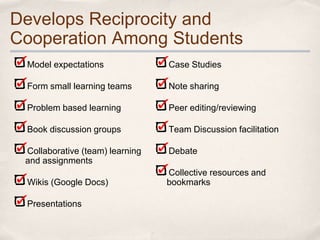
Develops Reciprocity and
Cooperation Among Students
 Model expectations              Case Studies

 Form small learning teams       Note sharing

 Problem based learning          Peer editing/reviewing

 Book discussion groups          Team Discussion facilitation

 Collaborative (team) learning   Debate
 and assignments
                                 Collective resources and
 Wikis (Google Docs)             bookmarks

 Presentations
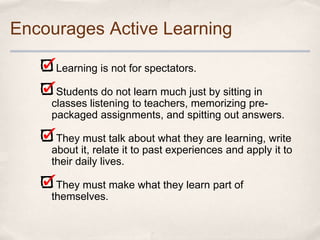
Encourages Active Learning

     Learning is not for spectators.

     Students do not learn much just by sitting in
    classes listening to teachers, memorizing pre-
    packaged assignments, and spitting out answers.

     They must talk about what they are learning, write
    about it, relate it to past experiences and apply it to
    their daily lives.

     They must make what they learn part of
    themselves.
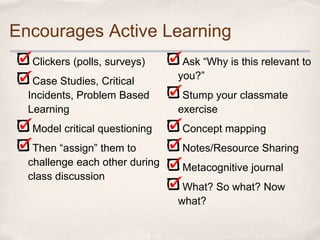
Encourages Active Learning
  Clickers (polls, surveys)      Ask “Why is this relevant to
   Case Studies, Critical       you?”
  Incidents, Problem Based       Stump your classmate
  Learning                      exercise
  Model critical questioning    Concept mapping
   Then “assign” them to        Notes/Resource Sharing
  challenge each other during   Metacognitive journal
  class discussion
                                 What? So what? Now
                                what?
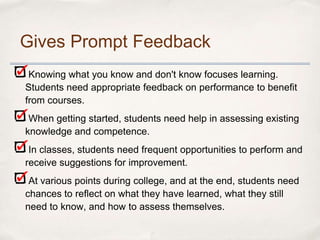
Gives Prompt Feedback
 Knowing what you know and don't know focuses learning.
Students need appropriate feedback on performance to benefit
from courses.
 When getting started, students need help in assessing existing
knowledge and competence.
 In classes, students need frequent opportunities to perform and
receive suggestions for improvement.
 At various points during college, and at the end, students need
chances to reflect on what they have learned, what they still
need to know, and how to assess themselves.
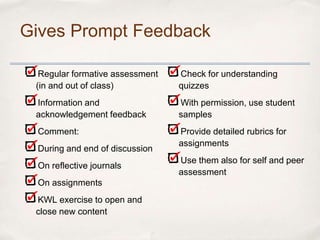
Gives Prompt Feedback

  Regular formative assessment   Check for understanding
 (in and out of class)           quizzes
 Information and                 With permission, use student
 acknowledgement feedback        samples
 Comment:                        Provide detailed rubrics for
                                 assignments
 During and end of discussion
                                 Use them also for self and peer
 On reflective journals
                                 assessment
 On assignments
 KWL exercise to open and
 close new content
Emphasizes Time on Task
  Time plus energy equals learning. There is no substitute for
 time on task.
  Learning to use one's time well is critical for students and
 professionals alike. Students need help in learning effective
 time management.
  Allocating realistic amounts of time means effective learning
 for students and effective teaching for faculty. How an
 institution defines time expectations for
 students, faculty, administrators, and other professional staff
 can establish the basis of high performance for all.
Emphasizes Time on Task
   Be organized and prepared for class
   Include objectives throughout the course
    Require groups to submit a task analysis with
  timelines and responsibilities (Learning Contracts)
   Estimate for students how much time they should
  spend on things
   Focus learners attention on provided
  resources, reading assignments, etc.
Communicates High Expectations
   Expect more and you will get more. High expectations are
  important for everyone -- for the poorly prepared, for those
  unwilling to exert themselves, and for the bright and well
  motivated.


   Expecting students to perform well becomes a self-
  fulfilling prophecy when teachers and institutions hold high
  expectations for themselves and make extra efforts.
Communicates High Expectations
 Clearly defined syllabus and             Authentic and problem based
 assignments                              learning

 Include learning objectives with units   Publicly praise quality and insight
 and assignments (know your
                                          Learners publish their work
 taxonomy!) Link feedback to
 objectives.                              Invite the library in (to work with you
                                          in setting up scholarly
 Post samples of assignments
                                          assignments, and into your class
 Provide detailed rubrics                 session for your students.)

 Give challenging assignments (and        Require scholarly resources and
 avoid "busy work")                       references
Respects Diverse Talents and
Ways of Learning
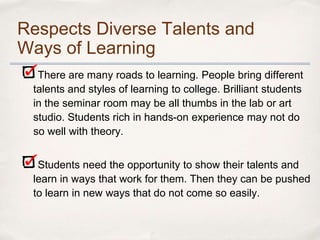
  There are many roads to learning. People bring different
 talents and styles of learning to college. Brilliant students
 in the seminar room may be all thumbs in the lab or art
 studio. Students rich in hands-on experience may not do
 so well with theory.


  Students need the opportunity to show their talents and
 learn in ways that work for them. Then they can be pushed
 to learn in new ways that do not come so easily.
Respects Diverse Talents and
Ways of Learning
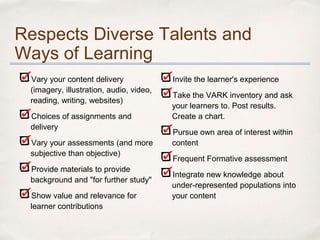
 Vary your content delivery              Invite the learner's experience
 (imagery, illustration, audio, video,
                                         Take the VARK inventory and ask
 reading, writing, websites)
                                         your learners to. Post results.
 Choices of assignments and              Create a chart.
 delivery
                                         Pursue own area of interest within
 Vary your assessments (and more         content
 subjective than objective)
                                         Frequent Formative assessment
 Provide materials to provide
                                         Integrate new knowledge about
 background and "for further study"
                                         under-represented populations into
 Show value and relevance for            your content
 learner contributions
A few resources
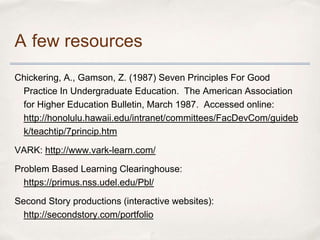
Chickering, A., Gamson, Z. (1987) Seven Principles For Good
 Practice In Undergraduate Education. The American Association
 for Higher Education Bulletin, March 1987. Accessed online:
 http://honolulu.hawaii.edu/intranet/committees/FacDevCom/guideb
 k/teachtip/7princip.htm

VARK: http://www.vark-learn.com/

Problem Based Learning Clearinghouse:
  https://primus.nss.udel.edu/Pbl/

Second Story productions (interactive websites):
  http://secondstory.com/portfolio

Effective ed practices.pptx

  • 1.
    Effective Educational Practices ✤ for quality teaching and learning
  • 2.
    *Five National Benchmarksof Effective Educational Practice Level of Academic Challenge Challenging intellectual and creative work is central to student learning and collegiate quality. Colleges and universities promote high levels of student achievement by setting high expectations for student performance. Student Interactions with Faculty Members Students learn firsthand how experts think about and solve practical problems by interacting with faculty members inside and outside the classroom. As a result, their teachers become role models, mentors, and guides for continuous, life-long learning. Active and Collaborative Learning Students learn more when they are intensively involved in their education and are asked to think about and apply what they are learning in different settings. Collaborating with others in solving problems or mastering difficult material prepares student to deal with the messy, unscripted problems they will encounter daily, both during and after college. *Adapted from the 2004 Annual NSSE Survey Report
  • 3.
    Five Benchmarks Continued... Enriching Educational Experiences Complementary learning opportunities inside and outside the classroom augment the academic program. Experiencing diversity teaches students valuable things about themselves and other cultures. Used appropriately, technology facilitates learning and promotes collaboration between peers and instructors. Internships, community service, and senior capstone courses provide students with opportunities to synthesize, integrate, and apply their knowledge. Such experiences make learning more meaningful and, ultimately, more useful because what students know becomes a part of who they are. Supportive Campus Environment Students perform better and are more satisfied at colleges that are committed to their success and cultivate positive working and social relations among different groups on campus. *Adapted from the 2004 Annual NSSE Survey Report
  • 4.
    Putting the benchmarksinto practice ✤ What are the principles for great teaching and learning
  • 5.
    The 7 Principlesfor Good Practice encourage contact between students and faculty, develop reciprocity and cooperation among students, encourage active learning, give prompt feedback, emphasize time on task, communicate high expectations, and respect diverse talents and ways of learning. Chickering, A. W., & Gamson, Z. F. (1987, March). Seven principles for good practice in undergraduate education. AAHEBulletin 39: 3-7, March 1987
  • 6.
    Two thoughts.... 1. Whilethese 7 principles can stand on their own, if we put them together we arrive at some very powerful forces for effective teaching and learning....just think about the following words...activity, expectations, cooperation, interaction, diversity, and Responsibility. 2. Think of effective teaching and learning like the mechanics of a clock. We can picture in our minds the gears, cogs and wheels, and how these move together so that time can be represented on the outward part of the machine - the clock face. This is a universal image, represented and replicated throughout our world...but the capturing of time is a profound concept...Just as the mechanics of teaching and learning, nebulous and profound requiring symbiotic movement, just as in the workings of a clock!
  • 7.
    The 7 principlesexplained...
  • 8.
    Encourage contact betweenfaculty and student Frequent student-faculty contact in and out of classes is the most important factor in student motivation and involvement. Faculty concern helps students get through rough times and keep on working. Knowing a few faculty members well enhances students' intellectual commitment and encourages them to think about their own values and future plans.
  • 9.
    Encourages Contact Between Studentsand Faculty Provide multiple ways for students to contact you Hold Office Hours and Virtual Office Hours (and encourage appointments) Provide guidelines for communication – i.e. how and when to best reach you, when to reasonably expect a response from you Send class emails regularly (whole class, individuals) Assign Reflective journals Provide feedback quickly – tell them what your turnaround will be. Encourage them to follow-up with you
  • 10.
    Develops Reciprocity and CooperationAmong Students Learning is enhanced when it is within the context of a team. Good learning, like good work, is collaborative and social, not competitive and isolated. Working with others often increases involvement in learning. Sharing one's own ideas and responding to others' reactions sharpens thinking and deepens understanding.
  • 11.
    Develops Reciprocity and CooperationAmong Students Model expectations Case Studies Form small learning teams Note sharing Problem based learning Peer editing/reviewing Book discussion groups Team Discussion facilitation Collaborative (team) learning Debate and assignments Collective resources and Wikis (Google Docs) bookmarks Presentations
  • 12.
    Encourages Active Learning Learning is not for spectators. Students do not learn much just by sitting in classes listening to teachers, memorizing pre- packaged assignments, and spitting out answers. They must talk about what they are learning, write about it, relate it to past experiences and apply it to their daily lives. They must make what they learn part of themselves.
  • 13.
    Encourages Active Learning Clickers (polls, surveys) Ask “Why is this relevant to Case Studies, Critical you?” Incidents, Problem Based Stump your classmate Learning exercise Model critical questioning Concept mapping Then “assign” them to Notes/Resource Sharing challenge each other during Metacognitive journal class discussion What? So what? Now what?
  • 14.
    Gives Prompt Feedback Knowing what you know and don't know focuses learning. Students need appropriate feedback on performance to benefit from courses. When getting started, students need help in assessing existing knowledge and competence. In classes, students need frequent opportunities to perform and receive suggestions for improvement. At various points during college, and at the end, students need chances to reflect on what they have learned, what they still need to know, and how to assess themselves.
  • 15.
    Gives Prompt Feedback Regular formative assessment Check for understanding (in and out of class) quizzes Information and With permission, use student acknowledgement feedback samples Comment: Provide detailed rubrics for assignments During and end of discussion Use them also for self and peer On reflective journals assessment On assignments KWL exercise to open and close new content
  • 16.
    Emphasizes Time onTask Time plus energy equals learning. There is no substitute for time on task. Learning to use one's time well is critical for students and professionals alike. Students need help in learning effective time management. Allocating realistic amounts of time means effective learning for students and effective teaching for faculty. How an institution defines time expectations for students, faculty, administrators, and other professional staff can establish the basis of high performance for all.
  • 17.
    Emphasizes Time onTask Be organized and prepared for class Include objectives throughout the course Require groups to submit a task analysis with timelines and responsibilities (Learning Contracts) Estimate for students how much time they should spend on things Focus learners attention on provided resources, reading assignments, etc.
  • 18.
    Communicates High Expectations Expect more and you will get more. High expectations are important for everyone -- for the poorly prepared, for those unwilling to exert themselves, and for the bright and well motivated. Expecting students to perform well becomes a self- fulfilling prophecy when teachers and institutions hold high expectations for themselves and make extra efforts.
  • 19.
    Communicates High Expectations Clearly defined syllabus and Authentic and problem based assignments learning Include learning objectives with units Publicly praise quality and insight and assignments (know your Learners publish their work taxonomy!) Link feedback to objectives. Invite the library in (to work with you in setting up scholarly Post samples of assignments assignments, and into your class Provide detailed rubrics session for your students.) Give challenging assignments (and Require scholarly resources and avoid "busy work") references
  • 20.
    Respects Diverse Talentsand Ways of Learning There are many roads to learning. People bring different talents and styles of learning to college. Brilliant students in the seminar room may be all thumbs in the lab or art studio. Students rich in hands-on experience may not do so well with theory. Students need the opportunity to show their talents and learn in ways that work for them. Then they can be pushed to learn in new ways that do not come so easily.
  • 21.
    Respects Diverse Talentsand Ways of Learning Vary your content delivery Invite the learner's experience (imagery, illustration, audio, video, Take the VARK inventory and ask reading, writing, websites) your learners to. Post results. Choices of assignments and Create a chart. delivery Pursue own area of interest within Vary your assessments (and more content subjective than objective) Frequent Formative assessment Provide materials to provide Integrate new knowledge about background and "for further study" under-represented populations into Show value and relevance for your content learner contributions
  • 22.
    A few resources Chickering,A., Gamson, Z. (1987) Seven Principles For Good Practice In Undergraduate Education. The American Association for Higher Education Bulletin, March 1987. Accessed online: http://honolulu.hawaii.edu/intranet/committees/FacDevCom/guideb k/teachtip/7princip.htm VARK: http://www.vark-learn.com/ Problem Based Learning Clearinghouse: https://primus.nss.udel.edu/Pbl/ Second Story productions (interactive websites): http://secondstory.com/portfolio