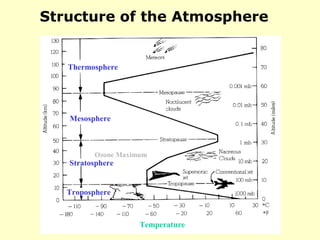

Structure of the Atmosphere
Thermosphere
Mesosphere
Ozone Maximum
Stratosphere
Troposphere
Temperature
http://www.ems.psu.edu/Courses/earth002/0402G_M.htm
How does energy input to the earth surface vary across the globe?
This Class - The Green House Effect and Global Warming
How is energy distributed to the earth’s surface?
What are greenhouse gases and the greenhouse effect?
Impact of an increase in atmospheric CO2
on greenhouse effect
Recent changes in greenhouse gas concentrations
Relationship between the greenhouse effect and global
warming
The “Greenhouse Effect”
The Earth’s surface thus receives energy
from two sources: the sun & the
atmosphere
– As a result the Earth’s surface is ~33°C warmer
than it would be without an atmosphere
Greenhouse gases are transparent to
shortwave but absorb longwave radiation
– Thus the atmosphere stores energy
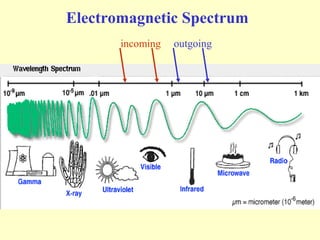
Electromagnetic Spectrum
incoming outgoing
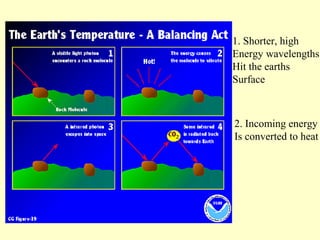
1. Shorter, high
Energy wavelengths
Hit the earths
Surface
2. Incoming energy
Is converted to heat
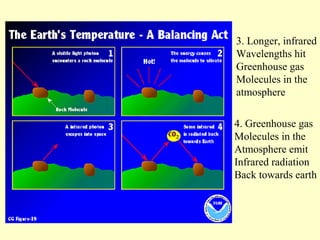
3. Longer, infrared
Wavelengths hit
Greenhouse gas
Molecules in the
atmosphere
4. Greenhouse gas
Molecules in the
Atmosphere emit
Infrared radiation
Back towards earth
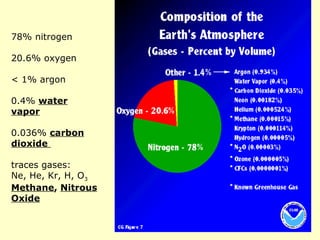
78% nitrogen
20.6% oxygen
< 1% argon
0.4% water
vapor
0.036% carbon
dioxide
traces gases:
Ne, He, Kr, H, O3
Methane, Nitrous
Oxide
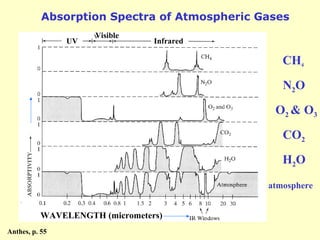
Absorption Spectra of Atmospheric Gases
Anthes, p. 55
CH4
CO2
N2O
H2O
O2 & O3
atmosphere
WAVELENGTH (micrometers)
Infrared
Visible
UV
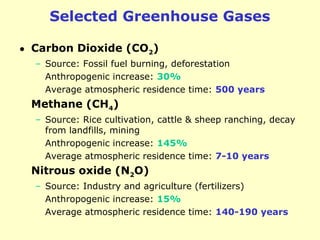
Selected Greenhouse Gases
• Carbon Dioxide (CO2)
– Source: Fossil fuel burning, deforestation
Anthropogenic increase: 30%
Average atmospheric residence time: 500 years
Methane (CH4)
– Source: Rice cultivation, cattle & sheep ranching, decay
from landfills, mining
Anthropogenic increase: 145%
Average atmospheric residence time: 7-10 years
Nitrous oxide (N2O)
– Source: Industry and agriculture (fertilizers)
Anthropogenic increase: 15%
Average atmospheric residence time: 140-190 years
Summary
Greenhouse gases absorb infrared radiation and prevent it
from escaping to space.
Carbon dioxide, methane, and nitrous oxide are very good
at capturing energy at wavelengths that other compounds
miss
Greenhouse Effect & Global Warming
• The “greenhouse effect” & global
warming are not the same thing.
– Global warming refers to a rise in the
temperature of the surface of the earth
• An increase in the concentration of
greenhouse gases leads to an
increase in the the magnitude of the
greenhouse effect. (Called enhanced
greenhouse effect)
– This results in global warming
1840 1860 1880 1900 1920 1940 1960 1980 2000
14.5
1920
14.4
14.3
14.2
14.1
14.0
13.9
13.8
13.7
13.6
13.5
13.4
58.0
57.8
57.6
57.4
57.2
57.0
56.8
56.6
56.4
56.2
www.gcrio.org/ipcc/qa/cover.html (modified)
Variability
Average
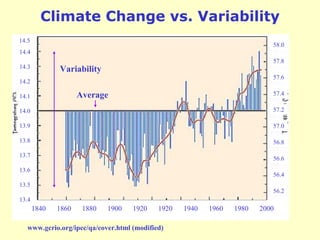
Climate Change vs. Variability
Even in a stable climate regime, there will always
be some variation (wet/dry years, warm/cold
years) A year with completely “average” or
“normal” climate conditions is rare
Climate variability is natural.
The challenge for scientists is to determine
whether any increase/decrease in precipitation,
temperature, frequency of storms, sea level, etc.
is due to climate variability or climate change.
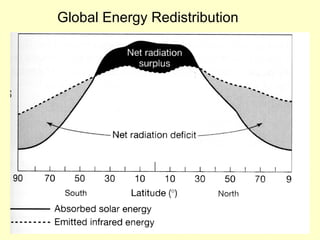
Global Energy Redistribution
Radiation is not evenly distributed over the
Surface of the earth. The northern latitudes have an
energy deficit and the low latitude/ equator has an excess.
But the low latitudes don’t indefinitely get hotter and the
northern latitudes don’t get colder.
Why?
The atmosphere and ocean transfer energy from low
latitudes to high
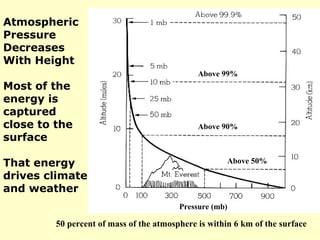
Atmospheric
Pressure
Decreases
With Height
Most of the
energy is
captured
close to the
surface
That energy
drives climate
and weather
50 percent of mass of the atmosphere is within 6 km of the surface
Pressure (mb)
Above 99%
Above 90%
Above 50%
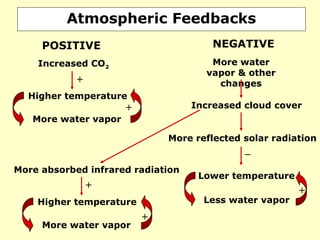
Atmospheric Feedbacks
Increased CO2
Higher temperature
More water vapor
POSITIVE NEGATIVE
More water
vapor & other
changes
Increased cloud cover
More reflected solar radiation
Lower temperature
Less water vapor
More absorbed infrared radiation
Higher temperature
More water vapor
+
+
+
+
+
–
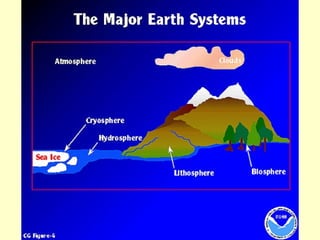
The Major Earth Systems

The Major Earth Systems

  • 2.
    Structure of theAtmosphere Thermosphere Mesosphere Ozone Maximum Stratosphere Troposphere Temperature
  • 3.
    http://www.ems.psu.edu/Courses/earth002/0402G_M.htm How does energyinput to the earth surface vary across the globe?
  • 4.
    This Class -The Green House Effect and Global Warming How is energy distributed to the earth’s surface? What are greenhouse gases and the greenhouse effect? Impact of an increase in atmospheric CO2 on greenhouse effect Recent changes in greenhouse gas concentrations Relationship between the greenhouse effect and global warming
  • 5.
    The “Greenhouse Effect” TheEarth’s surface thus receives energy from two sources: the sun & the atmosphere – As a result the Earth’s surface is ~33°C warmer than it would be without an atmosphere Greenhouse gases are transparent to shortwave but absorb longwave radiation – Thus the atmosphere stores energy
  • 6.
  • 7.
    1. Shorter, high Energywavelengths Hit the earths Surface 2. Incoming energy Is converted to heat
  • 8.
    3. Longer, infrared Wavelengthshit Greenhouse gas Molecules in the atmosphere 4. Greenhouse gas Molecules in the Atmosphere emit Infrared radiation Back towards earth
  • 9.
    78% nitrogen 20.6% oxygen <1% argon 0.4% water vapor 0.036% carbon dioxide traces gases: Ne, He, Kr, H, O3 Methane, Nitrous Oxide
  • 10.
    Absorption Spectra ofAtmospheric Gases Anthes, p. 55 CH4 CO2 N2O H2O O2 & O3 atmosphere WAVELENGTH (micrometers) Infrared Visible UV
  • 13.
    Selected Greenhouse Gases •Carbon Dioxide (CO2) – Source: Fossil fuel burning, deforestation Anthropogenic increase: 30% Average atmospheric residence time: 500 years Methane (CH4) – Source: Rice cultivation, cattle & sheep ranching, decay from landfills, mining Anthropogenic increase: 145% Average atmospheric residence time: 7-10 years Nitrous oxide (N2O) – Source: Industry and agriculture (fertilizers) Anthropogenic increase: 15% Average atmospheric residence time: 140-190 years
  • 14.
    Summary Greenhouse gases absorbinfrared radiation and prevent it from escaping to space. Carbon dioxide, methane, and nitrous oxide are very good at capturing energy at wavelengths that other compounds miss
  • 15.
    Greenhouse Effect &Global Warming • The “greenhouse effect” & global warming are not the same thing. – Global warming refers to a rise in the temperature of the surface of the earth • An increase in the concentration of greenhouse gases leads to an increase in the the magnitude of the greenhouse effect. (Called enhanced greenhouse effect) – This results in global warming
  • 16.
    1840 1860 18801900 1920 1940 1960 1980 2000 14.5 1920 14.4 14.3 14.2 14.1 14.0 13.9 13.8 13.7 13.6 13.5 13.4 58.0 57.8 57.6 57.4 57.2 57.0 56.8 56.6 56.4 56.2 www.gcrio.org/ipcc/qa/cover.html (modified) Variability Average Climate Change vs. Variability
  • 17.
    Climate Change vs.Variability Even in a stable climate regime, there will always be some variation (wet/dry years, warm/cold years) A year with completely “average” or “normal” climate conditions is rare Climate variability is natural. The challenge for scientists is to determine whether any increase/decrease in precipitation, temperature, frequency of storms, sea level, etc. is due to climate variability or climate change.
  • 18.
  • 19.
    Radiation is notevenly distributed over the Surface of the earth. The northern latitudes have an energy deficit and the low latitude/ equator has an excess. But the low latitudes don’t indefinitely get hotter and the northern latitudes don’t get colder. Why? The atmosphere and ocean transfer energy from low latitudes to high
  • 20.
    Atmospheric Pressure Decreases With Height Most ofthe energy is captured close to the surface That energy drives climate and weather 50 percent of mass of the atmosphere is within 6 km of the surface Pressure (mb) Above 99% Above 90% Above 50%
  • 21.
    Atmospheric Feedbacks Increased CO2 Highertemperature More water vapor POSITIVE NEGATIVE More water vapor & other changes Increased cloud cover More reflected solar radiation Lower temperature Less water vapor More absorbed infrared radiation Higher temperature More water vapor + + + + + –

Editor's Notes

  • #4 Lets break it down for the earth and look a little more closely at the energy coming in.