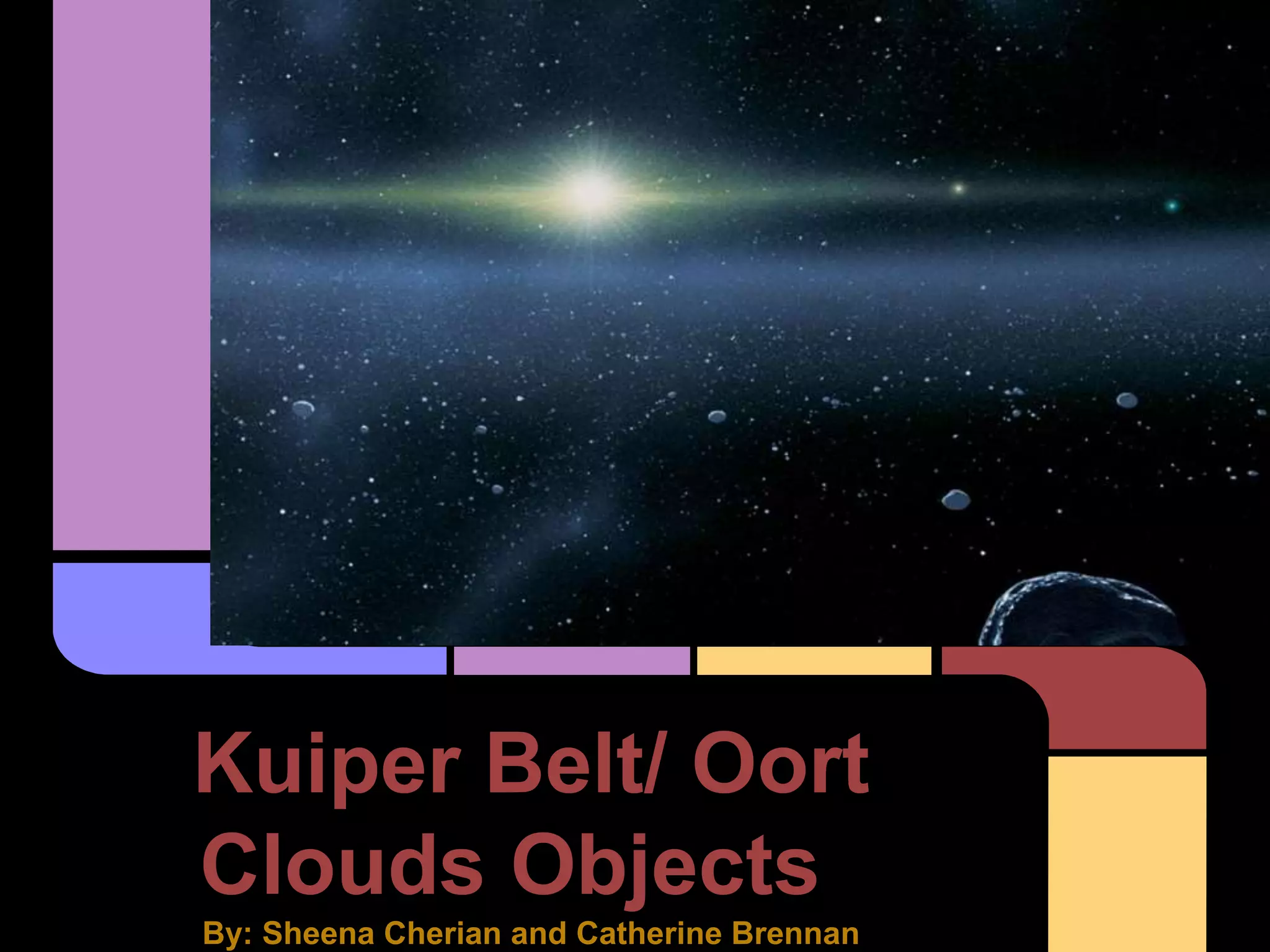
Kuiper Belt/ Oort
Clouds Objects
By: Sheena Cherian and Catherine Brennan
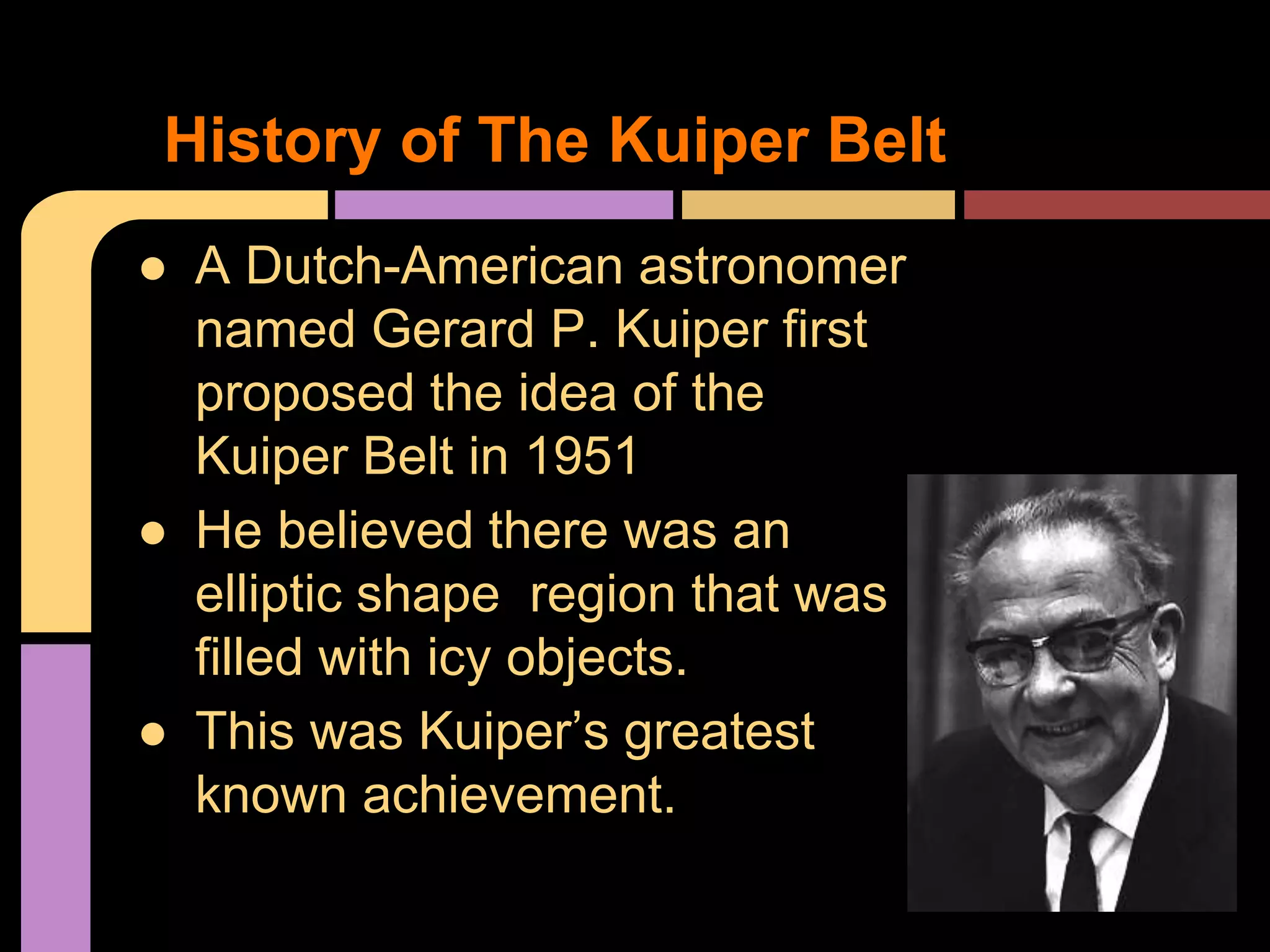
● A Dutch-American astronomer
named Gerard P. Kuiper first
proposed the idea of the
Kuiper Belt in 1951
● He believed there was an
elliptic shape region that was
filled with icy objects.
● This was Kuiper’s greatest
known achievement.
History of The Kuiper Belt
 It contains small icy bodies
 It is a disk shaped region past the orbit of
Neptune
Kuiper Belt Objects?
 Extends from 30 to
50 AU (2.5 to 4.5
billion miles) from
the Sun
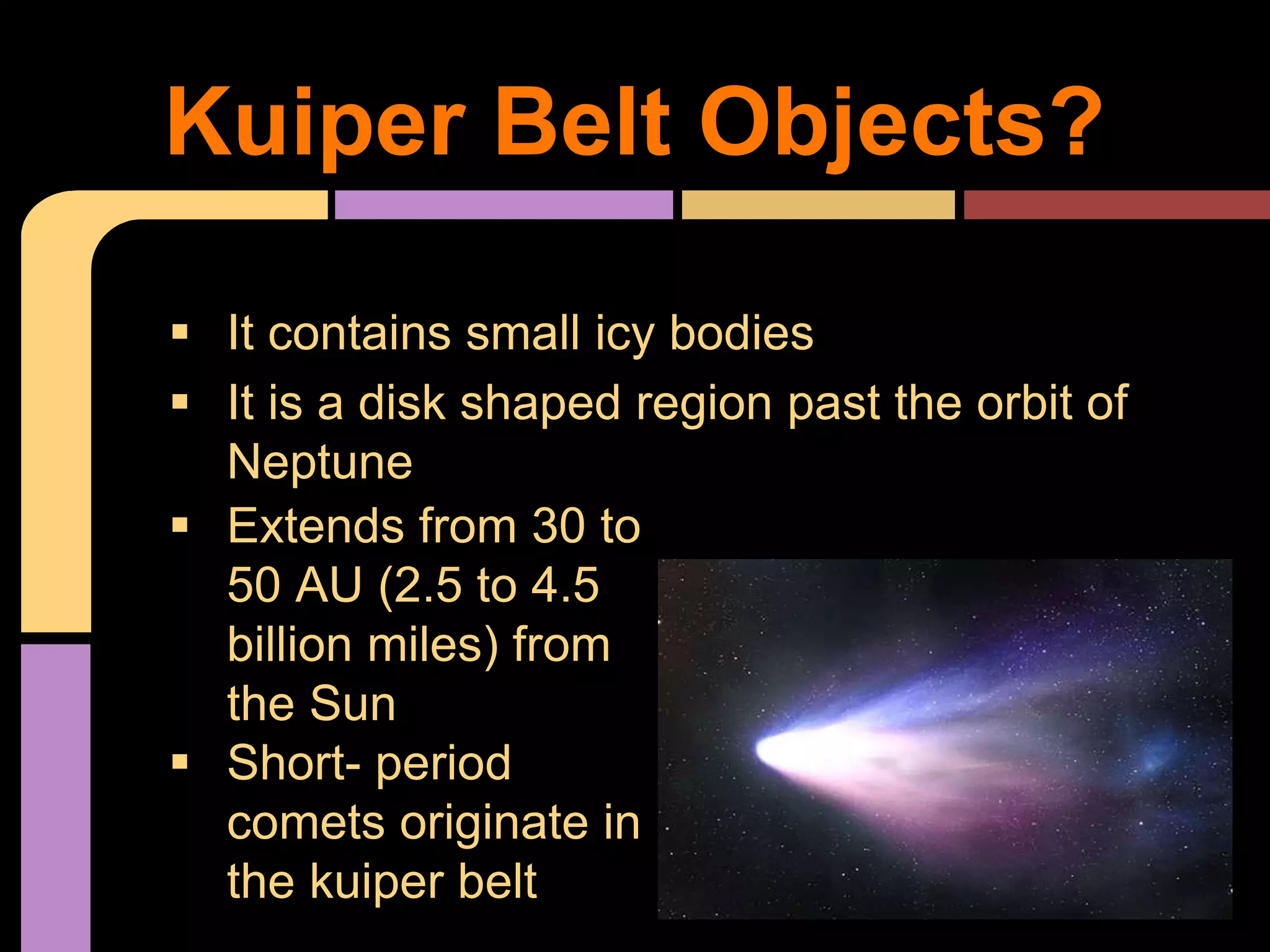
 Short- period
comets originate in
the kuiper belt
 There are many dwarf planets that are seen
on the belt
 The largest dwarf planet is Eris, it's coated
with methane ice
 Next is Pluto, 2006 it was discovered that it
was not a planet, but only a dwarf planet
 Haumea rotates every 3.9 hours
 Makemake was discovered in 2005
 Ceres is the first asteroid discovered and
also the largest
Kuiper Belt Objects:
Planets
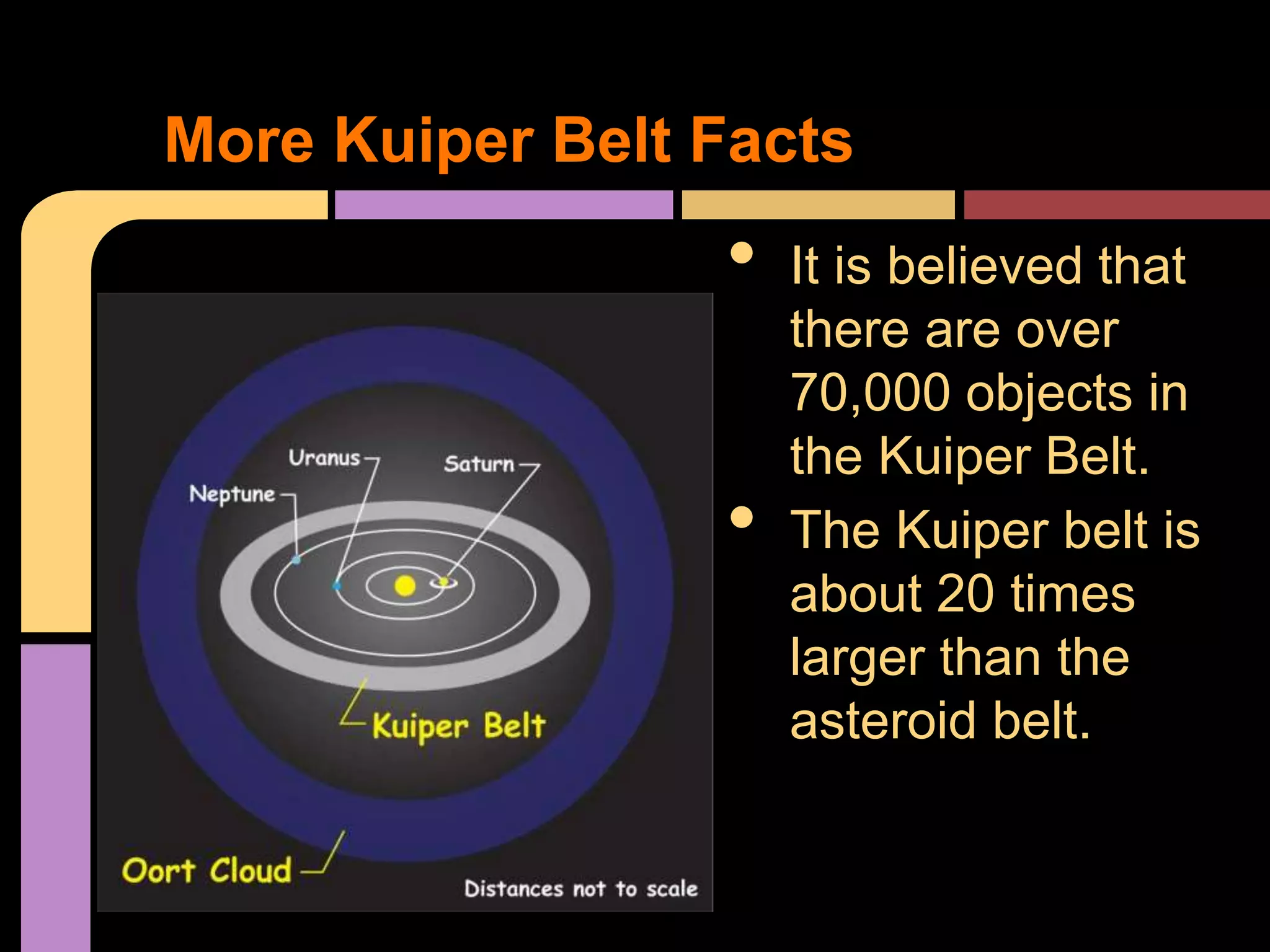
• It is believed that
there are over
70,000 objects in
the Kuiper Belt.
• The Kuiper belt is
about 20 times
larger than the
asteroid belt.
More Kuiper Belt Facts
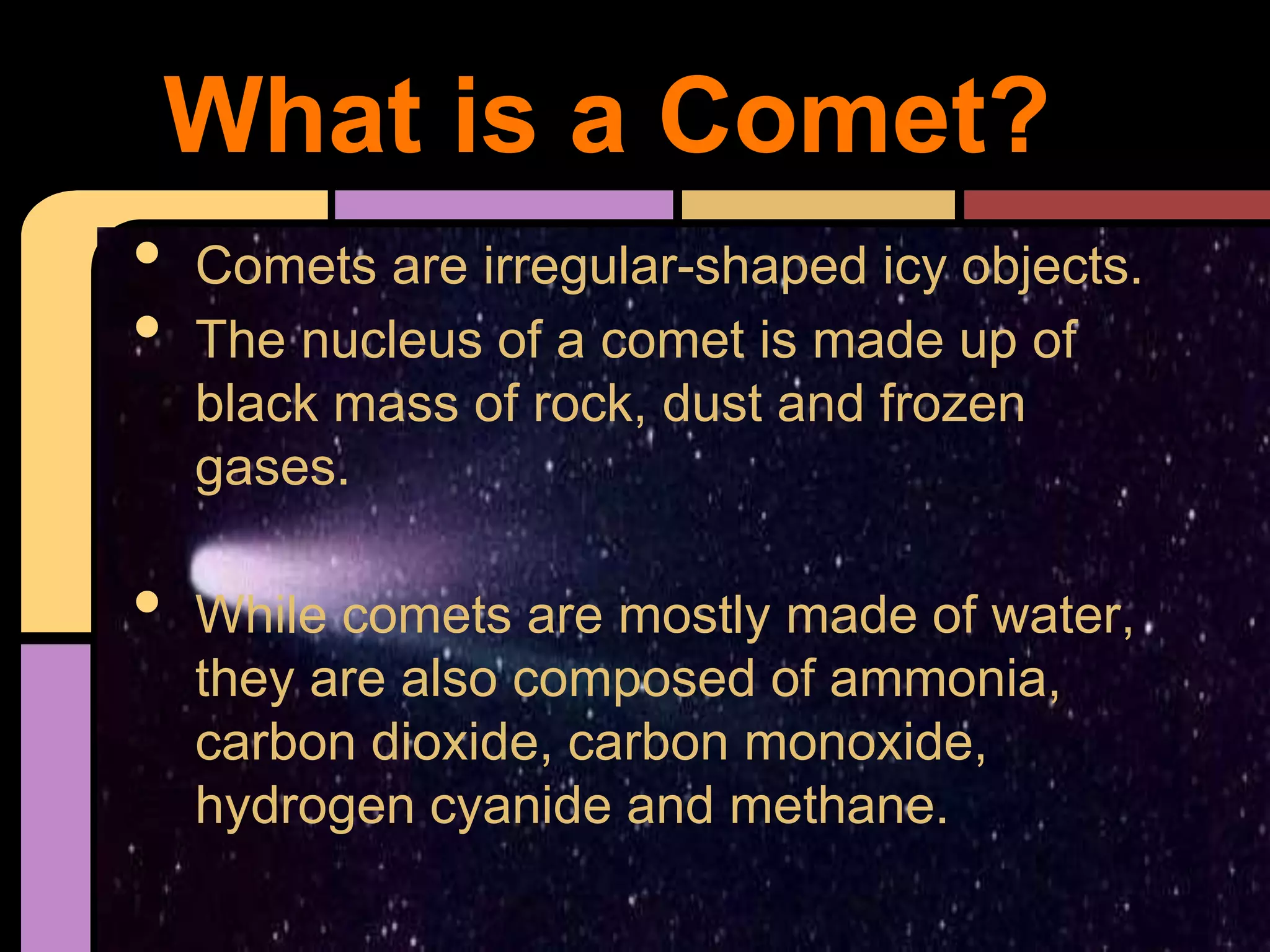
• Comets are irregular-shaped icy objects.
• The nucleus of a comet is made up of
black mass of rock, dust and frozen
gases.
• While comets are mostly made of water,
they are also composed of ammonia,
carbon dioxide, carbon monoxide,
hydrogen cyanide and methane.
What is a Comet?
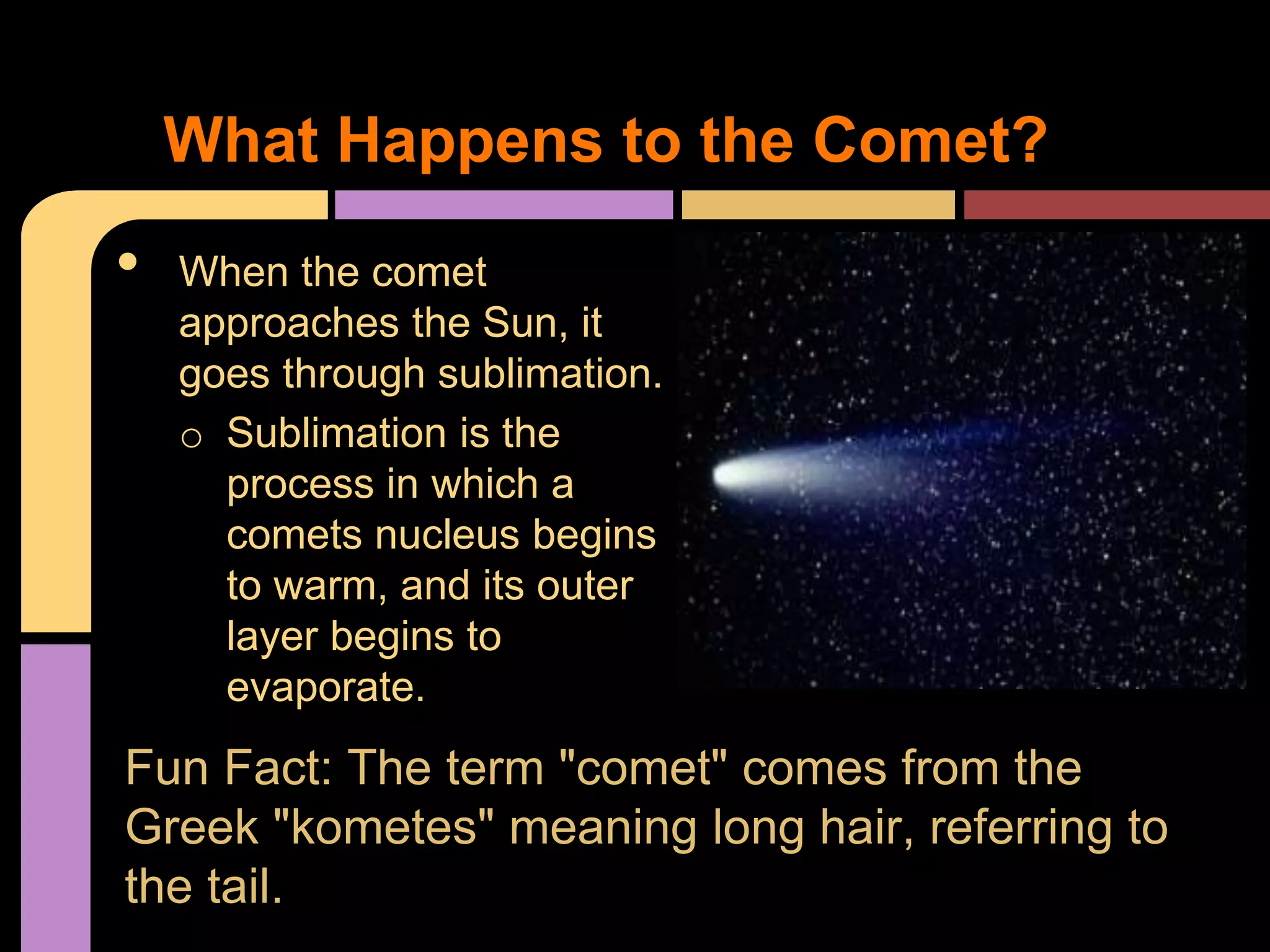
• When the comet
approaches the Sun, it
goes through sublimation.
o Sublimation is the
process in which a
comets nucleus begins
to warm, and its outer
layer begins to
evaporate.
What Happens to the Comet?
Fun Fact: The term "comet" comes from the
Greek "kometes" meaning long hair, referring to
the tail.
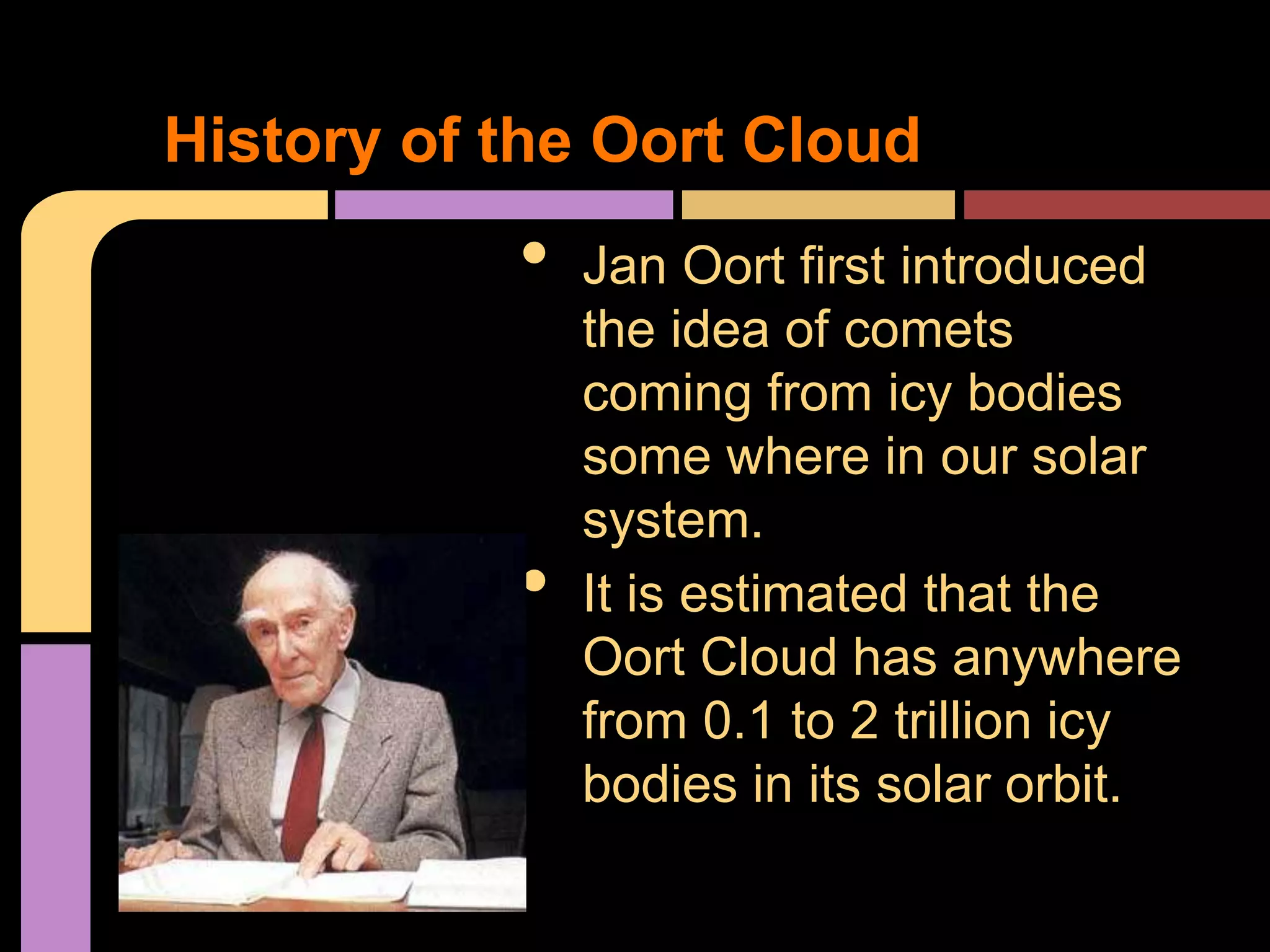
• Jan Oort first introduced
the idea of comets
coming from icy bodies
some where in our solar
system.
• It is estimated that the
Oort Cloud has anywhere
from 0.1 to 2 trillion icy
bodies in its solar orbit.
History of the Oort Cloud
 A distribution of icy objects (ammonia, water
and methane) like comets orbiting around our
Sun
 Distance around 50,000 AU or a light-year
 Believed to be the origin of the long-period
comets in the solar system; for example
comet Hale-Bopp was thought to originate
from there
 Scientists have yet to examine Oort Cloud up
close; it'll be decades before they send a
craft there
Oort Cloud Objects?
• The total mass of comets in the Oort cloud
at this time is about 40 times that of Earth.
• Halley’s Comet was originated in the Oort
Cloud.
• All objects in the Oort Cloud are known as
trans-Neptunian objects.
• This means that they are at a greater
distance form the sun then Neptune is.
More Facts About the Oort Cloud
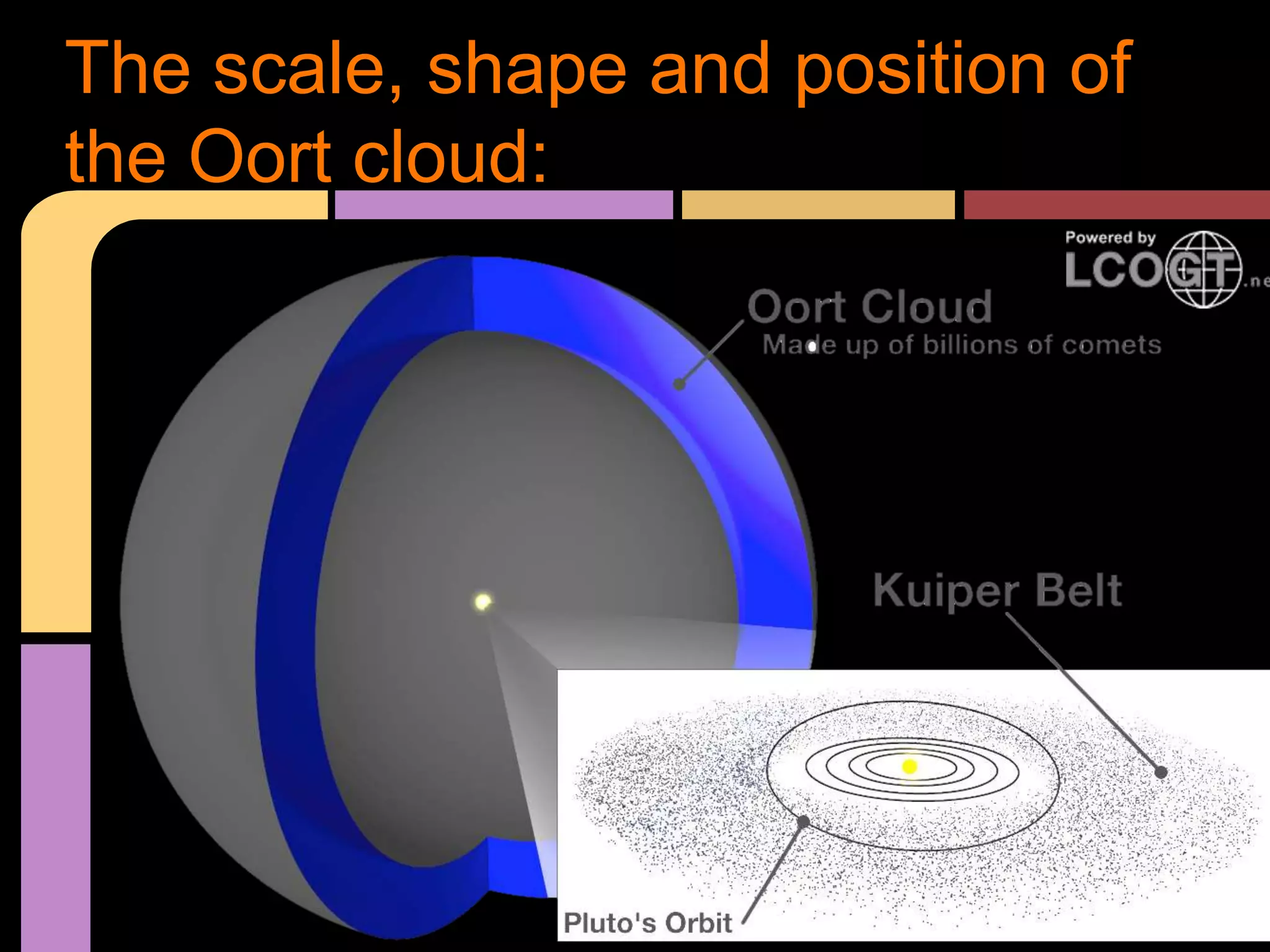
The scale, shape and position of
the Oort cloud:
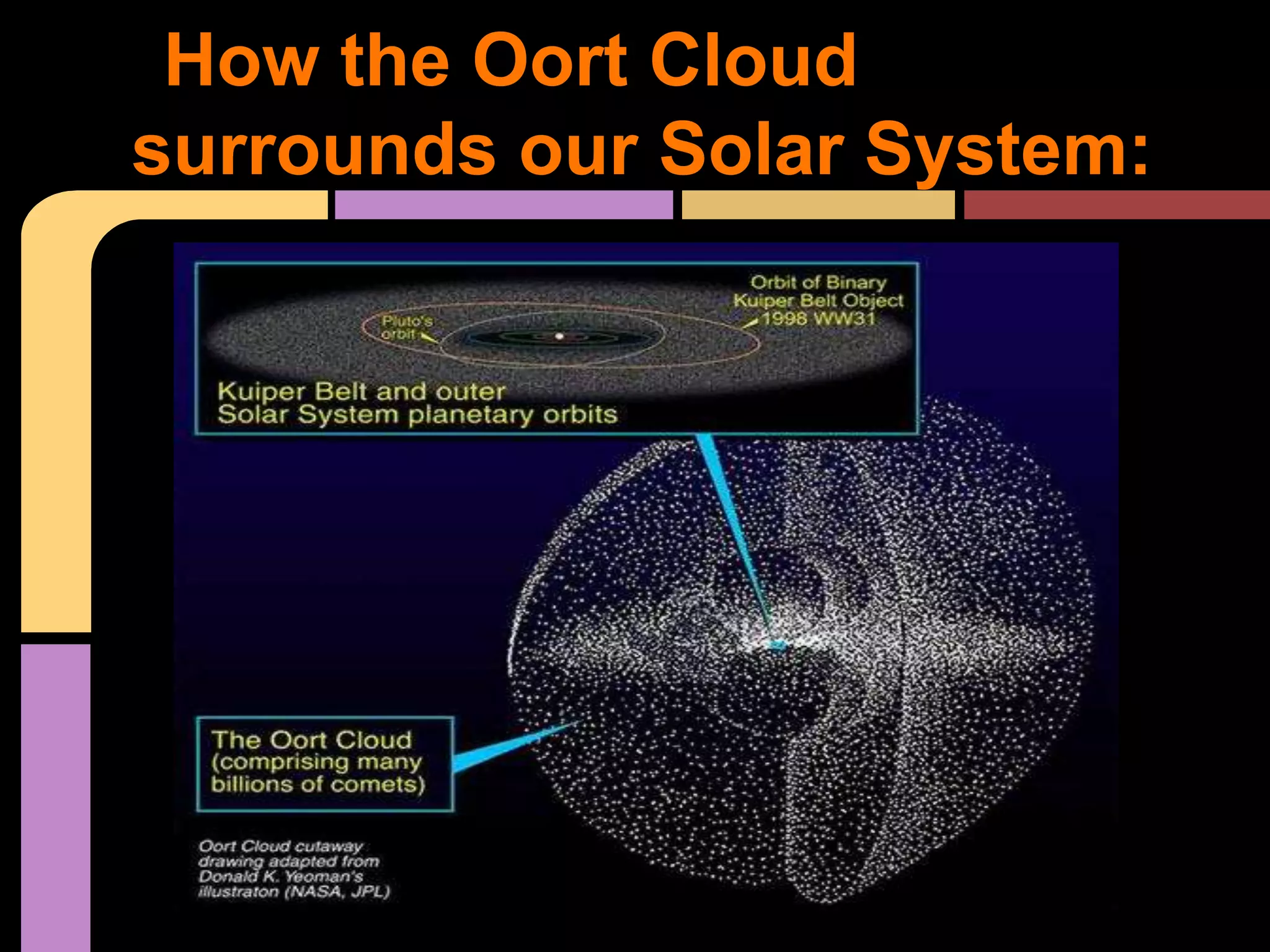
How the Oort Cloud
surrounds our Solar System:
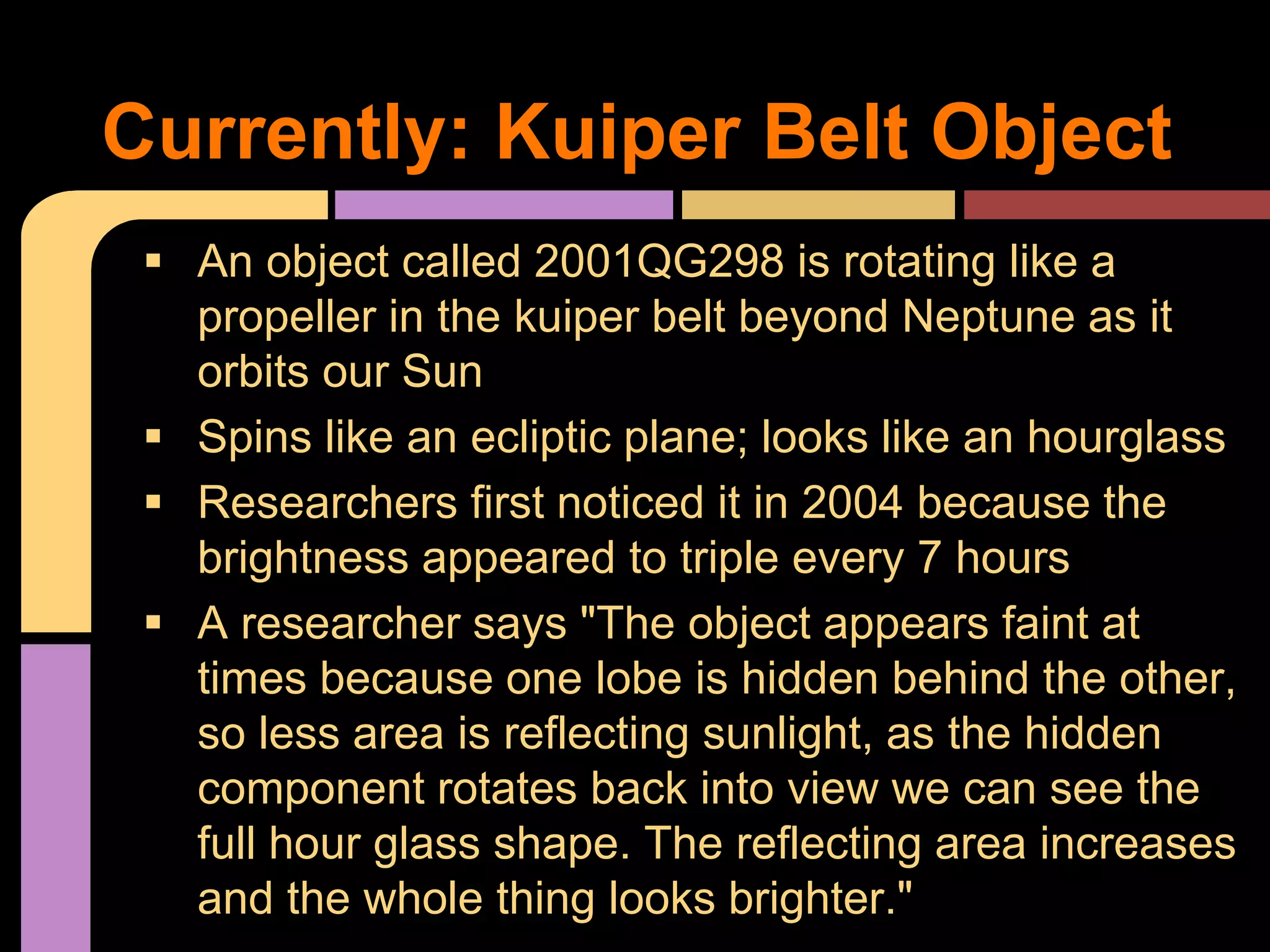
Currently: Kuiper Belt Object
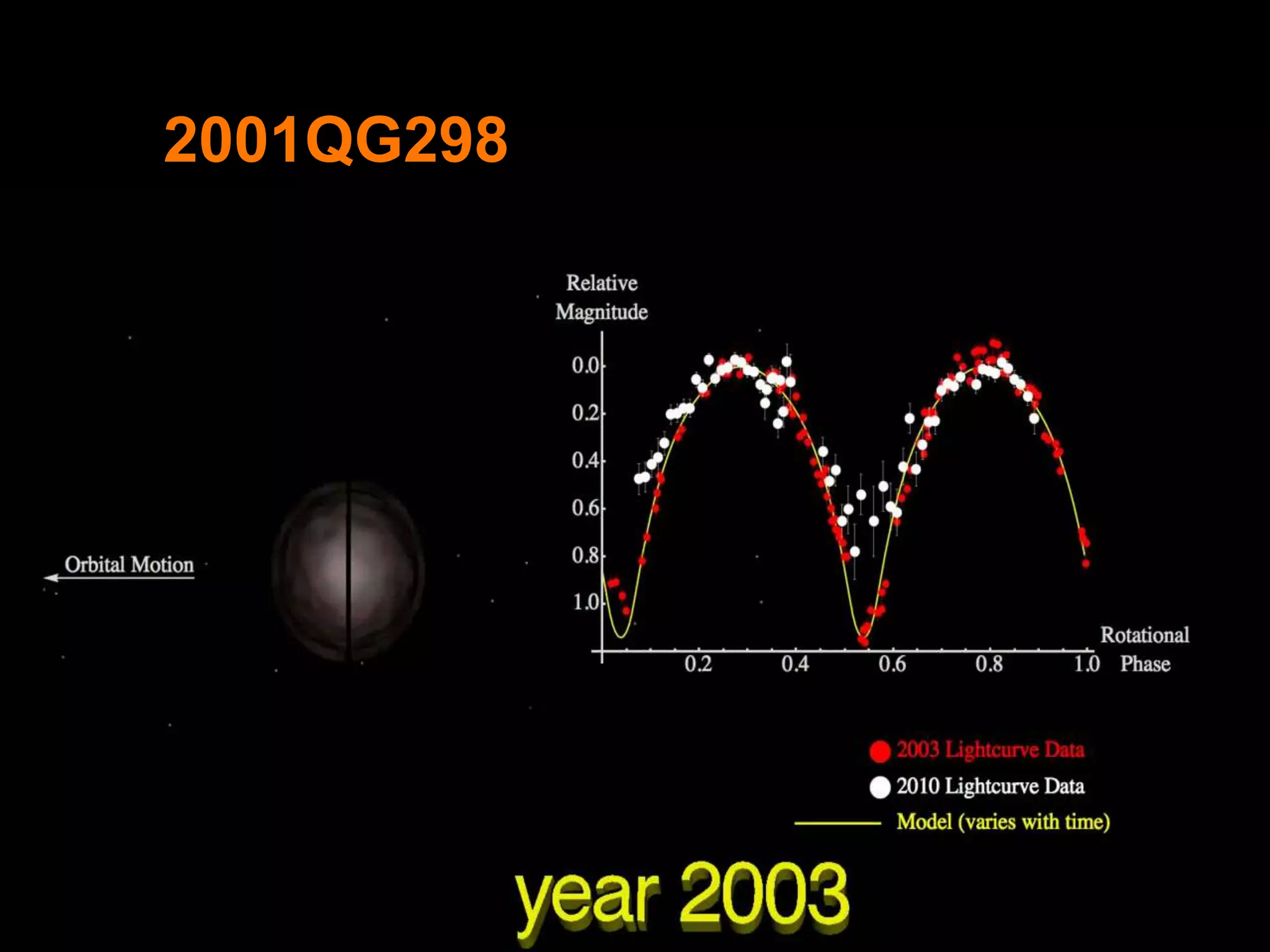
 An object called 2001QG298 is rotating like a
propeller in the kuiper belt beyond Neptune as it
orbits our Sun
 Spins like an ecliptic plane; looks like an hourglass
 Researchers first noticed it in 2004 because the
brightness appeared to triple every 7 hours
 A researcher says "The object appears faint at
times because one lobe is hidden behind the other,
so less area is reflecting sunlight, as the hidden
component rotates back into view we can see the
full hour glass shape. The reflecting area increases
and the whole thing looks brighter."
2001QG298
 http://nineplanets.org/kboc.html
 http://www.space.com/16144-kuiper-belt-objects.html
 http://www.britannica.com/EBchecked/topic/1224420/dwarf-
planet
 http://lcogt.net/spacebook/comets-kuiper-belt-and-oort-cloud
 http://www.universetoday.com/32522/oort-cloud/
 http://www.theepochtimes.com/n2/science/mysterious-
hourglass-object-is-spinning-in-kuiper-belt-video-140055.html
 http://solarsystem.nasa.gov/planets/profile.cfm?Object=KBOs&
Display=OverviewLong
 http://www.8planets.co.uk/oort-cloud-facts
 http://www.universetoday.com/32522/oort-cloud/
Citations: Sources

Kuiper belt & oort cloud 2

  • 1.
    Kuiper Belt/ Oort CloudsObjects By: Sheena Cherian and Catherine Brennan
  • 2.
    ● A Dutch-Americanastronomer named Gerard P. Kuiper first proposed the idea of the Kuiper Belt in 1951 ● He believed there was an elliptic shape region that was filled with icy objects. ● This was Kuiper’s greatest known achievement. History of The Kuiper Belt
  • 3.
     It containssmall icy bodies  It is a disk shaped region past the orbit of Neptune Kuiper Belt Objects?  Extends from 30 to 50 AU (2.5 to 4.5 billion miles) from the Sun  Short- period comets originate in the kuiper belt
  • 4.
     There aremany dwarf planets that are seen on the belt  The largest dwarf planet is Eris, it's coated with methane ice  Next is Pluto, 2006 it was discovered that it was not a planet, but only a dwarf planet  Haumea rotates every 3.9 hours  Makemake was discovered in 2005  Ceres is the first asteroid discovered and also the largest Kuiper Belt Objects: Planets
  • 5.
    • It isbelieved that there are over 70,000 objects in the Kuiper Belt. • The Kuiper belt is about 20 times larger than the asteroid belt. More Kuiper Belt Facts
  • 6.
    • Comets areirregular-shaped icy objects. • The nucleus of a comet is made up of black mass of rock, dust and frozen gases. • While comets are mostly made of water, they are also composed of ammonia, carbon dioxide, carbon monoxide, hydrogen cyanide and methane. What is a Comet?
  • 7.
    • When thecomet approaches the Sun, it goes through sublimation. o Sublimation is the process in which a comets nucleus begins to warm, and its outer layer begins to evaporate. What Happens to the Comet? Fun Fact: The term "comet" comes from the Greek "kometes" meaning long hair, referring to the tail.
  • 8.
    • Jan Oortfirst introduced the idea of comets coming from icy bodies some where in our solar system. • It is estimated that the Oort Cloud has anywhere from 0.1 to 2 trillion icy bodies in its solar orbit. History of the Oort Cloud
  • 9.
     A distributionof icy objects (ammonia, water and methane) like comets orbiting around our Sun  Distance around 50,000 AU or a light-year  Believed to be the origin of the long-period comets in the solar system; for example comet Hale-Bopp was thought to originate from there  Scientists have yet to examine Oort Cloud up close; it'll be decades before they send a craft there Oort Cloud Objects?
  • 10.
    • The totalmass of comets in the Oort cloud at this time is about 40 times that of Earth. • Halley’s Comet was originated in the Oort Cloud. • All objects in the Oort Cloud are known as trans-Neptunian objects. • This means that they are at a greater distance form the sun then Neptune is. More Facts About the Oort Cloud
  • 11.
    The scale, shapeand position of the Oort cloud:
  • 12.
    How the OortCloud surrounds our Solar System:
  • 13.
    Currently: Kuiper BeltObject  An object called 2001QG298 is rotating like a propeller in the kuiper belt beyond Neptune as it orbits our Sun  Spins like an ecliptic plane; looks like an hourglass  Researchers first noticed it in 2004 because the brightness appeared to triple every 7 hours  A researcher says "The object appears faint at times because one lobe is hidden behind the other, so less area is reflecting sunlight, as the hidden component rotates back into view we can see the full hour glass shape. The reflecting area increases and the whole thing looks brighter."
  • 14.
  • 15.
     http://nineplanets.org/kboc.html  http://www.space.com/16144-kuiper-belt-objects.html http://www.britannica.com/EBchecked/topic/1224420/dwarf- planet  http://lcogt.net/spacebook/comets-kuiper-belt-and-oort-cloud  http://www.universetoday.com/32522/oort-cloud/  http://www.theepochtimes.com/n2/science/mysterious- hourglass-object-is-spinning-in-kuiper-belt-video-140055.html  http://solarsystem.nasa.gov/planets/profile.cfm?Object=KBOs& Display=OverviewLong  http://www.8planets.co.uk/oort-cloud-facts  http://www.universetoday.com/32522/oort-cloud/ Citations: Sources