What is the Greenhouse Effect?
Review of last lectureReview of last lecture
– The two basic motions of the EarthThe two basic motions of the Earth
– What causes the four seasons: the Earth’s tiltWhat causes the four seasons: the Earth’s tilt
and the 3 ways it affects the solar insolationand the 3 ways it affects the solar insolation
(change of length of the day, beam spreading,(change of length of the day, beam spreading,
beam depletion)beam depletion)
– Change of the Earth’s orbit at longer timeChange of the Earth’s orbit at longer time
scales (Milankovitch cycles): eccentricity, axialscales (Milankovitch cycles): eccentricity, axial
tilt, and precessiontilt, and precession
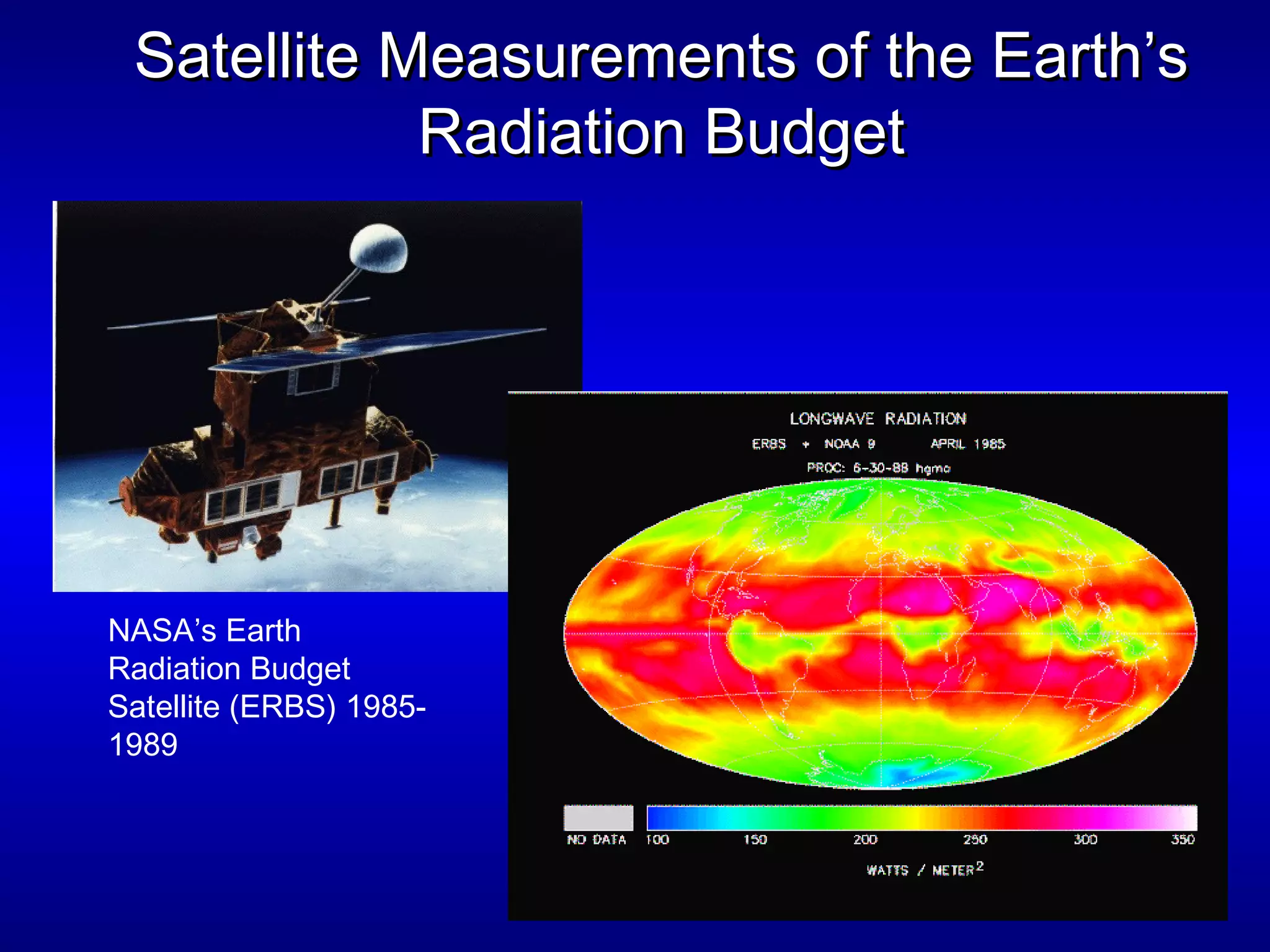
Satellite Measurements of the Earth’sSatellite Measurements of the Earth’s
Radiation BudgetRadiation Budget
NASA’s Earth
Radiation Budget
Satellite (ERBS) 1985-
1989
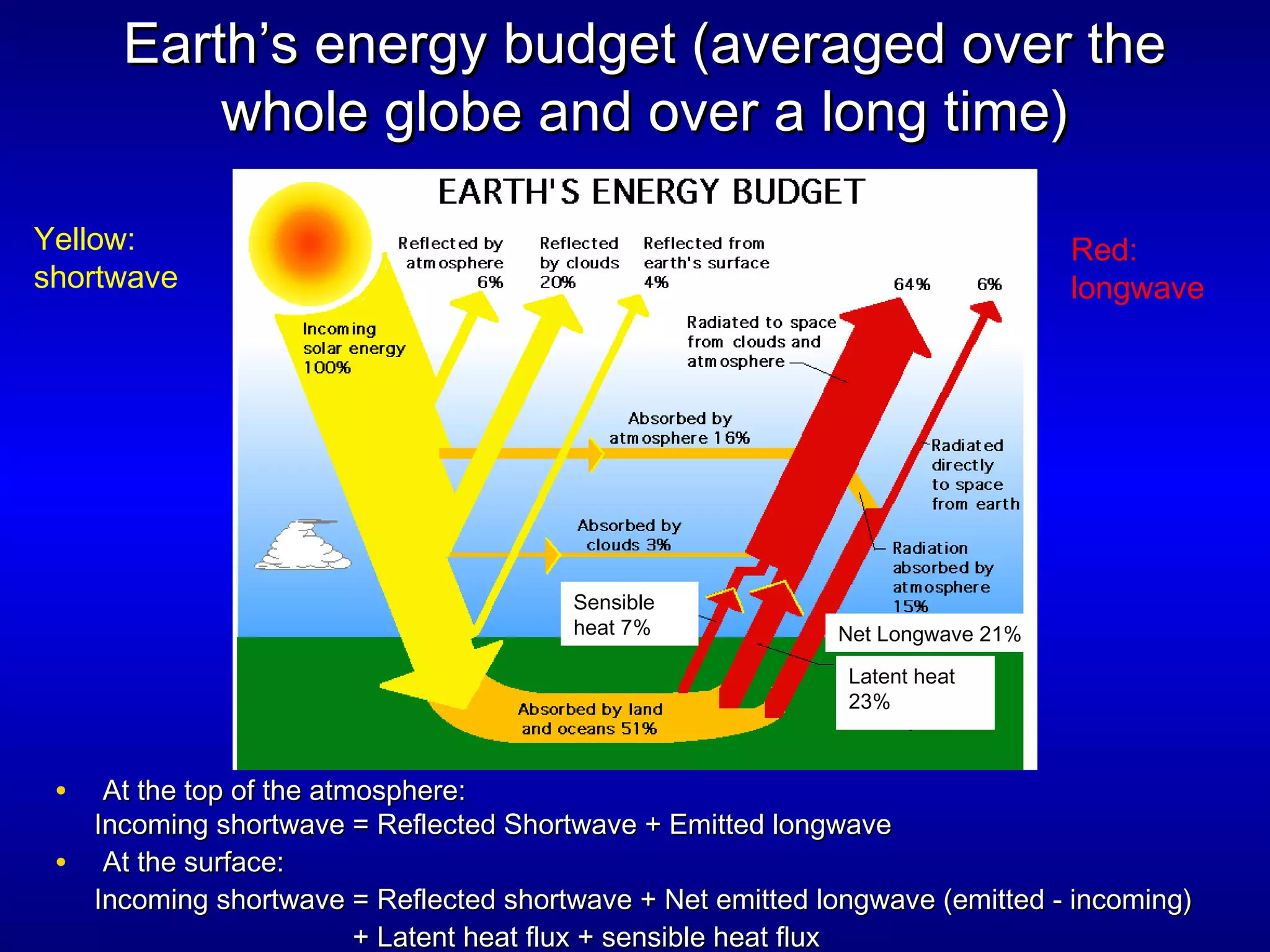
Earth’s energy budget (averaged over theEarth’s energy budget (averaged over the
whole globe and over a long time)whole globe and over a long time)
• At the top of the atmosphere:At the top of the atmosphere:
Incoming shortwave = Reflected Shortwave + Emitted longwaveIncoming shortwave = Reflected Shortwave + Emitted longwave
• At the surface:At the surface:
Incoming shortwave = Reflected shortwave + Net emitted longwave (emitted - incoming)Incoming shortwave = Reflected shortwave + Net emitted longwave (emitted - incoming)
+ Latent heat flux + sensible heat flux+ Latent heat flux + sensible heat flux
Sensible
heat 7%
Latent heat
23%
Net Longwave 21%
Yellow:
shortwave
Red:
longwave
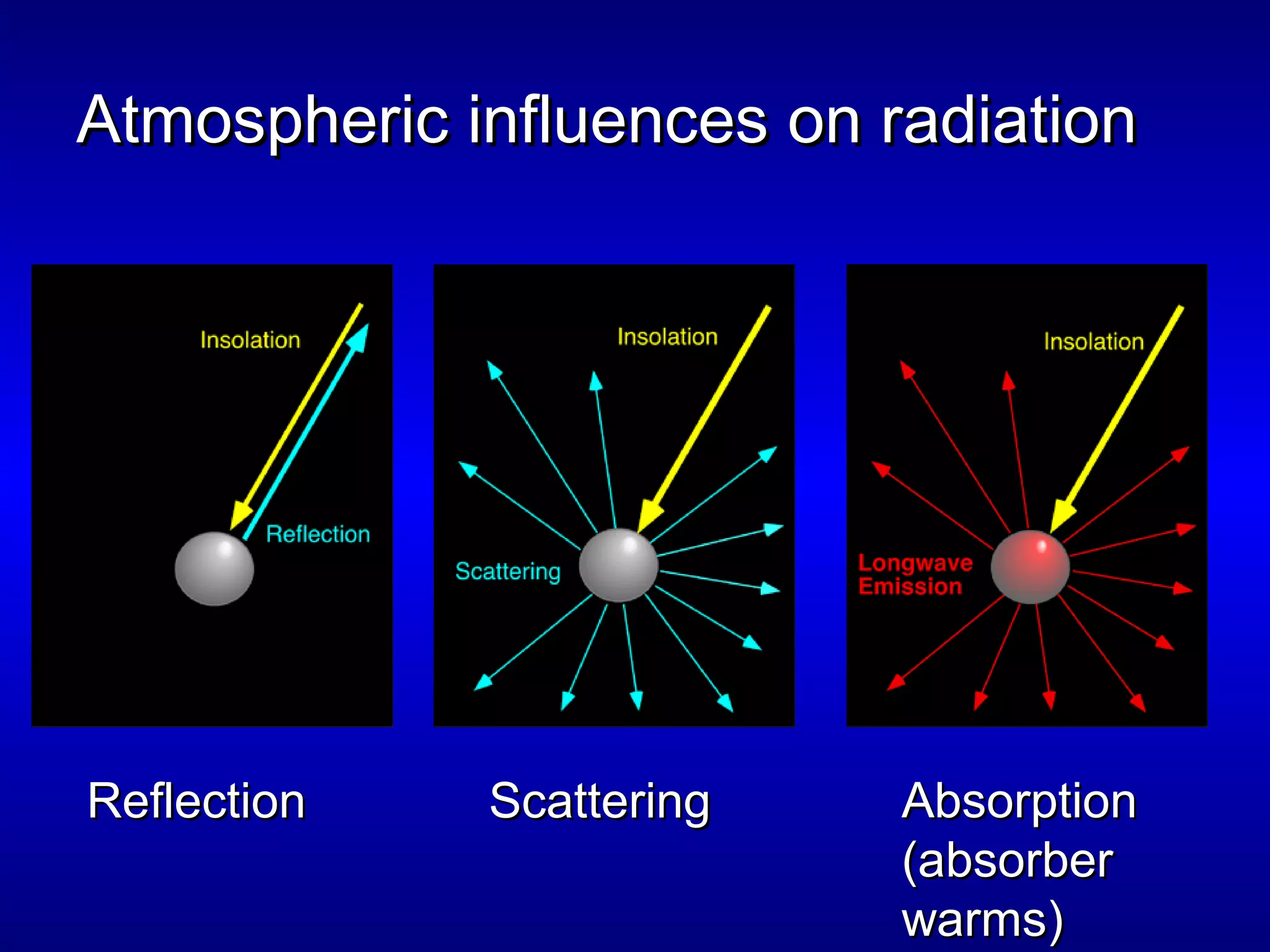
Atmospheric influences on radiationAtmospheric influences on radiation
ReflectionReflection ScatteringScattering AbsorptionAbsorption
(absorber(absorber
warms)warms)
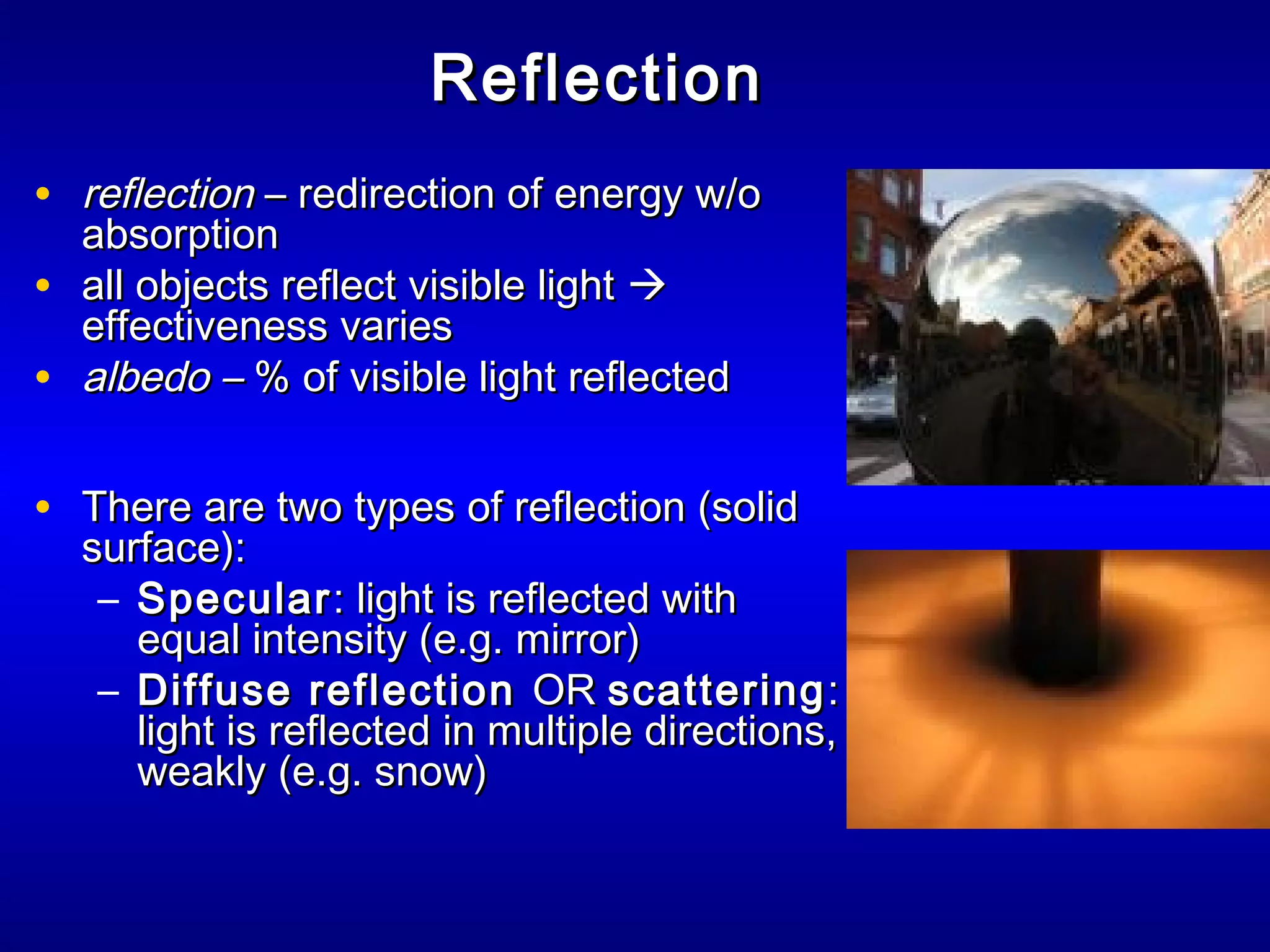
ReflectionReflection
• reflectionreflection – redirection of energy w/o– redirection of energy w/o
absorptionabsorption
• all objects reflect visible lightall objects reflect visible light 
effectiveness varieseffectiveness varies
• albedo –albedo – % of visible light reflected% of visible light reflected
• There are two types of reflection (solidThere are two types of reflection (solid
surface):surface):
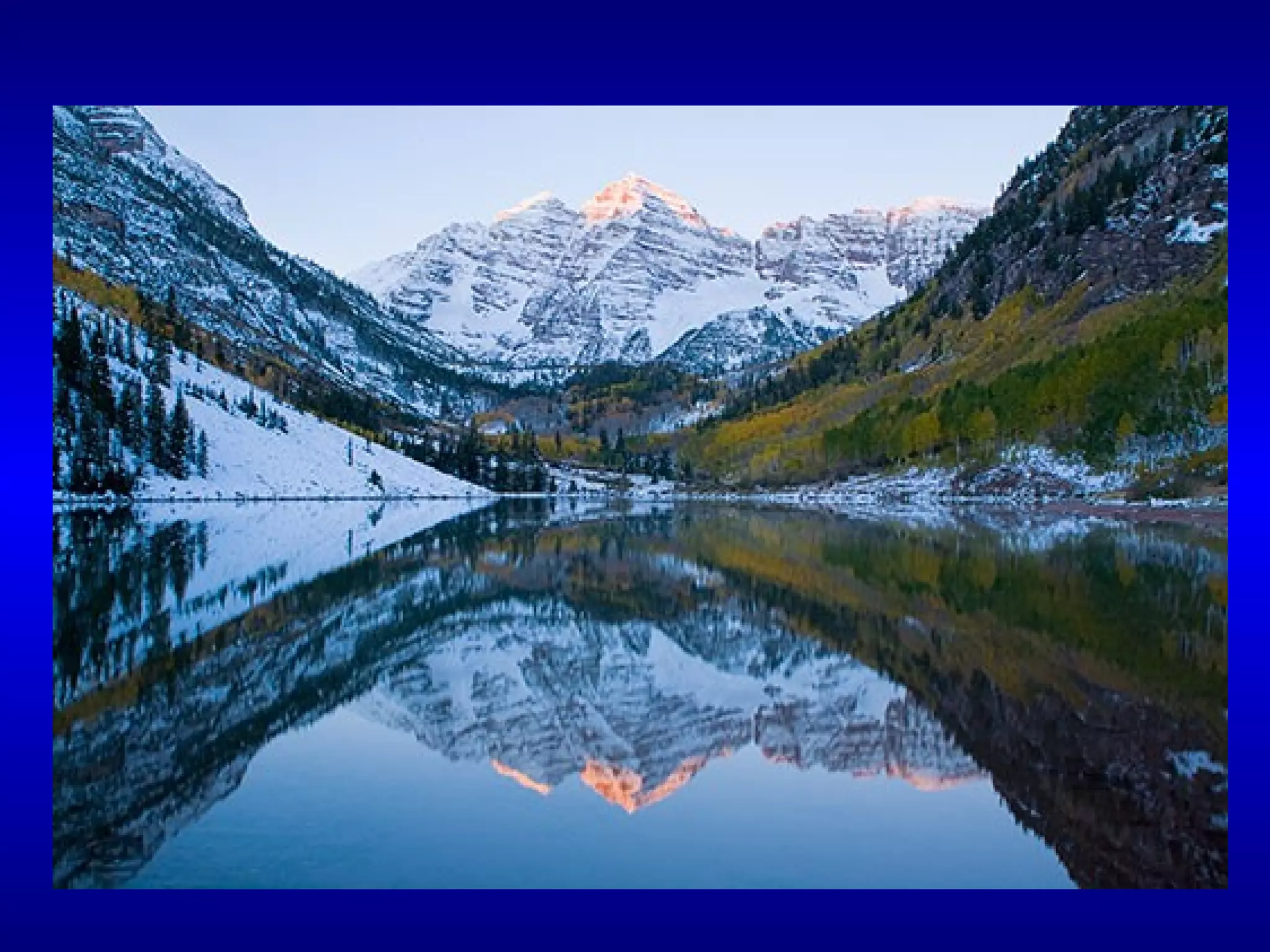
– SpecularSpecular: light is reflected with: light is reflected with
equal intensity (e.g. mirror)equal intensity (e.g. mirror)
– Diffuse reflectionDiffuse reflection OROR scatteringscattering::
light is reflected in multiple directions,light is reflected in multiple directions,
weakly (e.g. snow)weakly (e.g. snow)
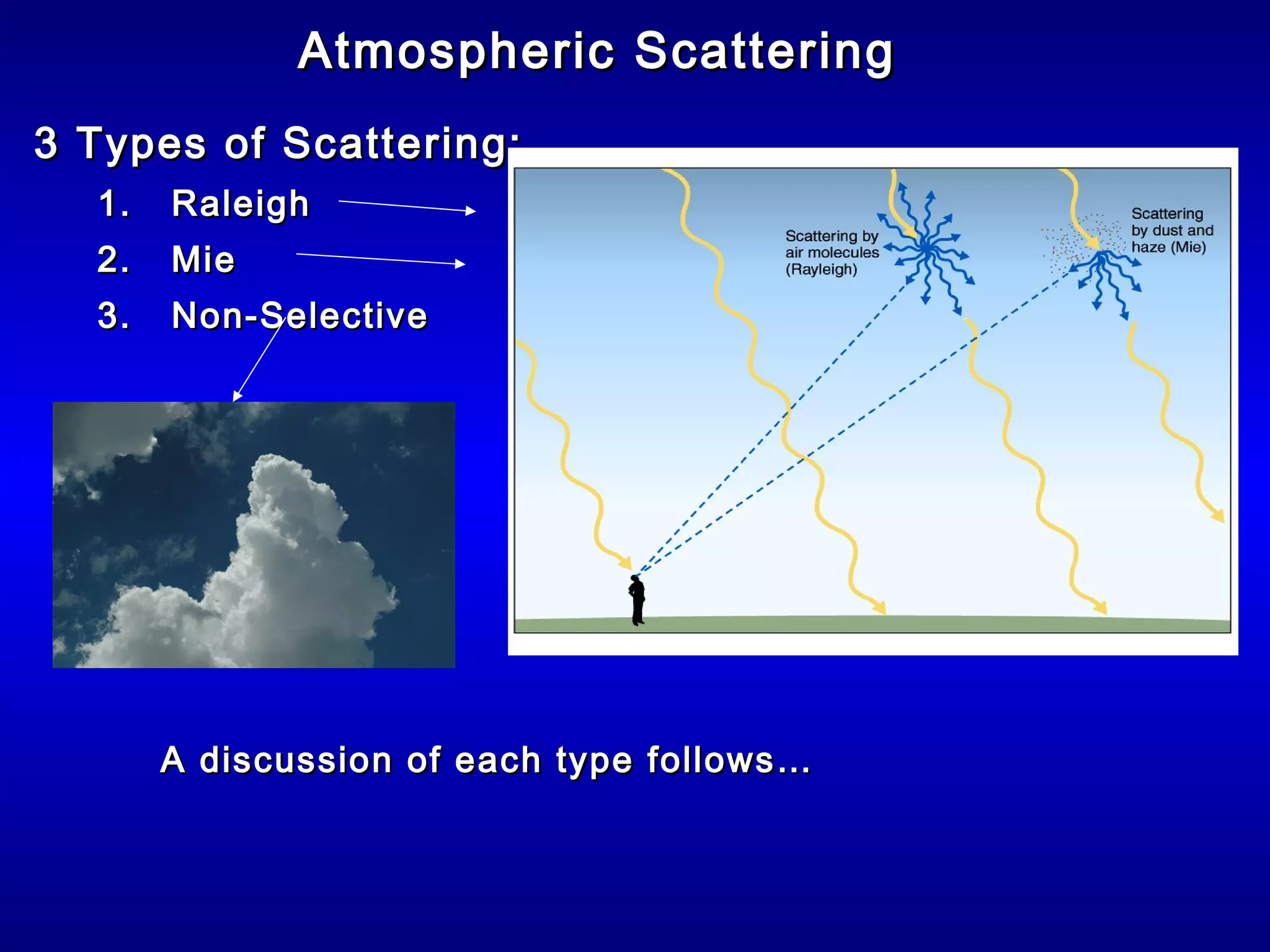
3 Types of Scattering:3 Types of Scattering:
1.1. RaleighRaleigh
2.2. MieMie
3.3. Non-SelectiveNon-Selective
Atmospheric ScatteringAtmospheric Scattering
A discussion of each type follows…A discussion of each type follows…
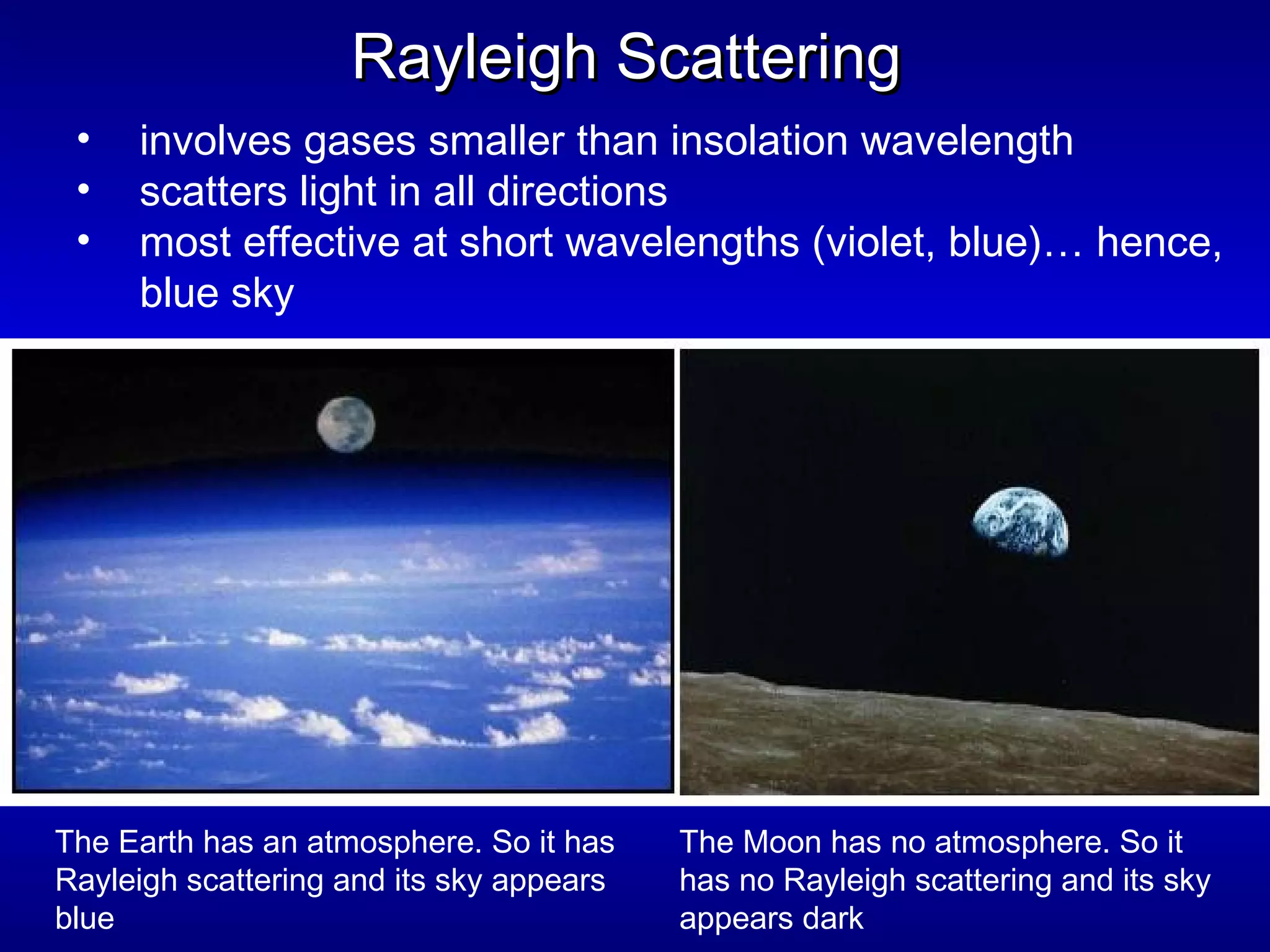
• involves gases smaller than insolation wavelength
• scatters light in all directions
• most effective at short wavelengths (violet, blue)… hence,
blue sky
Rayleigh ScatteringRayleigh Scattering
The Earth has an atmosphere. So it has
Rayleigh scattering and its sky appears
blue
The Moon has no atmosphere. So it
has no Rayleigh scattering and its sky
appears dark
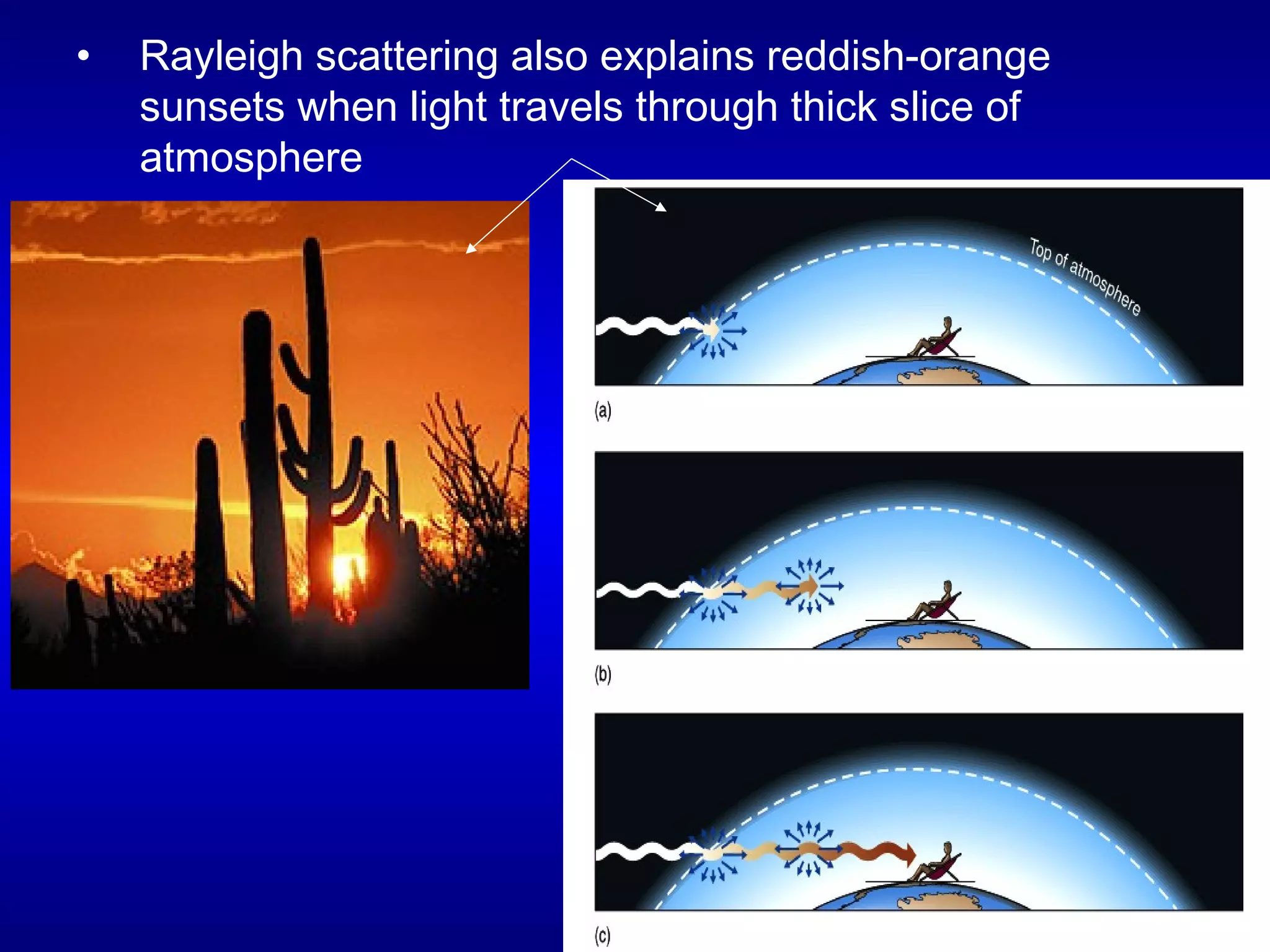
• Rayleigh scattering also explains reddish-orange
sunsets when light travels through thick slice of
atmosphere
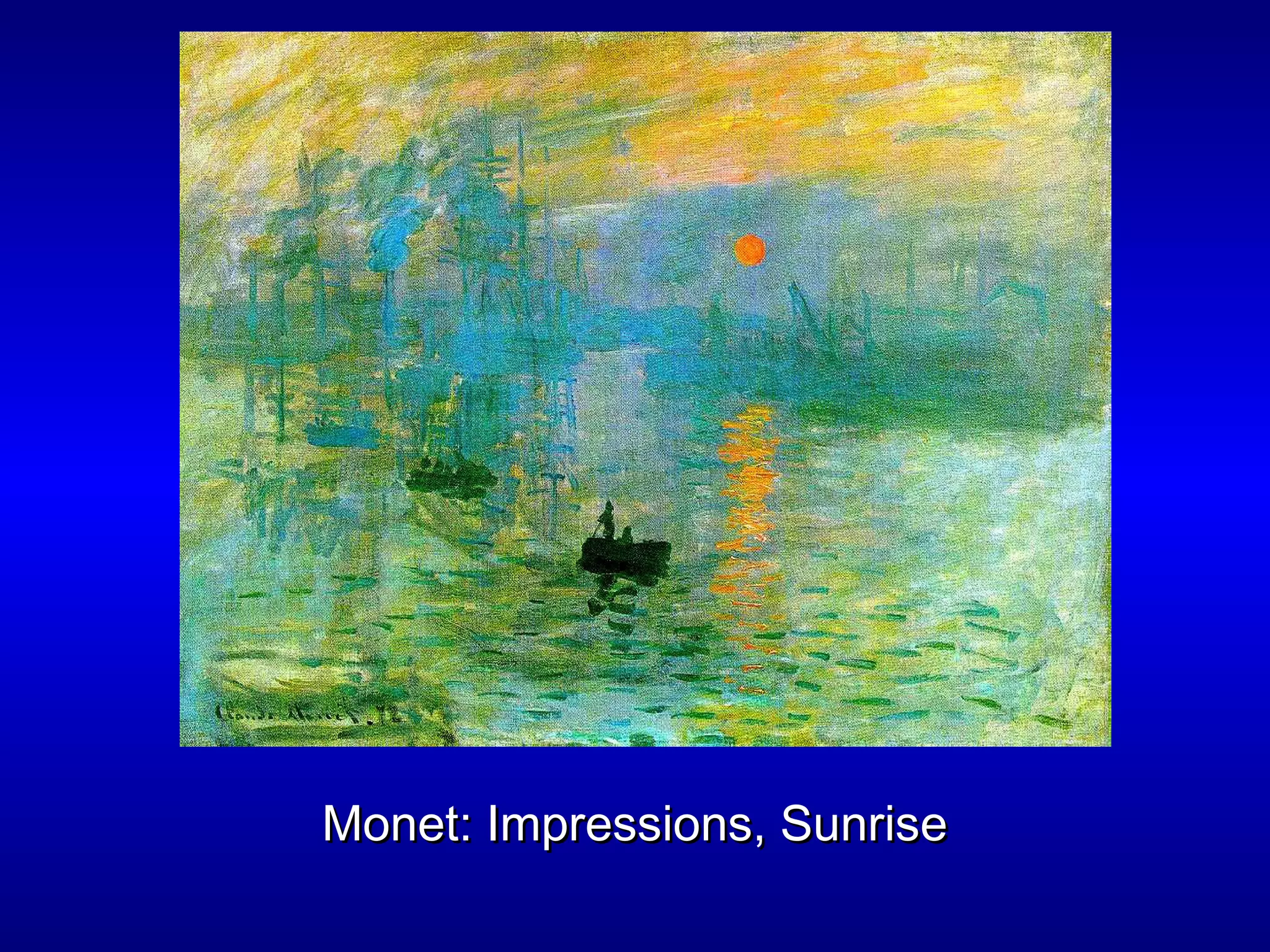
Monet: Impressions, SunriseMonet: Impressions, Sunrise
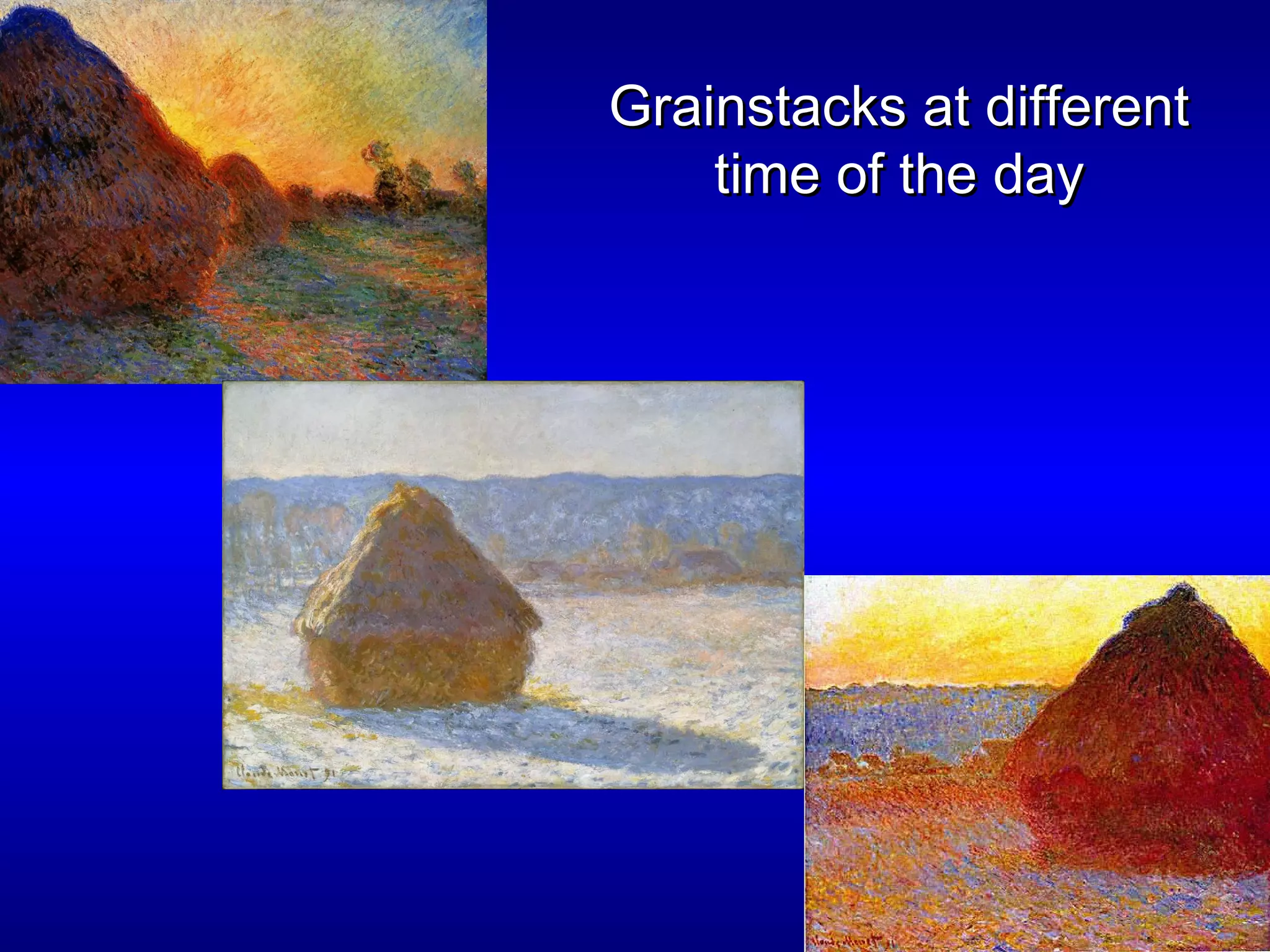
Grainstacks at differentGrainstacks at different
time of the daytime of the day
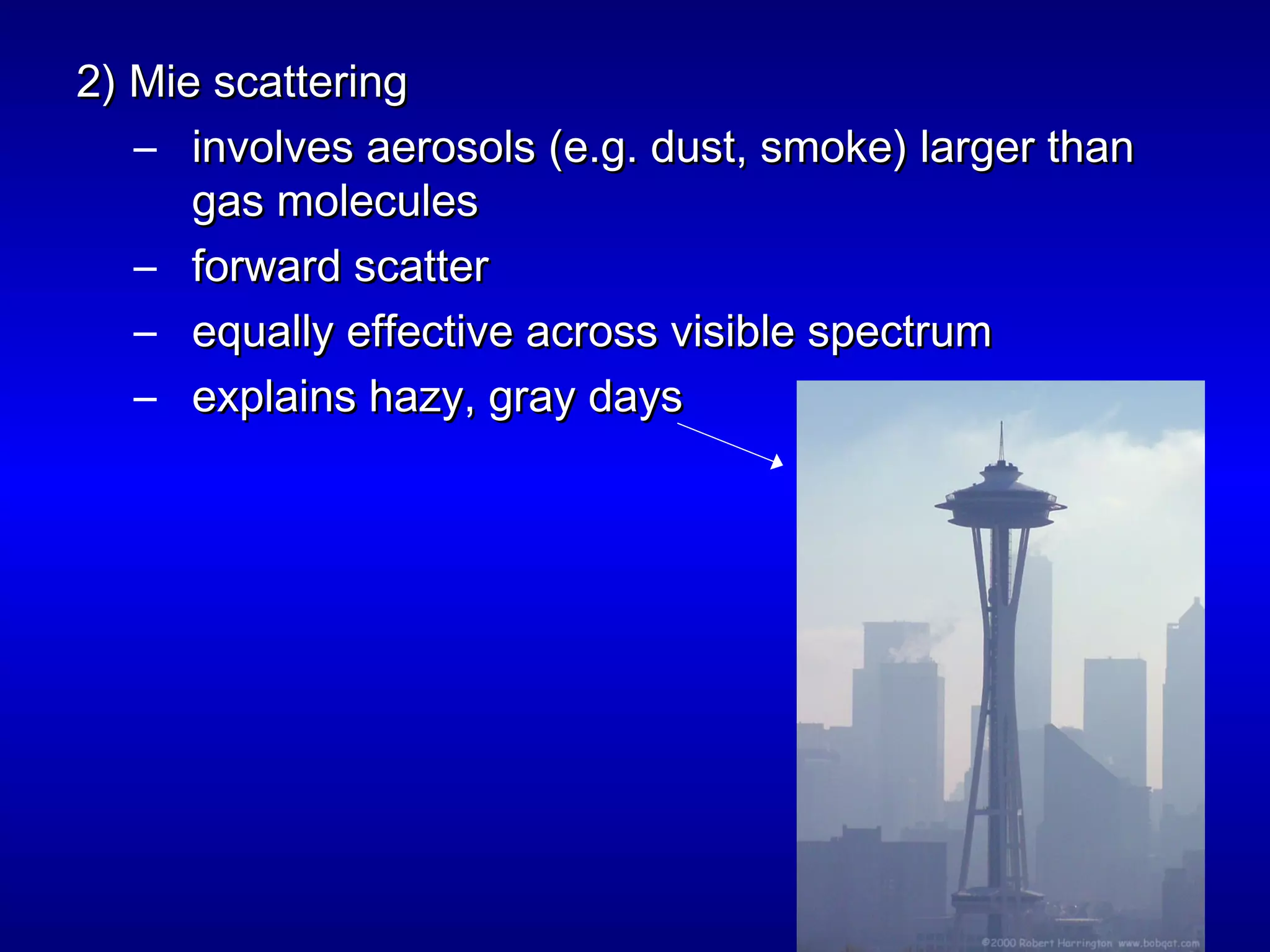
2) Mie scattering2) Mie scattering
– involves aerosols (e.g. dust, smoke) larger thaninvolves aerosols (e.g. dust, smoke) larger than
gas moleculesgas molecules
– forward scatterforward scatter
– equally effective across visible spectrumequally effective across visible spectrum
– explains hazy, gray daysexplains hazy, gray days
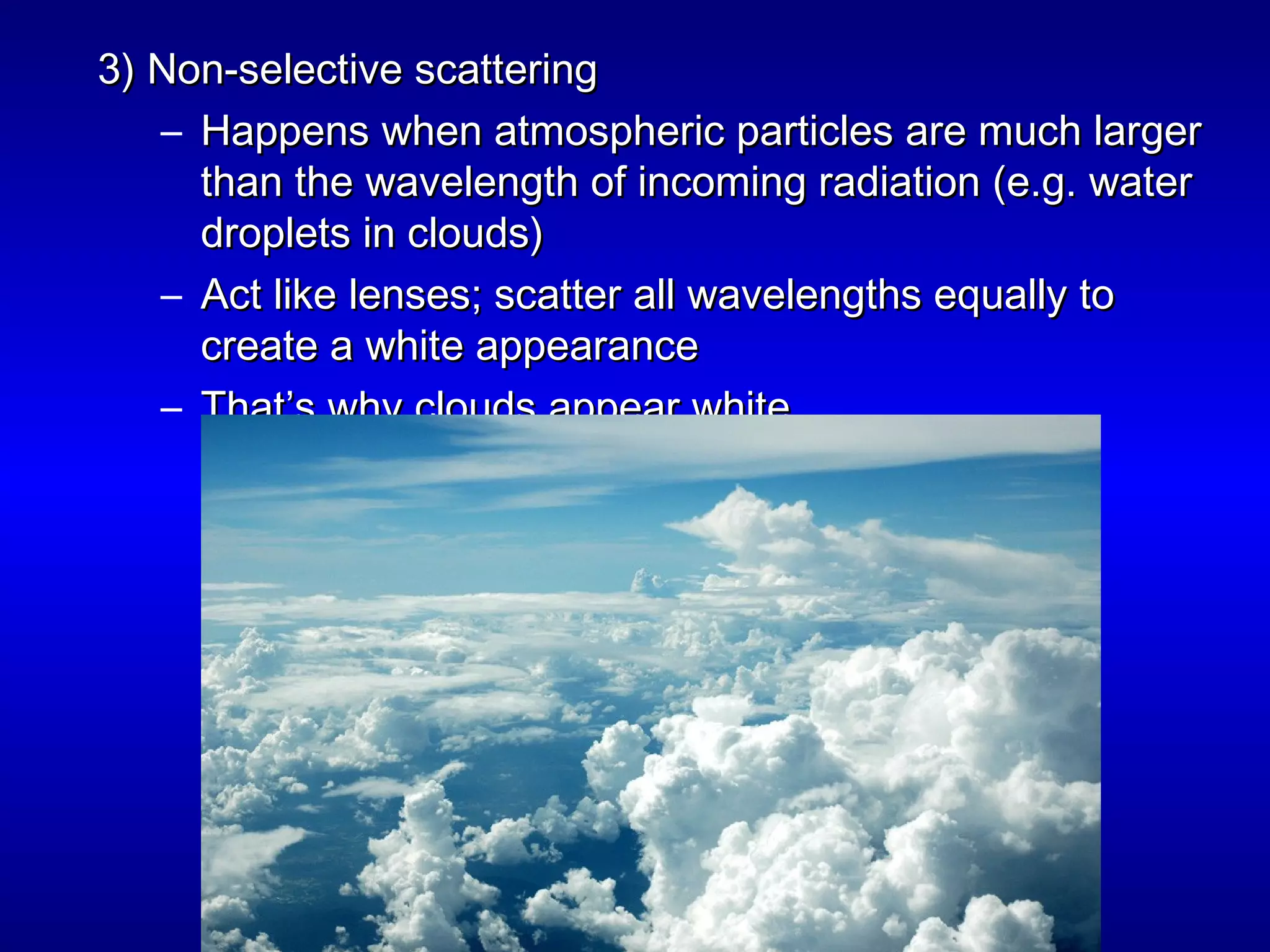
3) Non-selective scattering3) Non-selective scattering
– Happens when atmospheric particles are much largerHappens when atmospheric particles are much larger
than the wavelength of incoming radiation (e.g. waterthan the wavelength of incoming radiation (e.g. water
droplets in clouds)droplets in clouds)
– Act like lenses; scatter all wavelengths equally toAct like lenses; scatter all wavelengths equally to
create a white appearancecreate a white appearance
– That’s why clouds appear whiteThat’s why clouds appear white
Video: The greenhouse effectVideo: The greenhouse effect
• http://www.youtube.com/watch?v=ZzCA60WnoMkhttp://www.youtube.com/watch?v=ZzCA60WnoMk
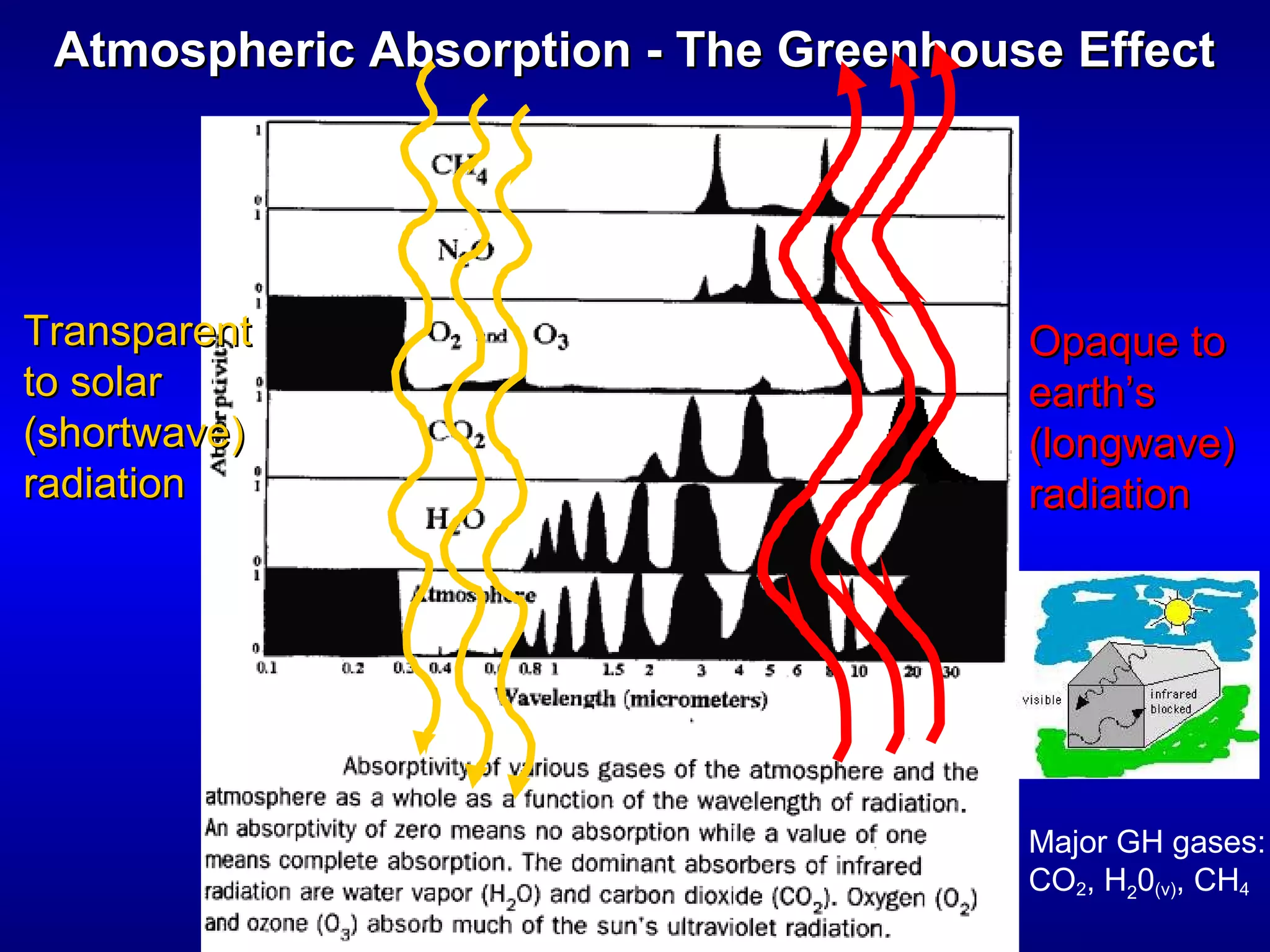
Atmospheric Absorption - The Greenhouse EffectAtmospheric Absorption - The Greenhouse Effect
TransparentTransparent
to solarto solar
(shortwave)(shortwave)
radiationradiation
Opaque toOpaque to
earth’searth’s
(longwave)(longwave)
radiationradiation
Major GH gases:
CO2, H20(v), CH4
The importance of methane (CHThe importance of methane (CH44))
• 23 times more powerful as a greenhouse gas than23 times more powerful as a greenhouse gas than
COCO22
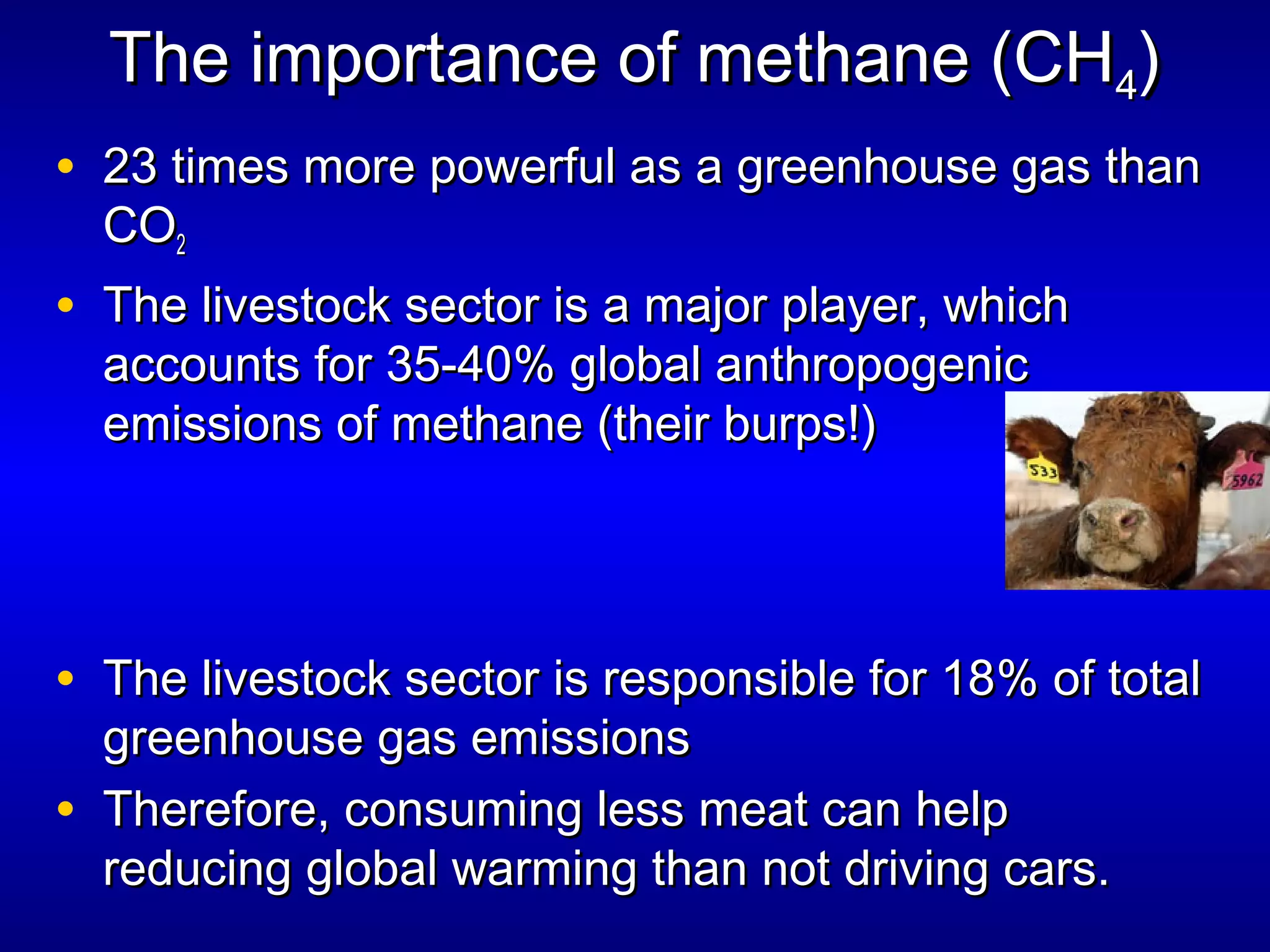
• The livestock sector is a major player, whichThe livestock sector is a major player, which
accounts for 35-40% global anthropogenicaccounts for 35-40% global anthropogenic
emissions of methane (their burps!)emissions of methane (their burps!)
• The livestock sector is responsible for 18% of totalThe livestock sector is responsible for 18% of total
greenhouse gas emissionsgreenhouse gas emissions
• Therefore, consuming less meat can helpTherefore, consuming less meat can help
reducing global warming than not driving cars.reducing global warming than not driving cars.
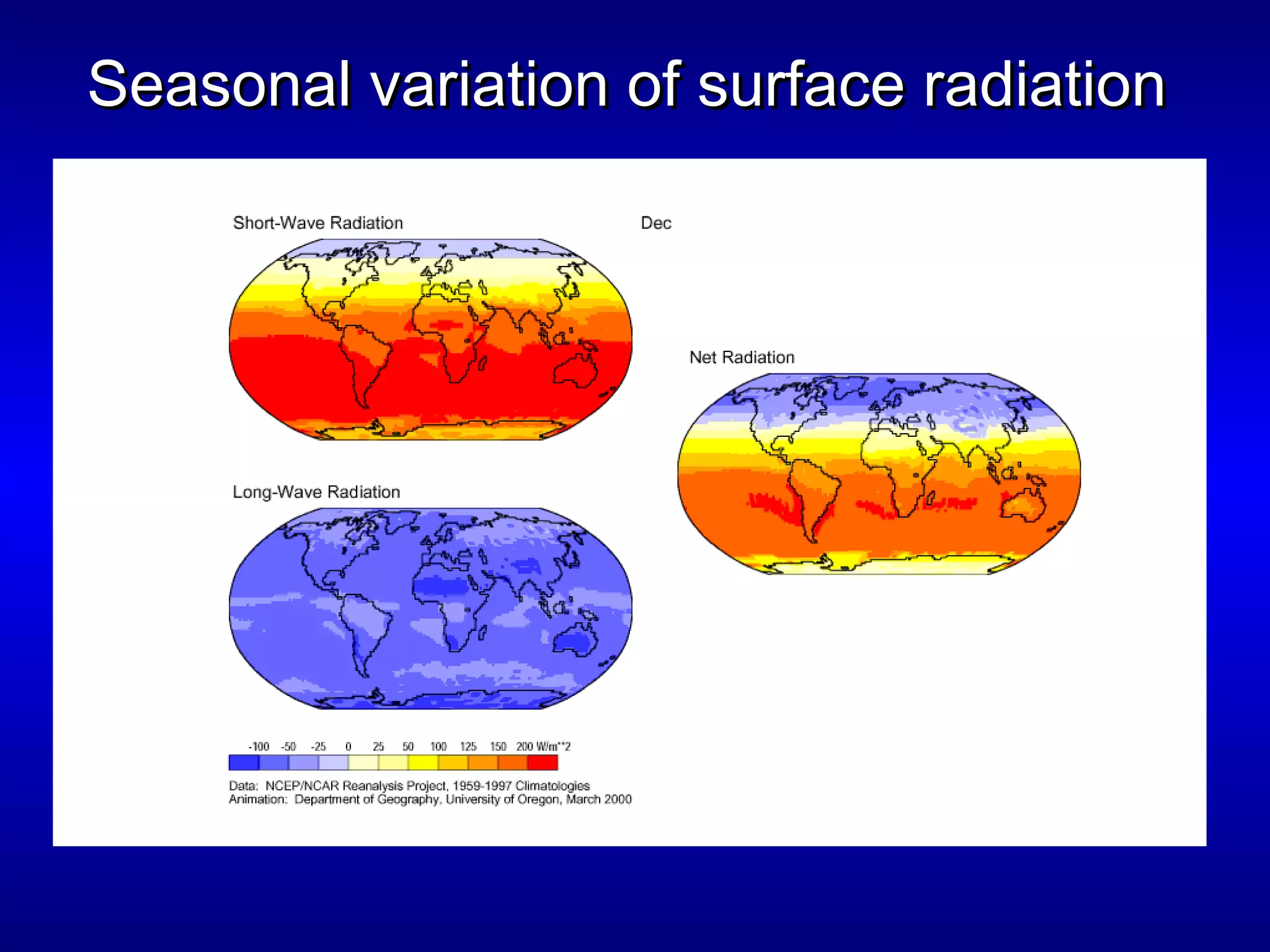
Seasonal variation of surface radiationSeasonal variation of surface radiation
Surface “Sensible” andSurface “Sensible” and
“Latent” heat transfers“Latent” heat transfers
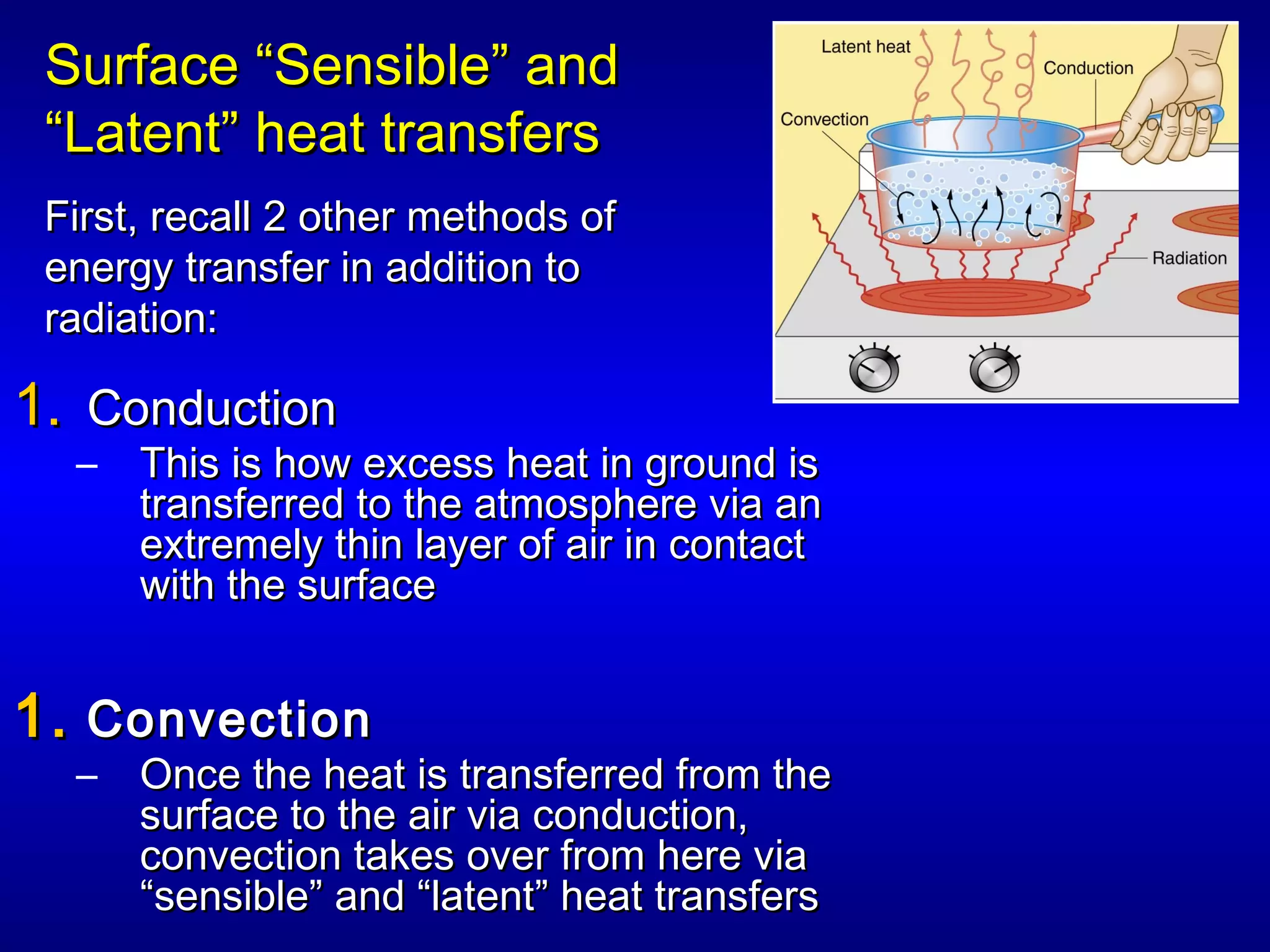
1.1. ConductionConduction
– This is how excess heat in ground isThis is how excess heat in ground is
transferred to the atmosphere via antransferred to the atmosphere via an
extremely thin layer of air in contactextremely thin layer of air in contact
with the surfacewith the surface
1.1. ConvectionConvection
– Once the heat is transferred from theOnce the heat is transferred from the
surface to the air via conduction,surface to the air via conduction,
convection takes over from here viaconvection takes over from here via
“sensible” and “latent” heat transfers“sensible” and “latent” heat transfers
First, recall 2 other methods ofFirst, recall 2 other methods of
energy transfer in addition toenergy transfer in addition to
radiation:radiation:
Sensible HeatSensible Heat
• Heat energy which is readily detectedHeat energy which is readily detected
• Magnitude is related to an object’s specific heatMagnitude is related to an object’s specific heat
– The amount of energy needed to change the temperature ofThe amount of energy needed to change the temperature of
an object a particular amount in J/kg/Kan object a particular amount in J/kg/K
• Related to massRelated to mass
– Higher mass requires more energy for heatingHigher mass requires more energy for heating
• Sensible heat transfer occurs from warmer to coolerSensible heat transfer occurs from warmer to cooler
areas (i.e., from ground upward)areas (i.e., from ground upward)
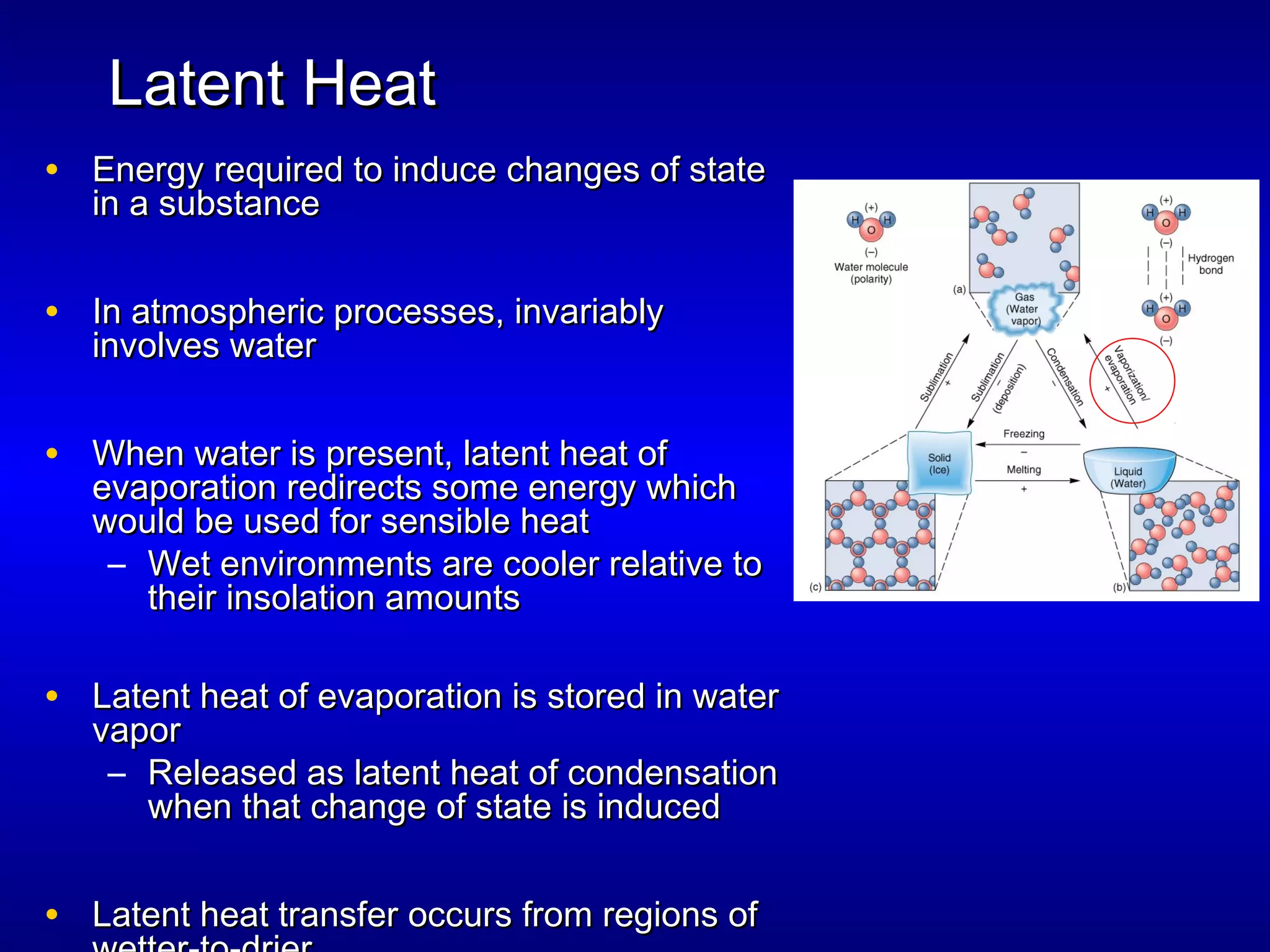
Latent HeatLatent Heat
• Energy required to induce changes of stateEnergy required to induce changes of state
in a substancein a substance
• In atmospheric processes, invariablyIn atmospheric processes, invariably
involves waterinvolves water
• When water is present, latent heat ofWhen water is present, latent heat of
evaporation redirects some energy whichevaporation redirects some energy which
would be used for sensible heatwould be used for sensible heat
– Wet environments are cooler relative toWet environments are cooler relative to
their insolation amountstheir insolation amounts
• Latent heat of evaporation is stored in waterLatent heat of evaporation is stored in water
vaporvapor
– Released as latent heat of condensationReleased as latent heat of condensation
when that change of state is inducedwhen that change of state is induced
• Latent heat transfer occurs from regions ofLatent heat transfer occurs from regions of
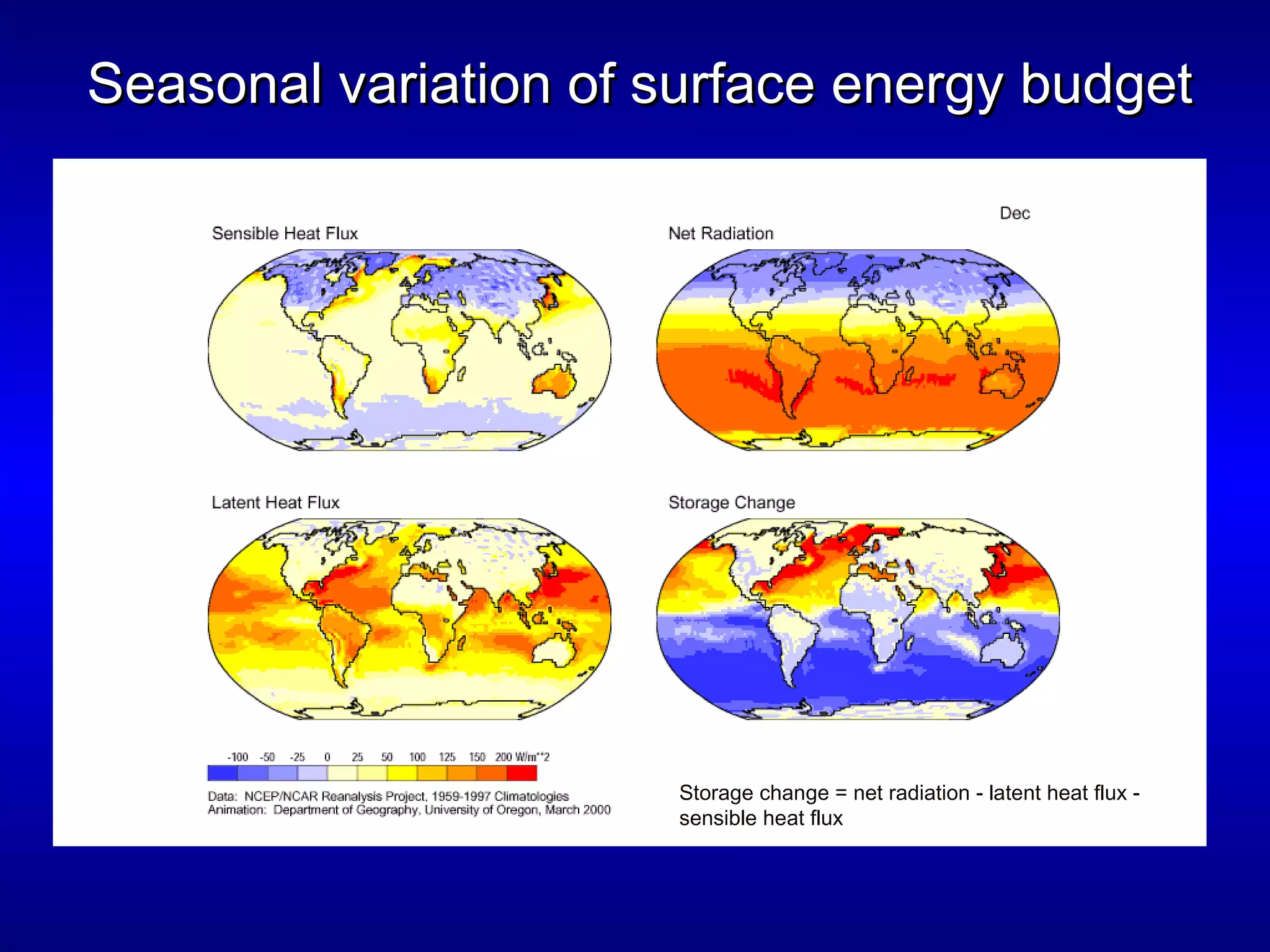
Seasonal variation of surface energy budgetSeasonal variation of surface energy budget
Storage change = net radiation - latent heat flux -
sensible heat flux
SummarySummary
• Earth’s energy balance at the top of the atmosphere and at theEarth’s energy balance at the top of the atmosphere and at the
surface. What percentage of solar energy is absorbed by thesurface. What percentage of solar energy is absorbed by the
surface?surface?
• Atmospheric influences on radiation (3 ways)Atmospheric influences on radiation (3 ways)
• The three types of atmospheric scattering. What causes theThe three types of atmospheric scattering. What causes the
blue sky? Why causes the reddish-orange sunsets?blue sky? Why causes the reddish-orange sunsets?
• What cause the greenhouse effect? What are the majorWhat cause the greenhouse effect? What are the major
greenhouse gases? Why is methane important?greenhouse gases? Why is methane important?
• Sensible heat flux (dry flux from warm to cold regions) andSensible heat flux (dry flux from warm to cold regions) and
latent heat flux (wet flux from wet to dry regions)latent heat flux (wet flux from wet to dry regions)

What Is The Greenhouse Effect

  • 1.
    What is theGreenhouse Effect?
  • 2.
    Review of lastlectureReview of last lecture – The two basic motions of the EarthThe two basic motions of the Earth – What causes the four seasons: the Earth’s tiltWhat causes the four seasons: the Earth’s tilt and the 3 ways it affects the solar insolationand the 3 ways it affects the solar insolation (change of length of the day, beam spreading,(change of length of the day, beam spreading, beam depletion)beam depletion) – Change of the Earth’s orbit at longer timeChange of the Earth’s orbit at longer time scales (Milankovitch cycles): eccentricity, axialscales (Milankovitch cycles): eccentricity, axial tilt, and precessiontilt, and precession
  • 3.
    Satellite Measurements ofthe Earth’sSatellite Measurements of the Earth’s Radiation BudgetRadiation Budget NASA’s Earth Radiation Budget Satellite (ERBS) 1985- 1989
  • 4.
    Earth’s energy budget(averaged over theEarth’s energy budget (averaged over the whole globe and over a long time)whole globe and over a long time) • At the top of the atmosphere:At the top of the atmosphere: Incoming shortwave = Reflected Shortwave + Emitted longwaveIncoming shortwave = Reflected Shortwave + Emitted longwave • At the surface:At the surface: Incoming shortwave = Reflected shortwave + Net emitted longwave (emitted - incoming)Incoming shortwave = Reflected shortwave + Net emitted longwave (emitted - incoming) + Latent heat flux + sensible heat flux+ Latent heat flux + sensible heat flux Sensible heat 7% Latent heat 23% Net Longwave 21% Yellow: shortwave Red: longwave
  • 5.
    Atmospheric influences onradiationAtmospheric influences on radiation ReflectionReflection ScatteringScattering AbsorptionAbsorption (absorber(absorber warms)warms)
  • 6.
    ReflectionReflection • reflectionreflection –redirection of energy w/o– redirection of energy w/o absorptionabsorption • all objects reflect visible lightall objects reflect visible light  effectiveness varieseffectiveness varies • albedo –albedo – % of visible light reflected% of visible light reflected • There are two types of reflection (solidThere are two types of reflection (solid surface):surface): – SpecularSpecular: light is reflected with: light is reflected with equal intensity (e.g. mirror)equal intensity (e.g. mirror) – Diffuse reflectionDiffuse reflection OROR scatteringscattering:: light is reflected in multiple directions,light is reflected in multiple directions, weakly (e.g. snow)weakly (e.g. snow)
  • 8.
    3 Types ofScattering:3 Types of Scattering: 1.1. RaleighRaleigh 2.2. MieMie 3.3. Non-SelectiveNon-Selective Atmospheric ScatteringAtmospheric Scattering A discussion of each type follows…A discussion of each type follows…
  • 9.
    • involves gasessmaller than insolation wavelength • scatters light in all directions • most effective at short wavelengths (violet, blue)… hence, blue sky Rayleigh ScatteringRayleigh Scattering The Earth has an atmosphere. So it has Rayleigh scattering and its sky appears blue The Moon has no atmosphere. So it has no Rayleigh scattering and its sky appears dark
  • 10.
    • Rayleigh scatteringalso explains reddish-orange sunsets when light travels through thick slice of atmosphere
  • 11.
  • 12.
    Grainstacks at differentGrainstacksat different time of the daytime of the day
  • 13.
    2) Mie scattering2)Mie scattering – involves aerosols (e.g. dust, smoke) larger thaninvolves aerosols (e.g. dust, smoke) larger than gas moleculesgas molecules – forward scatterforward scatter – equally effective across visible spectrumequally effective across visible spectrum – explains hazy, gray daysexplains hazy, gray days
  • 14.
    3) Non-selective scattering3)Non-selective scattering – Happens when atmospheric particles are much largerHappens when atmospheric particles are much larger than the wavelength of incoming radiation (e.g. waterthan the wavelength of incoming radiation (e.g. water droplets in clouds)droplets in clouds) – Act like lenses; scatter all wavelengths equally toAct like lenses; scatter all wavelengths equally to create a white appearancecreate a white appearance – That’s why clouds appear whiteThat’s why clouds appear white
  • 15.
    Video: The greenhouseeffectVideo: The greenhouse effect • http://www.youtube.com/watch?v=ZzCA60WnoMkhttp://www.youtube.com/watch?v=ZzCA60WnoMk
  • 16.
    Atmospheric Absorption -The Greenhouse EffectAtmospheric Absorption - The Greenhouse Effect TransparentTransparent to solarto solar (shortwave)(shortwave) radiationradiation Opaque toOpaque to earth’searth’s (longwave)(longwave) radiationradiation Major GH gases: CO2, H20(v), CH4
  • 17.
    The importance ofmethane (CHThe importance of methane (CH44)) • 23 times more powerful as a greenhouse gas than23 times more powerful as a greenhouse gas than COCO22 • The livestock sector is a major player, whichThe livestock sector is a major player, which accounts for 35-40% global anthropogenicaccounts for 35-40% global anthropogenic emissions of methane (their burps!)emissions of methane (their burps!) • The livestock sector is responsible for 18% of totalThe livestock sector is responsible for 18% of total greenhouse gas emissionsgreenhouse gas emissions • Therefore, consuming less meat can helpTherefore, consuming less meat can help reducing global warming than not driving cars.reducing global warming than not driving cars.
  • 18.
    Seasonal variation ofsurface radiationSeasonal variation of surface radiation
  • 19.
    Surface “Sensible” andSurface“Sensible” and “Latent” heat transfers“Latent” heat transfers 1.1. ConductionConduction – This is how excess heat in ground isThis is how excess heat in ground is transferred to the atmosphere via antransferred to the atmosphere via an extremely thin layer of air in contactextremely thin layer of air in contact with the surfacewith the surface 1.1. ConvectionConvection – Once the heat is transferred from theOnce the heat is transferred from the surface to the air via conduction,surface to the air via conduction, convection takes over from here viaconvection takes over from here via “sensible” and “latent” heat transfers“sensible” and “latent” heat transfers First, recall 2 other methods ofFirst, recall 2 other methods of energy transfer in addition toenergy transfer in addition to radiation:radiation:
  • 20.
    Sensible HeatSensible Heat •Heat energy which is readily detectedHeat energy which is readily detected • Magnitude is related to an object’s specific heatMagnitude is related to an object’s specific heat – The amount of energy needed to change the temperature ofThe amount of energy needed to change the temperature of an object a particular amount in J/kg/Kan object a particular amount in J/kg/K • Related to massRelated to mass – Higher mass requires more energy for heatingHigher mass requires more energy for heating • Sensible heat transfer occurs from warmer to coolerSensible heat transfer occurs from warmer to cooler areas (i.e., from ground upward)areas (i.e., from ground upward)
  • 21.
    Latent HeatLatent Heat •Energy required to induce changes of stateEnergy required to induce changes of state in a substancein a substance • In atmospheric processes, invariablyIn atmospheric processes, invariably involves waterinvolves water • When water is present, latent heat ofWhen water is present, latent heat of evaporation redirects some energy whichevaporation redirects some energy which would be used for sensible heatwould be used for sensible heat – Wet environments are cooler relative toWet environments are cooler relative to their insolation amountstheir insolation amounts • Latent heat of evaporation is stored in waterLatent heat of evaporation is stored in water vaporvapor – Released as latent heat of condensationReleased as latent heat of condensation when that change of state is inducedwhen that change of state is induced • Latent heat transfer occurs from regions ofLatent heat transfer occurs from regions of
  • 22.
    Seasonal variation ofsurface energy budgetSeasonal variation of surface energy budget Storage change = net radiation - latent heat flux - sensible heat flux
  • 23.
    SummarySummary • Earth’s energybalance at the top of the atmosphere and at theEarth’s energy balance at the top of the atmosphere and at the surface. What percentage of solar energy is absorbed by thesurface. What percentage of solar energy is absorbed by the surface?surface? • Atmospheric influences on radiation (3 ways)Atmospheric influences on radiation (3 ways) • The three types of atmospheric scattering. What causes theThe three types of atmospheric scattering. What causes the blue sky? Why causes the reddish-orange sunsets?blue sky? Why causes the reddish-orange sunsets? • What cause the greenhouse effect? What are the majorWhat cause the greenhouse effect? What are the major greenhouse gases? Why is methane important?greenhouse gases? Why is methane important? • Sensible heat flux (dry flux from warm to cold regions) andSensible heat flux (dry flux from warm to cold regions) and latent heat flux (wet flux from wet to dry regions)latent heat flux (wet flux from wet to dry regions)