Science and Technology Capacity
and the Knowledge Society
The Dawn of Knowledge EraThe Dawn of Knowledge Era
21st
century will be the century of knowledge
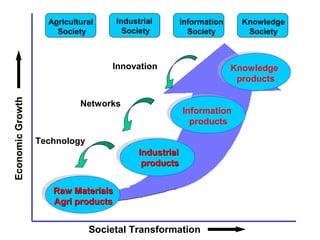
Raw MaterialsRaw Materials
Agri productsAgri products
IndustrialIndustrial
productsproducts
Knowledge
products
Information
products
Innovation
Networks
Technology
Industrial
Society
Agricultural
Society
Information
Society
Knowledge
Society
Societal Transformation
EconomicGrowth
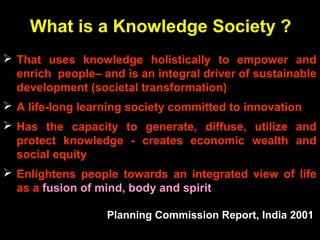
What is a Knowledge Society ?
 That uses knowledge holistically to empower and
enrich people– and is an integral driver of sustainable
development (societal transformation)
 A life-long learning society committed to innovation
 Has the capacity to generate, diffuse, utilize and
protect knowledge - creates economic wealth and
social equity
 Enlightens people towards an integrated view of life
as a fusion of mind, body and spirit
Planning Commission Report, India 2001
The Age of Science
“The 20th
century’s unprecedented gains
in advancing human development and
eradicating poverty came largely from
technological breakthroughs”
In a globalizing, knowledge driven world with
increasing importance of service industries and
technological competitiveness, this contribution
can only become higher.
S & T as an engine for development ?
Consensus is emerging among policy makers and
economists that at least half, if not more, of the
economic growth in countries is directly
attributable to science and technology.
“There is hardly any social problem on which
science cannot make some contribution”
-D. K. Price, Scientific Estate
Science is never sufficient to solve a problem
completely; it is, however, always necessary.
Science for policy
and
Policy for Science
“Policy, not charity, will determine
whether new technologies become a
tool for human development
everywhere”
UNDP-HDR 2001
“There is enough in this world for
everyone's needs but not greed”
-Mahatma Gandhi
The Dignity of Work
“Development is about expanding the
choices people have to lead lives that
they value”
…..But, two thirds of the world population
lives in conditions of relative to complete
deprivation…..What choices do they have?
….1 billion without safe drinking water, 2.4 billion
without access to basic sanitation, 1 billion illiterates…
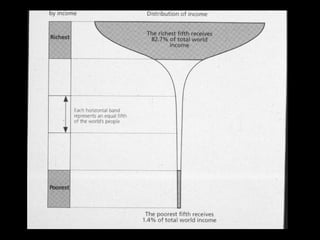
The Paradox of Our Time
Growing inequalities
Knowledge Divide
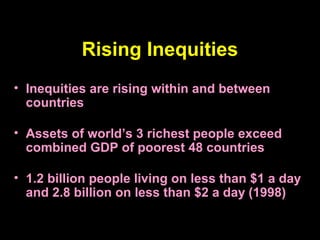
Rising Inequities
• Inequities are rising within and between
countries
• Assets of world’s 3 richest people exceed
combined GDP of poorest 48 countries
• 1.2 billion people living on less than $1 a day
and 2.8 billion on less than $2 a day (1998)
Industrialized nations
vs
Less Developed Countries (LDCs)
Widening gaps in ……
human resource capacity
S & T infrastructure
which are critical in the new knowledge
based world………
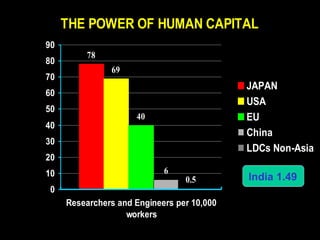
THE POWER OF HUMAN CAPITAL
78
69
40
6
0.5
0
10
20
30
40
50
60
70
80
90
Researchers and Engineers per 10,000
workers
JAPAN
USA
EU
China
LDCs Non-Asia
India 1.49
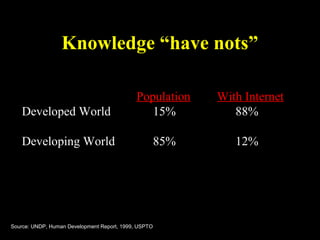
Knowledge “have nots”
Source: UNDP, Human Development Report, 1999, USPTO
Population With Internet
Developed World 15% 88%
Developing World 85% 12%
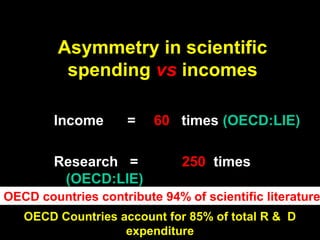
Asymmetry in scientific
spending vs incomes
Income = 60 times (OECD:LIE)
Research = 250 times
(OECD:LIE)
OECD countries contribute 94% of scientific literature
OECD Countries account for 85% of total R & D
expenditure
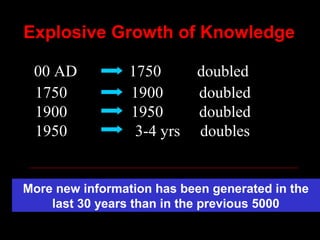
1750 1900 doubled
1900 1950 doubled
1950 3-4 yrs doubles
Explosive Growth of Knowledge
00 AD 1750 doubled
More new information has been generated in the
last 30 years than in the previous 5000
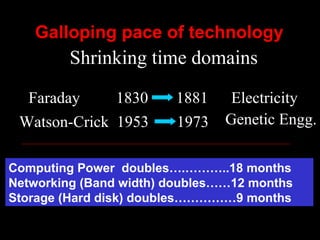
Watson-Crick 1953 1973
Galloping pace of technology
Shrinking time domains
ElectricityFaraday 1830 1881
Genetic Engg.
Computing Power doubles….………..18 months
Networking (Band width) doubles……12 months
Storage (Hard disk) doubles……………9 months
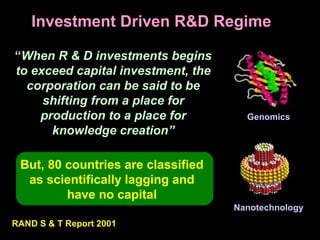
“When R & D investments begins
to exceed capital investment, the
corporation can be said to be
shifting from a place for
production to a place for
knowledge creation”
But, 80 countries are classified
as scientifically lagging and
have no capital
RAND S & T Report 2001
Nanotechnology
Genomics
Investment Driven R&D Regime
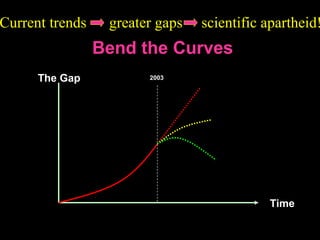
Bend the Curves
The Gap
Time
2003
Current trends greater gaps scientific apartheid!
Among the many challenges of the
global knowledge divide,
the growing S&T gap
between North and South is the most
important
Distribution of S & T capacities is even more lopsided
than that of economic power
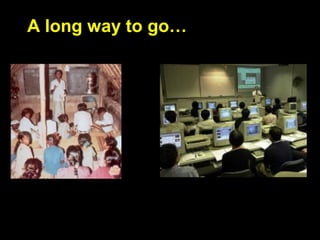
A long way to go…
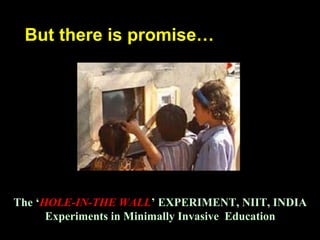
But there is promise…
The ‘HOLE-IN-THE WALL’ EXPERIMENT, NIIT, INDIA
Experiments in Minimally Invasive Education
.….and there is great potential of rich
human capital in the south
Population can be a renewable knowledge
resource as important as capital
Inventing the Future
Urgent Need for
S & T Capacity Building for transition
to the knowledge society
Recognize it as a worldwide challenge
Capacity building is a continuum
S & T Capacity Building-The Road Ahead
 Need for a global perspective and
commitment- harmonize with local contexts
 Rethink by global institutions that deal with
scientific knowledge
 New understanding of south--talent is all
pervasive, access & opportunity are not
 Practical, pragmatic strategies
“Broad Banding”-S & T Capacities
“…it is more appropriate to view innovations as the
fusion of different types of technology rather than as a
series of technical breakthroughs. Fusion means more
than a combination of different technologies:it invokes an
arithmetic in which one plus one makes three”
F. Kodama
 That developing countries need only relevant
technologies is a ‘myth’
 Every country needs the capacity to understand and
adapt global technologies for local needs
 Integration of immediate needs and long term vision
10,000 years ago…………..
“Let Knowledge come from all sides”
-Rig Veda
Segmentation of knowledge leads to divisiveness
Let knowledge be harnessed to uplift the
blossoms in the dust too
Clusters of Action points
• Human Resources-New paradigms in science education
• Universal scientific and technical literacy
• Science, its values and Societal engagement
• Institutions, infrastructure and networks
• Information access-particularly to scientific journals
• Public/Private partnerships
• Policy issues - national and international
 Need for a major rethink at pedagogic and curricular level
 Imaginative synergy with other knowledge streams
 Rekindle interest in experiments and sensory observations
 Restore the inspirational role of teacher-motivator & mentor
 Integration with concepts of sustainable development
 Learning science as an enlivening experience-neither esoteric
nor prosaic
New Paradigms in Science Education
Strengthening science education at all levels is an
enabling requirement, especially for
developing nations, for a self-standing national
science base.
New initiatives in different countries
are being attempted
Need to share experiences and
evolve local strategies
IAP Science Education Program
UNESCO,TWAS, ICSU ………
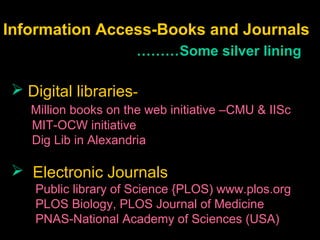
Information Access-Books and Journals
………Some silver lining
 Digital libraries-
Million books on the web initiative –CMU & IISc
MIT-OCW initiative
Dig Lib in Alexandria
 Electronic Journals
Public library of Science {PLOS) www.plos.org
PLOS Biology, PLOS Journal of Medicine
PNAS-National Academy of Sciences (USA)
The interactive complexity of the
triumvirate of science, innovation and
commercialization indicates that the
linear conception of S & T for progress
in the emerging knowledge society may
be inadequate.
Scientific revolution has outpaced
social revolution for over a century now
 Recognize indigenous knowledge-as a common
heritage of humankind- many of its features could be
key elements of sustainable development strategies
 Innovative approaches to international S & T
cooperation-primacy of south-south cooperation
 Alliances to build capacities for the generation,
infusion and absorption of technologies in real time
 Establish “BANK” to which patents can be assigned
for public good, “peace and happiness”
Towards New Understandings and Partnerships
The Role of the Science Academies
Origin of IAC
• Established in 2001 and supported by the
world’s leading academies of sciences
[Inter Academy Panel, IAP, ~90 academies ]
Purpose of IAC
• Mobilizing the world’s best science for a better
tomorrow.
Inter Academy Council
Executive Board
• Academies of Science from Brazil, China, France,
Germany, India, Israel, Japan, Malaysia, Mexico, Russia,
South Africa, Sweden, United Kingdom, United States;
and the Third World Academy of Sciences
Co-Chairs
• Bruce Alberts, President, National Academy of Sciences
• Goverdhan Mehta, Past President, Indian National
Science Academy
Observers
• International Council for Science, ICSU;
• InterAcademy Panel (IAP) ; and
• The Royal Netherlands Academy of Arts and Sciences
Inter Academy Council
Modus operandi
• Project-by-project studies, sponsor-initiated
• Transparent Process
Independence
• Study panels established through broad
consultations (IAP Academies)
• Composition of panels approved by IAC Board
Merit-based
• Draft reports subject to intensive peer review
• Released after approval by the IAC Board
Inter Academy Council
First study:
• Strategy for Building Worldwide Capacities in
Science and Technology.
(Expected release Dec 2003, Mexico City)
• Second study:
• Science and Technology for Improving
Agricultural Productivity in Africa
(Expected completion Jan 2004)
Third study initiated:
• Towards Transitions to Sustainable Energy
Systems
(under implementation)
Inter Academy Council
Activities Planned
• Gender Issues in Science & Technology
• Use of Internet for Distance Education in S & T
• Science and Technology in Preserving World
Heritage Sites (UNESCO)
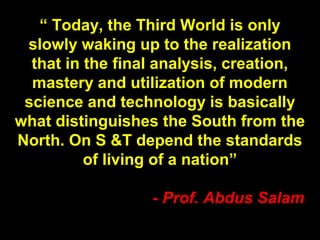
“ Today, the Third World is only
slowly waking up to the realization
that in the final analysis, creation,
mastery and utilization of modern
science and technology is basically
what distinguishes the South from the
North. On S &T depend the standards
of living of a nation”
- Prof. Abdus Salam
Thank You

Science And Technology Capacity And The Knowledge Society

  • 1.
    Science and TechnologyCapacity and the Knowledge Society
  • 2.
    The Dawn ofKnowledge EraThe Dawn of Knowledge Era 21st century will be the century of knowledge
  • 3.
    Raw MaterialsRaw Materials AgriproductsAgri products IndustrialIndustrial productsproducts Knowledge products Information products Innovation Networks Technology Industrial Society Agricultural Society Information Society Knowledge Society Societal Transformation EconomicGrowth
  • 4.
    What is aKnowledge Society ?  That uses knowledge holistically to empower and enrich people– and is an integral driver of sustainable development (societal transformation)  A life-long learning society committed to innovation  Has the capacity to generate, diffuse, utilize and protect knowledge - creates economic wealth and social equity  Enlightens people towards an integrated view of life as a fusion of mind, body and spirit Planning Commission Report, India 2001
  • 5.
    The Age ofScience “The 20th century’s unprecedented gains in advancing human development and eradicating poverty came largely from technological breakthroughs”
  • 6.
    In a globalizing,knowledge driven world with increasing importance of service industries and technological competitiveness, this contribution can only become higher. S & T as an engine for development ? Consensus is emerging among policy makers and economists that at least half, if not more, of the economic growth in countries is directly attributable to science and technology.
  • 7.
    “There is hardlyany social problem on which science cannot make some contribution” -D. K. Price, Scientific Estate Science is never sufficient to solve a problem completely; it is, however, always necessary. Science for policy and Policy for Science
  • 8.
    “Policy, not charity,will determine whether new technologies become a tool for human development everywhere” UNDP-HDR 2001 “There is enough in this world for everyone's needs but not greed” -Mahatma Gandhi
  • 9.
    The Dignity ofWork “Development is about expanding the choices people have to lead lives that they value” …..But, two thirds of the world population lives in conditions of relative to complete deprivation…..What choices do they have? ….1 billion without safe drinking water, 2.4 billion without access to basic sanitation, 1 billion illiterates…
  • 10.
  • 11.
  • 13.
    Rising Inequities • Inequitiesare rising within and between countries • Assets of world’s 3 richest people exceed combined GDP of poorest 48 countries • 1.2 billion people living on less than $1 a day and 2.8 billion on less than $2 a day (1998)
  • 14.
    Industrialized nations vs Less DevelopedCountries (LDCs) Widening gaps in …… human resource capacity S & T infrastructure which are critical in the new knowledge based world………
  • 15.
    THE POWER OFHUMAN CAPITAL 78 69 40 6 0.5 0 10 20 30 40 50 60 70 80 90 Researchers and Engineers per 10,000 workers JAPAN USA EU China LDCs Non-Asia India 1.49
  • 16.
    Knowledge “have nots” Source:UNDP, Human Development Report, 1999, USPTO Population With Internet Developed World 15% 88% Developing World 85% 12%
  • 17.
    Asymmetry in scientific spendingvs incomes Income = 60 times (OECD:LIE) Research = 250 times (OECD:LIE) OECD countries contribute 94% of scientific literature OECD Countries account for 85% of total R & D expenditure
  • 18.
    1750 1900 doubled 19001950 doubled 1950 3-4 yrs doubles Explosive Growth of Knowledge 00 AD 1750 doubled More new information has been generated in the last 30 years than in the previous 5000
  • 19.
    Watson-Crick 1953 1973 Gallopingpace of technology Shrinking time domains ElectricityFaraday 1830 1881 Genetic Engg. Computing Power doubles….………..18 months Networking (Band width) doubles……12 months Storage (Hard disk) doubles……………9 months
  • 20.
    “When R &D investments begins to exceed capital investment, the corporation can be said to be shifting from a place for production to a place for knowledge creation” But, 80 countries are classified as scientifically lagging and have no capital RAND S & T Report 2001 Nanotechnology Genomics Investment Driven R&D Regime
  • 21.
    Bend the Curves TheGap Time 2003 Current trends greater gaps scientific apartheid!
  • 22.
    Among the manychallenges of the global knowledge divide, the growing S&T gap between North and South is the most important Distribution of S & T capacities is even more lopsided than that of economic power
  • 23.
    A long wayto go…
  • 24.
    But there ispromise… The ‘HOLE-IN-THE WALL’ EXPERIMENT, NIIT, INDIA Experiments in Minimally Invasive Education
  • 25.
    .….and there isgreat potential of rich human capital in the south Population can be a renewable knowledge resource as important as capital
  • 26.
    Inventing the Future UrgentNeed for S & T Capacity Building for transition to the knowledge society Recognize it as a worldwide challenge
  • 27.
    Capacity building isa continuum S & T Capacity Building-The Road Ahead  Need for a global perspective and commitment- harmonize with local contexts  Rethink by global institutions that deal with scientific knowledge  New understanding of south--talent is all pervasive, access & opportunity are not  Practical, pragmatic strategies
  • 28.
    “Broad Banding”-S &T Capacities “…it is more appropriate to view innovations as the fusion of different types of technology rather than as a series of technical breakthroughs. Fusion means more than a combination of different technologies:it invokes an arithmetic in which one plus one makes three” F. Kodama  That developing countries need only relevant technologies is a ‘myth’  Every country needs the capacity to understand and adapt global technologies for local needs  Integration of immediate needs and long term vision
  • 29.
    10,000 years ago………….. “LetKnowledge come from all sides” -Rig Veda Segmentation of knowledge leads to divisiveness Let knowledge be harnessed to uplift the blossoms in the dust too
  • 30.
    Clusters of Actionpoints • Human Resources-New paradigms in science education • Universal scientific and technical literacy • Science, its values and Societal engagement • Institutions, infrastructure and networks • Information access-particularly to scientific journals • Public/Private partnerships • Policy issues - national and international
  • 31.
     Need fora major rethink at pedagogic and curricular level  Imaginative synergy with other knowledge streams  Rekindle interest in experiments and sensory observations  Restore the inspirational role of teacher-motivator & mentor  Integration with concepts of sustainable development  Learning science as an enlivening experience-neither esoteric nor prosaic New Paradigms in Science Education Strengthening science education at all levels is an enabling requirement, especially for developing nations, for a self-standing national science base.
  • 32.
    New initiatives indifferent countries are being attempted Need to share experiences and evolve local strategies IAP Science Education Program UNESCO,TWAS, ICSU ………
  • 33.
    Information Access-Books andJournals ………Some silver lining  Digital libraries- Million books on the web initiative –CMU & IISc MIT-OCW initiative Dig Lib in Alexandria  Electronic Journals Public library of Science {PLOS) www.plos.org PLOS Biology, PLOS Journal of Medicine PNAS-National Academy of Sciences (USA)
  • 34.
    The interactive complexityof the triumvirate of science, innovation and commercialization indicates that the linear conception of S & T for progress in the emerging knowledge society may be inadequate. Scientific revolution has outpaced social revolution for over a century now
  • 35.
     Recognize indigenousknowledge-as a common heritage of humankind- many of its features could be key elements of sustainable development strategies  Innovative approaches to international S & T cooperation-primacy of south-south cooperation  Alliances to build capacities for the generation, infusion and absorption of technologies in real time  Establish “BANK” to which patents can be assigned for public good, “peace and happiness” Towards New Understandings and Partnerships
  • 36.
    The Role ofthe Science Academies
  • 37.
    Origin of IAC •Established in 2001 and supported by the world’s leading academies of sciences [Inter Academy Panel, IAP, ~90 academies ] Purpose of IAC • Mobilizing the world’s best science for a better tomorrow. Inter Academy Council
  • 38.
    Inter Academy Council ExecutiveBoard • Academies of Science from Brazil, China, France, Germany, India, Israel, Japan, Malaysia, Mexico, Russia, South Africa, Sweden, United Kingdom, United States; and the Third World Academy of Sciences Co-Chairs • Bruce Alberts, President, National Academy of Sciences • Goverdhan Mehta, Past President, Indian National Science Academy Observers • International Council for Science, ICSU; • InterAcademy Panel (IAP) ; and • The Royal Netherlands Academy of Arts and Sciences
  • 39.
    Inter Academy Council Modusoperandi • Project-by-project studies, sponsor-initiated • Transparent Process Independence • Study panels established through broad consultations (IAP Academies) • Composition of panels approved by IAC Board Merit-based • Draft reports subject to intensive peer review • Released after approval by the IAC Board
  • 40.
    Inter Academy Council Firststudy: • Strategy for Building Worldwide Capacities in Science and Technology. (Expected release Dec 2003, Mexico City) • Second study: • Science and Technology for Improving Agricultural Productivity in Africa (Expected completion Jan 2004) Third study initiated: • Towards Transitions to Sustainable Energy Systems (under implementation)
  • 41.
    Inter Academy Council ActivitiesPlanned • Gender Issues in Science & Technology • Use of Internet for Distance Education in S & T • Science and Technology in Preserving World Heritage Sites (UNESCO)
  • 42.
    “ Today, theThird World is only slowly waking up to the realization that in the final analysis, creation, mastery and utilization of modern science and technology is basically what distinguishes the South from the North. On S &T depend the standards of living of a nation” - Prof. Abdus Salam
  • 43.