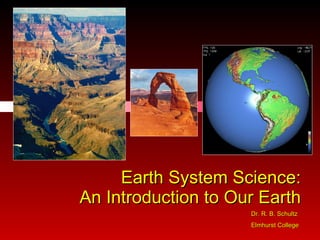
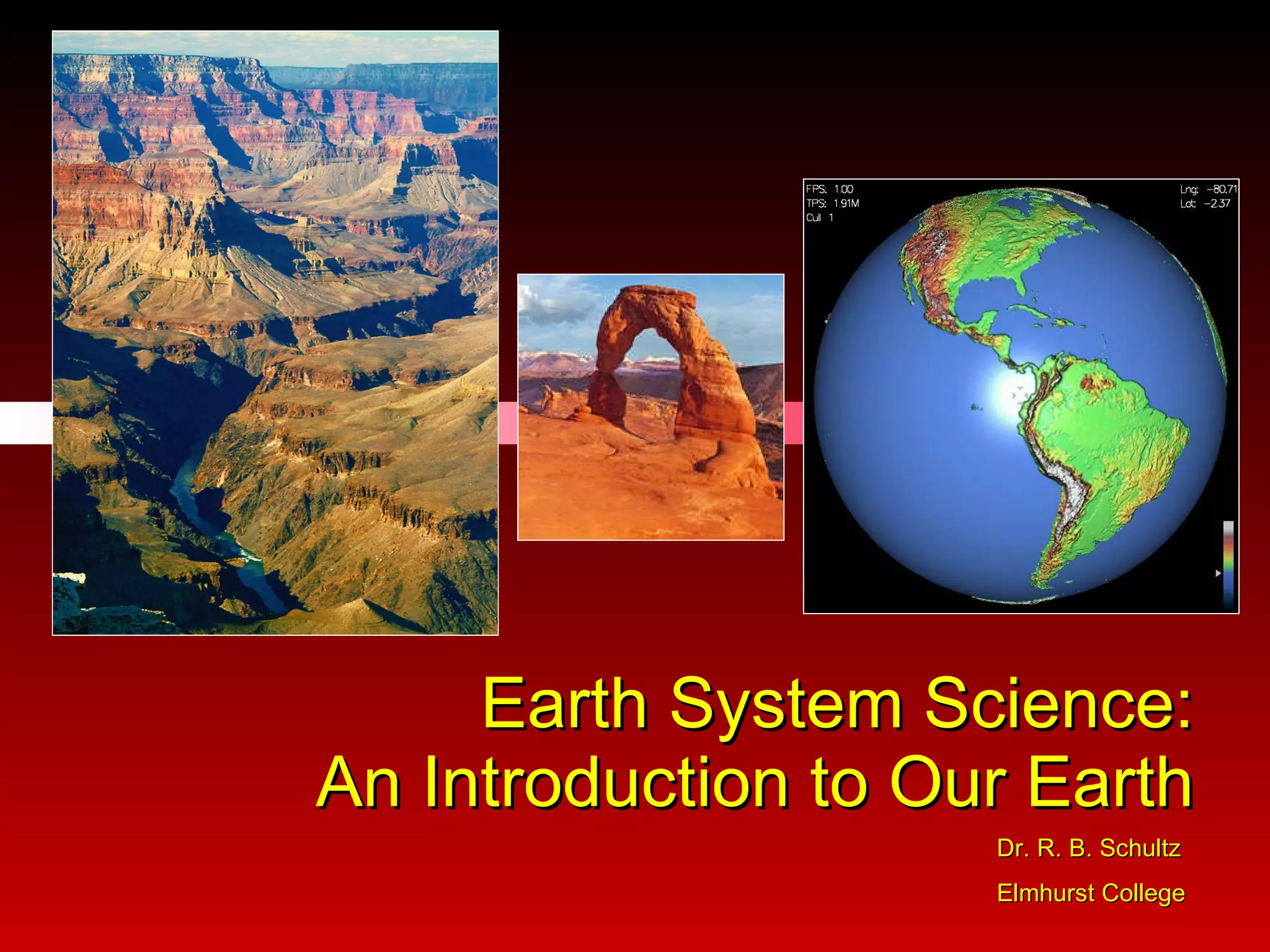


Earth System Science: An Introduction to Our Earth Dr. R. B. Schultz Elmhurst College
When you registered for a geography course, you probably thought you would be getting this… http://www.youtube.com/watch/v/VyzQItUhXyw
Actually, you’ll be learning about this…
… and you’ll learn this…
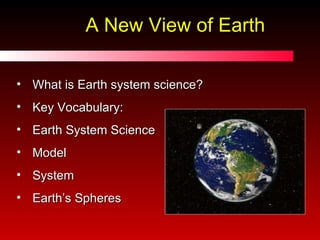
A New View of Earth What is Earth system science? Key Vocabulary: Earth System Science Model System Earth’s Spheres
Past Perceptions  Meet New Issues We used to study Earth as a  collection of parts . This approach led to many important discoveries about our planet.  However, during the late 20 th  century and early 21 st  century, scientists came up against the limits that arise when regarding Earth science as a collection of specialties, with each specialty independent of the other.  In short, the scientific community was not sharing as they could have.
Earth Sciences and the physical environment of the Earth contain four (4) components: 1.     Geology 2.     Oceanography 3.     Meteorology 4.     Astronomy The Planets and Earth  as a System
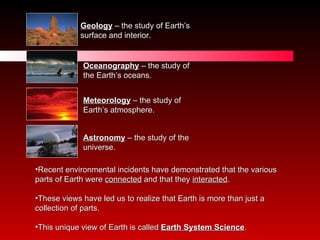
Geology  – the study of Earth’s surface and interior. Oceanography  – the study of the Earth’s oceans. Meteorology  – the study of Earth’s atmosphere. Astronomy  – the study of the universe. Recent environmental incidents have demonstrated that the various parts of Earth were  connected  and that they  interacted . These views have led us to realize that Earth is more than just a collection of parts. This unique view of Earth is called  Earth System Science .
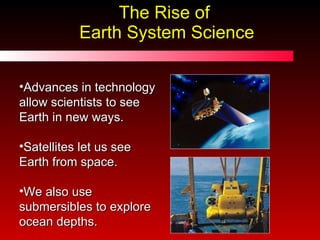
The Rise of  Earth System Science Advances in technology allow scientists to see Earth in new ways. Satellites let us see Earth from space. We also use submersibles to explore ocean depths.
The Rise of Earth System Science Powerful computers and computer programs called  Geographic   Information   Systems  (GIS) help scientists to interpret great amounts of data, and see how Earth changes over time. What is GIS and how does it tie everything together?
Models Using the information from these new tools, scientists can create complex pictures of how processes work by coming up with  models  that explain unseen details. A  model  is a representation of an object, a process, or a phenomenon.  For example, architects may create a model of a new skyscraper before ever starting construction.
What is a System? A  system  is a kind of model.  It is defined as part of the universe that can be studied separately. System models also include  time  as a variable. System models can be used to describe what happened in the past, what is currently happening, or what might happen in the future.
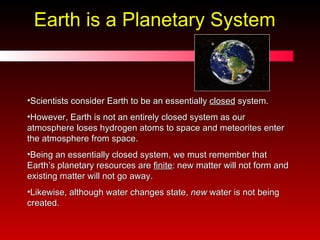
Earth is a Planetary System Scientists consider Earth to be an essentially  closed  system. However, Earth is not an entirely closed system as our atmosphere loses hydrogen atoms to space and meteorites enter the atmosphere from space. Being an essentially closed system, we must remember that Earth’s planetary resources are  finite : new matter will not form and existing matter will not go away.  Likewise, although water changes state,  new  water is not being created.
The Earth is a Planetary System
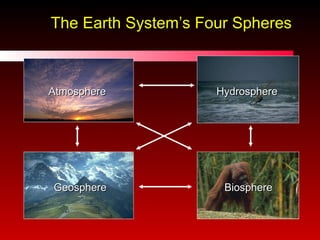
The Earth System’s Four Spheres Earth is unique in the solar system: it is the only planet  currently  known to support life. This capacity is due to the interactions among its four spheres. What are the Earth system’s four spheres, and how do they affect one another?
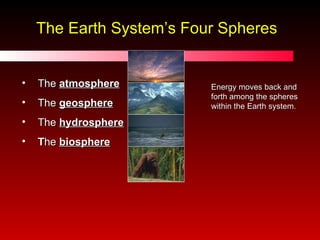
The Earth System’s Four Spheres The  atmosphere The  geosphere The  hydrosphere T he  biosphere Energy moves back and forth among the spheres within the Earth system.
The Atmosphere Atmo - means vapor. The gaseous envelope surrounding Earth is called the  atmosphere . Composed of a mixture of gases (78% nitrogen and 21% oxygen), the atmosphere provides living things with oxygen and carbon dioxide.  Other gases (I.e., ozone) absorb and alter rays from the sun, blocking potentially harmful radiation.  Changing amounts of water vapor cause humidity and clouds.  Varying amount of atmospheric pressure causes winds.  The oxygen in our atmosphere makes our planet unique.
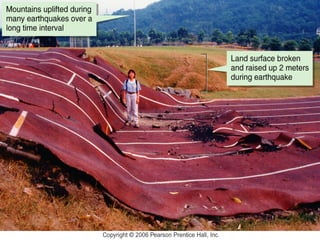
The Geosphere Geo - means Earth. The rocks, the mountains, the beaches, and all other physical features of the Earth (except water), makes up the  geosphere . The geosphere includes the ocean basins and the rock layers beneath your feet, including those you cannot see.  These layers include the mantle (the source of the lava that pours from volcanoes) and the core that forms the planet’s center and generates Earth’s magnetic field.  The geosphere is dynamically changing (slowly).
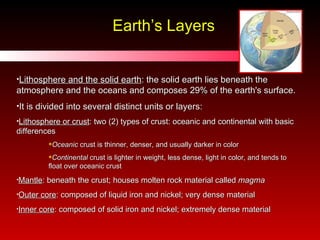
Lithosphere and the solid earth : the solid earth lies beneath the atmosphere and the oceans and composes 29% of the earth's surface.  It is divided into several distinct units or layers: Lithosphere or crust : two (2) types of crust: oceanic and continental with basic differences Oceanic  crust is thinner, denser, and usually darker in color Continental  crust is lighter in weight, less dense, light in color, and tends to float over oceanic crust Mantle : beneath the crust; houses molten rock material called  magma Outer core : composed of liquid iron and nickel; very dense material Inner core : composed of solid iron and nickel; extremely dense material Earth’s Layers
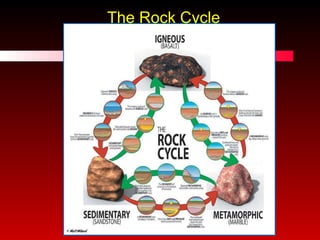
We will study the three (3) rock types composing the earth: 1. Igneous - related to molten rock 2. Sedimentary - layers of eroded particles and sediments 3. Metamorphic - rock resulting from pre-existing igneous or sedimentary  rock that has undergone a change by pressure and/or temperature  changes. The interaction between the three (3) rock types is referred to as the  Rock Cycle . Rocks and the Rock Cycle
The Rock Cycle
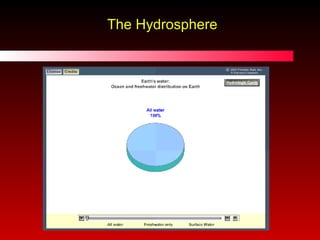
The Hydrosphere Hydro - means water. The  hydrosphere  contains all the water in the Earth system. The hydrosphere includes the water in the oceans, lakes, rivers, groundwater, and water locked up in ice and snow at the poles and in high mountains.  Only about one percent (1%) of all the water in the hydrosphere is potable (useable for drinking) water.  All the water on Earth is continuously recycled.
The Hydrosphere
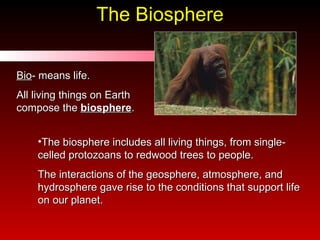
The Biosphere Bio - means life. All living things on Earth compose the  biosphere . The biosphere includes all living things, from single-celled protozoans to redwood trees to people. The interactions of the geosphere, atmosphere, and hydrosphere gave rise to the conditions that support life on our planet.
Interactions Among The Spheres The four spheres are constantly moving, changing, and interacting.  These actions do not occur in isolation.  The four spheres are interacting ever day, all around you. Interactions among the spheres have changed the Earth system and the individual spheres.  Changes to one sphere have profound effects on one or more of the other spheres.
The Earth System’s Four Spheres Atmosphere Geosphere Hydrosphere Biosphere
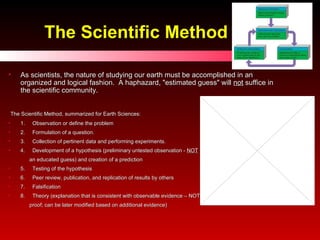
The Scientific Method As scientists, the nature of studying our earth must be accomplished in an organized and logical fashion.  A haphazard, "estimated guess" will  not  suffice in the scientific community.     The Scientific Method, summarized for Earth Sciences: 1.     Observation or define the problem  2.     Formulation of a question. 3.     Collection of pertinent data and performing experiments. 4.     Development of a hypothesis (preliminary untested observation -  NOT   an educated guess) and creation of a prediction 5.     Testing of the hypothesis 6.     Peer review, publication, and replication of results by others 7.  Falsification 8.  Theory (explanation that is consistent with observable evidence – NOT  proof; can be later modified based on additional evidence)
 
Key Terminology Geology Oceanography Meteorology Astronomy Hydrosphere Atmosphere Lithosphere Biosphere Ozone Continental crust Oceanic crust Mantle Magma Lava Outer core Inner core Igneous rocks Sedimentary rocks Metamorphic rocks Scientific Method Rock cycle System Earth System Science Hypothesis

Intro to Earth System Science

  • 1.
    Earth System Science:An Introduction to Our Earth Dr. R. B. Schultz Elmhurst College
  • 2.
    When you registeredfor a geography course, you probably thought you would be getting this… http://www.youtube.com/watch/v/VyzQItUhXyw
  • 3.
    Actually, you’ll belearning about this…
  • 4.
    … and you’lllearn this…
  • 5.
    A New Viewof Earth What is Earth system science? Key Vocabulary: Earth System Science Model System Earth’s Spheres
  • 6.
    Past Perceptions Meet New Issues We used to study Earth as a collection of parts . This approach led to many important discoveries about our planet. However, during the late 20 th century and early 21 st century, scientists came up against the limits that arise when regarding Earth science as a collection of specialties, with each specialty independent of the other. In short, the scientific community was not sharing as they could have.
  • 7.
    Earth Sciences andthe physical environment of the Earth contain four (4) components: 1.     Geology 2.     Oceanography 3.     Meteorology 4.     Astronomy The Planets and Earth as a System
  • 8.
    Geology –the study of Earth’s surface and interior. Oceanography – the study of the Earth’s oceans. Meteorology – the study of Earth’s atmosphere. Astronomy – the study of the universe. Recent environmental incidents have demonstrated that the various parts of Earth were connected and that they interacted . These views have led us to realize that Earth is more than just a collection of parts. This unique view of Earth is called Earth System Science .
  • 9.
    The Rise of Earth System Science Advances in technology allow scientists to see Earth in new ways. Satellites let us see Earth from space. We also use submersibles to explore ocean depths.
  • 10.
    The Rise ofEarth System Science Powerful computers and computer programs called Geographic Information Systems (GIS) help scientists to interpret great amounts of data, and see how Earth changes over time. What is GIS and how does it tie everything together?
  • 11.
    Models Using theinformation from these new tools, scientists can create complex pictures of how processes work by coming up with models that explain unseen details. A model is a representation of an object, a process, or a phenomenon. For example, architects may create a model of a new skyscraper before ever starting construction.
  • 12.
    What is aSystem? A system is a kind of model. It is defined as part of the universe that can be studied separately. System models also include time as a variable. System models can be used to describe what happened in the past, what is currently happening, or what might happen in the future.
  • 13.
    Earth is aPlanetary System Scientists consider Earth to be an essentially closed system. However, Earth is not an entirely closed system as our atmosphere loses hydrogen atoms to space and meteorites enter the atmosphere from space. Being an essentially closed system, we must remember that Earth’s planetary resources are finite : new matter will not form and existing matter will not go away. Likewise, although water changes state, new water is not being created.
  • 14.
    The Earth isa Planetary System
  • 15.
    The Earth System’sFour Spheres Earth is unique in the solar system: it is the only planet currently known to support life. This capacity is due to the interactions among its four spheres. What are the Earth system’s four spheres, and how do they affect one another?
  • 16.
    The Earth System’sFour Spheres The atmosphere The geosphere The hydrosphere T he biosphere Energy moves back and forth among the spheres within the Earth system.
  • 17.
    The Atmosphere Atmo- means vapor. The gaseous envelope surrounding Earth is called the atmosphere . Composed of a mixture of gases (78% nitrogen and 21% oxygen), the atmosphere provides living things with oxygen and carbon dioxide. Other gases (I.e., ozone) absorb and alter rays from the sun, blocking potentially harmful radiation. Changing amounts of water vapor cause humidity and clouds. Varying amount of atmospheric pressure causes winds. The oxygen in our atmosphere makes our planet unique.
  • 18.
    The Geosphere Geo- means Earth. The rocks, the mountains, the beaches, and all other physical features of the Earth (except water), makes up the geosphere . The geosphere includes the ocean basins and the rock layers beneath your feet, including those you cannot see. These layers include the mantle (the source of the lava that pours from volcanoes) and the core that forms the planet’s center and generates Earth’s magnetic field. The geosphere is dynamically changing (slowly).
  • 19.
    Lithosphere and thesolid earth : the solid earth lies beneath the atmosphere and the oceans and composes 29% of the earth's surface. It is divided into several distinct units or layers: Lithosphere or crust : two (2) types of crust: oceanic and continental with basic differences Oceanic crust is thinner, denser, and usually darker in color Continental crust is lighter in weight, less dense, light in color, and tends to float over oceanic crust Mantle : beneath the crust; houses molten rock material called magma Outer core : composed of liquid iron and nickel; very dense material Inner core : composed of solid iron and nickel; extremely dense material Earth’s Layers
  • 20.
    We will studythe three (3) rock types composing the earth: 1. Igneous - related to molten rock 2. Sedimentary - layers of eroded particles and sediments 3. Metamorphic - rock resulting from pre-existing igneous or sedimentary rock that has undergone a change by pressure and/or temperature changes. The interaction between the three (3) rock types is referred to as the Rock Cycle . Rocks and the Rock Cycle
  • 21.
  • 22.
    The Hydrosphere Hydro- means water. The hydrosphere contains all the water in the Earth system. The hydrosphere includes the water in the oceans, lakes, rivers, groundwater, and water locked up in ice and snow at the poles and in high mountains. Only about one percent (1%) of all the water in the hydrosphere is potable (useable for drinking) water. All the water on Earth is continuously recycled.
  • 23.
  • 24.
    The Biosphere Bio- means life. All living things on Earth compose the biosphere . The biosphere includes all living things, from single-celled protozoans to redwood trees to people. The interactions of the geosphere, atmosphere, and hydrosphere gave rise to the conditions that support life on our planet.
  • 25.
    Interactions Among TheSpheres The four spheres are constantly moving, changing, and interacting. These actions do not occur in isolation. The four spheres are interacting ever day, all around you. Interactions among the spheres have changed the Earth system and the individual spheres. Changes to one sphere have profound effects on one or more of the other spheres.
  • 26.
    The Earth System’sFour Spheres Atmosphere Geosphere Hydrosphere Biosphere
  • 27.
    The Scientific MethodAs scientists, the nature of studying our earth must be accomplished in an organized and logical fashion. A haphazard, "estimated guess" will not suffice in the scientific community.     The Scientific Method, summarized for Earth Sciences: 1.     Observation or define the problem 2.     Formulation of a question. 3.     Collection of pertinent data and performing experiments. 4.     Development of a hypothesis (preliminary untested observation - NOT an educated guess) and creation of a prediction 5.     Testing of the hypothesis 6.     Peer review, publication, and replication of results by others 7. Falsification 8. Theory (explanation that is consistent with observable evidence – NOT proof; can be later modified based on additional evidence)
  • 28.
  • 29.
    Key Terminology GeologyOceanography Meteorology Astronomy Hydrosphere Atmosphere Lithosphere Biosphere Ozone Continental crust Oceanic crust Mantle Magma Lava Outer core Inner core Igneous rocks Sedimentary rocks Metamorphic rocks Scientific Method Rock cycle System Earth System Science Hypothesis

Editor's Notes

  • #12 Examples include an architect building a small model, a scientist creating a globe or map to show physical features of the Earth, or a scientist showing how something works (especially when something is too large or too small to observe directly).
  • #19 Minerals, such as iron and copper, are mined from the geosphere. The stone and concrete used in building materials comes from the geosphere. Things are constantly changing: volcanoes erupt and form new land, mountains are uplifted and then erode, and Earth’s continents are in slow but constant motion.
  • #23 Most of Earth’s water is salty, only about 3% is fresh water, and about 70% of that is frozen in the form of glacial ice. Fresh water comes from groundwater, lakes, rivers, soil moisture, and water vapor. The water you drank this morning may have irrigated a field last year, flowed through aqueducts during the time of the Roman Empire, or washed around the feet of a dinosaur standing at a river’s edge millions of years ago.
  • #27 The four spheres: the atmosphere, the geosphere, the hydrosphere, and the biosphere. These interact continuously, each affecting the others.