The Earth System 
The Blue Planet: Chapter 1
Outline 
• Earth System Science 
• Systems 
• Earth System Reservoirs 
• Dynamic Interactions Among 
Reservoirs 
• How Science Works
Earth System Science 
• Earth system science is the new 
holisitic approach to studying the Earth 
as a whole system of many interacting 
parts 
– The ocean -Soils 
– The atmosphere -Plants 
– The continents -Animals 
– Lakes and rivers
Earth System Science 
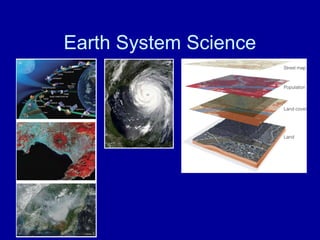
• Requires observations of Earth at 
various scales 
• The quintessential tool for making these 
observations is remote sensing with 
satellites 
• Geographic Information Systems 
provide ways for scientists to store and 
analyze vast amounts of data
Earth System Science
Outline 
• Earth System Science 
• Systems 
• Earth System Reservoirs 
• Dynamic Interactions Among 
Reservoirs 
• How Science Works
Systems 
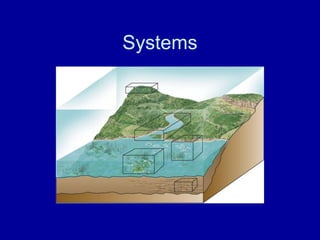
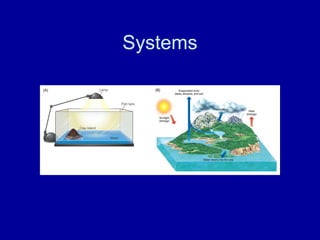
• A system is any portion of the universe 
that can be isolated from the rest for the 
purpose of observing and measuring 
changes 
• By observing and measuring changes, 
systems can be used to study complex 
problems
Systems
Systems 
• A model is a representation of 
something, typically a simplification of a 
complex original 
• We can build models of processes, 
which can represent some of Earth’s 
systems
Systems
Systems 
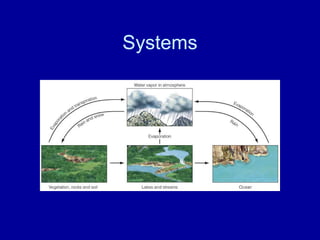
• A box model is a simple graphical 
representation of a system 
• It can show essential features 
– The processes and rates by which matter 
or energy enters and leaves the system 
– The processes and rates by which matter 
or energy moves within the system 
– The amount of matter or energy in the 
system and its distribution
Systems
Systems 
• A key to understanding the Earth 
system is to measure how volumes and 
exchanges of materials and energy 
between Earth’s reservoirs change over 
time 
• The challenge is to determine why the 
changes happen, and how quickly
Systems 
• The amount and of energy or matter that is 
transferred is called flux 
• The places where energy or matter is stored are 
called reservoirs 
– If the flux into a reservoir is greater than the flux out, 
that reservoir is a sink 
– If the flux into a reservoir is less than the flux out, that 
reservoir is a source 
• The length of time energy or matter spends in a 
reservoir is its residence time, when this time is 
so great that matter is isolated for very long 
periods, it is called sequestration
Systems 
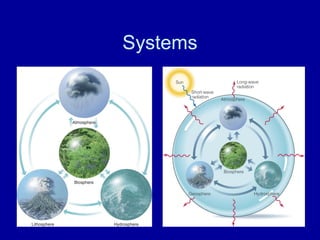
• Earth comprises four vast reservoirs 
with constant flows of energy and 
matter among them 
– The atmosphere 
– The hydrosphere 
– The biosphere 
– The geosphere 
• As a whole, Earth is essentially a closed 
system
Systems
Systems 
• Two important implications of Earth 
being a closed system are 
1. The amount of matter in a closed system 
is fixed and finite 
2. If changes are made in one part of a 
closed system, the results of those 
changes eventually will affect other parts 
of the system
Outline 
• Earth System Science 
• Systems 
• Earth System Reservoirs 
• Dynamic Interactions Among 
Reservoirs 
• How Science Works
Earth System Reservoirs 
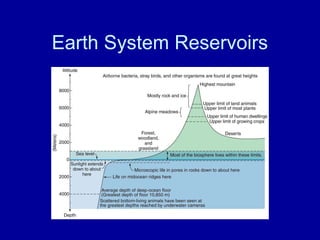
• The place where Earth’s four reservoirs 
interact most intensively is a narrow 
zone called the life zone 
• Conditions favorable for life are created 
by interactions between the lithosphere, 
hydrosphere and atmosphere, and 
modified by the biosphere
Earth System Reservoirs
Earth System Reservoirs 
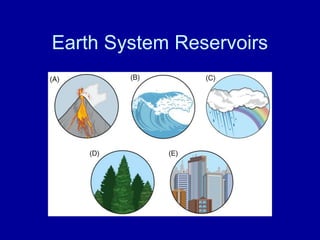
• The Geosphere 
– Is the solid earth 
– Composed mainly of rock and regolith 
– Where energy that comes into the Earth 
system from outside sources meets energy 
that comes from within the planet 
– Energy sources combine and compete to 
build up and wear down the materials of 
Earth’s surface
Earth System Reservoirs 
• The Hydrosphere 
– The totality of Earth’s water 
– Includes oceans, lakes, streams, 
underground water, and all snow and ice 
– The perennially frozen parts of the 
hydrosphere are collectively the cryosphere 
– The hydrosphere and the atmosphere store, 
purify, and continually redistribute water
Earth System Reservoirs 
• The Atmosphere 
– The mixture of gases that surrounds Earth 
– Predominantly Ni, O2, Ar, CO2, and H2O 
– In the context of the planet it is a very very 
thin layer, but it protects life from damaging 
solar radiation, is the reservoir for oxygen 
and carbon dioxide 
– It is the outer boundary of the Earth system
Earth System Reservoirs
Earth System Reservoirs 
• The Biosphere 
– Includes all of Earth’s organisms and 
matter that has not yet decomposed 
– The biosphere greatly affects every other 
of Earth’s systems 
• Photosynthesis 
• Oxygen as a highly reactive gas
Earth System Reservoirs 
• The Anthroposphere 
– The “human sphere” 
– Comprises people, their interests, and their 
impacts on the Earth system 
– The part of the natural system that has 
been modified by humans 
– Includes the technosphere, specifically to 
technology, machines, and the built 
environment
Outline 
• Earth System Science 
• Systems 
• Earth System Reservoirs 
• Dynamic Interactions Among 
Reservoirs 
• How Science Works
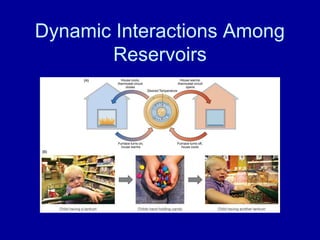
Dynamic Interactions Among 
Reservoirs 
• Because energy flows freely into and out 
of systems, all systems respond to inputs 
and, as a result, have outputs 
• A special kind of response, feedback, 
occurs when the output of the system also 
serves as an input 
– Negative feedback: the system’s response is 
in the opposite direction of initial input 
• Often self-limiting or self-regulating
Dynamic Interactions Among 
Reservoirs 
• Positive feedback: an increase in output 
leads to a further increase in output 
– Vicious cycle 
– Destabilizing
Dynamic Interactions Among 
Reservoirs
Dynamic Interactions Among 
Reservoirs 
• The constant movement of material 
from one reservoir to another is called a 
cycle 
• Natural cycles are not simple, and exist 
in a state of dynamic equilibrium 
• There are many important Earth cycles
Dynamic Interactions Among 
Reservoirs 
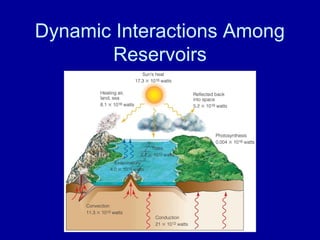
• The Hydrologic Cycle 
• The Energy Cycle 
• The Rock Cycle 
• The Tectonic Cycle 
• Biogeochemical Cycles
Dynamic Interactions Among 
Reservoirs
Dynamic Interactions Among 
Reservoirs 
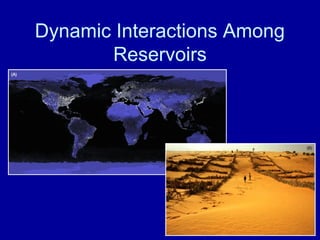
• Humans involve or affect natural cycles 
• Significant changes are now taking 
place in many Earth reservoirs, as a 
result, many are changing in 
unexpected ways 
• Scientists have coined a term to 
describe changes produced in the Earth 
system as a result of human activities: 
global change
Dynamic Interactions Among 
Reservoirs
Outline 
• Earth System Science 
• Systems 
• Earth System Reservoirs 
• Dynamic Interactions Among 
Reservoirs 
• How Science Works
How Science Works 
• Earth system science, like all other 
forms of science, advances by 
application of the scientific method 
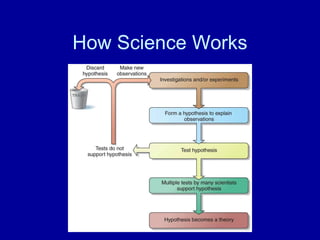
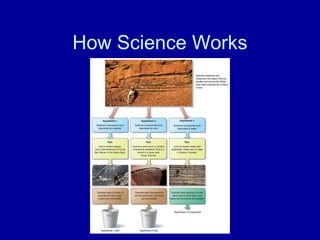
• The scientific method is based on 
observations and the systematic 
collection of evidence that can be seen 
and tested by anyone with resources
How Science Works
How Science Works 
• Scientists start with an observation and seek to 
acquire evidence about it through measurement 
and experimentation 
• Scientists try to explain their observations by 
developing a hypothesis 
• Once a hypothesis has been examined and found 
to make successful predictions and withstand 
numerous tests, it may become a theory 
• Eventually, a theory or group of theories whose 
applicability has been decisively demonstrated, 
may become a law or a principle
How Science Works
How Science Works 
• The fact that nothing is absolutely 
certain in nature is not problematic for 
scientists, but can be difficult for non-scientists 
to comprehend fully 
• It is important to understand that 
uncertainty does not imply a lack of 
scientific knowledge or understanding

The Earth System ch1

  • 1.
    The Earth System The Blue Planet: Chapter 1
  • 2.
    Outline • EarthSystem Science • Systems • Earth System Reservoirs • Dynamic Interactions Among Reservoirs • How Science Works
  • 3.
    Earth System Science • Earth system science is the new holisitic approach to studying the Earth as a whole system of many interacting parts – The ocean -Soils – The atmosphere -Plants – The continents -Animals – Lakes and rivers
  • 4.
    Earth System Science • Requires observations of Earth at various scales • The quintessential tool for making these observations is remote sensing with satellites • Geographic Information Systems provide ways for scientists to store and analyze vast amounts of data
  • 5.
  • 6.
    Outline • EarthSystem Science • Systems • Earth System Reservoirs • Dynamic Interactions Among Reservoirs • How Science Works
  • 7.
    Systems • Asystem is any portion of the universe that can be isolated from the rest for the purpose of observing and measuring changes • By observing and measuring changes, systems can be used to study complex problems
  • 8.
  • 9.
    Systems • Amodel is a representation of something, typically a simplification of a complex original • We can build models of processes, which can represent some of Earth’s systems
  • 10.
  • 11.
    Systems • Abox model is a simple graphical representation of a system • It can show essential features – The processes and rates by which matter or energy enters and leaves the system – The processes and rates by which matter or energy moves within the system – The amount of matter or energy in the system and its distribution
  • 12.
  • 13.
    Systems • Akey to understanding the Earth system is to measure how volumes and exchanges of materials and energy between Earth’s reservoirs change over time • The challenge is to determine why the changes happen, and how quickly
  • 14.
    Systems • Theamount and of energy or matter that is transferred is called flux • The places where energy or matter is stored are called reservoirs – If the flux into a reservoir is greater than the flux out, that reservoir is a sink – If the flux into a reservoir is less than the flux out, that reservoir is a source • The length of time energy or matter spends in a reservoir is its residence time, when this time is so great that matter is isolated for very long periods, it is called sequestration
  • 15.
    Systems • Earthcomprises four vast reservoirs with constant flows of energy and matter among them – The atmosphere – The hydrosphere – The biosphere – The geosphere • As a whole, Earth is essentially a closed system
  • 16.
  • 17.
    Systems • Twoimportant implications of Earth being a closed system are 1. The amount of matter in a closed system is fixed and finite 2. If changes are made in one part of a closed system, the results of those changes eventually will affect other parts of the system
  • 18.
    Outline • EarthSystem Science • Systems • Earth System Reservoirs • Dynamic Interactions Among Reservoirs • How Science Works
  • 19.
    Earth System Reservoirs • The place where Earth’s four reservoirs interact most intensively is a narrow zone called the life zone • Conditions favorable for life are created by interactions between the lithosphere, hydrosphere and atmosphere, and modified by the biosphere
  • 20.
  • 21.
    Earth System Reservoirs • The Geosphere – Is the solid earth – Composed mainly of rock and regolith – Where energy that comes into the Earth system from outside sources meets energy that comes from within the planet – Energy sources combine and compete to build up and wear down the materials of Earth’s surface
  • 22.
    Earth System Reservoirs • The Hydrosphere – The totality of Earth’s water – Includes oceans, lakes, streams, underground water, and all snow and ice – The perennially frozen parts of the hydrosphere are collectively the cryosphere – The hydrosphere and the atmosphere store, purify, and continually redistribute water
  • 23.
    Earth System Reservoirs • The Atmosphere – The mixture of gases that surrounds Earth – Predominantly Ni, O2, Ar, CO2, and H2O – In the context of the planet it is a very very thin layer, but it protects life from damaging solar radiation, is the reservoir for oxygen and carbon dioxide – It is the outer boundary of the Earth system
  • 24.
  • 25.
    Earth System Reservoirs • The Biosphere – Includes all of Earth’s organisms and matter that has not yet decomposed – The biosphere greatly affects every other of Earth’s systems • Photosynthesis • Oxygen as a highly reactive gas
  • 26.
    Earth System Reservoirs • The Anthroposphere – The “human sphere” – Comprises people, their interests, and their impacts on the Earth system – The part of the natural system that has been modified by humans – Includes the technosphere, specifically to technology, machines, and the built environment
  • 27.
    Outline • EarthSystem Science • Systems • Earth System Reservoirs • Dynamic Interactions Among Reservoirs • How Science Works
  • 28.
    Dynamic Interactions Among Reservoirs • Because energy flows freely into and out of systems, all systems respond to inputs and, as a result, have outputs • A special kind of response, feedback, occurs when the output of the system also serves as an input – Negative feedback: the system’s response is in the opposite direction of initial input • Often self-limiting or self-regulating
  • 29.
    Dynamic Interactions Among Reservoirs • Positive feedback: an increase in output leads to a further increase in output – Vicious cycle – Destabilizing
  • 30.
  • 31.
    Dynamic Interactions Among Reservoirs • The constant movement of material from one reservoir to another is called a cycle • Natural cycles are not simple, and exist in a state of dynamic equilibrium • There are many important Earth cycles
  • 32.
    Dynamic Interactions Among Reservoirs • The Hydrologic Cycle • The Energy Cycle • The Rock Cycle • The Tectonic Cycle • Biogeochemical Cycles
  • 33.
  • 34.
    Dynamic Interactions Among Reservoirs • Humans involve or affect natural cycles • Significant changes are now taking place in many Earth reservoirs, as a result, many are changing in unexpected ways • Scientists have coined a term to describe changes produced in the Earth system as a result of human activities: global change
  • 35.
  • 36.
    Outline • EarthSystem Science • Systems • Earth System Reservoirs • Dynamic Interactions Among Reservoirs • How Science Works
  • 37.
    How Science Works • Earth system science, like all other forms of science, advances by application of the scientific method • The scientific method is based on observations and the systematic collection of evidence that can be seen and tested by anyone with resources
  • 38.
  • 39.
    How Science Works • Scientists start with an observation and seek to acquire evidence about it through measurement and experimentation • Scientists try to explain their observations by developing a hypothesis • Once a hypothesis has been examined and found to make successful predictions and withstand numerous tests, it may become a theory • Eventually, a theory or group of theories whose applicability has been decisively demonstrated, may become a law or a principle
  • 40.
  • 41.
    How Science Works • The fact that nothing is absolutely certain in nature is not problematic for scientists, but can be difficult for non-scientists to comprehend fully • It is important to understand that uncertainty does not imply a lack of scientific knowledge or understanding