The Italian High Renaissance
A Time of Renewal and Discovery
Origins

✤   The High Renaissance began during the 1480’s, specifically with
    Leonardo da Vinci’s Last Supper.


✤   It occurred principally in Rome.

✤   The Popes in Rome spent copious amounts of money on
    commissioned works of art during this time.
Historical and Cultural Context

✤   With the invention and use of the printing press, there was a greater
    spread of ideas, and artists could sell prints of their work.

✤   Travel also increased during the High Renaissance; therefore, art
    became more international.

✤   Christopher Columbus discovered the Americas in 1492, which
    challenged the classical world view and encouraged a new age of
    science and math.

✤   Changes were also reflected in literature, poetry, philosophy, science,
    architecture, and music.
The Figure


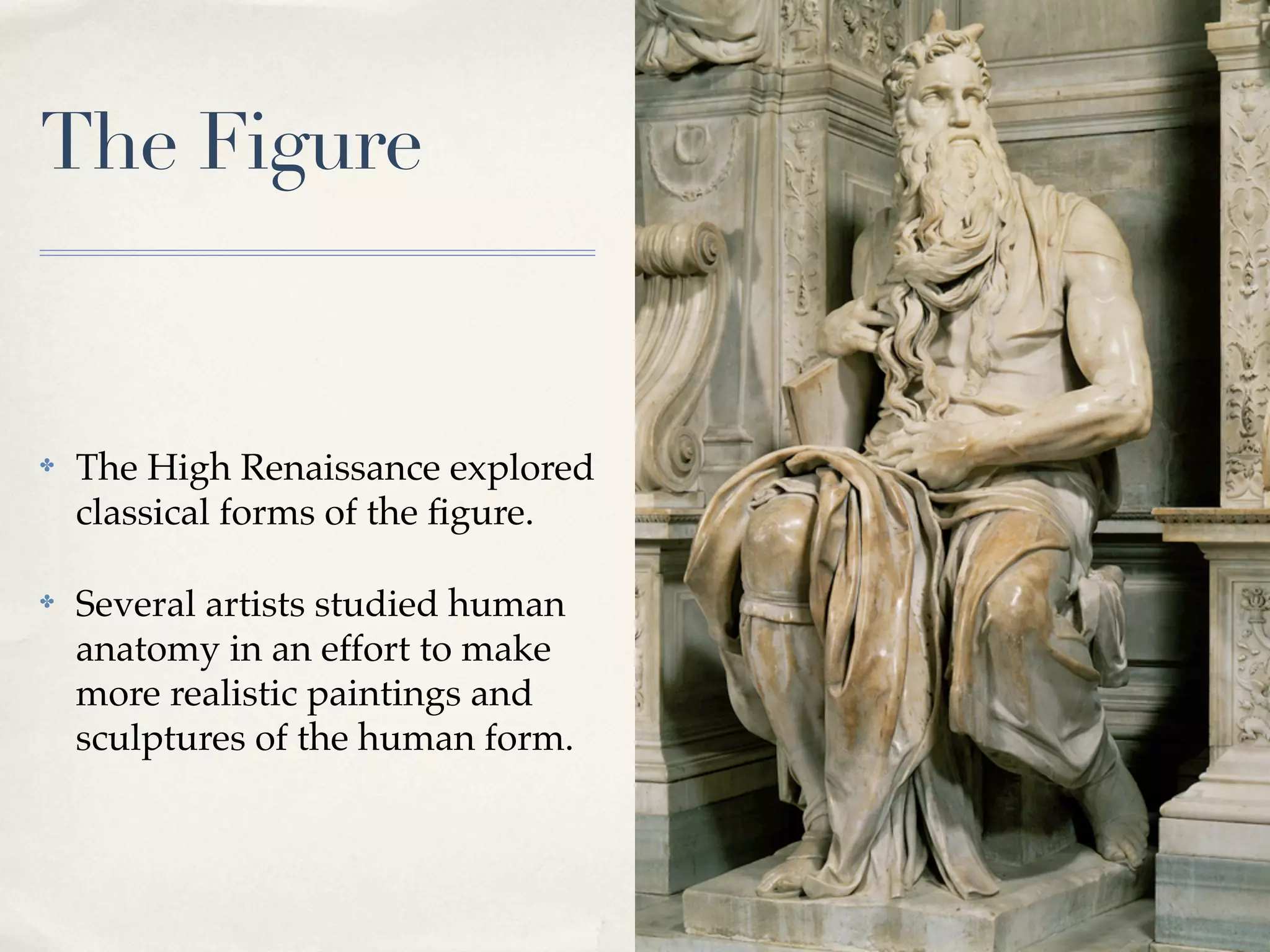
✤   The High Renaissance explored
    classical forms of the figure.

✤   Several artists studied human
    anatomy in an effort to make
    more realistic paintings and
    sculptures of the human form.
Masters of the High Renaissance


✤   Leonardo da Vinci

✤   Michelangelo

✤   Raphael
Leonardo da
Vinci
✤   1452 – 1519

✤   Born in Vinci, Italy.

✤   Was a painter, sculptor, architect,
    musician, scientist,
    mathematician, engineer,
    inventor, anatomist, geologist,
    cartographer, botanist and writer.

✤   His work dissecting human
    corpses and studying anatomy
    helped artists develop proper
    proportions and realism.
San Giovenale Triptych (1422) Masaccio   The Virgin and Child with St. Anne (1508-1517) da Vinci


He also developed the technique of “sfumato”- the blurred outline
 and mellowed colors that allow one form to merge with another
         and always leave something to our imagination.
Leonardo da Vinci’s
Vitruvian Man

✤   Also known as the Proportions
    of Man.

✤   Uses text and drawing to
    describe and show the ideal
    proportions for a human male.

✤   Excellent example of the blend
    of science and art.

✤   Combined the classical ideals
    of the human figure with da
    Vinci’s own observations.
Leonardo da
Vinci’s Mona
✤   31” x 21”

✤   da Vinci’s most famous work of
    art.

✤   One of the first portraits to
    depict the subject in front of an
    imaginary background.

✤   For many years there was
    controversy regarding the
    subject of the painting, though
    in 2008 it was confirmed that it is
    Lisa Gherardini del Giocondo.
Leonardo da Vinci’s The Last Supper (1495-1498)
✤   15 feet x 29 feet
✤   Inspired the book The Da Vinci Code.
✤   Controversial because some art historians believe it is Mary
    Magdalene, rather than the Apostle John, seated next to Jesus.
Michelangelo

✤   1475-1564.

✤   Believed God put the sculpture
    within the rock and that the
    artist must uncover it.

✤   Also believed good art comes
    from divine inspiration and
    beauty is a path to salvation.

✤   Preferred sculpting above all
    other forms of art.              “Every block of stone has a statue inside it and
                                       it is the task of the sculptor to discover it.”
                                                       - Michelangelo
Michelangelo’s
The Pieta (1498-1499)
✤   Made of marble and is 68.5 in
    × 76.8 in.

✤   Finished when Michelangelo
    was just 24 years old.

✤   Balances the Renaissance ideals
    of classical beauty and
    naturalism.

✤   When others attributed the
    sculpture to another artist,
    Michelangelo carved his name
    across Mary’s chest.
Michelangelo’s
The David (1501-1504)

✤   Made of marble that was
    abandoned by another sculptor, it
    stands 17 feet tall.

✤   Finished when Michelangelo was
    29 years old.

✤   The statue’s hands and head are
    disproportionately large. Because
    the statue was originally intended
    to be installed on the roofline of a
    cathedral, it is most likely that
    Michelangelo did this
    intentionally, so these important
    details could be seen from below.
Michelangelo’s
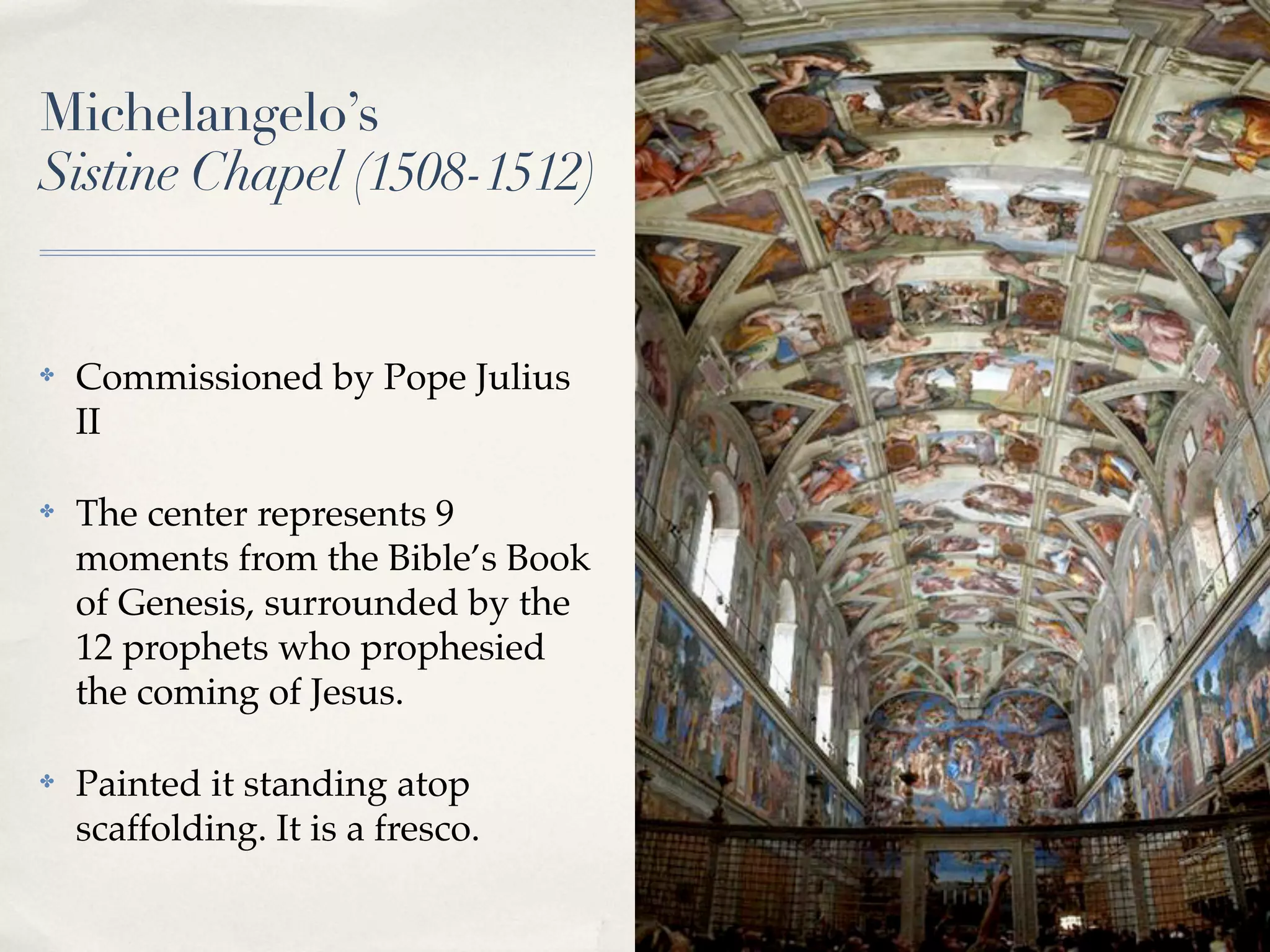
Sistine Chapel (1508-1512)


✤   Commissioned by Pope Julius
    II

✤   The center represents 9
    moments from the Bible’s Book
    of Genesis, surrounded by the
    12 prophets who prophesied
    the coming of Jesus.

✤   Painted it standing atop
    scaffolding. It is a fresco.
Masculinity in
Renaissance Art

✤   Why are Michelangelo’s
    women painted so masculine?

✤   The models he used were male.

✤   The male figure was
    considered the ideal of beauty
    during the Renaissance.
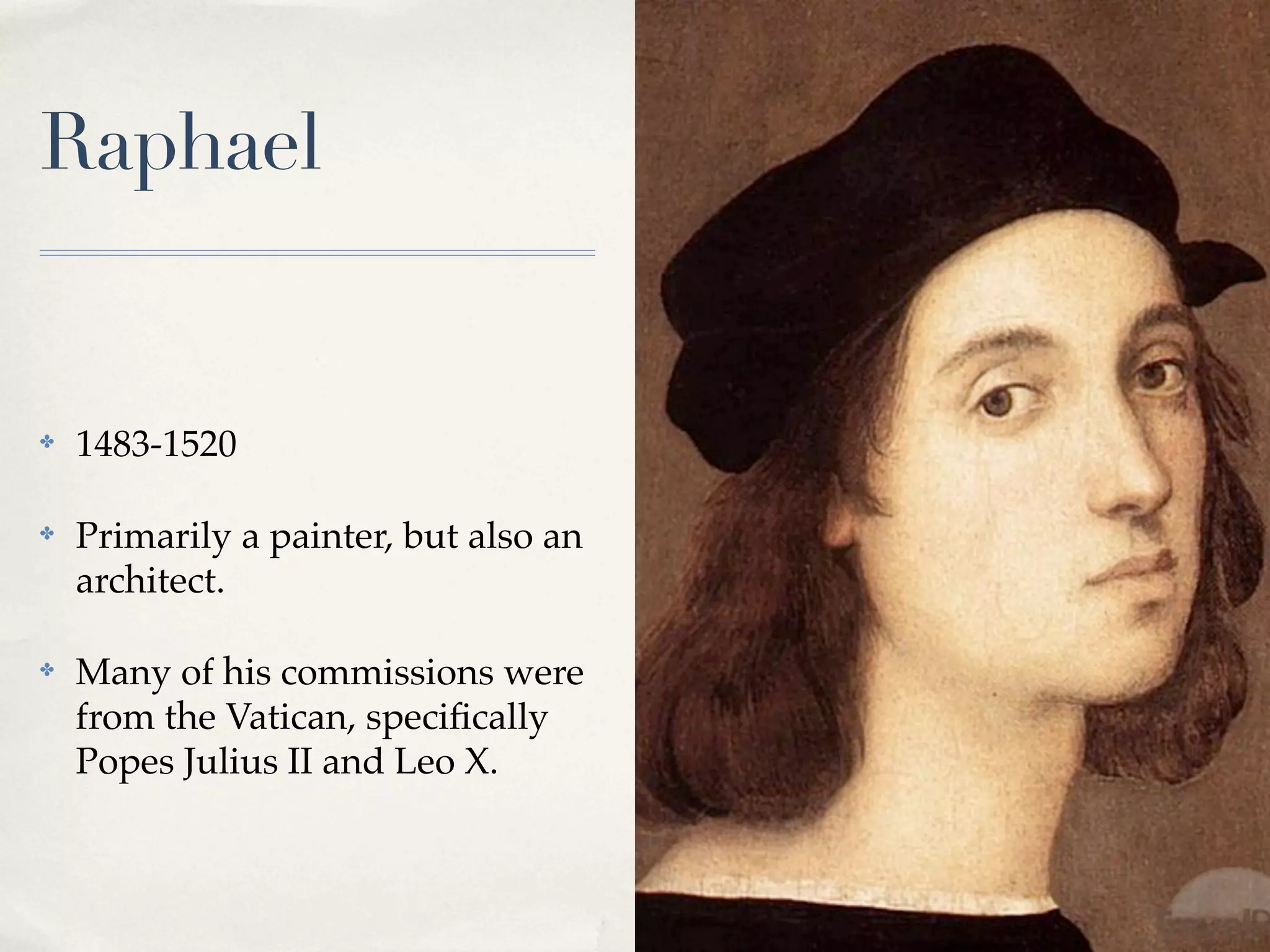
Raphael


✤   1483-1520

✤   Primarily a painter, but also an
    architect.

✤   Many of his commissions were
    from the Vatican, specifically
    Popes Julius II and Leo X.
The School of Athens (1510-1511) Raphael
✤   17 x 25 foot fresco
✤   Depicts all of the great Greek philosophers - Plato and Aristotle are the
    two central figures.
✤   Represented the revival of classical philosophy during the Renaissance.
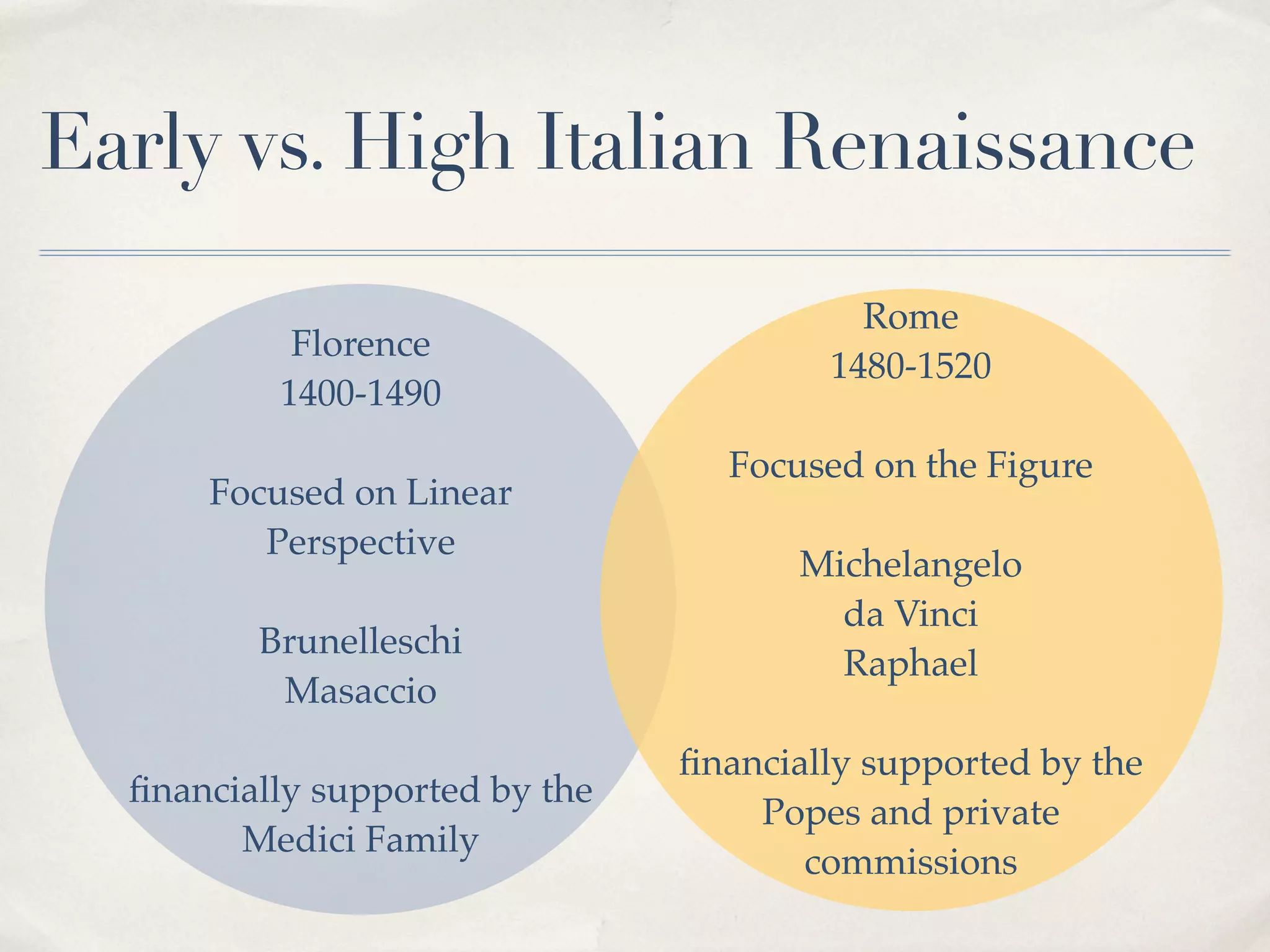
Early vs. High Italian Renaissance

                                          Rome
           Florence
                                        1480-1520
          1400-1490
                                  Focused on the Figure
      Focused on Linear
         Perspective
                                       Michelangelo
                                         da Vinci
         Brunelleschi
                                         Raphael
          Masaccio
                                financially supported by the
  financially supported by the
                                    Popes and private
        Medici Family
                                       commissions

The Italian High Renaissance

  • 1.
    The Italian HighRenaissance A Time of Renewal and Discovery
  • 2.
    Origins ✤ The High Renaissance began during the 1480’s, specifically with Leonardo da Vinci’s Last Supper. ✤ It occurred principally in Rome. ✤ The Popes in Rome spent copious amounts of money on commissioned works of art during this time.
  • 3.
    Historical and CulturalContext ✤ With the invention and use of the printing press, there was a greater spread of ideas, and artists could sell prints of their work. ✤ Travel also increased during the High Renaissance; therefore, art became more international. ✤ Christopher Columbus discovered the Americas in 1492, which challenged the classical world view and encouraged a new age of science and math. ✤ Changes were also reflected in literature, poetry, philosophy, science, architecture, and music.
  • 4.
    The Figure ✤ The High Renaissance explored classical forms of the figure. ✤ Several artists studied human anatomy in an effort to make more realistic paintings and sculptures of the human form.
  • 5.
    Masters of theHigh Renaissance ✤ Leonardo da Vinci ✤ Michelangelo ✤ Raphael
  • 6.
    Leonardo da Vinci ✤ 1452 – 1519 ✤ Born in Vinci, Italy. ✤ Was a painter, sculptor, architect, musician, scientist, mathematician, engineer, inventor, anatomist, geologist, cartographer, botanist and writer. ✤ His work dissecting human corpses and studying anatomy helped artists develop proper proportions and realism.
  • 7.
    San Giovenale Triptych(1422) Masaccio The Virgin and Child with St. Anne (1508-1517) da Vinci He also developed the technique of “sfumato”- the blurred outline and mellowed colors that allow one form to merge with another and always leave something to our imagination.
  • 8.
    Leonardo da Vinci’s VitruvianMan ✤ Also known as the Proportions of Man. ✤ Uses text and drawing to describe and show the ideal proportions for a human male. ✤ Excellent example of the blend of science and art. ✤ Combined the classical ideals of the human figure with da Vinci’s own observations.
  • 9.
    Leonardo da Vinci’s Mona ✤ 31” x 21” ✤ da Vinci’s most famous work of art. ✤ One of the first portraits to depict the subject in front of an imaginary background. ✤ For many years there was controversy regarding the subject of the painting, though in 2008 it was confirmed that it is Lisa Gherardini del Giocondo.
  • 10.
    Leonardo da Vinci’sThe Last Supper (1495-1498) ✤ 15 feet x 29 feet ✤ Inspired the book The Da Vinci Code. ✤ Controversial because some art historians believe it is Mary Magdalene, rather than the Apostle John, seated next to Jesus.
  • 11.
    Michelangelo ✤ 1475-1564. ✤ Believed God put the sculpture within the rock and that the artist must uncover it. ✤ Also believed good art comes from divine inspiration and beauty is a path to salvation. ✤ Preferred sculpting above all other forms of art. “Every block of stone has a statue inside it and it is the task of the sculptor to discover it.” - Michelangelo
  • 12.
    Michelangelo’s The Pieta (1498-1499) ✤ Made of marble and is 68.5 in × 76.8 in. ✤ Finished when Michelangelo was just 24 years old. ✤ Balances the Renaissance ideals of classical beauty and naturalism. ✤ When others attributed the sculpture to another artist, Michelangelo carved his name across Mary’s chest.
  • 13.
    Michelangelo’s The David (1501-1504) ✤ Made of marble that was abandoned by another sculptor, it stands 17 feet tall. ✤ Finished when Michelangelo was 29 years old. ✤ The statue’s hands and head are disproportionately large. Because the statue was originally intended to be installed on the roofline of a cathedral, it is most likely that Michelangelo did this intentionally, so these important details could be seen from below.
  • 14.
    Michelangelo’s Sistine Chapel (1508-1512) ✤ Commissioned by Pope Julius II ✤ The center represents 9 moments from the Bible’s Book of Genesis, surrounded by the 12 prophets who prophesied the coming of Jesus. ✤ Painted it standing atop scaffolding. It is a fresco.
  • 15.
    Masculinity in Renaissance Art ✤ Why are Michelangelo’s women painted so masculine? ✤ The models he used were male. ✤ The male figure was considered the ideal of beauty during the Renaissance.
  • 16.
    Raphael ✤ 1483-1520 ✤ Primarily a painter, but also an architect. ✤ Many of his commissions were from the Vatican, specifically Popes Julius II and Leo X.
  • 17.
    The School ofAthens (1510-1511) Raphael ✤ 17 x 25 foot fresco ✤ Depicts all of the great Greek philosophers - Plato and Aristotle are the two central figures. ✤ Represented the revival of classical philosophy during the Renaissance.
  • 18.
    Early vs. HighItalian Renaissance Rome Florence 1480-1520 1400-1490 Focused on the Figure Focused on Linear Perspective Michelangelo da Vinci Brunelleschi Raphael Masaccio financially supported by the financially supported by the Popes and private Medici Family commissions