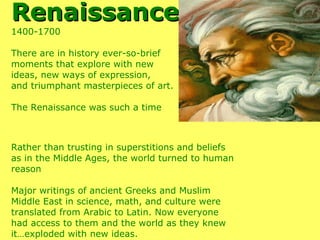


Renaissance   1400-1700 There are in history ever-so-brief  moments that explore with new  ideas, new ways of expression,  and triumphant masterpieces of art. The Renaissance was such a time Rather than trusting in superstitions and beliefs as in the Middle Ages, the world turned to human reason Major writings of ancient Greeks and Muslim Middle East in science, math, and culture were translated from Arabic to Latin. Now everyone had access to them and the world as they knew it…exploded with new ideas.
You might be asking… Where did the Renaissance occur? What does "renaissance" mean? When did the Renaissance occur? Who were the most influential people during the Renaissance? Who were the great artists, musicians and writers during the Renaissance? Why is the Renaissance important to us today? The Dawn of the  Renaissance
Italian Renaissance  An Era of Awakening Renaissance = Rebirth Philosophical and artistic mov’t Renew interest in Greek/Roman literature and life Need to bring this in harmony w/ Christian teachings New emphasis on power of human reason New emphasis on advances in science and arts
Why Italy?
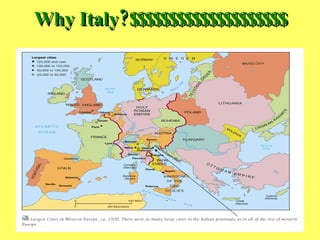
Why Italy? $$$$$$$$$$$$$$$$$$$$
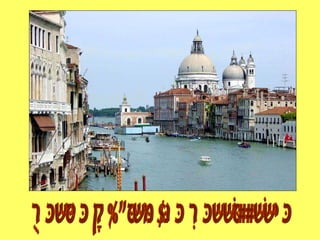
Venice, Italy   Venice full of wealthy, educated merchants
Venice During the Renaissance
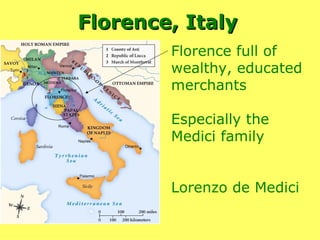
Florence, Italy   Florence full of wealthy, educated merchants Especially the Medici family Lorenzo de Medici
The Italian Renaissance  The Cause One guess… Trade with Byzantine Trade with southeast Asia Trade with Africa Science Technology Fabrics Weapons Trade = Money and Italy has it!
Renaissance Florence
Lorenzo  the Magnificent 1478 - 1521 Cosimo de Medici 1517 - 1574
Florence Under the Medici Medici Chapel The  Medici Palace
Filippo Brunelleschi Commissioned to build the cathedral dome. Used unique architectural concepts. He studied the ancient  Pantheon in Rome. Used ribs for support.
Brunelleschi’s  Dome
Dome Comparisons   Il Duomo   St. Peter’s  St. Paul’s  US capital  (Florence)  (Rome)  (London)  (Washington)
Renaissance Society
Renaissance Society The noble or aristocrat was expected to fulfill certain ideals.  The Italian Baldassare Castiglione expressed these in  The Book of the Courtier.   He described the characteristics of a perfect Renaissance noble.  Nobles were expected to have talent, character, and grace.  ttp:// www.storiain.net/arret/num60/borgi601.jpg
Baldassare Castiglione Castiglione represented the humanist “gentleman” as a man of refinement and self-control.
Art and Patronage Italians were willing to spend a lot of money on art. Art communicated social, political, and spiritual values. Italian banking & international trade interests had the money. Public art in Florence was organized and supported by guilds. Therefore, the consumption of art was used as  a form of competition for social & political status!
The Art  of the Italian Renaissance
Greek Art
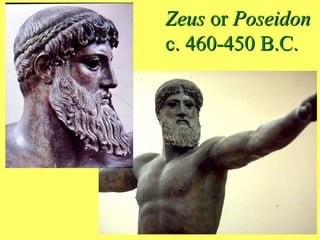
Zeus  or  Poseidon c. 460-450 B.C.
Three Goddesses  (Shestia, Dione, and Aphrodite) C. 438-432 B.C. Nike (Victory of Samothrace) c. 450 B.C.
Roman Art
Roman Senator and His Wife
Medieval Art
 
Can you see any perspective?
 
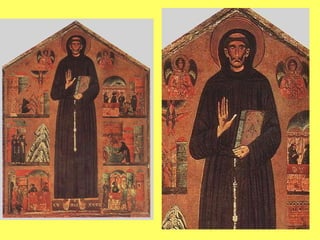
Medieval Art Characteristics Disproportionate and no perspective All faces the same, unrealistic 2 dimensional, flat, and dull Religious themes 180 degree relief statues Storytelling, either about religion or warfare Artists are craftsmen, works for guild
Giotto The Scrovegni Chapel, or Cappella degli Scrovegni, also known as the Arena Chapel is a church in Padua, Veneto, Italy.  It contains a fresco cycle by Giotto, completed about 1305, that is one of the most important masterpieces of Western art
Side by Side Renaissance  vs  Middle Ages
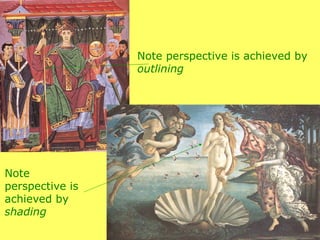
Note perspective is achieved by outlining Note perspective is achieved by shading
 
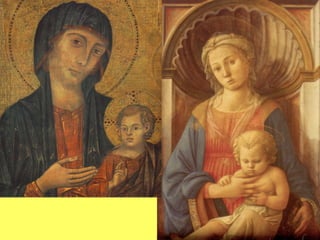
Madonna and Child  Fra Filippo Lippi, 1406-1469
Adoration of the Magi Sandro Botticelli
 
Dead Christ Andrea Mantegna, 1501
Characteristics of Renaissance Art
During the middle ages and before, pictures were painted on the wall and wood, usually with a mixture of color dye and egg yolk.  That all changed radically with the Renaissance.  Starting with Jan van Eyck (Netherlands) painters started to paint with slow drying,  oil-based paints .  These oil-based paints enabled the artist to slowly layer subtle different shades of hue and color to make very realistic skin tones.  The oil-based paints were also superior at refracting light, resulting in very bright colors.  Two well known Italian  painters quickly became champions of this new painting –  Leonardo da Vinci  and  Raphae l.  One of the first oil paintings by Leonardo da Vinci is the  Mona Lisa.  Within 100 years every major painter of the Renaissance was painting in oils. Note from the Future : until the invention of acrylics in the late 20th century, virtually every major artist in the world in the past 400 years after the Renaissance used oil as a major way of painting
5 Characteristics of Italian Renaissance Art
1. Realism & Expression Expulsion from the Garden Masaccio 1427 First nudes since classical times.
2. Perspective Perspective! Perspective! Perspective! Perspective! Perspective! First use  of linear  perspective! Perspective! Perspective! The Trinity Masaccio 1427 What you are, I once was; what I am, you will become.
3. Emphasis on Individualism Batista Sforza & Federico de Montefeltre:  The Duke & Dutchess of Urbino Piero della Francesca, 1465-1466.
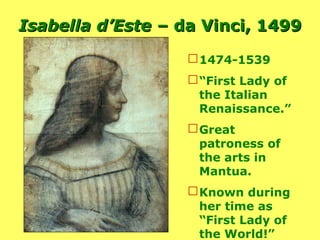
Isabella d’Este –  da Vinci,   1499 1474-1539 “ First Lady of the Italian Renaissance.” Great patroness of the arts in Mantua. Known during her time as “First Lady of the World!”
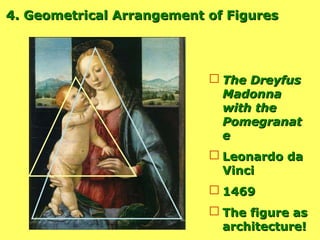
4. Geometrical Arrangement of Figures The Dreyfus Madonna  with the Pomegranate Leonardo da Vinci 1469 The figure as architecture!
5. Artists as Personalities/Celebrities Lives of the Most  Excellent Painters,  Sculptors, and Architects Giorgio Vasari 1550
The Renaissance 'Individual'
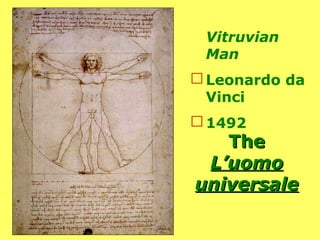
Vitruvian Man  Leonardo da Vinci 1492 The L’uomo universale
The Renaissance “Man” Broad knowledge about many things in different fields. Deep knowledge/skill in one area. Able to link information from different areas/disciplines and create new knowledge. The Greek ideal of the “well-rounded man” was at the heart of Renaissance education.
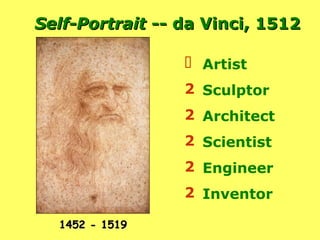
Self-Portrait  -- da Vinci, 1512 1452 - 1519 Artist Sculptor Architect Scientist Engineer Inventor
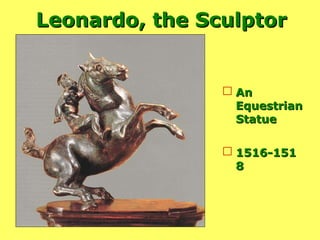
Leonardo, the Sculptor An Equestrian Statue 1516-1518
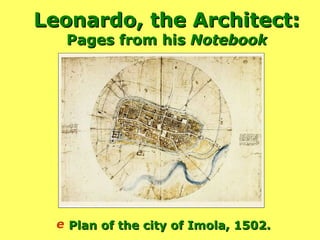
Leonardo, the Architect: Pages from his  Notebook Plan of the city of Imola, 1502.
Leonardo, the Scientist: Biology:  ( Pages from his  Notebook An example of the humanist desire to unlock the secrets of nature.
Leonardo, the Scientist (Anatomy):  Pages from his  Notebook
Leonardo, the Inventor:   Pages from his  Notebook
A study of siege defenses. Studies of water-lifting devices. Leonardo, the Engineer:  Pages from his  Notebook
Leonardo, the Artist: From his Notebooks of over  5000 pages (1508-1519)
Leonardo, the Artist The Virgin of the Rocks  Leonardo da Vinci 1483-1486
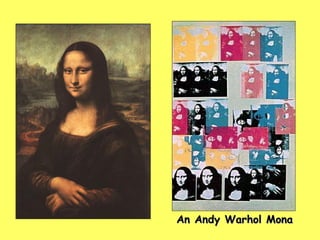
Mona Lisa  – da Vinci, 1503-4 ?
A Macaroni Mona
A Picasso Mona
An Andy Warhol Mona
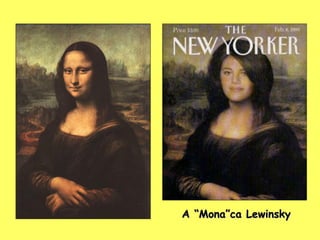
A “Mona”ca Lewinsky
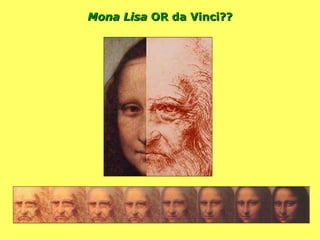
Mona Lisa  OR da Vinci??
Refractory Convent of Santa Maria delle Grazie Milan
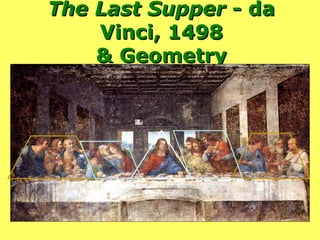
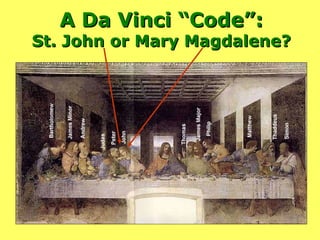
The Last Supper  - da Vinci, 1498 & Geometry
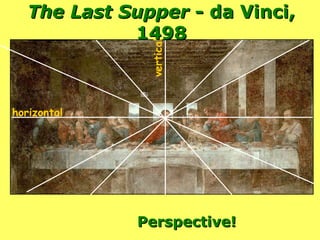
horizontal vertical Perspective! The Last Supper  - da Vinci, 1498
A Da Vinci “Code”: St. John or Mary Magdalene?
Ninja Turtles Raphael Sanzio Donatelo Michelango  Leonardo Da Vinci
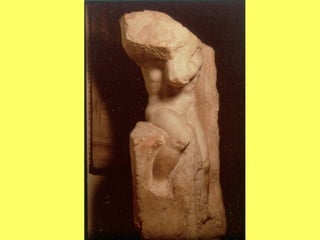
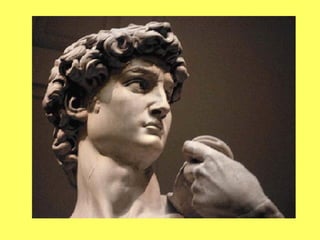
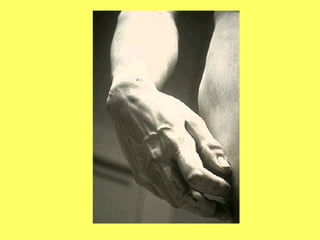
Michelangelo Patron: Medici Family
 
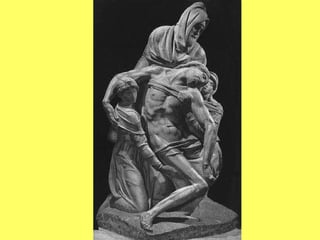
Pieta Michelangelo, 1498-99 Michelangelo was 24 years old when he completed the  Pieta
 
Michelangelo completed this in his 20s. Statue is given a place of honor outside Florence’s Palazzo  Vecchio, the seat of  the Medici gov’t


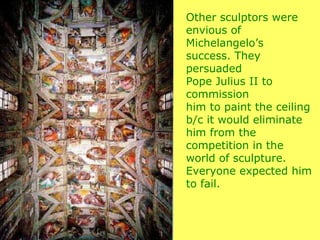
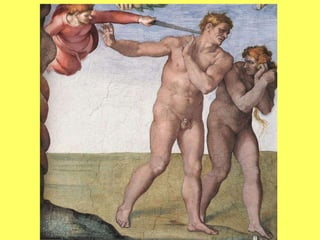
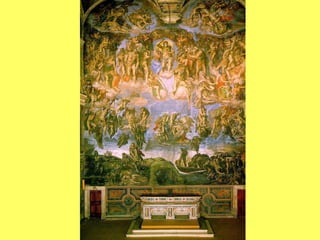
Other sculptors were envious of Michelangelo’s  success. They persuaded  Pope Julius II to commission him to paint the ceiling b/c it would eliminate him from the competition in the world of sculpture. Everyone expected him to fail.
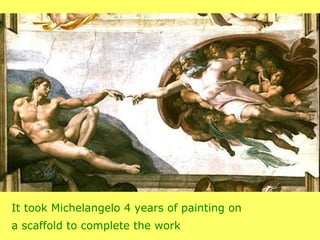
It took Michelangelo 4 years of painting on  a scaffold to complete the work .
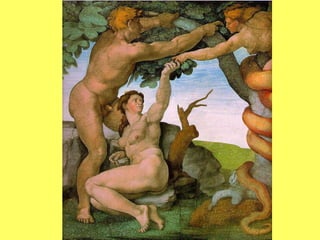
The Sistine Chapel  Details Creation of Man


Raphael
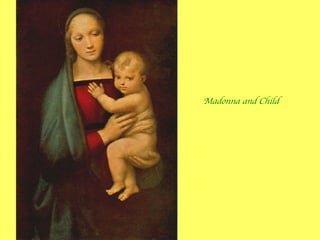
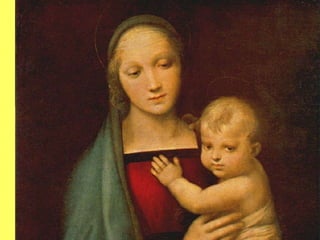
Madonna and Child
 
School of Athens , Raphael Raphael worked on this commission simultaneously as Michelangelo was doing the Sistine Chapel. No Christian themes here.
Aristotle : looks to this earth [the here and now]. Plato : looks to the heavens [or  the IDEAL realm]. The School of Athens  – Raphael,
Birth of Venus  – Botticelli, 1485 An attempt to depict perfect beauty.
The Humanists
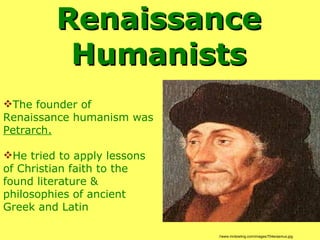
Renaissance Humanists //www.mrdowling.com/images/704erasmus.jpg The founder of Renaissance humanism was  Petrarch. He tried to apply lessons of Christian faith to the found literature & philosophies of ancient Greek and Latin
Renaissance Humanists //www.mrdowling.com/images/704erasmus.jpg A person who studied the classics was called a  humanist .  Humanists recreated classical styles in art, literature, and architecture.  Humanists believed that by studying the classics, they could understand people and the world better.
Education in the Renaissance  Renaissance  humanists  believed that education could dramatically change human beings. Humanists studied the Roman and Greek classics. Studied grammar, history, poetry, and rhetoric. Most humanists still strong Christians so sometimes felt tension b/w their studies and religion
Following the Greek ideal, humanist educators also stressed physical education, including dancing.  The goal of humanist education was  to create complete citizens.  Humanist schools provided the model for the basic education of the European ruling classes until the twentieth century. Education in the Renaissance
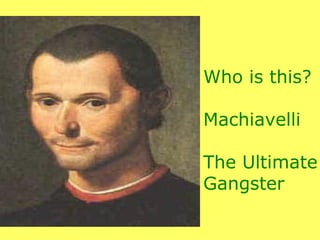
Who is this? Machiavelli The Ultimate Gangster
Machiavelli and the New Statecraft  The Prince  by  Niccolò Machiavelli  is one of the most influential works on political power in the western world.  It concerns how to get and keep political power.  Previously authors had stressed that princes should be ethical and follow Christian principles.  Machiavelli argued the prince’s attitude toward power should be based on understanding that human nature is self-interested. Machiavelli video (20 minutes)
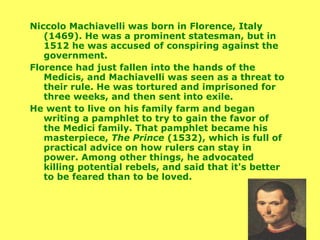
Niccolo Machiavelli was born in Florence, Italy (1469). He was a prominent statesman, but in 1512 he was accused of conspiring against the government.  Florence had just fallen into the hands of the Medicis, and Machiavelli was seen as a threat to their rule. He was tortured and imprisoned for three weeks, and then sent into exile.  He went to live on his family farm and began writing a pamphlet to try to gain the favor of the Medici family. That pamphlet became his masterpiece,  The Prince  (1532), which is full of practical advice on how rulers can stay in power. Among other things, he advocated killing potential rebels, and said that it's better to be feared than to be loved.
Machiavelli has never had a good reputation. Twentieth-century philosopher Bertrand Russell called  The Prince  "a handbook for gangsters."  Some people say Machiavelli was a big influence on dictators like Hitler and Stalin. Today, the word "Machiavellian" has come to mean "marked by cunning, duplicity or bad faith."
Machiavelli's main point in  The Prince  is that the most important task for a ruler is to keep his country secure and peaceful, using whatever means possible. Sometimes, this means doing things that most people would consider immoral, but Machiavelli said that that's just part of the job. He was cynical about human nature: he argued that it was natural for most people to be selfish, and so a great ruler has to accept that he lives in an immoral world.   He wrote, "A man who might want to make a show of goodness in all things necessarily comes to ruin among so many who are not good. Because of this it is necessary for a prince, wanting to maintain himself, to learn how to be able to be not good and to use this and not use it according to necessity."
He also argued that most people value their property more than the lives of their friends and family, and so in some situations it's okay for rulers to kill their citizens, but it's almost never okay to take away their property. He wrote, "Men must be either pampered or crushed, because they can get revenge for small injuries, but not for grievous ones. So any injury a prince does a man should be of a kind where there is no fear of revenge." Despite Machiavelli's hopes,  The Prince  didn't win over the Medici’s. A few years later, a new republic was established in Italy, but his name had already become so associated with evil and violence that he wasn't able to get another government job for the rest of his life. He wrote two more books, and died in 1527
Post Seminar Take the Dear Abbey prompt awarded to you Answer in a Machiavellian manner ALSO Speak to your parents. Ask them: “does the end justify the means” Write down their response and your comments.
The Northern Renaissance
Renaissance Art in Northern Europe Should not be considered an appendage to Italian art. But, Italian influence was strong. Painting in OIL, developed in Flanders, was widely adopted in Italy . The differences between the two cultures: Italy     change was inspired by humanism with its emphasis on the revival of the values of classical antiquity. No. Europe     change was driven by religious reform, the return to Christian values, and the revolt against the authority of the Church. More princes & kings were patrons of artists.
Characteristics of Northern Renaissance Art The continuation of late medieval attention to details. Tendency toward realism & naturalism [less emphasis on the “classical ideal”]. Interest in landscapes. More emphasis on middle-class and peasant life. Details of domestic interiors. Great skill in portraiture.
Flemish Realism
Begins in Flanders Moves from there to France, Germany, and Spain
Dutch Realism
 
Jan van Eyck (1395 – 1441) More courtly and aristocratic work. Court painter to the Duke of Burgundy, Philip the Good.  The Virgin and Chancellor Rolin , 1435.
Giovanni Arnolfini and His Wife (Wedding Portrait)   Jan Van Eyck 1434
http://www.ibiblio.org/wm/paint/auth/eyck/arnolfini/arnolfini.jpg The Marriage of Giovanni Arnolfini and Giovanna Cenami; 1434   In the mirror at the back of the room we see the whole scene reflected from behind, and there, so it seems, we also see the image of the painter and witness. We do not know whether it was the Italian merchant or the northern artist who conceived the idea of making this use of the new kind of painting, which may be compared to the legal use of a photograph, properly endorsed by a witness. But whoever it was that originated this idea, he had certainly been quick to understand the tremendous possibilities which lay in Van Eyck's new way of painting. For the first time in history the artist became the perfect eye-witness in the truest sense of the term.   Symbolic candle The solitary flame burning in bright daylight can be interpreted as the bridal candle, or God's all-seeing eye, or simply as a devotional candle. Another symbol is St Margaret (the patron saint of women in childbirth), whose image is carved on the high chairback.   The mirror is painted with almost miraculous skill. Its carved frame is inset with ten miniature medallions depicting scenes from the life of Christ. Yet more remarkable is the mirror's reflection, which includes van Eyck's own tiny self-portrait, accompanied by another man who may have been the official witness to the ceremony.  Symbol of faithfulness Almost every detail can be interpreted as a symbol. The companion dog is seen as a symbol of faithfulness and love. The fruits on the window ledge probably stand for fertility and our fall from Paradise. Even the discarded shoes are not thought to be incidental, but to signify the sanctity of marriage .
Jan van Eyck  - Giovanni Arnolfini & His Wife   (details)
van der Weyden’s  Deposition  (details)
Albrecht Dürer (1471-1528) The greatest of German artists. A scholar as well as an artist. His patron was the Emperor Maximilian I. Also a scientist Wrote books on geometry, fortifications, and human proportions. Self-conscious individualism of the Renaissance is seen in his portraits.    Self-Portrait at 26 , 1498.
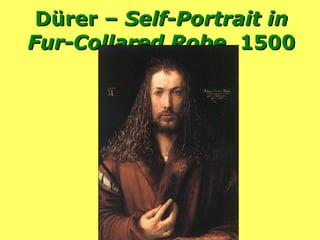
Dürer –  Self-Portrait in Fur-Collared Robe , 1500
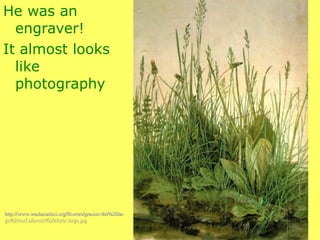
He was an engraver! It almost looks like photography http://www.washacadsci.org/flowers/grasses-the%20lar ge%20turf.albrecht%20durer.large.jpg
Dürer  Four Horsemen of the Apocalypse woodcut, 1498
He did this just from an oral description. He never saw a real Rhinoceros! http://www.washacadsci.org/flowers/grasses-the%20lar ge%20turf.albrecht%20durer.large.jpg
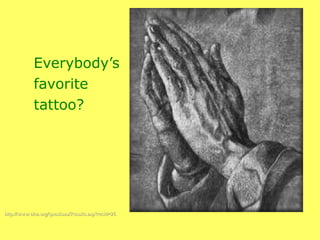
Everybody’s favorite tattoo? http://www.elca.org/questions/Results.asp?recid=26
England
Hans Holbein, the Younger (1497-1543) One of the great German artists who did most of his work in England. While in Basel, he befriended Erasmus. Erasmus Writing , 1523   Henry VIII was his patron from 1536. Great portraitist noted for: Objectivity & detachment. Doesn’t conceal the weaknesses of his subjects.
Artist to the Tudors Henry VIII (left), 1540 and the future Edward VI (above), 1543.
Multiple Perspectives
The English Were More Interested in Architecture than Painting Hardwick Hall, designed by Robert Smythson in the 1590s, for the Duchess of Shrewsbury [more medieval in style].
Burghley House for William Cecil The largest & grandest house  of the early Elizabethan era.
The Low Countries
Pieter Bruegel the Elder (1525-1569) One of the greatest artistic geniuses of his age. Worked in Antwerp and then moved to Brussels. In touch with a circle of Erasmian humanists. Was deeply concerned with human vice and follies. A master of landscapes; not a portraitist. People in his works often have round, blank, heavy faces. They are expressionless, mindless, and sometimes malicious. They are types, rather than individuals. Their purpose is to convey a message.
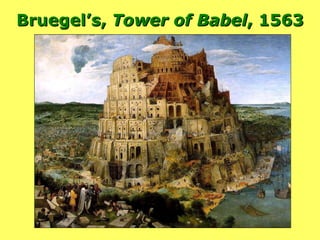
Bruegel’s,  Tower of Babel , 1563
Bruegel’s,  The Triumph of Death , 1562
New Ideas New Philosophical Ideas New Political Ideas New Ideas in Education
The best known Christian humanist  was  Desiderius Erasmus.   He developed what he called “the philosophy of Christ,”  meant to show people how to live good lives on a daily basis rather than how to achieve salvation.  He stressed inward piety, not external observance of rules and rituals.  Erasmus and Christian Humanism   http://www.artchive.com/artchive/h/holbein/erasmus.jpg
To reform the Church, Erasmus  wanted to spread the philosophy of Christ, educate people about Christianity, and  criticize the abuses of the Church .  In his 1509 work  The Praise of Folly,  he especially criticized the monks.  Erasmus did not want to break away from the Church, as later reformers would.  Yet people of his day said,  “Erasmus laid the egg that Luther hatched.”  What does this mean? Erasmus and Christian Humanism
Thomas More  wrote a famous  book called Utopia which was about an “ideal” society Thomas More famously opposed the king and was beheaded. What is it  With these British kings  And beheading! Author of  Utopia … how  ironic! Thomas More of England
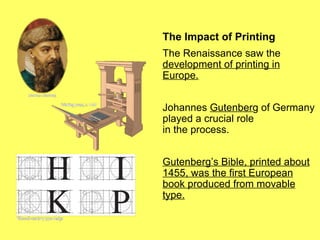
The Impact of Printing The Renaissance saw the  development of printing in Europe. Johannes  Gutenber g of Germany played a crucial role  in the process.  Gutenberg’s Bible, printed about 1455, was the first European book produced from movable type.
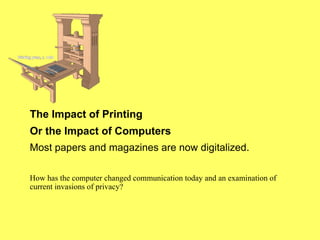
The Impact of Printing Or the Impact of Computers Most papers and magazines are now digitalized. How has the computer changed communication today and an examination of current invasions of privacy?
Objectives List three characteristics of the Renaissance Explain the three estates of Renaissance society. Explain Renaissance education. Describe artistic contributions of the Renaissance. Describe Christian humanism Describe Luther’s role in the Reformation Describe religious changes in Switzerland, in England, and within the Catholic Church.

Wh Renaissance For Posting

  • 1.
    Renaissance 1400-1700 There are in history ever-so-brief moments that explore with new ideas, new ways of expression, and triumphant masterpieces of art. The Renaissance was such a time Rather than trusting in superstitions and beliefs as in the Middle Ages, the world turned to human reason Major writings of ancient Greeks and Muslim Middle East in science, math, and culture were translated from Arabic to Latin. Now everyone had access to them and the world as they knew it…exploded with new ideas.
  • 2.
    You might beasking… Where did the Renaissance occur? What does "renaissance" mean? When did the Renaissance occur? Who were the most influential people during the Renaissance? Who were the great artists, musicians and writers during the Renaissance? Why is the Renaissance important to us today? The Dawn of the Renaissance
  • 3.
    Italian Renaissance An Era of Awakening Renaissance = Rebirth Philosophical and artistic mov’t Renew interest in Greek/Roman literature and life Need to bring this in harmony w/ Christian teachings New emphasis on power of human reason New emphasis on advances in science and arts
  • 4.
  • 5.
  • 6.
    Venice, Italy Venice full of wealthy, educated merchants
  • 7.
    Venice During theRenaissance
  • 8.
    Florence, Italy Florence full of wealthy, educated merchants Especially the Medici family Lorenzo de Medici
  • 9.
    The Italian Renaissance The Cause One guess… Trade with Byzantine Trade with southeast Asia Trade with Africa Science Technology Fabrics Weapons Trade = Money and Italy has it!
  • 10.
  • 11.
    Lorenzo theMagnificent 1478 - 1521 Cosimo de Medici 1517 - 1574
  • 12.
    Florence Under theMedici Medici Chapel The Medici Palace
  • 13.
    Filippo Brunelleschi Commissionedto build the cathedral dome. Used unique architectural concepts. He studied the ancient Pantheon in Rome. Used ribs for support.
  • 14.
  • 15.
    Dome Comparisons Il Duomo St. Peter’s St. Paul’s US capital (Florence) (Rome) (London) (Washington)
  • 16.
  • 17.
    Renaissance Society Thenoble or aristocrat was expected to fulfill certain ideals. The Italian Baldassare Castiglione expressed these in The Book of the Courtier. He described the characteristics of a perfect Renaissance noble. Nobles were expected to have talent, character, and grace. ttp:// www.storiain.net/arret/num60/borgi601.jpg
  • 18.
    Baldassare Castiglione Castiglionerepresented the humanist “gentleman” as a man of refinement and self-control.
  • 19.
    Art and PatronageItalians were willing to spend a lot of money on art. Art communicated social, political, and spiritual values. Italian banking & international trade interests had the money. Public art in Florence was organized and supported by guilds. Therefore, the consumption of art was used as a form of competition for social & political status!
  • 20.
    The Art of the Italian Renaissance
  • 21.
  • 22.
    Zeus or Poseidon c. 460-450 B.C.
  • 23.
    Three Goddesses (Shestia, Dione, and Aphrodite) C. 438-432 B.C. Nike (Victory of Samothrace) c. 450 B.C.
  • 24.
  • 25.
  • 26.
  • 27.
  • 28.
    Can you seeany perspective?
  • 29.
  • 30.
    Medieval Art CharacteristicsDisproportionate and no perspective All faces the same, unrealistic 2 dimensional, flat, and dull Religious themes 180 degree relief statues Storytelling, either about religion or warfare Artists are craftsmen, works for guild
  • 31.
    Giotto The ScrovegniChapel, or Cappella degli Scrovegni, also known as the Arena Chapel is a church in Padua, Veneto, Italy. It contains a fresco cycle by Giotto, completed about 1305, that is one of the most important masterpieces of Western art
  • 32.
    Side by SideRenaissance vs Middle Ages
  • 33.
    Note perspective isachieved by outlining Note perspective is achieved by shading
  • 34.
  • 35.
    Madonna and Child Fra Filippo Lippi, 1406-1469
  • 36.
    Adoration of theMagi Sandro Botticelli
  • 37.
  • 38.
    Dead Christ AndreaMantegna, 1501
  • 39.
  • 40.
    During the middleages and before, pictures were painted on the wall and wood, usually with a mixture of color dye and egg yolk. That all changed radically with the Renaissance. Starting with Jan van Eyck (Netherlands) painters started to paint with slow drying, oil-based paints . These oil-based paints enabled the artist to slowly layer subtle different shades of hue and color to make very realistic skin tones. The oil-based paints were also superior at refracting light, resulting in very bright colors. Two well known Italian painters quickly became champions of this new painting – Leonardo da Vinci and Raphae l. One of the first oil paintings by Leonardo da Vinci is the Mona Lisa. Within 100 years every major painter of the Renaissance was painting in oils. Note from the Future : until the invention of acrylics in the late 20th century, virtually every major artist in the world in the past 400 years after the Renaissance used oil as a major way of painting
  • 41.
    5 Characteristics ofItalian Renaissance Art
  • 42.
    1. Realism &Expression Expulsion from the Garden Masaccio 1427 First nudes since classical times.
  • 43.
    2. Perspective Perspective!Perspective! Perspective! Perspective! Perspective! First use of linear perspective! Perspective! Perspective! The Trinity Masaccio 1427 What you are, I once was; what I am, you will become.
  • 44.
    3. Emphasis onIndividualism Batista Sforza & Federico de Montefeltre: The Duke & Dutchess of Urbino Piero della Francesca, 1465-1466.
  • 45.
    Isabella d’Este – da Vinci, 1499 1474-1539 “ First Lady of the Italian Renaissance.” Great patroness of the arts in Mantua. Known during her time as “First Lady of the World!”
  • 46.
    4. Geometrical Arrangementof Figures The Dreyfus Madonna with the Pomegranate Leonardo da Vinci 1469 The figure as architecture!
  • 47.
    5. Artists asPersonalities/Celebrities Lives of the Most Excellent Painters, Sculptors, and Architects Giorgio Vasari 1550
  • 48.
  • 49.
    Vitruvian Man Leonardo da Vinci 1492 The L’uomo universale
  • 50.
    The Renaissance “Man”Broad knowledge about many things in different fields. Deep knowledge/skill in one area. Able to link information from different areas/disciplines and create new knowledge. The Greek ideal of the “well-rounded man” was at the heart of Renaissance education.
  • 51.
    Self-Portrait --da Vinci, 1512 1452 - 1519 Artist Sculptor Architect Scientist Engineer Inventor
  • 52.
    Leonardo, the SculptorAn Equestrian Statue 1516-1518
  • 53.
    Leonardo, the Architect:Pages from his Notebook Plan of the city of Imola, 1502.
  • 54.
    Leonardo, the Scientist:Biology: ( Pages from his Notebook An example of the humanist desire to unlock the secrets of nature.
  • 55.
    Leonardo, the Scientist(Anatomy): Pages from his Notebook
  • 56.
    Leonardo, the Inventor: Pages from his Notebook
  • 57.
    A study ofsiege defenses. Studies of water-lifting devices. Leonardo, the Engineer: Pages from his Notebook
  • 58.
    Leonardo, the Artist:From his Notebooks of over 5000 pages (1508-1519)
  • 59.
    Leonardo, the ArtistThe Virgin of the Rocks Leonardo da Vinci 1483-1486
  • 60.
    Mona Lisa – da Vinci, 1503-4 ?
  • 61.
  • 62.
  • 63.
  • 64.
  • 65.
    Mona Lisa OR da Vinci??
  • 66.
    Refractory Convent ofSanta Maria delle Grazie Milan
  • 67.
    The Last Supper - da Vinci, 1498 & Geometry
  • 68.
    horizontal vertical Perspective!The Last Supper - da Vinci, 1498
  • 69.
    A Da Vinci“Code”: St. John or Mary Magdalene?
  • 70.
    Ninja Turtles RaphaelSanzio Donatelo Michelango Leonardo Da Vinci
  • 71.
  • 72.
  • 73.
    Pieta Michelangelo, 1498-99Michelangelo was 24 years old when he completed the Pieta
  • 74.
  • 75.
    Michelangelo completed thisin his 20s. Statue is given a place of honor outside Florence’s Palazzo Vecchio, the seat of the Medici gov’t
  • 76.
  • 77.
  • 78.
  • 79.
    Other sculptors wereenvious of Michelangelo’s success. They persuaded Pope Julius II to commission him to paint the ceiling b/c it would eliminate him from the competition in the world of sculpture. Everyone expected him to fail.
  • 80.
    It took Michelangelo4 years of painting on a scaffold to complete the work .
  • 81.
    The Sistine Chapel Details Creation of Man
  • 82.
  • 83.
  • 84.
  • 85.
  • 86.
  • 87.
  • 88.
    School of Athens, Raphael Raphael worked on this commission simultaneously as Michelangelo was doing the Sistine Chapel. No Christian themes here.
  • 89.
    Aristotle : looksto this earth [the here and now]. Plato : looks to the heavens [or the IDEAL realm]. The School of Athens – Raphael,
  • 90.
    Birth of Venus – Botticelli, 1485 An attempt to depict perfect beauty.
  • 91.
  • 92.
    Renaissance Humanists //www.mrdowling.com/images/704erasmus.jpgThe founder of Renaissance humanism was Petrarch. He tried to apply lessons of Christian faith to the found literature & philosophies of ancient Greek and Latin
  • 93.
    Renaissance Humanists //www.mrdowling.com/images/704erasmus.jpgA person who studied the classics was called a humanist . Humanists recreated classical styles in art, literature, and architecture. Humanists believed that by studying the classics, they could understand people and the world better.
  • 94.
    Education in theRenaissance Renaissance humanists believed that education could dramatically change human beings. Humanists studied the Roman and Greek classics. Studied grammar, history, poetry, and rhetoric. Most humanists still strong Christians so sometimes felt tension b/w their studies and religion
  • 95.
    Following the Greekideal, humanist educators also stressed physical education, including dancing. The goal of humanist education was to create complete citizens. Humanist schools provided the model for the basic education of the European ruling classes until the twentieth century. Education in the Renaissance
  • 96.
    Who is this?Machiavelli The Ultimate Gangster
  • 97.
    Machiavelli and theNew Statecraft The Prince by Niccolò Machiavelli is one of the most influential works on political power in the western world. It concerns how to get and keep political power. Previously authors had stressed that princes should be ethical and follow Christian principles. Machiavelli argued the prince’s attitude toward power should be based on understanding that human nature is self-interested. Machiavelli video (20 minutes)
  • 98.
    Niccolo Machiavelli wasborn in Florence, Italy (1469). He was a prominent statesman, but in 1512 he was accused of conspiring against the government. Florence had just fallen into the hands of the Medicis, and Machiavelli was seen as a threat to their rule. He was tortured and imprisoned for three weeks, and then sent into exile. He went to live on his family farm and began writing a pamphlet to try to gain the favor of the Medici family. That pamphlet became his masterpiece, The Prince (1532), which is full of practical advice on how rulers can stay in power. Among other things, he advocated killing potential rebels, and said that it's better to be feared than to be loved.
  • 99.
    Machiavelli has neverhad a good reputation. Twentieth-century philosopher Bertrand Russell called The Prince "a handbook for gangsters." Some people say Machiavelli was a big influence on dictators like Hitler and Stalin. Today, the word "Machiavellian" has come to mean "marked by cunning, duplicity or bad faith."
  • 100.
    Machiavelli's main pointin The Prince is that the most important task for a ruler is to keep his country secure and peaceful, using whatever means possible. Sometimes, this means doing things that most people would consider immoral, but Machiavelli said that that's just part of the job. He was cynical about human nature: he argued that it was natural for most people to be selfish, and so a great ruler has to accept that he lives in an immoral world. He wrote, "A man who might want to make a show of goodness in all things necessarily comes to ruin among so many who are not good. Because of this it is necessary for a prince, wanting to maintain himself, to learn how to be able to be not good and to use this and not use it according to necessity."
  • 101.
    He also arguedthat most people value their property more than the lives of their friends and family, and so in some situations it's okay for rulers to kill their citizens, but it's almost never okay to take away their property. He wrote, "Men must be either pampered or crushed, because they can get revenge for small injuries, but not for grievous ones. So any injury a prince does a man should be of a kind where there is no fear of revenge." Despite Machiavelli's hopes, The Prince didn't win over the Medici’s. A few years later, a new republic was established in Italy, but his name had already become so associated with evil and violence that he wasn't able to get another government job for the rest of his life. He wrote two more books, and died in 1527
  • 102.
    Post Seminar Takethe Dear Abbey prompt awarded to you Answer in a Machiavellian manner ALSO Speak to your parents. Ask them: “does the end justify the means” Write down their response and your comments.
  • 103.
  • 104.
    Renaissance Art inNorthern Europe Should not be considered an appendage to Italian art. But, Italian influence was strong. Painting in OIL, developed in Flanders, was widely adopted in Italy . The differences between the two cultures: Italy  change was inspired by humanism with its emphasis on the revival of the values of classical antiquity. No. Europe  change was driven by religious reform, the return to Christian values, and the revolt against the authority of the Church. More princes & kings were patrons of artists.
  • 105.
    Characteristics of NorthernRenaissance Art The continuation of late medieval attention to details. Tendency toward realism & naturalism [less emphasis on the “classical ideal”]. Interest in landscapes. More emphasis on middle-class and peasant life. Details of domestic interiors. Great skill in portraiture.
  • 106.
  • 107.
    Begins in FlandersMoves from there to France, Germany, and Spain
  • 108.
  • 109.
  • 110.
    Jan van Eyck(1395 – 1441) More courtly and aristocratic work. Court painter to the Duke of Burgundy, Philip the Good.  The Virgin and Chancellor Rolin , 1435.
  • 111.
    Giovanni Arnolfini andHis Wife (Wedding Portrait) Jan Van Eyck 1434
  • 112.
    http://www.ibiblio.org/wm/paint/auth/eyck/arnolfini/arnolfini.jpg The Marriageof Giovanni Arnolfini and Giovanna Cenami; 1434 In the mirror at the back of the room we see the whole scene reflected from behind, and there, so it seems, we also see the image of the painter and witness. We do not know whether it was the Italian merchant or the northern artist who conceived the idea of making this use of the new kind of painting, which may be compared to the legal use of a photograph, properly endorsed by a witness. But whoever it was that originated this idea, he had certainly been quick to understand the tremendous possibilities which lay in Van Eyck's new way of painting. For the first time in history the artist became the perfect eye-witness in the truest sense of the term. Symbolic candle The solitary flame burning in bright daylight can be interpreted as the bridal candle, or God's all-seeing eye, or simply as a devotional candle. Another symbol is St Margaret (the patron saint of women in childbirth), whose image is carved on the high chairback. The mirror is painted with almost miraculous skill. Its carved frame is inset with ten miniature medallions depicting scenes from the life of Christ. Yet more remarkable is the mirror's reflection, which includes van Eyck's own tiny self-portrait, accompanied by another man who may have been the official witness to the ceremony. Symbol of faithfulness Almost every detail can be interpreted as a symbol. The companion dog is seen as a symbol of faithfulness and love. The fruits on the window ledge probably stand for fertility and our fall from Paradise. Even the discarded shoes are not thought to be incidental, but to signify the sanctity of marriage .
  • 113.
    Jan van Eyck - Giovanni Arnolfini & His Wife (details)
  • 114.
    van der Weyden’s Deposition (details)
  • 115.
    Albrecht Dürer (1471-1528)The greatest of German artists. A scholar as well as an artist. His patron was the Emperor Maximilian I. Also a scientist Wrote books on geometry, fortifications, and human proportions. Self-conscious individualism of the Renaissance is seen in his portraits.  Self-Portrait at 26 , 1498.
  • 116.
    Dürer – Self-Portrait in Fur-Collared Robe , 1500
  • 117.
    He was anengraver! It almost looks like photography http://www.washacadsci.org/flowers/grasses-the%20lar ge%20turf.albrecht%20durer.large.jpg
  • 118.
    Dürer FourHorsemen of the Apocalypse woodcut, 1498
  • 119.
    He did thisjust from an oral description. He never saw a real Rhinoceros! http://www.washacadsci.org/flowers/grasses-the%20lar ge%20turf.albrecht%20durer.large.jpg
  • 120.
    Everybody’s favorite tattoo?http://www.elca.org/questions/Results.asp?recid=26
  • 121.
  • 122.
    Hans Holbein, theYounger (1497-1543) One of the great German artists who did most of his work in England. While in Basel, he befriended Erasmus. Erasmus Writing , 1523  Henry VIII was his patron from 1536. Great portraitist noted for: Objectivity & detachment. Doesn’t conceal the weaknesses of his subjects.
  • 123.
    Artist to theTudors Henry VIII (left), 1540 and the future Edward VI (above), 1543.
  • 124.
  • 125.
    The English WereMore Interested in Architecture than Painting Hardwick Hall, designed by Robert Smythson in the 1590s, for the Duchess of Shrewsbury [more medieval in style].
  • 126.
    Burghley House forWilliam Cecil The largest & grandest house of the early Elizabethan era.
  • 127.
  • 128.
    Pieter Bruegel theElder (1525-1569) One of the greatest artistic geniuses of his age. Worked in Antwerp and then moved to Brussels. In touch with a circle of Erasmian humanists. Was deeply concerned with human vice and follies. A master of landscapes; not a portraitist. People in his works often have round, blank, heavy faces. They are expressionless, mindless, and sometimes malicious. They are types, rather than individuals. Their purpose is to convey a message.
  • 129.
    Bruegel’s, Towerof Babel , 1563
  • 130.
    Bruegel’s, TheTriumph of Death , 1562
  • 131.
    New Ideas NewPhilosophical Ideas New Political Ideas New Ideas in Education
  • 132.
    The best knownChristian humanist was Desiderius Erasmus. He developed what he called “the philosophy of Christ,” meant to show people how to live good lives on a daily basis rather than how to achieve salvation. He stressed inward piety, not external observance of rules and rituals. Erasmus and Christian Humanism http://www.artchive.com/artchive/h/holbein/erasmus.jpg
  • 133.
    To reform theChurch, Erasmus wanted to spread the philosophy of Christ, educate people about Christianity, and criticize the abuses of the Church . In his 1509 work The Praise of Folly, he especially criticized the monks. Erasmus did not want to break away from the Church, as later reformers would. Yet people of his day said, “Erasmus laid the egg that Luther hatched.” What does this mean? Erasmus and Christian Humanism
  • 134.
    Thomas More wrote a famous book called Utopia which was about an “ideal” society Thomas More famously opposed the king and was beheaded. What is it With these British kings And beheading! Author of Utopia … how ironic! Thomas More of England
  • 135.
    The Impact ofPrinting The Renaissance saw the development of printing in Europe. Johannes Gutenber g of Germany played a crucial role in the process. Gutenberg’s Bible, printed about 1455, was the first European book produced from movable type.
  • 136.
    The Impact ofPrinting Or the Impact of Computers Most papers and magazines are now digitalized. How has the computer changed communication today and an examination of current invasions of privacy?
  • 137.
    Objectives List threecharacteristics of the Renaissance Explain the three estates of Renaissance society. Explain Renaissance education. Describe artistic contributions of the Renaissance. Describe Christian humanism Describe Luther’s role in the Reformation Describe religious changes in Switzerland, in England, and within the Catholic Church.

Editor's Notes

  • #23 Zeus or Poseidan with Triton? Pulled from water Poised to through lightening bolt or triton Perfect proportions
  • #24 Both in British Muesem from Parthenon Bodies fluidly related to each other, related to draperies also Left Heskie, Diana, Aphrodite Right Nike, Goddess of Victory
  • #25 Lifelike detail Individual look Everyday subject
  • #26 Roman Senator and his wife
  • #28 Both relief scuptures from cathedrals No proportion or perspective Right shows the weighing of souls.
  • #29 No perspective, proportion
  • #30 St Francis of Assisi, 1235
  • #35 Comparison of Medieval and Renaissance styles, artists unknown Medieval: King Edward Renaissance: Queen Elizabeth
  • #36 Madonna and Child, Fra Filippo Lippi 1406-1469 Emotion of face -she looks like a real mother - tired, worn down
  • #37 Adoration of the Magi Sandro Botticelli Whole Medici family in picture Cosmo de Medici at Christ’s feet Lorenzo de Medici at far left Botticelli on far right looking at viewers
  • #39 Andrea Mantegna Dead Christ, 1501 Tempra on Canvas Foreshortening - slightly modified, feet smaller than would if photographs Harsh sharp lines
  • #72 Michelangelo Tormented, intractable, jealous of Raphael, dislike Leonardo, had continuous difficulties with patrons. “ inspired genious”
  • #73 Captive, Michelangelo Example of statue already in marble, he just has to release it Series of Captives line hall leading to the David.
  • #74 Pieta, Michelangelo, 1498-99 Mary cradling the dead body of Christ Beautiful faithful mary Polish and luminosity of marble cannot be capture by camera.
  • #76 David, Michelangelo 1501-1504
  • #77 Moment he sees Golith on the horizen
  • #79 Pieta II, Michelangelo
  • #89 Plato and Aristotle on either side of center axis Plato points skyward to indicate his idealistic worldview Aristotle gestures to ground to to show his concern with the real world Metaphysical philosophers on Plato’s side Physical scientists on Aristotle’s side Raphael on extreme right Figures grouped and placed on purpose
  • #97 ff