Michelangelo
 Buonarroti
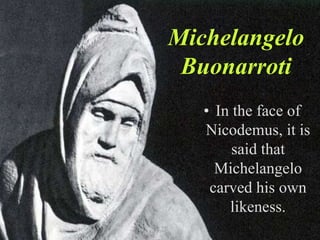
   • In the face of
   Nicodemus, it is
        said that
     Michelangelo
    carved his own
       likeness.
Pieta del Duomo
     • This Pieta was
       left unfinished by
       Michelangelo, as
       there was some
       problems with the
       stone.
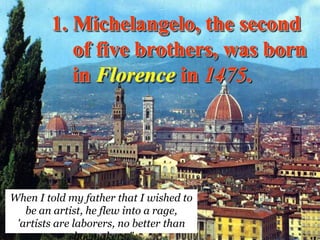
1. Michelangelo, the second
           of five brothers, was born
           in Florence in 1475.


When I told my father that I wished to
   be an artist, he flew into a rage,
 'artists are laborers, no better than
             shoemakers."
2. He created his first
  sculpture at age 5.
3. Became a painter’s
  apprentice at age 13.
When Michelangelo
  was 18, Lorenzo de
  Medici became his
  patron.
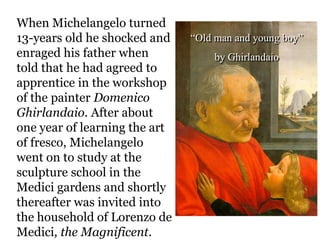
When Michelangelo turned
13-years old he shocked and    “Old man and young boy”
enraged his father when            by Ghirlandaio
told that he had agreed to
apprentice in the workshop
of the painter Domenico
Ghirlandaio. After about
one year of learning the art
of fresco, Michelangelo
went on to study at the
sculpture school in the
Medici gardens and shortly
thereafter was invited into
the household of Lorenzo de
Medici, the Magnificent.
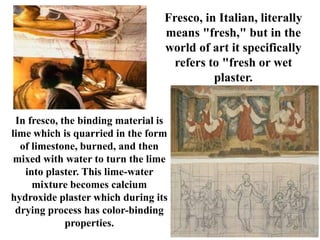
Fresco, in Italian, literally
                                  means "fresh," but in the
                                  world of art it specifically
                                    refers to "fresh or wet
                                            plaster.


 In fresco, the binding material is
lime which is quarried in the form
  of limestone, burned, and then
 mixed with water to turn the lime
   into plaster. This lime-water
     mixture becomes calcium
hydroxide plaster which during its
 drying process has color-binding
             properties.
4. Michelangelo
      thought of
    himself as a
  sculptor more
  than anything
           else.
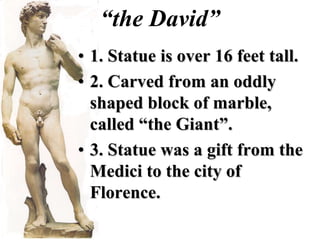
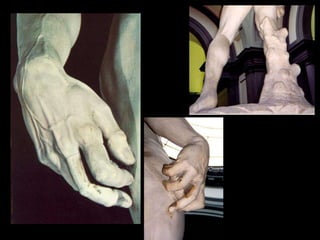
“the David”
• 1. Statue is over 16 feet tall.
• 2. Carved from an oddly
  shaped block of marble,
  called “the Giant”.
• 3. Statue was a gift from the
  Medici to the city of
  Florence.
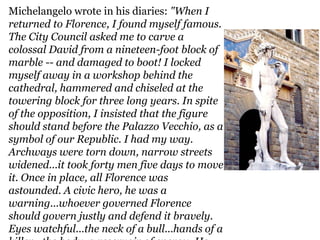
Michelangelo wrote in his diaries: "When I
returned to Florence, I found myself famous.
The City Council asked me to carve a
colossal David from a nineteen-foot block of
marble -- and damaged to boot! I locked
myself away in a workshop behind the
cathedral, hammered and chiseled at the
towering block for three long years. In spite
of the opposition, I insisted that the figure
should stand before the Palazzo Vecchio, as a
symbol of our Republic. I had my way.
Archways were torn down, narrow streets
widened...it took forty men five days to move
it. Once in place, all Florence was
astounded. A civic hero, he was a
warning...whoever governed Florence
should govern justly and defend it bravely.
Eyes watchful...the neck of a bull...hands of a
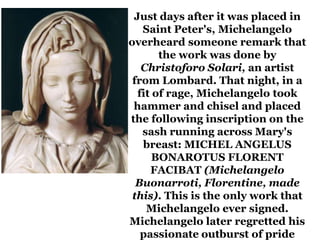
• 1. “The Pieta” - a
  statue of Mary and the
  body of Christ.
• 2. Located in Rome at
  St. Peter’s.
• 3. Carved at age 25.
Just days after it was placed in
   Saint Peter's, Michelangelo
overheard someone remark that
       the work was done by
   Christoforo Solari, an artist
 from Lombard. That night, in a
  fit of rage, Michelangelo took
 hammer and chisel and placed
the following inscription on the
   sash running across Mary's
   breast: MICHEL ANGELUS
      BONAROTUS FLORENT
     FACIBAT (Michelangelo
  Buonarroti, Florentine, made
 this). This is the only work that
    Michelangelo ever signed.
Michelangelo later regretted his
   passionate outburst of pride
• “the Pieta” is the
   only statue that
     Michelangelo
       ever signed.
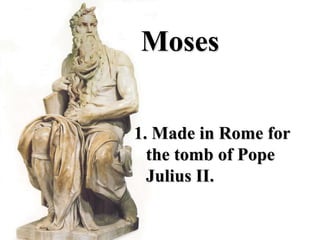
Moses


1. Made in Rome for
  the tomb of Pope
  Julius II.
Q: Why does Moses have
   horns on his head?
     A: Michelangelo's
    "Moses" has horns
because one of the biblical
  translations of "rays of
light" became "horns" in
  Italian. Because of this
mistranslation, depictions
    of Moses with horns
     became somewhat
       commonplace.
2. “Horns” represent
 the rays of light
 from God.
Sistine Chapel
"as a result of having painted for so long a
                time, keeping his eyes fixed on the ceiling, he
                saw little when he looked down; if he had to
                  read a letter or some other small thing, he
                    was obliged to hold it above his head."


 "After four tortured years, more than
400 over life-sized figures, I felt as old
and as weary as Jeremiah. I was only
37, yet friends did not recognize the old
           man I had become."
“The Last Judgement”
            • 1. Back wall of
              Sistine Chapel,
              took 6 years to
                        paint.
         • 2. 48 feet high, 48
               feet wide, with
                  200 figures.
• 3. Shows a powerful, beardless Christ.
              The Last Judgment, was the largest
              fresco of the Renaissance. Christ,
              with a clap of thunder, puts into
              motion the inevitable separation,
              with the saved ascending on the left
              side of the painting and the
              damned descending on the right
              into hell. As was his custom,
              Michelangelo portrayed all the
              figures nude, but prudish draperies
              were added by another artist (who
              was dubbed the "breeches-maker")
              a decade later, as the cultural
              climate became more conservative.
              Michelangelo painted his own
              image in the flayed skin of St.
              Bartholomew.
He is one of the greatest artists of all time, a
man whose name has become synonymous
with the word "masterpiece": Michelangelo
                 Buonarroti.
 Unlike many artists of his time, his genius
  was recognized, but at what cost to his
              personal life?

Michelangelo

  • 1.
    Michelangelo Buonarroti • In the face of Nicodemus, it is said that Michelangelo carved his own likeness.
  • 2.
    Pieta del Duomo • This Pieta was left unfinished by Michelangelo, as there was some problems with the stone.
  • 3.
    1. Michelangelo, thesecond of five brothers, was born in Florence in 1475. When I told my father that I wished to be an artist, he flew into a rage, 'artists are laborers, no better than shoemakers."
  • 4.
    2. He createdhis first sculpture at age 5. 3. Became a painter’s apprentice at age 13. When Michelangelo was 18, Lorenzo de Medici became his patron.
  • 5.
    When Michelangelo turned 13-yearsold he shocked and “Old man and young boy” enraged his father when by Ghirlandaio told that he had agreed to apprentice in the workshop of the painter Domenico Ghirlandaio. After about one year of learning the art of fresco, Michelangelo went on to study at the sculpture school in the Medici gardens and shortly thereafter was invited into the household of Lorenzo de Medici, the Magnificent.
  • 6.
    Fresco, in Italian,literally means "fresh," but in the world of art it specifically refers to "fresh or wet plaster. In fresco, the binding material is lime which is quarried in the form of limestone, burned, and then mixed with water to turn the lime into plaster. This lime-water mixture becomes calcium hydroxide plaster which during its drying process has color-binding properties.
  • 7.
    4. Michelangelo thought of himself as a sculptor more than anything else.
  • 8.
    “the David” • 1.Statue is over 16 feet tall. • 2. Carved from an oddly shaped block of marble, called “the Giant”. • 3. Statue was a gift from the Medici to the city of Florence.
  • 10.
    Michelangelo wrote inhis diaries: "When I returned to Florence, I found myself famous. The City Council asked me to carve a colossal David from a nineteen-foot block of marble -- and damaged to boot! I locked myself away in a workshop behind the cathedral, hammered and chiseled at the towering block for three long years. In spite of the opposition, I insisted that the figure should stand before the Palazzo Vecchio, as a symbol of our Republic. I had my way. Archways were torn down, narrow streets widened...it took forty men five days to move it. Once in place, all Florence was astounded. A civic hero, he was a warning...whoever governed Florence should govern justly and defend it bravely. Eyes watchful...the neck of a bull...hands of a
  • 11.
    • 1. “ThePieta” - a statue of Mary and the body of Christ. • 2. Located in Rome at St. Peter’s. • 3. Carved at age 25.
  • 12.
    Just days afterit was placed in Saint Peter's, Michelangelo overheard someone remark that the work was done by Christoforo Solari, an artist from Lombard. That night, in a fit of rage, Michelangelo took hammer and chisel and placed the following inscription on the sash running across Mary's breast: MICHEL ANGELUS BONAROTUS FLORENT FACIBAT (Michelangelo Buonarroti, Florentine, made this). This is the only work that Michelangelo ever signed. Michelangelo later regretted his passionate outburst of pride
  • 13.
    • “the Pieta”is the only statue that Michelangelo ever signed.
  • 14.
    Moses 1. Made inRome for the tomb of Pope Julius II.
  • 15.
    Q: Why doesMoses have horns on his head? A: Michelangelo's "Moses" has horns because one of the biblical translations of "rays of light" became "horns" in Italian. Because of this mistranslation, depictions of Moses with horns became somewhat commonplace.
  • 16.
    2. “Horns” represent the rays of light from God.
  • 17.
  • 19.
    "as a resultof having painted for so long a time, keeping his eyes fixed on the ceiling, he saw little when he looked down; if he had to read a letter or some other small thing, he was obliged to hold it above his head." "After four tortured years, more than 400 over life-sized figures, I felt as old and as weary as Jeremiah. I was only 37, yet friends did not recognize the old man I had become."
  • 20.
    “The Last Judgement” • 1. Back wall of Sistine Chapel, took 6 years to paint. • 2. 48 feet high, 48 feet wide, with 200 figures.
  • 21.
    • 3. Showsa powerful, beardless Christ. The Last Judgment, was the largest fresco of the Renaissance. Christ, with a clap of thunder, puts into motion the inevitable separation, with the saved ascending on the left side of the painting and the damned descending on the right into hell. As was his custom, Michelangelo portrayed all the figures nude, but prudish draperies were added by another artist (who was dubbed the "breeches-maker") a decade later, as the cultural climate became more conservative. Michelangelo painted his own image in the flayed skin of St. Bartholomew.
  • 22.
    He is oneof the greatest artists of all time, a man whose name has become synonymous with the word "masterpiece": Michelangelo Buonarroti. Unlike many artists of his time, his genius was recognized, but at what cost to his personal life?