High Renaissance in Italy

Michelangelo, Da Vinci, Raphael,
    and the Venetian School
Mannerism appears late century…
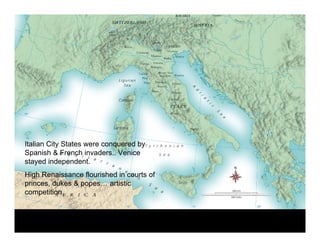
Italian City States were conquered by
Spanish & French invaders.. Venice
stayed independent.
High Renaissance flourished in courts of
princes, dukes & popes… artistic
competition
High Renaissance Italy….
        1495-1527 Big Ideas
• Pope Julius II revitalizes the city of Rome
• High Renaissance artists try to emulate Roman grandeur
  with enormous frescoes, statues, and amazing architecture
• Compositions marked by balance, symmetry, and ideal
  proportions.. Triangular layout is favored.
• Venetian painters take up oil with school of painting with
  sophisticated color harmonies
• Portraiture reveals likeness of subject PLUS their character
  and personality
High Renaissance Italy….
                Patronage
•   Pope Julius II is biggest patron.. Powerful force in Roman and
    European politics and religion.
•   Transformed Rome, a ramshackle medieval town, into an artistic
    center to rival Florence.
•   Women were also key patrons, such as Queen Isabella d’Este
•   St. Peter’s church in Rome is rebuilt, first by Bramante then by
    Michelangelo.
•   Medici still have influence; Michelangelo originally studied sculptures
    on one of their estates
•   Kings and Queens of Europe become patrons of artists such as Da
    Vinci and Titian.
High Renaissance Italy….
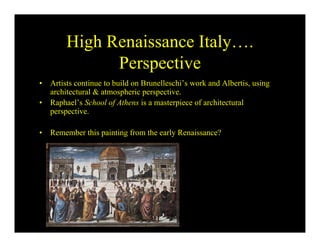
               Perspective
•   Artists continue to build on Brunelleschi’s work and Albertis, using
    architectural & atmospheric perspective.
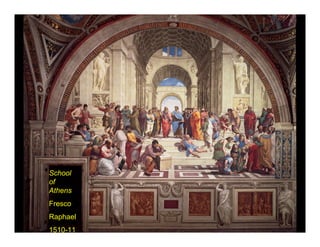
•   Raphael’s School of Athens is a masterpiece of architectural
    perspective.

•   Remember this painting from the early Renaissance?
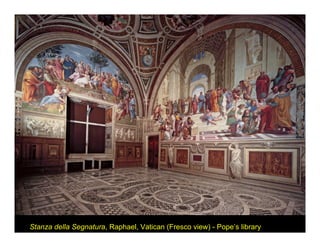
Stanza della Segnatura, Raphael, Vatican (Fresco view) - Pope’s library
School
of
Athens
Fresco
Raphael
1510-11
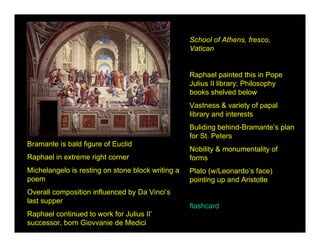
School of Athens, fresco,
                                                   Vatican


                                                   Raphael painted this in Pope
                                                   Julius II library; Philosophy
                                                   books shelved below
                                                   Vastness & variety of papal
                                                   library and interests
                                                   Buliding behind-Bramante’s plan
                                                   for St. Peters
Bramante is bald figure of Euclid
                                                   Nobility & monumentality of
Raphael in extreme right corner                    forms
Michelangelo is resting on stone block writing a   Plato (w/Leonardo’s face)
poem                                               pointing up and Aristotle
Overall composition influenced by Da Vinci’s
last supper
                                                   flashcard
Raphael continued to work for Julius II’
successor, born Giovvanie de Medici
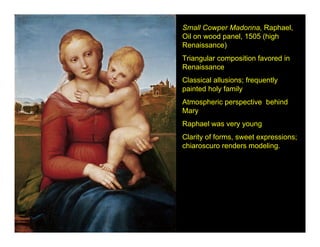
Small Cowper Madonna, Raphael,
Oil on wood panel, 1505 (high
Renaissance)
Triangular composition favored in
Renaissance
Classical allusions; frequently
painted holy family
Atmospheric perspective behind
Mary
Raphael was very young
Clarity of forms, sweet expressions;
chiaroscuro renders modeling.
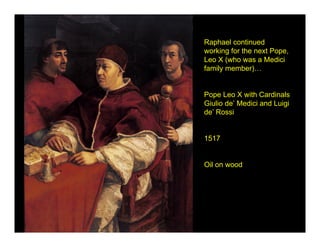
Raphael continued
working for the next Pope,
Leo X (who was a Medici
family member)…


Pope Leo X with Cardinals
Giulio de’ Medici and Luigi
de’ Rossi


1517


Oil on wood
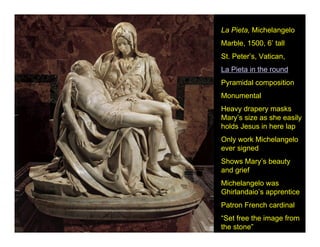
La Pieta, Michelangelo
Marble, 1500, 6’ tall
St. Peter’s, Vatican,
La Pieta in the round
Pyramidal composition
Monumental
Heavy drapery masks
Mary’s size as she easily
holds Jesus in here lap
Only work Michelangelo
ever signed
Shows Mary’s beauty
and grief
Michelangelo was
Ghirlandaio’s apprentice
Patron French cardinal
“Set free the image from
the stone”
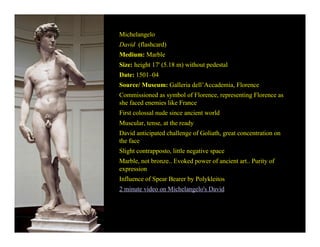
Michelangelo
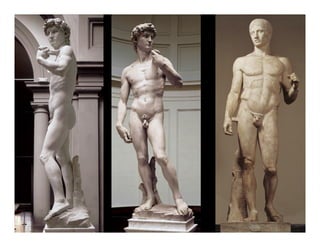
David (flashcard)
Medium: Marble
Size: height 17' (5.18 m) without pedestal
Date: 1501–04
Source/ Museum: Galleria dell’Accademia, Florence
Commissioned as symbol of Florence, representing Florence as
she faced enemies like France
First colossal nude since ancient world
Muscular, tense, at the ready
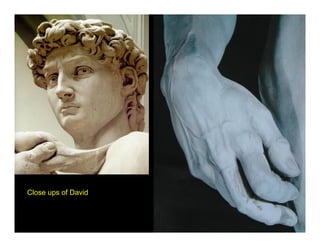
David anticipated challenge of Goliath, great concentration on
the face
Slight contrapposto, little negative space
Marble, not bronze.. Evoked power of ancient art.. Purity of
expression
Influence of Spear Bearer by Polykleitos
2 minute video on Michelangelo's David
Close ups of David
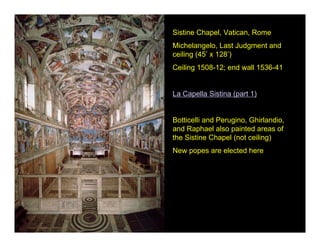
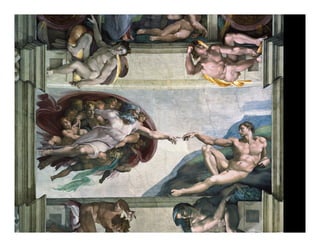
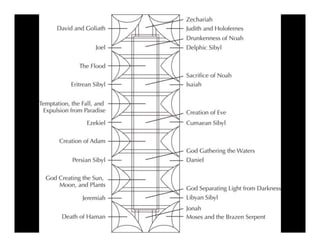
Sistine Chapel, Vatican, Rome
Michelangelo, Last Judgment and
ceiling (45’ x 128’)
Ceiling 1508-12; end wall 1536-41


La Capella Sistina (part 1)


Botticelli and Perugino, Ghirlandio,
and Raphael also painted areas of
the Sistine Chapel (not ceiling)
New popes are elected here
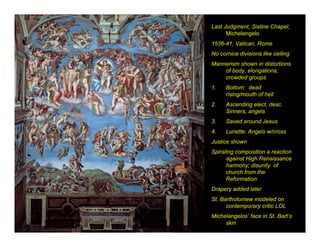
Last Judgment, Sistine Chapel,
      Michelangelo
1536-41, Vatican, Rome
No cornice divisions like ceiling
Mannerism shown in distortions
    of body, elongations,
    crowded groups
1.    Bottom: dead
      rising/mouth of hell
2.    Ascending elect, desc.
      Sinners, angels
3.    Saved around Jesus
4.    Lunette: Angels w/cross
Justice shown
Spiraling composition a reaction
      against High Renaissance
      harmony; disunity of
      church from the
      Reformation
Drapery added later
St. Bartholomew modeled on
      contemporary critic LOL
Michelangelos’ face in St. Bart’s
     skin
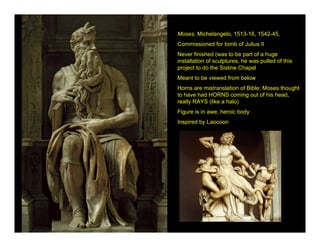
Moses, Michelangelo, 1513-16, 1542-45,
Commissioned for tomb of Julius II
Never finished (was to be part of a huge
installation of sculptures, he was pulled of this
project to do the Sistine Chapel
Meant to be viewed from below
Horns are mistranslation of Bible; Moses thought
to have had HORNS coming out of his head,
really RAYS (like a halo)
Figure is in awe, heroic body
Inspired by Laocoon
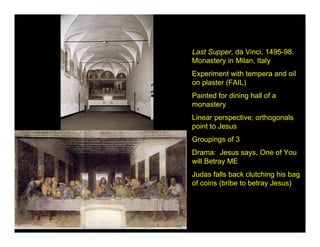
Last Supper, da Vinci, 1495-98,
Monastery in Milan, Italy
Experiment with tempera and oil
on plaster (FAIL)
Painted for dining hall of a
monastery
Linear perspective; orthogonals
point to Jesus
Groupings of 3
Drama: Jesus says, One of You
will Betray ME
Judas falls back clutching his bag
of coins (bribe to betray Jesus)
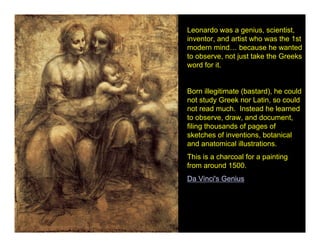
Leonardo was a genius, scientist,
inventor, and artist who was the 1st
modern mind… because he wanted
to observe, not just take the Greeks
word for it.


Born illegitimate (bastard), he could
not study Greek nor Latin, so could
not read much. Instead he learned
to observe, draw, and document,
filing thousands of pages of
sketches of inventions, botanical
and anatomical illustrations.
This is a charcoal for a painting
from around 1500.
Da Vinci's Genius
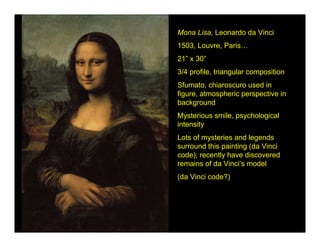
Mona Lisa, Leonardo da Vinci
1503, Louvre, Paris…
21” x 30”
3/4 profile, triangular composition
Sfumato, chiaroscuro used in
figure, atmospheric perspective in
background
Mysterious smile, psychological
intensity
Lots of mysteries and legends
surround this painting (da Vinci
code); recently have discovered
remains of da Vinci’s model
(da Vinci code?)
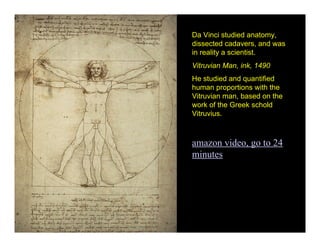
Da Vinci studied anatomy,
dissected cadavers, and was
in reality a scientist.
Vitruvian Man, ink, 1490
He studied and quantified
human proportions with the
Vitruvian man, based on the
work of the Greek schold
Vitruvius.


amazon video, go to 24
minutes
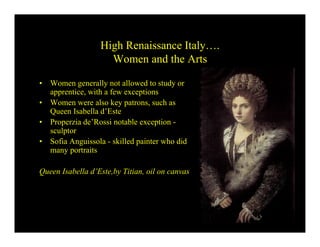
High Renaissance Italy….
                     Women and the Arts

•   Women generally not allowed to study or
    apprentice, with a few exceptions
•   Women were also key patrons, such as
    Queen Isabella d’Este
•   Properzia de’Rossi notable exception -
    sculptor
•   Sofia Anguissola - skilled painter who did
    many portraits

Queen Isabella d’Este,by Titian, oil on canvas
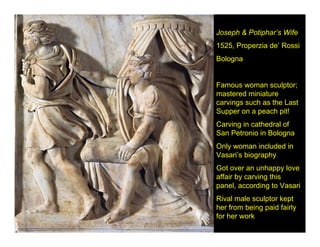
Joseph & Potiphar’s Wife
1525, Properzia de’ Rossi
Bologna


Famous woman sculptor;
mastered miniature
carvings such as the Last
Supper on a peach pit!
Carving in cathedral of
San Petronio in Bologna
Only woman included in
Vasari’s biography
Got over an unhappy love
affair by carving this
panel, according to Vasari
Rival male sculptor kept
her from being paid fairly
for her work
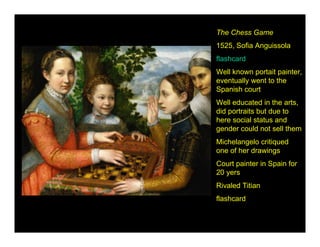
The Chess Game
1525, Sofia Anguissola
flashcard
Well known portait painter,
eventually went to the
Spanish court
Well educated in the arts,
did portraits but due to
here social status and
gender could not sell them
Michelangelo critiqued
one of her drawings
Court painter in Spain for
20 yers
Rivaled Titian
flashcard
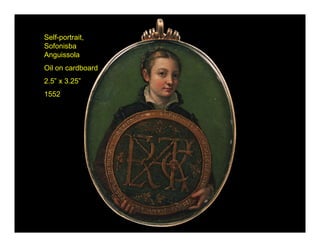
Self-portrait,
Sofonisba
Anguissola
Oil on cardboard
2.5” x 3.25”
1552
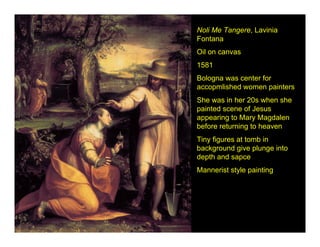
Noli Me Tangere, Lavinia
Fontana
Oil on canvas
1581
Bologna was center for
accopmlished women painters
She was in her 20s when she
painted scene of Jesus
appearing to Mary Magdalen
before returning to heaven
Tiny figures at tomb in
background give plunge into
depth and sapce
Mannerist style painting
Venice & the Venetto
• Venice was major naval power
• Rich light, pattern, and color inspired by
  Byzantium
• Oil painting universally preferred on both
  wood and canvas
• Giorgione & Titian early; later Veronese
  and Tintoretto
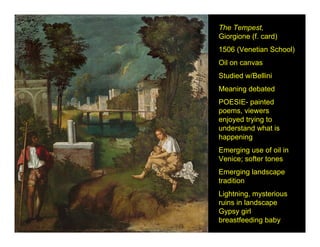
The Tempest,
Giorgione (f. card)
1506 (Venetian School)
Oil on canvas
Studied w/Bellini
Meaning debated
POESIE- painted
poems, viewers
enjoyed trying to
understand what is
happening
Emerging use of oil in
Venice; softer tones
Emerging landscape
tradition
Lightning, mysterious
ruins in landscape
Gypsy girl
breastfeeding baby
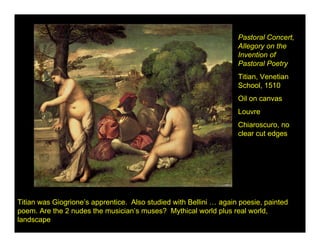
Pastoral Concert,
                                                                    Allegory on the
                                                                    Invention of
                                                                    Pastoral Poetry
                                                                    Titian, Venetian
                                                                    School, 1510
                                                                    Oil on canvas
                                                                    Louvre
                                                                    Chiaroscuro, no
                                                                    clear cut edges


Titian was Giogrione’s apprentice. Also studied with Bellini … again poesie, painted
poem. Are the 2 nudes the musician’s muses? Mythical world plus real world,
landscape
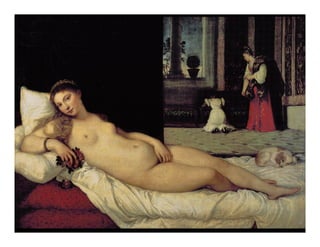
Venus of Urbino, Titian, oil on canvas, 1538.
Sensuous painting, skin tones, probably a courtesan, looks directly at viewer, deep
space in picture, flora motif. Dog = faithful, standard for future reclining female nudes
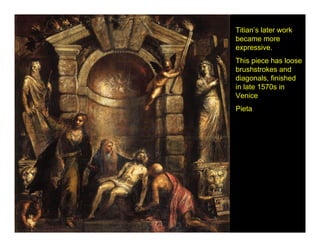
Titian’s later work
became more
expressive.
This piece has loose
brushstrokes and
diagonals, finished
in late 1570s in
Venice
Pieta
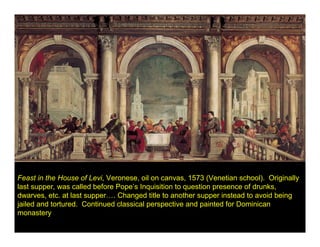
Feast in the House of Levi, Veronese, oil on canvas, 1573 (Venetian school). Originally
last supper, was called before Pope’s Inquisition to question presence of drunks,
dwarves, etc. at last supper…. Changed title to another supper instead to avoid being
jailed and tortured. Continued classical perspective and painted for Dominican
monastery
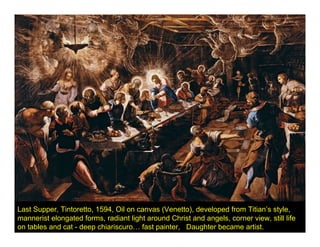
Last Supper, Tintoretto, 1594, Oil on canvas (Venetto), developed from Titian’s style,
mannerist elongated forms, radiant light around Christ and angels, corner view, still life
on tables and cat - deep chiariscuro… fast painter, Daughter became artist.
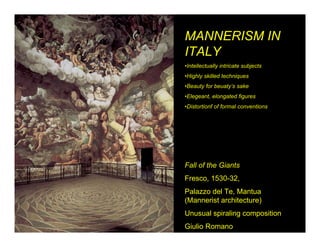
MANNERISM IN
ITALY
•Intellectually intricate subjects
•Highly skilled techniques
•Beauty for beuaty’s sake
•Elegeant, elongated figures
•Distortionf of formal conventions


Fall of the Giants
Fresco, 1530-32,
Palazzo del Te, Mantua
(Mannerist architecture)
Unusual spiraling composition
Giulio Romano
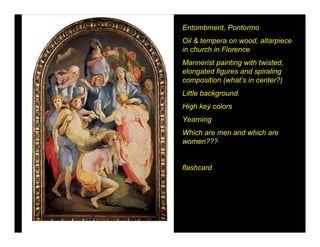
Entombment, Pontormo
Oil & tempera on wood, altarpiece
in church in Florence
Mannerist painting with twisted,
elongated figures and spiraling
composition (what’s in center?)
Little background.
High key colors
Yearning
Which are men and which are
women???


flashcard
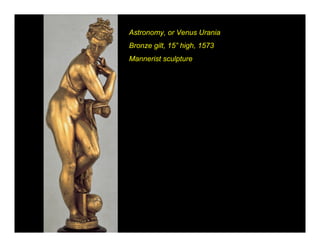
Astronomy, or Venus Urania
Bronze gilt, 15” high, 1573
Mannerist sculpture
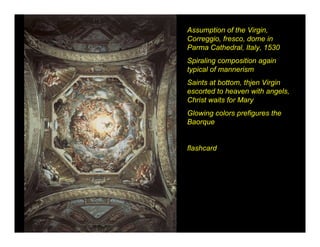
Assumption of the Virgin,
Correggio, fresco, dome in
Parma Cathedral, Italy, 1530
Spiraling composition again
typical of mannerism
Saints at bottom, thjen Virgin
escorted to heaven with angels,
Christ waits for Mary
Glowing colors prefigures the
Baorque


flashcard
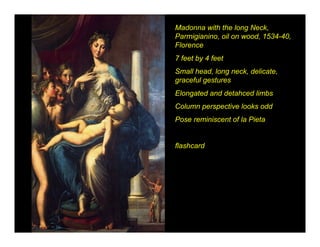
Madonna with the long Neck,
Parmigianino, oil on wood, 1534-40,
Florence
7 feet by 4 feet
Small head, long neck, delicate,
graceful gestures
Elongated and detahced limbs
Column perspective looks odd
Pose reminiscent of la Pieta


flashcard
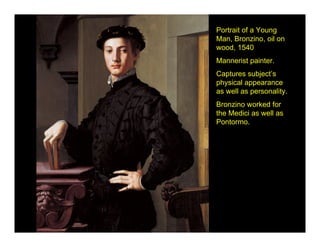
Portrait of a Young
Man, Bronzino, oil on
wood, 1540
Mannerist painter.
Captures subject’s
physical appearance
as well as personality.
Bronzino worked for
the Medici as well as
Pontormo.

High renaissance italy

  • 1.
    High Renaissance inItaly Michelangelo, Da Vinci, Raphael, and the Venetian School Mannerism appears late century…
  • 2.
    Italian City Stateswere conquered by Spanish & French invaders.. Venice stayed independent. High Renaissance flourished in courts of princes, dukes & popes… artistic competition
  • 3.
    High Renaissance Italy…. 1495-1527 Big Ideas • Pope Julius II revitalizes the city of Rome • High Renaissance artists try to emulate Roman grandeur with enormous frescoes, statues, and amazing architecture • Compositions marked by balance, symmetry, and ideal proportions.. Triangular layout is favored. • Venetian painters take up oil with school of painting with sophisticated color harmonies • Portraiture reveals likeness of subject PLUS their character and personality
  • 4.
    High Renaissance Italy…. Patronage • Pope Julius II is biggest patron.. Powerful force in Roman and European politics and religion. • Transformed Rome, a ramshackle medieval town, into an artistic center to rival Florence. • Women were also key patrons, such as Queen Isabella d’Este • St. Peter’s church in Rome is rebuilt, first by Bramante then by Michelangelo. • Medici still have influence; Michelangelo originally studied sculptures on one of their estates • Kings and Queens of Europe become patrons of artists such as Da Vinci and Titian.
  • 5.
    High Renaissance Italy…. Perspective • Artists continue to build on Brunelleschi’s work and Albertis, using architectural & atmospheric perspective. • Raphael’s School of Athens is a masterpiece of architectural perspective. • Remember this painting from the early Renaissance?
  • 6.
    Stanza della Segnatura,Raphael, Vatican (Fresco view) - Pope’s library
  • 7.
  • 8.
    School of Athens,fresco, Vatican Raphael painted this in Pope Julius II library; Philosophy books shelved below Vastness & variety of papal library and interests Buliding behind-Bramante’s plan for St. Peters Bramante is bald figure of Euclid Nobility & monumentality of Raphael in extreme right corner forms Michelangelo is resting on stone block writing a Plato (w/Leonardo’s face) poem pointing up and Aristotle Overall composition influenced by Da Vinci’s last supper flashcard Raphael continued to work for Julius II’ successor, born Giovvanie de Medici
  • 9.
    Small Cowper Madonna,Raphael, Oil on wood panel, 1505 (high Renaissance) Triangular composition favored in Renaissance Classical allusions; frequently painted holy family Atmospheric perspective behind Mary Raphael was very young Clarity of forms, sweet expressions; chiaroscuro renders modeling.
  • 10.
    Raphael continued working forthe next Pope, Leo X (who was a Medici family member)… Pope Leo X with Cardinals Giulio de’ Medici and Luigi de’ Rossi 1517 Oil on wood
  • 11.
    La Pieta, Michelangelo Marble,1500, 6’ tall St. Peter’s, Vatican, La Pieta in the round Pyramidal composition Monumental Heavy drapery masks Mary’s size as she easily holds Jesus in here lap Only work Michelangelo ever signed Shows Mary’s beauty and grief Michelangelo was Ghirlandaio’s apprentice Patron French cardinal “Set free the image from the stone”
  • 12.
    Michelangelo David (flashcard) Medium: Marble Size:height 17' (5.18 m) without pedestal Date: 1501–04 Source/ Museum: Galleria dell’Accademia, Florence Commissioned as symbol of Florence, representing Florence as she faced enemies like France First colossal nude since ancient world Muscular, tense, at the ready David anticipated challenge of Goliath, great concentration on the face Slight contrapposto, little negative space Marble, not bronze.. Evoked power of ancient art.. Purity of expression Influence of Spear Bearer by Polykleitos 2 minute video on Michelangelo's David
  • 14.
  • 15.
    Sistine Chapel, Vatican,Rome Michelangelo, Last Judgment and ceiling (45’ x 128’) Ceiling 1508-12; end wall 1536-41 La Capella Sistina (part 1) Botticelli and Perugino, Ghirlandio, and Raphael also painted areas of the Sistine Chapel (not ceiling) New popes are elected here
  • 18.
    Last Judgment, SistineChapel, Michelangelo 1536-41, Vatican, Rome No cornice divisions like ceiling Mannerism shown in distortions of body, elongations, crowded groups 1. Bottom: dead rising/mouth of hell 2. Ascending elect, desc. Sinners, angels 3. Saved around Jesus 4. Lunette: Angels w/cross Justice shown Spiraling composition a reaction against High Renaissance harmony; disunity of church from the Reformation Drapery added later St. Bartholomew modeled on contemporary critic LOL Michelangelos’ face in St. Bart’s skin
  • 19.
    Moses, Michelangelo, 1513-16,1542-45, Commissioned for tomb of Julius II Never finished (was to be part of a huge installation of sculptures, he was pulled of this project to do the Sistine Chapel Meant to be viewed from below Horns are mistranslation of Bible; Moses thought to have had HORNS coming out of his head, really RAYS (like a halo) Figure is in awe, heroic body Inspired by Laocoon
  • 20.
    Last Supper, daVinci, 1495-98, Monastery in Milan, Italy Experiment with tempera and oil on plaster (FAIL) Painted for dining hall of a monastery Linear perspective; orthogonals point to Jesus Groupings of 3 Drama: Jesus says, One of You will Betray ME Judas falls back clutching his bag of coins (bribe to betray Jesus)
  • 21.
    Leonardo was agenius, scientist, inventor, and artist who was the 1st modern mind… because he wanted to observe, not just take the Greeks word for it. Born illegitimate (bastard), he could not study Greek nor Latin, so could not read much. Instead he learned to observe, draw, and document, filing thousands of pages of sketches of inventions, botanical and anatomical illustrations. This is a charcoal for a painting from around 1500. Da Vinci's Genius
  • 22.
    Mona Lisa, Leonardoda Vinci 1503, Louvre, Paris… 21” x 30” 3/4 profile, triangular composition Sfumato, chiaroscuro used in figure, atmospheric perspective in background Mysterious smile, psychological intensity Lots of mysteries and legends surround this painting (da Vinci code); recently have discovered remains of da Vinci’s model (da Vinci code?)
  • 23.
    Da Vinci studiedanatomy, dissected cadavers, and was in reality a scientist. Vitruvian Man, ink, 1490 He studied and quantified human proportions with the Vitruvian man, based on the work of the Greek schold Vitruvius. amazon video, go to 24 minutes
  • 24.
    High Renaissance Italy…. Women and the Arts • Women generally not allowed to study or apprentice, with a few exceptions • Women were also key patrons, such as Queen Isabella d’Este • Properzia de’Rossi notable exception - sculptor • Sofia Anguissola - skilled painter who did many portraits Queen Isabella d’Este,by Titian, oil on canvas
  • 25.
    Joseph & Potiphar’sWife 1525, Properzia de’ Rossi Bologna Famous woman sculptor; mastered miniature carvings such as the Last Supper on a peach pit! Carving in cathedral of San Petronio in Bologna Only woman included in Vasari’s biography Got over an unhappy love affair by carving this panel, according to Vasari Rival male sculptor kept her from being paid fairly for her work
  • 26.
    The Chess Game 1525,Sofia Anguissola flashcard Well known portait painter, eventually went to the Spanish court Well educated in the arts, did portraits but due to here social status and gender could not sell them Michelangelo critiqued one of her drawings Court painter in Spain for 20 yers Rivaled Titian flashcard
  • 27.
  • 28.
    Noli Me Tangere,Lavinia Fontana Oil on canvas 1581 Bologna was center for accopmlished women painters She was in her 20s when she painted scene of Jesus appearing to Mary Magdalen before returning to heaven Tiny figures at tomb in background give plunge into depth and sapce Mannerist style painting
  • 29.
    Venice & theVenetto • Venice was major naval power • Rich light, pattern, and color inspired by Byzantium • Oil painting universally preferred on both wood and canvas • Giorgione & Titian early; later Veronese and Tintoretto
  • 30.
    The Tempest, Giorgione (f.card) 1506 (Venetian School) Oil on canvas Studied w/Bellini Meaning debated POESIE- painted poems, viewers enjoyed trying to understand what is happening Emerging use of oil in Venice; softer tones Emerging landscape tradition Lightning, mysterious ruins in landscape Gypsy girl breastfeeding baby
  • 31.
    Pastoral Concert, Allegory on the Invention of Pastoral Poetry Titian, Venetian School, 1510 Oil on canvas Louvre Chiaroscuro, no clear cut edges Titian was Giogrione’s apprentice. Also studied with Bellini … again poesie, painted poem. Are the 2 nudes the musician’s muses? Mythical world plus real world, landscape
  • 33.
    Venus of Urbino,Titian, oil on canvas, 1538. Sensuous painting, skin tones, probably a courtesan, looks directly at viewer, deep space in picture, flora motif. Dog = faithful, standard for future reclining female nudes
  • 34.
    Titian’s later work becamemore expressive. This piece has loose brushstrokes and diagonals, finished in late 1570s in Venice Pieta
  • 35.
    Feast in theHouse of Levi, Veronese, oil on canvas, 1573 (Venetian school). Originally last supper, was called before Pope’s Inquisition to question presence of drunks, dwarves, etc. at last supper…. Changed title to another supper instead to avoid being jailed and tortured. Continued classical perspective and painted for Dominican monastery
  • 36.
    Last Supper, Tintoretto,1594, Oil on canvas (Venetto), developed from Titian’s style, mannerist elongated forms, radiant light around Christ and angels, corner view, still life on tables and cat - deep chiariscuro… fast painter, Daughter became artist.
  • 37.
    MANNERISM IN ITALY •Intellectually intricatesubjects •Highly skilled techniques •Beauty for beuaty’s sake •Elegeant, elongated figures •Distortionf of formal conventions Fall of the Giants Fresco, 1530-32, Palazzo del Te, Mantua (Mannerist architecture) Unusual spiraling composition Giulio Romano
  • 38.
    Entombment, Pontormo Oil &tempera on wood, altarpiece in church in Florence Mannerist painting with twisted, elongated figures and spiraling composition (what’s in center?) Little background. High key colors Yearning Which are men and which are women??? flashcard
  • 39.
    Astronomy, or VenusUrania Bronze gilt, 15” high, 1573 Mannerist sculpture
  • 40.
    Assumption of theVirgin, Correggio, fresco, dome in Parma Cathedral, Italy, 1530 Spiraling composition again typical of mannerism Saints at bottom, thjen Virgin escorted to heaven with angels, Christ waits for Mary Glowing colors prefigures the Baorque flashcard
  • 41.
    Madonna with thelong Neck, Parmigianino, oil on wood, 1534-40, Florence 7 feet by 4 feet Small head, long neck, delicate, graceful gestures Elongated and detahced limbs Column perspective looks odd Pose reminiscent of la Pieta flashcard
  • 42.
    Portrait of aYoung Man, Bronzino, oil on wood, 1540 Mannerist painter. Captures subject’s physical appearance as well as personality. Bronzino worked for the Medici as well as Pontormo.