The Renaissance
2
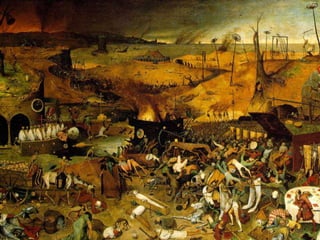
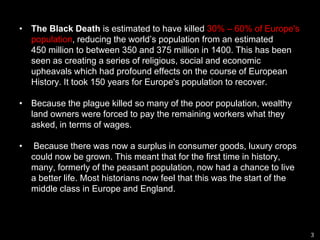
The Black Death is estimated to have killed 30% – 60% of Europe's population, reducing the world’s population from an estimated 450 million to between 350 and 375 million in 1400. This has been seen as creating a series of religious, social and economic upheavals which had profound effects on the course of European History. It took 150 years for Europe's population to recover. Because the plague killed so many of the poor population, wealthy land owners were forced to pay the remaining workers what they asked, in terms of wages. Because there was now a surplus in consumer goods, luxury crops could now be grown. This meant that for the first time in history, many, formerly of the peasant population, now had a chance to live a better life. Most historians now feel that this was the start of the middle class in Europe and England.3
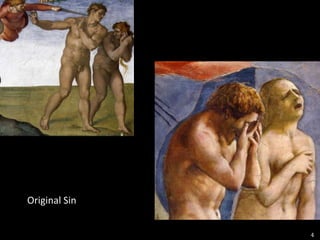
Original Sin4
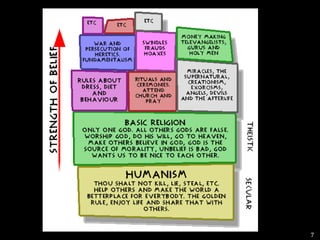
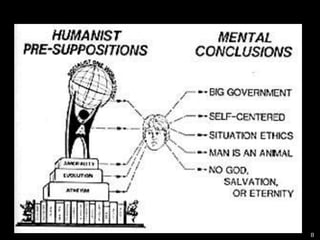
HumanismA cultural and intellectual movement during the Renaissance, following the rediscovery of the art and literature of ancient Greece and Rome. A philosophy or attitude concerned with the interests, achievements, and capabilities of human beings rather than with the abstract concepts and problems of theology and science.5
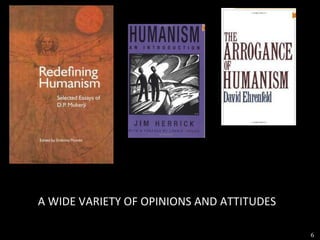
A WIDE VARIETY OF OPINIONS AND ATTITUDES6
7
8
HUMANISM a Focus on Human Beings: Education that perfected humans through the  study of past models of civic and personal virtue. Value system that emphasized personal effort and responsibility. Physically and intellectually active life that was directed at a common good as well as individual nobility .    9
RenaissancePeriod in Europe from the late fourteenth through the sixteenth centuries, which was characterized by a renewed interest in human-centered classical art, literature, and learning.10
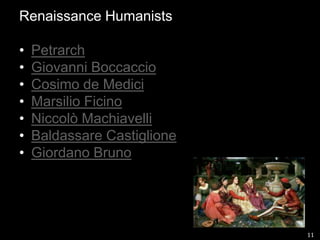
Renaissance HumanistsPetrarchGiovanni BoccaccioCosimo de MediciMarsilio FicinoNiccolò MachiavelliBaldassare CastiglioneGiordano Bruno11
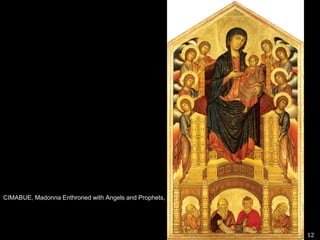
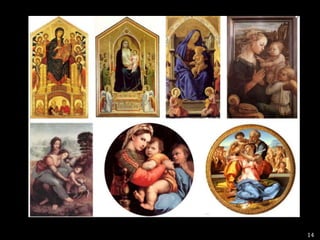
CIMABUE, Madonna Enthroned with Angels and Prophets, 12
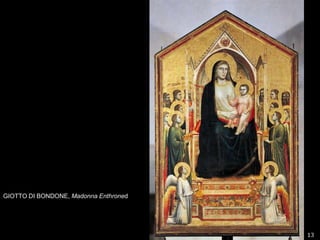
13GIOTTO DI BONDONE, Madonna Enthroned
14
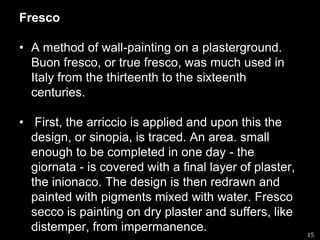
Fresco A method of wall-painting on a plasterground. Buon fresco, or true fresco, was much used in Italy from the thirteenth to the sixteenth centuries. First, the arriccio is applied and upon this the design, or sinopia, is traced. An area. small enough to be completed in one day - the giornata - is covered with a final layer of plaster, the inionaco. The design is then redrawn and painted with pigments mixed with water. Fresco secco is painting on dry plaster and suffers, like distemper, from impermanence.15
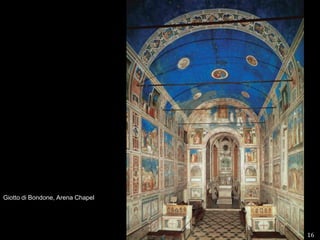
16Giotto diBondone, Arena Chapel
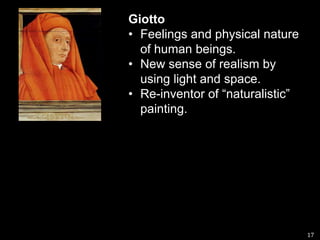
GiottoFeelings and physical nature of human beings.New sense of realism by using light and space.Re-inventor of “naturalistic” painting.17
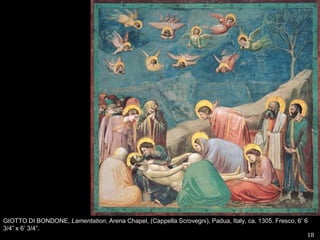
18GIOTTO DI BONDONE, Lamentation, Arena Chapel, (Cappella Scrovegni), Padua, Italy, ca. 1305. Fresco, 6’ 6 3/4” x 6’ 3/4”.
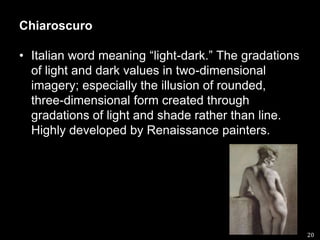
ChiaroscuroItalian word meaning “light-dark.” The gradations of light and dark values in two-dimensional imagery; especially the illusion of rounded, three-dimensional form created through gradations of light and shade rather than line. Highly developed by Renaissance painters.20
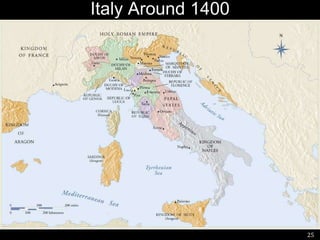
25Italy Around 1400
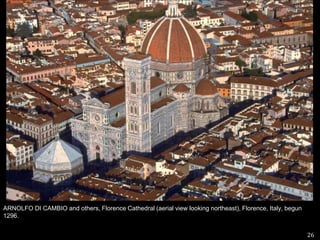
26ARNOLFO DI CAMBIO and others, Florence Cathedral (aerial view looking northeast), Florence, Italy, begun 1296.
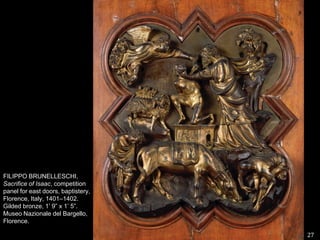
27FILIPPO BRUNELLESCHI, Sacrifice of Isaac, competition panel for east doors, baptistery, Florence, Italy, 1401–1402. Gilded bronze, 1’ 9” x 1’ 5”. MuseoNazionale del Bargello, Florence.
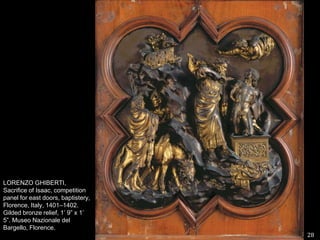
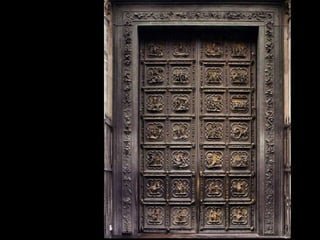
28LORENZO GHIBERTI, Sacrifice of Isaac, competition panel for east doors, baptistery, Florence, Italy, 1401–1402. Gilded bronze relief, 1’ 9” x 1’ 5”. MuseoNazionale del Bargello, Florence.
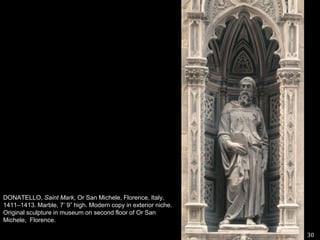
30DONATELLO, Saint Mark, Or San Michele, Florence, Italy, 1411–1413. Marble, 7’ 9” high. Modern copy in exterior niche. Original sculpture in museum on second floor of Or San Michele,  Florence.
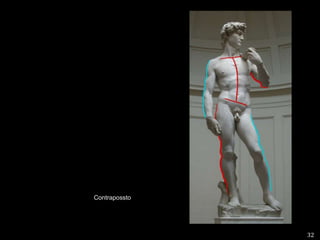
ContraposstoItalian for “counterpose.” The counterpositioning of parts of the human figure about a central vertical axis, as when the weight is placed on one foot causing the hip and shoulder lines to counter balance each other-often in a graceful s-curve.31
Contrapossto32
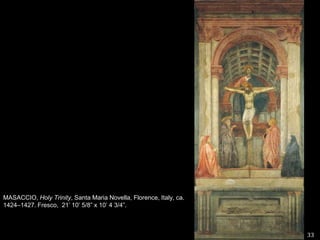
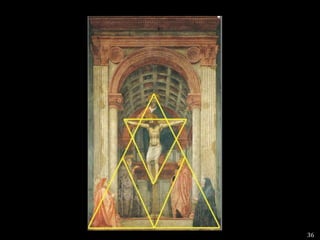
33MASACCIO, Holy Trinity, Santa Maria Novella, Florence, Italy, ca. 1424–1427. Fresco,  21’ 10’ 5/8” x 10’ 4 3/4”.
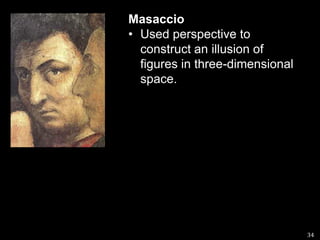
MasaccioUsed perspective to construct an illusion of figures in three-dimensional space.34
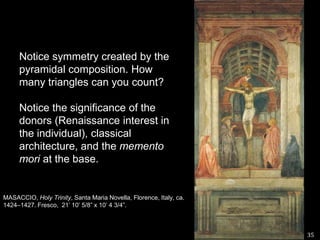
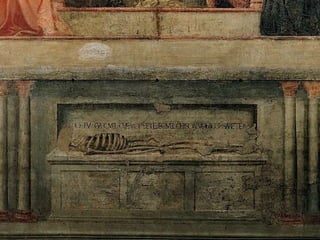
35Notice symmetry created by the pyramidal composition. How many triangles can you count? Notice the significance of the donors (Renaissance interest in the individual), classical architecture, and the memento moriat the base.MASACCIO, Holy Trinity, Santa Maria Novella, Florence, Italy, ca. 1424–1427. Fresco,  21’ 10’ 5/8” x 10’ 4 3/4”.
36
37
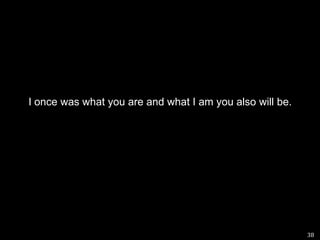
I once was what you are and what I am you also will be.38
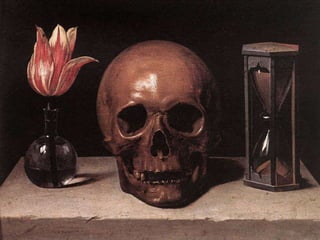
Memento MoriA visual reminder of human mortality.39
40
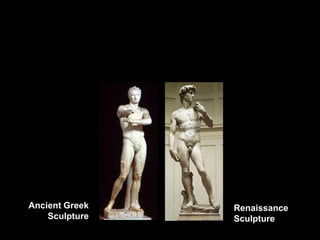
Ancient Greek SculptureRenaissance Sculpture
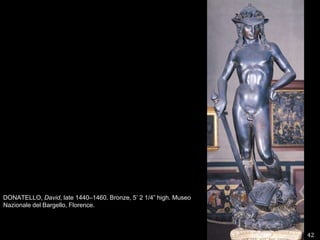
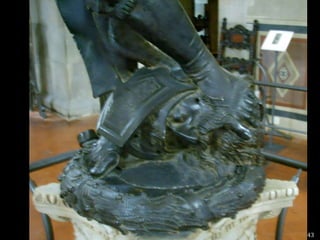
42DONATELLO, David, late 1440–1460. Bronze, 5’ 2 1/4” high. MuseoNazionale del Bargello, Florence.
43
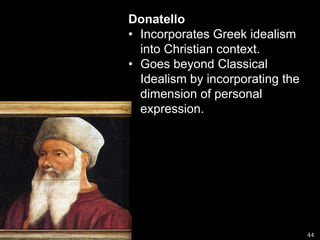
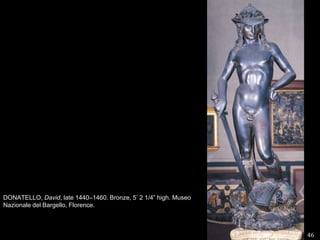
DonatelloIncorporates Greek idealism into Christian context.Goes beyond Classical Idealism by incorporating the dimension of personal expression.44
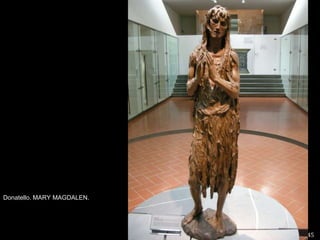
Donatello. MARY MAGDALEN.45
46DONATELLO, David, late 1440–1460. Bronze, 5’ 2 1/4” high. MuseoNazionale del Bargello, Florence.
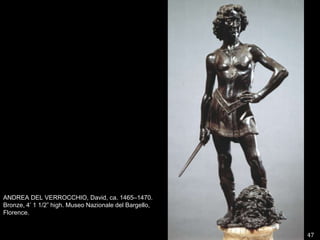
47ANDREA DEL VERROCCHIO, David, ca. 1465–1470. Bronze, 4’ 1 1/2” high. MuseoNazionale del Bargello, Florence.
Neoplatonism
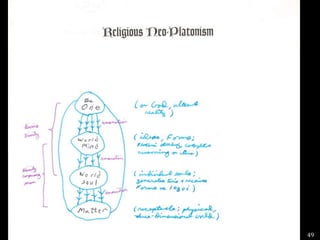
A compilation of Platonic, Aristotelian and Stoic ideas that experienced a strong revival during the late Middle Ages and the Renaissance. Central to the philosophy is the notion that spiritual things are real and that material things are not. The freeing of the spiritual element, the soul, from the material element, the body, should be the ultimate goal of all of mankind and could be achieved through knowledge and contemplation.48
49
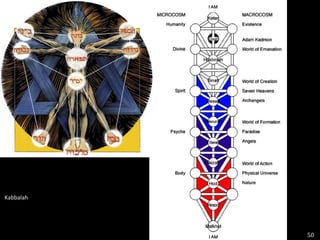
Kabbalah50
Neoplatonism
Embraced by the powerful Medici family.All sources of inspiration, whether Biblical or Classical (Pagan) mythology, represent a means of ascending earthly existence to amystical union with “the One”.51
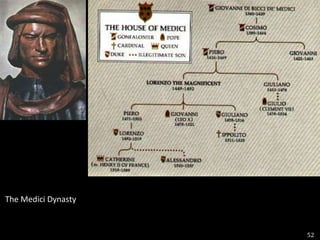
 The Medici Dynasty52
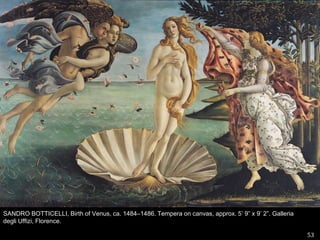
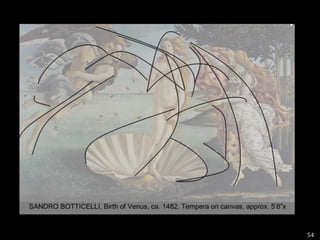
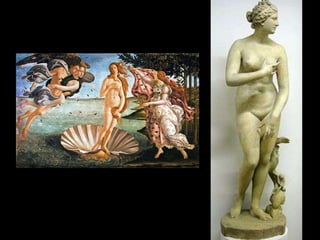
53SANDRO BOTTICELLI, Birth of Venus, ca. 1484–1486. Tempera on canvas, approx. 5’ 9” x 9’ 2”. Galleria degli Uffizi, Florence.
54
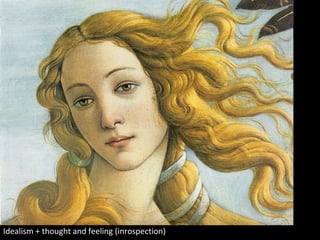
Idealism + thought and feeling (inrospection)
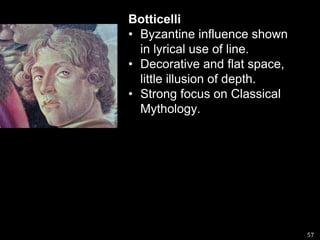
BotticelliByzantine influence shown in lyrical use of line.Decorative and flat space, little illusion of depth.Strong focus on Classical Mythology.57
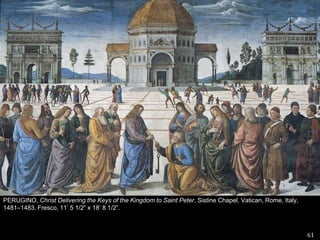
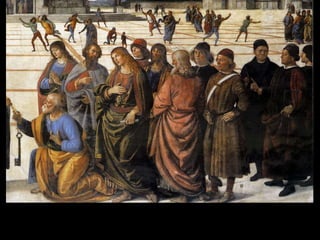
61PERUGINO, Christ Delivering the Keys of the Kingdom to Saint Peter, Sistine Chapel, Vatican, Rome, Italy, 1481–1483. Fresco, 11’ 5 1/2” x 18’ 8 1/2”.
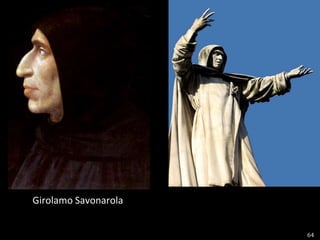
Girolamo Savonarola64
65
66
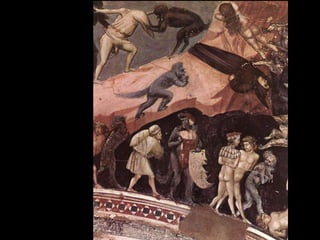
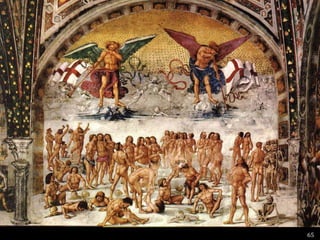
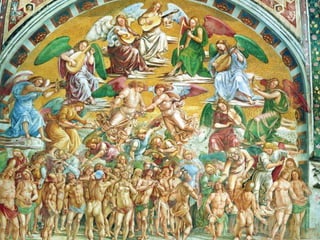
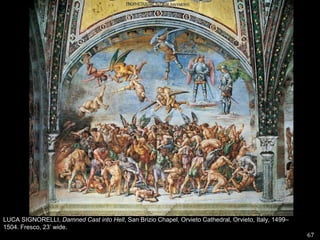
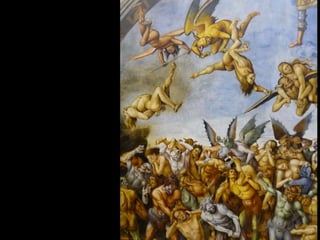
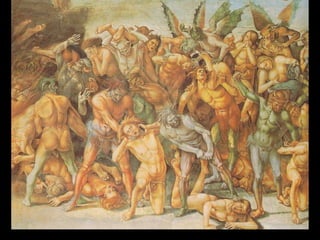
67LUCA SIGNORELLI, Damned Cast into Hell, San Brizio Chapel, Orvieto Cathedral, Orvieto, Italy, 1499–1504. Fresco, 23’ wide.
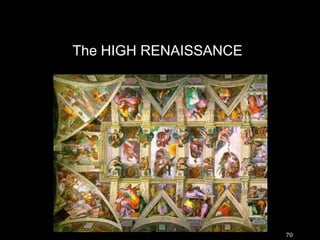
The HIGH RENAISSANCE70
71The Achievements of the MastersLeonardo da Vinci:  superb master of line, pioneer of sfumato, inventor, naturalist, and painter of the soul’s intent.RaffaeloSanzio(a.k.a Raphael):  younger master painter who incorporated elements of Leonardo and Michelangelo in to his own unique style.Michelangelo Buonarroti:  master of sculpture, also excellent painter and architect, the man in demand.Venetian mastersBellini, Giorgione, TitianPalladio (architecture)
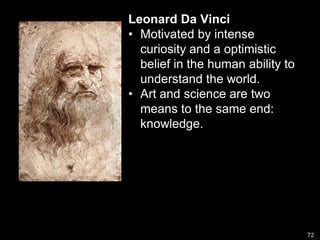
Leonard Da VinciMotivated by intense curiosity and a optimistic belief in the human ability to understand the world.Art and science are two means to the same end: knowledge.72
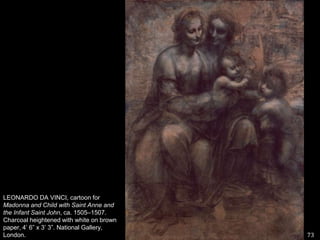
73LEONARDO DA VINCI, cartoon for Madonna and Child with Saint Anne and the Infant Saint John, ca. 1505–1507. Charcoal heightened with white on brown paper, 4’ 6” x 3’ 3”. National Gallery, London.
74
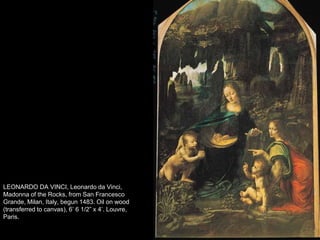
LEONARDO DA VINCI, Leonardo da Vinci, Madonna of the Rocks, from San Francesco Grande, Milan, Italy, begun 1483. Oil on wood (transferred to canvas), 6’ 6 1/2” x 4’. Louvre, Paris.   75
sfumato      A painting technique using an imperceptable, subtle transition from light to dark, without any clear break or line. The theory was developed and mastered by Leonardo da Vinci, and the term derives from the Italian word fumo, meaning vapor, or smoke.76
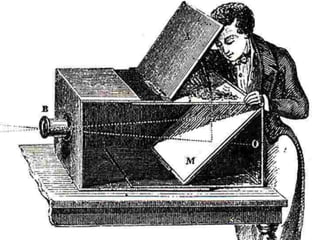
Camera ObscuraA technical aid, widelv used in the seventeenth and eighteenth centuries, which consisted of a darkened box or tent containing lenses and a mirror. The artist could project the image of an object or landscape onto the oil painting surface and then trace it out in charcoal or graphite.77
78
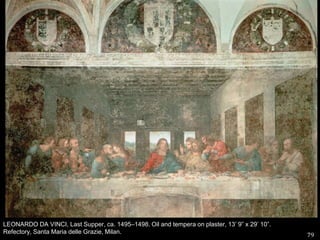
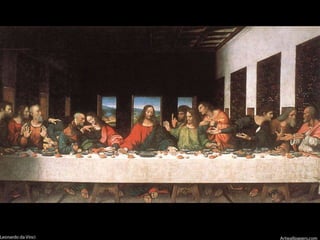
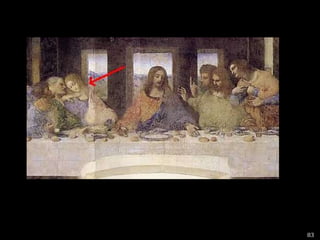
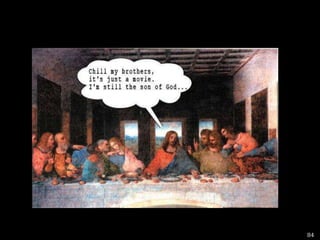
79LEONARDO DA VINCI, Last Supper, ca. 1495–1498. Oil and tempera on plaster, 13’ 9” x 29’ 10”. Refectory, Santa Maria delle Grazie, Milan.
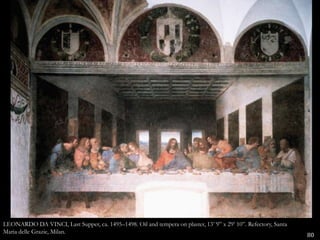
80LEONARDO DA VINCI, Last Supper, ca. 1495–1498. Oil and tempera on plaster, 13’ 9” x 29’ 10”. Refectory, Santa Maria delle Grazie, Milan.
81
82
83
84
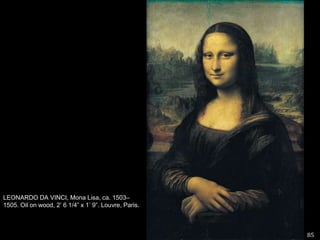
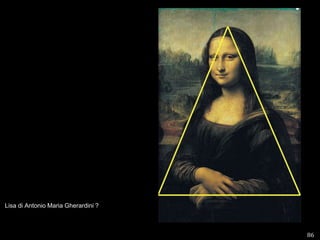
85LEONARDO DA VINCI, Mona Lisa, ca. 1503–1505. Oil on wood, 2’ 6 1/4” x 1’ 9”. Louvre, Paris.
 Lisa di Antonio Maria Gherardini ?86
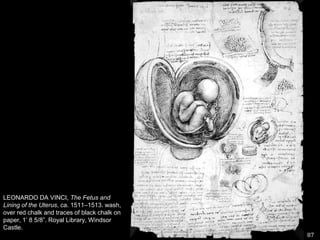
87LEONARDO DA VINCI, The Fetus and Lining of the Uterus, ca. 1511–1513. wash, over red chalk and traces of black chalk on paper, 1’ 8 5/8”. Royal Library, Windsor Castle.
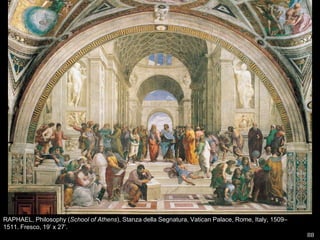
88RAPHAEL, Philosophy (School of Athens), Stanza dellaSegnatura, Vatican Palace, Rome, Italy, 1509–1511. Fresco, 19’ x 27’.
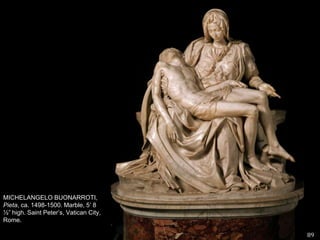
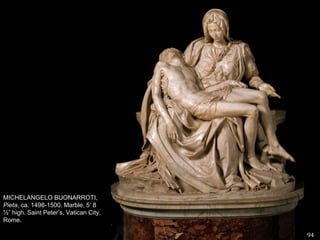
MICHELANGELO BUONARROTI, Pieta, ca. 1498-1500. Marble, 5’ 8 ½” high. Saint Peter’s, Vatican City, Rome.89
PietaWorks in which the Virgin is supporting and mourning the death of Jesus.90
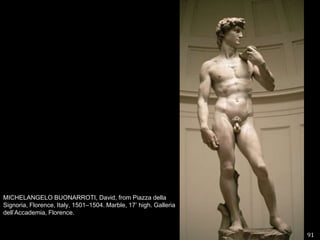
91MICHELANGELO BUONARROTI, David, from Piazza dellaSignoria, Florence, Italy, 1501–1504. Marble, 17’ high. Galleria dell’Accademia, Florence.
DavidCarved from an abandoned eighteen foot block or marble.Symbol of freedom from tyranny for Florence which had just become a Republic.Career making piece for a 26 year old Michelangelo.92
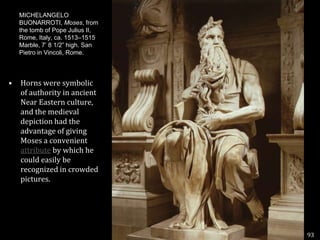
MICHELANGELO BUONARROTI, Moses, from the tomb of Pope Julius II, Rome, Italy, ca. 1513–1515 Marble, 7’ 8 1/2” high. San Pietro in Vincoli, Rome.Horns were symbolic of authority in ancient Near Eastern culture, and the medieval depiction had the advantage of giving Moses a convenient attribute by which he could easily be recognized in crowded pictures.93
MICHELANGELO BUONARROTI, Pieta, ca. 1498-1500. Marble, 5’ 8 ½” high. Saint Peter’s, Vatican City, Rome.94
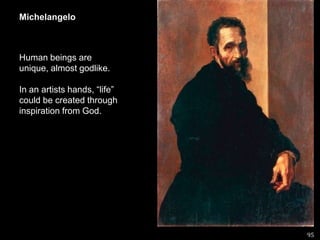
MichelangeloHuman beings are unique, almost godlike.In an artists hands, “life” could be created through inspiration from God.95
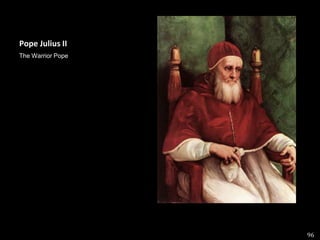
Pope Julius IIThe Warrior Pope96
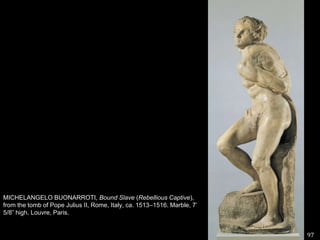
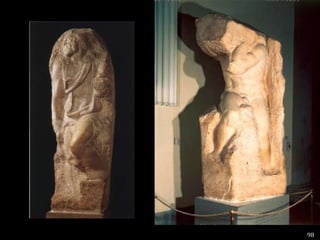
97MICHELANGELO BUONARROTI, Bound Slave (Rebellious Captive), from the tomb of Pope Julius II, Rome, Italy, ca. 1513–1516. Marble, 7’ 5/8” high. Louvre, Paris.
98
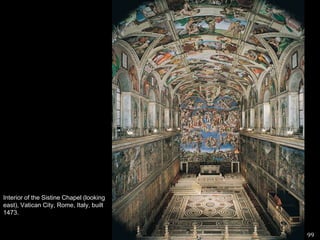
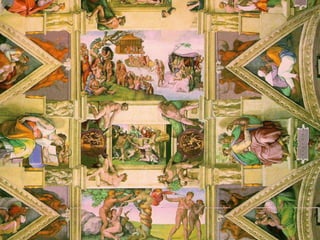
99Interior of the Sistine Chapel (looking east), Vatican City, Rome, Italy, built 1473.
100
101
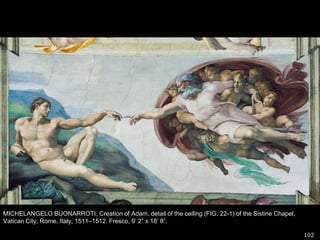
102MICHELANGELO BUONARROTI, Creation of Adam. detail of the ceiling (FIG. 22-1) of the Sistine Chapel, Vatican City, Rome, Italy, 1511–1512. Fresco, 9’ 2” x 18’ 8”.
Expresses the Humanist concept of God: an idealized, rational man who actively tends every aspect of human creation and has a special interest in humans.103
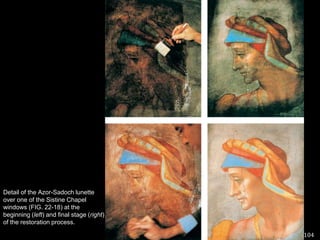
104Detail of the Azor-Sadoch lunette over one of the Sistine Chapel windows (FIG. 22-18) at the beginning (left) and final stage (right) of the restoration process.
105
106
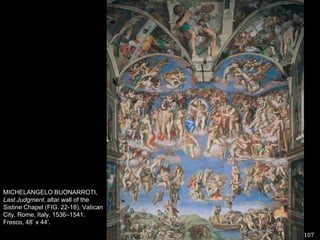
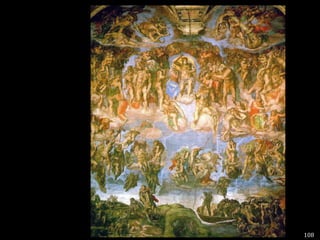
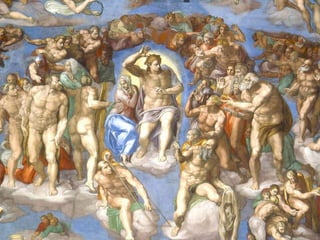
107MICHELANGELO BUONARROTI, Last Judgment, altar wall of the Sistine Chapel (FIG. 22-18), Vatican City, Rome, Italy, 1536–1541. Fresco, 48’ x 44’.
108
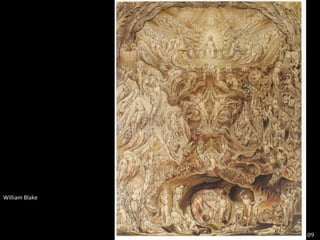
William Blake109
110
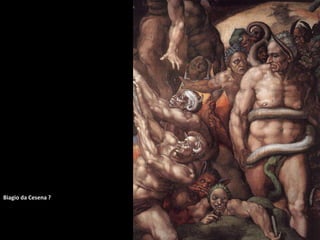
BiagiodaCesena ?111
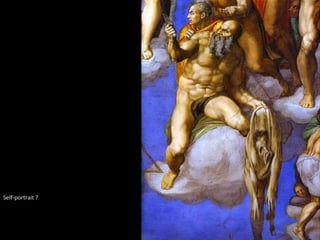
Self-portrait ?112

AF chapter16a

  • 1.
  • 2.
  • 3.
    The Black Deathis estimated to have killed 30% – 60% of Europe's population, reducing the world’s population from an estimated 450 million to between 350 and 375 million in 1400. This has been seen as creating a series of religious, social and economic upheavals which had profound effects on the course of European History. It took 150 years for Europe's population to recover. Because the plague killed so many of the poor population, wealthy land owners were forced to pay the remaining workers what they asked, in terms of wages. Because there was now a surplus in consumer goods, luxury crops could now be grown. This meant that for the first time in history, many, formerly of the peasant population, now had a chance to live a better life. Most historians now feel that this was the start of the middle class in Europe and England.3
  • 4.
  • 5.
    HumanismA cultural andintellectual movement during the Renaissance, following the rediscovery of the art and literature of ancient Greece and Rome. A philosophy or attitude concerned with the interests, achievements, and capabilities of human beings rather than with the abstract concepts and problems of theology and science.5
  • 6.
    A WIDE VARIETYOF OPINIONS AND ATTITUDES6
  • 7.
  • 8.
  • 9.
    HUMANISM a Focuson Human Beings: Education that perfected humans through the study of past models of civic and personal virtue. Value system that emphasized personal effort and responsibility. Physically and intellectually active life that was directed at a common good as well as individual nobility . 9
  • 10.
    RenaissancePeriod in Europefrom the late fourteenth through the sixteenth centuries, which was characterized by a renewed interest in human-centered classical art, literature, and learning.10
  • 11.
    Renaissance HumanistsPetrarchGiovanni BoccaccioCosimode MediciMarsilio FicinoNiccolò MachiavelliBaldassare CastiglioneGiordano Bruno11
  • 12.
    CIMABUE, Madonna Enthronedwith Angels and Prophets, 12
  • 13.
    13GIOTTO DI BONDONE,Madonna Enthroned
  • 14.
  • 15.
    Fresco A methodof wall-painting on a plasterground. Buon fresco, or true fresco, was much used in Italy from the thirteenth to the sixteenth centuries. First, the arriccio is applied and upon this the design, or sinopia, is traced. An area. small enough to be completed in one day - the giornata - is covered with a final layer of plaster, the inionaco. The design is then redrawn and painted with pigments mixed with water. Fresco secco is painting on dry plaster and suffers, like distemper, from impermanence.15
  • 16.
  • 17.
    GiottoFeelings and physicalnature of human beings.New sense of realism by using light and space.Re-inventor of “naturalistic” painting.17
  • 18.
    18GIOTTO DI BONDONE,Lamentation, Arena Chapel, (Cappella Scrovegni), Padua, Italy, ca. 1305. Fresco, 6’ 6 3/4” x 6’ 3/4”.
  • 20.
    ChiaroscuroItalian word meaning“light-dark.” The gradations of light and dark values in two-dimensional imagery; especially the illusion of rounded, three-dimensional form created through gradations of light and shade rather than line. Highly developed by Renaissance painters.20
  • 25.
  • 26.
    26ARNOLFO DI CAMBIOand others, Florence Cathedral (aerial view looking northeast), Florence, Italy, begun 1296.
  • 27.
    27FILIPPO BRUNELLESCHI, Sacrificeof Isaac, competition panel for east doors, baptistery, Florence, Italy, 1401–1402. Gilded bronze, 1’ 9” x 1’ 5”. MuseoNazionale del Bargello, Florence.
  • 28.
    28LORENZO GHIBERTI, Sacrificeof Isaac, competition panel for east doors, baptistery, Florence, Italy, 1401–1402. Gilded bronze relief, 1’ 9” x 1’ 5”. MuseoNazionale del Bargello, Florence.
  • 30.
    30DONATELLO, Saint Mark,Or San Michele, Florence, Italy, 1411–1413. Marble, 7’ 9” high. Modern copy in exterior niche. Original sculpture in museum on second floor of Or San Michele, Florence.
  • 31.
    ContraposstoItalian for “counterpose.”The counterpositioning of parts of the human figure about a central vertical axis, as when the weight is placed on one foot causing the hip and shoulder lines to counter balance each other-often in a graceful s-curve.31
  • 32.
  • 33.
    33MASACCIO, Holy Trinity,Santa Maria Novella, Florence, Italy, ca. 1424–1427. Fresco, 21’ 10’ 5/8” x 10’ 4 3/4”.
  • 34.
    MasaccioUsed perspective toconstruct an illusion of figures in three-dimensional space.34
  • 35.
    35Notice symmetry createdby the pyramidal composition. How many triangles can you count? Notice the significance of the donors (Renaissance interest in the individual), classical architecture, and the memento moriat the base.MASACCIO, Holy Trinity, Santa Maria Novella, Florence, Italy, ca. 1424–1427. Fresco, 21’ 10’ 5/8” x 10’ 4 3/4”.
  • 36.
  • 37.
  • 38.
    I once waswhat you are and what I am you also will be.38
  • 39.
    Memento MoriA visualreminder of human mortality.39
  • 40.
  • 41.
  • 42.
    42DONATELLO, David, late1440–1460. Bronze, 5’ 2 1/4” high. MuseoNazionale del Bargello, Florence.
  • 43.
  • 44.
    DonatelloIncorporates Greek idealisminto Christian context.Goes beyond Classical Idealism by incorporating the dimension of personal expression.44
  • 45.
  • 46.
    46DONATELLO, David, late1440–1460. Bronze, 5’ 2 1/4” high. MuseoNazionale del Bargello, Florence.
  • 47.
    47ANDREA DEL VERROCCHIO,David, ca. 1465–1470. Bronze, 4’ 1 1/2” high. MuseoNazionale del Bargello, Florence.
  • 48.
    Neoplatonism
A compilation ofPlatonic, Aristotelian and Stoic ideas that experienced a strong revival during the late Middle Ages and the Renaissance. Central to the philosophy is the notion that spiritual things are real and that material things are not. The freeing of the spiritual element, the soul, from the material element, the body, should be the ultimate goal of all of mankind and could be achieved through knowledge and contemplation.48
  • 49.
  • 50.
  • 51.
    Neoplatonism
Embraced by thepowerful Medici family.All sources of inspiration, whether Biblical or Classical (Pagan) mythology, represent a means of ascending earthly existence to amystical union with “the One”.51
  • 52.
    The MediciDynasty52
  • 53.
    53SANDRO BOTTICELLI, Birthof Venus, ca. 1484–1486. Tempera on canvas, approx. 5’ 9” x 9’ 2”. Galleria degli Uffizi, Florence.
  • 54.
  • 56.
    Idealism + thoughtand feeling (inrospection)
  • 57.
    BotticelliByzantine influence shownin lyrical use of line.Decorative and flat space, little illusion of depth.Strong focus on Classical Mythology.57
  • 61.
    61PERUGINO, Christ Deliveringthe Keys of the Kingdom to Saint Peter, Sistine Chapel, Vatican, Rome, Italy, 1481–1483. Fresco, 11’ 5 1/2” x 18’ 8 1/2”.
  • 64.
  • 65.
  • 66.
  • 67.
    67LUCA SIGNORELLI, DamnedCast into Hell, San Brizio Chapel, Orvieto Cathedral, Orvieto, Italy, 1499–1504. Fresco, 23’ wide.
  • 70.
  • 71.
    71The Achievements ofthe MastersLeonardo da Vinci: superb master of line, pioneer of sfumato, inventor, naturalist, and painter of the soul’s intent.RaffaeloSanzio(a.k.a Raphael): younger master painter who incorporated elements of Leonardo and Michelangelo in to his own unique style.Michelangelo Buonarroti: master of sculpture, also excellent painter and architect, the man in demand.Venetian mastersBellini, Giorgione, TitianPalladio (architecture)
  • 72.
    Leonard Da VinciMotivatedby intense curiosity and a optimistic belief in the human ability to understand the world.Art and science are two means to the same end: knowledge.72
  • 73.
    73LEONARDO DA VINCI,cartoon for Madonna and Child with Saint Anne and the Infant Saint John, ca. 1505–1507. Charcoal heightened with white on brown paper, 4’ 6” x 3’ 3”. National Gallery, London.
  • 74.
  • 75.
    LEONARDO DA VINCI,Leonardo da Vinci, Madonna of the Rocks, from San Francesco Grande, Milan, Italy, begun 1483. Oil on wood (transferred to canvas), 6’ 6 1/2” x 4’. Louvre, Paris. 75
  • 76.
    sfumato  A painting technique using an imperceptable, subtle transition from light to dark, without any clear break or line. The theory was developed and mastered by Leonardo da Vinci, and the term derives from the Italian word fumo, meaning vapor, or smoke.76
  • 77.
    Camera ObscuraA technicalaid, widelv used in the seventeenth and eighteenth centuries, which consisted of a darkened box or tent containing lenses and a mirror. The artist could project the image of an object or landscape onto the oil painting surface and then trace it out in charcoal or graphite.77
  • 78.
  • 79.
    79LEONARDO DA VINCI,Last Supper, ca. 1495–1498. Oil and tempera on plaster, 13’ 9” x 29’ 10”. Refectory, Santa Maria delle Grazie, Milan.
  • 80.
    80LEONARDO DA VINCI,Last Supper, ca. 1495–1498. Oil and tempera on plaster, 13’ 9” x 29’ 10”. Refectory, Santa Maria delle Grazie, Milan.
  • 81.
  • 82.
  • 83.
  • 84.
  • 85.
    85LEONARDO DA VINCI,Mona Lisa, ca. 1503–1505. Oil on wood, 2’ 6 1/4” x 1’ 9”. Louvre, Paris.
  • 86.
    Lisa diAntonio Maria Gherardini ?86
  • 87.
    87LEONARDO DA VINCI,The Fetus and Lining of the Uterus, ca. 1511–1513. wash, over red chalk and traces of black chalk on paper, 1’ 8 5/8”. Royal Library, Windsor Castle.
  • 88.
    88RAPHAEL, Philosophy (Schoolof Athens), Stanza dellaSegnatura, Vatican Palace, Rome, Italy, 1509–1511. Fresco, 19’ x 27’.
  • 89.
    MICHELANGELO BUONARROTI, Pieta,ca. 1498-1500. Marble, 5’ 8 ½” high. Saint Peter’s, Vatican City, Rome.89
  • 90.
    PietaWorks in whichthe Virgin is supporting and mourning the death of Jesus.90
  • 91.
    91MICHELANGELO BUONARROTI, David,from Piazza dellaSignoria, Florence, Italy, 1501–1504. Marble, 17’ high. Galleria dell’Accademia, Florence.
  • 92.
    DavidCarved from anabandoned eighteen foot block or marble.Symbol of freedom from tyranny for Florence which had just become a Republic.Career making piece for a 26 year old Michelangelo.92
  • 93.
    MICHELANGELO BUONARROTI, Moses,from the tomb of Pope Julius II, Rome, Italy, ca. 1513–1515 Marble, 7’ 8 1/2” high. San Pietro in Vincoli, Rome.Horns were symbolic of authority in ancient Near Eastern culture, and the medieval depiction had the advantage of giving Moses a convenient attribute by which he could easily be recognized in crowded pictures.93
  • 94.
    MICHELANGELO BUONARROTI, Pieta,ca. 1498-1500. Marble, 5’ 8 ½” high. Saint Peter’s, Vatican City, Rome.94
  • 95.
    MichelangeloHuman beings areunique, almost godlike.In an artists hands, “life” could be created through inspiration from God.95
  • 96.
    Pope Julius IITheWarrior Pope96
  • 97.
    97MICHELANGELO BUONARROTI, BoundSlave (Rebellious Captive), from the tomb of Pope Julius II, Rome, Italy, ca. 1513–1516. Marble, 7’ 5/8” high. Louvre, Paris.
  • 98.
  • 99.
    99Interior of theSistine Chapel (looking east), Vatican City, Rome, Italy, built 1473.
  • 100.
  • 101.
  • 102.
    102MICHELANGELO BUONARROTI, Creationof Adam. detail of the ceiling (FIG. 22-1) of the Sistine Chapel, Vatican City, Rome, Italy, 1511–1512. Fresco, 9’ 2” x 18’ 8”.
  • 103.
    Expresses the Humanistconcept of God: an idealized, rational man who actively tends every aspect of human creation and has a special interest in humans.103
  • 104.
    104Detail of theAzor-Sadoch lunette over one of the Sistine Chapel windows (FIG. 22-18) at the beginning (left) and final stage (right) of the restoration process.
  • 105.
  • 106.
  • 107.
    107MICHELANGELO BUONARROTI, LastJudgment, altar wall of the Sistine Chapel (FIG. 22-18), Vatican City, Rome, Italy, 1536–1541. Fresco, 48’ x 44’.
  • 108.
  • 109.
  • 110.
  • 111.
  • 112.