RENAISSANCE ART
14th to the 17th century
By: Lucylle Bianca
Cawaling, Alina Bianca
Arellano, Sofia Valera,
Rheana Gabriel,
Dominique Avanzando
RENAISSANCE
• The 14th century was a time of great crisis; the plague, the Hundred
Years war, and the turmoil in the Catholic Church all shook people’s
faith in government, religion, and their fellow man. In this dark period
Europeans sought a new start, a cultural rebirth, a renaissance.
• The Renaissance began in Italy where the culture was surrounded
by the remnants of a once glorious empire.
• Italians rediscovered the writings, philosophy, art, and architecture
of the ancient Greeks and Romans and began to see antiquity as a
golden age which held the answers to reinvigorating their society.
• Humanistic education, based on rhetoric, ethics and the liberal arts,
was pushed as a way to create well-rounded citizens who could
actively participate in the political process.
• Humanists celebrated the mind, beauty, power, and enormous
potential of human beings. They believed that people were able to
experience God directly and should have a personal, emotional
relationship to their faith. God had made the world but humans
were able to share in his glory by becoming creators themselves.
CATEGORIES OF RENAISSANCE ART
• Pre- (or "Proto"-) Renaissance
• around 1150 or so
• stable enough to allow explorations in art to develop
• Early Renaissance
• period of great creative and intellectual activity, during which artists broke
away from the restrictions of Byzantine Art
• 15th century, artists studied the natural world in order to perfect their
understanding of such subjects as anatomy and perspective.
• High Renaissance
• lasted from roughly 1495 to 1527
• Late Renaissance
• between 1527 and 1600
• artistic school known as Mannerism
• complexity and virtuosity over naturalistic representation
• favored compositional tension and instability rather than the balance and clarity
• distortion of the human figure, a flattening of pictorial space, and a cultivated
intellectual sophistication.
Pre-Renaissance Early Renaissance High Renaissance Late Renaissance
Nicola Pisano Brunelleschi Giovanni Bellini Pontormo
Arnolfo di Cambio Ghiberti Leonardo da Vinci Benvenuto Cellini
Giovanni Pisano Masolino Filippino Lippi Bronzino
Giotto Nanni di Banco Michelangelo Parmigianino
Pietro Lorenzetti Donatello Giorgione Tintoretto
Ambrogio Lorenzetti Fra Angelico Raphael Paolo Veronese
Taddeo Gaddi Uccello Titian Giambologna
Orcagna Masaccio Andrea del Sarto El Greco
Altichiero Filippo Lippi
Giusto de' Menabuoi Piero della Francesca
Andrea del Castagno
Gentile Bellini
Antonello da Messina
Botticelli
Signorelli
Perugino
Ghirlandaio
Donatello (ca. 1386–1466)
Donato di Niccolò di Betto Bardi
Donatello
• The greatest Florentine sculptor before Michelangelo (1475–1564)
and was the most influential individual artist of the 15th century in
Italy.
• He was gaining a reputation for creating larger-than-life figures
using innovative techniques and extraordinary skills. Before,
European sculptors used a flat background upon which figures were
placed. Donatello also drew heavily from reality for inspiration in his
sculptures, accurately showing expression in his figures’ faces and
body positions.
David [marble]
(1408–1409)
Museo Nazionale del
Bargello, Florence
The marble David is Donatello's
earliest known important
commission, and it is a work
closely tied to tradition, giving
few signs of the innovative
approach to representation that
the artist would develop as he
matured.
David [bronze]
(1400s)
Museo Nazionale del
Bargello, Florence
Donatello's bronze statue of
David is famous as the first
unsupported standing work of
bronze cast during the
Renaissance, and the first
freestanding nude male sculpture
made since antiquity. It depicts
David with an enigmatic smile,
posed with his foot on Goliath's
severed head just after defeating
the giant. The youth is completely
naked, apart from a laurel-topped
hat and boots, bearing the sword
of Goliath.
Equestrian statue of
Gattamelata
(1453)
Piazza del Santo, Padua, Italy
After Erasmo of Narni's death in
1443, the mercenary’s family paid
for a sculpture in his honor. It is
the earliest surviving Renaissance
equestrian statue and the first to
reintroduce the grandeur of
Classical equestrian portraiture.
After its conception, the statue
served as a precedent for later
sculptures honoring military
heroes.
Penitent
Magdalene
(1453–1455)
Museo dell'Opera del
Duomo, Florence
A statue of a gaunt-looking
Mary Magdalene.
Donatello died of unknown
causes leaving his work
unfinished however
faithfully completed by his
student Bertoldo di
Giovanni.
Sandro Botticelli
1445- 17 MAY 1510
• flat backdrop
• Devoid of atmospheric perspective
• lyrical and courtly style of visual poetry parallel to the love
poetry of Lorenzo de’ Medici.
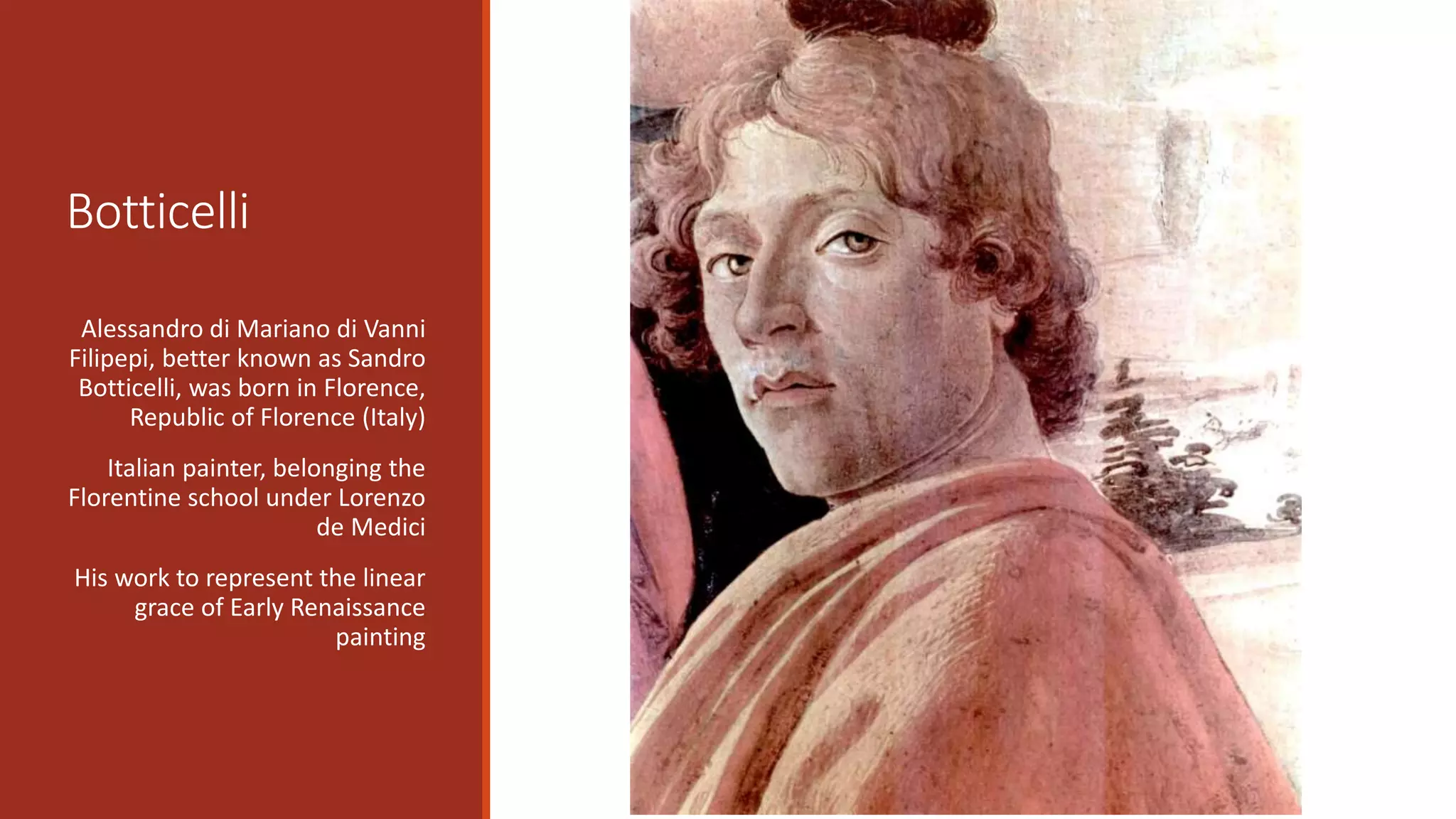
Botticelli
Alessandro di Mariano di Vanni
Filipepi, better known as Sandro
Botticelli, was born in Florence,
Republic of Florence (Italy)
Italian painter, belonging the
Florentine school under Lorenzo
de Medici
His work to represent the linear
grace of Early Renaissance
painting
The Virgin and
Child
Surrounded by
Five Angels
STYLE Early Renaissance
GALLERY Louvre, Paris, france
COMPLETION DATE c1470
TECHNIQUE oil
MATERIAL panel
DIMENSIONS 40X58 CM
GENRE religious painting
Madonna of
the Magnificat
STYLE Early Renaissance
GALLERY Galleria degli Uffizi,
Florence, Italy
START DATE 1480
COMPLETION DATE 1481
TECHNIQUE Tempera
MATERIAL panel
GENRE religious painting
Portrait of a
Young Man
STYLE Early Renaissance
GALLERY National Gallery
COMPLETION DATE 1483
TECHNIQUE tempera
MATERIAL wood
GENRE religious painting
The Mystical
Nativity
STYLE Early Renaissance
GALLERY National Gallery
COMPLETION DATE c.1500
TECHNIQUE tempera
MATERIAL canvas
DIMENSIONS 109X75 cm
GENRE religious painting
Leonardo Da Vinci
Leonardo Da Vinci
•Born in small town of Vinci, near Florence
•“Renaissance man”
•Unquenchable curiosity
•Studies Botany, Geology, cartography, zoology, Military, Engineering, Animal lore, Anatomy, and
Aspects of Physical Science, including hydraulics and Mechanics
•Studying gave him an understanding of perspective, light, and color that he used in his painting
•Scientific drawings are themselves artworks
•His great ambition in his painting, as well as scientific endeavors, was to discover the laws
underlying the processes and flux of naure
•All his scientific investigations made him a better painter
Madonna of
the Rocks
• Use of chiaroscuro
• Subtle play of light and dark
(modeling with light & shadow,
and expressing emotional
states = heart of painting for
Leonardo)
• 2 chief objects to paint
• Man
• Intention of his soul =
expressed by gestures and
the movement of his limbs
• Pyramidal grouping
• Share the same light-infused
environment
Last Supper
•For the refrectory of the Church of santa Maria delle Grazie in Millan
•Christ
• Center of the 2-dimensional surface
• Focal point of all converging perspective lines in the composition
• Perspectival focus
• Psychological focus and cause of Action
•Disciples
• Agitated
• In four groups of three, united among within themselves by the figures, gestures and postures
•Light source- corresponds to the window in the refrectory
•Emotional responses: fear, doubt, protestation, rage and love
Mona Lisa
• World’s most famous portrait
•Renaissance etiquette: a woman should not look
directly into a man’s eye’s
•Chiascuro and atmospheric perspective
•Portrayed of this self-assured young woman without
trappings of power but engaging the audience
psychologically
•Darker today than 500 years ago
•Backdrop of a mysterious uninhabited landscape
Anatomical Studies
• very few paintings
•Perfectionism, relentless experimenting and far-ranging curiosity
•Originated the scientific illustration
•http://www.royalcollection.org.uk/exhibitions/leonardo-da-vinci-anatomy/items
A male nude, and
a partial study of
the left leg
A study of the nude figure of a man
seen full length, facing the spectator.
His legs are set well apart, and his
arms are slightly raised from his sides,
resting on two sticks which are slightly
indicated. To the left is part of a flexed
left leg.
it was important for the artist to know
how to draw the muscles in tension, it
was just as important to know how to
draw the body when relaxed.
Recto: The superficial
anatomy of the
shoulder and neck.
Verso: The muscles of
the shoulder
This sheet displays the full range of
Leonardo’s illustrative techniques,
showing the structure of the muscles
of the shoulder. Pectoralis major is
divided into parts to represent the
lines of force along which it acts. This
method reaches its logical conclusion
in the drawing at top right, which is an
example of Leonardo’s ‘thread model’.
This technique - invented by Leonardo
- reduced the muscles to single cords
along their central lines of force, such
that the spatial structure of an entire
system can be perceived at once.
Recto: The foetus in
the womb. Verso:
Notes on
reproduction, with
sketches of a foetus in
utero, etc.
Recto: Large drawing of an embryo
within a human uterus with a cow's
placenta; smaller sketch of the same;
notes on the subject; illustrative
drawings in detail of the placenta &
uterus; diagram demonstrating
binocular vision; a note on relief in
painting & on mechanics. Verso: A
note on light & shade; numerous notes
on reproduction; L side of a foetus
with a cord; 3 drawings of foetal liver,
stomach & umbilical vein; sketches of
chick embryo & membranes & front
(uterus is sphere-shaped;
characterization of lining is incorrect)
Recto: The heart,
bronchi and bronchial
vessels. Verso: A
sketch of the heart
and great vessels
Recto: Drawing of a bovine heart,
great vessels & bronchial tree. Details
of trachea & effects of respiration on
it; numerous notes on the action of
the heart. Verso: Sketch of human
heart & main vessels
Michelangelo (1475–1564)
Michelangelo di Lodovico Buonarroti Simoni
Michelangelo
•Italian sculptor, painter, architect, poet, and engineer of the
High Renaissance who exerted an unparalleled influence on
the development of Western art.
•He believed the image produced by the artist’s hand must
come from the idea in the artist’s mind. But artists are not
the creators of the ideas they conceive. They find their ideas
in the natural world, reflecting the absolute idea: beauty.
Michelangelo
•The artistic license to aspire far beyond the “rules” was, in
part, a manifestation of the pursuit of fame and success that
humanism fostered.
•He put in its stead a style of vast, expressive strength
conveyed through complex, eccentric, and often titanic
forms that loom before the viewer in tragic grandeur.
Terribilità the sublime shadowed by the awesome and the
fearful conception and execution in an artist.
Pietà
(1498–1500)
Saint Peter’s, Vatican City,
Rome
Michelangelo’s
representation of Mary
cradling Christ’s corpse
brilliantly captures the
sadness and beauty of the
young Virgin but was
controversial because the
Madonna seems younger
than her son.
Pietà
•French cardinal Jean de Bilhères Lagraulas
commissioned the statue to adorn the
chapel in Old Saint Peter’s in which he was
to be buried .
• Michelangelo transformed marble into
flesh, hair, and fabric with a sensitivity for
texture that is almost without parallel. The
polish and luminosity of the exquisite
marble surface.
David
(1501–1504)
Galleria
dell’Accademia,
Florence
In this colossal statue,
Michelangelo represented
David in heroic classical
nudity, capturing the tension
of Lysippan athletes and the
emotionalism of Hellenistic
statuary.
David or “the Giant”
•Florence Cathedral building committee
commissioned him to fashion a statue of
David.
•Served as a symbol of Florentine liberty.
•Michelangelo chose to represent the
young biblical warrior sternly watchful of
the approaching foe.
David or “the Giant”
•David exhibits the characteristic
representation of energy in reserve.
•The anatomy of David’s body plays an
important part in this prelude to action:
Every aspect of his muscular body,
including his face, is tense with gathering
power.
His rugged torso, sturdy limbs, and large
hands and feet alert viewers to the
strength to come.
The swelling veins and tightening sinews
amplify the psychological energy of the
pose.
David or “the Giant”
•He greatly admired Greco-Roman statues, in
particular the skillful and precise rendering of
heroic physique.
•David is compositionally and emotionally
connected to an unseen presence beyond the
statue, a feature also of Hellenistic sculpture.
• Michelangelo invested his efforts in presenting
towering, pent-up emotion rather than calm,
ideal beauty.
The Sistine Chapel
1473
The Sistine Chapel
•Takes its name from Pope Sixtus IV della Rovere
•Restored between 1477 and 1480
• A team of Renaissance painters that included Sandro
Botticelli, Pietro Perugino, Pinturicchio, Domenico
Ghirlandaio and Cosimo Roselli, created a series of
frescos depicting the Life of Moses and the Life of
Christ
The Sistine Chapel Ceiling (1508–12)
Sistine Chapel, Vatican City, Rome, Italy
Fresco painting that Michelangelo labored almost four years in the Sistine Chapel painting more than 300
biblical figures on the ceiling illustrating the Creation and Fall of humankind.
The Sistine Chapel Ceiling
•Its dimensions (some 5,800 square feet), its height above the pavement (almost 70
feet), and the complicated perspective problems the vault’s height and curve
presented.
•A long sequence of narrative panels describing the Creation, as recorded in Genesis,
runs along the crown of the vault. (God’s Separation of Light and Darkness to
Drunkenness of Noah)
•More than 300 figures in a grand drama of the human race.
•The ceiling’s design and narrative structure not only presents a sweeping chronology
of Christianity but also is in keeping with Renaissance ideas about Christian history.
The Sistine Chapel Ceiling
•The Hebrew prophets and pagan sibyls who foretold the coming of Christ appear
seated in large thrones on both sides of the central row of scenes from Genesis,
where the vault curves down.
•In the four corner pendentives, where the four Old Testament scenes placed with
David, Judith, Haman, and Moses and the Brazen Serpent.
•The ancestors of Christ fill the triangular compartments above the windows,
nude youths punctuate the corners of the central panels, and small pairs of putti
in grisaille. (monochrome painting using shades of gray to imitate sculpture)
The Sistine Chapel Ceiling
•Focuses on figure after figure
•The body was the manifestation of the soul or of a state of mind and
character.
•Michelangelo represented the body in its most simple, elemental aspect—in
the nude or simply draped, with no background and no ornamental
embellishment.
•That is why many of the figures seem to be tinted reliefs or freestanding
statues.
The Creation of Adam (1510)
Life leaps to Adam like a spark from the extended hand of God in this fresco, which recalls the
communication between gods and heroes in the classical myths so admired by Renaissance humanists.
The Creation of Adam
•Michelangelo did not paint the traditional representation but instead produced a
bold, humanistic interpretation of the momentous event.
•God and Adam confront each other in a primordial unformed landscape of which
Adam is still a material part, heavy as earth while the Lord transcends the earth,
wrapped in a billowing cloud of drapery and borne up by his powers.
•Michelangelo incorporated into his fresco one of the essential tenets of Christian
faith—the belief that Adam’s Original Sin eventually led to the sacrifice of Christ:
Redemption of humankind.
The Creation of Adam
•The focal point of this right-to-left-to-right movement—the fingertips
of Adam and the Lord—is dramatically off-center.
•Michelangelo’s style is The reclining positions of the figures, the
heavy musculature, and the twisting poses are all intrinsic.
•Michelangelo replaced the straight architectural axes thus, motion
directs not only the figures but also the whole composition.
The Last Judgement
(Il Giudizio Universale)
(1536–1541)
Sistine Chapel, Vatican City
The fresco painting depicted
Christ as the stern judge of the
world—a giant who raises his
mighty right arm in a gesture of
damnation so broad and
universal as to suggest he will
destroy all creation.
The Last Judgement
(Il Giudizio Universale)
•A large fresco for the Sistine Chapel’s altar wall
•Michelangelo depicted Christ as the stern judge of
the world—a giant who raises his mighty right arm
in a gesture of damnation so broad and universal
as to suggest he will destroy all creation.
•The choirs of Heaven surrounding him pulse with
anxiety and awe.
•On the left, the dead awake and assume flesh.
•On the right, demons whose gargoyle masks and
burning eyes revive the demons of Romanesque
tympana, torment the damned.
The Last Judgement
(Il Giudizio Universale)
•Michelangelo’s terrifying vision of the fate
that awaits sinners goes far beyond any
previous rendition.
•The figures are huge and violently
twisted, with small heads and contorted
features.
Raffaello Sanzio da Urbino
(APRIL 6 OR MARCH 28, 1483 -
APRIL 6, 1520)
Raphael
• also known as just Raphael
• His work is known for its clarity of form and ease of composition
• left behind an extraordinary amount of work despite having died an early death
at 37
•declared a master, meaning he was fully trained, in 1501
•His career falls naturally into three phases and three styles: his early years
in Umbria, then a period of about four years (1504–1508) absorbing the artistic
traditions of Florence, followed by his last hectic and triumphant twelve years in
Rome, working for two Popes and their close associates.
Early Work
•Reputedly an apprentice of Pietro Perugino due to their similar
techniques and stylistic closeness.
•For example, having paint applied thickly to shadows and darker
garments but applied thinly on flesh areas. Many art historians
claim to detect his hand in Perugino's work.
Early Work
These are large works,
some in fresco, where
Raphael confidently
marshals his
compositions in the
somewhat static style of
Perugino.
The Oddi Altarpiece is an
altarpiece of the Coronation of
the Virgin painted in 1502-1504
The Mond Crucifixion.
An early work
influenced by Perugino,
it was originally an
altarpiece in the church
of San Domenico in
Città di Castello, near
Raphael's hometown of
Urbino.
The Wedding of the
Virgin, Raphael's
most sophisticated
altarpiece of this
period.
Influence of Florence
•Raphael was able to assimilate the influence of Florentine art, whilst
keeping his own developing style.
•Most striking influence is Leonardo da Vinci's work.
•He also perfects his own version of Leonardo's sfumato modelling, to
give subtlety to his painting of flesh, and develops the interplay of
glances between his groups, which are much less enigmatic than
those of Leonardo. But he keeps the soft clear light of Perugino in his
paintings.
The Madonna of
the Meadow, c.
1506, using
Leonardo's
pyramidal
composition for
subjects of the
Holy Family
Saint
Catherine of
Alexandria,
1507,
borrows
from the
pose of
Leonardo's
Leda
Roman Period
By the end of 1508, he had moved to Rome, where he lived for the rest of his life.
Raphael was immediately commissioned by Julius to fresco what was
intended to become the Pope's private library at the Vatican
Palace.This was a much larger and more important commission than
any he had received before; he had only painted one altarpiece in
Florence itself.
This first of the
famous "Stanze" or
"Raphael Rooms" to
be painted, now
always known as the
Stanza della Segnatura
after its use in Vasari's
time, was to make a
stunning impact on
Roman art, and
remains generally
regarded as his
greatest masterpiece,
containing The School
of Athens, The
Parnassus and the
Disputa.
•Raphael was clearly influenced by Michelangelo's Sistine Chapel
ceiling in the course of painting the room.
•The reaction of other artists to the daunting force of
Michelangelo was the dominating question in Italian art for the
following few decades, and Raphael, who had already shown his
gift for absorbing influences into his own personal style, rose to
the challenge perhaps better than any other artist.
•Michelangelo accused Raphael of plagiarism and years after
Raphael's death, complained in a letter that "everything he knew
about art he got from me".
One of the first and
clearest instances was
the portrait in The
School of Athens of
Michelangelo himself,
as Heraclitus, which
seems to draw clearly
from the Sybils and
ignudi of the Sistine
ceiling. Other figures in
that and later paintings
in the room show the
same influences, but as
still cohesive with a
development of
Raphael's own style.
The Mass at Bolsena is located in the Stanza di Eliodoro, which is named after The Expulsion of Heliodorus
from the Temple.
The Mass at Bolsena shows an incident that is said to have taken place in 1263. A Bohemian priest who
doubted the doctrine of transubstantiation, celebrated mass at Bolsena, where the bread of the eucharist
began to bleed.
The liberation of
Saint Peter is
located in the
Stanza di Eliodoro.
The painting shows
how Saint Peter was
liberated from
Herod's prison by
an angel, as
described in Acts
12.
Other Work
(portraits)
The woman portrayed is
Elisabetta Gonzaga, wife of
Duke Guidobaldo I of Urbino
(the portrait is now
exhibited at the Uffizi next
to the latter's) and a woman
of literary and artistic
interests. Details include the
black dress with applied
trim in a patchwork pattern,
and the scorpion-like
diadem on the woman's
forehead. Her hairdo
includes the coazzone, a
long plait which is present
also in a medal of her now
at the British Museum.
The portrait of
Pope Julius II was
unusual for its
time and would
carry a long
influence on papal
portraiture.
Raphael's last and unfinished portrait
The Transfiguration is the last painting by the Italian High
Renaissance master Raphael. Commissioned by Cardinal Giulio de
Medici, the later Pope Clement VII (1523–1534) and conceived as an
altarpiece for the Narbonne Cathedral in France, Raphael worked on
it until his death in 1520. The painting exemplifies Raphael's
development as an artist and the culmination of his career.
Unusually for a depiction of the Transfiguration of Jesus in Christian
art, the subject is combined with an additional episode from the
Gospels in the lower part of the painting.
Renaissance art

Renaissance art

  • 1.
    RENAISSANCE ART 14th tothe 17th century By: Lucylle Bianca Cawaling, Alina Bianca Arellano, Sofia Valera, Rheana Gabriel, Dominique Avanzando
  • 4.
    RENAISSANCE • The 14thcentury was a time of great crisis; the plague, the Hundred Years war, and the turmoil in the Catholic Church all shook people’s faith in government, religion, and their fellow man. In this dark period Europeans sought a new start, a cultural rebirth, a renaissance. • The Renaissance began in Italy where the culture was surrounded by the remnants of a once glorious empire. • Italians rediscovered the writings, philosophy, art, and architecture of the ancient Greeks and Romans and began to see antiquity as a golden age which held the answers to reinvigorating their society. • Humanistic education, based on rhetoric, ethics and the liberal arts, was pushed as a way to create well-rounded citizens who could actively participate in the political process. • Humanists celebrated the mind, beauty, power, and enormous potential of human beings. They believed that people were able to experience God directly and should have a personal, emotional relationship to their faith. God had made the world but humans were able to share in his glory by becoming creators themselves.
  • 5.
    CATEGORIES OF RENAISSANCEART • Pre- (or "Proto"-) Renaissance • around 1150 or so • stable enough to allow explorations in art to develop • Early Renaissance • period of great creative and intellectual activity, during which artists broke away from the restrictions of Byzantine Art • 15th century, artists studied the natural world in order to perfect their understanding of such subjects as anatomy and perspective. • High Renaissance • lasted from roughly 1495 to 1527 • Late Renaissance • between 1527 and 1600 • artistic school known as Mannerism • complexity and virtuosity over naturalistic representation • favored compositional tension and instability rather than the balance and clarity • distortion of the human figure, a flattening of pictorial space, and a cultivated intellectual sophistication.
  • 6.
    Pre-Renaissance Early RenaissanceHigh Renaissance Late Renaissance Nicola Pisano Brunelleschi Giovanni Bellini Pontormo Arnolfo di Cambio Ghiberti Leonardo da Vinci Benvenuto Cellini Giovanni Pisano Masolino Filippino Lippi Bronzino Giotto Nanni di Banco Michelangelo Parmigianino Pietro Lorenzetti Donatello Giorgione Tintoretto Ambrogio Lorenzetti Fra Angelico Raphael Paolo Veronese Taddeo Gaddi Uccello Titian Giambologna Orcagna Masaccio Andrea del Sarto El Greco Altichiero Filippo Lippi Giusto de' Menabuoi Piero della Francesca Andrea del Castagno Gentile Bellini Antonello da Messina Botticelli Signorelli Perugino Ghirlandaio
  • 7.
    Donatello (ca. 1386–1466) Donatodi Niccolò di Betto Bardi
  • 8.
    Donatello • The greatestFlorentine sculptor before Michelangelo (1475–1564) and was the most influential individual artist of the 15th century in Italy. • He was gaining a reputation for creating larger-than-life figures using innovative techniques and extraordinary skills. Before, European sculptors used a flat background upon which figures were placed. Donatello also drew heavily from reality for inspiration in his sculptures, accurately showing expression in his figures’ faces and body positions.
  • 9.
    David [marble] (1408–1409) Museo Nazionaledel Bargello, Florence The marble David is Donatello's earliest known important commission, and it is a work closely tied to tradition, giving few signs of the innovative approach to representation that the artist would develop as he matured.
  • 10.
    David [bronze] (1400s) Museo Nazionaledel Bargello, Florence Donatello's bronze statue of David is famous as the first unsupported standing work of bronze cast during the Renaissance, and the first freestanding nude male sculpture made since antiquity. It depicts David with an enigmatic smile, posed with his foot on Goliath's severed head just after defeating the giant. The youth is completely naked, apart from a laurel-topped hat and boots, bearing the sword of Goliath.
  • 11.
    Equestrian statue of Gattamelata (1453) Piazzadel Santo, Padua, Italy After Erasmo of Narni's death in 1443, the mercenary’s family paid for a sculpture in his honor. It is the earliest surviving Renaissance equestrian statue and the first to reintroduce the grandeur of Classical equestrian portraiture. After its conception, the statue served as a precedent for later sculptures honoring military heroes.
  • 12.
    Penitent Magdalene (1453–1455) Museo dell'Opera del Duomo,Florence A statue of a gaunt-looking Mary Magdalene. Donatello died of unknown causes leaving his work unfinished however faithfully completed by his student Bertoldo di Giovanni.
  • 13.
    Sandro Botticelli 1445- 17MAY 1510 • flat backdrop • Devoid of atmospheric perspective • lyrical and courtly style of visual poetry parallel to the love poetry of Lorenzo de’ Medici.
  • 14.
    Botticelli Alessandro di Marianodi Vanni Filipepi, better known as Sandro Botticelli, was born in Florence, Republic of Florence (Italy) Italian painter, belonging the Florentine school under Lorenzo de Medici His work to represent the linear grace of Early Renaissance painting
  • 15.
    The Virgin and Child Surroundedby Five Angels STYLE Early Renaissance GALLERY Louvre, Paris, france COMPLETION DATE c1470 TECHNIQUE oil MATERIAL panel DIMENSIONS 40X58 CM GENRE religious painting
  • 16.
    Madonna of the Magnificat STYLEEarly Renaissance GALLERY Galleria degli Uffizi, Florence, Italy START DATE 1480 COMPLETION DATE 1481 TECHNIQUE Tempera MATERIAL panel GENRE religious painting
  • 17.
    Portrait of a YoungMan STYLE Early Renaissance GALLERY National Gallery COMPLETION DATE 1483 TECHNIQUE tempera MATERIAL wood GENRE religious painting
  • 18.
    The Mystical Nativity STYLE EarlyRenaissance GALLERY National Gallery COMPLETION DATE c.1500 TECHNIQUE tempera MATERIAL canvas DIMENSIONS 109X75 cm GENRE religious painting
  • 19.
  • 20.
    Leonardo Da Vinci •Bornin small town of Vinci, near Florence •“Renaissance man” •Unquenchable curiosity •Studies Botany, Geology, cartography, zoology, Military, Engineering, Animal lore, Anatomy, and Aspects of Physical Science, including hydraulics and Mechanics •Studying gave him an understanding of perspective, light, and color that he used in his painting •Scientific drawings are themselves artworks •His great ambition in his painting, as well as scientific endeavors, was to discover the laws underlying the processes and flux of naure •All his scientific investigations made him a better painter
  • 21.
    Madonna of the Rocks •Use of chiaroscuro • Subtle play of light and dark (modeling with light & shadow, and expressing emotional states = heart of painting for Leonardo) • 2 chief objects to paint • Man • Intention of his soul = expressed by gestures and the movement of his limbs • Pyramidal grouping • Share the same light-infused environment
  • 22.
    Last Supper •For therefrectory of the Church of santa Maria delle Grazie in Millan •Christ • Center of the 2-dimensional surface • Focal point of all converging perspective lines in the composition • Perspectival focus • Psychological focus and cause of Action •Disciples • Agitated • In four groups of three, united among within themselves by the figures, gestures and postures •Light source- corresponds to the window in the refrectory •Emotional responses: fear, doubt, protestation, rage and love
  • 24.
    Mona Lisa • World’smost famous portrait •Renaissance etiquette: a woman should not look directly into a man’s eye’s •Chiascuro and atmospheric perspective •Portrayed of this self-assured young woman without trappings of power but engaging the audience psychologically •Darker today than 500 years ago •Backdrop of a mysterious uninhabited landscape
  • 25.
    Anatomical Studies • veryfew paintings •Perfectionism, relentless experimenting and far-ranging curiosity •Originated the scientific illustration •http://www.royalcollection.org.uk/exhibitions/leonardo-da-vinci-anatomy/items
  • 26.
    A male nude,and a partial study of the left leg A study of the nude figure of a man seen full length, facing the spectator. His legs are set well apart, and his arms are slightly raised from his sides, resting on two sticks which are slightly indicated. To the left is part of a flexed left leg. it was important for the artist to know how to draw the muscles in tension, it was just as important to know how to draw the body when relaxed.
  • 27.
    Recto: The superficial anatomyof the shoulder and neck. Verso: The muscles of the shoulder This sheet displays the full range of Leonardo’s illustrative techniques, showing the structure of the muscles of the shoulder. Pectoralis major is divided into parts to represent the lines of force along which it acts. This method reaches its logical conclusion in the drawing at top right, which is an example of Leonardo’s ‘thread model’. This technique - invented by Leonardo - reduced the muscles to single cords along their central lines of force, such that the spatial structure of an entire system can be perceived at once.
  • 28.
    Recto: The foetusin the womb. Verso: Notes on reproduction, with sketches of a foetus in utero, etc. Recto: Large drawing of an embryo within a human uterus with a cow's placenta; smaller sketch of the same; notes on the subject; illustrative drawings in detail of the placenta & uterus; diagram demonstrating binocular vision; a note on relief in painting & on mechanics. Verso: A note on light & shade; numerous notes on reproduction; L side of a foetus with a cord; 3 drawings of foetal liver, stomach & umbilical vein; sketches of chick embryo & membranes & front (uterus is sphere-shaped; characterization of lining is incorrect)
  • 29.
    Recto: The heart, bronchiand bronchial vessels. Verso: A sketch of the heart and great vessels Recto: Drawing of a bovine heart, great vessels & bronchial tree. Details of trachea & effects of respiration on it; numerous notes on the action of the heart. Verso: Sketch of human heart & main vessels
  • 30.
  • 31.
    Michelangelo •Italian sculptor, painter,architect, poet, and engineer of the High Renaissance who exerted an unparalleled influence on the development of Western art. •He believed the image produced by the artist’s hand must come from the idea in the artist’s mind. But artists are not the creators of the ideas they conceive. They find their ideas in the natural world, reflecting the absolute idea: beauty.
  • 32.
    Michelangelo •The artistic licenseto aspire far beyond the “rules” was, in part, a manifestation of the pursuit of fame and success that humanism fostered. •He put in its stead a style of vast, expressive strength conveyed through complex, eccentric, and often titanic forms that loom before the viewer in tragic grandeur. Terribilità the sublime shadowed by the awesome and the fearful conception and execution in an artist.
  • 33.
    Pietà (1498–1500) Saint Peter’s, VaticanCity, Rome Michelangelo’s representation of Mary cradling Christ’s corpse brilliantly captures the sadness and beauty of the young Virgin but was controversial because the Madonna seems younger than her son.
  • 34.
    Pietà •French cardinal Jeande Bilhères Lagraulas commissioned the statue to adorn the chapel in Old Saint Peter’s in which he was to be buried . • Michelangelo transformed marble into flesh, hair, and fabric with a sensitivity for texture that is almost without parallel. The polish and luminosity of the exquisite marble surface.
  • 35.
    David (1501–1504) Galleria dell’Accademia, Florence In this colossalstatue, Michelangelo represented David in heroic classical nudity, capturing the tension of Lysippan athletes and the emotionalism of Hellenistic statuary.
  • 36.
    David or “theGiant” •Florence Cathedral building committee commissioned him to fashion a statue of David. •Served as a symbol of Florentine liberty. •Michelangelo chose to represent the young biblical warrior sternly watchful of the approaching foe.
  • 37.
    David or “theGiant” •David exhibits the characteristic representation of energy in reserve. •The anatomy of David’s body plays an important part in this prelude to action: Every aspect of his muscular body, including his face, is tense with gathering power. His rugged torso, sturdy limbs, and large hands and feet alert viewers to the strength to come. The swelling veins and tightening sinews amplify the psychological energy of the pose.
  • 38.
    David or “theGiant” •He greatly admired Greco-Roman statues, in particular the skillful and precise rendering of heroic physique. •David is compositionally and emotionally connected to an unseen presence beyond the statue, a feature also of Hellenistic sculpture. • Michelangelo invested his efforts in presenting towering, pent-up emotion rather than calm, ideal beauty.
  • 39.
  • 40.
    The Sistine Chapel •Takesits name from Pope Sixtus IV della Rovere •Restored between 1477 and 1480 • A team of Renaissance painters that included Sandro Botticelli, Pietro Perugino, Pinturicchio, Domenico Ghirlandaio and Cosimo Roselli, created a series of frescos depicting the Life of Moses and the Life of Christ
  • 41.
    The Sistine ChapelCeiling (1508–12) Sistine Chapel, Vatican City, Rome, Italy Fresco painting that Michelangelo labored almost four years in the Sistine Chapel painting more than 300 biblical figures on the ceiling illustrating the Creation and Fall of humankind.
  • 42.
    The Sistine ChapelCeiling •Its dimensions (some 5,800 square feet), its height above the pavement (almost 70 feet), and the complicated perspective problems the vault’s height and curve presented. •A long sequence of narrative panels describing the Creation, as recorded in Genesis, runs along the crown of the vault. (God’s Separation of Light and Darkness to Drunkenness of Noah) •More than 300 figures in a grand drama of the human race. •The ceiling’s design and narrative structure not only presents a sweeping chronology of Christianity but also is in keeping with Renaissance ideas about Christian history.
  • 43.
    The Sistine ChapelCeiling •The Hebrew prophets and pagan sibyls who foretold the coming of Christ appear seated in large thrones on both sides of the central row of scenes from Genesis, where the vault curves down. •In the four corner pendentives, where the four Old Testament scenes placed with David, Judith, Haman, and Moses and the Brazen Serpent. •The ancestors of Christ fill the triangular compartments above the windows, nude youths punctuate the corners of the central panels, and small pairs of putti in grisaille. (monochrome painting using shades of gray to imitate sculpture)
  • 44.
    The Sistine ChapelCeiling •Focuses on figure after figure •The body was the manifestation of the soul or of a state of mind and character. •Michelangelo represented the body in its most simple, elemental aspect—in the nude or simply draped, with no background and no ornamental embellishment. •That is why many of the figures seem to be tinted reliefs or freestanding statues.
  • 45.
    The Creation ofAdam (1510) Life leaps to Adam like a spark from the extended hand of God in this fresco, which recalls the communication between gods and heroes in the classical myths so admired by Renaissance humanists.
  • 46.
    The Creation ofAdam •Michelangelo did not paint the traditional representation but instead produced a bold, humanistic interpretation of the momentous event. •God and Adam confront each other in a primordial unformed landscape of which Adam is still a material part, heavy as earth while the Lord transcends the earth, wrapped in a billowing cloud of drapery and borne up by his powers. •Michelangelo incorporated into his fresco one of the essential tenets of Christian faith—the belief that Adam’s Original Sin eventually led to the sacrifice of Christ: Redemption of humankind.
  • 47.
    The Creation ofAdam •The focal point of this right-to-left-to-right movement—the fingertips of Adam and the Lord—is dramatically off-center. •Michelangelo’s style is The reclining positions of the figures, the heavy musculature, and the twisting poses are all intrinsic. •Michelangelo replaced the straight architectural axes thus, motion directs not only the figures but also the whole composition.
  • 48.
    The Last Judgement (IlGiudizio Universale) (1536–1541) Sistine Chapel, Vatican City The fresco painting depicted Christ as the stern judge of the world—a giant who raises his mighty right arm in a gesture of damnation so broad and universal as to suggest he will destroy all creation.
  • 49.
    The Last Judgement (IlGiudizio Universale) •A large fresco for the Sistine Chapel’s altar wall •Michelangelo depicted Christ as the stern judge of the world—a giant who raises his mighty right arm in a gesture of damnation so broad and universal as to suggest he will destroy all creation. •The choirs of Heaven surrounding him pulse with anxiety and awe. •On the left, the dead awake and assume flesh. •On the right, demons whose gargoyle masks and burning eyes revive the demons of Romanesque tympana, torment the damned.
  • 50.
    The Last Judgement (IlGiudizio Universale) •Michelangelo’s terrifying vision of the fate that awaits sinners goes far beyond any previous rendition. •The figures are huge and violently twisted, with small heads and contorted features.
  • 52.
    Raffaello Sanzio daUrbino (APRIL 6 OR MARCH 28, 1483 - APRIL 6, 1520)
  • 53.
    Raphael • also knownas just Raphael • His work is known for its clarity of form and ease of composition • left behind an extraordinary amount of work despite having died an early death at 37 •declared a master, meaning he was fully trained, in 1501 •His career falls naturally into three phases and three styles: his early years in Umbria, then a period of about four years (1504–1508) absorbing the artistic traditions of Florence, followed by his last hectic and triumphant twelve years in Rome, working for two Popes and their close associates.
  • 54.
    Early Work •Reputedly anapprentice of Pietro Perugino due to their similar techniques and stylistic closeness. •For example, having paint applied thickly to shadows and darker garments but applied thinly on flesh areas. Many art historians claim to detect his hand in Perugino's work.
  • 55.
    Early Work These arelarge works, some in fresco, where Raphael confidently marshals his compositions in the somewhat static style of Perugino. The Oddi Altarpiece is an altarpiece of the Coronation of the Virgin painted in 1502-1504
  • 56.
    The Mond Crucifixion. Anearly work influenced by Perugino, it was originally an altarpiece in the church of San Domenico in Città di Castello, near Raphael's hometown of Urbino.
  • 57.
    The Wedding ofthe Virgin, Raphael's most sophisticated altarpiece of this period.
  • 58.
    Influence of Florence •Raphaelwas able to assimilate the influence of Florentine art, whilst keeping his own developing style. •Most striking influence is Leonardo da Vinci's work. •He also perfects his own version of Leonardo's sfumato modelling, to give subtlety to his painting of flesh, and develops the interplay of glances between his groups, which are much less enigmatic than those of Leonardo. But he keeps the soft clear light of Perugino in his paintings.
  • 59.
    The Madonna of theMeadow, c. 1506, using Leonardo's pyramidal composition for subjects of the Holy Family
  • 60.
  • 61.
    Roman Period By theend of 1508, he had moved to Rome, where he lived for the rest of his life. Raphael was immediately commissioned by Julius to fresco what was intended to become the Pope's private library at the Vatican Palace.This was a much larger and more important commission than any he had received before; he had only painted one altarpiece in Florence itself.
  • 62.
    This first ofthe famous "Stanze" or "Raphael Rooms" to be painted, now always known as the Stanza della Segnatura after its use in Vasari's time, was to make a stunning impact on Roman art, and remains generally regarded as his greatest masterpiece, containing The School of Athens, The Parnassus and the Disputa.
  • 63.
    •Raphael was clearlyinfluenced by Michelangelo's Sistine Chapel ceiling in the course of painting the room. •The reaction of other artists to the daunting force of Michelangelo was the dominating question in Italian art for the following few decades, and Raphael, who had already shown his gift for absorbing influences into his own personal style, rose to the challenge perhaps better than any other artist. •Michelangelo accused Raphael of plagiarism and years after Raphael's death, complained in a letter that "everything he knew about art he got from me".
  • 64.
    One of thefirst and clearest instances was the portrait in The School of Athens of Michelangelo himself, as Heraclitus, which seems to draw clearly from the Sybils and ignudi of the Sistine ceiling. Other figures in that and later paintings in the room show the same influences, but as still cohesive with a development of Raphael's own style.
  • 65.
    The Mass atBolsena is located in the Stanza di Eliodoro, which is named after The Expulsion of Heliodorus from the Temple. The Mass at Bolsena shows an incident that is said to have taken place in 1263. A Bohemian priest who doubted the doctrine of transubstantiation, celebrated mass at Bolsena, where the bread of the eucharist began to bleed.
  • 67.
    The liberation of SaintPeter is located in the Stanza di Eliodoro. The painting shows how Saint Peter was liberated from Herod's prison by an angel, as described in Acts 12.
  • 68.
    Other Work (portraits) The womanportrayed is Elisabetta Gonzaga, wife of Duke Guidobaldo I of Urbino (the portrait is now exhibited at the Uffizi next to the latter's) and a woman of literary and artistic interests. Details include the black dress with applied trim in a patchwork pattern, and the scorpion-like diadem on the woman's forehead. Her hairdo includes the coazzone, a long plait which is present also in a medal of her now at the British Museum.
  • 69.
    The portrait of PopeJulius II was unusual for its time and would carry a long influence on papal portraiture.
  • 70.
    Raphael's last andunfinished portrait The Transfiguration is the last painting by the Italian High Renaissance master Raphael. Commissioned by Cardinal Giulio de Medici, the later Pope Clement VII (1523–1534) and conceived as an altarpiece for the Narbonne Cathedral in France, Raphael worked on it until his death in 1520. The painting exemplifies Raphael's development as an artist and the culmination of his career. Unusually for a depiction of the Transfiguration of Jesus in Christian art, the subject is combined with an additional episode from the Gospels in the lower part of the painting.

Editor's Notes

  • #35 kjkjkjkkk
  • #37 kjkjkjkkk
  • #38 kjkjkjkkk
  • #39 kjkjkjkkk
  • #48 The focal point is the center of interest or activity in a work of art. It may or may not be the actual center of a painting or drawing, but it is always the most important part. Contrast, structure and color are three things that help define the focal point. Read more : http://www.ehow.com/about_5127594_definition-focal-point-art.html
  • #59 Sfumato comes from the Italian "sfumare", “to tone down” or “to evaporate like smoke” sfumato as "without lines or borders, in the manner of smoke or beyond the focus plane."