Michelangelo
Presented by: bruceblackart.com
Michelangelo Buonarroti

► Perhaps the greatest influence on western
 art in the last five centuries, Michelangelo
 was an Italian sculptor, architect, painter
 and poet in the period known as the High
 Renaissance. Along with contemporaries
 Leonardo da Vinci and Raphael, he is
 considered one of the greatest masters in
 the history of European art.
Biography
► Michelangelo was one of the most inspired
 creators in the history of art and, with
 Leonardo da Vinci, the most potent force in
 the Italian High Renaissance. As a sculptor,
 architect, painter, and poet, he exerted a
 tremendous influence on his
 contemporaries and on subsequent
 Western art in general.
► A Florentine—although born March 6, 1475, in the
  small village of Caprese near Arezzo—
  Michelangelo continued to have a deep
  attachment to his city, its art, and its culture
  throughout his long life. He spent the greater part
  of his adulthood in Rome, employed by the popes;
  characteristically, however, he left instructions that
  he be buried in Florence, and his body was placed
  there in a fine monument in the church of Santa
  Croce.
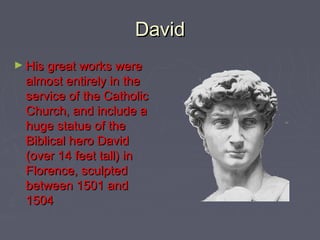
David
► His great works were
  almost entirely in the
  service of the Catholic
  Church, and include a
  huge statue of the
  Biblical hero David
  (over 14 feet tall) in
  Florence, sculpted
  between 1501 and
  1504
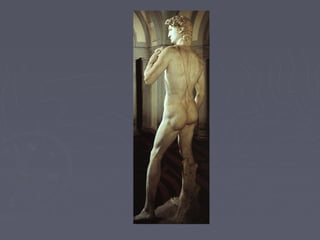
► David
 Gigantic marble, started in 1501 and completed in
 1504
 Michelangelo began work on the colossal figure of
 David in 1501, and by 1504 the sculpture
 (standing at 4.34m/14 ft 3 in tall) was in place
 outside the Palazzo Vecchio. The choice of David
 was supposed to reflect the power and
 determination of Republican Florence and was
 under constant attack from supporters of the
 usurped Medicis. In the 19th century the statue
 was moved to the Accademia.
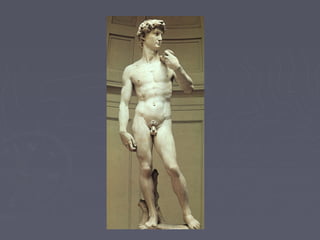
► The high point of Michelangelo's early style is the
  gigantic (4.34 m/14.24 ft) marble David
  (Accademia, Florence), which he produced
  between 1501 and 1504, after returning to
  Florence. The Old Testament hero is depicted by
  Michelangelo as a lithe nude youth, muscular and
  alert, looking off into the distance as if sizing up
  the enemy Goliath, whom he has not yet
  encountered. The fiery intensity of David's facial
  expression is termed terribilità, a feature
  characteristic of many of Michelangelo's figures
  and of his own personality. David, Michelangelo's
  most famous sculpture, became the symbol of
  Florence and originally was placed in the Piazza
  della Signoria in front of the Palazzo Vecchio, the
  Florentine town hall.
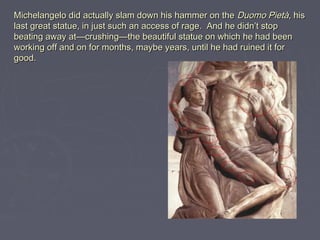
Michelangelo did actually slam down his hammer on the Duomo Pietà, his
last great statue, in just such an access of rage.  And he didn’t stop
beating away at—crushing—the beautiful statue on which he had been
working off and on for months, maybe years, until he had ruined it for
good.
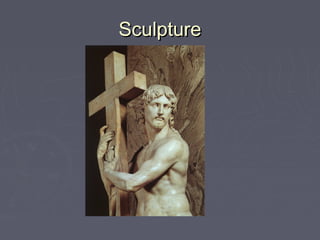
Sculpture
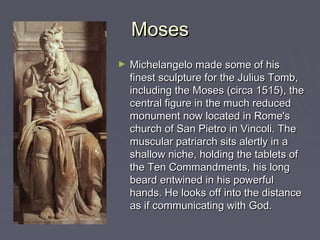
Moses
►   Michelangelo made some of his
    finest sculpture for the Julius Tomb,
    including the Moses (circa 1515), the
    central figure in the much reduced
    monument now located in Rome's
    church of San Pietro in Vincoli. The
    muscular patriarch sits alertly in a
    shallow niche, holding the tablets of
    the Ten Commandments, his long
    beard entwined in his powerful
    hands. He looks off into the distance
    as if communicating with God.
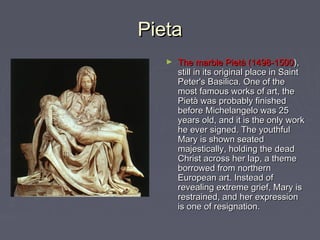
Pieta
   ►   The marble Pietà (1498-1500),
       still in its original place in Saint
       Peter's Basilica. One of the
       most famous works of art, the
       Pietà was probably finished
       before Michelangelo was 25
       years old, and it is the only work
       he ever signed. The youthful
       Mary is shown seated
       majestically, holding the dead
       Christ across her lap, a theme
       borrowed from northern
       European art. Instead of
       revealing extreme grief, Mary is
       restrained, and her expression
       is one of resignation.
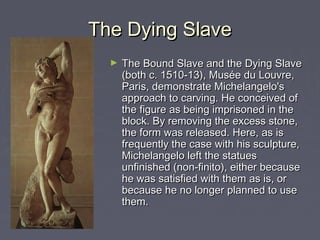
The Dying Slave
  ►   The Bound Slave and the Dying Slave
      (both c. 1510-13), Musée du Louvre,
      Paris, demonstrate Michelangelo's
      approach to carving. He conceived of
      the figure as being imprisoned in the
      block. By removing the excess stone,
      the form was released. Here, as is
      frequently the case with his sculpture,
      Michelangelo left the statues
      unfinished (non-finito), either because
      he was satisfied with them as is, or
      because he no longer planned to use
      them.
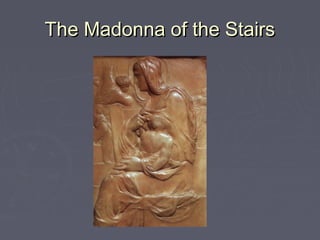
The Madonna of the Stairs
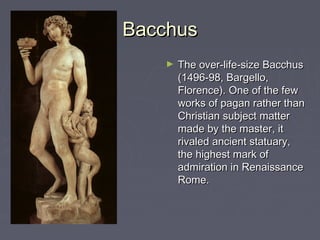
Bacchus
   ►   The over-life-size Bacchus
       (1496-98, Bargello,
       Florence). One of the few
       works of pagan rather than
       Christian subject matter
       made by the master, it
       rivaled ancient statuary,
       the highest mark of
       admiration in Renaissance
       Rome.
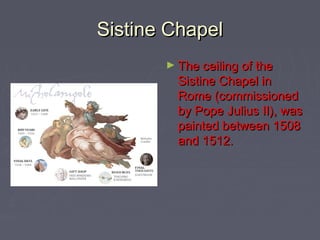
Sistine Chapel
       ► The ceiling of the
         Sistine Chapel in
         Rome (commissioned
         by Pope Julius II), was
         painted between 1508
         and 1512.
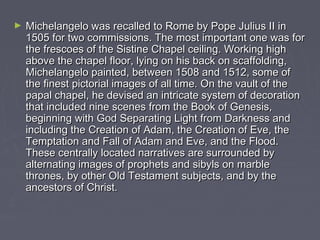
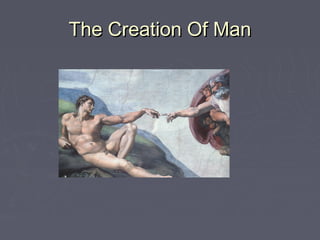
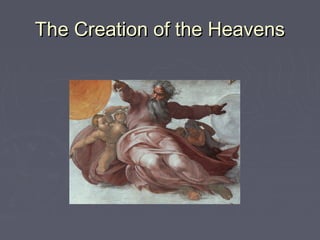
►   Michelangelo was recalled to Rome by Pope Julius II in
    1505 for two commissions. The most important one was for
    the frescoes of the Sistine Chapel ceiling. Working high
    above the chapel floor, lying on his back on scaffolding,
    Michelangelo painted, between 1508 and 1512, some of
    the finest pictorial images of all time. On the vault of the
    papal chapel, he devised an intricate system of decoration
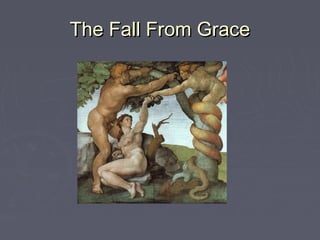
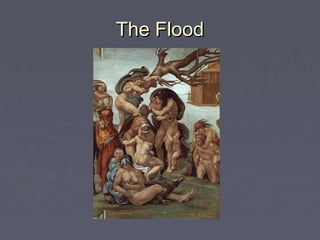
    that included nine scenes from the Book of Genesis,
    beginning with God Separating Light from Darkness and
    including the Creation of Adam, the Creation of Eve, the
    Temptation and Fall of Adam and Eve, and the Flood.
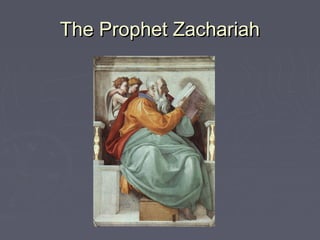
    These centrally located narratives are surrounded by
    alternating images of prophets and sibyls on marble
    thrones, by other Old Testament subjects, and by the
    ancestors of Christ.
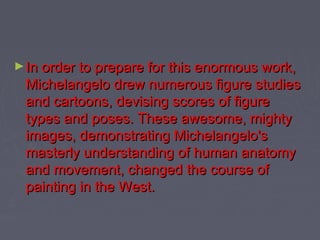
► In order to prepare for this enormous work,
 Michelangelo drew numerous figure studies
 and cartoons, devising scores of figure
 types and poses. These awesome, mighty
 images, demonstrating Michelangelo's
 masterly understanding of human anatomy
 and movement, changed the course of
 painting in the West.
The Creation Of Man
The Creation of the Heavens
The Erythraean Sibyl
The Fall From Grace
The Flood
The Prophet Zachariah
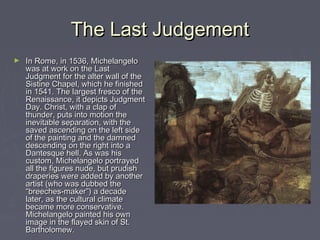
The Last Judgement
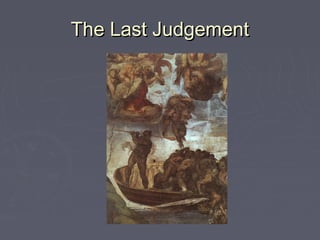
►   In Rome, in 1536, Michelangelo
    was at work on the Last
    Judgment for the alter wall of the
    Sistine Chapel, which he finished
    in 1541. The largest fresco of the
    Renaissance, it depicts Judgment
    Day. Christ, with a clap of
    thunder, puts into motion the
    inevitable separation, with the
    saved ascending on the left side
    of the painting and the damned
    descending on the right into a
    Dantesque hell. As was his
    custom, Michelangelo portrayed
    all the figures nude, but prudish
    draperies were added by another
    artist (who was dubbed the
    “breeches-maker”) a decade
    later, as the cultural climate
    became more conservative.
    Michelangelo painted his own
    image in the flayed skin of St.
    Bartholomew.
The Last Judgement
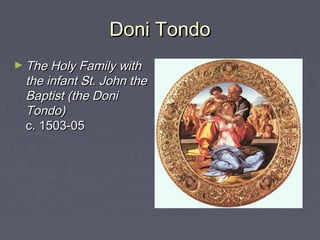
Doni Tondo
► The Holy Family with
  the infant St. John the
  Baptist (the Doni
  Tondo)
  c. 1503-05
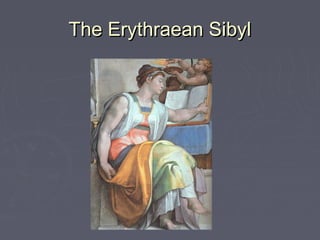
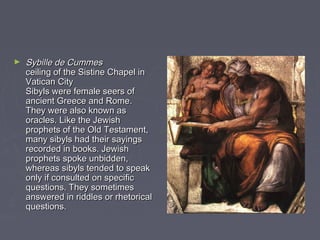
►   Sybille de Cummes
    ceiling of the Sistine Chapel in
    Vatican City
    Sibyls were female seers of
    ancient Greece and Rome.
    They were also known as
    oracles. Like the Jewish
    prophets of the Old Testament,
    many sibyls had their sayings
    recorded in books. Jewish
    prophets spoke unbidden,
    whereas sibyls tended to speak
    only if consulted on specific
    questions. They sometimes

    answered in riddles or rhetorical
    questions.
Sistine Chapel Virtual Tour
► http://mv.vatican.va/3_EN/pages/x-
 Pano/CSN/Visit_CSN_Main.html
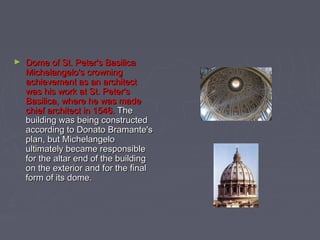
►   Dome of St. Peter's Basilica
    Michelangelo's crowning
    achievement as an architect
    was his work at St. Peter's
    Basilica, where he was made
    chief architect in 1546. The
    building was being constructed
    according to Donato Bramante's
    plan, but Michelangelo
    ultimately became responsible
    for the altar end of the building
    on the exterior and for the final
    form of its dome.
Michelangelo's Achievements
►
    During his long lifetime, Michelangelo was an
    intimate of princes and popes, from Lorenzo de'
    Medici to Leo X, Clement VIII, and Pius III, as well
    as cardinals, painters, and poets. Neither easy to
    get along with nor easy to understand, he
    expressed his view of himself and the world even
    more directly in his poetry than in the other arts.
    Much of his verse deals with art and the hardships
    he underwent, or with Neoplatonic philosophy and
    personal relationships.
► The great Renaissance poet Ludovico Ariosto
  wrote succinctly of this famous artist: “Michael
  more than mortal, divine angel.” Indeed,
  Michelangelo was widely awarded the
  epithet“divine” because of his extraordinary
  accomplishments. Two generations of Italian
  painters and sculptors were impressed by his
  treatment of the human figure: Raphael, Annabale
  Carracci, Pontormo, Rosso Fiorentino, Sebastiano
  del Piombo, and Titian. His dome for St. Peter's
  became the symbol of authority, as well as the
  model, for domes all over the Western world; the
  majority of state capitol buildings in the U.S., as
  well as the Capitol in Washington, D.C., are
  derived from it.
End Slide Show
► Presented by: bruceblackart.com

Michelangelo

  • 1.
  • 2.
    Michelangelo Buonarroti ► Perhapsthe greatest influence on western art in the last five centuries, Michelangelo was an Italian sculptor, architect, painter and poet in the period known as the High Renaissance. Along with contemporaries Leonardo da Vinci and Raphael, he is considered one of the greatest masters in the history of European art.
  • 3.
    Biography ► Michelangelo wasone of the most inspired creators in the history of art and, with Leonardo da Vinci, the most potent force in the Italian High Renaissance. As a sculptor, architect, painter, and poet, he exerted a tremendous influence on his contemporaries and on subsequent Western art in general.
  • 4.
    ► A Florentine—althoughborn March 6, 1475, in the small village of Caprese near Arezzo— Michelangelo continued to have a deep attachment to his city, its art, and its culture throughout his long life. He spent the greater part of his adulthood in Rome, employed by the popes; characteristically, however, he left instructions that he be buried in Florence, and his body was placed there in a fine monument in the church of Santa Croce.
  • 5.
    David ► His greatworks were almost entirely in the service of the Catholic Church, and include a huge statue of the Biblical hero David (over 14 feet tall) in Florence, sculpted between 1501 and 1504
  • 6.
    ► David Giganticmarble, started in 1501 and completed in 1504 Michelangelo began work on the colossal figure of David in 1501, and by 1504 the sculpture (standing at 4.34m/14 ft 3 in tall) was in place outside the Palazzo Vecchio. The choice of David was supposed to reflect the power and determination of Republican Florence and was under constant attack from supporters of the usurped Medicis. In the 19th century the statue was moved to the Accademia.
  • 7.
    ► The highpoint of Michelangelo's early style is the gigantic (4.34 m/14.24 ft) marble David (Accademia, Florence), which he produced between 1501 and 1504, after returning to Florence. The Old Testament hero is depicted by Michelangelo as a lithe nude youth, muscular and alert, looking off into the distance as if sizing up the enemy Goliath, whom he has not yet encountered. The fiery intensity of David's facial expression is termed terribilità, a feature characteristic of many of Michelangelo's figures and of his own personality. David, Michelangelo's most famous sculpture, became the symbol of Florence and originally was placed in the Piazza della Signoria in front of the Palazzo Vecchio, the Florentine town hall.
  • 8.
    Michelangelo did actuallyslam down his hammer on the Duomo Pietà, his last great statue, in just such an access of rage.  And he didn’t stop beating away at—crushing—the beautiful statue on which he had been working off and on for months, maybe years, until he had ruined it for good.
  • 11.
  • 12.
    Moses ► Michelangelo made some of his finest sculpture for the Julius Tomb, including the Moses (circa 1515), the central figure in the much reduced monument now located in Rome's church of San Pietro in Vincoli. The muscular patriarch sits alertly in a shallow niche, holding the tablets of the Ten Commandments, his long beard entwined in his powerful hands. He looks off into the distance as if communicating with God.
  • 13.
    Pieta ► The marble Pietà (1498-1500), still in its original place in Saint Peter's Basilica. One of the most famous works of art, the Pietà was probably finished before Michelangelo was 25 years old, and it is the only work he ever signed. The youthful Mary is shown seated majestically, holding the dead Christ across her lap, a theme borrowed from northern European art. Instead of revealing extreme grief, Mary is restrained, and her expression is one of resignation.
  • 14.
    The Dying Slave ► The Bound Slave and the Dying Slave (both c. 1510-13), Musée du Louvre, Paris, demonstrate Michelangelo's approach to carving. He conceived of the figure as being imprisoned in the block. By removing the excess stone, the form was released. Here, as is frequently the case with his sculpture, Michelangelo left the statues unfinished (non-finito), either because he was satisfied with them as is, or because he no longer planned to use them.
  • 15.
    The Madonna ofthe Stairs
  • 16.
    Bacchus ► The over-life-size Bacchus (1496-98, Bargello, Florence). One of the few works of pagan rather than Christian subject matter made by the master, it rivaled ancient statuary, the highest mark of admiration in Renaissance Rome.
  • 17.
    Sistine Chapel ► The ceiling of the Sistine Chapel in Rome (commissioned by Pope Julius II), was painted between 1508 and 1512.
  • 18.
    Michelangelo was recalled to Rome by Pope Julius II in 1505 for two commissions. The most important one was for the frescoes of the Sistine Chapel ceiling. Working high above the chapel floor, lying on his back on scaffolding, Michelangelo painted, between 1508 and 1512, some of the finest pictorial images of all time. On the vault of the papal chapel, he devised an intricate system of decoration that included nine scenes from the Book of Genesis, beginning with God Separating Light from Darkness and including the Creation of Adam, the Creation of Eve, the Temptation and Fall of Adam and Eve, and the Flood. These centrally located narratives are surrounded by alternating images of prophets and sibyls on marble thrones, by other Old Testament subjects, and by the ancestors of Christ.
  • 19.
    ► In orderto prepare for this enormous work, Michelangelo drew numerous figure studies and cartoons, devising scores of figure types and poses. These awesome, mighty images, demonstrating Michelangelo's masterly understanding of human anatomy and movement, changed the course of painting in the West.
  • 20.
  • 21.
    The Creation ofthe Heavens
  • 22.
  • 23.
  • 24.
  • 25.
  • 26.
    The Last Judgement ► In Rome, in 1536, Michelangelo was at work on the Last Judgment for the alter wall of the Sistine Chapel, which he finished in 1541. The largest fresco of the Renaissance, it depicts Judgment Day. Christ, with a clap of thunder, puts into motion the inevitable separation, with the saved ascending on the left side of the painting and the damned descending on the right into a Dantesque hell. As was his custom, Michelangelo portrayed all the figures nude, but prudish draperies were added by another artist (who was dubbed the “breeches-maker”) a decade later, as the cultural climate became more conservative. Michelangelo painted his own image in the flayed skin of St. Bartholomew.
  • 27.
  • 28.
    Doni Tondo ► TheHoly Family with the infant St. John the Baptist (the Doni Tondo) c. 1503-05
  • 29.
    Sybille de Cummes ceiling of the Sistine Chapel in Vatican City Sibyls were female seers of ancient Greece and Rome. They were also known as oracles. Like the Jewish prophets of the Old Testament, many sibyls had their sayings recorded in books. Jewish prophets spoke unbidden, whereas sibyls tended to speak only if consulted on specific questions. They sometimes answered in riddles or rhetorical questions.
  • 30.
    Sistine Chapel VirtualTour ► http://mv.vatican.va/3_EN/pages/x- Pano/CSN/Visit_CSN_Main.html
  • 31.
    Dome of St. Peter's Basilica Michelangelo's crowning achievement as an architect was his work at St. Peter's Basilica, where he was made chief architect in 1546. The building was being constructed according to Donato Bramante's plan, but Michelangelo ultimately became responsible for the altar end of the building on the exterior and for the final form of its dome.
  • 32.
    Michelangelo's Achievements ► During his long lifetime, Michelangelo was an intimate of princes and popes, from Lorenzo de' Medici to Leo X, Clement VIII, and Pius III, as well as cardinals, painters, and poets. Neither easy to get along with nor easy to understand, he expressed his view of himself and the world even more directly in his poetry than in the other arts. Much of his verse deals with art and the hardships he underwent, or with Neoplatonic philosophy and personal relationships.
  • 33.
    ► The greatRenaissance poet Ludovico Ariosto wrote succinctly of this famous artist: “Michael more than mortal, divine angel.” Indeed, Michelangelo was widely awarded the epithet“divine” because of his extraordinary accomplishments. Two generations of Italian painters and sculptors were impressed by his treatment of the human figure: Raphael, Annabale Carracci, Pontormo, Rosso Fiorentino, Sebastiano del Piombo, and Titian. His dome for St. Peter's became the symbol of authority, as well as the model, for domes all over the Western world; the majority of state capitol buildings in the U.S., as well as the Capitol in Washington, D.C., are derived from it.
  • 34.
    End Slide Show ►Presented by: bruceblackart.com