Renaissance Painting
Revision
Renaissance Painting
• Naturalism:

– people must be represented as they are
– observation is essential

• Rationalism:

– Things are represented following the reason
– Use of perspective and backgrounds

• Universalism:

– Subjects general for any culture
– Related to human beings
Renaissance Painting
• Idealisation:
– Characters are idealised
– They do not have deformations

• Order, proportion and harmony:
– Things transmit calm and serenity

• Perfection:
– Works perfectly finished
– Attention to the small detail
Renaissance Painting
• Supports

– Wall painting was frequent in Italy; mosaic
left way to mural painting in Venice
– Even if the canvas advanced, wood was of
frequent use
– Poliptics were common in Spain and
Northern Europe whereas in Italy they
used an only panel.
Renaissance Painting
• Techniques:
– In Italy the fresco continued
– Book illumination lost importance with the printed
books
– Engraving on wood and on copper developed
– Drawing became more important
– Temple was replaced by oil systematically
Renaissance Painting
• Gaiak:
• Themes:
– Religious continued being important, mainly
in Northern Europe and Spain.
– In Italy mythology was more important
– Portrait developed
– Landscape, without being independent,
acquired more importance in the paintings
Renaissance Painting
• Composition:
– Space was rationalised with the resource to lineal
and atmospheric perspective
– The organization of the painting put more
attention in the centre than in the periphery
– Sometimes the shapes are organised following
simple shapes.
– The background used traditional motives or
architectures of Roman inspiration.
Renaissance Painting
• Drawing, colour and brushstroke:
– Gold disappeared, the same as light colours in the
strategic areas of the painting
– Palette diversified, being commonly light
– Oil painting permitted the use of delicate nuances
(transparencies, luminosity)
– Triumph of the sfumato.
Mannerism Painting
• Images:
– Faces are full of a new realism
– Bodies must be convinced by the imitation of real
forms.
– Worry for idealization, especially in nudes, using
canons of beauty
– The normalisation of beauty led to the apparition
of their antagonists, with grotesque or
caricaturized images.
Mannerism Painting
• Technique and support:
– Are the same as those of the Renaissance
– Format of paintings:
• Big in churches and palaces
• Small for stamps

• Themes:
– Religious were frequent
– Mythology and allegory depiction improved
– Portrait developed more
Mannerism Painting
• Composition, drawing, colour and
brushstrokes:
–
–
–
–

Everything tried to create surprise
Compositions are not centred
Colours are not common
Images are numerous

• Images:
– They try to surprise
– Deformations and complicated lines
Renaissance painters
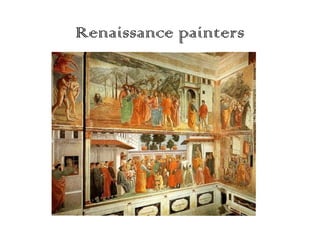
• Massacio:
–
–
–
–
–

Material characters with power and dignity
Perfection of detail
Sense of tactile values
He painted frescoes
Works: Brancaci Chapel
Renaissance painters
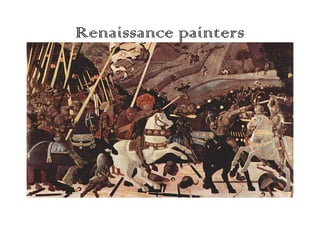
• Ucello:
– Famous for his paintings that remain
medieval period
– Interested in perspective
– Figures appeared solid and real
– He did not know how to use light and
shade
– Preocupation with applied geometry
– Works: San Romano’s Battle
Renaissance painters
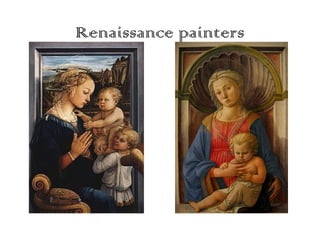
• Filippo Lippi:
–
–
–
–
–
–

Author of crowded fresco scenes
Madonnas and saints holy, serene
His works were more naturalistic with the time.
He used tempera.
Work of precision, depth and fluidity
Works: Madonna
Renaissance painters
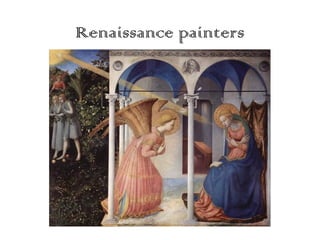
• Fra Angelico:
– He used a simple style, sacrificing
perspective to it.
– He produced many frescoes
– His works are elegant and delicate
– Works: Annunciation, frescoes at San
Marco’s convent.
Renaissance painters
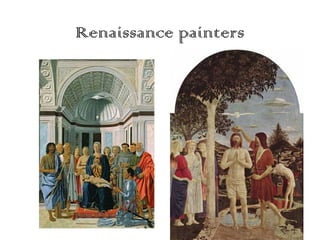
• Piero della Francesca

– Perspective and geometry are dominant
in his works
– He liked to organise large, plain masses
of colour in patters which suggest and
underlyin geometrical scheme
– Light palette
– Large areas of white or near-white
– Works: The Baptism of Christ, The
Nativity.
Renaissance painters
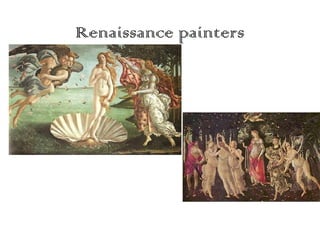
• Botticelli
– Individual and graceful style
– Pure visual poetry
– Denial of rational spatial construction and no
attempt to model solid-looking figures
– Figures float on the forward plane, agains a
decorative landscape
– Form outlined
– Personal type of femenine beauty
– Works: The Spring, The Birth of Venus
Renaissance painters
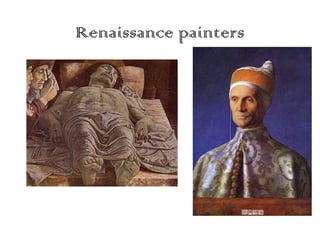
• Mantegna
–
–
–
–

Mastery of perspective
Adapt the scene to low viewpoint
Scorzo
Works: Death Christ

• Bellini

– Famous for his portraits
– Large-scale narrative paintings
– Works: Portrait of the Dux
Renaissance painters
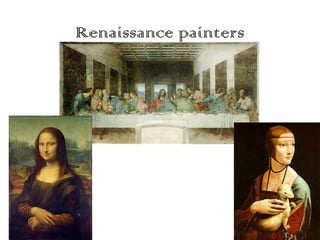
• Leonardo
– Delicate treatment of the characters
portrayed
– Lack of rigidity in the contours
– Sfumato or special way of changing colours,
covering them with shadows
– Direct gazes of enigmatic meaning
– Variety of techniques not always successful
– Works: Mona Lisa, The Virgin of the Rocks,
Saint John
Renaissance painters
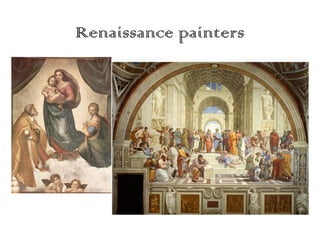
• Raphael

– Clear organization of the composition
– Avoidance of excessive detail
– Expansive style of composition which presented
itself as a homogeneous and easily intellegible
whole
– Painting was no longer to be a portrayal of an event
but an interpretation of its subject-matter
– He adopted the innovations of Leonardo and
Michelangelo
– Works: The Athens School, Madonna Sixtina, The
Weddings of the Virgin.
Renaissance painters
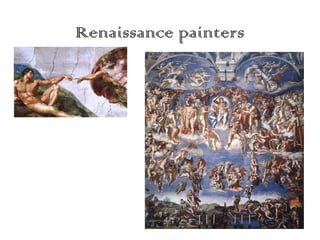
• Michelangelo
– His characters are depicted in an sculptoric
way, with an important entity
– Images are full of movement
– Characteristic terribilitá
– Richness of colours, light in general
– Works: Ceiling of the Sixtine Chapel, Panel
of the Last Judgement, Tondo Doni
Renaissance painters
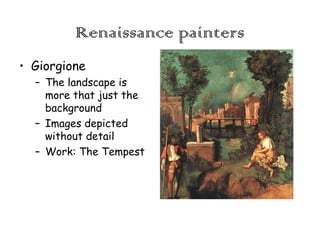
• Giorgione
– The landscape is
more that just the
background
– Images depicted
without detail
– Work: The Tempest
Renaissance painters
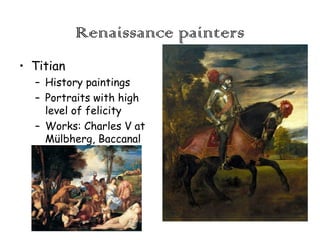
• Titian
– History paintings
– Portraits with high
level of felicity
– Works: Charles V at
Mülbherg, Baccanal
Renaissance painters
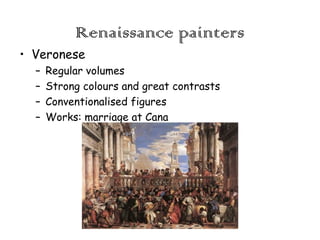
• Veronese
–
–
–
–

Regular volumes
Strong colours and great contrasts
Conventionalised figures
Works: marriage at Cana
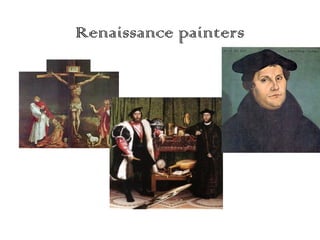
Renaissance painters
• Dürer
– The greatest artist of Northern
Renaissance
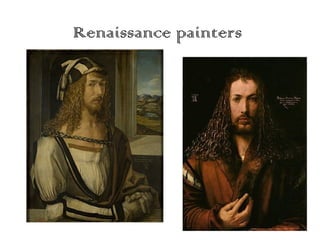
– First author who painted self-portraits
– Woodcuts and engravings
– Author of magnificent altarpieces and
powerful portraits
– Diversity of subjects in his watercolours
– Works: Adan and Eve, Self-portrait
Renaissance painters
• Grünewald
• Grünewald

– Religious paintings of visionary expressiveness
– Intense colours and agitated lines
– Work: The Isenheim Altarpiece

• Holbeing the Younger
–
–
–
–

Excellent portratist
Portraits do not reveal the personality
Taste for illusionist effects
Works: Henry VIII , The Ambassadors

• Cranach the Elder

– Portraits and female nudes
– Works: Luther, Duke Henry of Saxony
Renaissance painters
• Yañez de la Almedina
– Introduced the High Renaissance in Spain

• Masip
– Combined Italian and Netherlandish influences

• Juan de Juanes
– Ideal Counter-Reformation images
– Influences of Leonardo and Raphael
– Sfumato effects
Renaissance painters
Mannerism painters
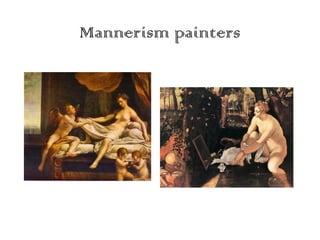
• Corregio
– Conscious elegance, soft sfumato and gestures of
captivating charm
– Sensuous mythologies, as his Venuses

• Tintoretto
– Figures full of heath
– Effects of light and shadow
– Colossal conception of the human but with elegance
Mannerism painters
Mannerism painters
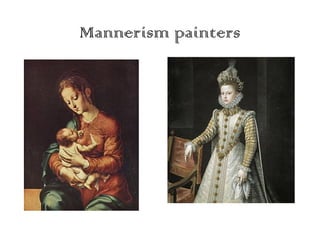
• Morales
– Devotional images influenced by Leonardo

• Sanchez Coello
– Pioneer of the Spanish portrait painting
– Ease of pose and execution, dignity and
sobriety and warmth of colouring
Mannerism painters
Mannerism painters
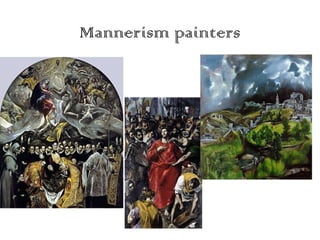
• El Greco
– Influenced by the mysticism of CounterReformation
– Elongated figures
– Intense and unusual colour
– Ardour and energy
Mannerism painters

Renaissance painting

  • 1.
  • 2.
    Renaissance Painting • Naturalism: –people must be represented as they are – observation is essential • Rationalism: – Things are represented following the reason – Use of perspective and backgrounds • Universalism: – Subjects general for any culture – Related to human beings
  • 3.
    Renaissance Painting • Idealisation: –Characters are idealised – They do not have deformations • Order, proportion and harmony: – Things transmit calm and serenity • Perfection: – Works perfectly finished – Attention to the small detail
  • 4.
    Renaissance Painting • Supports –Wall painting was frequent in Italy; mosaic left way to mural painting in Venice – Even if the canvas advanced, wood was of frequent use – Poliptics were common in Spain and Northern Europe whereas in Italy they used an only panel.
  • 5.
    Renaissance Painting • Techniques: –In Italy the fresco continued – Book illumination lost importance with the printed books – Engraving on wood and on copper developed – Drawing became more important – Temple was replaced by oil systematically
  • 6.
    Renaissance Painting • Gaiak: •Themes: – Religious continued being important, mainly in Northern Europe and Spain. – In Italy mythology was more important – Portrait developed – Landscape, without being independent, acquired more importance in the paintings
  • 7.
    Renaissance Painting • Composition: –Space was rationalised with the resource to lineal and atmospheric perspective – The organization of the painting put more attention in the centre than in the periphery – Sometimes the shapes are organised following simple shapes. – The background used traditional motives or architectures of Roman inspiration.
  • 8.
    Renaissance Painting • Drawing,colour and brushstroke: – Gold disappeared, the same as light colours in the strategic areas of the painting – Palette diversified, being commonly light – Oil painting permitted the use of delicate nuances (transparencies, luminosity) – Triumph of the sfumato.
  • 9.
    Mannerism Painting • Images: –Faces are full of a new realism – Bodies must be convinced by the imitation of real forms. – Worry for idealization, especially in nudes, using canons of beauty – The normalisation of beauty led to the apparition of their antagonists, with grotesque or caricaturized images.
  • 10.
    Mannerism Painting • Techniqueand support: – Are the same as those of the Renaissance – Format of paintings: • Big in churches and palaces • Small for stamps • Themes: – Religious were frequent – Mythology and allegory depiction improved – Portrait developed more
  • 11.
    Mannerism Painting • Composition,drawing, colour and brushstrokes: – – – – Everything tried to create surprise Compositions are not centred Colours are not common Images are numerous • Images: – They try to surprise – Deformations and complicated lines
  • 12.
    Renaissance painters • Massacio: – – – – – Materialcharacters with power and dignity Perfection of detail Sense of tactile values He painted frescoes Works: Brancaci Chapel
  • 13.
  • 14.
    Renaissance painters • Ucello: –Famous for his paintings that remain medieval period – Interested in perspective – Figures appeared solid and real – He did not know how to use light and shade – Preocupation with applied geometry – Works: San Romano’s Battle
  • 15.
  • 16.
    Renaissance painters • FilippoLippi: – – – – – – Author of crowded fresco scenes Madonnas and saints holy, serene His works were more naturalistic with the time. He used tempera. Work of precision, depth and fluidity Works: Madonna
  • 17.
  • 18.
    Renaissance painters • FraAngelico: – He used a simple style, sacrificing perspective to it. – He produced many frescoes – His works are elegant and delicate – Works: Annunciation, frescoes at San Marco’s convent.
  • 19.
  • 20.
    Renaissance painters • Pierodella Francesca – Perspective and geometry are dominant in his works – He liked to organise large, plain masses of colour in patters which suggest and underlyin geometrical scheme – Light palette – Large areas of white or near-white – Works: The Baptism of Christ, The Nativity.
  • 21.
  • 22.
    Renaissance painters • Botticelli –Individual and graceful style – Pure visual poetry – Denial of rational spatial construction and no attempt to model solid-looking figures – Figures float on the forward plane, agains a decorative landscape – Form outlined – Personal type of femenine beauty – Works: The Spring, The Birth of Venus
  • 23.
  • 24.
    Renaissance painters • Mantegna – – – – Masteryof perspective Adapt the scene to low viewpoint Scorzo Works: Death Christ • Bellini – Famous for his portraits – Large-scale narrative paintings – Works: Portrait of the Dux
  • 25.
  • 26.
    Renaissance painters • Leonardo –Delicate treatment of the characters portrayed – Lack of rigidity in the contours – Sfumato or special way of changing colours, covering them with shadows – Direct gazes of enigmatic meaning – Variety of techniques not always successful – Works: Mona Lisa, The Virgin of the Rocks, Saint John
  • 27.
  • 28.
    Renaissance painters • Raphael –Clear organization of the composition – Avoidance of excessive detail – Expansive style of composition which presented itself as a homogeneous and easily intellegible whole – Painting was no longer to be a portrayal of an event but an interpretation of its subject-matter – He adopted the innovations of Leonardo and Michelangelo – Works: The Athens School, Madonna Sixtina, The Weddings of the Virgin.
  • 29.
  • 30.
    Renaissance painters • Michelangelo –His characters are depicted in an sculptoric way, with an important entity – Images are full of movement – Characteristic terribilitá – Richness of colours, light in general – Works: Ceiling of the Sixtine Chapel, Panel of the Last Judgement, Tondo Doni
  • 31.
  • 32.
    Renaissance painters • Giorgione –The landscape is more that just the background – Images depicted without detail – Work: The Tempest
  • 33.
    Renaissance painters • Titian –History paintings – Portraits with high level of felicity – Works: Charles V at Mülbherg, Baccanal
  • 34.
    Renaissance painters • Veronese – – – – Regularvolumes Strong colours and great contrasts Conventionalised figures Works: marriage at Cana
  • 35.
    Renaissance painters • Dürer –The greatest artist of Northern Renaissance – First author who painted self-portraits – Woodcuts and engravings – Author of magnificent altarpieces and powerful portraits – Diversity of subjects in his watercolours – Works: Adan and Eve, Self-portrait
  • 36.
  • 37.
    Renaissance painters • Grünewald •Grünewald – Religious paintings of visionary expressiveness – Intense colours and agitated lines – Work: The Isenheim Altarpiece • Holbeing the Younger – – – – Excellent portratist Portraits do not reveal the personality Taste for illusionist effects Works: Henry VIII , The Ambassadors • Cranach the Elder – Portraits and female nudes – Works: Luther, Duke Henry of Saxony
  • 38.
  • 39.
    Renaissance painters • Yañezde la Almedina – Introduced the High Renaissance in Spain • Masip – Combined Italian and Netherlandish influences • Juan de Juanes – Ideal Counter-Reformation images – Influences of Leonardo and Raphael – Sfumato effects
  • 40.
  • 41.
    Mannerism painters • Corregio –Conscious elegance, soft sfumato and gestures of captivating charm – Sensuous mythologies, as his Venuses • Tintoretto – Figures full of heath – Effects of light and shadow – Colossal conception of the human but with elegance
  • 42.
  • 43.
    Mannerism painters • Morales –Devotional images influenced by Leonardo • Sanchez Coello – Pioneer of the Spanish portrait painting – Ease of pose and execution, dignity and sobriety and warmth of colouring
  • 44.
  • 45.
    Mannerism painters • ElGreco – Influenced by the mysticism of CounterReformation – Elongated figures – Intense and unusual colour – Ardour and energy
  • 46.