+


    Propaganda
+
    What is Propaganda?

       The manipulation of public
        opinion.

       An attempt to change opinions
        by persuasively presenting new
        ones.

       Can range from Public Service
        Announcements to Political
        Campaign Ads.
+
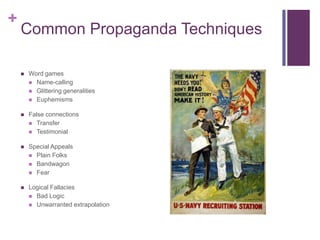
    Common Propaganda Techniques

       Word games
         Name-calling
         Glittering generalities
         Euphemisms


       False connections
         Transfer
         Testimonial


       Special Appeals
         Plain Folks
         Bandwagon
         Fear


       Logical Fallacies
         Bad Logic
         Unwarranted extrapolation
+
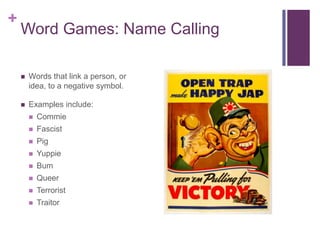
    Word Games: Name Calling

       Words that link a person, or
        idea, to a negative symbol.

       Examples include:
           Commie
           Fascist
           Pig
           Yuppie
           Bum
           Queer
           Terrorist
           Traitor
+
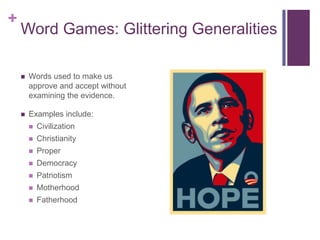
    Word Games: Glittering Generalities

       Words used to make us
        approve and accept without
        examining the evidence.

       Examples include:
           Civilization
           Christianity
           Proper
           Democracy
           Patriotism
           Motherhood
           Fatherhood
+
    Word Games: Euphemisms

       Words used to pacify the
        audience in order to make an
        unpleasant reality more
        palatable.

       Examples include:
           Post-Traumatic Stress
            Disorder
           Collateral Damage
           Certified Pre-Owned
+
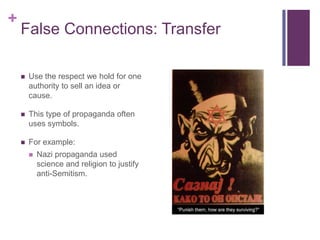
    False Connections: Transfer

       Use the respect we hold for one
        authority to sell an idea or
        cause.

       This type of propaganda often
        uses symbols.

       For example:
           Nazi propaganda used
            science and religion to justify
            anti-Semitism.
+
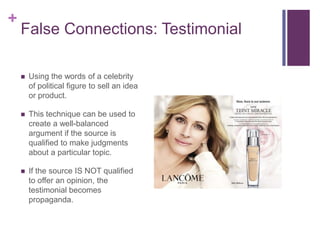
    False Connections: Testimonial

       Using the words of a celebrity
        of political figure to sell an idea
        or product.

       This technique can be used to
        create a well-balanced
        argument if the source is
        qualified to make judgments
        about a particular topic.

       If the source IS NOT qualified
        to offer an opinion, the
        testimonial becomes
        propaganda.
+
    Special Appeals: Plain Folks

       Used to convince the general
        audience the speaker is “one of
        them.”

       Examples include:
         Bill Clinton ate at McDonald's
          and confessed a fondness for
          trashy spy novels.
         George Bush Sr. hated
          broccoli, and loved to fish.
         Ronald Reagan was often
          photographed chopping wood.
         Jimmy Carter presented
          himself as a humble peanut
          farmer from Georgia.
+
    Special Appeals: Bandwagon

       “Everyone else is doing it, and
        so should you.”

       Appeals to people as a group,
        for example:
           Catholics
           Jews
           Housewives
           Farmers
+
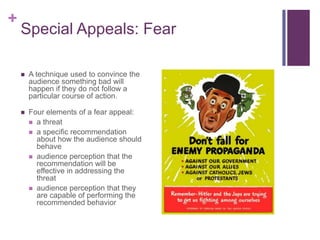
    Special Appeals: Fear

       A technique used to convince the
        audience something bad will
        happen if they do not follow a
        particular course of action.

       Four elements of a fear appeal:
         a threat
         a specific recommendation
          about how the audience should
          behave
         audience perception that the
          recommendation will be
          effective in addressing the
          threat
         audience perception that they
          are capable of performing the
          recommended behavior
+
    Logical Fallacies: Bad Logic

       Using an argument that makes huge predictions about the
        future on the basis of a few small facts.

       Examples include:
           If the United States approves NAFTA, the giant sucking sound that
            we hear will be the sound of thousands of jobs and factories
            disappearing to Mexico.
           The introduction of communication tools such as the Internet will
            lead to a radical decentralization of government, greater political
            participation, and a rebirth of community.
+
    Logical Fallacies: Unwarranted
    Extrapolation
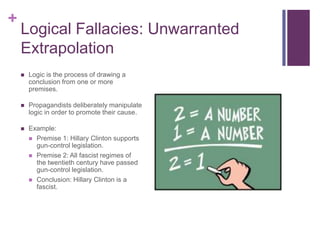
       Logic is the process of drawing a
        conclusion from one or more
        premises.

       Propagandists deliberately manipulate
        logic in order to promote their cause.

       Example:
         Premise 1: Hillary Clinton supports
          gun-control legislation.
         Premise 2: All fascist regimes of
          the twentieth century have passed
          gun-control legislation.
         Conclusion: Hillary Clinton is a
          fascist.
+
    10 Commandments of Propaganda
    (1937 - Institute for Propaganda Analysis)

       Divide and conquer                   Use "expert" testimonial.

       Tell the people what they want.      Always refer to the "authority"
                                              of your sources.
       The bigger the lie, the more
        people will believe it.              Stack the cards with
                                              "information."
       Always appeal to the lowest
        common denominator.                  A confused people are easily
                                              led.
       Generalize as much as
        possible.                            Get the "plain folks" onto the
                                              "bandwagon."

Propaganda

  • 1.
    + Propaganda
  • 2.
    + What is Propaganda?  The manipulation of public opinion.  An attempt to change opinions by persuasively presenting new ones.  Can range from Public Service Announcements to Political Campaign Ads.
  • 3.
    + Common Propaganda Techniques  Word games  Name-calling  Glittering generalities  Euphemisms  False connections  Transfer  Testimonial  Special Appeals  Plain Folks  Bandwagon  Fear  Logical Fallacies  Bad Logic  Unwarranted extrapolation
  • 4.
    + Word Games: Name Calling  Words that link a person, or idea, to a negative symbol.  Examples include:  Commie  Fascist  Pig  Yuppie  Bum  Queer  Terrorist  Traitor
  • 5.
    + Word Games: Glittering Generalities  Words used to make us approve and accept without examining the evidence.  Examples include:  Civilization  Christianity  Proper  Democracy  Patriotism  Motherhood  Fatherhood
  • 6.
    + Word Games: Euphemisms  Words used to pacify the audience in order to make an unpleasant reality more palatable.  Examples include:  Post-Traumatic Stress Disorder  Collateral Damage  Certified Pre-Owned
  • 7.
    + False Connections: Transfer  Use the respect we hold for one authority to sell an idea or cause.  This type of propaganda often uses symbols.  For example:  Nazi propaganda used science and religion to justify anti-Semitism.
  • 8.
    + False Connections: Testimonial  Using the words of a celebrity of political figure to sell an idea or product.  This technique can be used to create a well-balanced argument if the source is qualified to make judgments about a particular topic.  If the source IS NOT qualified to offer an opinion, the testimonial becomes propaganda.
  • 9.
    + Special Appeals: Plain Folks  Used to convince the general audience the speaker is “one of them.”  Examples include:  Bill Clinton ate at McDonald's and confessed a fondness for trashy spy novels.  George Bush Sr. hated broccoli, and loved to fish.  Ronald Reagan was often photographed chopping wood.  Jimmy Carter presented himself as a humble peanut farmer from Georgia.
  • 10.
    + Special Appeals: Bandwagon  “Everyone else is doing it, and so should you.”  Appeals to people as a group, for example:  Catholics  Jews  Housewives  Farmers
  • 11.
    + Special Appeals: Fear  A technique used to convince the audience something bad will happen if they do not follow a particular course of action.  Four elements of a fear appeal:  a threat  a specific recommendation about how the audience should behave  audience perception that the recommendation will be effective in addressing the threat  audience perception that they are capable of performing the recommended behavior
  • 12.
    + Logical Fallacies: Bad Logic  Using an argument that makes huge predictions about the future on the basis of a few small facts.  Examples include:  If the United States approves NAFTA, the giant sucking sound that we hear will be the sound of thousands of jobs and factories disappearing to Mexico.  The introduction of communication tools such as the Internet will lead to a radical decentralization of government, greater political participation, and a rebirth of community.
  • 13.
    + Logical Fallacies: Unwarranted Extrapolation  Logic is the process of drawing a conclusion from one or more premises.  Propagandists deliberately manipulate logic in order to promote their cause.  Example:  Premise 1: Hillary Clinton supports gun-control legislation.  Premise 2: All fascist regimes of the twentieth century have passed gun-control legislation.  Conclusion: Hillary Clinton is a fascist.
  • 14.
    + 10 Commandments of Propaganda (1937 - Institute for Propaganda Analysis)  Divide and conquer  Use "expert" testimonial.  Tell the people what they want.  Always refer to the "authority" of your sources.  The bigger the lie, the more people will believe it.  Stack the cards with "information."  Always appeal to the lowest common denominator.  A confused people are easily led.  Generalize as much as possible.  Get the "plain folks" onto the "bandwagon."