The Hydrological cycle

                        LO:
1. To learn key words and definitions relating to
   the hydrological cycle
2. To be able to explain if something is an
   input, output, store or transfer.
3. To be able to complete a hydrological cycle
   diagram
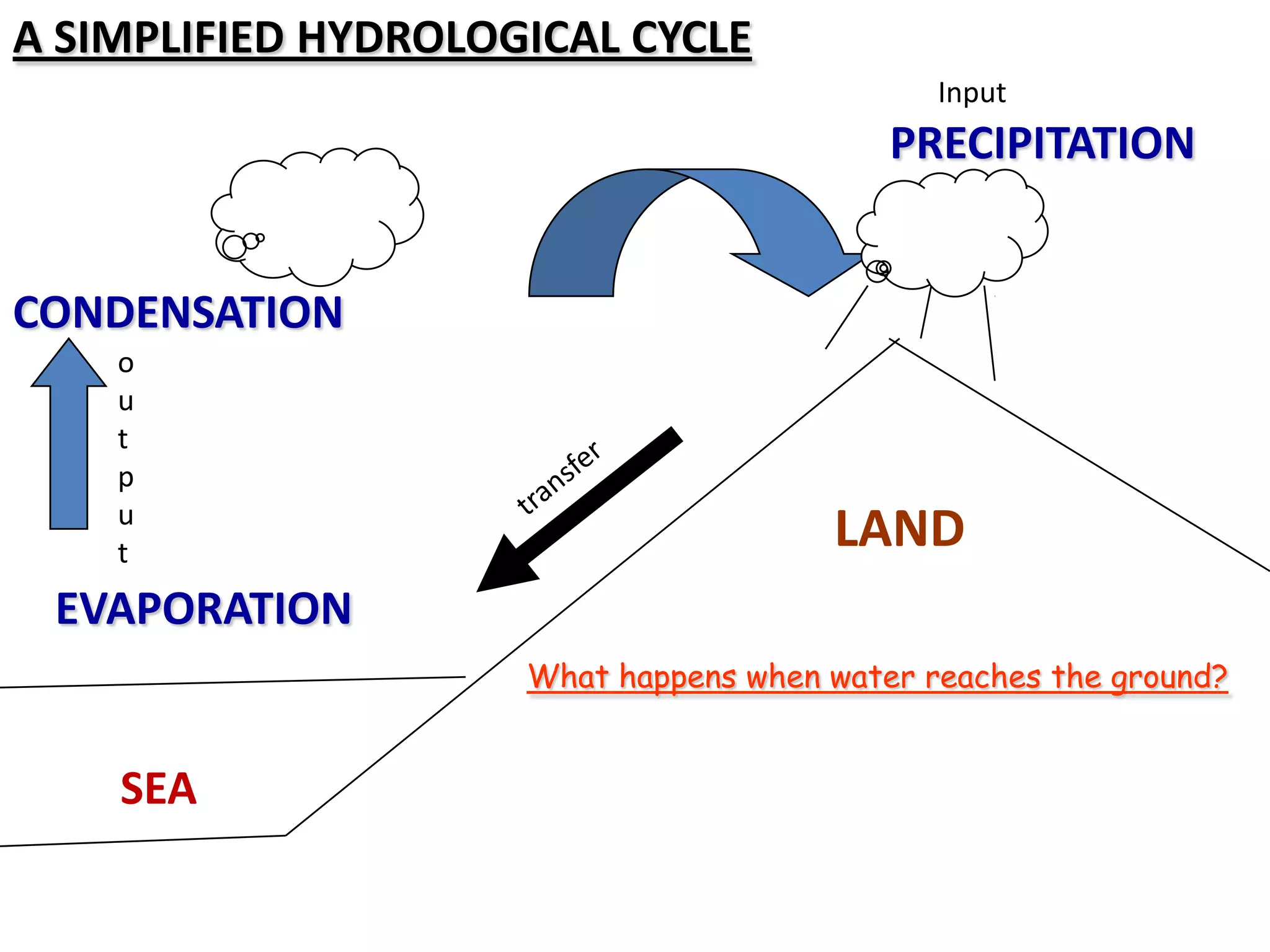
A SIMPLIFIED HYDROLOGICAL CYCLE
                                              Input
                                           PRECIPITATION


CONDENSATION
    o
    u
    t
    p
    u
    t
                                       LAND
 EVAPORATION
                     What happens when water reaches the ground?


    SEA
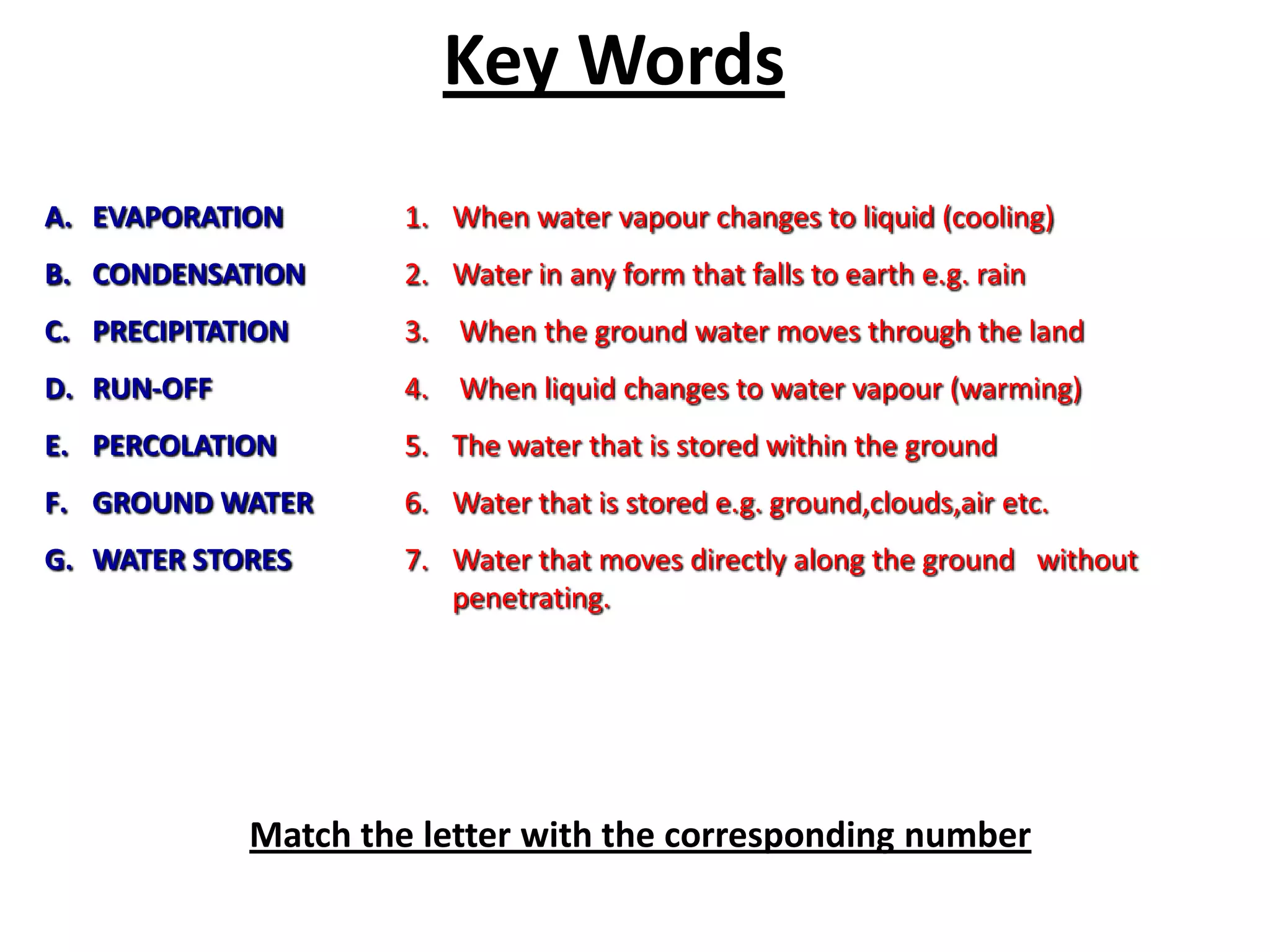
Key Words
A. EVAPORATION        1. When water vapour changes to liquid (cooling)
B. CONDENSATION       2. Water in any form that falls to earth e.g. rain
C. PRECIPITATION      3. When the ground water moves through the land
D. RUN-OFF            4. When liquid changes to water vapour (warming)
E. PERCOLATION        5. The water that is stored within the ground
F. GROUND WATER       6. Water that is stored e.g. ground,clouds,air etc.
G. WATER STORES       7. Water that moves directly along the ground without
                         penetrating.


             Match the letter with the corresponding number
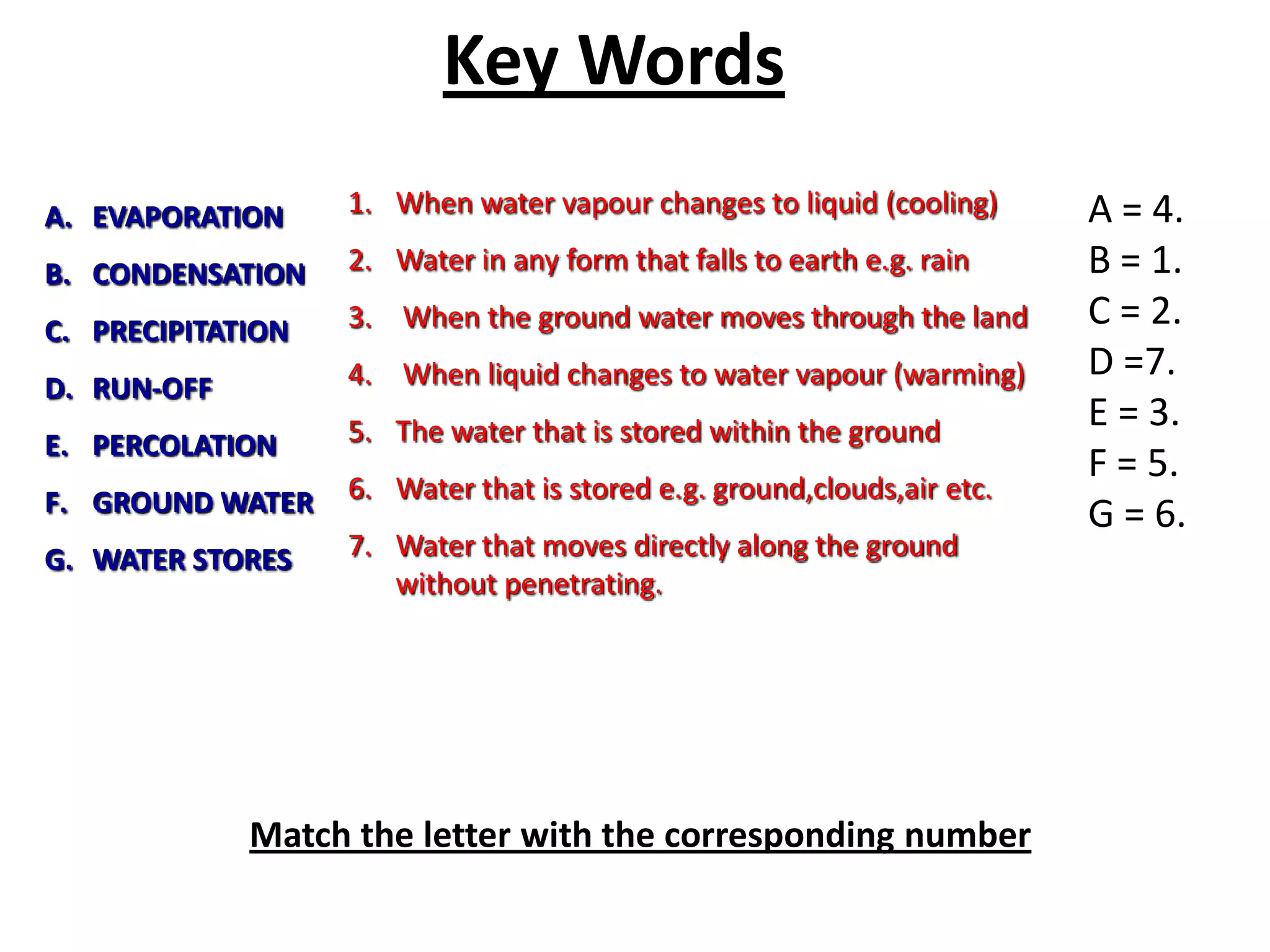
Key Words
A. EVAPORATION     1. When water vapour changes to liquid (cooling)      A = 4.
B. CONDENSATION    2. Water in any form that falls to earth e.g. rain    B = 1.
C. PRECIPITATION   3. When the ground water moves through the land       C = 2.
                   4. When liquid changes to water vapour (warming)      D =7.
D. RUN-OFF
                   5. The water that is stored within the ground         E = 3.
E. PERCOLATION
                                                                         F = 5.
F. GROUND WATER    6. Water that is stored e.g. ground,clouds,air etc.
                                                                         G = 6.
G. WATER STORES    7. Water that moves directly along the ground
                      without penetrating.


             Match the letter with the corresponding number
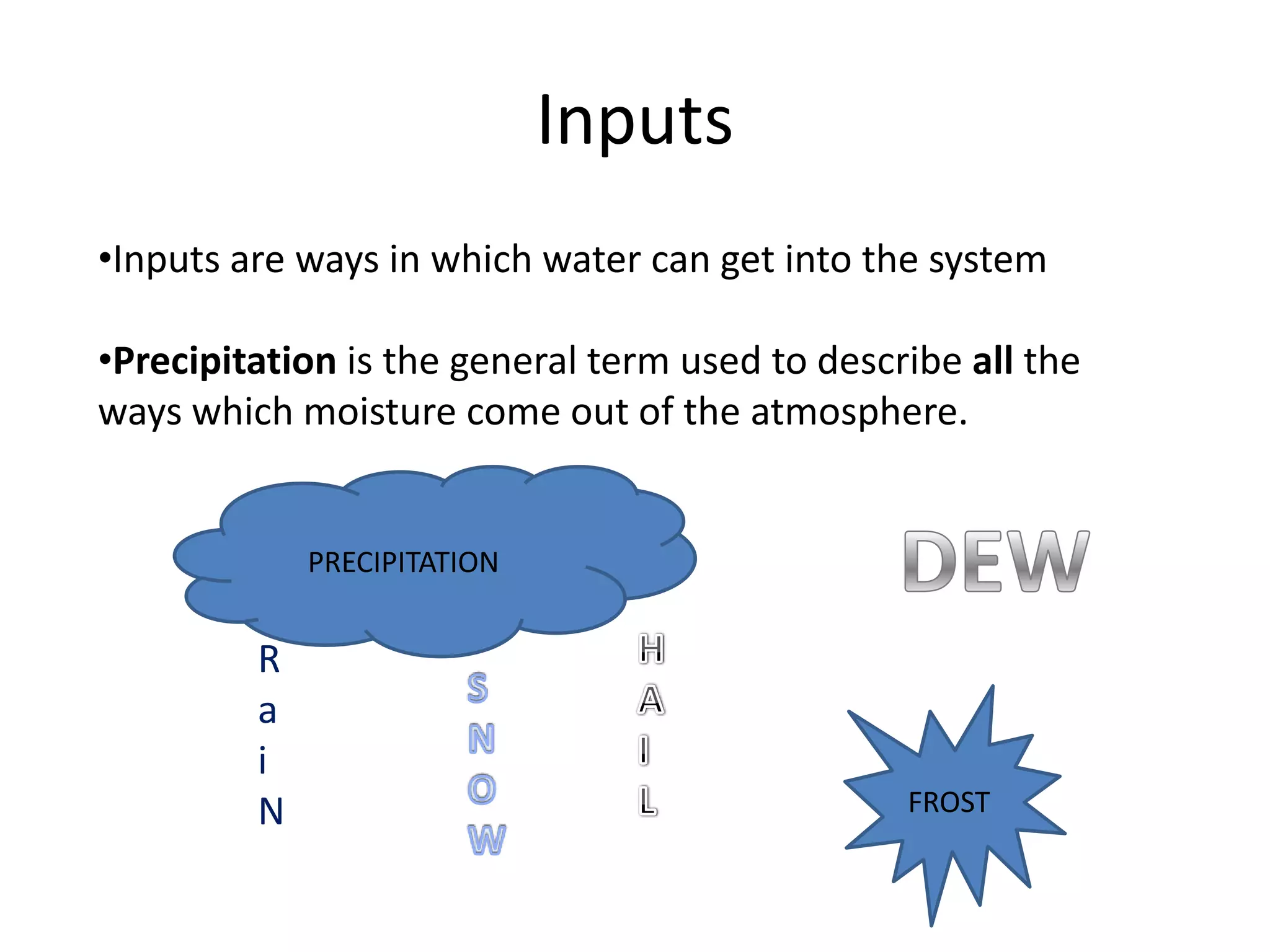
Inputs
•Inputs are ways in which water can get into the system

•Precipitation is the general term used to describe all the
ways which moisture come out of the atmosphere.


             PRECIPITATION


         R
         a
         i
         N                                      FROST
OUTPUTS
•Outputs are ways in which water can leave a system.

•Evaporation – water on the surface can easily be evaporated
(turned to vapour) naturally by the suns heat energy – a breeze
will also help evaporation.

•Transpiration – evaporation from plant leaves of water which
has been taken up from the roots and transported to the leaves

•Evapotranspiration – general term for evaporation and
transpiration together

•River discharge – when the river reaches the sea/ lake and
ends.
Transfer/ flows
•Transfer/ flows are mechanisms which allow water to move
from one place to another.

•Surface runoff/ overland flow – water that flows over the
land; common in areas where the water cannot be absorbed
by the ground such as permeable surfaces e.g. concrete or
saturated areas.

•Throughfall – water dripping from one leaf to another

•Stemflow – water running down a plants stem/trunk

•Throughflow – water moving slowly downhill through the
soil. “pipes” such as cracks, or burrows in the soil will
increase the rate of throughflow.
Transfer/ flows
•Infiltration – Water soaking into the SOIL. Infiltration rate
depends on soil type, and how saturated the soil already is.

•Percolation – water seeping through the ROCKS, under the
soil surface. Rate of percolation depends on rock type.

•Groundwater flow – water flowing slowly below the water
table through permeable rocks.

•Baseflow – groundwater that feeds into rivers

•Interflow – water flowing downhill through the permeable
rock above the water table

•Channel flow/ river discharge - water flowing in the river/
stream.
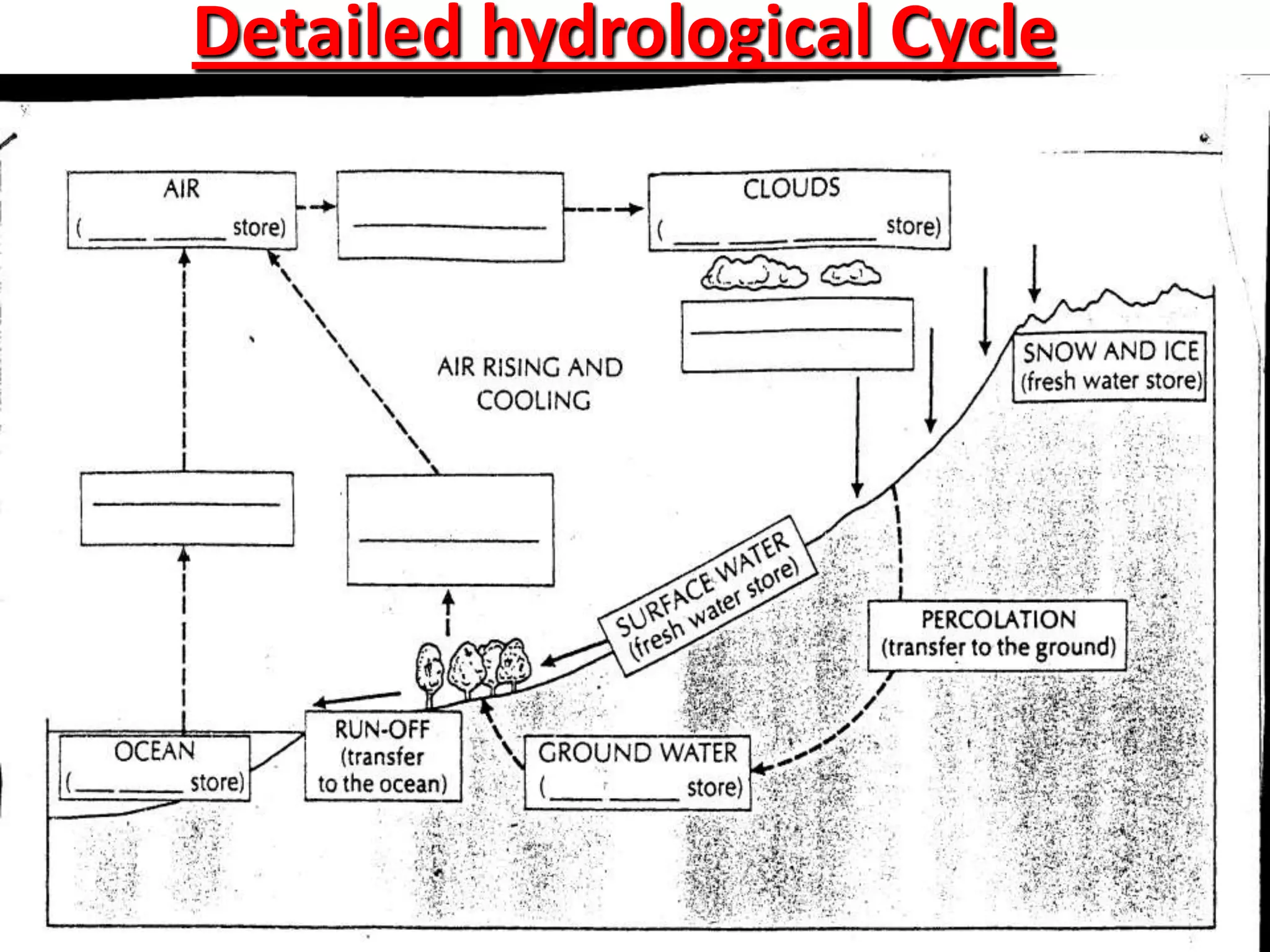
Detailed hydrological Cycle
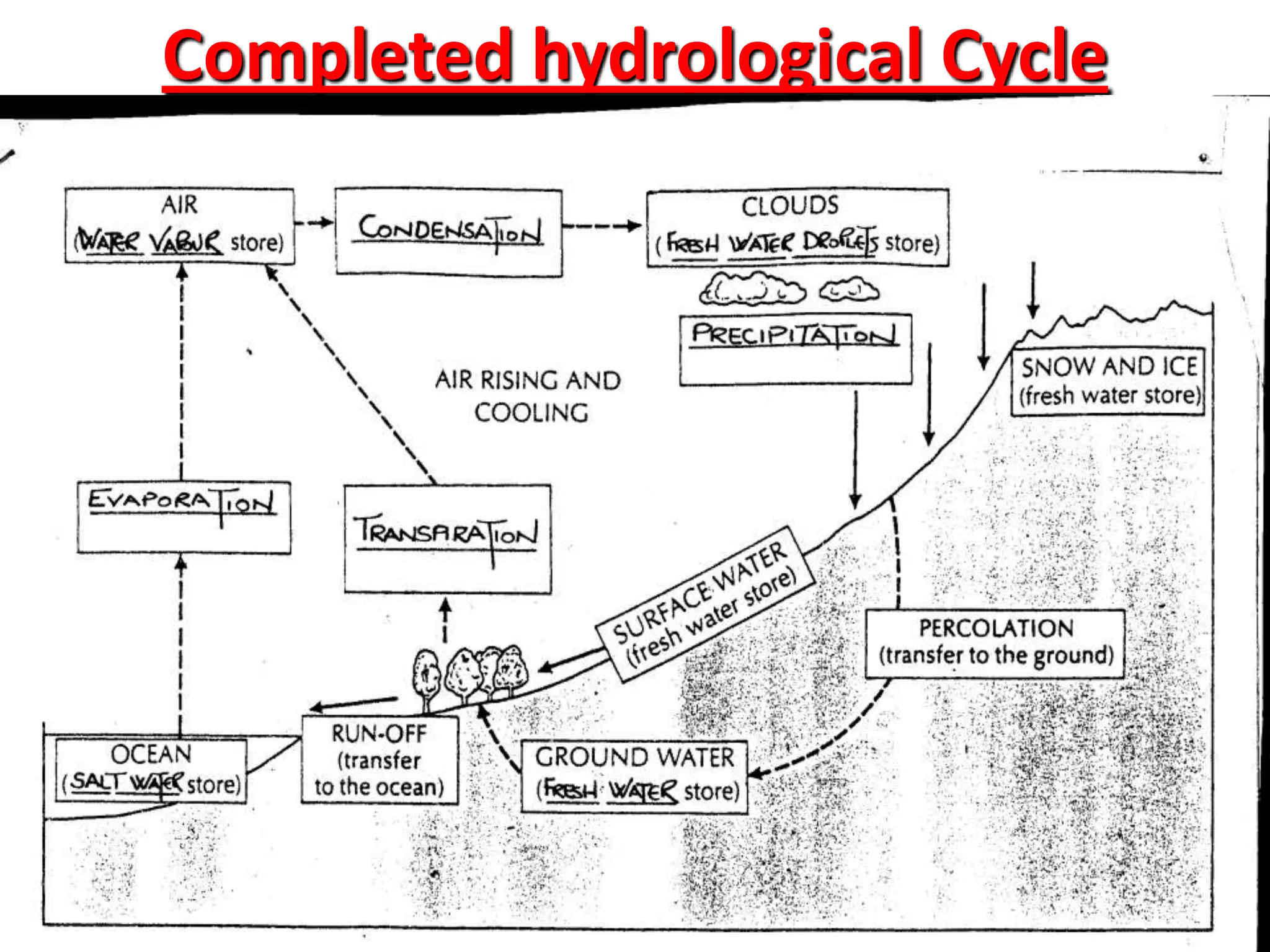
Completed hydrological Cycle
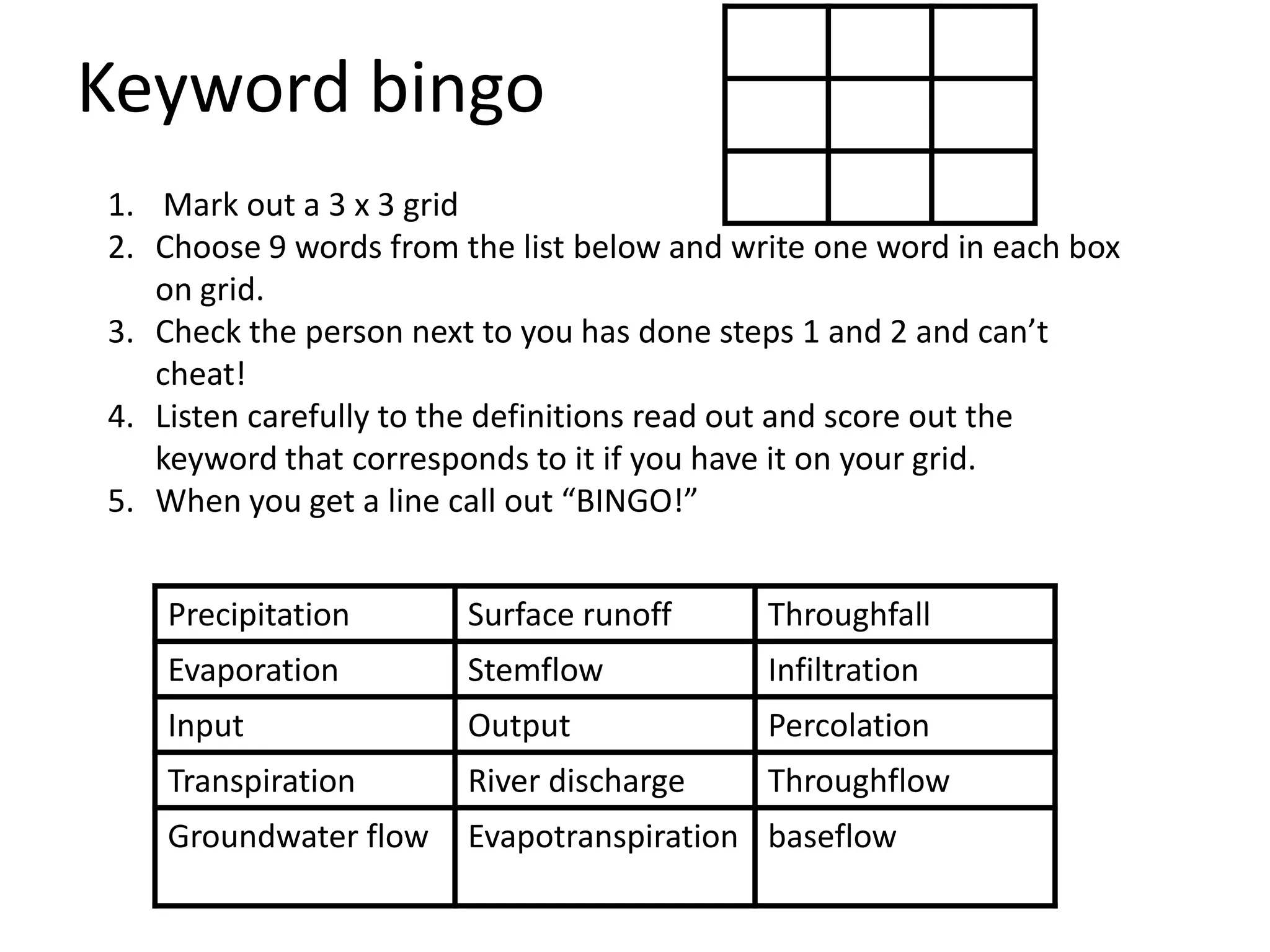
Keyword bingo
1. Mark out a 3 x 3 grid
2. Choose 9 words from the list below and write one word in each box
   on grid.
3. Check the person next to you has done steps 1 and 2 and can’t
   cheat!
4. Listen carefully to the definitions read out and score out the
   keyword that corresponds to it if you have it on your grid.
5. When you get a line call out “BINGO!”


    Precipitation       Surface runoff      Throughfall
    Evaporation         Stemflow            Infiltration
    Input               Output              Percolation
    Transpiration       River discharge     Throughflow
    Groundwater flow    Evapotranspiration baseflow

The hydrological cycle

  • 1.
    The Hydrological cycle LO: 1. To learn key words and definitions relating to the hydrological cycle 2. To be able to explain if something is an input, output, store or transfer. 3. To be able to complete a hydrological cycle diagram
  • 2.
    A SIMPLIFIED HYDROLOGICALCYCLE Input PRECIPITATION CONDENSATION o u t p u t LAND EVAPORATION What happens when water reaches the ground? SEA
  • 3.
    Key Words A. EVAPORATION 1. When water vapour changes to liquid (cooling) B. CONDENSATION 2. Water in any form that falls to earth e.g. rain C. PRECIPITATION 3. When the ground water moves through the land D. RUN-OFF 4. When liquid changes to water vapour (warming) E. PERCOLATION 5. The water that is stored within the ground F. GROUND WATER 6. Water that is stored e.g. ground,clouds,air etc. G. WATER STORES 7. Water that moves directly along the ground without penetrating. Match the letter with the corresponding number
  • 4.
    Key Words A. EVAPORATION 1. When water vapour changes to liquid (cooling) A = 4. B. CONDENSATION 2. Water in any form that falls to earth e.g. rain B = 1. C. PRECIPITATION 3. When the ground water moves through the land C = 2. 4. When liquid changes to water vapour (warming) D =7. D. RUN-OFF 5. The water that is stored within the ground E = 3. E. PERCOLATION F = 5. F. GROUND WATER 6. Water that is stored e.g. ground,clouds,air etc. G = 6. G. WATER STORES 7. Water that moves directly along the ground without penetrating. Match the letter with the corresponding number
  • 5.
    Inputs •Inputs are waysin which water can get into the system •Precipitation is the general term used to describe all the ways which moisture come out of the atmosphere. PRECIPITATION R a i N FROST
  • 6.
    OUTPUTS •Outputs are waysin which water can leave a system. •Evaporation – water on the surface can easily be evaporated (turned to vapour) naturally by the suns heat energy – a breeze will also help evaporation. •Transpiration – evaporation from plant leaves of water which has been taken up from the roots and transported to the leaves •Evapotranspiration – general term for evaporation and transpiration together •River discharge – when the river reaches the sea/ lake and ends.
  • 7.
    Transfer/ flows •Transfer/ flowsare mechanisms which allow water to move from one place to another. •Surface runoff/ overland flow – water that flows over the land; common in areas where the water cannot be absorbed by the ground such as permeable surfaces e.g. concrete or saturated areas. •Throughfall – water dripping from one leaf to another •Stemflow – water running down a plants stem/trunk •Throughflow – water moving slowly downhill through the soil. “pipes” such as cracks, or burrows in the soil will increase the rate of throughflow.
  • 8.
    Transfer/ flows •Infiltration –Water soaking into the SOIL. Infiltration rate depends on soil type, and how saturated the soil already is. •Percolation – water seeping through the ROCKS, under the soil surface. Rate of percolation depends on rock type. •Groundwater flow – water flowing slowly below the water table through permeable rocks. •Baseflow – groundwater that feeds into rivers •Interflow – water flowing downhill through the permeable rock above the water table •Channel flow/ river discharge - water flowing in the river/ stream.
  • 9.
  • 10.
  • 11.
    Keyword bingo 1. Markout a 3 x 3 grid 2. Choose 9 words from the list below and write one word in each box on grid. 3. Check the person next to you has done steps 1 and 2 and can’t cheat! 4. Listen carefully to the definitions read out and score out the keyword that corresponds to it if you have it on your grid. 5. When you get a line call out “BINGO!” Precipitation Surface runoff Throughfall Evaporation Stemflow Infiltration Input Output Percolation Transpiration River discharge Throughflow Groundwater flow Evapotranspiration baseflow