H Y D R O L O G Y A N D F L U V I A L
G E O M O R P H O L O G Y
Geography AS Level
Introduction
 Water enters and continually cycles around the earth through
the global hydrological cycle, it is a closed system with no
inputs or outputs. The hydrological cycle refers to the cycle of
water between atmosphere, lithosphere and biosphere.
 The Drainage basin system however is an open local system
as it has inputs, outputs and transfers of energy and matter
into and from the system.
 A rivers drainage basin is the area of land drained by a river
and its tributaries - also called the rivers catchment
 The drainage basin is surrounded by higher land -
this boundary of the drainage basin is called the watershed-
any precipitation falling beyond the watershed enters a
different basin. The watershed separates different drainage
basins.
Drainage Basin Features
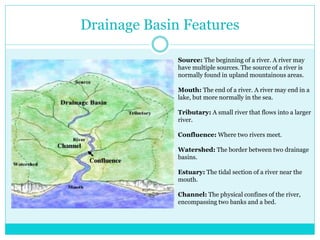
Source: The beginning of a river. A river may
have multiple sources. The source of a river is
normally found in upland mountainous areas.
Mouth: The end of a river. A river may end in a
lake, but more normally in the sea.
Tributary: A small river that flows into a larger
river.
Confluence: Where two rivers meet.
Watershed: The border between two drainage
basins.
Estuary: The tidal section of a river near the
mouth.
Channel: The physical confines of the river,
encompassing two banks and a bed.
The Hydrological Cycle
 Water evaporates from water bodies such as rivers,
lakes and seas, and from plants and trees. The water
vapour rises, cools and condenses to form clouds.
Rain falls from the clouds . The rain water is
intercepted by plants , seeps into the ground before
reaching surface streams, or runs off the land surface
into streams and rivers. The rivers enter lakes or
seas. The hydrological cycle is then repeated.
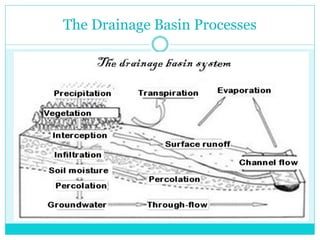
The Drainage Basin Processes
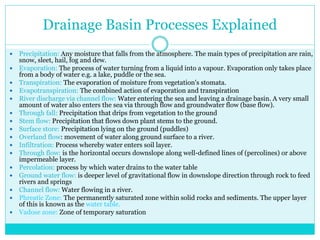
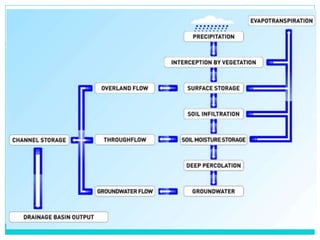
Drainage Basin Processes Explained
 Precipitation: Any moisture that falls from the atmosphere. The main types of precipitation are rain,
snow, sleet, hail, fog and dew.
 Evaporation: The process of water turning from a liquid into a vapour. Evaporation only takes place
from a body of water e.g. a lake, puddle or the sea.
 Transpiration: The evaporation of moisture from vegetation's stomata.
 Evapotranspiration: The combined action of evaporation and transpiration
 River discharge via channel flow: Water entering the sea and leaving a drainage basin. A very small
amount of water also enters the sea via through flow and groundwater flow (base flow).
 Through fall: Precipitation that drips from vegetation to the ground
 Stem flow: Precipitation that flows down plant stems to the ground.
 Surface store: Precipitation lying on the ground (puddles)
 Overland flow: movement of water along ground surface to a river.
 Infiltration: Process whereby water enters soil layer.
 Through flow: is the horizontal occurs downslope along well-defined lines of (percolines) or above
impermeable layer.
 Percolation: process by which water drains to the water table
 Ground water flow: is deeper level of gravitational flow in downslope direction through rock to feed
rivers and springs
 Channel flow: Water flowing in a river.
 Phreatic Zone: The permanently saturated zone within solid rocks and sediments. The upper layer
of this is known as the water table.
 Vadose zone: Zone of temporary saturation
Types of Surface Runoff/Overland Flow
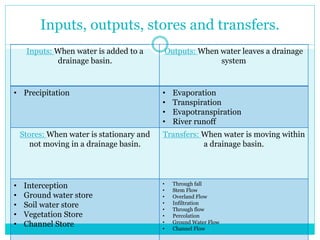
Inputs, outputs, stores and transfers.
Inputs: When water is added to a
drainage basin.
Outputs: When water leaves a drainage
system
• Precipitation • Evaporation
• Transpiration
• Evapotranspiration
• River runoff
Stores: When water is stationary and
not moving in a drainage basin.
Transfers: When water is moving within
a drainage basin.
• Interception
• Ground water store
• Soil water store
• Vegetation Store
• Channel Store
• Through fall
• Stem Flow
• Overland Flow
• Infiltration
• Through flow
• Percolation
• Ground Water Flow
• Channel Flow
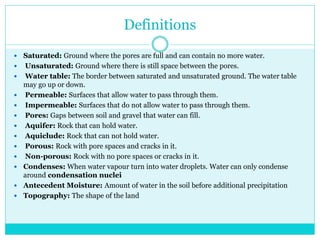
Definitions
 Saturated: Ground where the pores are full and can contain no more water.
 Unsaturated: Ground where there is still space between the pores.
 Water table: The border between saturated and unsaturated ground. The water table
may go up or down.
 Permeable: Surfaces that allow water to pass through them.
 Impermeable: Surfaces that do not allow water to pass through them.
 Pores: Gaps between soil and gravel that water can fill.
 Aquifer: Rock that can hold water.
 Aquiclude: Rock that can not hold water.
 Porous: Rock with pore spaces and cracks in it.
 Non-porous: Rock with no pore spaces or cracks in it.
 Condenses: When water vapour turn into water droplets. Water can only condense
around condensation nuclei
 Antecedent Moisture: Amount of water in the soil before additional precipitation
 Topography: The shape of the land
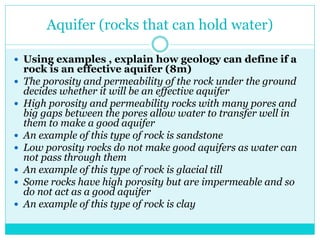
Aquifer (rocks that can hold water)
 Using examples , explain how geology can define if a
rock is an effective aquifer (8m)
 The porosity and permeability of the rock under the ground
decides whether it will be an effective aquifer
 High porosity and permeability rocks with many pores and
big gaps between the pores allow water to transfer well in
them to make a good aquifer
 An example of this type of rock is sandstone
 Low porosity rocks do not make good aquifers as water can
not pass through them
 An example of this type of rock is glacial till
 Some rocks have high porosity but are impermeable and so
do not act as a good aquifer
 An example of this type of rock is clay
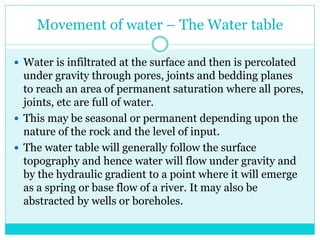
Movement of water – The Water table
 Water is infiltrated at the surface and then is percolated
under gravity through pores, joints and bedding planes
to reach an area of permanent saturation where all pores,
joints, etc are full of water.
 This may be seasonal or permanent depending upon the
nature of the rock and the level of input.
 The water table will generally follow the surface
topography and hence water will flow under gravity and
by the hydraulic gradient to a point where it will emerge
as a spring or base flow of a river. It may also be
abstracted by wells or boreholes.
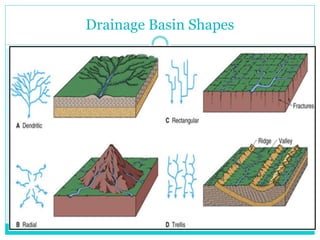
Drainage Basin Shapes
The Water Balance
 The water balance is worked out from inputs and outputs and
affects how much water is stored in the basin. The general
water balance in the UK shows seasonal patterns:
 in wet seasons, precipitation exceeds
evapotranspiration creating water surplus. the ground stores
fill with water so there's more surface runoff and higher
discharge- river levels rise
 in drier seasons, precipitation is lower than
evapotranspiration. ground stores are depleted as some ware
is used and flows into the river channel but isn't replaced by
precipitation
 at the end of a dry season there's a deficit of water in the
ground. the ground stores are recharged in the next wet
season.
River Discharge
 River Discharge = is defined as the volume of water
passing a measuring point or gauging station in a river in
a given time. It is measured in cubic metres per second
(cumecs)
 precipitation- more precipitation, higher the discharge
 hot weather- higher temperature, lower the discharge
because evaporation is higher
 removal of water from the river- reduces discharge
Discharge can be illustrated using hydrographs. These can
show annual patterns of flow ( the river regime) in
response to climate. Short-term variations in discharge are
shown using a flood of storm hydrograph.
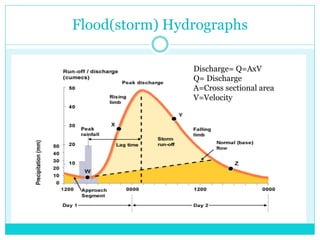
Flood(storm) Hydrographs
Discharge= Q=AxV
Q= Discharge
A=Cross sectional area
V=Velocity
Flood storm hydrograph
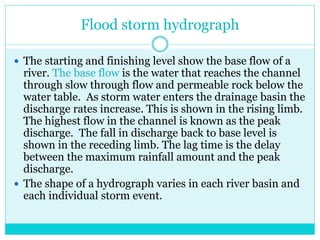
 The starting and finishing level show the base flow of a
river. The base flow is the water that reaches the channel
through slow through flow and permeable rock below the
water table. As storm water enters the drainage basin the
discharge rates increase. This is shown in the rising limb.
The highest flow in the channel is known as the peak
discharge. The fall in discharge back to base level is
shown in the receding limb. The lag time is the delay
between the maximum rainfall amount and the peak
discharge.
 The shape of a hydrograph varies in each river basin and
each individual storm event.
Definitions and Explanation of Terms involved in
hydrographs.
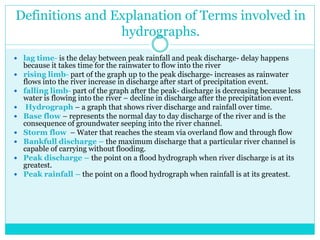
 lag time- is the delay between peak rainfall and peak discharge- delay happens
because it takes time for the rainwater to flow into the river
 rising limb- part of the graph up to the peak discharge- increases as rainwater
flows into the river increase in discharge after start of precipitation event.
 falling limb- part of the graph after the peak- discharge is decreasing because less
water is flowing into the river – decline in discharge after the precipitation event.
 Hydrograph – a graph that shows river discharge and rainfall over time.
 Base flow – represents the normal day to day discharge of the river and is the
consequence of groundwater seeping into the river channel.
 Storm flow – Water that reaches the steam via overland flow and through flow
 Bankfull discharge – the maximum discharge that a particular river channel is
capable of carrying without flooding.
 Peak discharge – the point on a flood hydrograph when river discharge is at its
greatest.
 Peak rainfall – the point on a flood hydrograph when rainfall is at its greatest.
Factors affecting flood storm hydrographs
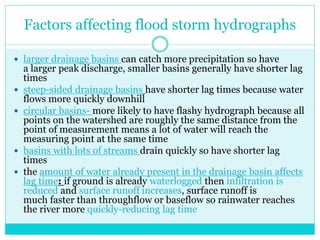
 larger drainage basins can catch more precipitation so have
a larger peak discharge, smaller basins generally have shorter lag
times
 steep-sided drainage basins have shorter lag times because water
flows more quickly downhill
 circular basins- more likely to have flashy hydrograph because all
points on the watershed are roughly the same distance from the
point of measurement means a lot of water will reach the
measuring point at the same time
 basins with lots of streams drain quickly so have shorter lag
times
 the amount of water already present in the drainage basin affects
lag time: if ground is already waterlogged then infiltration is
reduced and surface runoff increases, surface runoff is
much faster than throughflow or baseflow so rainwater reaches
the river more quickly-reducing lag time
Factors affecting storm hydrograph
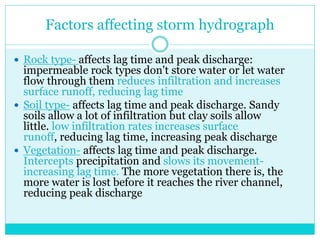
 Rock type- affects lag time and peak discharge:
impermeable rock types don't store water or let water
flow through them reduces infiltration and increases
surface runoff, reducing lag time
 Soil type- affects lag time and peak discharge. Sandy
soils allow a lot of infiltration but clay soils allow
little. low infiltration rates increases surface
runoff, reducing lag time, increasing peak discharge
 Vegetation- affects lag time and peak discharge.
Intercepts precipitation and slows its movement-
increasing lag time. The more vegetation there is, the
more water is lost before it reaches the river channel,
reducing peak discharge
Factors affecting flood storm hydrograph
 Precipitation- affects peak discharge. Intense storms will
generate more precipitation and so greater peak
discharges than light rain showers
 the type of precipitation affects lag time e.g. snow thats fallen
in a winter storm can melt and flow into the river in spring,
giving a very long lag time
 Seasonal variation
 temperature- affects lag time and peak discharge
 hot, dry conditions and cold, freezing conditions both result
in hard ground- reduces infiltration and increases surface
runoff- reducing lag time and increasing peak discharge
 high temperatures can increase evapotranspiration, so less
water reaches the river channel, reducing peak discharge
Factors affecting storm hydrographs (human)
 in urban areas- much of the soil is covered with man-
made impermeable materials like concrete
 water can't infiltrate into the soil, which increases surface runoff, so
water flows more quickly into the river making lag time short and
increases peak discharge
 man-made drainage systems affect the hydrograph in a
similar way. water flows down drains into the river
before it can evaporate or infiltrate into the soil,
causing a shorter lag time and increased peak
discharge
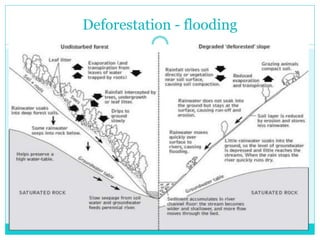
 Deforestation means less interception, so rain reaches
the ground faster. The ground is likely to become
saturated and surface run-off will increase
River Channel Processes and Landforms
 Rivers - Source to Mouth Having understood the
basics of a Drainage Basin we now need to consider the
journey that a river within a Drainage Basin takes from
its beginning to its end.
 The path the river follows from its source to mouth is
known as the river's course.
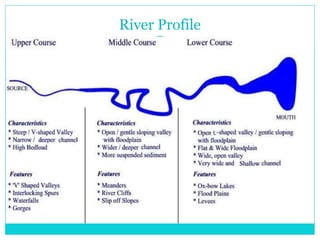
 When studying rivers we often divide it into 3 main
sections, the upper course; middle course and
lower course.
 Each part of the river has distinctive features which form
and the characteristics of the river and its surrounding
valley change downstream.
River Profile
Processes in different stages of river profile:
 Processes in the Upper Course
In the upper course, the river has a lot of gravitational potential energy so it has a lot of energy to
erode vertically. The bed of the river is eroded greatly while the banks aren’t eroded as much. The
river mainly transports large pieces of angular rock and does so by traction because it doesn’t have
enough kinetic energy to move the load in any other way. This increases erosion of the bed by
abrasion as a result of the load being dragged along the bed of the river. Vertical erosion is further
increased by the rough nature of the channel in the upper course which increases the water’s
turbulence and its ability to erode. Erosion and transportation only takes place in large quantities
in the upper course when the river’s discharge is high after periods of heavy precipitation. When
the river’s discharge falls the river stops transporting the large boulders its transporting and
deposits them.
 Processes in the Middle Course
In the middle course, the river has less gravitational potential energy and more kinetic energy so
erosion shifts from vertical to lateral erosion. Abrasion is still the main erosive process as large
particles are transported by saltation. The average load size has decreased in the middle course, so
more load is being transported in suspension. In the middle course, the river can flood and in
doing so, it deposits gravel and sand sized particles onto its flood plain.
 Processes in the Lower Course
In the lower course, the river has next to no gravitational potential energy so erosion is almost
exclusively lateral. There isn’t much erosion though because the channel is smoother resulting in
less turbulent flow. The main place where erosion takes place is where the river meanders. The
average particle size is very small now, another reason for the reduction in erosion. The river’s load
is mainly composed of silts and clays and it is transported in suspension or even solution. Like in
the middle course, when the river floods it deposits its load but deposition now also takes place at
the mouth of the river where the river meets the sea or a stationary body of water.
River Channel Processes
 As a river flows along its course it undertakes 3 main
processes which together help to shape the river
channel and the surrounding valley. These are
 Erosion
 Transportation
 Deposition
 At any one time the dominant process operating
within the river depends on the amount of energy
available.
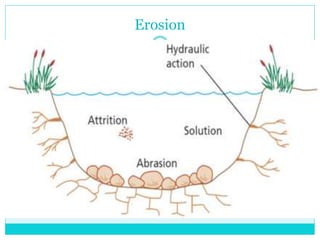
Erosion
 River erosion is the wearing away of the land as the water flows past the bed
and banks. There are four main types of river erosion. These are:
1. Abrasion (corrosion): This is the scraping and rubbing action of material carried
along by a river (bed load). Rivers carry rack fragments in the flow of water or drag
them along the bed, and in doing so wear away the banks and bed of the river channel.
Abrasion is most effective in short turbulent periods when the river is at Bankfull or in
flood. During times when river levels are low, the load consists of small particles such
as sand grains, and these tend to smooth the surface of the river.
2. Hydraulic Action: this is where the water in the river compresses air in cracks in the
bed and banks (Cavitation – force of air exploding) This results in increased pressure
caused by the compression of air, mini 'explosions' are caused as the pressure is then
released gradually forcing apart parts of the bed and banks
3. Solution: Is most active on rocks that contain carbonates such as limestone and
chalk. The minerals in rocks are dissolved by weak acids in the river water and are
carried away in solution.
4. Attrition: Is the reduction in the size of fragments and particles within a river due to
the collision of boulders with one another as they move down the river. The fragments
strike one another as well as the river bed, therefore, becoming smoother, smaller and
rounder. Consequently larger, more angular fragments tend to be found upstream,
which smaller, more rounded fragments are found downstream.
Erosion
 Rivers erode because they have energy. Their total energy
depends on 3 main factors…
1. The weight of the water: The greater the mass of the
water, the more energy it will posses due to the
influence of gravity on its movement.
2. The height of the river above its base level: this gives it
a source of potential energy and the higher the source
of the river the more gravitational potential energy it
has.
3. The steepness of the channel: this controls the speed of
the river which determines how much kinetic energy it
has.
Erosion
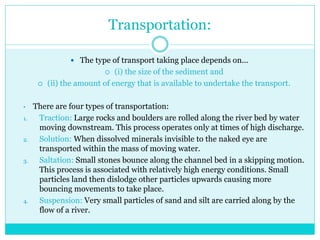
Transportation:
 The type of transport taking place depends on...
 (i) the size of the sediment and
 (ii) the amount of energy that is available to undertake the transport.
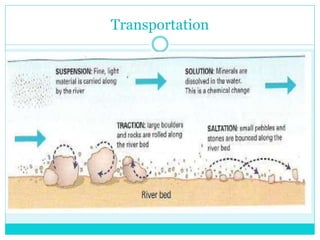
• There are four types of transportation:
1. Traction: Large rocks and boulders are rolled along the river bed by water
moving downstream. This process operates only at times of high discharge.
2. Solution: When dissolved minerals invisible to the naked eye are
transported within the mass of moving water.
3. Saltation: Small stones bounce along the channel bed in a skipping motion.
This process is associated with relatively high energy conditions. Small
particles land then dislodge other particles upwards causing more
bouncing movements to take place.
4. Suspension: Very small particles of sand and silt are carried along by the
flow of a river.
Transportation
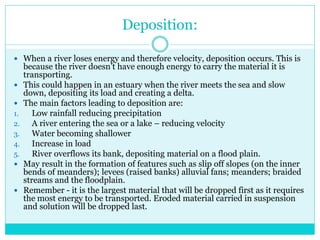
Deposition:
 When a river loses energy and therefore velocity, deposition occurs. This is
because the river doesn’t have enough energy to carry the material it is
transporting.
 This could happen in an estuary when the river meets the sea and slow
down, depositing its load and creating a delta.
 The main factors leading to deposition are:
1. Low rainfall reducing precipitation
2. A river entering the sea or a lake – reducing velocity
3. Water becoming shallower
4. Increase in load
5. River overflows its bank, depositing material on a flood plain.
 May result in the formation of features such as slip off slopes (on the inner
bends of meanders); levees (raised banks) alluvial fans; meanders; braided
streams and the floodplain.
 Remember - it is the largest material that will be dropped first as it requires
the most energy to be transported. Eroded material carried in suspension
and solution will be dropped last.
River Capacity
 =the total amount of material it can carry
 capacity is the total volume of the load
 the load of a river can be divided into different
categories according to particle size- which varies
from fine silt and clay to big boulders
 the competence describes the maximum particle size
that a river is capable of transporting at a given point
Hydraulic Radius
 The efficiency of a channel can be quantified as the
channel’s hydraulic radius. The hydraulic radius shows you how
efficient a channel is. The larger the hydraulic radius, the higher the
channel’s efficiency. The hydraulic radius can be calculated using
the following formula:
 Rh=AP
 Where Rh is the hydraulic radius, A is the cross-sectional area of the
channel and P is the wetted perimeter of the channel. The wetted
perimeter is the length of the river’s bed and banks that is in contact
with the water.
 A large hydraulic radius is more efficient because it means that a
smaller proportion of the river’s water is in contact with the bed &
banks so there is less friction. The ideal channel shape for a large
hydraulic radius would be a narrow and deep channel. Wide and
shallow channels are less efficient and have a smaller hydraulic
radius.
Hjulstrom Curve
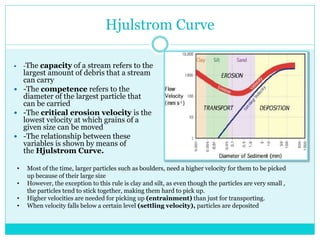
 -The capacity of a stream refers to the
largest amount of debris that a stream
can carry
 -The competence refers to the
diameter of the largest particle that
can be carried
 -The critical erosion velocity is the
lowest velocity at which grains of a
given size can be moved
 -The relationship between these
variables is shown by means of
the Hjulstrom Curve.
• Most of the time, larger particles such as boulders, need a higher velocity for them to be picked
up because of their large size
• However, the exception to this rule is clay and silt, as even though the particles are very small ,
the particles tend to stick together, making them hard to pick up.
• Higher velocities are needed for picking up (entrainment) than just for transporting.
• When velocity falls below a certain level (settling velocity), particles are deposited
Patterns of Flow in a river:
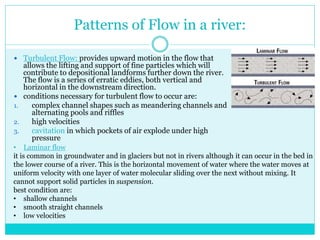
 Turbulent Flow: provides upward motion in the flow that
allows the lifting and support of fine particles which will
contribute to depositional landforms further down the river.
The flow is a series of erratic eddies, both vertical and
horizontal in the downstream direction.
 conditions necessary for turbulent flow to occur are:
1. complex channel shapes such as meandering channels and
alternating pools and riffles
2. high velocities
3. cavitation in which pockets of air explode under high
pressure
• Laminar flow
it is common in groundwater and in glaciers but not in rivers although it can occur in the bed in
the lower course of a river. This is the horizontal movement of water where the water moves at
uniform velocity with one layer of water molecular sliding over the next without mixing. It
cannot support solid particles in suspension.
best condition are:
• shallow channels
• smooth straight channels
• low velocities
Helicoidal Flow
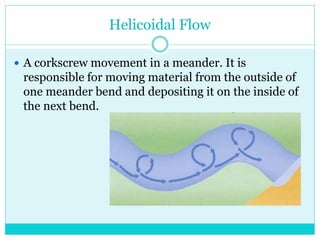
 A corkscrew movement in a meander. It is
responsible for moving material from the outside of
one meander bend and depositing it on the inside of
the next bend.
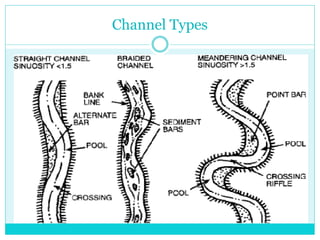
Channel Types
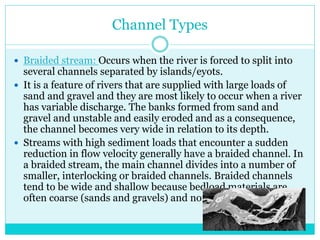
 Braided stream: Occurs when the river is forced to split into
several channels separated by islands/eyots.
 It is a feature of rivers that are supplied with large loads of
sand and gravel and they are most likely to occur when a river
has variable discharge. The banks formed from sand and
gravel and unstable and easily eroded and as a consequence,
the channel becomes very wide in relation to its depth.
 Streams with high sediment loads that encounter a sudden
reduction in flow velocity generally have a braided channel. In
a braided stream, the main channel divides into a number of
smaller, interlocking or braided channels. Braided channels
tend to be wide and shallow because bedload materials are
often coarse (sands and gravels) and non-cohesive.
Channel Types
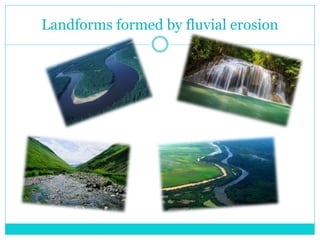
Landforms formed by fluvial erosion
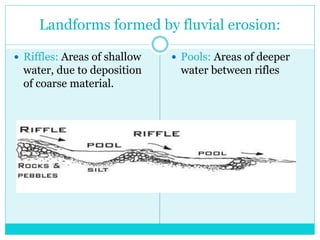
Landforms formed by fluvial erosion:
 Riffles: Areas of shallow
water, due to deposition
of coarse material.
 Pools: Areas of deeper
water between rifles
V-Shaped Valleys
 V-Shaped valleys are found in the upper course of the river and are a result of both erosion by the
river and weathering. V-Shaped valleys are deep river valleys with steep sides that look like a letter
V when a cross section of them is taken, hence the name. They’re found in the upper course
because this is where the river has the greatest gravitational potential energy and so the greatest
potential to erode vertically. It does so during periods of high discharge. When the river’s discharge
is high, it is able to transport its large bedload by traction eroding the river’s bed and valley by
corrasion, deepening it. Not much lateral erosion takes place so the channel and valley remains
relatively narrow.
 As the channel and valley deepens the sides of the valley are exposed and become susceptible to
weathering. The valley’s sides also undergo mass movements resulting in large volumes of material
falling into the river’s channel, adding to its erosive power and causing the valley sides to take up a
V shape. The steepness of the valley sides and whether the valley actually looks like a V is
dependent on the climate, vegetation and rock structure among things. In cold, wet climates, freeze
thaw weathering is abundant and rainwater can act as a lubricant, aiding mass movements.
Vegetation can impede mass movements because it will help bind the soil. If the valley is composed
of hard rock the valley sides will be very steep because they won’t be weathered easily.
 The steepness of Valley sides depends on factors such as:
1. Climate: valleys are steeper where there is sufficient rainfall for mass movement.
2. Rock Structure Resistant, permeable rocks such as limestone produce vertical sides
3. Vegetation: helps to bind soil together and keep hill slope more stable.
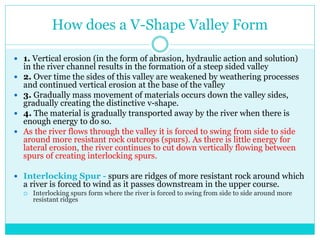
How does a V-Shape Valley Form
 1. Vertical erosion (in the form of abrasion, hydraulic action and solution)
in the river channel results in the formation of a steep sided valley
 2. Over time the sides of this valley are weakened by weathering processes
and continued vertical erosion at the base of the valley
 3. Gradually mass movement of materials occurs down the valley sides,
gradually creating the distinctive v-shape.
 4. The material is gradually transported away by the river when there is
enough energy to do so.
 As the river flows through the valley it is forced to swing from side to side
around more resistant rock outcrops (spurs). As there is little energy for
lateral erosion, the river continues to cut down vertically flowing between
spurs of creating interlocking spurs.
 Interlocking Spur - spurs are ridges of more resistant rock around which
a river is forced to wind as it passes downstream in the upper course.
 Interlocking spurs form where the river is forced to swing from side to side around more
resistant ridges
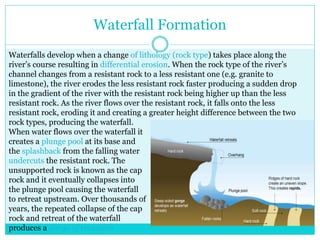
Waterfall Formation
Waterfalls develop when a change of lithology (rock type) takes place along the
river’s course resulting in differential erosion. When the rock type of the river’s
channel changes from a resistant rock to a less resistant one (e.g. granite to
limestone), the river erodes the less resistant rock faster producing a sudden drop
in the gradient of the river with the resistant rock being higher up than the less
resistant rock. As the river flows over the resistant rock, it falls onto the less
resistant rock, eroding it and creating a greater height difference between the two
rock types, producing the waterfall.
When water flows over the waterfall it
creates a plunge pool at its base and
the splashback from the falling water
undercuts the resistant rock. The
unsupported rock is known as the cap
rock and it eventually collapses into
the plunge pool causing the waterfall
to retreat upstream. Over thousands of
years, the repeated collapse of the cap
rock and retreat of the waterfall
produces a gorge of recession
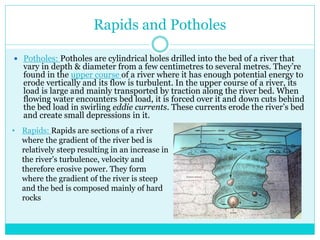
Rapids and Potholes
 Potholes: Potholes are cylindrical holes drilled into the bed of a river that
vary in depth & diameter from a few centimetres to several metres. They’re
found in the upper course of a river where it has enough potential energy to
erode vertically and its flow is turbulent. In the upper course of a river, its
load is large and mainly transported by traction along the river bed. When
flowing water encounters bed load, it is forced over it and down cuts behind
the bed load in swirling eddie currents. These currents erode the river’s bed
and create small depressions in it.
• Rapids: Rapids are sections of a river
where the gradient of the river bed is
relatively steep resulting in an increase in
the river’s turbulence, velocity and
therefore erosive power. They form
where the gradient of the river is steep
and the bed is composed mainly of hard
rocks
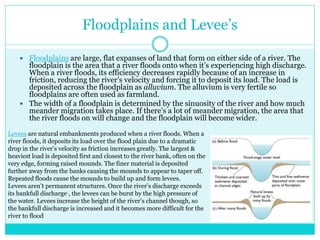
Floodplains and Levee’s
 Floodplains are large, flat expanses of land that form on either side of a river. The
floodplain is the area that a river floods onto when it’s experiencing high discharge.
When a river floods, its efficiency decreases rapidly because of an increase in
friction, reducing the river’s velocity and forcing it to deposit its load. The load is
deposited across the floodplain as alluvium. The alluvium is very fertile so
floodplains are often used as farmland.
 The width of a floodplain is determined by the sinuosity of the river and how much
meander migration takes place. If there’s a lot of meander migration, the area that
the river floods on will change and the floodplain will become wider.
Levees are natural embankments produced when a river floods. When a
river floods, it deposits its load over the flood plain due to a dramatic
drop in the river’s velocity as friction increases greatly. The largest &
heaviest load is deposited first and closest to the river bank, often on the
very edge, forming raised mounds. The finer material is deposited
further away from the banks causing the mounds to appear to taper off.
Repeated floods cause the mounds to build up and form levees.
Levees aren’t permanent structures. Once the river’s discharge exceeds
its bankfull discharge1, the levees can be burst by the high pressure of
the water. Levees increase the height of the river’s channel though, so
the bankfull discharge is increased and it becomes more difficult for the
river to flood
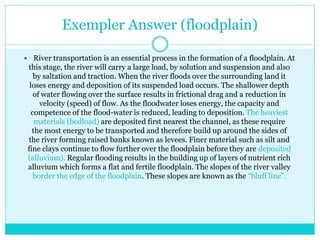
Exempler Answer (floodplain)
 River transportation is an essential process in the formation of a floodplain. At
this stage, the river will carry a large load, by solution and suspension and also
by saltation and traction. When the river floods over the surrounding land it
loses energy and deposition of its suspended load occurs. The shallower depth
of water flowing over the surface results in frictional drag and a reduction in
velocity (speed) of flow. As the floodwater loses energy, the capacity and
competence of the flood-water is reduced, leading to deposition. The heaviest
materials (bedload) are deposited first nearest the channel, as these require
the most energy to be transported and therefore build up around the sides of
the river forming raised banks known as levees. Finer material such as silt and
fine clays continue to flow further over the floodplain before they are deposited
(alluvium). Regular flooding results in the building up of layers of nutrient rich
alluvium which forms a flat and fertile floodplain. The slopes of the river valley
border the edge of the floodplain. These slopes are known as the “bluff line”.
Delta
 Deltas are depositional landforms found at the mouth of a river where the river
meets a body of water with a lower velocity than the river (e.g. a lake or the sea). For
a delta to develop, the body of water needs to be relatively quiet with a low tidal
range so that deposited sediment isn’t washed away and has time to accumulate.
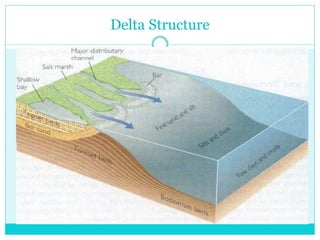
 When a river meets a stationary body of water, its velocity falls causing any material
being transported by the river to be deposited. Deltas are made up of three sediment
beds that have been sorted by the size of the sediment. The bottom most bed,
the bottomset bed, is composed primarily of clay and some other fine grained
sediments. Clay is the main constituent because when clay meets salt water a
process called flocculation takes place where clay & salt particles clump together
(flocculate) due to an electrostatic charge developing between the particles. This
makes the clay particles sink due to their increased weight producing the bottomset
bed. The bottomset bed stretches a fair distance from the mouth of the river as the
fine sediments can be transported a reasonable distance from the river’s mouth.
 The foreset bed lies on top of the bottomset bed. The foreset bed is composed of
coarser sediments that are deposited due to a fall in the river’s velocity and aren’t
transported very far into the stationary body of water that the river flows into. The
foreset bed makes up the majority of the delta and is dipped towards deep water in
the direction that the river is flowing in.
 The topset bed is, as the name suggests, the topmost bed of the delta. It too is
composed of coarse sediment but, unlike the foreset bed, the topset bed doesn’t dip,
it’s horizontally bedded
Delta Structure
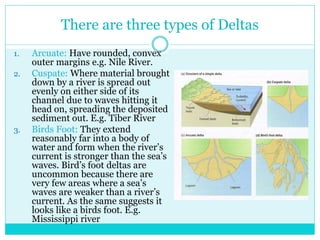
There are three types of Deltas
1. Arcuate: Have rounded, convex
outer margins e.g. Nile River.
2. Cuspate: Where material brought
down by a river is spread out
evenly on either side of its
channel due to waves hitting it
head on, spreading the deposited
sediment out. E.g. Tiber River
3. Birds Foot: They extend
reasonably far into a body of
water and form when the river’s
current is stronger than the sea’s
waves. Bird’s foot deltas are
uncommon because there are
very few areas where a sea’s
waves are weaker than a river’s
current. As the same suggests it
looks like a birds foot. E.g.
Mississippi river
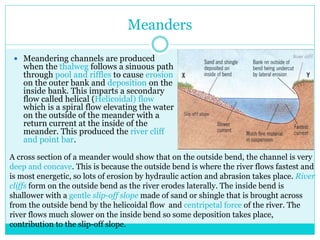
Meanders
 Meandering channels are produced
when the thalweg follows a sinuous path
through pool and riffles to cause erosion
on the outer bank and deposition on the
inside bank. This imparts a secondary
flow called helical (Helicoidal) flow
which is a spiral flow elevating the water
on the outside of the meander with a
return current at the inside of the
meander. This produced the river cliff
and point bar.
A cross section of a meander would show that on the outside bend, the channel is very
deep and concave. This is because the outside bend is where the river flows fastest and
is most energetic, so lots of erosion by hydraulic action and abrasion takes place. River
cliffs form on the outside bend as the river erodes laterally. The inside bend is
shallower with a gentle slip-off slope made of sand or shingle that is brought across
from the outside bend by the helicoidal flow and centripetal force of the river. The
river flows much slower on the inside bend so some deposition takes place,
contribution to the slip-off slope.
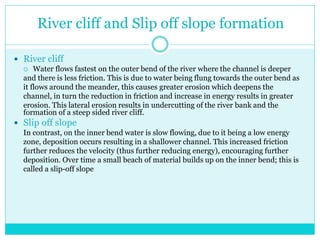
River cliff and Slip off slope formation
 River cliff
 Water flows fastest on the outer bend of the river where the channel is deeper
and there is less friction. This is due to water being flung towards the outer bend as
it flows around the meander, this causes greater erosion which deepens the
channel, in turn the reduction in friction and increase in energy results in greater
erosion. This lateral erosion results in undercutting of the river bank and the
formation of a steep sided river cliff.
 Slip off slope
In contrast, on the inner bend water is slow flowing, due to it being a low energy
zone, deposition occurs resulting in a shallower channel. This increased friction
further reduces the velocity (thus further reducing energy), encouraging further
deposition. Over time a small beach of material builds up on the inner bend; this is
called a slip-off slope
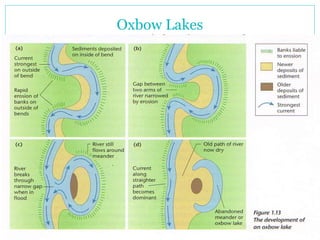
Oxbow Lakes
Oxbow Lakes
 As the outer banks of a meander continue to be eroded
through processes such as hydraulic action the neck of the meander
becomes narrow and
narrower.
Eventually due to the narrowing of the neck, the two outer
bends meet and the river cuts through the neck of the meander
usually during a flood event when the energy in the river is at its
highest. The water now takes its
shortest route rather than flowing around the bend.
Deposition gradually seals off the old meander bend forming a new
straighter river channel.
Due to deposition the old meander bend is left isolated from
the main channel as an ox-bow lake.
Over time this feature may fill up with sediment and may gradually
dry up (except for periods of heavy rain). When the water dries up,
the feature left behind is known as a meander scar.
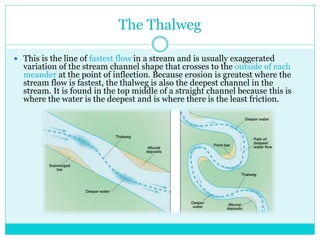
The Thalweg
 This is the line of fastest flow in a stream and is usually exaggerated
variation of the stream channel shape that crosses to the outside of each
meander at the point of inflection. Because erosion is greatest where the
stream flow is fastest, the thalweg is also the deepest channel in the
stream. It is found in the top middle of a straight channel because this is
where the water is the deepest and is where there is the least friction.
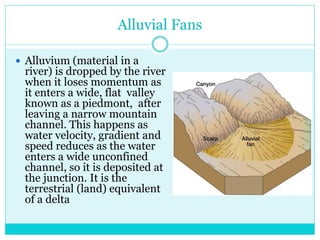
Alluvial Fans
 Alluvium (material in a
river) is dropped by the river
when it loses momentum as
it enters a wide, flat valley
known as a piedmont, after
leaving a narrow mountain
channel. This happens as
water velocity, gradient and
speed reduces as the water
enters a wide unconfined
channel, so it is deposited at
the junction. It is the
terrestrial (land) equivalent
of a delta
Definitions
 Meander - a bend in a river
 River Cliff - a small cliff formed on the outside of a meander bend due
to erosion in this high energy zone.
 Slip off Slope - a small beach found on the inside of a meander bend
where deposition has occurred in the low energy zone.
 Ox-bow lake - a lake formed when the continued narrowing of a
meander neck results in the eventual cut through of the neck as two
outer bends join. This result in the straightening of the river channel
and the old meander bend becomes cut off forming an ox-bow lake.
 Meander scar - feature left behind when the water in an ox-bow lake
dries up.
HYDROLOGY AND
FLUVIAL
GEOMORPHOLOGY
The Human Impact
The influence of human activity on the
hydrological cycle
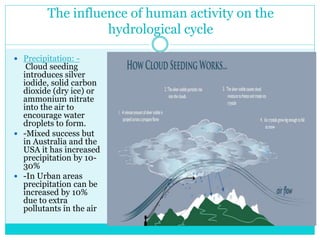
 Precipitation: -
Cloud seeding
introduces silver
iodide, solid carbon
dioxide (dry ice) or
ammonium nitrate
into the air to
encourage water
droplets to form.
 -Mixed success but
in Australia and the
USA it has increased
precipitation by 10-
30%
 -In Urban areas
precipitation can be
increased by 10%
due to extra
pollutants in the air
The influence of human activity on the
hydrological cycle
 The human impact on evaporation and
evapotranspiration is relatively small in relation to the
rest of the hydrological cycle but nevertheless important.
There are a number of impacts:
 Dams: the construction of large dams have increased
evaporation. For example: Lake Nasser behind the
Aswan Dam loses up to a third of water due to
evaporation. Water loss can be reduced by using
chemical sprays or covering the dam in a form of plastic.
 Urbanisation: Leads to a huge reduction in
evapotranspiration due to the lack of vegetation. There
may also be a slight increase in evaporation because of
higher temperatures and increased surface storage.
The influence of human activity on the
hydrological cycle
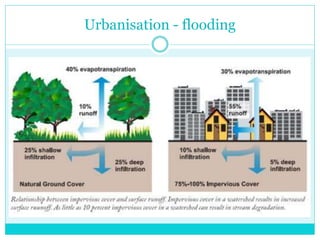
 If a river’s drainage basin or floodplain has been heavily urbanised,
a river becomes much more prone to flooding. Urbanisation
(generally) involves the laying down of tarmac and concrete,
impermeable substances that will increase surface runoff into the
river and therefore increase the river’s discharge.
 Urbanisation often involves deforestation. This (obviously) reduces
vegetation cover, reducing infiltration and increasing surface runoff
into a river.
 To stop roads and streets from flooding, humans will often build
storm drains that collect rainwater and channel it into a river or
stream. Humans will often send this water to the local river or
stream so, although roads and streets won’t be flooded by rainwater
the entire town will be as the rainwater enters the river much faster
than it would without the storm drains.
Urbanisation - flooding
Deforestation - flooding
Flooding: (Physical Factors)
 Flooding occurs when a river’s discharge exceeds its channel’s volume causing the river to
overflow onto the area surrounding the channel known as the floodplain. The increase in
discharge can be triggered by several events. The most common cause of flooding is prolonged
rainfall. If it rains for a long time, the ground will become saturated and the soil will no longer
be able to store water leading to increased surface runoff. Rainwater will enter the river much
faster than it would if the ground wasn’t saturated leading to higher discharge levels and floods.
 As well as prolonged rainfall, brief periods of heavy rain can also lead to floods. If there’s a
sudden “burst” of heavy rain, the rainwater won’t be able to infiltrate fast enough and the water
will instead enter the river via surface runoff. This leads to a sudden and large increase in the
river’s discharge which can result in a flash flood.
 Although many floods are triggered directly by precipitation just a few hours after it falls some
floods can be triggered by precipitation that fell many months ago. Precipitation that falls as
snow can remain as snow on the ground until it melts. This mightn’t be until the end of winter,
so potentially several months. When the snow does melt, large volumes of meltwater will enter
the river increasing its discharge and triggering floods. These floods are often annual, occurring
every year when snow melts in the spring. In Bangladesh, for example, melting snow in the
Himalayas triggers annual floods in the summer.
 Flash floods can also be triggered by slightly more catastrophic events. Erupting volcanoes can
trigger very large flash floods called jökulhlaups when glaciers are partially or even fully melted
by an erupting volcano or some other form of geothermal activity. The meltwater can enter
rivers and greatly increase the river’s discharge leading to a flood. The eruption of
Eyjafjallajökull1 in 2010 triggered jökulhlaups as the volcano had been capped by a glacier that
melted when it erupted. Similarly earthquakes can bring about landslides – loosened soil may
be deposited in rivers causing overflowing.
Effects of flooding
 Flooding can have numerous social, economic and environmental effects that can vary
depending on the demographics of a population and the economic development of an area.
 Social Effects
 The biggest, most obvious effect is death. Floods, especially flash floods, will kill people. Flood
water can travel surprisingly quickly and weighs3 a lot, so people can easily get swept away by
floods. Large chunks of debris and objects like cars can easily get picked up by floodwater and
can easily kill a person should they get hit by the debris. In a LEDC, you’re generally going to get
much more deaths than you would in a MEDC. In a MEDC, people and governments are better
prepared for floods. Rescue services can be dispatched to a flood quickly in a MEDC whereas in a
LEDC, rescue teams mightn’t arrive until several hours after the flood started.
 During a flood, sewage pipes are often broken and raw sewage leaks into the floodwater. This
has two effects. First, it contaminates not just floodwater but drinking water too which leads to a
spread of waterborne diseases such as cholera especially in LEDCs where emergency drinking
water mightn’t be available. Second, the sewage gets into people’s homes.
 In LEDCs, famines can follow floods which can lead to even more deaths. Floods will commonly
inundate farmland because farmland normally develops on floodplains. If the floodwater is
polluted by sewage, it will contaminate the farmland and make any food grown on it dangerous
to eat. Furthermore, cattle are often killed by floods which can lead to people starving because
they either don’t have a source of food or don’t have a source of income to buy food with.
Effects of Flooding
 Economic Effects
 The big economic effect of a flood is property damage. Water can cause a lot of damage to
property and when it picks up large chunks of debris such as cars, it can act like a wrecking ball,
taking out chunks of buildings when cars crash into them. Very large and powerful floods can
even dislodge buildings from their foundations and move them. In a MEDC, property damage is
often extensive as people have lots of expensive possessions. This isn’t the case in LEDCs but
that’s only because people don’t have a lot to lose in the first place. This means that the overall
cost of a flood is generally substantially higher in a MEDC than in a LEDC.
 Floods can cause extensive damage to infrastructure such as power lines, roads, water pipes etc.
Bridges frequently collapse during a flood as they aren’t designed to withstand the high
discharge of the river. The Northside Bridge in Workington, Cumbria collapsed when there were
large floods in 2009. Repairing bridges and other types of infrastructure is very costly. Not only
this, it can lead to a decline in the local economy as businesses are unable to operate without
power or road connections. Unemployment can even increase if businesses are unable to fully
recover from a flood. The economic impact of infrastructure damage and unemployment is
larger in MEDCs since these countries have modern and expensive infrastructure in place. In
LEDCs, this infrastructure is lacking, so there isn’t much economic damage. In fact, in a LEDC,
floods can lead to positive economic effects in the long term. An influx of funding to a less
developed area from charities and NGOs after a flood can result in new infrastructure being
constructed that is substantially better than the previously existing infrastructure. This, in turn,
creates new economic opportunities in an area by, for example, creating new trade routes.
 Another economic benefit comes from when a river floods and deposits sediment across the
floodplain. This improves the fertility of the floodplain and can improve agricultural yield in an
area (assuming the floodwater wasn’t polluted).
Effects of flooding
 Environmental Effects
 Floodwater that is contaminated with sewage will pollute
rivers and land when it drains back into the river.
Similarly, if the river floods onto farmland, the water can
be polluted by pesticides and other chemicals sprayed
onto the farmland that, when drained back into the river,
can pollute it and kill off wildlife that inhabits the river. If
the floodwater isn’t polluted though, flooding can create
wetlands that can help introduce new habitats for many
species of animals.
 Vegetation may be destroyed, along with natural habitats
and animal species.
Reducing impacts of floods
 1) Prediction
 Using weather satellites to predict high rainfall amounts
 Estimating rainfall and snow pack amounts
 Using river gauges to study river levels over time and map flood recurrence
 Create computer flooding models including information on human infrastructure and what
would be most at risk.

 2) Preparing people for floods
 Loss sharing adjustments (e.g. disaster aid and insurance)
 Removal of settlements from flood plains
 Education on what to do in a flood.

 3) Prevention and amelioration of floods
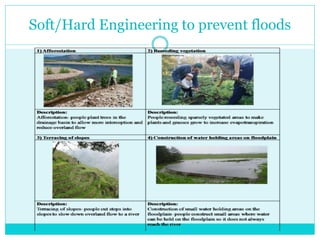
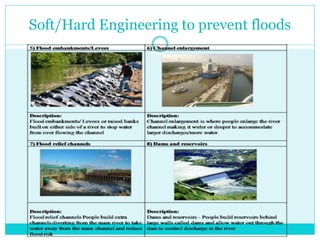
 There are two types of flood protection methods which act to prevent or ameliorate flooding.
 Hard engineering= Defence schemes that halt a rivers natural processes.
 Soft engineering = involves the use of the natural environment surrounding a river, and the
schemes often work with the river’s natural processes.
Examples on next slides…
Soft/Hard Engineering to prevent floods
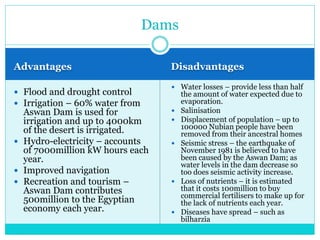
Advantages Disadvantages
 Flood and drought control
 Irrigation – 60% water from
Aswan Dam is used for
irrigation and up to 4000km
of the desert is irrigated.
 Hydro-electricity – accounts
of 7000million kW hours each
year.
 Improved navigation
 Recreation and tourism –
Aswan Dam contributes
500million to the Egyptian
economy each year.
 Water losses – provide less than half
the amount of water expected due to
evaporation.
 Salinisation
 Displacement of population – up to
100000 Nubian people have been
removed from their ancestral homes
 Seismic stress – the earthquake of
November 1981 is believed to have
been caused by the Aswan Dam; as
water levels in the dam decrease so
too does seismic activity increase.
 Loss of nutrients – it is estimated
that it costs 100million to buy
commercial fertilisers to make up for
the lack of nutrients each year.
 Diseases have spread – such as
bilharzia
Dams
Droughts
Is an extended period of dry weather leading to conditions of extreme
dryness.
 Absolute drought is a period of at least 15 days with less than
0.2mm of rainfall
 Natural causes of droughts: Insufficient rainfall can be caused by
several factors:
1. Global atmospheric circulation leads to descending air over sub-
tropical areas and therefore a lack of rain ( no clouds are formed)
2. An area’s distance from the sea can limit the amount of water
carried by the wind
3. Some places are affected by rain shadow effects. This is where air
passes over mountains, and rain is released, but the air has
therefore lost all its moisture as it reaches the far side of the
mountains
Human causes of droughts
 Deforestation: Reduced vegetation cover results in lower
rates of transpiration. Less water vapour in the
atmosphere leads to fewer clouds formed. Soil exposed to
direct sunlight dries up quickly.
 Enhanced greenhouse effect: Global warming can cause
droughts in places with drier climates. High
temperatures increase the rate of evaporation, drying up
land, rivers and lakes.
 Over use of water: places with rapid population growth
require more water for hoes, industry and agriculture.
Water sources such as rivers and ground water may not
be able to sustain an increase in water usuage.
Impacts of droughts
 Economic impacts
 Economic impacts range from direct losses in the broad agricultural and
agriculturally related sectors (including forestry and fishing), to losses in recreation,
transportation, banking, and energy sectors. Other economic impacts would include
added unemployment and loss of revenue to local, state, and federal government.
 Environmental Impacts.
 Environmental losses include damages to plant and animal species, wildlife habitat,
and air and water quality; forest and range fires; degradation of landscape quality;
and soil erosion. These losses are difficult to quantify, but growing public awareness
and concern for environmental quality has forced public officials to focus greater
attention on them.
 Social impacts
 Social impacts mainly involve public safety, health, conflicts between water users,
and inequities in the distribution of impacts and disaster relief programs. As with all
natural hazards, the economic impacts of drought are highly variable within and
between economic sectors and geographic regions, producing a complex assortment
of winners and losers with the occurrence of each disaster.
How to reduce impacts of droughts:
 Management of watershed and agricultural
practices: reistance crops prevent desertification.
 Using proper irrigation techniques – helps conserve
water.
 Cloud seeding – enables water droplets to form
easily.
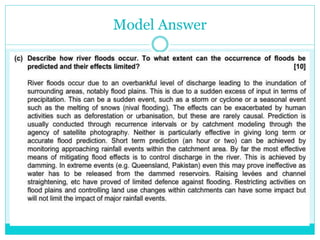
Model Answer
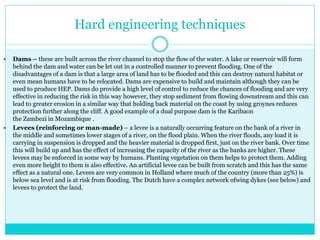
Hard engineering techniques
 Dams – these are built across the river channel to stop the flow of the water. A lake or reservoir will form
behind the dam and water can be let out in a controlled manner to prevent flooding. One of the
disadvantages of a dam is that a large area of land has to be flooded and this can destroy natural habitat or
even mean humans have to be relocated. Dams are expensive to build and maintain although they can be
used to produce HEP. Dams do provide a high level of control to reduce the chances of flooding and are very
effective in reducing the risk in this way however, they stop sediment from flowing downstream and this can
lead to greater erosion in a similar way that holding back material on the coast by using groynes reduces
protection further along the cliff. A good example of a dual purpose dam is the Karibaon
the Zambezi in Mozambique .
 Levees (reinforcing or man-made) – a levee is a naturally occurring feature on the bank of a river in
the middle and sometimes lower stages of a river, on the flood plain. When the river floods, any load it is
carrying in suspension is dropped and the heavier material is dropped first, just on the river bank. Over time
this will build up and has the effect of increasing the capacity of the river as the banks are higher. These
levees may be enforced in some way by humans. Planting vegetation on them helps to protect them. Adding
even more height to them is also effective. An artificial levee can be built from scratch and this has the same
effect as a natural one. Levees are very common in Holland where much of the country (more than 25%) is
below sea level and is at risk from flooding. The Dutch have a complex network ofwing dykes (see below) and
levees to protect the land.
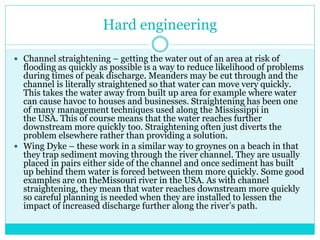
Hard engineering
 Channel straightening – getting the water out of an area at risk of
flooding as quickly as possible is a way to reduce likelihood of problems
during times of peak discharge. Meanders may be cut through and the
channel is literally straightened so that water can move very quickly.
This takes the water away from built up area for example where water
can cause havoc to houses and businesses. Straightening has been one
of many management techniques used along the Mississippi in
the USA. This of course means that the water reaches further
downstream more quickly too. Straightening often just diverts the
problem elsewhere rather than providing a solution.
 Wing Dyke – these work in a similar way to groynes on a beach in that
they trap sediment moving through the river channel. They are usually
placed in pairs either side of the channel and once sediment has built
up behind them water is forced between them more quickly. Some good
examples are on theMissouri river in the USA. As with channel
straightening, they mean that water reaches downstream more quickly
so careful planning is needed when they are installed to lessen the
impact of increased discharge further along the river’s path.
Soft engineering
 Afforestation – This may be part
of wetland and river restoration when vegetation
may be planted to return an area to its original form.
Large scale afforestation can not only lower flood
risk by intercepting and storing water but it can
reduce the erosion of soil which ends up in the river
channel. Material in the river channel effectively
decreases its depth and the river level is higher,
increasing flood risk during times of high discharge.
Afforestation is widely used in Australia to achieve
several things which includes helping to manage
water flow in a catchment area (drainage basin).
 Meteorology= The study of the Atmosphere
 Weather= Short term atmospheric conditions of a particular place.
 Climate= Long term atmospheric conditions of a particular place.
 Atmosphere=is an area of transparent gases surrounding the earth
 The gases stretch to 500-1000km above the earth’s surface
 There are several layers to the atmosphere
 The area between layers is called a pause
 Weather occurs only in the lowest part of the earth’s atmosphere
called the troposphere.
Introduction
Layers of the Atmosphere
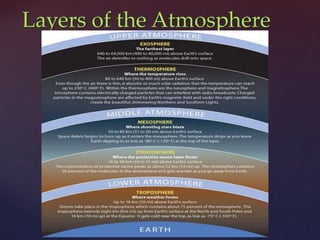
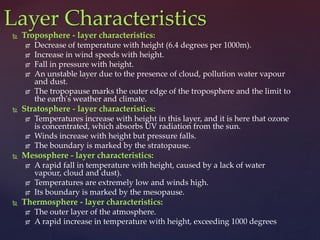
 Troposphere - layer characteristics:
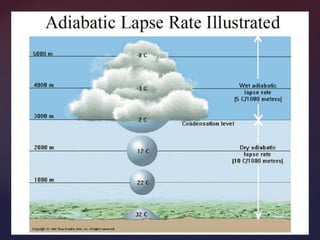
 Decrease of temperature with height (6.4 degrees per 1000m).
 Increase in wind speeds with height.
 Fall in pressure with height.
 An unstable layer due to the presence of cloud, pollution water vapour
and dust.
 The tropopause marks the outer edge of the troposphere and the limit to
the earth's weather and climate.
 Stratosphere - layer characteristics:
 Temperatures increase with height in this layer, and it is here that ozone
is concentrated, which absorbs UV radiation from the sun.
 Winds increase with height but pressure falls.
 The boundary is marked by the stratopause.
 Mesosphere - layer characteristics:
 A rapid fall in temperature with height, caused by a lack of water
vapour, cloud and dust).
 Temperatures are extremely low and winds high.
 Its boundary is marked by the mesopause.
 Thermosphere - layer characteristics:
 The outer layer of the atmosphere.
 A rapid increase in temperature with height, exceeding 1000 degrees
Layer Characteristics
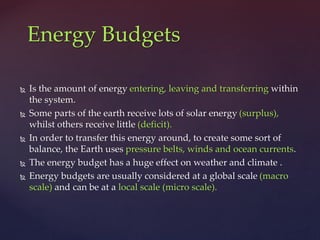
 Is the amount of energy entering, leaving and transferring within
the system.
 Some parts of the earth receive lots of solar energy (surplus),
whilst others receive little (deficit).
 In order to transfer this energy around, to create some sort of
balance, the Earth uses pressure belts, winds and ocean currents.
 The energy budget has a huge effect on weather and climate .
 Energy budgets are usually considered at a global scale (macro
scale) and can be at a local scale (micro scale).
Energy Budgets
Global energy budget
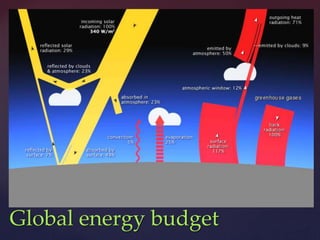
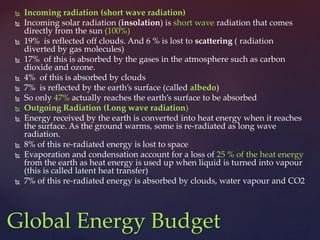
 Incoming radiation (short wave radiation)
 Incoming solar radiation (insolation) is short wave radiation that comes
directly from the sun (100%)
 19% is reflected off clouds. And 6 % is lost to scattering ( radiation
diverted by gas molecules)
 17% of this is absorbed by the gases in the atmosphere such as carbon
dioxide and ozone.
 4% of this is absorbed by clouds
 7% is reflected by the earth’s surface (called albedo)
 So only 47% actually reaches the earth’s surface to be absorbed
 Outgoing Radiation (Long wave radiation)
 Energy received by the earth is converted into heat energy when it reaches
the surface. As the ground warms, some is re-radiated as long wave
radiation.
 8% of this re-radiated energy is lost to space
 Evaporation and condensation account for a loss of 25 % of the heat energy
from the earth as heat energy is used up when liquid is turned into vapour
(this is called latent heat transfer)
 7% of this re-radiated energy is absorbed by clouds, water vapour and CO2
Global Energy Budget
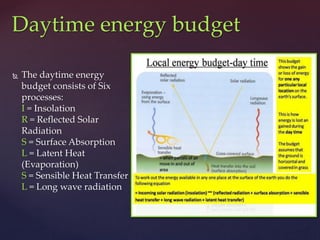
 The daytime energy
budget consists of Six
processes:
I = Insolation
R = Reflected Solar
Radiation
S = Surface Absorption
L = Latent Heat
(Evaporation)
S = Sensible Heat Transfer
L = Long wave radiation
Daytime energy budget
Insolation:
 Atmosphere’s main energy input which is strongly influenced by cloud cover and latitude. At the equator, the
sun’s rays are more concentrated than at the poles. (75% of insolation reaches equator, 5% reaches Poles)
Reflected Solar Radiation-
 The proportion of reflected solar radiation varies greatly with the nature of the surface.
 The reflectivity of a surface is known as the albedo.
 Fresh snow & ice have the highest albedos, reflecting up to 95% of sunlight.
 Ocean surfaces absorb most sunlight, and so have low albedos.
Surface Absorption-
 Energy arriving at the surface has the potential to heat that surface, as heat is absorbed by it.
 The nature of the surface has an effect, e.g. If the surface can conduct heat rapidly into the lower layers of the
soil its temperature will be low. If the heat is not carried away quickly it will be concentrated at the surface &
result in high temperatures there.
Latent Heat (evaporation)
 The turning of liquid water into vapour (evaporation) it consumes a considerable amount of energy.
 When water is present at the surface, a proportion of the incoming solar radiation will be used to evaporate it.
 Consequently, that energy will not be available to raise local energy levels and temperatures.
Sensible Heat Transfer
 This term is used to describe the transfer of parcels of air to or from the point at which the energy budget is
being assessed. If relatively cold air moves in, energy may be taken from the surface, creating an energy loss. If
warm air rises from the surface to be replaced by cooler air, a loss will also occur. This process is best described
as convective transfer, and during the day it is responsible for removing energy from the surface and passing it
to the air.
Long wave Radiation
 This is emitted by the surface, and passes into the atmosphere, and eventually into space.
 There is also a downward-directed stream of long-wave radiation from particles in the atmosphere
 The difference between the 2 streams is known as the net radiation balance.
 During the day, since the outgoing stream is greater than the incoming one, there is a net loss of energy from
the surface.
Daytime energy budget
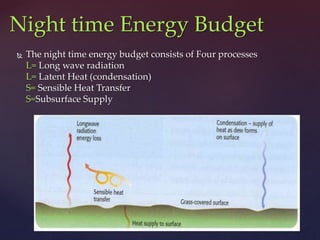
 The night time energy budget consists of Four processes
L= Long wave radiation
L= Latent Heat (condensation)
S= Sensible Heat Transfer
S=Subsurface Supply
Night time Energy Budget
 Long Wave Radiation: During a cloudless night, little long wave
radiation arrives back at the surface of the ground from the
atmosphere and consequently the outgoing stream is greater than
incoming stream leading to a net loss of energy. Under cloudy
conditions this loss is reduced because long wave radiation can reflect
off clouds back to the surface; they act like a blanket around the earth.
 Latent Heat (Condensation): At night water vapour in the air, close to
the ground can condense and form dew as the air is cooled by the
cold surface. This releases stored energy, resulting in a net gain of
energy.
 Subsurface supply: Heat transferred by the sun to the surface during
the day, may be released back to the surface at night which can off set
the night time cooling at the surface
 Sensible heat transfer still occurs and cold air moving into an area
may reduce temperatures whereas warm air moving in will raise
temperatures
Night Time Energy Budget
 Absolute Humidity: The amount of water in the atmosphere
 Relative Humidity: Ratio of the amount of water vapour currently
in the air compared to how much the air can hold at that
temperature (usually expressed as a percentage).
 Saturated Air: Air with a relative humidity of 100%
 Dew point: The temperature at which condensation occurs,
allowing the formation of dew, mist or fog.
WARMER AIR CAN TYPICALLY HOLD MORE WATER VAPOUR
THAN COOLER AIR CAN
Humidity
 Mist and Fog: are cloud at ground level. A cloud is a collection of water droplets.
Mist occurs when visibility is between 1000m and 5000m. Whereas Fog occurs
where visibility is below 1000m. So Fog is thicker cloud cover than mist.
 These clouds form at ground level because, air can only hold a certain amount of
moisture. Colder air can hold less moisture than warmer air. Once this
maximum amount of moisture is reached, air is saturated and the water vapour in
the air turns to liquid (dew point). This is when clouds form as condensation of
water vapour to water droplets occur.
 For these clouds of fog/mist to form close to the ground level , one of two things
must have occurred:
1. Air must have been cooled close to the ground
 e.g. Advection Fog: As warm, moist air passes horizontally over a cold surface, it is chilled,
and condensation takes place as the temperature of the air is reduced and therefore it
reaches dew (saturation) point
 e.g. Radiation Fog: Occurs in low lying areas when the ground surface loses heat at night
by long wave radiation and therefore the air immediately above it is cooled causing
condensation and fog.
2. More water vapour must have been added to the atmosphere close to the ground.
 This can occur over warm, wet surfaces like large lakes, where water is evaporated from
the warm surface of the lake and condenses in the cold air above to form fog)
 For mist or fog to form, condensation nuclei are needed (e.g. dust or salt particles in the
air). These are more common in urban or coastal areas, so mist of fog are more common
here.
Mist and Fog
Temperature Inversions
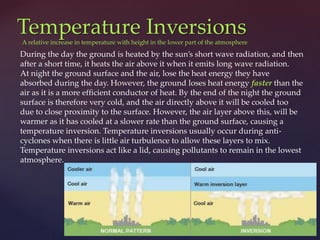
During the day the ground is heated by the sun’s short wave radiation, and then
after a short time, it heats the air above it when it emits long wave radiation.
At night the ground surface and the air, lose the heat energy they have
absorbed during the day. However, the ground loses heat energy faster than the
air as it is a more efficient conductor of heat. By the end of the night the ground
surface is therefore very cold, and the air directly above it will be cooled too
due to close proximity to the surface. However, the air layer above this, will be
warmer as it has cooled at a slower rate than the ground surface, causing a
temperature inversion. Temperature inversions usually occur during anti-
cyclones when there is little air turbulence to allow these layers to mix.
Temperature inversions act like a lid, causing pollutants to remain in the lowest
atmosphere.
A relative increase in temperature with height in the lower part of the atmosphere
The Global Energy Budget
Atmospheric Energy
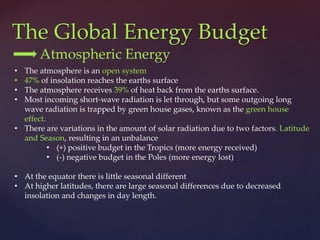
• The atmosphere is an open system
• 47% of insolation reaches the earths surface
• The atmosphere receives 39% of heat back from the earths surface.
• Most incoming short-wave radiation is let through, but some outgoing long
wave radiation is trapped by green house gases, known as the green house
effect.
• There are variations in the amount of solar radiation due to two factors. Latitude
and Season, resulting in an unbalance
• (+) positive budget in the Tropics (more energy received)
• (-) negative budget in the Poles (more energy lost)
• At the equator there is little seasonal different
• At higher latitudes, there are large seasonal differences due to decreased
insolation and changes in day length.
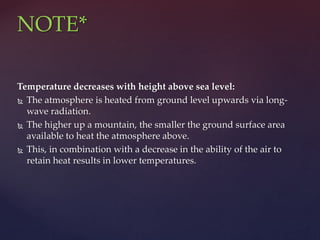
Temperature decreases with height above sea level:
 The atmosphere is heated from ground level upwards via long-
wave radiation.
 The higher up a mountain, the smaller the ground surface area
available to heat the atmosphere above.
 This, in combination with a decrease in the ability of the air to
retain heat results in lower temperatures.
NOTE*
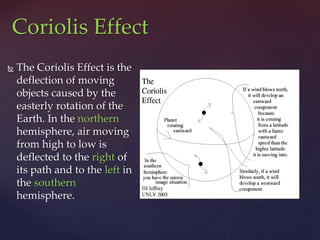
 The Coriolis Effect is the
deflection of moving
objects caused by the
easterly rotation of the
Earth. In the northern
hemisphere, air moving
from high to low is
deflected to the right of
its path and to the left in
the southern
hemisphere.
Coriolis Effect
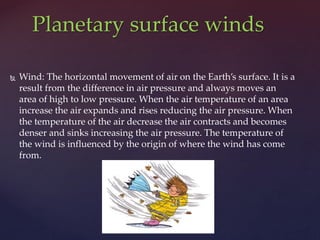
 Wind: The horizontal movement of air on the Earth’s surface. It is a
result from the difference in air pressure and always moves an
area of high to low pressure. When the air temperature of an area
increase the air expands and rises reducing the air pressure. When
the temperature of the air decrease the air contracts and becomes
denser and sinks increasing the air pressure. The temperature of
the wind is influenced by the origin of where the wind has come
from.
Planetary surface winds
 Pressure is measure in Malabar's (mb) and is represented by isobars (lines
of equal pressure).
 Poor weather = low pressure
 Fine Weather = high pressure
 The North Hemisphere has much more land so there is a lot of seasonal
change, whereas the South Hemisphere has a lot of water, so little seasonal
change occurs.
 Air pressure: The gases in the atmosphere press down on the Earth’s
surface, exerting a force called air pressure.
 It is differences in air pressure that cause different weather in our
atmosphere. You don’t feel it because you have equal pressure pushing out
from inside your body
 Winds and air pressure: Changes in air pressure make winds blow. They
are due to seasonal differences in the overhead sun.
 Air moves from areas of high pressure to areas of low pressure, and this
produces winds.
“Winds blow from high to low !“
Pressure Variations
Pressure Variations
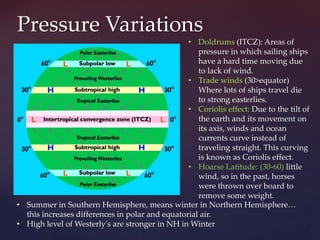
• Doldrums (ITCZ): Areas of
pressure in which sailing ships
have a hard time moving due
to lack of wind.
• Trade winds (30>equator)
Where lots of ships travel die
to strong easterlies.
• Coriolis effect: Due to the tilt of
the earth and its movement on
its axis, winds and ocean
currents curve instead of
traveling straight. This curving
is known as Coriolis effect.
• Hoarse Latitude: (30-60) little
wind, so in the past, horses
were thrown over board to
remove some weight.
• Summer in Southern Hemisphere, means winter in Northern Hemisphere…
this increases differences in polar and equatorial air.
• High level of Westerly's are stronger in NH in Winter
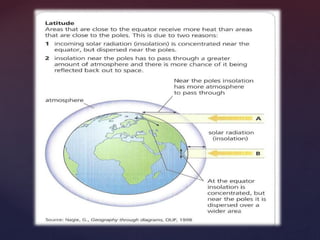
 Angle of the overhead sun, latitude and thickness of atmosphere: Lower
latitudes (equatorial regions) have higher temperatures than higher latitudes
(Poles) this is as a result of the amount of heating that each area receives. Places
near the equator receive direct heat on a small surface area, and experience little
energy loss via absorption, scattering and reflection, as there is a relatively small
amount of atmosphere to pass through. Towards the Poles, the surface area to be
heated increases, as does the amount of atmosphere to pass through, increasing
losses via, absorption, scattering, and reflection.
 Height above sea level: It is important to remember that the atmosphere is heated
from ground level upwards via long-wave radiation. The higher up a mountain
you go, the smaller the surface area available to heat the atmosphere above. This,
in combination with a decrease in the ability of the air to retain heat results in
lower temperatures.
 Distance from land and sea: Land and sea have vastly different specific heat
capacities (the amount of energy needed to raise 1kg of a substance by 1 degree).
They have different abilities to absorb, transfer and radiate heat energy. Generally,
land surfaces respond to heating on a daily basis (diurnal) meaning that
differences between day and night temperatures can be into double figures, but
sea surfaces respond over a period of months and retain heat for longer. The sea
heats up and cools down more slowly than the land, acting to moderate
temperatures for coastal locations.
Exploring variations in
Temperature and winds:
Surface pressure belts There are many pressure belts existing on Earth, due to the rotation and tilt of the Earth on its axis,
these vary.
 In the equator region, warm air rises causing a low pressure belt. Whereas at the polar regions cold air
sinks, thus creating a high pressure belt. The sub polar regions, around latitudes 60-65 degrees North
and South of the equator, the rotation of the Earth flings the bulk of the air towards the equator,,
creating a low pressure belt. These four main pressure belts however are not continuous because the
surface of the earth is composed of both land and water, which are heated in different ways.
1. The first main pressure belt is the equatorial low pressure belt, which extends 5 degrees north and
south. Being at the equator is receives direct sunlight and thus the air here is warm, this air expands
and rises, creating low pressure in the process. This is a region of calm air known as the Doldrums,
due to its very little winds.
2. The second pressure belt, is the subtropical high pressure belt, that coincides with latitudes of 30-
33degrees north and south. The air that rises eventually meets the tropopause where it can rise no
further, it cools while rising and spreads outwards towards the poles, gradually cooling back down
to the surface of 30degrees, which causes an increase in air pressure. The air flings off the polar
region due to the rotation of the earth and also descends in this region thus adding to the already
high pressure existing in this region. The subtropical high pressure belt is an area of low winds and
so it is also known as the horse latitudes (an area where ship crew would throw horses overboard to
lighten the load and spare food after being caught in these areas).
3. The third major belt is the sub polar low pressure belt at latitudes 60-65degres. It is created mainly to
the rotation of the Earth, which swings the bulk of air towards the equator, these are areas of
storminess, especially in winter.
4. The forth and final pressure belt is the polar high pressure belt, located in the polar region. This belt
is created because in this region the air is extremely cold and heavy, leading to a high pressure.
5. Pressure belts are caused mainly due to the temperature differences on the Earths surface and
therefore move in response to the migration of the sun. The sun shines vertically oer the Tropical of
Cancer on June 21st. At this time all the pressure belts move about 5degrees North. On the 21st
September, the sunshine's vertically over the equator and on December 22nd the sun shines vertically
over the tropic of Capricorn, thus all belts move 5degrees south (winter). The shifting of pressure
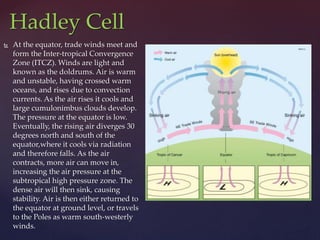
belts affects the direction of wind flow, causing wind belts during the year and as these wind belts
shift with the season, belts of precipitation change also.
Ocean currents
Ocean currents can be either warm or cold and they act to either raise or
lower temperatures of the coastal areas. Warm currents transfer heat away
from the Equator and towards the poles whilst cold currents carry water
towards the Equator. Major ocean currents circulate clockwise in the NH
and anticlockwise in the SH. They are caused by the influence of prevailing
winds blowing across the oceans, and mean in the same motion.
 The dominant pattern is roughly circular and known as a GYRE
 Gyres move clockwise in NH and Anti clockwise in SH, due to
CORIOLIS EFFECT
 Like atmospheric circulation, ocean currents help to redistribute energy
across the earth. Because they cover 67% of the earth's surface, the
oceans receive 67% of the sun's energy that reaches earth. The ocean
holds on to this heat for longer than the land does and the ocean
currents move this heat around, from the tropics to higher latitudes. In
total, ocean currents transfer about 25% of the global heat budget.
Ocean Currents
Ocean Currents
 Ocean currents flowing away from the equator are called warm
currents. The water in these currents is not necessarily warm, but it's
warm compared to what you would expect for that latitude. The Gulf
Stream is a good example of a warm current. If a current
flows towards the equator it is a cold current, for example the Canaries
current.
 Water always flows down toward the lowest point.
 Water’s density is determined by the water’s temperature
and salinity (amount of salt).
 Cold water is denser than warm water.
 Water with high salinity is denser than water with low salinity.
 Ocean water always moves toward an equilibrium, or balance. For
example, if surface water cools and becomes denser, it will sink. The
warmer water below will rise to balance out the missing surface water
Ocean Currents
Ocean Conveyor Belt (global)
1. Cold, salty water from polar regions sink into the depths and move
towards the equator
2. The densest water is found around Antarctica, due to the amount of
salt left in the water after ice is formed.
3. Surface currents bring warm water to North Atlantic from the
Indian and Pacific Oceans, loosing heat in the northern areas. Water
sinks, reversing convection current.
4. North Atlantic Is warmer than North Pacific – this leads to more
evaporation in the Atlantic. This evaporation leaves more salt
behind, making water denser, causing it to sink. Water will then
travel back to the North Pacific, picking up more water which
reduces its density.
Ocean Conveyor belt
 The ocean is not a still body of water. There is constant motion in the
ocean in the form of a global ocean conveyor belt. This motion is
caused by a combination of thermohaline currents (thermo =
temperature; haline = salinity) in the deep ocean and wind-driven
currents on the surface. Cold, salty water is dense and sinks to the
bottom of the ocean while warm water is less dense and remains on
the surface.
 The ocean conveyor gets its “start” in the Norwegian Sea, where
warm water from the Gulf Stream heats the atmosphere in the cold
northern latitudes. This loss of heat to the atmosphere makes the
water cooler and denser, causing it to sink to the bottom of the ocean.
As more warm water is transported north, the cooler water sinks and
moves south to make room for the incoming warm water. This cold
bottom water flows south of the equator all the way down to
Antarctica. Eventually, the cold bottom waters return to the surface
through mixing and wind-driven upwelling, continuing the conveyor
belt that encircles the globe.
Ocean conveyor belt
Land-sea breezes
These are Meso (small) scale / local winds caused a pressure gradient
between land and sea.
 Created on a daily basis, as a result of the differences in heating and
cooling of the land and sea (i.e. specific heat capacities)
 During the day, onshore winds are created, as land temperatures are
higher than sea temperatures; thus low pressure is formed over the
land, air rises and cools
 Cool air then drifts out over the sea, increasing in density and starts to
sink. Thus creating high pressure over the sea.
 The sea breeze is caused by air flowing from high to low pressure (sea
to land)
 The situation is reversed at night, leading to high pressure over the land
and thus an off shore breeze. Pressure is lower over the sea as it is
warmer than the land, and air above it rises
Local pressure gradients
The two winds that exist in mountain
and valley locations are uphill, anabatic
winds and downhill, katabatic winds.
 Anabatic: An uphill wind develops
under sunny morning conditions
when slopes receive sunlight, become
warm and then heat the atmosphere
above them. Air above these slopes
expands and rises. A pressure
gradient results accompanied by a
strong uphill wind
 Katabatic: Downhill winds form, as
heat is lost from a valley during the
evening. Colder, denser air from
higher areas drains into the valley
Mountain and Valley winds
General circulation model
• Warm air is transferred pole
wards and is replaced by cold
air moving towards the
equator.
• Air that rises is associated with
low pressure, whereas air that
sinks is associated with high
pressure.
• Low pressure produces rain,
while high pressure produces
dry conditions.
• There are three major cells
present: Hadley, Ferrell and
Polar.
• They shift northwards and
southwards throughout the
year due the shift in location of
the sun’s rays focusing most
intensely on the Earth’s surface.
 At the equator, trade winds meet and
form the Inter-tropical Convergence
Zone (ITCZ). Winds are light and
known as the doldrums. Air is warm
and unstable, having crossed warm
oceans, and rises due to convection
currents. As the air rises it cools and
large cumulonimbus clouds develop.
The pressure at the equator is low.
Eventually, the rising air diverges 30
degrees north and south of the
equator,where it cools via radiation
and therefore falls. As the air
contracts, more air can move in,
increasing the air pressure at the
subtropical high pressure zone. The
dense air will then sink, causing
stability. Air is then either returned to
the equator at ground level, or travels
to the Poles as warm south-westerly
winds.
Hadley Cell
 The Ferrel cell circulation is not as easily explained as the Hadley and
Polar cells. Unlike the other two cells, where the upper and low-level
flows are reversed, a generally westerly flow dominates the Ferrell cell
at the surface and aloft. It is believed the cell is a forced phenomena,
induced by interaction between the other two cells whereby it acts like
a gear. The stronger downward vertical motion and surface
convergence at 30°N coupled with surface convergence and net
upward vertical motion at 60°N induces the circulation of the Ferrel
cell. This net circulation pattern is greatly upset by the exchange of
polar air moving southward and tropical air moving northward. This
best explains why the mid-latitudes experience the widest range of
weather types.
Ferrell Cell
 This is the northernmost cell of circulation and its mean position is
between 60°N and the North Pole. At the pole, cold, dense air
descends, causing an area of subsidence and high pressure. As the
air sinks, it begins spreading southward. Since the coriolis force is
strongest at the poles, the southward moving air deflects sharply to
the right. This wind regime is called the surface polar easterlies,
although the upper winds are still predominantly from the
southwest. Near 60ºN, the southeasterly moving air moving along
the surface collides with the weak, northwesterly surface flow that
resulted from spreading air at 30°N. This colliding air rises, creating
a belt of low pressure near 60°N.
Polar Cell
 At the Equator, the sun warms the Earth and this transfers heat to the air above,
which causes it to rise. The rising air creates an area of low pressure with clouds
and rain - this is called the Inter Tropical Convergence Zone (ITCZ) and is where
the trade winds meet in the equatorial zone.
 As the rising air cools, it begins to move away from the Equator and then further
cooling, increasing density and diversion by the Coriolis force cause it to slow
down and descend, forming the descending limb of the Hadley Cell.
 The cool air sinks at 30o north and south of the Equator, creating an area of high
pressure with clear skies and stable conditions - this is where sub-tropical jet
streams are found
 The cool air reaches the ground surface - some is returned to the Equator as
surface winds (trade winds) whilst the remaining air is diverted polewards.
 60o north and south of the Equator, warm south-westerlies/ north-
westerlies which have collected moisture from the sea meet the cold air from the
Poles - the warmer air is less dense and this causes it to rise, creating an area
of low pressure
 Some of the air joins the Ferrell Cell and moves back towards the Equator and the
rest joins the polar cell and moves towards the Poles
 At the poles, the cool air sinks to create a high-pressure zone - the high-
pressure is then drawn back to the Equator as part of the surface winds
Combined effect of the three
cells
 Between the different atmospheric cells high up in the tropopause at a
height of about 10km are the jet streams, named the polar jet stream
(40-60°N+S) and the subtropical jet stream (25-30°N+S). These jet
streams move air at a high speed (up to 300km/h) around the Earth
horizontally and give rise to Rossby waves. The jet streams were first
discovered when Zeppelins were blown off course in WW1. The
greater the temperature difference – the greater the jetstream.
 Rossby waves were discovered by Carl-Gustaf Rossby, a Swedish
meteorologist, in the 1930’s. They are waves or zigzags in the jet
streams as the travel around the Earth. The number of waves varies
throughout the year but usually in summer it’s between four and six
while in winter it’s three. Rossby waves are formed by major releif
barriers (like mountains), thermal differences and uneven land-sea
interfaces.
 Jet streams have also been known to influence flights, for example it’s
quicker to travel by aeroplane from London to New York then it is the
other way around because the altitude planes travel at is similar to
these high speed winds.
Jet Streams and Rossby Waves
Jet stream and Rossby Wave
The wave like
meandering of air is
described as a
rossby wave, which
are affected by
major topographic
barriers. As the
pattern becomes
more exaggerated it
leads to blocking
anticyclones.
A weather front is a term used in meteorology to describe the boundary
where two air masses converge, sparking weather events. There is a cold
front and a warm front.
Fronts
• Cold fronts often come with thunderstorms or
other types of extreme weather. They usually
move from west to east. Cold fronts move faster
than warm fronts because cold air is denser,
meaning there are more molecules of material in
cold air than in warm air.
• Strong, powerful cold fronts often take over
warm air that might be nearly motionless in the
atmosphere. Cold, dense air squeezes its way
through the warmer, less-dense air, and lifts the
warm air. Because air is lifted instead of being
pressed down, the movement of a cold front
through a warm front is usually called a low-
pressure system. Low-pressure systems often
cause severe rainfall or thunderstorms.
• Warm fronts usually show up on the tail end
of precipitation and fog. As they overtake cold
air masses, warm fronts move slowly, usually
from north to south. Because warm fronts
aren't as dense or powerful as cold fronts,
they bring more moderate and long-lasting
weather patterns. Warm fronts are often
associated with high-pressure systems, where
warm air is pressed close to the ground. High-
pressure systems usually indicate calm,
clearweather.
{Section 2.3
Weather processes
and phenomena
 Atmospheric moisture exists in all three states – vapour, liquid and
solid.
 Energy is used in the change from one phase to another.
 When evaporation occurs, it takes 600 calories of heat to change 1
gramme of water from liquid to vapour, thus a heat loss occurs.
 Condensation however released locked latent heat, causing a rise in
temperature.
 Changes between vapour and ice releases heat when vapour is
converted to ice.
 By contrast, heat is absorbed in the process of sublimation (snow
patches that disappear without melting.
Moisture in the atmosphere
{ {Evaporation
 Initial humidity of the
air- if air is very dry
then strong
evaporation occurs; if
it is saturated then
very little occurs.
 Supply of heat – the
hotter the air, the
more evaporation that
takes place.
 Wind Strength –
under calm conditions
air becomes saturated
rapidly and therefore
little evaporation
occurs.
Condensation
 Condensation occurs
when either enough
water vapour is
evaporated into an air
mass for it to become
saturated or when the
temperature drops so
that dew point is
reached. The Cooling
occurs in three main
ways…
1. Radiation cooling of
the air
2. Contact cooling of the
air when It rests over a
cold surface.
3. Adiabatic cooling of
air when it rises.
Factors affecting…
 Precipitation refers to all forms of deposition of moisture from the atmosphere
– including rain, hail , snow and dew. Because rain is the most common form
of precipitation in many areas, the term is sometimes applied for rainfall
alone. For any type of precipitation to form, clouds must first be produced.
 When minute droplets of water are condensed from water vapour, they float
in the atmosphere as clouds. If droplets coalesce they form large droplets
which, when heavy enough to overcome gravity, fall as rain.
 The BERGERON THEORY suggests that for rain to form, water and ice must
exist in clouds at temperatures below 0 degrees C. At such temperatures water
droplets and ice droplets form and grow by condensation until big enough to
overcome turbulence and cloud updrafts, so they fall. As they fall, crystals
coalesce to form larger snowflakes, which generally melt and become rain as
they pass into the warm air layers near the ground. Thus according to
Bergeron, rain comes from clouds that are well below freezing at high
altitudes, where the coexistence of water and ice is possible.
 Other mechanisms must also exist as rain as rain also comes from clouds that
are not so cold. These include….
 Condensation on extra-large hydroscopic nuclei
 Coalescence by sweeping, whereby a falling droplet sweets up others in its
path
 The growth of droplets by electrical attraction.
Humidity and Precipitation
 Relates to the rising and sinking of air. This means that the temperature of the
air is changed internally, without any other influence. It is the rising
(expanding and cooling) and sinking (contracting and warming) of air that
causes its temperature change.
 Air moves for four reasons…
1. Convection: The most powerful lifting mechanism initiated by the heat of
the Sun warming the ground, causing air to warm, expand and rise.
2. Orographic barriers: When air is forced to rise over a hill, mountain etc.
3. Turbulence: in air flow
4. Frontal Systems
 When air rises from one elevation to another, the temperature changes. The
decrease of pressure with height allows the rising parcel of air to expand. As
it expands it uses up energy from within the parcel. Likewise when air is
sinking it gains heat from contraction. Therefore adibiatic heating is an
internal mechanism without any heat exchange.
Adiabatic processes (lapse
rates)
 The Environmental lapse rate (ELR) is the actual temperature decline
with height – on average this is 6degrees per 1000 metres.
 Adiabatic cooling and warming in dry air occurs at a rate of 10
degrees/ 1000m. This is known as the dry adiabatic lapse rate (DALR)
 Air in which condensation is occurring cools at the lower saturated
adiabatic lapse rates (SALR) between 4-9 degrees/1000m. This is
because latent heat released in the condensation process partly offsets
the temperature loss from cooling. The rate varies according to the
amount of latent heat released. 4degrees being in warm saturated air,
9/1000 being in cold saturated air.
 Lapse rates can be shown on a temperature height diagram.
Adiabatic processes
Rocks and Weathering
Elementary Plate Tectonics
• The theory of plate tectonics states that the Earth is made of a number of layers
1. The Crust: Thin outer layer which holds tectonic plates.
2. The Mantle: Thickest layer making up 82% of Earths volume. Made up of
magma, with diameter of approximately 2900KM
3. The Outer Core: Hot layer surrounding inner core. Liquid layer made up of iron
and nickel, with temperatures of approximately 5000degrees.
4. The Inner Core: Dense, solid core made of iron and nickel with temperatures
exceeding 5500degrees Celsius.
• There are two types of crust:
1. Oceanic: Dense, thinner plate made up of Basaltic rock, approximately 16km
thick.
2. Continental: Much thicker plate made up of granite, silica and aluminium, less
dense than oceanic plate.
• The upper mantle and crust make up a layer called the Lithosphere which is broken
into a number of plates. These move over the Asthenosphere, which is a plastic
layer in the mantle, which drives plate movement.
Earths Structure
Alfred Wegener's theory for
continental drift
• Wegener in 1912 proposed his hypothesis on continental drift, using
several lines of evidence to support his ideas that the continents were
once joined together in one super continent called Pangaea (which
means “entire earth” in Greek) These included…
1. The apparent fit of the continents like a jigsaw puzzle
2. The correlation of multiple fossils such as the mesosaurus, found in
only South America and Africa. As a creation who could only live in
shallow water, couldn’t swim well or fly, how could it have travelled
over an entire ocean? Solution: The continents were once connected.
3. Matching rock formations and mountain chains found in South
America and Africa, consisting of the same rock and same age.
4. Glacial striations found in tropical rainforests suggests that countries
were always in their current climatic regions.
• However whilst Wegener had some very valid points and a good
argument, he had no driving mechanism to make this happen. He
believes that somehow continents were pushing ocean plates along –
however critics commented that continental plates lacked momentum
to achieve this and thus his theory fell through.
Harry Hess’s hypothesis of Sea
floor spreading 1960s
• Harry Hess in the 1960s suggested that convection currents within the
mantle could be forcing magma to rise and crack the crust above it
forcing it apart.
• He believes that as it welled up and cooled on the ocean floor at
divergent zones, new oceanic crust was forming at mid ocean ridges,
pushing older, colder and more dense crust towards deep sea trenches,
where it is subducted, recycled back into the mantle or creates
volcanism.
• However when there is no trench for old crust to subject under (such as
the coast of Africa), then in pushes the continent along with it as crust
accumulates.
• As there are few trenches in the Atlantic Ocean it is expanding
• As there are many trenches in the Pacific Ocean it is shrinking
• How did Hess support his theory? Rock Magnetism. Hess looked at the
polarity on either sides of the ridge, a correlation of identical bonds
between the two sides supported his theory.
• Magnetic grains in the rock align with the Earth’s magnetic field at the
time of cooling (known as paleomagnetism)
Sea floor spreading
J Wilson 1965
• In 1965 J Wilson linked together ideas of continental drift and
sea floor spreading, developing the concept of plate tectonics.
• Wilson said that Earth’s crust, or lithosphere, was divided into
large, rigid pieces called plates. These plates “float” atop an
underlying rock layer called the asthenosphere. In the
asthenosphere, rocks are under such tremendous heat and
pressure that they behave like a viscous liquid (like very thick
honey). The term “continental drift” was no longer fully
accurate, because the plates are made up of continental and
oceanic crust, which both “drift” over Earth’s face.
Tuzo Wilson predicted three types of boundaries between
plates: mid-ocean ridges (where ocean crust is created),
trenches (where the ocean plates are subducted) and large
fractures in the seafloor called transform faults, where the
plates slip by each other.
Types of Plate boundaries
• Divergent/Constructive: These plates are moving away from each other.
They are usually found in the middle of the oceans and mid ocean
ridges are found here.
• Convergent/Destructive: These plates are moving towards each other
causing earthquakes, volcanoes, deep ocean trenches and fold
mountains.
• Transform/conservative: These plates are sliding past each other. At
these zones land is not being created nor destroyed , however frequent
earthquakes are common. An example is San Andrea Fault in California
How do the plates move?
• There are three main theories explaining plate movement…
1. Convection currents: This states that huge convection currents
occur in the earths interior causing hot magma to rise to the
surface and then spread out at mid ocean ridges, whilst the
cooler magma gets denser and sinks back deep into the mantle
where it is reheated.
2. Dragging Theory: Plates are dragged or subducted by their
oldest edge when they become cold and dense. Plates are hot
at mid ocean ridges, but cool as they are pushed further away.
As the cold plates descend at the trenches, pressure causes the
rocks to become heavier and therefore they are subducted.
3. Hotspot: Hotspots are plumes of molten rock which rise
underneath a plate penetrating weaknesses in the crust and
resulting in volcanic activity. As plates are moving and hotspots
stay still, these therefore led to chains of land creation such as
Hawaii.
Convection
Currents
Hot Spots Dragging Theory
Subduction Zones
• Subduction occurs when an oceanic lithospheric plate collides
with another plate. As the density of the ocean plate Is similar
to that of the asthenosphere it can easily be subducted.
Subduction zones dip mainly at 30-70 degree angles.
• If a continental and oceanic plate meet, the oceanic plate will
be subducted beneath the continental as it is more dense.
• Evidence of subduction:
• The existence of certain landforms such as deep sea trenches and
folded sediments (usually arc shaped and containing volcanoes)
• Benioff zone – a deep active seismic area dipping away from the
deep sea trench.
• Earthquake focal mechanisms (ring of fire)
Island Arcs
• Island arcs are features of
oceanic/continental
convergence. They are
chains of volcanoes which
are aligned in an arc shape
and sit close to the boundary
where two plates meet.
During subduction hot re-
melted material from the
subducting slab rises and
leaks into the crust forming a
series of volcanoes. These
volcanoes can make a chain
of islands called Island arcs.
Many are found in the Pacific
and Western Atlantic.
Mountain Building
• Plate tectonics are associated with mountain building. Where
oceanic plates meet continental, the light less dense plate may
be bulked and folded up creating fold mountains, such as the
Andes.
• Where two continental plates meet, both may be folded and
buckled, forming mountains such as the Himalayas formed by
the collision of the Eurasian and Indian plates.
• The Indian subcontinent moved rapidly north during the last
70 million years, eventually colliding with the main body of
Asia. The huge ocean Tethys has been entirely lost between
these masses in the collision zone and the crust has thickened
because Asia overrides India, resulting in crust thickening
causing the uplift of the Himalayas.
Plate landforms
WEATHERING
Decomposition and Disintegration
Weathering
• Describes the processes that break up rocks. There are three
types of weathering…
1. Chemical Weathering (Decomposition): Processes that break
down rocks atom by atom through chemical reactions.
Water plays a key role here.
2. Mechanical Weathering (Disintegration): The tearing apart
and breaking of rocks through physically destroying them
3. Biological Weathering: When animals and vegetation (root
wedging) break up rocks.
• Hot wet climates enhance chemical weathering
• Cold wet climates enhance mechanical weathering.
Mechanical Weathering
Processes
• Freeze Thaw: Water becomes trapped in the cracks and joints in a rock and freezes in cold
conditions. As this happens the water puts a pressure on the rock as it expands by 9%.
When temperatures rise the ice will melt and the pressure will be released, but the rock
weakened. After many repetitive cycles this eventually breaks up rocks and causes them
to fragment.
• Salt Crystallisation: This causes decomposition of rock by solution of salts. When
temperatures fluctuate around 26-28 degrees sodium sulphate and sodium carbonate in
rocks expand by 300% creating pressure on joints forcing them to crack. Also when rocks
are near salt water, the water evaporates leaving behind salt crystals. Similarly as
temperatures rise further these crystals expand and exert pressure on the rock causing it
to slowly break apart.
• Exfoliation/Disintegration: This process is found in hot desert areas where there are large
diurnal temperature ranges. Rocks heat up during the day and expand, then cool and
contract at night. As a rock is a poor conductor of heat, stresses occur only in the outer
layers, causing peeling or exfoliation to occur. Griggs 1936 showed that moisture is
essential for this to happen and that temperature change alone did not cause rock
breakdown. Exfoliation is most common in granite.
• Pressure release/fracturing: This is the process whereby overlying rocks are removed by
erosion, causing underlying rocks to expand and fracture parallel to the surface due to
loss of pressure (referred to unloading). The unloading of pressure by removal of
underlying rocks causes cracks or joints to form at right angles to the unloading surface.
There cracks are lines of weakness in the rocks.
Freeze Thaw
Exfoliation
Salt Crystallisation
Pressure Release
Chemical Weathering
• Carbonation: Occurs on rocks with calcium carbonate such as chalk
and limestone. Rainfall combines with dissolved CO2 to form a weak
carbonic acid. When the carbonic acid and calcium carbonate in
rocks react they form a calcium bicarbonate which is soluble. This is
then carried away in percolating water, removing particles holding
the rock together and slowly breaking it apart.
• Hydrolysis: Occurs on rocks containing feldspar – notably granite.
Feldspar reacts with acid water to form kaolin, which is a soft clay
mineral which weakens the rock. It is described as the chemical
breakdown due to a reaction with water.
• Hydration: is the process whereby certain minerals absorb water,
expand and change.
• Oxidation: Is the reaction of a substance with oxygen. Especially with
iron compounds leading to rusting.
Carbonation ^
Hydrolysis v
Hydration ^
Carbonation
Chemical
Weathering
Weathering Controls: Climate
• The type and rate of weathering
varies with climate.
• Pelletier's diagram (1950) shows
how weathering is related to
moisture availability and average
annual temperatures in an area.
• Cold temperatures for instance,
would increase the number of
freeze thaw cycles.
• Whereas in warm moist regions
chemical weathering increases.
• Van Hoff's law states that the rate
of chemical weathering increases 2-
3 times for everything increase in
temperature of 10degrees
Weathering Controls: Geology
• Rock type and structure also influence the rate and type of weathering due to…
• Chemical composition
• Nature of cements in sedimentary rocks
• Joints and bedding planes
• Rock type: Determines that resistance of the rock to the weathering processes
that operate in a particular environment. Each rock type consists of different
minerals which are joined together by crystallisation, chemical bonding or
dementing for example – limestone consists of calcium carbonate and is
therefore susceptible to carbonation, whereas granite contains feldspar and is
therefore susceptable to hydrolysis.
• Rock structure: is also important as rocks consisting of many joints or faults have
lines of weakness along which penetrating weathering agents can attack,
whereas rocks without these are more resistance to weathering.
• Grain size: influences the speed at which rocks weather. Coarse grained rocks
weather quickly due to a large void space and high permeability, whereas fine
grained rocks offer a greater surface area and are therefore more resistant. The
importance of individual materials was stressed by Goldish (1938). Rocks formed
of resistance minerals such as quartz and feldspar in granite will resist
weathering, by contrast to those consisting of weaker
Limestone scenery
• Limestone pavement is a habitat with a high geological
interest. Forms of limestone pavement can be found in many
places in the world, especially in Alpine and Mediterranean
areas, but these lack the distinctive surface patterning seen on
British pavements.
How does limestone scenery
form?
1. Limestone is a hard sedimentary rock consisting of calcium carbonate, formed by the
deposition of plant and animal remains on the sea floor and is thus known as a
calcareous rock.
2. As limestone is a sedimentary rock, it is laid down in layers or ‘beds’ separated by
‘bedding planes’ which are caused by changes in deposition rates or content of
material deposited. Limestone pavements in England, Wales and Ireland are mainly
formed on deep beds of Carboniferous limestones which were deposited about 350
million years ago.
3. The formation of limestone pavements in the UK and Ireland began with the scouring
of the limestone by kilometre thick glaciers during the last ice age. The weight of the
ice removed the soil that lay over the limestone, and also fractured the limestone
along bedding planes. Fractured rocks were stripped away leaving level platforms of
limestone
4. From the flat limestone surfaces, the characteristic features of limestone pavement
have been formed by water in the glacially deposited soil exploiting cracks and fissures
in the rock such as bedding planes and joints (lines of weakness in the rock generally
running at 90o to bedding planes). These faults allow water to percolate into the rock
and dissolve it via carbonation solution, forming caverns and other features.
5. Limestone pavement is a type of karst landform. Karst is the word for an area of
soluble rock in which the landforms are of a solutional nature where drainage is usually
underground through rock fissures rather than in surface streams.
Characteristics of limestone
scenery
Features of limestone scenery
• Due to the solubility of limestone, limestone pavements are associated
with some very curious and unusual landforms. The most characteristic
surface feature of limestone pavements is their division into blocks,
called clints, bounded by deep vertical fissures known as grikes.Clints
and grikes form under relatively deep cover of soil where water, carrying
carbonic acid which is formed from dissolved carbon dioxide as well as
organic acids from decaying vegetation, picks out vertical lines of
weakness (joints) in the rock. These fissures widen over the years as the
acidic water preferentially attacks the lines of weakness. As the carbonic
acid dissolved the lime stone a swallow hole usually is formed where
water percolates through bedding planes and joints in the limestone
due to gravity. As it moves in faults in the limestone, it continues to
chemically weather the rock (carbonation solution) creating a cavern. As
calcium bicarbonate drips off the ceiling of the cavern, wheather
evaporates leaving behind a calcite deposit which forms stalactites and
stalagmites. As these grow bigger they sometimes form, creating a pillar,
therefore reversing the erosional process. Sometimes however the
cavern becomes very large and collapses under gravity, leaving behind a
gorge.
Factors controlling the amount
and rate of limestone solution
1. The amount of carbon dioxide in the atmosphere,
groundwater and soil
2. The amount of water in contact with the limestone
3. Water temperature (limestone is more soluble with lower
temperatures)
4. The turbulence of water
5. The presence of lead, iron, sulphides, sodium or potassium
in the water.
6. Limestone weathers more quickly under soil cover than bare
surfaces.
Granite Tors
• Granite is an igneous rock made up of 3
very resistant minerals to weathering
1. Quartz
2. Mica
3. Feldspar
Granite tors: are isolated blocks of granite which have weathered slower than the
granite around them.
Linton in 1955 advocated deep chemical weathering as the exponent, suggesting
that where joints in the rock were closer together the rock would be more deeply
weathered and so easily removed by later erosion. He saw a prolonged chemical
weathering under tropical conditions as the main factor in tor genesis.
A second theory favoured by arctic workers suggests mechanical weathering during
the ice age was responsible. King believed them to be nothing more than the
residual remains of sub aerial erosion surfaces.
SLOPE PROCESSES AND
DEVELOPMENT
Slopes
• A slope is described as an inclined surface or angle of
inclination and can be…
1. sub aerial (exposed)
2. sub-marine (underwater)
3. Aggradational (depositional)
4. Degradational (erosional)
5. Transportational
6. Or a mixture
• Given the large scale of the definition geographers generally
study the hill slope (the area between the water shed and the
base)
• Slope form = the shape of the slopes cross section
• Slope processes = activities acting on the slope
• Slope evaluation = development of slopes over time
Mass movement
• Mass movement, is the downward movement by gravity of rock, regolith
(loose, weathered rock) and/or soil on the sloped top layers of the Earth’s
surface. It is a significant part of the process of erosion because it moves
material from high elevations to lower elevations. It can be triggered by
natural events like earthquakes, volcanic eruptions and floods but gravity is
its driving force. Water often acts as a lubricant in mass movement.
Causes of mass movement
• Safety Factor (relative strength or resistance of a slope) Rock particles on slopes are held on the slope
by friction in a state of dynamic equilibrium. Their steady state (not moving) represents a balance
between the internal (within/ between the particles known as internal or shear strength) and external
forces (known as external/shear stress). When shear strength = shear stress = no movement. If one is
greater than the other = movement.
• Volcanic activity many times causes huge mudflows when the icy cover of a volcano melts and mixes
with the soil to form mud as the magma in the volcano stirs preceding an eruption.
• Human modification of the land or weathering and erosion help loosen large chunks of earth and start
them sliding downhill.
• Vibrations from machinery, traffic, weight loading from accumulation of snow; stockpiling of rock or
ore; from waste piles and from buildings and other structures.
• Gravitational pull of the earth on soil, rocks, and mud.
• Water is a very important factor in influencing slope stability. Particles in the soil stick together if it
rains, the rain infiltrates via the pores and lubricates the weathered material therefore reduces friction
and makes the weathered material easier to move down the slopes. Water may also increase external
stress because it adds weight to the slope (because of an increase in pore pressure)
• If an area has decreased vegetation, it will be more prone to mass wasting. Vegetation stabilizes soil
particles on the surface and anchors soil under the surface through its root system. This is much like
comparing two sand dunes on a beach. If one sand dune has grasses growing on it, it will resist the
erosion of water and wind better than a sand dune without vegetation.
• Another factor that plays a role in mass wasting is earthquakes. The violent shaking that occurs in a
region where an earthquake takes place has the ability to break off sections of mountains or hills,
causing them to slide down the slope.
Shear Strength and Resistance
• Slope failure is caused by two factors…
1. A reduction in the internal resistance or shear strength of a
slope (ability to overcome gravity)
2. An increase in shear stress (forces trying to pull a mass
downslope)
3. When the shear strength and shear stress are in equillibrium
there is no mass movement – when shear stress exceeds a
slopes shear strength mass movement will occur.
• Downward movement can be opposed by…
• Friction: can be overcome on gentle slope angles if water is
present.
• Cohesive forces: bind particles to the slope. Clay may have high
cohesion, but this may reduce as water contents get too high.
• Vegetation: binds the soil and therefore stabilises slopes
Factors that contribute to
shear stress
• Removal of lateral support through undercutting or slope
steepening – Erosion by rivers, glaciers, wave action, faulting,
previous rock falls or slides.
• Removal of underlying support –Undercutting by rivers,
waves, sub-surface solution, loss of strength by extrusion of
underlying sediments.
• Loading of slope – Weight of water, vegetation, and
accumulation of debris.
• Lateral pressure – Water in cracks, freezing in cracks, swelling
and pressure release.
• Transient stresses – Earthquakes and movement of trees in
the wind.
Factors that contribute to
reduced shear strength:
• Weathering effects – Disintegration of granular rocks,
hydration of clay materials, dissolution of cementing minerals
in rock or soil.
• Changes in pore water pressure – Saturation or softening of
material
• Changes in structure – Creation of fissures in shale's and clays,
remoulding of sand and sensitive clay.
• Organic effects – Burrowing of animals and decaying tree root
Slope Controls - Climate
• Many slopes vary with climate…
• In humid areas slopes are generally rounder due to chemical
weathering, soil creep and fluvial transport.
• By contrast, in arid areas, slopes are jaggered or straight owing to
mechanical weathering.
• Climatic geomorphology studies how different processes operate
in different climatic zones. Climate affects the type and rate of
processes that operate in the region. For example in humid
tropics, accelerated chemical weathering occurs due to hot wet
conditions and the availability of organic acids. Deep clays are
produced favouring low angle slopes.
Slope Controls – Geological
Structures
• Faults, angles of dip and vulcanicity
influence the strength of rocks and
create potential weaknesses within it.
• Rock types and character affect the
vulnerability to weathering and the
degree of resistance to downslope
movement.
• Faulting may produce steep valley
sides and folding can produce steep or
gentle slopes.
• Geological structure can influence the
occurrence of land slides – slopes
consisting of multiple rock types are
more vulnerable to landslides due to
differential erosion.
• Regular jointing in rocks may also
increase the risk of movement as well
as increase the amount of water that
enters the rock.
Slope Controls - Regolith
• Regolith is the layer of
unconsolidated material (lose) at
the earths surface covering bed
rock. It includes…
• Soil
• Scree
• Weathered bedrock and
• Deposited material.
• Its un-consolidated nature makes it prone to down slope movement.
Clay rich regolith are particularly unstable because of there ability to retain water.
• By contrast, where the regolith has a high pressure of sand particles, slope failure is
reduced.
• Soil can be considered apart of regolith. Its structure and texture will greatly influence
how much water it can hold. Clay soils hold more than sand soils. A deep clay on a
slope with removed vegetation would therefore have little resistance to mass
movement.
Slope Controls - Aspect
• Aspect relates to the direction in which a slope is facing.
Aspect only really affects local climate, not global ones. In the
Northern Hemisphere, south facing slopes receive far more
sunlight than north facing ones. These are therefore much
better for agriculture and often settlement will locate there
due to the better aspect.
Slope controls - vegetation
• Vegetation can decrease overland runoff through interception
and storage of moisture.
• Deforested slopes are frequently exposed to intense erosion
and gullying.
• Vegetation can also increase the chance of major landslides.
Dense forests reduce surface wash, causing a build-up of soil
between trees, thus depending the regolith and increasing the
potential for failure.
Rain splash erosion
• soil erosion caused from the impact of raindrops
• The impact of rain droplets on the soil surface often detaches
individual grains of soil moving them some distance from their
source
• On flat surfaces, the effect of rain drop impact is to
redistribute the material without any net transport in any
particular direction
• However, on a slope the influence of gravity and slope
encourage more material to be redistributed downslope
rather than upslope
• When slopes become 25 degrees or greater, almost all the
redistribution occurs in a downslope direction.
There are two categories of
mass movement.
1.Slow movement: gravity is main
factor, but water also plays
important role > Soil creep, Rock
Creep, Solidification
2.Fast movement: Water is main
factor > Landslide, earth flow,
mud flow sheet wash
Slow movement
• Soil Creep: Very slow continuous process that occurs on very
gentle slopes because of the way soil particles repeatedly
expand and contract in wet and dry periods. When wet, soil
particles increase in size and weight, and expand at right
angles. When the soil dries out, it contracts vertically. As a
result, the soil slowly moves downslope.
Cycles of freeze thaw heave particles up on freezing and allow
them to fall further down slope when the ice melts. Alternating
hydration and dehydration have the same effect.
Evidence of soil creep
Slow movement
• Solifluction: flowage of saturated soil
down a steep slope.
Because permafrost is impermeable
to water, soil overlying it may
become oversaturated and slide
downslope under the pull of gravity.
Soil that has been opened and
weakened by frost action is most
susceptible. Movement is at a
maximum rate of a few inches per
day, eventually producing smooth,
gentle, concave slopes. Original
stratifications of the soil become
contorted if not completely
destroyed.
Fast movements
• Mudflows are movement of materials such as sand, silt and
clay-sized particles, downhill due to prolonged or heavy
rainfall. When water saturates the ground e.g. heavy or
prolonged rainfall - it causes a thick, liquid downhill flow of
Earth in a lobe. The saturated soils and debris form a stream.
Some broad mudflows are rather viscous and therefore slow;
others begin very quickly and continue like an avalanche. They
usually occur on slopes of more than 10 degrees.
Fast movements
• Earth flow: Occurs on slopes between 5 and 15 degrees, often after
the regolith has become saturated, and flow then results. It
represents the intermediate stage between creep and mudflow.
Earthflows usually begin in a large basin on the upper part of a slope
where debris and weathered material accumulate; the movement,
usually set off by heavy rainfall, may be relatively slow or very fast,
depending on the amount of water present, the angle of the slope,
and other aspects of the terrain. Vegetation can be destroyed and
speeds range from 1 to 15km per year.
Rapid movements
• Rock fall: is a rapid free-fall of rock from a steep cliff face,
usually where little or no vegetation is found. The rock face is
usually exposed and suffers from weathering on a regular
basis causing well jointed rocks to be detached from the cliff
face and fall quickly due to gravity – gathering as scree.
• Triggers are usually earthquakes, heavy rain or eruptions as
well as undercutting and traffic vibrations.
Rapid movements
• Slides: occur when an entire mass of material move across a
slip plane. This includes rockslides, landslides and rotational
slides, which are weakened by weathering.
• Slip planes occur for a variety of reasons
1. At the junction of two layers
2. At a fault line
3. Where there's a joint
4. Along a bedding plane
5. At a point beneath the surface where shear stress > shear
strength
• Weak rocks such as clay have little shear strength and are
particularly vulnerable to the development of slip planes.
Rapid movements - slides
• Landslides: Is the down slope movement of large blocks of
material that moves as a coherent mass – it retains its internal
structure until hitting the base of the slope and fracturing into
smaller pieces.
• It is more common over wet periods and on steep slopes,
often coastlines.
• Landslides are very sensitive to water content
Rotational slumping
• Slumps: Occur for a number of reasons usually where softer
material overlies resistant rocks, especially clay that becomes
saturated and heavy. They can also develop due to
undercutting of cliffs by wave action as well as human activity
increasing pressure on rocks, as shown in Scarborough in
1993, where the Holbeck Hall Hotel slumped into the sea.
Rapid movement - Avalanche
• rapid movement of snow, ice rock and earth downslope
• Can reach up to 400km / hr. especially fast if air gets trapped
between rock fragments as it acts rather like a hovercraft
cushion
• Common in mountainous areas, on slopes of over 22º and on
North facing slopes where a lack of sun limits snow stability
• In winter new snow falling on old triggers dry avalanches
• In spring partially melted snow makes the slope unstable and
skiers often trigger movement
Landslides (6m)
• Landslides are the result of sudden and massive slope failure.
This occurs along a slideplane where shear stress overcomes
shear strength. This could be due to a geological unconformity
or to the percolation of water. Human agency can play a part
in producing instability in slopes and hence land slides through
increases in weight (buildings reservoirs etc), undercutting and
diversions of water flows. The result is to produce a shallower
slope where the angle of rest has been reduced and the
length of the slope increased.
HUMAN IMPACT
What influences mass
movement?
• The actual movement itself can be influenced by both human and physical factors;
• Amount and type of vegetation – Less vegetation means the land is prone to damage. More
vegetation, such as trees and bushes means that they can intercept and help prevent the land
from damage. Also, roots from the vegetation make the soil stronger as they bind the soil.
• Degree of weathering and erosion – Higher amounts of weathering and erosion leads to the
actual movement more likely to happen-there is more material available to move. Processes
such as frost shattering, wetting & drying and heating & cooling loosen the soil. Removal of
material from the base of the slope by marine or fluvial erosion destabilises the slope.
• Amount of moisture present – If the land is heavily saturated, the material is loosened and
therefore more likely to collapse.
• Human activity – Recreational/leisure activities (walking, golf courses etc) and farming all
damage the slope and weaken it. Road, railway and housing construction.
• Type and structure of rock – Weaker rocks are more liable to collapse, whereas harder rocks
retain their structure. Porous rocks allow water into the rock therefore weakening it, whereas
impermeable rocks do not.
• Slope angle – Higher slopes mean quicker/more rapid movement.
• Climate – More rain leads to heavier saturation, more weathering/erosion equals quicker rates
of mass movement. Slopes will become weaker quicker.
Physical causes
• Natural hazards such as volcanic eruptions and earthquakes exceed the strength of the
rock, making it difficult for the slope to retain its structure. Slopes can fail during
earthquakes and cause major damage to structures and facilities as well as people.
• An example of this is the Huascaran Avalanche triggered by the Peru earthquake in 1970.
An offshore earthquake in the Pacific Ocean (7.7 on the Richter scale) triggered rock and
snow avalanches on Nevado Huascaran. The movement began as a rock fall, but soon
transformed into a debris avalanche and then a debris flow, about 100 million cubic
metres of material. The overall vertical drop was approximately 4000 metres and
travelled 16km laterally. The debris buried the town of Yungay, killing 18,000 people.
• Other physical factors, such as heavy rainfall, can also lead to slope instability and thus
failure. If there is a prolonged period or heavy rainfall, the slope becomes heavily
saturated. The water infiltrates and percolates into the slope, making it weaker. Snow
melt works in the same way.
• Normal everyday processes such as gravity can also lead to slope failure. Gravity has two
effects; it acts to move the material down slope (slide component) and it acts to stick the
particle to the slope (stick component). The down slope movement is proportional to
the weight of the particle and the slope angle. Water lubricated particles, and, in some
cases, fills the spaces between the particles. This forces them apart under pressure. Pore
pressure will greatly increase the ability of the material to move. This factor is
particularly important in movements of wet material on low angle slopes
Human impact - Weathering
• Weathering processes can be intensified by local climate. Changes in
the nature and rate of weathering are closely linked to air quality.
• Increased emissions of sulphur dioxide (from burning fossil fuels)
has led to high levels of sulphuric acid. Chemical reactions with
sulphuric acid can create salts such as calcium sulphate and
magnesium sulphate, which can weather rocks.
• Similarly, as atmospheric levels of carbon dioxide increase, the
potential for carbonation increases. Thus as carbon dioxide levels
rise, so does the potential for increased weathering in rocks such as
chalks and limestone containing calcium carbonate.
• Human activity has many impacts on the nature and rate of
limestone denudation…
1. Burning of fossil fuels and deforestation are increasing carbon
dioxide levels.
2. Agriculture and forestry are affecting soil acidity
3. Increased lighting in caves allows plants to grow and biological
weathering has increased in some cases due to increased levels of
organic acids.
Mass movement – Human
impact
• Mass movement is the movement of matter on a slope due to gravity. This varies
with the nature of the material, topography, climate and vegetation. Mass
movement can be increased and triggered by human activities such as…
1. Building, excavation, drainage or agriculture.
2. Destabilising of slopes
3. Footpath trampling in recreational areas (increases erosion)
4. Piling up of soils and rocks into unstable accumulations
5. Undercutting and overloading.
6. Urbanisation can completely destroy the slope’s structure. In LEDC cities such
as Rio de Janeiro, Brazil, the city often has little room to accommodate the
population. The city and its population begins to spread out, and the low
income residents are forced to build on the only available land, usually on
steep slopes.
7. Mining can also have a severe effect on the internal structure of the slope.
Continuous mining can eventually destabilise the slope and force it to
collapse. This is also similar when extracting resources.
8. Deforestation, which means there are no roots to bind the soil/earth together,
However vegetation can also increase the chance of landslips. In dense
forests, surface runoff is reduced causing a build up of soil between trees. This
extra weight of this regolith increases the potential for failure.
How to reduce impacts of mass
movement
• the replanting of trees, or afforestation, can stabilise the
slope. The roots from the trees will bind the soil, making it
harder to collapse.
• Avoid building structures on the slopes (but some may deter
this advice and continue to build)
• Improve slope drainage (reduce the impact of the water)
• Attach the slope material to the bedrock with physical
restraints – this can include things such as chicken wire
Human Geography
Population
Early Humankind
 The first hominids appeared in Africa around 5 million years ago.
 During early years, 1 million years ago, the population was thought to be very
small, around 125000.
 It is estimated that 10000 years ago people began to domesticate animals and
cultivate land. At this time the population was no more than 5 million.
 This period of economic change known as the “Neolithic Revolution" significantly
altered that relationship between people and their environments.
 The average annual growth was less than 1% per year; a natural increase of just
1/1000.
 As a result of technological advances, the carrying capacity of the land has
increased and population rose from 5million 10000 years ago to 30 million 5500
years ago (3500bc)
 World population was estimated to be 500 million by 1650 from which point this
grew at an increasing rate – we reached 7 billion in 2011.
Population growth 1750-2050
Recent demographic change
 Rate of population growth is much higher in LEDCs
(particularly since the 1950s) and 75% of the worlds
population live in the developing world.
 Global population growth rates peaked in 1960s when
the term “population explosion” came about, but has
declined since.
 Fertility has dropped faster than expected, except in
Africa and the Middle East, where in over 30
countries, Women have at least 5 children (this is the
norm) – growth rates are still 2.5%
 Today approximately 1 in 3 people are under 15. This
has huge implications for future population growth.
Components of population change
 In terms of the planet as a whole, natural change accounts for all population
increase.
 Natural change is the balance between births and deaths,
 net migration is the difference between immigration and emigration
 Natural change can be stated in relative terms (expressed as a rate per 1000)
or absolute (actual change in population as a result of differences between
number of deaths and births)
P=(B-D) ±M
P=population
B=Births
D=Deaths
M=Migration
Key definitions
 Population Structure; the breakdown of a country’s population into groups defined by age and
sex
 Death Rate; the number of deaths per 1000 per year.
 Birth Rate; the number of life births per 1000 per year
 Infant Mortality; a measure of the number of infants dying under one year of age, usually
expressed as the number of deaths per 1000 live births per year.
 Natural Increase/Decrease; the difference between the numbers of births and deaths for every
hundred people per year. Expressed as a percentage.
 Dependency Ratio; shows how many young and old people depend on people of working age.
100(
% 𝑢𝑛𝑑𝑒𝑟 15 + % 𝑜𝑣𝑒𝑟 65
% 𝑏𝑒𝑡𝑤𝑒𝑒𝑛 15 𝑎𝑛𝑑 64
)
 Life expectancy; the average age to which the population lives. Expressed in terms of years.
Male and female figures often given separately.
 Optimum Population; the population at which the quality of life of the people of a country or a
region is the highest possible, at a given level of technological development.
 Overpopulation; when any increase in population reduced the average quality of life of the
population.
 Under Population; when an increase in population could increase the average quality of life.
Fertility
 Fertility varies widely around the world with the Crude Birth Rate 52/1000 in Niger to only 7/1000 in
Monaco. The Crude birth rate is the most basic measure of fertility – this is the total number of births
in a year per 1000 people. However, for a more accurate measurement of fertility, the fertility rate is
used. This is the number of live births per 1000 women ages 15-49 in one year. The fertility rate
ranges from a high 7.4 in Niger to a low 1 in Hong Kong.
Factors affecting fertility – Social
 Healthcare: Access to/ improvements in healthcare has a huge impact on
infant mortality rates
 People have access to contraception and family planning which reduces fertility rates
 Access to health care, better sanitation and diet also help decrease infant mortality
rates
 Education: Education plays an important role in fertility rates, especially in
females
 Education allows women greater access to information about contraception/ family
planning, healthcare and nutrition
 If women are more articulate/educated they can assume a more equal and less
subservient role in the household and society
 Education allows women opportunities to expand their careers, this will reduce fertility
rates as marriages and child birth and more likely to be delayed
 Higher female literacy rates lead to improved knowledge of birth control – as well as
more opportunities for employment and career choices – they may embark on their
career instead of having a family – this will lead to lower fertility rates due to greater
social awareness and opportunities
 75% of the illiterate persons in the world are women
Factors affecting fertility – demographic
Demographic – mortality rates, particularly child and
infant mortality rates influence fertility rates
 children are investment / security for the woman in
old age. Often women have no inheritance / land
rights, so if their husband dies and there are no
children, a woman becomes destitute
 in Sub-Saharan Africa it has been found that
women must have 10 children to be 95 % sure of
having a surviving adult son
Factors affecting fertility - cultural
 Religion: Many religions oppose religion - Catholicism can promote high
birth rates. In Mexico contraceptive use was at 12% in the 1970’s. The
reversal of government policy which removed the ban by the church on the
advertising of contraceptives has led to an increase in use to 53%
 Right wing Christians also have very conservative ideas, namely
cohabitation the use of contraceptives, divorce and abortion. This attitude
too has implications for fertility rates
 Cultural : In some cultures it is custom/traditional to have lots of children.
 Some regions, women have low status’s and are obliged to have children
without a say – Nigeria for example has a total fertility rate of 4.9
 In some cultures, more children is a sign of high prestige and wealth and
therefore is encouraged.
Factors affecting fertility - political
 Political: Some countries have government schemes
in place to attempt to manage population growth and
decline - which affect the fertility rate.
 For example China has the one child policy to
encourage decline in population growth,
 Germany, Italy and Japan have all offered
concessions and inducements to those with larger
families for many years now
 Most governments today, still want to reduce fertility;
either through schemes that offer free choice or by
more forceful means
Factors affecting fertility - economic
 Economic
 Children are seen as economic assets in
LEDCs. They can be used as workers on land or
to bring in more income.
 In MEDCs they are seen as expensive as
education and the cost of childcare makes it more
expensive to have a child. In the UK the
estimated cost of raising a child to 21 is
£166,000.
 Stronger economy tends to mean greater
investment in health, housing, nutrition and
education – thus lowering mortality
Fertility decline
 The main reasons for slow down in population growth is
that fertility levels have fallen faster then previously
expected. In the late 1960s after a quarter century of
increasing growth, the rate of population growth began
to slow down. Since then some LEDCs have seen there
speediest falls in fertility ever known. A fertility of 2.1
children per women is the replacement level fertility,
below which populations begin falling. According to the
2010 world population data sheet, there are already 87
countries with total fertility below 2.1. The movement to
replacement level fertility is undoubtedly one of the
most dramatic social changes in history allowing for
more and more women to work and children to be
educated.
Highest fertility rates
Mortality
The crude death rate is a very generalised measure of mortality. The infant
mortality rate and life expectancy are much more accurate measures.
 Crude death rate - The average annual number of deaths a year per 1000 of
the population.
 Age specific death rate - This shows death rates per 1000 population by sex
for age groups e.g. under 1, 1 - 4, 5 - 15 etc.
 Life Expectancy - The average number of years to be lived by a group of
people born in the same year, if mortality at each age remains constant in the
future.
 Infant Mortality rate - The number of deaths of children under the age of 1 per
1000 live births per year.
 The causes of deaths vary significantly between LEDCs and MEDCs.
 In LEDCs infectious and parasitic diseases account for over 40 % of all
deaths. Expected life expectancy 64 years in LEDCs
 By contrast in MEDC these diseases are relatively low impact and instead
heart disease and cancers are the large killers. Expected life expectancy 75
years in MEDCs
Factors affecting mortality rates
Age distribution - The higher the proportion of old people to young people, the
higher the death rate since older people are more likely to die.
Gender - Women generally have a higher life expectancy than men, possibly due
to the lifestyle or biological differences preventing certain diseases.
Occupation - In some countries people may be employed in dangerous
occupations increasing the death rate e.g. Timber cutters in America with 105
deaths in 2000.
Income - Low income levels correlate to a low life expectancy whilst high income
levels correlate with a high life expectancy. This is because a high income allows
people to afford medical care, higher standards of living and healthier foods,
prolonging their life.
Literacy/Education- Areas with high literacy levels have higher life expectancies
whereas areas with low literacy rates have low life expectancies. The reasoning
behind this is that when people can read & write, they can obtain higher paying
jobs and therefore receive a higher income improving their life expectancy. In
addition, when people can read they can read information on preventing the
spread of disease and basic hygiene standards improving life expectancy.
Factors affecting mortality rates
 Access to food - Countries with a lack of food have low life expectancies
since the people suffer from malnutrition and are more susceptible to
diseases due to a weakened immune system increasing the mortality rates.
 Medical Facilities - Access to vaccination programs helps to prolong life
expectancy and prevent the spread of diseases. Equipment such as
mosquito nets also help prolong life expectancy. Access to medical clinics
and doctors will also help to substantially lower the death rate. Access to and
usage of these services is dependant on income and literacy rates however.
 Environmental factors – areas with extreme will be more prone to
hypothermia and heat stoke and thus pose greater threats to increase
mortality rates. Furthermore, areas in seismic zones are more likely to have
higher mortality rates as natural disasters can cause disasters (floods and
earthquakes etc.)
 Socio-economic factors – wealthier areas will have better sanitation and
housing, whereas poor countries that lack descent quality housing, fresh
uncontaminated water will have higher mortality rates.
 WAR
Global Crude DR 1950-2005
Factors affecting infant mortality rates
 Age of Mother: Younger mothers (less than 20 years) giving birth generally
results in higher infant mortality rates. The same is true for older women (40
- 49 years).
 Health of mother: if the mother consumes alcohol, drugs, smokes or
unhealthy food whilst pregnant the infant mortality rate is likely to be higher
 Sanitation: if the child is born at home in a poorly sanitised area, it may be
exposed to disease whilst its immune system is poor leading to death early
on
 Sex of Infant: Baby girls are more likely to die from neglect than boys due to
the requirement of a boy for work, looking after parents, land etc. in some
countries. This is particularly true in China
 Education Level of Mother: Areas with high literacy rates generally have low
IMRs since mothers are able for learn about child care, what to eat & do
during pregnancy and how to stay healthy.
 Income: Countries with a high IMR generally have a low income and
countries with a high income generally have a low IMR. Countries with more
money have access to better sanitary healthcare, vaccinations and more
nutritious food resulting in a reduced IMR.
Highest/Lowest IMR global
World IFMR
Factors that affect world population
Healthcare
 A high standard of health care in a country will help to lower infant mortality, reducing the birth rate as people don’t need to
have as many children in order to ensure some survive.
 High health care standards ensure people have good access to modern health treatment, prolonging life expectancy and
lowering death rate.
 In areas with balanced, healthy diets the death rate will be lowered but in countries with poor diets or a lack of food the
death rate will increase due to malnutrition.
 Countries with high health care standards will have access to retroviral drugs giving them the potential to tackle HIV and
other STIs.
Education
 Emancipation of women will reduce the birth rate as women are able to get careers rather than staying at home and
nurturing children also making them less likely to have children.
 Compulsory education ensures that people are educated about hygiene, STIs and contraception. Knowledge of basic
hygiene will lower the death rate since people can maintain a better standard of hygiene (assuming the necessary items are
available). Education about contraception will help reduce birth rate since people will be aware of the benefits of using
contraception but again, this relies on the provision of contraceptives from governments or charities.
Social Provisions
 If proper social care is provided to the elderly and they are well looked after, death rate will be reduced since they are able
to live longer.
 If clean water is available, death rate is reduced as water born diseases such as cholera aren’t prevalent. I
 The availability of media makes it easier to educate people and raise awareness about outbreaks of diseases potentially
reducing death rate. The availability of media is also important for educating people about hygiene, avoiding disease etc. if
they were unable to attend school.
Factors that affect world population
Cultural Factors
 In some cultures and religions, people are respected more if they have many children resulting in an
increased birth rate. For example, in some cultures having many children is seen as a sign of virility in men.
 Certain religions view birth control and abortion as bad in the eyes of their beliefs. As a result they discourage
the use of these procedures resulting in an increased birth rate in countries where these religions are
prevalent.
 Some religions and cultures relegate the role of women preventing them from obtaining an education or
career and encouraging/forcing them to have large families which results in an increased birth rate.
Political Factors
 Pro natal and Anti natal policies
 If taxes in a country are high, people may not have children as they can’t afford to, decreasing the birth rate. In
addition, young people may migrate away from the country if they can afford to in order to escape the taxes
reducing the countries (young, fertile) population and also resulting in an increased death rate due to the
knock on effects of an aging population.
 During times of warfare the birth rate will fall significantly (since people are occupied fighting) and the death
rate will often rise substantially. After a war however, there is often a “baby boom” resulting in a massive
increase in the birth rate of a country.
BR – DR relationship LEDC/MEDC
Birth Rates (BR) Death Rates (DR)
MEDC Low birth rate due to:
• Expense of children
• Love infant mortality rates
• Increased gender equality in work
has attracted more women to
establish careers.
• Family planning
Increasing DR due to:
• Increasing amounts of old people means
more people die of old age despite
medical advances.
• Diet and lifestyle changes lead to
increased occurrence of diseases such as
cancer.
LEDC High birth rate due to:
• Lack of contraception and family
planning
• Higher IMF due to infectious
diseases
• Lack of education
• Religion/tradition
• Rely on children when elderly as
lack state pensions.
Falling DR due to:
• Improvements in health care
• Better diet
• Improved sanitation
• Improved housing (risk of disease)
Factors
affecting
population
distribution
Economic
Water
availability
Natural
resources
Climate
Topography
Summary
Factors affecting population distribution
Factor High population Low population
Topography of
land
low lying, flat areas will
encourage settlement.
Flat land is likely to have
a deep soil layer e.g. Nile
Delta.
Low population: rugged high mountains
are a particularly difficult place to settle
e.g. Himalayas.
Water A fresh water supply will
encourage settlement.
areas where the water supply is
inconsistent, in short supply or polluted
will have difficulty maintaining a
population e.g. Ethiopia
Climate Nice, stable climates : harsh climates will discourage
settlement. Such as Australian outback
Vegetation temperate areas have
easily manageable
vegetation.
Vegetation such as that found in the
Amazon rainforest can be a very
physical barrier to settlement.
Factors affecting population distribution
Factor High population Low population
Soils high population - Deep humus
filled soils or those enriched by silt
deposits allow a good agricultural
yield so can support a larger
population e.g. Nile Delta
Thin, unproductive or damaged soils cannot
produce high yields so fail to support a large
population.
Diseases
and pests
A country can have sufficient
finance to eradicate diseases and
pests
Many countries particularly around the tropics
have huge problems with diseases and pests
Economic Countries with successful industry,
rich economies and good
communication and transport
systems often are densely
populated.
Poorly developed economies with little
communication, industry and technological
advancements cannot support major
populations and therefore are often sparsely
populated.
Natural
resources
countries with easily accessible
natural resources can sustain a
large population
countries lacking raw/natural materials don't
have the ability to trade them and exploit them
for profit and therefore have sparse populations
Population distribution
 Population distribution describes the way that people
are spread out across the Earth’s surface.
 Population density describes the number of people
living in a given area. Total population / total land area
in km2
Demographic transition model
 The Demographic Transition Model (DMT) shows how the birth and death
rate of a population affect the overall population over time. It is split into four
distinct stages. Many have questioned the possibility of a fifth section which
our global population would be entering in the 21st century.
Stage one (High fluctuating)
 A period of high birth rates and death rates which both fluctuate.
Population growth is small.
 Reasons for high birth rates:
1. Limited birth control and family
2. Lack of education
3. Children viewed as source of income
4. Infant mortality rates high so this encouraged people to have lots of
children in case complications arose.
 Reasons for high death rates:
1. Poor healthcare and sanitation/hygiene levels
2. Poor nutrition and famine
3. High rates of diseases
 In stage one, the high birth and death rates cancel each other out,
resulting in a low total population.
 Stage 1 represents the global population a few hundred years ago or
the modern local population of areas such as the Amazon and very
remote areas of Bangladesh.
Stage two (Early expanding)
 A period of high birth rates but falling death rates. The
population begins to rise almost exponentially as there is a
dramatic drop in the death rate.
 Reasons for falling Death Rates:
1. Improved health care – medical advances
2. Technological advancements
 Reasons for no change in birth rates:
1. Lack of education
2. Lack of contraception
3. Religion influential and opposed contraception meaning that the
total population rose quickly
 Stage 2 represents the global population during the industrial
revolution or local populations in areas such as Ghana or
Afghanistan
Stage three (late expanding)
 A period of falling Birth rates and continually
falling death rates.
 Reasons for falling birth rates:
1. Improvements in education
2. Changing socio-economic conditions
3. Growing availability of contraception and family
planning
4. Rise in materialism
5. Compulsory schooling – children expensive
 Stage 3 represents the global population during
the mid-20th century or countries such as
Mexico
Stage four (late fluctuating)
 A period with low birth rates and death rates which
fluctuate. Population growth is small/slow as
fertility levels continue to drop and the birth and
death rates begin to cancel each other out.
 Why?
1. Birth rates are the lowest they have ever been as
women begin to choose a career over having
multiple children or have smaller families to increase
their income and improve their quality of life.
 Stage 4 represents the current global population
or countries such as South Korea and the United
States.
Stage five (decline)
 There is some controversy over whether stage 5
should be incorporated into the model, however in this
stage the birth rate actually falls below the death rate,
resulting in a natural decrease in the population. In
this period the death rate remains low and the
population begins to age.
 Reasons for low birth rate:
1. Ageing population
2. Greater financial independence of women
3. Non tradition lifestyles – same sex couples
4. Concern of impact of rising population
 Stage 5 possibly represents the future global
population or countries such as Italy and Japan.
Age/gender pyramids
 The population pyramid can be split into three sections…
1. The young dependent population (<15)
2. The economically active (16-64)
3. The elderly dependent population (65>)
 What does the population pyramid tell us?
 The shape of a population pyramid gives us information about birth
and death rates as well as life expectancy.
 A population pyramid tells us how many dependants there are living in
an area. There are two groups of dependants; young dependants
(aged below 15) and elderly dependants (aged over 65).
 Those of working age are classed as economically active Dependants
rely upon the economically active for economic support.
 Many LEDCs have a high number of young dependants, whilst many
MEDCs have a growing number of elderly dependants.
Demographic transition model
 Can be applied to all
countries in world predictions
 Flexible timescales
 Easy to understand and offers
reasons for level of
development
 Provides a starting point for
the study of demographic
change
 Enables comparisons to be
made demographically
 As with all models, the DTM
is just a guide and cannot be
used to predict changes.
Many countries will have not
and will not pass through
some of the stages, for
example the United States
entered the model at the
second stage as they gained
their population through
emigration. The model does
not account for these sorts of
human and natural impacts
which could cause a huge
change to a countries
population.
Advantages Disadvantages
Demographic Transition Stage 4 Case
Study: Argentina
 Since the middle of the 19th Century, Argentina has maintained a strong economy, keeping on
par with Western Europe and North America. Much of the country’s development in economic
and social mobility has been steady, combining with the technological and medical advances
that allow for a quite rapid progression through Stages 1-3 of the DTM. Through
industrialization cities became the epicentre of life, causing internal migration as people move
from rural to urban areas. Due to the limited space within cities, and the changing demands of
work, smaller family size becomes an indirect result of urbanization. Argentina’s transition to
Stage 4 is unique when compared to the rest of South America because of how early it was
accomplished – the birth rate has been in decline since the early 1900s with the only exception
being the “baby boom” post World War II.
 Today Argentina’s rate of natural increase is 1.1%. Though this figure is below replacement
level the country still has a higher birth rate (19/1000) than death rate (7/1000), so total
population will still rise. But why the early decline in birth rate? The simple answer: gender
equality. Argentine women have been protected, at least in theory, by a civil code that outlaws
gender discrimination since 1869. Women maintain a relatively high level of employment and
educational opportunities in relation to men. Gender equality and a high status of women are
large components of lowered birth rates. And while the Argentine government has historically
been against contraception, today condoms and birth control are widely available without cost.
 Low birth rates and low death rates characterize the countries in Stage 4 of the Demographic
Transition Model. Not since Stage 1 of the DTM have birth rates and death rates been so
equal in value, the main difference being that in Stage 4 total population is already high.
Countries will remain categorized as Stage 4 until they reach the point where death rate
exceeds birth rate, the definition of Stage 5; but there is no formula or estimate for how long
that transition will take.
Demographic Transition Model Stage 2 Case
Study: Afghanistan
 In 2013, Afghanistan had one of the higher rates of natural increase (birth rate minus death rate; or net
increase) in the world at 2.7% – much higher than any other central Asian nation. Data provided from
the Population Reference Bureau had the Afghan birth rate at (35/1000) and the death rate at (8/1000). What
is most significant here is that the death rate in Afghanistan is low and it continues to decline. Only a decade
ago the death rate was over 20/1000, peaking around 2004. This fast reduction in the death rate is interesting
to demographers because although life expectancy has risen quickly, one of the primary indicators of a
lowered death rate (child mortality) remains high. Afghanistan currently has the highest rate of child mortality
in the world, where one in ten children do not live passed the age of 5. Why then the decrease in death rate?
Overall public health has greatly improved, and even though the child mortality rate is still high it is an
improvement, as is the increased access to food and sanitation that has allowed adults to live longer. Quite
remarkable for a country that has experienced so much war during the same time period.
 Looking beyond the numbers of birth and death rate brings the discussion back to the Demographic Transition
Model’s focus on progress. Like Afghanistan, many countries in Stage 2 are categorized as “developing.” The
rates of birth and death are both the cause and effect of social and political factors within a country.
Afghanistan has experienced decades of war both internally, and externally, and this has had significant
impacts on the overall health and health care system of the country. With continued improvement to both, the
expected outcome determined by the DTM is a transition into Stage 3 where total population growth
continues, but at a lower rate. The DTM does not provide a time table for transition, but the large gap between
the birth and death may signal that the country is nearing the end of Stage 2. For that transition to occur,
Afghanistan will need to address outstanding social and economic factors that lead to lower birth rates, most
notably in the areas of education and the status of women. Afghanistan has a very high illiteracy rate and
limited educational opportunities for women, both indicators towards a high birth rate. Without either of those
issues being addressed, the country will remain in Stage 2, with a high rate of population growth. If the current
growth rate continues the total population of Afghanistan is expected to double in just 25 years.
Population pyramids
 Population pyramids give information about a
country. They show the population structure by
age and sex as well as the relative proportion of
the population who are dependents or
economically active
 The population pyramid can be split into three
sections:
 Young dependents (<15)
 Economically Active (16-64)
 Elder dependents (65>)
Population pyramid of a LEDC
Elder dependents (65+)
Economically active
(16-64)
Young dependents
(-15)
Low proportion of elderly in
society – indicates high death
rate and low life expectancy
(caused by inadequate
healthcare, sanitation, hygiene
etc.
High birth
rate levels –
lack of
education,
religion,
culture etc.
Females on
average live
longer than males
Population pyramid of a MEDC
Comparison LEDC:MEDC
 The population structure of a country is often
usually matched by its stage in the demographic
transition model.
 LEDC's in stages 2 -3 generally have very high birth
rates and declining death rates. Their population
pyramid has a wide base indicating a large youthful
dependent population.
 By contrast MEDC's, in stages 4-5, have low birth and
death rates and a rectangular shaped population
'pyramid', indicating a large elderly dependent
population.
Sex structure
 The sex ratio is the number of males per 1000 to
females in the population.
 Males constantly exceed female births, as many
couples decide to complete their family on the
birth of a boy as well as a number of social
reasons. In the UK 105 boys are born to every
100 girls.
 However, after birth females out number males as
at every age male mortality is higher then
females.
 In the poorest countries the overall sex ratio may
show excess males due to the position of women
being markedly subordinate.
Dependency ratio
 Is the relationship between the economically
active and the non working population
(dependents)
 The Dependency Ratio= Depends (old+ young)/
economically active
 The Support Ratio= Economically active/
Dependents (youth + elderly)
 Juvenile Index= Youth dependents/ Economically
active
 Old Age Index= Elder dependents/ Economically
active
Factors influencing high dependency
ratios
 Increasing life expectancy: People are living longer
meaning that there is an ever growing elder
population.
 Falling death rates: With advances in medicine and
health care mortality rates are declining and the life
expectancy increasing meaning more elderly and
infants are living
 Immigration of dependents: if young and elderly
migrate into a country, the dependency ratio will rise.
 Emigration of economically active: if a large proportion
of economically active people leave the country the
dependency ratio will rise.
Ageing populations
 Occur when there is a rise in the median age of a
population, usually associated with an increase in
elderly dependents.
 Causes of ageing populations:
1. High life expectancies
 Improved medical care
 Good diet and improved water supplies
 Good sanitation and hygiene
2. Low birth rates
 Emancipation of women
 Cost of children
 Emigration of economically active
Positive impacts of ageing populations
 Creates job opportunities in growing sector of retirement and
nursing homes – construction, wardens, security teams.
 More volunteers - older people tend to volunteer in charity
shops and baby sitting.
 Elderly people have lots of work experience and can be
valuable in the workplace.
 Offer a growing “grey” market for leisure and health products.
 Elderly workers will not take maternity leave.
 The elderly travel less and therefore have a smaller carbon
footprint (which is good for everyone)
 Many take part in leisure activities, attend theatre productions
etc. and therefore contribute to the community.
 Act as role models for the younger generation
Negative impact of ageing populations
 Economic: The cost of providing
pensions and health care reduces
taxation for government spending on
education, transport etc. This is create
greater drains on resources.
 The support ratio means there are
less tax contributors to cover welfare
costs of elderly services – this will
lead to an increase in tax
 Many economically active may leave
work to look after there elderly
parents, this will impact the economy.
Methods for coping with ageing
populations
 People are encouraged to save for their
retirement in pensions and investments.
 The retirement age is increasing.
 Economically active skilled and unskilled
migrants could be encouraged.
 Pro-natal policies introduced to increase
fertility rates
 Increased tax
Statistics
 In 1800s less than 25% of men lived to 60. Today
90% do.
 The global average life expectancy increased from
46 in 1950 to 65 in 2000 and is projected to reach 74
by 2050.
 In MEDC it is estimated by 2050 that older people
will outnumber youth 2:1
 The population aged 80+ reached 60 million in 2000
and is projected to reach 375 million by 2050.
 Japan is the oldest nation with a median age of 41.3
years
Youthful populations
 A fall in the median age of the population usually
associated with an increase in the proportion of
young dependents.
 Causes of youthful populations:
 Lack of family planning
 Lack of education (regarding contraception)
 High infant mortality rates
 No care for old dependents from government
 Political factors – pro-natal policies
 Immigration of young dependents
 Cultural/Tradition/Religious reasons
Advantages of youthful populations
 gives the country a chance to build an
educated and civilized community
 provides a large tax base for the country
 Large market for potential goods
 Large potential workforce
 Children can look after there parents as they
get older, reducing the need of healthcare
services
Disadvantages of a youthful population
 Strain of food supplies and accommodation
availabilities.
 Having a youthful population means lack of
availability of jobs in future.
 Infant mortality rate rises as the government is
unable to afford medical treatment facilities.
 There is also ecological destruction in order to create
more space for the agriculture and accommodation.
 Young children need health care - for example,
immunisations. This is expensive for a country to
provide.
 Young people need to be educated - providing
schools and teachers are expensive. Resources for
lessons are difficult to access, and costly to buy.
Solution to youthful populations?
• Anti-natal policies e.g. China’s one child policy
• Increased immigration of economically active
• Privatised education (removes cost from government
• Privatised health care
• Family planning, contraception
• Immigration restrictions to prevent more youth flooding in.
The link between population and
development
 Development occurs when there are
improvements to the individual factors making
up the quality of life. Such as…
1. Improvements in local food supply due to
investments in machinery and fertilises
2. Improvement in literacy levels throughout the
country
3. Increase in average incomes
What causes development?
 There has been much debate about the causes of development. Detailed
studies have shown that variations between countries are due to a variety
of factors…
1. Physical geography:
 Landlocked countries have generally developed more slowly than coastal ones
 Small island countries face considerable disadvantages in development
 Depending on the allocation of natural resources has spurred economic growth in a
number of countries.
2. Economic policies:
 Open economies that welcomed and encouraged foreign investment have developed
faster than closed economies.
 Fast growing countries tend to have high rates of saving and low spending relative to
GDP
 Governments free of corruption generally have higher rates of growth.
3. Demography:
 Progress through demographic transition is a significant factor, with the highest
rates of economic growth experienced by those nations where the birth rate
has fallen the most.
Ways of measuring development
 Economic development is a measure of a country's wealth and how it is generated (for
example agriculture is considered less economically advanced then banking). Indices for
measuring this include…
 Gross Domestic Product (GDP) is the total value of goods and services produced by a country in a
year.
 Gross National Product (GNP) measures the total economic output of a country, including earnings
from foreign investments.
 GNP per capita is a country's GNP divided by its population. (Per capita means per person.)
 Economic growth measures the annual increase in GDP, GNP, GDP per capita, or GNP per capita.
 Inequality of wealth is the gap in income between a country's richest and poorest people. It can be
measured in many ways, (eg the proportion of a country's wealth owned by the richest 10 per cent of
the population, compared with the proportion owned by the remaining 90 per cent).
 Inflation measures how much the prices of goods, services and wages increase each year. High
inflation (above a few percent) can be a bad thing, and suggests a government lacks control over the
economy.
 Unemployment is the number of people who cannot find work.
 Economic structure shows the division of a country's economy
between primary, secondary and tertiary industries.
 Demographics study population growth and structure. It compares birth
rates to death rates, life expectancy and urban and rural ratios.
Many LEDCs have a younger,
faster-growing population than MEDCs, with more people living
in the countryside than in towns.
Ways of measuring development
 Human development measures the access the population has to wealth, jobs, education, nutrition, health,
leisure and safety - as well as political and cultural freedom. Material elements, such as wealth and
nutrition, are described as the standard of living. Health and leisure are often referred to as quality of life.
 Human development indicators include:
Life expectancy - the average age to which a person lives, eg this is 79 in the UK and 48 in Kenya.
1. Infant mortality rate - counts the number of babies, per 1000 live births, who die under the age of one. This is 5 in
the UK and 61 in Kenya.
2. Poverty - indices count the percentage of people living below the poverty level, or on very small incomes (eg under
£1 per day).
3. Access to basic services - the availability of services necessary for a healthy life, such as clean water and
sanitation.
4. Access to healthcare - takes into account statistics such as how many doctors there are for every patient.
5. Risk of disease - calculates the percentage of people with diseases such as AIDS, malaria and tuberculosis.
6. Access to education - measures how many people attend primary school, secondary school and higher education.
7. Literacy rate - is the percentage of adults who can read and write. This is 99 per cent in the UK, 85 per cent in
Kenya and 60 per cent in India.
8. Access to technology - includes statistics such as the percentage of people with access to phones, mobile phones,
television and the internet.
9. Male/female equality - compares statistics such as the literacy rates and
employment between the sexes.
10. Government spending priorities - compares health and education
expenditure with military expenditure and paying off debts.
Human development index (HDI)
 In 1990 the Human development Index HDI
was devised by the United Nations to indicate
levels of development in countries. This is the
best indicator and it is a mixture of different
indices. The HDI contains three variables:
1. Life expectancy
2. Educational attainment
3. GDP per capita
 These three index values are combined and
averaged to give an overall Human
development index value.
HDI
Changes in demographic indices over
time
 Fertility and mortality: Today the average infant mortality rate for the world is 50/1000
 only the poorest countries having rates over 100/1000.
 In the past England’s IMR was 200/1000 in 1770.
 Infant mortality is considered the key measure of socio-economic development.
 Child mortality: For the first time ever in 2006 the mortality rate of children dying under 5
dropped bellow 10 million
 – this is due to measles vaccines, mosquito nets and increased rates of breast feeding.
 The majority of child deaths occurred in Sub-Saharan Africa (one of the least developed regions)
 Maternal mortality: Reducing maternal mortality is one of the UN’s eight Millennium
Development goals.
 Globally 1:92 women die from pregnancy related causes.
 However, in MEDC the risk is only 1/600 compared with 1/22 in Sub-Saharan Africa.
 This is due to prenatal care available and the type of attendance at birth.
 The countries economic position in investing healthcare plays a key role here.
 Life expectancy: In 1900 the world average life expectancy was 30 years and now has
reached 68 years,
 with a gender gap of 74F:81M in MEDCs
 and 65F:68M in LEDCs
Carrying Capacity
 Carrying capacity: The optimum number of people that can be sustained
by an environment and its resources at a given level of technology.
 Factors that can affect a countries carrying capacity:
1. Terrain: It is harder to build infrastructure in mountainous regions
causing a smaller carrying capacity.
2. Climate: Extreme climate zones are harder to grow crops in: Cold
areas like Greenland and hot areas like the Sahara are therefore likely
to have lower carrying capacities.
3. Political Stability: Countries that are stable with low levels of corruption
are likely to have higher carrying capacities
4. Technology and Development: Richer countries with access to
technology tend to have higher carrying capacities as they can
minimise environmental damage by affording renewable energy and
can create jobs through development
5. Arable land/Soil: Countries with fertile soil and good levels of farming
are likely to have higher carrying capacities (like the UK) as they can
provide resources for the population.
What are resources?
 Resources are a source of supply from which benefits are produced. They can be
 Natural - Physically provided from the earth/atmosphere – wind, solar energy etc.
 Human – man made resources
 Renewable – have a natural rate of availability and yield a sustainable continuous flow. E.g.
wind energy
 non-renewable – Finite resources which have been built up over time and connot be used
without depleting stock levels. They are not sustainable e.g. coal and oil.
 Fuel and non-fuel
 Critical – sustainable resources from the Earth that require prudent management e.g. Dung
and Plants
 non-critical – everlasting resources that do not require prudent management e.g. Wind and
solar energy
 Aesthetic resources
 The enormous growth of the global economy in recent decades has had a
phenomenal impact on the planet’s resources and natural environment. Many
resources are running out and waste sinks are becoming full. The remaining natural
world can no longer support the existing global economy. The main responsibility
lies with rich countries of the world who account for 76% of the worlds private
consumption in 2005, while the poorest were only responsible for 1.5%
Sustainability
 Sustainability is meeting the needs of the present
without compromising the ability of future generations
to meet their needs.
 Sustainable management is management that
improves basic standards of living without affecting
the needs of future generations, i.e. it is long-term
and does not affect the resource base.
On a global scale, we are living
unsustainably
Problems if a country exceeds its
carrying capacity?
 Inflation
 Deforestation
 Congestion
 Water pollution from increased waste
 Water shortages from increasing demands
 Air pollutants from increases in cars/flights
 Unemployment/Underemployment
 Drought and famine
 Increase in Crime
 Power cuts (electricity shortages)
Ecological footprint
 The ecological footprint is a measure of natural resource consumption and was conceived
in 1990 by Wackernagel and Rees at the University of British Columbia.
 The ecological footprint for a country has been defined as “the sum of all the cropland,
grazing land, forest and fishing grounds required to produce the food, fibre and timber it
consumes, to absorb the wastes emitted when it uses energy, and to provide space for its
infrastructure”.
 Thus the ecological footprint is calculated by looking at six components in a country…
1. Built up land: this is the amount of land built and covered by human infrastructure
including transportation, housing, industrial structures and reservoirs.
2. Fishing ground: calculated from the estimated primary production required to support
the fish and seafood caught, based on catch data from marine and fresh water species.
3. Forest: Represents the amount of forest needed to provide timber products, pulp and
firewood.
4. Grazing Land: represents the amount of grazing land is used to raise livestock for meat,
dairy and wool products.
5. Crop Land: Represents the amount of cropland used to grow crops for fibre for human
consumption as well as criminal feed, ass crops and rubber.
6. Carbon Footprint: represents the amount of forest land that could requester CO2
emissions from burning fossil fuels, excluding the fraction absorbed by oceans leading
to acidification.
 The ecological footprint is measured in global hectares (a hectare with world-average
ability to produce resources and absorb wastes).
Highest ecological footprints in the
world?
WWFs Living Planet Report 2014
 Found that in 2010, the global economic footprint
was 18.1 billion hectares (GHA) or 2.6gha per
capita. Earth’s total bio-capacity was 12 billion
gha or 1.7gha per capita. This means earth
needed 18 billion gha of productive land in order
to provide each person with the resources they
required to support their lifestyles and absorb the
waste they produced. Having on 12 billion
available, this meant that in 2010 people used
about 50% more natural resources then Earth
could generate.
Global consumption use
Definitions
 Bio-capacity: the ability of an area to provide
resources and absorb waste.
 Global hectares: The measurement of bio-capacity
and ecological footprint. For example there were 13.4
billion hectares of biologically productive land and
water on Earth in 2005. Dividing by the population that
year (6.5 billion) gives 2.1 gha per capita.
 Ecological Debtor: Country's whole ecological footprint
is higher than their biocapacity.
 Ecological Creditor: Country's whose ecological
footprint is lower than their biocapacity.
The causes and consequences of food
shortages
 About 800 million people in the world suffer from hunger for both natural and human
reasons. LEDCs are the most affected by food shortages due to inadequate food
stocks to cover emergencies however, MEDCs have not been without their problems.
 Natural reasons:
1. Soil exhaustion
2. Drought
3. Floods
4. Tropical cyclones
5. Pests
6. Disease
 Human reasons:
1. Low capital investment
2. Rapidly rising population
3. Poor distribution/transport difficulties
4. Conflict situations > war
 The effects of food shortages are both short and long term and lead to malnutrition.
This makes people less resistant to diseases such as beriberi (vitamin B1
deficiency), rickets (vitamin d deficiency) and Kwashlarker (protein deficiency)
The role of technology and innovation
in resource development
 Technological advance has been the key to:
 The development of new resources
 The replacement of less efficient resources with more efficient
ones
 As a result of technological advancements during the
industrial revolution, new resources have been brought
about…
 Water power has been replaced with steam power and resulted
in rapid developments in UK coalfields
 Advances in agricultural science made it possible to obtain
reasonable crop yields.
 Development in nuclear power in UK found new use for uranium
increasing its value
 Renewable energy has been discovered
 Recycling
The Green Revolution
 The green revolution is a term used to describe the
application of modern agricultural practices in
developing countries - seen as the answer to food
shortages.
 India was one of the first countries to benefit when a
HVP (high-yielding variety seed programme)
commenced in 1966-67. The HVP introduced new
hybrid varieties of 5 cereals wheat,
rice, maize, sorghum and millet, all
of which were drought resistant, with
the exception of rice, responsive to
the application of fertilisers and
faster at growing than the
traditional varieties.
Green revolution – Good or bad?
 Yields are 2-4x greater than that of
traditional varieties.
 The shorter growing season has allowed
the introduction of an extra crop in some
areas.
 Farming incomes have increased, allowing
the purchase of machinery, better seeds,
fertilisers and pesticides.
 The diet of rural communities is now more
varied.
 Local infrastructure has been upgraded to
accommodate a stronger market
approach.
 Employment has been created in
industries supplying farms with inputs
 High inputs of fertiliser and pesticides are
required to optimise production. This is
costly in both economic and environmental
terms.
 High yielding varies require more weed
control and are often more susceptible to
pests and disease.
 Middle- and higher income farmers have
often benefited much more than the
majority on low incomes, thus widening the
income gap in rural communities.
 Mechanisation has increased rural
unemployment.
 Some HYVs have an inferior taste
Advantages Disadvantages
The role and constraints of
sustaining populations
 There are a number of potential constraints in developing resources to
sustain changing populations…
 War is a major issue for development. It significantly retards development and the
ability for a country to sustain its population. This is due to that fact that in
conflicts water, food and other resources are deliberately destroyed in the
attempt to make life as difficult as possible for the opposing side.
 Trade barriers are another significant constraint. If tariffs, quotas and regulations
imposed by MEDCs are too stringent this will reduce the export potential of
poorer countries and therefore hinder their ability to develop
 Climatic and hazardous factors also play a key role. For example flooding can
lead to deprived investment in agriculture and other aspects of development
because of the potential losses involved.
 Droughts and desertification have considerable impact on the ability to sustain changing
populations.
 Volcanic eruptions can devastate large areas, covering farmland with lava, burying
settlements and destroying infrastructure.
 Earthquakes can have a significant impact on resource development
Overpopulation, optimum
population and under population
 Optimum population is when there is a balance between the population size
and the amounts of resources available.
 The reality of achieving OPTIMUM population is difficult in practice because of 2
main reasons:
1. Population sizes are not static but DYNAMIC and grow or shrink over time.
2. Technology changes, allowing the exploitation of natural resources that might
not have previously been available (e.g. technology has allowed us to farm
increasing amounts of land in the UK that 200 years ago would have been
inadequate for farming).
 However, beyond a certain level, rising numbers place increasing pressure
on resources and living standards begin to decline. Indeed, overpopulation
is a condition where there are too many people living in a nation or area
relative to the natural resources (food, water, fuel, building materials etc)
that exist in that place (the UK could be considered overpopulated in terms
of food supply as we only produce 60percent of the food we consume)
 In contrast, under population is where there are too few people living in an
area to efficiently exploit and use the natural resources within that area (e.g.
Northern Canada has huge mineral wealth but too few people to exploit
those minerals because of climatic constraints)
Population theories - Pessimistic
The ideas of Thomas Malthus:
 Malthus believed that the population increases faster than the supporting food resources and as a result
an increase in population will lead to an increase in demand for food, which will lead to less food per
person, resulting in increased mortality, decreased fertility and eventual decrease in population growth.
Malthus believed that food supply increased arithmetically (1-2-3) whilst human population tends to
increase geometrically multiplying itself (1-2-4-8) and thus population would outstrip food supply until a
catastrophe occurred in the form of famine, disease or war.
 However, Malthus was clearly influenced by events that had occurred in or before the 18th century and
therefore he couldn’t have foreseen some technological advancements in agriculture that allow resources
to be produced well above his mathematical predictions.
 Supporters of Thomas Malthus ideology are called Neo-Malthusians and they argue that expanding
population will lead to unsustainable pressure on food and other resources, highlighting that in recent
years..
 Steady global decline in the area of farmland per person
 The steep rise in the cost of many food products in many years.
 The growing scarcity of fish in many parts of the world
 The already apparent impact of Climate change on agriculture in some world regions
Population theories - Optimistic
 Boserup’s theory:
 In 1965 Ester Boserup, a Danish economist asserted that an increase in population
would stimulate technologists to increase food production. As boserup said any rise
in population would increase demand for food and this would act as an incentive to
change agrarian technology and produce more food. Her theory can be summed up
by the sentence ‘necessity is the mother of invention’. Therefore population growth
will spark innovators who will solve the problems the increasing population has
caused therefore making it sustainable for a growing population.
 Supporters of Boserup’s theory are known as Neo-Malthusians and they have
optimists believing that human ingenuity will continue to conquer resource problems.
They highlight a number of continuing advances which include
1. The development of new resources
2. The replacement of less efficient with more efficient resources
3. The rapid development of green technology with increase research
and development in this growing economic sector
4. Important advances in agricultural reserch
5. Stabilising levels of consumption in some MEDCs
The concept of a population ceiling and
population adjustments over time
 Studies of growth of animal and fungus
populations show that population numbers
may either crash after reaching a high level or
reach an equilibrium around the carrying
capacity. These contrasting scenarios are
represented by S and J-growth curves. Both
incorporate the concept of a population ceiling
 Population ceiling is the point beyond which a
population cannot grow because of the
influence of limiting factors such as lack of
food, space and disease.
S-Growth curve
 S-curves begin with exponential growth, but
beyond a certain population size the growth rate
gradually slows, eventually resulting in a stable
population. Research shows that population
growth reduces more in larger populations.
• Over the first few days the colony grows slowly as it
begins to multiply (lag phase)
• This is followed by a phase of rapid growth due to a
plentiful supply of nutrients (exponential phase)
• Later the population size stabilises because only a
set number of yeast cells can survive on the limited
resources available (stationary phase). The
population has stabilised at the carrying capacity.
J-Curve Growth
 J curves illustrate a high
growth and collapse
pattern.
 The population initially
grows exponentially.
 Then the population
suddenly collapses. Such
collapses are known as
“diebacks”. Often the
population exceeds the
carrying capacity
(overshoot) before the
collapse occurs. J curved growth have been observed in
population of microbes, invertebrates,
fish and small mammals.
The management of natural
increase
 Population policy encompasses all of the measures taken by
a government aimed at influencing population size, growth,
distribution or composition in the attempt to achieve optimum
population. There are two main types.
 Pro-natal policies: policies that promote large families or
immigration to increase population size. (e.g. France)
 Anti natal policies: policies that encourage limitation of births
to decrease it. (E.g. China)
 Birth bonuses
 Salary enhancement per child
 Cash incentives
 Ban contraception
Pro natal
 Salary enhancement per
child
 Subsidise on children’s
clothes/food
 Improve healthcare
Direct Indirect
 Compulsory sterilisation
 Restrict number of children
 Forced abortion
Anti natal
 Education
 Improving female literacy
 Family planning
 Redefining role of women
 Lower child benefit
 Minimum marriage age
Migration
Introduction
• Migration: is the movement of people from one location to another
across a specified boundary, internal, or international, to establish a
PERMANENT place of residence.
• Internal migration: migration within the borders of one nation
• Intra-urban migration: is when migrants move internally within the
same urban area
• Inter-urban: migrants move between urban areas
• Urbanisation: rural to urban migration
• Counter-urbanisation: urban to rural migration
• International migration= migration across international borders
• The United nations defines ‘permanent' as lasting more than one
year. Holidays and commuting are correctly termed “circulatory
movements” rather than migration.
Types of migration
• Chain: process that occurs after a small number of
pioneering groups lead the way somewhere else and
others from the same rural community follow. Chain
migration results in ‘migration fields (the clustering of
people from a specific region into certain neighbourhoods
or small towns)
• Relay: is a phenomenon that occurs when families at
different stages of the family life cycle take responsibility
for migration in order to improve the financial position of
the family.
• Impelled: individuals are not forced out of their country,
but leave because of unfavourable situations such as
warfare, political problems or religious persecution.
• Step migration: is the process where migration initially
heads for a small town and then after a period of time
moves onto a larger settlement, over many years taking a
number of steps up the urban hierarchy.
People migrate because of
push and pull factors
• Push factors: things that make people want to move/leave from a place.
• Unemployment
• Poverty
• War/Civil unrest
• Hazards
• Lack of services
• Crime
• Lack of Safety
• Housing shortages
• Low income
• Pull factors: attractions of potential place of destination
• Employment
• High stands of living
• High wages
• Improved housing
• Attractive Environment
• Low crime rates
• Friends and Family
• Good food supplies.
Push/Pull factors and
barriers are often
perceived and vary
from person to
person.
Migration Theories –
Ravenstein 1885
Ravenstein’s Migration Theory 1885
Findings Explanation
Most migrants proceed over a short
distance.
Due to limited technology, transport
and poor communication. People
know more about local opportunities.
Migration occurs in a series of stages Urban hierarchy
As well as movement to cities there is
also movement away from cities.
The rich move away and commute
from nearby villages and small towns
(early form of suburbanisation)
Women are more migratory then men
over short distances
Especially for marriage and in societies
where women have a low status.
Migration increase with technological
advancement
Such as transport and communication
developments with allow the
spreading of information.
Migration Theories: Peterson
1958 ‘Five migratory types
• Peterson claimed there were 5 types of migration…
1. Primitive: People who move in response to environmental
conditions as they are concerned with cultivation practices.
Seasonal rainfall and limits of soil fertility govern such migratory
practices.
2. Forced: This refers to a migration where people have little or no
choice but to leave their country or area. This could be for political
reasons, persecution, natural disasters etc.
3. Impelled: This migration occurs when people perceive threat
either human or physical and therefore leave for safety, however,
unlike forced migration they have a degree of control whether
they leave or not.
4. Free: this is when people choose to migrate by their own free will
for economic reasons, job opportunities, family etc.
5. Mass: is a type of free migration on a larger scale, when a mass
amount of people migrate in a common route.
Migration theories – Lee’s
model 1966
• Lee produced a series of principles of migration attempting to bring
together all sorts of migration theories at the time. He suggested that
there were four factors influencing the decision to migrate…
1. Those associated with place of origin
2. Those associated with place of destination
3. Intervening obstacles between origin and destination
4. a variety of personal factors
• Intervening obstacles may prevent migration from taking place, or
may reduce the
numbers of people
moving. Intervening obstacles
are factors that are potential
problems for migrating such as distance
and cost of migrating to
destination.
Recent approaches to
Migration – Todaro Model
• Is about how an individuals income changes as they migrate from
Rural to Urban areas in LEDCs
• Created by an American economist called Michael Todaro the model
suggests a common pattern for the income that a migrant will
experience if they move from a rural > urban area in LEDCs
• He suggested that not only would they experience this pattern but
they would be aware of it, from previous friends and family that had
migrated before them. They therefore would weigh up the costs and
benefits of moving.
• They were all aware that they would have to spend money to get to
the urban area and would maybe not make money there for awhile,
but realised that in the long term, benefits would be better than if
they had stayed in the rural areas.
Starks new economies of
migration model
• Is about how a families economic situation may change as a
child migrates from a rural > urban area in LEDCs.
• Stark agues that Todaro’s model only considers the individual
migration, but that most migrants think of their family as well.
• He believed that families act together to spread the costs and
all benefit eventually.
1. Initial cost to send and help the migrant setup in an urban
area is covered by the family
2. The family do this often with their first born son to educate
them and help them work in the urban formal sector
3. The son keeps in contact with the family
4. The son will send home money from work to help the family
5. The general standard of living in the family is improved and
they are able to sponsor upbringing of more children.
Marxist Theory
• Believes that migration occurs in LEDCs for the purpose of jobs
in productive services for large capitalist companies in MEDCs
to the detriment of the LEDC workers
• The theory suggests that capitalism is the cause of most
migration within LEDCs or from LEDCs to MEDCs
• Cheap migrant labour from LEDCs is used to aid production for
large capitalist MEDC companies
• The MEDC companies benefit more from this arrangement
than the migrants themselves.
Impact of migration on the
country of Origin
• Economic:
• The area benefits from remittances sent home
• Upon return, migrants bring new skills
• There is less pressure on resources
• Loss of economically active means more dependents and less to support
them
• Loss of skilled workers
• Social:
• Population density is reduced which can help over-population
• Remittances sent home can be used to finance services
• Marriage trends fall as more men migrate
• Lots of young people migrating may increase dependency ratio of elderly
population
• Loss of culture
• Political:
• Policies to increase natural increase can be developed
• Policies to encourage immigration to counteract outflow
• Requests for international aid.
Impact of migration on country
of destination
• Economic
• Migrants take up less desirable, menial jobs which natives would not take but need
filling
• Can obtain skilled labour cheaply
• Labour surplus skilled workers fuel the economy
• Migrants children must be educated
• Much of the money earned by migrants isn't spent in the host country and is
instead sent home to origin country
• More people can increase pressure on services
• Social:
• The creation of multi-ethnic societies increases understanding and tolerance of
other cultures
• There is an influx of new or revitalised services e.g. Kebab shop
• People from other countries can encourage the learning of new languages, helping
people develop skills for working internationally
• The dominance of males is reinforced (as most migrants are male)
• Aspects of cultural identity are lost
• Segregated ethnic groups are created. E.g. china town.
• Political:
• Discrimination against ethnic groups and minorities could lead to unrest
• Calls for control on immigration.
The role of constraints,
obstacles and barriers
• Closing up: this refers to the cost of “closing up" your affairs in your
origin location e.g. selling your house incurs estate agent fees and just
must pay to have our goods transported.
• Actual transport costs: this will depend on the mode of transport used
and the time taken for the journey
• Opening up costs: if there are fees of buying a new property in the
destination location this can be a barrier. Other legal costs may also be
involved
• Human danger along borders: this refers to any human dangers
presented during the migration journey e.g. bandits waiting to rob
people at border may be a problem
• Government immigration laws: this is one of the biggest barriers. Most
countries require visas to enter and remain in a country and these often
aren’t easily granted.
• Skills required for visa: in some countries such as Canada, a skills test is
required and only certain trades and professions are allowed in the
country.
Constraints, obstacles and
barriers to migration
• PHYSICAL: The most basic barrier to migration is the physical barrier.
In this example, Cuba is an island country, hundreds of illegal
immigrants die in an attempt to cross across the gulf to the States.
Man-made physical barriers including walls, fences, artificial
deserts, canals etc., specifically made with the intentions of keeping
someone in or out also act as a constraint to migration.
• EMOTIONAL BARRIES: Having to leave a group of friends or people
you've grown up around can be quite traumatic. This is considered
another kind of barrier to immigration as it reduces mobility by
reducing a person's will of moving.
• POLITICAL: Different countries have different rules, laws and policies
about people leaving and entering their countries. This may be
emigration barriers (such as in China) where exit taxes are enforced
to discourage migration or immigration barriers such as the Green
card in America.
Migration Data
• There are three principle sources of migration data: censuses, government data
and social surveys.
1. Population censuses: are important sources taken at regular intervals and
cover whole countries. They provide Birth place info but not movement
between birth and present destination.. They provide period migration figures
(movement over a particular period of time) if census asks for previous places
of residence. But many movements go unrecorded.
2. Government data: records of immigrants and emigration passing through
official border control points, but only if the passport is scanned and data
captured. Such data will only include
• details of the migrant (home, age, sex, nationality)
• Records of migrants with asylum seeker or refugee status
• Records of those migrants officially deported or repatriated
3. Social surveys: International passenger survey (UK) carried out at seaports and
airports
• General household surveys (uk) of 15000 homes provides useful information
• Questionnaire based surveys assess attitudes and migration behaviour
• Conclusion: a large proportion of migration movement goes entirely unrecorded
• The impact of migration is political, social, cultural, economical and environment
• We can only speculate on locations and causes of future migrations.
Internal Migration
• Internal migration is when people migrate within the same
country or region permanently (for more than one year) There
are multiple types of internal migration movements…
1. Rural – Rural
2. Urban – Urban (inter-urban)
3. Urban – Rural (counter-urbanisation)
4. Rural – Urban (urbanisation)
5. Stepped migration
Distance, directions and patterns
of movement in LEDCs
• Distance: Parnwell states “distance provides a useful basis for differentiating
between types of movement, and types of mover because the distance over
which a person travels can be used as a proxy for other important variables”.
• Cost is a significant factor in the distance over which migration takes place – the
relative distance of movements may have a filtering effect upon the kinds of
people who are moving between different areas.
• With distance the change in dialect, language, culture, race becomes more
obvious resulting with the migrant seeming like an “obvious outsider”, for this
reason migrants tend to move shorter distances to avoid assimilation.
• Direction: Most common within LEDCs are rural-urban movements and
periphery to core movements.
• Rural to rural migration is also common in LEDCs (although of a lesser magnitude)
for a variety of reasons including employment or marriage.
• Pattern/Step migration: Is common in LEDCs whereby a rural mgirant initially
heads for a familiar small town for a period before moving on to a larger urban
settlement, slowly working their way up the urban hierarchy over many years.
• This occurs for many reasons including risk minimisation
• gaining confidence and saving up money for the next step
• Improving education for promotion in work and better job opportunities.
Causes of internal migration –
Macro Level
• Macro is a national scale caused from above by government
policies etc. So in LEDCs there is a huge rural to urban
migration because of the way that capitalism has concentrated
jobs and money in the cities. The dimension highlights socio—
economic differences at a national scale focusing particularly
on the core-periphery concept.
• The macro level perspective provides a general explanation of
migration patterns in LEDCs however it has two weaknesses.
1. It fails to explain why some people migrate and others stay
when facing similar circumstances in peripheral areas
2. It offers no explanation as to why not all forms of migration
occur in the direction of economic core regions.
Causes of internal migration :
Meso scale
• This is a more complex view that is similar to the macro scale
(people moving to the city for jobs) but takes into account
more regional factors such as employment, health, education
etc. in the origin and destination area. It also focuses on
perception more than facts (not whether there are better
wages, but if the migrant perceives there to be)
• Lees model is useful to understanding this approach.
Causes of internal migration –
Micro level
• This is local individual scale factors that impact migration.
Does the person know anyone there? How financially secure
are they? What is their level of education? Etc.
Urbanisation
Urbanisation is the increase in the proportion of people living in towns and cities caused by the
movement of people from rural to urban areas. This occurs in developing countries and results in
rapid growth of large cities.
Causes: Rural Push factors
• Population pressure and lack of resources such as food in rural areas.
• Lack of employment opportunities
• Many families do not own any land
• Overpopulation resulting in high birth rates
• Mechanisation means there is less need for labour on the farms
• Farming is hard work with little reward – in LEDCs this lack of money means alack of machinery,
pesticides and fertiliser.
• Lack of services (schools and hospitals)
• Lack of investment – no government money is spent on rural areas
Urban ‘Pull’ Factors
• Many people are attracted to the ‘bright lights of the big city’ believing it offers better standards
of living
• They are looking for better paid jobs
• They expect to be housed in better houses
• They want access to better services – schools and hospitals
• There are more reliable food supplies
• Religious and political activities can be carried out more safely in larger cities
Urbanisation
Most rural-urban migrants in LEDC’s tend to be:
• single males, in Asia and Africa, where it is less
common for single women to migrate, especially
in Muslim areas where females have a more
restricted lifestyle
• single women, in certain more developed parts
of Asia and Latin America, where women have a
greater social standing.
Counter urbanisation
Counter- urbanisation is the migration of people from major urban areas to smaller urban settlements
and rural areas. It first took place as a reaction to inner city deprivation and overcrowding with people
moving from towns and cities to new towns, estates or commuter towns and villages.
CAUSES – PUSH
• People want a better quality of life, they want to be able to live in a clean and quiet area without air
and noise pollution, busy traffic, dirt and the crime of urban environments.
• They also aspire to having larger houses with more land for cheap prices compared to the large
towns and cities.
• Employers have also started to move to rural areas, adding to the cause of counter- urbanisation by
attracting people with new jobs. Between 1981 and 1996 rural areas gained more than 1 million
jobs. The use of internet has allowed people to work at home, allowing them to move away from
the towns and cities where they previously worked to a more quiet environment.
• Another cause is that there has been a rise in demand for second homes or homes to be bought for
retirees due to higher levels of affluence.
CAUSES – PULL
• Cheaper land and houses for bigger and better properties
• Lower crime rates
• Less pollution
• New job opportunities
• More services moving to periphery
Counter urbanisation
EFFECTS:
• A majority of the services in the area are forced to close as the
majority of people moving into the areas commute to work
everyday so instead of using the small village shops for their
groceries they use the large supermarkets in the urban areas
in which they work.
• More car parking areas have to be built as commuters have
more cars and sometimes commute using public transport,
needing room to leave their cars.
• Demolition of old properties to make way for newer, large
executive homes in the area leading to house prices rising and
the view of the area spoilt by new builds.
• Rising house prices means that traditional settlers may be
forced to move as they cannot afford the prices of rent or
living therefore causing resentment.
Causes and impact of intra-
urban movements
• Demographic analysis shows that movement of population
within cities are closely related to the stages in the family life
cycle, with the available housing stock being a major
determinant of where people live at different stages of their
lives.
• Young adults frequently choose housing close to te CBD
• while older families occupy the next ring out.
• Middle aged families are more likely to reside at a greater
distance from central areas
• farther out still in the newest suburban areas young families
dominate.
International migration
When people cross international borders to reside in a country other than their birth
place. Currently 1/35 people live outside their country of birth – this is approximately
175 million people.
Causes: Push factors Pull factors
• Poor medical care
• Few jobs
• Poor living standards
• Religious discrimination
• Unrest
• Poor climate
• Natural disasters
• War
• Few opportunities
• Better living standards
• Better education
• Security
• Low crime
• Job opportunities
• Medical care
• Family ties
• Public services
• Nice climate
International migration
There are a lot of reasons why international migration occurs: On the one hand there is the voluntary
migration, on the other hand the forced migration.
• The causes for voluntary international migration are split into three groups, the macro-level, the
Meso-level and the micro-level.
• The macro-level causes for voluntary international migration are for example socio-economic
reasons.
• The Meso-level causes for voluntary international migration are more detailed factors concerning
the origin and the destination places. The meso-level causes also include individual choices of the
migrants.
• The micro-level causes for voluntary international migration are specific circumstances of
individual people – whether they know anyone at the destination country, how financially stable
they are etc.
• Forced international migration occurs when people are forced to move to a different country.
Forced migrants include
1. Refugees: a person residing outside their country of nationality who is unable or unwilling to
return home because of fear of persecution for reasons of race, religion, nationality, war,
conflict, famine etc. Those recognised as a refugee have a clear international legal status.
2. Internally displaced persons (IDP): are persons or groups of persons who have been forced or
obliged to flee or leave their homes/ place of habitual residence as a result of/ or in order to
avoid effects of armed conflict, violence , violations of human rights, and natural disasters. They
however do not officially cross state borders.
3. Asylum seekers: Asylum seekers are people who claim to be refugees and cross international
borders in search of protection. They are usually undergo legal procedures in which the host
countries decides whether they qualify for refugee status.

Geography AS Level full revision notes

  • 1.
    H Y DR O L O G Y A N D F L U V I A L G E O M O R P H O L O G Y Geography AS Level
  • 2.
    Introduction  Water entersand continually cycles around the earth through the global hydrological cycle, it is a closed system with no inputs or outputs. The hydrological cycle refers to the cycle of water between atmosphere, lithosphere and biosphere.  The Drainage basin system however is an open local system as it has inputs, outputs and transfers of energy and matter into and from the system.  A rivers drainage basin is the area of land drained by a river and its tributaries - also called the rivers catchment  The drainage basin is surrounded by higher land - this boundary of the drainage basin is called the watershed- any precipitation falling beyond the watershed enters a different basin. The watershed separates different drainage basins.
  • 3.
    Drainage Basin Features Source:The beginning of a river. A river may have multiple sources. The source of a river is normally found in upland mountainous areas. Mouth: The end of a river. A river may end in a lake, but more normally in the sea. Tributary: A small river that flows into a larger river. Confluence: Where two rivers meet. Watershed: The border between two drainage basins. Estuary: The tidal section of a river near the mouth. Channel: The physical confines of the river, encompassing two banks and a bed.
  • 4.
    The Hydrological Cycle Water evaporates from water bodies such as rivers, lakes and seas, and from plants and trees. The water vapour rises, cools and condenses to form clouds. Rain falls from the clouds . The rain water is intercepted by plants , seeps into the ground before reaching surface streams, or runs off the land surface into streams and rivers. The rivers enter lakes or seas. The hydrological cycle is then repeated.
  • 5.
  • 6.
    Drainage Basin ProcessesExplained  Precipitation: Any moisture that falls from the atmosphere. The main types of precipitation are rain, snow, sleet, hail, fog and dew.  Evaporation: The process of water turning from a liquid into a vapour. Evaporation only takes place from a body of water e.g. a lake, puddle or the sea.  Transpiration: The evaporation of moisture from vegetation's stomata.  Evapotranspiration: The combined action of evaporation and transpiration  River discharge via channel flow: Water entering the sea and leaving a drainage basin. A very small amount of water also enters the sea via through flow and groundwater flow (base flow).  Through fall: Precipitation that drips from vegetation to the ground  Stem flow: Precipitation that flows down plant stems to the ground.  Surface store: Precipitation lying on the ground (puddles)  Overland flow: movement of water along ground surface to a river.  Infiltration: Process whereby water enters soil layer.  Through flow: is the horizontal occurs downslope along well-defined lines of (percolines) or above impermeable layer.  Percolation: process by which water drains to the water table  Ground water flow: is deeper level of gravitational flow in downslope direction through rock to feed rivers and springs  Channel flow: Water flowing in a river.  Phreatic Zone: The permanently saturated zone within solid rocks and sediments. The upper layer of this is known as the water table.  Vadose zone: Zone of temporary saturation
  • 7.
    Types of SurfaceRunoff/Overland Flow
  • 8.
    Inputs, outputs, storesand transfers. Inputs: When water is added to a drainage basin. Outputs: When water leaves a drainage system • Precipitation • Evaporation • Transpiration • Evapotranspiration • River runoff Stores: When water is stationary and not moving in a drainage basin. Transfers: When water is moving within a drainage basin. • Interception • Ground water store • Soil water store • Vegetation Store • Channel Store • Through fall • Stem Flow • Overland Flow • Infiltration • Through flow • Percolation • Ground Water Flow • Channel Flow
  • 10.
    Definitions  Saturated: Groundwhere the pores are full and can contain no more water.  Unsaturated: Ground where there is still space between the pores.  Water table: The border between saturated and unsaturated ground. The water table may go up or down.  Permeable: Surfaces that allow water to pass through them.  Impermeable: Surfaces that do not allow water to pass through them.  Pores: Gaps between soil and gravel that water can fill.  Aquifer: Rock that can hold water.  Aquiclude: Rock that can not hold water.  Porous: Rock with pore spaces and cracks in it.  Non-porous: Rock with no pore spaces or cracks in it.  Condenses: When water vapour turn into water droplets. Water can only condense around condensation nuclei  Antecedent Moisture: Amount of water in the soil before additional precipitation  Topography: The shape of the land
  • 11.
    Aquifer (rocks thatcan hold water)  Using examples , explain how geology can define if a rock is an effective aquifer (8m)  The porosity and permeability of the rock under the ground decides whether it will be an effective aquifer  High porosity and permeability rocks with many pores and big gaps between the pores allow water to transfer well in them to make a good aquifer  An example of this type of rock is sandstone  Low porosity rocks do not make good aquifers as water can not pass through them  An example of this type of rock is glacial till  Some rocks have high porosity but are impermeable and so do not act as a good aquifer  An example of this type of rock is clay
  • 12.
    Movement of water– The Water table  Water is infiltrated at the surface and then is percolated under gravity through pores, joints and bedding planes to reach an area of permanent saturation where all pores, joints, etc are full of water.  This may be seasonal or permanent depending upon the nature of the rock and the level of input.  The water table will generally follow the surface topography and hence water will flow under gravity and by the hydraulic gradient to a point where it will emerge as a spring or base flow of a river. It may also be abstracted by wells or boreholes.
  • 13.
  • 14.
    The Water Balance The water balance is worked out from inputs and outputs and affects how much water is stored in the basin. The general water balance in the UK shows seasonal patterns:  in wet seasons, precipitation exceeds evapotranspiration creating water surplus. the ground stores fill with water so there's more surface runoff and higher discharge- river levels rise  in drier seasons, precipitation is lower than evapotranspiration. ground stores are depleted as some ware is used and flows into the river channel but isn't replaced by precipitation  at the end of a dry season there's a deficit of water in the ground. the ground stores are recharged in the next wet season.
  • 15.
    River Discharge  RiverDischarge = is defined as the volume of water passing a measuring point or gauging station in a river in a given time. It is measured in cubic metres per second (cumecs)  precipitation- more precipitation, higher the discharge  hot weather- higher temperature, lower the discharge because evaporation is higher  removal of water from the river- reduces discharge Discharge can be illustrated using hydrographs. These can show annual patterns of flow ( the river regime) in response to climate. Short-term variations in discharge are shown using a flood of storm hydrograph.
  • 16.
    Flood(storm) Hydrographs Discharge= Q=AxV Q=Discharge A=Cross sectional area V=Velocity
  • 17.
    Flood storm hydrograph The starting and finishing level show the base flow of a river. The base flow is the water that reaches the channel through slow through flow and permeable rock below the water table. As storm water enters the drainage basin the discharge rates increase. This is shown in the rising limb. The highest flow in the channel is known as the peak discharge. The fall in discharge back to base level is shown in the receding limb. The lag time is the delay between the maximum rainfall amount and the peak discharge.  The shape of a hydrograph varies in each river basin and each individual storm event.
  • 18.
    Definitions and Explanationof Terms involved in hydrographs.  lag time- is the delay between peak rainfall and peak discharge- delay happens because it takes time for the rainwater to flow into the river  rising limb- part of the graph up to the peak discharge- increases as rainwater flows into the river increase in discharge after start of precipitation event.  falling limb- part of the graph after the peak- discharge is decreasing because less water is flowing into the river – decline in discharge after the precipitation event.  Hydrograph – a graph that shows river discharge and rainfall over time.  Base flow – represents the normal day to day discharge of the river and is the consequence of groundwater seeping into the river channel.  Storm flow – Water that reaches the steam via overland flow and through flow  Bankfull discharge – the maximum discharge that a particular river channel is capable of carrying without flooding.  Peak discharge – the point on a flood hydrograph when river discharge is at its greatest.  Peak rainfall – the point on a flood hydrograph when rainfall is at its greatest.
  • 19.
    Factors affecting floodstorm hydrographs  larger drainage basins can catch more precipitation so have a larger peak discharge, smaller basins generally have shorter lag times  steep-sided drainage basins have shorter lag times because water flows more quickly downhill  circular basins- more likely to have flashy hydrograph because all points on the watershed are roughly the same distance from the point of measurement means a lot of water will reach the measuring point at the same time  basins with lots of streams drain quickly so have shorter lag times  the amount of water already present in the drainage basin affects lag time: if ground is already waterlogged then infiltration is reduced and surface runoff increases, surface runoff is much faster than throughflow or baseflow so rainwater reaches the river more quickly-reducing lag time
  • 20.
    Factors affecting stormhydrograph  Rock type- affects lag time and peak discharge: impermeable rock types don't store water or let water flow through them reduces infiltration and increases surface runoff, reducing lag time  Soil type- affects lag time and peak discharge. Sandy soils allow a lot of infiltration but clay soils allow little. low infiltration rates increases surface runoff, reducing lag time, increasing peak discharge  Vegetation- affects lag time and peak discharge. Intercepts precipitation and slows its movement- increasing lag time. The more vegetation there is, the more water is lost before it reaches the river channel, reducing peak discharge
  • 21.
    Factors affecting floodstorm hydrograph  Precipitation- affects peak discharge. Intense storms will generate more precipitation and so greater peak discharges than light rain showers  the type of precipitation affects lag time e.g. snow thats fallen in a winter storm can melt and flow into the river in spring, giving a very long lag time  Seasonal variation  temperature- affects lag time and peak discharge  hot, dry conditions and cold, freezing conditions both result in hard ground- reduces infiltration and increases surface runoff- reducing lag time and increasing peak discharge  high temperatures can increase evapotranspiration, so less water reaches the river channel, reducing peak discharge
  • 22.
    Factors affecting stormhydrographs (human)  in urban areas- much of the soil is covered with man- made impermeable materials like concrete  water can't infiltrate into the soil, which increases surface runoff, so water flows more quickly into the river making lag time short and increases peak discharge  man-made drainage systems affect the hydrograph in a similar way. water flows down drains into the river before it can evaporate or infiltrate into the soil, causing a shorter lag time and increased peak discharge  Deforestation means less interception, so rain reaches the ground faster. The ground is likely to become saturated and surface run-off will increase
  • 23.
    River Channel Processesand Landforms  Rivers - Source to Mouth Having understood the basics of a Drainage Basin we now need to consider the journey that a river within a Drainage Basin takes from its beginning to its end.  The path the river follows from its source to mouth is known as the river's course.  When studying rivers we often divide it into 3 main sections, the upper course; middle course and lower course.  Each part of the river has distinctive features which form and the characteristics of the river and its surrounding valley change downstream.
  • 24.
  • 25.
    Processes in differentstages of river profile:  Processes in the Upper Course In the upper course, the river has a lot of gravitational potential energy so it has a lot of energy to erode vertically. The bed of the river is eroded greatly while the banks aren’t eroded as much. The river mainly transports large pieces of angular rock and does so by traction because it doesn’t have enough kinetic energy to move the load in any other way. This increases erosion of the bed by abrasion as a result of the load being dragged along the bed of the river. Vertical erosion is further increased by the rough nature of the channel in the upper course which increases the water’s turbulence and its ability to erode. Erosion and transportation only takes place in large quantities in the upper course when the river’s discharge is high after periods of heavy precipitation. When the river’s discharge falls the river stops transporting the large boulders its transporting and deposits them.  Processes in the Middle Course In the middle course, the river has less gravitational potential energy and more kinetic energy so erosion shifts from vertical to lateral erosion. Abrasion is still the main erosive process as large particles are transported by saltation. The average load size has decreased in the middle course, so more load is being transported in suspension. In the middle course, the river can flood and in doing so, it deposits gravel and sand sized particles onto its flood plain.  Processes in the Lower Course In the lower course, the river has next to no gravitational potential energy so erosion is almost exclusively lateral. There isn’t much erosion though because the channel is smoother resulting in less turbulent flow. The main place where erosion takes place is where the river meanders. The average particle size is very small now, another reason for the reduction in erosion. The river’s load is mainly composed of silts and clays and it is transported in suspension or even solution. Like in the middle course, when the river floods it deposits its load but deposition now also takes place at the mouth of the river where the river meets the sea or a stationary body of water.
  • 26.
    River Channel Processes As a river flows along its course it undertakes 3 main processes which together help to shape the river channel and the surrounding valley. These are  Erosion  Transportation  Deposition  At any one time the dominant process operating within the river depends on the amount of energy available.
  • 27.
    Erosion  River erosionis the wearing away of the land as the water flows past the bed and banks. There are four main types of river erosion. These are: 1. Abrasion (corrosion): This is the scraping and rubbing action of material carried along by a river (bed load). Rivers carry rack fragments in the flow of water or drag them along the bed, and in doing so wear away the banks and bed of the river channel. Abrasion is most effective in short turbulent periods when the river is at Bankfull or in flood. During times when river levels are low, the load consists of small particles such as sand grains, and these tend to smooth the surface of the river. 2. Hydraulic Action: this is where the water in the river compresses air in cracks in the bed and banks (Cavitation – force of air exploding) This results in increased pressure caused by the compression of air, mini 'explosions' are caused as the pressure is then released gradually forcing apart parts of the bed and banks 3. Solution: Is most active on rocks that contain carbonates such as limestone and chalk. The minerals in rocks are dissolved by weak acids in the river water and are carried away in solution. 4. Attrition: Is the reduction in the size of fragments and particles within a river due to the collision of boulders with one another as they move down the river. The fragments strike one another as well as the river bed, therefore, becoming smoother, smaller and rounder. Consequently larger, more angular fragments tend to be found upstream, which smaller, more rounded fragments are found downstream.
  • 28.
    Erosion  Rivers erodebecause they have energy. Their total energy depends on 3 main factors… 1. The weight of the water: The greater the mass of the water, the more energy it will posses due to the influence of gravity on its movement. 2. The height of the river above its base level: this gives it a source of potential energy and the higher the source of the river the more gravitational potential energy it has. 3. The steepness of the channel: this controls the speed of the river which determines how much kinetic energy it has.
  • 29.
  • 30.
    Transportation:  The typeof transport taking place depends on...  (i) the size of the sediment and  (ii) the amount of energy that is available to undertake the transport. • There are four types of transportation: 1. Traction: Large rocks and boulders are rolled along the river bed by water moving downstream. This process operates only at times of high discharge. 2. Solution: When dissolved minerals invisible to the naked eye are transported within the mass of moving water. 3. Saltation: Small stones bounce along the channel bed in a skipping motion. This process is associated with relatively high energy conditions. Small particles land then dislodge other particles upwards causing more bouncing movements to take place. 4. Suspension: Very small particles of sand and silt are carried along by the flow of a river.
  • 31.
  • 32.
    Deposition:  When ariver loses energy and therefore velocity, deposition occurs. This is because the river doesn’t have enough energy to carry the material it is transporting.  This could happen in an estuary when the river meets the sea and slow down, depositing its load and creating a delta.  The main factors leading to deposition are: 1. Low rainfall reducing precipitation 2. A river entering the sea or a lake – reducing velocity 3. Water becoming shallower 4. Increase in load 5. River overflows its bank, depositing material on a flood plain.  May result in the formation of features such as slip off slopes (on the inner bends of meanders); levees (raised banks) alluvial fans; meanders; braided streams and the floodplain.  Remember - it is the largest material that will be dropped first as it requires the most energy to be transported. Eroded material carried in suspension and solution will be dropped last.
  • 33.
    River Capacity  =thetotal amount of material it can carry  capacity is the total volume of the load  the load of a river can be divided into different categories according to particle size- which varies from fine silt and clay to big boulders  the competence describes the maximum particle size that a river is capable of transporting at a given point
  • 34.
    Hydraulic Radius  Theefficiency of a channel can be quantified as the channel’s hydraulic radius. The hydraulic radius shows you how efficient a channel is. The larger the hydraulic radius, the higher the channel’s efficiency. The hydraulic radius can be calculated using the following formula:  Rh=AP  Where Rh is the hydraulic radius, A is the cross-sectional area of the channel and P is the wetted perimeter of the channel. The wetted perimeter is the length of the river’s bed and banks that is in contact with the water.  A large hydraulic radius is more efficient because it means that a smaller proportion of the river’s water is in contact with the bed & banks so there is less friction. The ideal channel shape for a large hydraulic radius would be a narrow and deep channel. Wide and shallow channels are less efficient and have a smaller hydraulic radius.
  • 35.
    Hjulstrom Curve  -Thecapacity of a stream refers to the largest amount of debris that a stream can carry  -The competence refers to the diameter of the largest particle that can be carried  -The critical erosion velocity is the lowest velocity at which grains of a given size can be moved  -The relationship between these variables is shown by means of the Hjulstrom Curve. • Most of the time, larger particles such as boulders, need a higher velocity for them to be picked up because of their large size • However, the exception to this rule is clay and silt, as even though the particles are very small , the particles tend to stick together, making them hard to pick up. • Higher velocities are needed for picking up (entrainment) than just for transporting. • When velocity falls below a certain level (settling velocity), particles are deposited
  • 36.
    Patterns of Flowin a river:  Turbulent Flow: provides upward motion in the flow that allows the lifting and support of fine particles which will contribute to depositional landforms further down the river. The flow is a series of erratic eddies, both vertical and horizontal in the downstream direction.  conditions necessary for turbulent flow to occur are: 1. complex channel shapes such as meandering channels and alternating pools and riffles 2. high velocities 3. cavitation in which pockets of air explode under high pressure • Laminar flow it is common in groundwater and in glaciers but not in rivers although it can occur in the bed in the lower course of a river. This is the horizontal movement of water where the water moves at uniform velocity with one layer of water molecular sliding over the next without mixing. It cannot support solid particles in suspension. best condition are: • shallow channels • smooth straight channels • low velocities
  • 37.
    Helicoidal Flow  Acorkscrew movement in a meander. It is responsible for moving material from the outside of one meander bend and depositing it on the inside of the next bend.
  • 38.
    Channel Types  Braidedstream: Occurs when the river is forced to split into several channels separated by islands/eyots.  It is a feature of rivers that are supplied with large loads of sand and gravel and they are most likely to occur when a river has variable discharge. The banks formed from sand and gravel and unstable and easily eroded and as a consequence, the channel becomes very wide in relation to its depth.  Streams with high sediment loads that encounter a sudden reduction in flow velocity generally have a braided channel. In a braided stream, the main channel divides into a number of smaller, interlocking or braided channels. Braided channels tend to be wide and shallow because bedload materials are often coarse (sands and gravels) and non-cohesive.
  • 39.
  • 40.
    Landforms formed byfluvial erosion
  • 41.
    Landforms formed byfluvial erosion:  Riffles: Areas of shallow water, due to deposition of coarse material.  Pools: Areas of deeper water between rifles
  • 42.
    V-Shaped Valleys  V-Shapedvalleys are found in the upper course of the river and are a result of both erosion by the river and weathering. V-Shaped valleys are deep river valleys with steep sides that look like a letter V when a cross section of them is taken, hence the name. They’re found in the upper course because this is where the river has the greatest gravitational potential energy and so the greatest potential to erode vertically. It does so during periods of high discharge. When the river’s discharge is high, it is able to transport its large bedload by traction eroding the river’s bed and valley by corrasion, deepening it. Not much lateral erosion takes place so the channel and valley remains relatively narrow.  As the channel and valley deepens the sides of the valley are exposed and become susceptible to weathering. The valley’s sides also undergo mass movements resulting in large volumes of material falling into the river’s channel, adding to its erosive power and causing the valley sides to take up a V shape. The steepness of the valley sides and whether the valley actually looks like a V is dependent on the climate, vegetation and rock structure among things. In cold, wet climates, freeze thaw weathering is abundant and rainwater can act as a lubricant, aiding mass movements. Vegetation can impede mass movements because it will help bind the soil. If the valley is composed of hard rock the valley sides will be very steep because they won’t be weathered easily.  The steepness of Valley sides depends on factors such as: 1. Climate: valleys are steeper where there is sufficient rainfall for mass movement. 2. Rock Structure Resistant, permeable rocks such as limestone produce vertical sides 3. Vegetation: helps to bind soil together and keep hill slope more stable.
  • 43.
    How does aV-Shape Valley Form  1. Vertical erosion (in the form of abrasion, hydraulic action and solution) in the river channel results in the formation of a steep sided valley  2. Over time the sides of this valley are weakened by weathering processes and continued vertical erosion at the base of the valley  3. Gradually mass movement of materials occurs down the valley sides, gradually creating the distinctive v-shape.  4. The material is gradually transported away by the river when there is enough energy to do so.  As the river flows through the valley it is forced to swing from side to side around more resistant rock outcrops (spurs). As there is little energy for lateral erosion, the river continues to cut down vertically flowing between spurs of creating interlocking spurs.  Interlocking Spur - spurs are ridges of more resistant rock around which a river is forced to wind as it passes downstream in the upper course.  Interlocking spurs form where the river is forced to swing from side to side around more resistant ridges
  • 44.
    Waterfall Formation Waterfalls developwhen a change of lithology (rock type) takes place along the river’s course resulting in differential erosion. When the rock type of the river’s channel changes from a resistant rock to a less resistant one (e.g. granite to limestone), the river erodes the less resistant rock faster producing a sudden drop in the gradient of the river with the resistant rock being higher up than the less resistant rock. As the river flows over the resistant rock, it falls onto the less resistant rock, eroding it and creating a greater height difference between the two rock types, producing the waterfall. When water flows over the waterfall it creates a plunge pool at its base and the splashback from the falling water undercuts the resistant rock. The unsupported rock is known as the cap rock and it eventually collapses into the plunge pool causing the waterfall to retreat upstream. Over thousands of years, the repeated collapse of the cap rock and retreat of the waterfall produces a gorge of recession
  • 45.
    Rapids and Potholes Potholes: Potholes are cylindrical holes drilled into the bed of a river that vary in depth & diameter from a few centimetres to several metres. They’re found in the upper course of a river where it has enough potential energy to erode vertically and its flow is turbulent. In the upper course of a river, its load is large and mainly transported by traction along the river bed. When flowing water encounters bed load, it is forced over it and down cuts behind the bed load in swirling eddie currents. These currents erode the river’s bed and create small depressions in it. • Rapids: Rapids are sections of a river where the gradient of the river bed is relatively steep resulting in an increase in the river’s turbulence, velocity and therefore erosive power. They form where the gradient of the river is steep and the bed is composed mainly of hard rocks
  • 46.
    Floodplains and Levee’s Floodplains are large, flat expanses of land that form on either side of a river. The floodplain is the area that a river floods onto when it’s experiencing high discharge. When a river floods, its efficiency decreases rapidly because of an increase in friction, reducing the river’s velocity and forcing it to deposit its load. The load is deposited across the floodplain as alluvium. The alluvium is very fertile so floodplains are often used as farmland.  The width of a floodplain is determined by the sinuosity of the river and how much meander migration takes place. If there’s a lot of meander migration, the area that the river floods on will change and the floodplain will become wider. Levees are natural embankments produced when a river floods. When a river floods, it deposits its load over the flood plain due to a dramatic drop in the river’s velocity as friction increases greatly. The largest & heaviest load is deposited first and closest to the river bank, often on the very edge, forming raised mounds. The finer material is deposited further away from the banks causing the mounds to appear to taper off. Repeated floods cause the mounds to build up and form levees. Levees aren’t permanent structures. Once the river’s discharge exceeds its bankfull discharge1, the levees can be burst by the high pressure of the water. Levees increase the height of the river’s channel though, so the bankfull discharge is increased and it becomes more difficult for the river to flood
  • 47.
    Exempler Answer (floodplain) River transportation is an essential process in the formation of a floodplain. At this stage, the river will carry a large load, by solution and suspension and also by saltation and traction. When the river floods over the surrounding land it loses energy and deposition of its suspended load occurs. The shallower depth of water flowing over the surface results in frictional drag and a reduction in velocity (speed) of flow. As the floodwater loses energy, the capacity and competence of the flood-water is reduced, leading to deposition. The heaviest materials (bedload) are deposited first nearest the channel, as these require the most energy to be transported and therefore build up around the sides of the river forming raised banks known as levees. Finer material such as silt and fine clays continue to flow further over the floodplain before they are deposited (alluvium). Regular flooding results in the building up of layers of nutrient rich alluvium which forms a flat and fertile floodplain. The slopes of the river valley border the edge of the floodplain. These slopes are known as the “bluff line”.
  • 48.
    Delta  Deltas aredepositional landforms found at the mouth of a river where the river meets a body of water with a lower velocity than the river (e.g. a lake or the sea). For a delta to develop, the body of water needs to be relatively quiet with a low tidal range so that deposited sediment isn’t washed away and has time to accumulate.  When a river meets a stationary body of water, its velocity falls causing any material being transported by the river to be deposited. Deltas are made up of three sediment beds that have been sorted by the size of the sediment. The bottom most bed, the bottomset bed, is composed primarily of clay and some other fine grained sediments. Clay is the main constituent because when clay meets salt water a process called flocculation takes place where clay & salt particles clump together (flocculate) due to an electrostatic charge developing between the particles. This makes the clay particles sink due to their increased weight producing the bottomset bed. The bottomset bed stretches a fair distance from the mouth of the river as the fine sediments can be transported a reasonable distance from the river’s mouth.  The foreset bed lies on top of the bottomset bed. The foreset bed is composed of coarser sediments that are deposited due to a fall in the river’s velocity and aren’t transported very far into the stationary body of water that the river flows into. The foreset bed makes up the majority of the delta and is dipped towards deep water in the direction that the river is flowing in.  The topset bed is, as the name suggests, the topmost bed of the delta. It too is composed of coarse sediment but, unlike the foreset bed, the topset bed doesn’t dip, it’s horizontally bedded
  • 49.
  • 50.
    There are threetypes of Deltas 1. Arcuate: Have rounded, convex outer margins e.g. Nile River. 2. Cuspate: Where material brought down by a river is spread out evenly on either side of its channel due to waves hitting it head on, spreading the deposited sediment out. E.g. Tiber River 3. Birds Foot: They extend reasonably far into a body of water and form when the river’s current is stronger than the sea’s waves. Bird’s foot deltas are uncommon because there are very few areas where a sea’s waves are weaker than a river’s current. As the same suggests it looks like a birds foot. E.g. Mississippi river
  • 51.
    Meanders  Meandering channelsare produced when the thalweg follows a sinuous path through pool and riffles to cause erosion on the outer bank and deposition on the inside bank. This imparts a secondary flow called helical (Helicoidal) flow which is a spiral flow elevating the water on the outside of the meander with a return current at the inside of the meander. This produced the river cliff and point bar. A cross section of a meander would show that on the outside bend, the channel is very deep and concave. This is because the outside bend is where the river flows fastest and is most energetic, so lots of erosion by hydraulic action and abrasion takes place. River cliffs form on the outside bend as the river erodes laterally. The inside bend is shallower with a gentle slip-off slope made of sand or shingle that is brought across from the outside bend by the helicoidal flow and centripetal force of the river. The river flows much slower on the inside bend so some deposition takes place, contribution to the slip-off slope.
  • 52.
    River cliff andSlip off slope formation  River cliff  Water flows fastest on the outer bend of the river where the channel is deeper and there is less friction. This is due to water being flung towards the outer bend as it flows around the meander, this causes greater erosion which deepens the channel, in turn the reduction in friction and increase in energy results in greater erosion. This lateral erosion results in undercutting of the river bank and the formation of a steep sided river cliff.  Slip off slope In contrast, on the inner bend water is slow flowing, due to it being a low energy zone, deposition occurs resulting in a shallower channel. This increased friction further reduces the velocity (thus further reducing energy), encouraging further deposition. Over time a small beach of material builds up on the inner bend; this is called a slip-off slope
  • 53.
  • 54.
    Oxbow Lakes  Asthe outer banks of a meander continue to be eroded through processes such as hydraulic action the neck of the meander becomes narrow and narrower. Eventually due to the narrowing of the neck, the two outer bends meet and the river cuts through the neck of the meander usually during a flood event when the energy in the river is at its highest. The water now takes its shortest route rather than flowing around the bend. Deposition gradually seals off the old meander bend forming a new straighter river channel. Due to deposition the old meander bend is left isolated from the main channel as an ox-bow lake. Over time this feature may fill up with sediment and may gradually dry up (except for periods of heavy rain). When the water dries up, the feature left behind is known as a meander scar.
  • 55.
    The Thalweg  Thisis the line of fastest flow in a stream and is usually exaggerated variation of the stream channel shape that crosses to the outside of each meander at the point of inflection. Because erosion is greatest where the stream flow is fastest, the thalweg is also the deepest channel in the stream. It is found in the top middle of a straight channel because this is where the water is the deepest and is where there is the least friction.
  • 56.
    Alluvial Fans  Alluvium(material in a river) is dropped by the river when it loses momentum as it enters a wide, flat valley known as a piedmont, after leaving a narrow mountain channel. This happens as water velocity, gradient and speed reduces as the water enters a wide unconfined channel, so it is deposited at the junction. It is the terrestrial (land) equivalent of a delta
  • 57.
    Definitions  Meander -a bend in a river  River Cliff - a small cliff formed on the outside of a meander bend due to erosion in this high energy zone.  Slip off Slope - a small beach found on the inside of a meander bend where deposition has occurred in the low energy zone.  Ox-bow lake - a lake formed when the continued narrowing of a meander neck results in the eventual cut through of the neck as two outer bends join. This result in the straightening of the river channel and the old meander bend becomes cut off forming an ox-bow lake.  Meander scar - feature left behind when the water in an ox-bow lake dries up.
  • 58.
  • 59.
    The influence ofhuman activity on the hydrological cycle  Precipitation: - Cloud seeding introduces silver iodide, solid carbon dioxide (dry ice) or ammonium nitrate into the air to encourage water droplets to form.  -Mixed success but in Australia and the USA it has increased precipitation by 10- 30%  -In Urban areas precipitation can be increased by 10% due to extra pollutants in the air
  • 60.
    The influence ofhuman activity on the hydrological cycle  The human impact on evaporation and evapotranspiration is relatively small in relation to the rest of the hydrological cycle but nevertheless important. There are a number of impacts:  Dams: the construction of large dams have increased evaporation. For example: Lake Nasser behind the Aswan Dam loses up to a third of water due to evaporation. Water loss can be reduced by using chemical sprays or covering the dam in a form of plastic.  Urbanisation: Leads to a huge reduction in evapotranspiration due to the lack of vegetation. There may also be a slight increase in evaporation because of higher temperatures and increased surface storage.
  • 61.
    The influence ofhuman activity on the hydrological cycle  If a river’s drainage basin or floodplain has been heavily urbanised, a river becomes much more prone to flooding. Urbanisation (generally) involves the laying down of tarmac and concrete, impermeable substances that will increase surface runoff into the river and therefore increase the river’s discharge.  Urbanisation often involves deforestation. This (obviously) reduces vegetation cover, reducing infiltration and increasing surface runoff into a river.  To stop roads and streets from flooding, humans will often build storm drains that collect rainwater and channel it into a river or stream. Humans will often send this water to the local river or stream so, although roads and streets won’t be flooded by rainwater the entire town will be as the rainwater enters the river much faster than it would without the storm drains.
  • 62.
  • 63.
  • 64.
    Flooding: (Physical Factors) Flooding occurs when a river’s discharge exceeds its channel’s volume causing the river to overflow onto the area surrounding the channel known as the floodplain. The increase in discharge can be triggered by several events. The most common cause of flooding is prolonged rainfall. If it rains for a long time, the ground will become saturated and the soil will no longer be able to store water leading to increased surface runoff. Rainwater will enter the river much faster than it would if the ground wasn’t saturated leading to higher discharge levels and floods.  As well as prolonged rainfall, brief periods of heavy rain can also lead to floods. If there’s a sudden “burst” of heavy rain, the rainwater won’t be able to infiltrate fast enough and the water will instead enter the river via surface runoff. This leads to a sudden and large increase in the river’s discharge which can result in a flash flood.  Although many floods are triggered directly by precipitation just a few hours after it falls some floods can be triggered by precipitation that fell many months ago. Precipitation that falls as snow can remain as snow on the ground until it melts. This mightn’t be until the end of winter, so potentially several months. When the snow does melt, large volumes of meltwater will enter the river increasing its discharge and triggering floods. These floods are often annual, occurring every year when snow melts in the spring. In Bangladesh, for example, melting snow in the Himalayas triggers annual floods in the summer.  Flash floods can also be triggered by slightly more catastrophic events. Erupting volcanoes can trigger very large flash floods called jökulhlaups when glaciers are partially or even fully melted by an erupting volcano or some other form of geothermal activity. The meltwater can enter rivers and greatly increase the river’s discharge leading to a flood. The eruption of Eyjafjallajökull1 in 2010 triggered jökulhlaups as the volcano had been capped by a glacier that melted when it erupted. Similarly earthquakes can bring about landslides – loosened soil may be deposited in rivers causing overflowing.
  • 65.
    Effects of flooding Flooding can have numerous social, economic and environmental effects that can vary depending on the demographics of a population and the economic development of an area.  Social Effects  The biggest, most obvious effect is death. Floods, especially flash floods, will kill people. Flood water can travel surprisingly quickly and weighs3 a lot, so people can easily get swept away by floods. Large chunks of debris and objects like cars can easily get picked up by floodwater and can easily kill a person should they get hit by the debris. In a LEDC, you’re generally going to get much more deaths than you would in a MEDC. In a MEDC, people and governments are better prepared for floods. Rescue services can be dispatched to a flood quickly in a MEDC whereas in a LEDC, rescue teams mightn’t arrive until several hours after the flood started.  During a flood, sewage pipes are often broken and raw sewage leaks into the floodwater. This has two effects. First, it contaminates not just floodwater but drinking water too which leads to a spread of waterborne diseases such as cholera especially in LEDCs where emergency drinking water mightn’t be available. Second, the sewage gets into people’s homes.  In LEDCs, famines can follow floods which can lead to even more deaths. Floods will commonly inundate farmland because farmland normally develops on floodplains. If the floodwater is polluted by sewage, it will contaminate the farmland and make any food grown on it dangerous to eat. Furthermore, cattle are often killed by floods which can lead to people starving because they either don’t have a source of food or don’t have a source of income to buy food with.
  • 66.
    Effects of Flooding Economic Effects  The big economic effect of a flood is property damage. Water can cause a lot of damage to property and when it picks up large chunks of debris such as cars, it can act like a wrecking ball, taking out chunks of buildings when cars crash into them. Very large and powerful floods can even dislodge buildings from their foundations and move them. In a MEDC, property damage is often extensive as people have lots of expensive possessions. This isn’t the case in LEDCs but that’s only because people don’t have a lot to lose in the first place. This means that the overall cost of a flood is generally substantially higher in a MEDC than in a LEDC.  Floods can cause extensive damage to infrastructure such as power lines, roads, water pipes etc. Bridges frequently collapse during a flood as they aren’t designed to withstand the high discharge of the river. The Northside Bridge in Workington, Cumbria collapsed when there were large floods in 2009. Repairing bridges and other types of infrastructure is very costly. Not only this, it can lead to a decline in the local economy as businesses are unable to operate without power or road connections. Unemployment can even increase if businesses are unable to fully recover from a flood. The economic impact of infrastructure damage and unemployment is larger in MEDCs since these countries have modern and expensive infrastructure in place. In LEDCs, this infrastructure is lacking, so there isn’t much economic damage. In fact, in a LEDC, floods can lead to positive economic effects in the long term. An influx of funding to a less developed area from charities and NGOs after a flood can result in new infrastructure being constructed that is substantially better than the previously existing infrastructure. This, in turn, creates new economic opportunities in an area by, for example, creating new trade routes.  Another economic benefit comes from when a river floods and deposits sediment across the floodplain. This improves the fertility of the floodplain and can improve agricultural yield in an area (assuming the floodwater wasn’t polluted).
  • 67.
    Effects of flooding Environmental Effects  Floodwater that is contaminated with sewage will pollute rivers and land when it drains back into the river. Similarly, if the river floods onto farmland, the water can be polluted by pesticides and other chemicals sprayed onto the farmland that, when drained back into the river, can pollute it and kill off wildlife that inhabits the river. If the floodwater isn’t polluted though, flooding can create wetlands that can help introduce new habitats for many species of animals.  Vegetation may be destroyed, along with natural habitats and animal species.
  • 68.
    Reducing impacts offloods  1) Prediction  Using weather satellites to predict high rainfall amounts  Estimating rainfall and snow pack amounts  Using river gauges to study river levels over time and map flood recurrence  Create computer flooding models including information on human infrastructure and what would be most at risk.   2) Preparing people for floods  Loss sharing adjustments (e.g. disaster aid and insurance)  Removal of settlements from flood plains  Education on what to do in a flood.   3) Prevention and amelioration of floods  There are two types of flood protection methods which act to prevent or ameliorate flooding.  Hard engineering= Defence schemes that halt a rivers natural processes.  Soft engineering = involves the use of the natural environment surrounding a river, and the schemes often work with the river’s natural processes. Examples on next slides…
  • 69.
  • 70.
  • 71.
    Advantages Disadvantages  Floodand drought control  Irrigation – 60% water from Aswan Dam is used for irrigation and up to 4000km of the desert is irrigated.  Hydro-electricity – accounts of 7000million kW hours each year.  Improved navigation  Recreation and tourism – Aswan Dam contributes 500million to the Egyptian economy each year.  Water losses – provide less than half the amount of water expected due to evaporation.  Salinisation  Displacement of population – up to 100000 Nubian people have been removed from their ancestral homes  Seismic stress – the earthquake of November 1981 is believed to have been caused by the Aswan Dam; as water levels in the dam decrease so too does seismic activity increase.  Loss of nutrients – it is estimated that it costs 100million to buy commercial fertilisers to make up for the lack of nutrients each year.  Diseases have spread – such as bilharzia Dams
  • 72.
    Droughts Is an extendedperiod of dry weather leading to conditions of extreme dryness.  Absolute drought is a period of at least 15 days with less than 0.2mm of rainfall  Natural causes of droughts: Insufficient rainfall can be caused by several factors: 1. Global atmospheric circulation leads to descending air over sub- tropical areas and therefore a lack of rain ( no clouds are formed) 2. An area’s distance from the sea can limit the amount of water carried by the wind 3. Some places are affected by rain shadow effects. This is where air passes over mountains, and rain is released, but the air has therefore lost all its moisture as it reaches the far side of the mountains
  • 73.
    Human causes ofdroughts  Deforestation: Reduced vegetation cover results in lower rates of transpiration. Less water vapour in the atmosphere leads to fewer clouds formed. Soil exposed to direct sunlight dries up quickly.  Enhanced greenhouse effect: Global warming can cause droughts in places with drier climates. High temperatures increase the rate of evaporation, drying up land, rivers and lakes.  Over use of water: places with rapid population growth require more water for hoes, industry and agriculture. Water sources such as rivers and ground water may not be able to sustain an increase in water usuage.
  • 74.
    Impacts of droughts Economic impacts  Economic impacts range from direct losses in the broad agricultural and agriculturally related sectors (including forestry and fishing), to losses in recreation, transportation, banking, and energy sectors. Other economic impacts would include added unemployment and loss of revenue to local, state, and federal government.  Environmental Impacts.  Environmental losses include damages to plant and animal species, wildlife habitat, and air and water quality; forest and range fires; degradation of landscape quality; and soil erosion. These losses are difficult to quantify, but growing public awareness and concern for environmental quality has forced public officials to focus greater attention on them.  Social impacts  Social impacts mainly involve public safety, health, conflicts between water users, and inequities in the distribution of impacts and disaster relief programs. As with all natural hazards, the economic impacts of drought are highly variable within and between economic sectors and geographic regions, producing a complex assortment of winners and losers with the occurrence of each disaster.
  • 75.
    How to reduceimpacts of droughts:  Management of watershed and agricultural practices: reistance crops prevent desertification.  Using proper irrigation techniques – helps conserve water.  Cloud seeding – enables water droplets to form easily.
  • 76.
  • 77.
    Hard engineering techniques Dams – these are built across the river channel to stop the flow of the water. A lake or reservoir will form behind the dam and water can be let out in a controlled manner to prevent flooding. One of the disadvantages of a dam is that a large area of land has to be flooded and this can destroy natural habitat or even mean humans have to be relocated. Dams are expensive to build and maintain although they can be used to produce HEP. Dams do provide a high level of control to reduce the chances of flooding and are very effective in reducing the risk in this way however, they stop sediment from flowing downstream and this can lead to greater erosion in a similar way that holding back material on the coast by using groynes reduces protection further along the cliff. A good example of a dual purpose dam is the Karibaon the Zambezi in Mozambique .  Levees (reinforcing or man-made) – a levee is a naturally occurring feature on the bank of a river in the middle and sometimes lower stages of a river, on the flood plain. When the river floods, any load it is carrying in suspension is dropped and the heavier material is dropped first, just on the river bank. Over time this will build up and has the effect of increasing the capacity of the river as the banks are higher. These levees may be enforced in some way by humans. Planting vegetation on them helps to protect them. Adding even more height to them is also effective. An artificial levee can be built from scratch and this has the same effect as a natural one. Levees are very common in Holland where much of the country (more than 25%) is below sea level and is at risk from flooding. The Dutch have a complex network ofwing dykes (see below) and levees to protect the land.
  • 78.
    Hard engineering  Channelstraightening – getting the water out of an area at risk of flooding as quickly as possible is a way to reduce likelihood of problems during times of peak discharge. Meanders may be cut through and the channel is literally straightened so that water can move very quickly. This takes the water away from built up area for example where water can cause havoc to houses and businesses. Straightening has been one of many management techniques used along the Mississippi in the USA. This of course means that the water reaches further downstream more quickly too. Straightening often just diverts the problem elsewhere rather than providing a solution.  Wing Dyke – these work in a similar way to groynes on a beach in that they trap sediment moving through the river channel. They are usually placed in pairs either side of the channel and once sediment has built up behind them water is forced between them more quickly. Some good examples are on theMissouri river in the USA. As with channel straightening, they mean that water reaches downstream more quickly so careful planning is needed when they are installed to lessen the impact of increased discharge further along the river’s path.
  • 79.
    Soft engineering  Afforestation– This may be part of wetland and river restoration when vegetation may be planted to return an area to its original form. Large scale afforestation can not only lower flood risk by intercepting and storing water but it can reduce the erosion of soil which ends up in the river channel. Material in the river channel effectively decreases its depth and the river level is higher, increasing flood risk during times of high discharge. Afforestation is widely used in Australia to achieve several things which includes helping to manage water flow in a catchment area (drainage basin).
  • 81.
     Meteorology= Thestudy of the Atmosphere  Weather= Short term atmospheric conditions of a particular place.  Climate= Long term atmospheric conditions of a particular place.  Atmosphere=is an area of transparent gases surrounding the earth  The gases stretch to 500-1000km above the earth’s surface  There are several layers to the atmosphere  The area between layers is called a pause  Weather occurs only in the lowest part of the earth’s atmosphere called the troposphere. Introduction
  • 82.
    Layers of theAtmosphere
  • 83.
     Troposphere -layer characteristics:  Decrease of temperature with height (6.4 degrees per 1000m).  Increase in wind speeds with height.  Fall in pressure with height.  An unstable layer due to the presence of cloud, pollution water vapour and dust.  The tropopause marks the outer edge of the troposphere and the limit to the earth's weather and climate.  Stratosphere - layer characteristics:  Temperatures increase with height in this layer, and it is here that ozone is concentrated, which absorbs UV radiation from the sun.  Winds increase with height but pressure falls.  The boundary is marked by the stratopause.  Mesosphere - layer characteristics:  A rapid fall in temperature with height, caused by a lack of water vapour, cloud and dust).  Temperatures are extremely low and winds high.  Its boundary is marked by the mesopause.  Thermosphere - layer characteristics:  The outer layer of the atmosphere.  A rapid increase in temperature with height, exceeding 1000 degrees Layer Characteristics
  • 84.
     Is theamount of energy entering, leaving and transferring within the system.  Some parts of the earth receive lots of solar energy (surplus), whilst others receive little (deficit).  In order to transfer this energy around, to create some sort of balance, the Earth uses pressure belts, winds and ocean currents.  The energy budget has a huge effect on weather and climate .  Energy budgets are usually considered at a global scale (macro scale) and can be at a local scale (micro scale). Energy Budgets
  • 85.
  • 86.
     Incoming radiation(short wave radiation)  Incoming solar radiation (insolation) is short wave radiation that comes directly from the sun (100%)  19% is reflected off clouds. And 6 % is lost to scattering ( radiation diverted by gas molecules)  17% of this is absorbed by the gases in the atmosphere such as carbon dioxide and ozone.  4% of this is absorbed by clouds  7% is reflected by the earth’s surface (called albedo)  So only 47% actually reaches the earth’s surface to be absorbed  Outgoing Radiation (Long wave radiation)  Energy received by the earth is converted into heat energy when it reaches the surface. As the ground warms, some is re-radiated as long wave radiation.  8% of this re-radiated energy is lost to space  Evaporation and condensation account for a loss of 25 % of the heat energy from the earth as heat energy is used up when liquid is turned into vapour (this is called latent heat transfer)  7% of this re-radiated energy is absorbed by clouds, water vapour and CO2 Global Energy Budget
  • 87.
     The daytimeenergy budget consists of Six processes: I = Insolation R = Reflected Solar Radiation S = Surface Absorption L = Latent Heat (Evaporation) S = Sensible Heat Transfer L = Long wave radiation Daytime energy budget
  • 88.
    Insolation:  Atmosphere’s mainenergy input which is strongly influenced by cloud cover and latitude. At the equator, the sun’s rays are more concentrated than at the poles. (75% of insolation reaches equator, 5% reaches Poles) Reflected Solar Radiation-  The proportion of reflected solar radiation varies greatly with the nature of the surface.  The reflectivity of a surface is known as the albedo.  Fresh snow & ice have the highest albedos, reflecting up to 95% of sunlight.  Ocean surfaces absorb most sunlight, and so have low albedos. Surface Absorption-  Energy arriving at the surface has the potential to heat that surface, as heat is absorbed by it.  The nature of the surface has an effect, e.g. If the surface can conduct heat rapidly into the lower layers of the soil its temperature will be low. If the heat is not carried away quickly it will be concentrated at the surface & result in high temperatures there. Latent Heat (evaporation)  The turning of liquid water into vapour (evaporation) it consumes a considerable amount of energy.  When water is present at the surface, a proportion of the incoming solar radiation will be used to evaporate it.  Consequently, that energy will not be available to raise local energy levels and temperatures. Sensible Heat Transfer  This term is used to describe the transfer of parcels of air to or from the point at which the energy budget is being assessed. If relatively cold air moves in, energy may be taken from the surface, creating an energy loss. If warm air rises from the surface to be replaced by cooler air, a loss will also occur. This process is best described as convective transfer, and during the day it is responsible for removing energy from the surface and passing it to the air. Long wave Radiation  This is emitted by the surface, and passes into the atmosphere, and eventually into space.  There is also a downward-directed stream of long-wave radiation from particles in the atmosphere  The difference between the 2 streams is known as the net radiation balance.  During the day, since the outgoing stream is greater than the incoming one, there is a net loss of energy from the surface. Daytime energy budget
  • 89.
     The nighttime energy budget consists of Four processes L= Long wave radiation L= Latent Heat (condensation) S= Sensible Heat Transfer S=Subsurface Supply Night time Energy Budget
  • 90.
     Long WaveRadiation: During a cloudless night, little long wave radiation arrives back at the surface of the ground from the atmosphere and consequently the outgoing stream is greater than incoming stream leading to a net loss of energy. Under cloudy conditions this loss is reduced because long wave radiation can reflect off clouds back to the surface; they act like a blanket around the earth.  Latent Heat (Condensation): At night water vapour in the air, close to the ground can condense and form dew as the air is cooled by the cold surface. This releases stored energy, resulting in a net gain of energy.  Subsurface supply: Heat transferred by the sun to the surface during the day, may be released back to the surface at night which can off set the night time cooling at the surface  Sensible heat transfer still occurs and cold air moving into an area may reduce temperatures whereas warm air moving in will raise temperatures Night Time Energy Budget
  • 91.
     Absolute Humidity:The amount of water in the atmosphere  Relative Humidity: Ratio of the amount of water vapour currently in the air compared to how much the air can hold at that temperature (usually expressed as a percentage).  Saturated Air: Air with a relative humidity of 100%  Dew point: The temperature at which condensation occurs, allowing the formation of dew, mist or fog. WARMER AIR CAN TYPICALLY HOLD MORE WATER VAPOUR THAN COOLER AIR CAN Humidity
  • 92.
     Mist andFog: are cloud at ground level. A cloud is a collection of water droplets. Mist occurs when visibility is between 1000m and 5000m. Whereas Fog occurs where visibility is below 1000m. So Fog is thicker cloud cover than mist.  These clouds form at ground level because, air can only hold a certain amount of moisture. Colder air can hold less moisture than warmer air. Once this maximum amount of moisture is reached, air is saturated and the water vapour in the air turns to liquid (dew point). This is when clouds form as condensation of water vapour to water droplets occur.  For these clouds of fog/mist to form close to the ground level , one of two things must have occurred: 1. Air must have been cooled close to the ground  e.g. Advection Fog: As warm, moist air passes horizontally over a cold surface, it is chilled, and condensation takes place as the temperature of the air is reduced and therefore it reaches dew (saturation) point  e.g. Radiation Fog: Occurs in low lying areas when the ground surface loses heat at night by long wave radiation and therefore the air immediately above it is cooled causing condensation and fog. 2. More water vapour must have been added to the atmosphere close to the ground.  This can occur over warm, wet surfaces like large lakes, where water is evaporated from the warm surface of the lake and condenses in the cold air above to form fog)  For mist or fog to form, condensation nuclei are needed (e.g. dust or salt particles in the air). These are more common in urban or coastal areas, so mist of fog are more common here. Mist and Fog
  • 93.
    Temperature Inversions During theday the ground is heated by the sun’s short wave radiation, and then after a short time, it heats the air above it when it emits long wave radiation. At night the ground surface and the air, lose the heat energy they have absorbed during the day. However, the ground loses heat energy faster than the air as it is a more efficient conductor of heat. By the end of the night the ground surface is therefore very cold, and the air directly above it will be cooled too due to close proximity to the surface. However, the air layer above this, will be warmer as it has cooled at a slower rate than the ground surface, causing a temperature inversion. Temperature inversions usually occur during anti- cyclones when there is little air turbulence to allow these layers to mix. Temperature inversions act like a lid, causing pollutants to remain in the lowest atmosphere. A relative increase in temperature with height in the lower part of the atmosphere
  • 94.
    The Global EnergyBudget Atmospheric Energy • The atmosphere is an open system • 47% of insolation reaches the earths surface • The atmosphere receives 39% of heat back from the earths surface. • Most incoming short-wave radiation is let through, but some outgoing long wave radiation is trapped by green house gases, known as the green house effect. • There are variations in the amount of solar radiation due to two factors. Latitude and Season, resulting in an unbalance • (+) positive budget in the Tropics (more energy received) • (-) negative budget in the Poles (more energy lost) • At the equator there is little seasonal different • At higher latitudes, there are large seasonal differences due to decreased insolation and changes in day length.
  • 95.
    Temperature decreases withheight above sea level:  The atmosphere is heated from ground level upwards via long- wave radiation.  The higher up a mountain, the smaller the ground surface area available to heat the atmosphere above.  This, in combination with a decrease in the ability of the air to retain heat results in lower temperatures. NOTE*
  • 96.
     The CoriolisEffect is the deflection of moving objects caused by the easterly rotation of the Earth. In the northern hemisphere, air moving from high to low is deflected to the right of its path and to the left in the southern hemisphere. Coriolis Effect
  • 97.
     Wind: Thehorizontal movement of air on the Earth’s surface. It is a result from the difference in air pressure and always moves an area of high to low pressure. When the air temperature of an area increase the air expands and rises reducing the air pressure. When the temperature of the air decrease the air contracts and becomes denser and sinks increasing the air pressure. The temperature of the wind is influenced by the origin of where the wind has come from. Planetary surface winds
  • 98.
     Pressure ismeasure in Malabar's (mb) and is represented by isobars (lines of equal pressure).  Poor weather = low pressure  Fine Weather = high pressure  The North Hemisphere has much more land so there is a lot of seasonal change, whereas the South Hemisphere has a lot of water, so little seasonal change occurs.  Air pressure: The gases in the atmosphere press down on the Earth’s surface, exerting a force called air pressure.  It is differences in air pressure that cause different weather in our atmosphere. You don’t feel it because you have equal pressure pushing out from inside your body  Winds and air pressure: Changes in air pressure make winds blow. They are due to seasonal differences in the overhead sun.  Air moves from areas of high pressure to areas of low pressure, and this produces winds. “Winds blow from high to low !“ Pressure Variations
  • 99.
    Pressure Variations • Doldrums(ITCZ): Areas of pressure in which sailing ships have a hard time moving due to lack of wind. • Trade winds (30>equator) Where lots of ships travel die to strong easterlies. • Coriolis effect: Due to the tilt of the earth and its movement on its axis, winds and ocean currents curve instead of traveling straight. This curving is known as Coriolis effect. • Hoarse Latitude: (30-60) little wind, so in the past, horses were thrown over board to remove some weight. • Summer in Southern Hemisphere, means winter in Northern Hemisphere… this increases differences in polar and equatorial air. • High level of Westerly's are stronger in NH in Winter
  • 100.
     Angle ofthe overhead sun, latitude and thickness of atmosphere: Lower latitudes (equatorial regions) have higher temperatures than higher latitudes (Poles) this is as a result of the amount of heating that each area receives. Places near the equator receive direct heat on a small surface area, and experience little energy loss via absorption, scattering and reflection, as there is a relatively small amount of atmosphere to pass through. Towards the Poles, the surface area to be heated increases, as does the amount of atmosphere to pass through, increasing losses via, absorption, scattering, and reflection.  Height above sea level: It is important to remember that the atmosphere is heated from ground level upwards via long-wave radiation. The higher up a mountain you go, the smaller the surface area available to heat the atmosphere above. This, in combination with a decrease in the ability of the air to retain heat results in lower temperatures.  Distance from land and sea: Land and sea have vastly different specific heat capacities (the amount of energy needed to raise 1kg of a substance by 1 degree). They have different abilities to absorb, transfer and radiate heat energy. Generally, land surfaces respond to heating on a daily basis (diurnal) meaning that differences between day and night temperatures can be into double figures, but sea surfaces respond over a period of months and retain heat for longer. The sea heats up and cools down more slowly than the land, acting to moderate temperatures for coastal locations. Exploring variations in Temperature and winds:
  • 102.
    Surface pressure beltsThere are many pressure belts existing on Earth, due to the rotation and tilt of the Earth on its axis, these vary.  In the equator region, warm air rises causing a low pressure belt. Whereas at the polar regions cold air sinks, thus creating a high pressure belt. The sub polar regions, around latitudes 60-65 degrees North and South of the equator, the rotation of the Earth flings the bulk of the air towards the equator,, creating a low pressure belt. These four main pressure belts however are not continuous because the surface of the earth is composed of both land and water, which are heated in different ways. 1. The first main pressure belt is the equatorial low pressure belt, which extends 5 degrees north and south. Being at the equator is receives direct sunlight and thus the air here is warm, this air expands and rises, creating low pressure in the process. This is a region of calm air known as the Doldrums, due to its very little winds. 2. The second pressure belt, is the subtropical high pressure belt, that coincides with latitudes of 30- 33degrees north and south. The air that rises eventually meets the tropopause where it can rise no further, it cools while rising and spreads outwards towards the poles, gradually cooling back down to the surface of 30degrees, which causes an increase in air pressure. The air flings off the polar region due to the rotation of the earth and also descends in this region thus adding to the already high pressure existing in this region. The subtropical high pressure belt is an area of low winds and so it is also known as the horse latitudes (an area where ship crew would throw horses overboard to lighten the load and spare food after being caught in these areas). 3. The third major belt is the sub polar low pressure belt at latitudes 60-65degres. It is created mainly to the rotation of the Earth, which swings the bulk of air towards the equator, these are areas of storminess, especially in winter. 4. The forth and final pressure belt is the polar high pressure belt, located in the polar region. This belt is created because in this region the air is extremely cold and heavy, leading to a high pressure. 5. Pressure belts are caused mainly due to the temperature differences on the Earths surface and therefore move in response to the migration of the sun. The sun shines vertically oer the Tropical of Cancer on June 21st. At this time all the pressure belts move about 5degrees North. On the 21st September, the sunshine's vertically over the equator and on December 22nd the sun shines vertically over the tropic of Capricorn, thus all belts move 5degrees south (winter). The shifting of pressure belts affects the direction of wind flow, causing wind belts during the year and as these wind belts shift with the season, belts of precipitation change also.
  • 103.
    Ocean currents Ocean currentscan be either warm or cold and they act to either raise or lower temperatures of the coastal areas. Warm currents transfer heat away from the Equator and towards the poles whilst cold currents carry water towards the Equator. Major ocean currents circulate clockwise in the NH and anticlockwise in the SH. They are caused by the influence of prevailing winds blowing across the oceans, and mean in the same motion.  The dominant pattern is roughly circular and known as a GYRE  Gyres move clockwise in NH and Anti clockwise in SH, due to CORIOLIS EFFECT  Like atmospheric circulation, ocean currents help to redistribute energy across the earth. Because they cover 67% of the earth's surface, the oceans receive 67% of the sun's energy that reaches earth. The ocean holds on to this heat for longer than the land does and the ocean currents move this heat around, from the tropics to higher latitudes. In total, ocean currents transfer about 25% of the global heat budget. Ocean Currents
  • 104.
  • 105.
     Ocean currentsflowing away from the equator are called warm currents. The water in these currents is not necessarily warm, but it's warm compared to what you would expect for that latitude. The Gulf Stream is a good example of a warm current. If a current flows towards the equator it is a cold current, for example the Canaries current.  Water always flows down toward the lowest point.  Water’s density is determined by the water’s temperature and salinity (amount of salt).  Cold water is denser than warm water.  Water with high salinity is denser than water with low salinity.  Ocean water always moves toward an equilibrium, or balance. For example, if surface water cools and becomes denser, it will sink. The warmer water below will rise to balance out the missing surface water Ocean Currents
  • 106.
  • 107.
    1. Cold, saltywater from polar regions sink into the depths and move towards the equator 2. The densest water is found around Antarctica, due to the amount of salt left in the water after ice is formed. 3. Surface currents bring warm water to North Atlantic from the Indian and Pacific Oceans, loosing heat in the northern areas. Water sinks, reversing convection current. 4. North Atlantic Is warmer than North Pacific – this leads to more evaporation in the Atlantic. This evaporation leaves more salt behind, making water denser, causing it to sink. Water will then travel back to the North Pacific, picking up more water which reduces its density. Ocean Conveyor belt
  • 108.
     The oceanis not a still body of water. There is constant motion in the ocean in the form of a global ocean conveyor belt. This motion is caused by a combination of thermohaline currents (thermo = temperature; haline = salinity) in the deep ocean and wind-driven currents on the surface. Cold, salty water is dense and sinks to the bottom of the ocean while warm water is less dense and remains on the surface.  The ocean conveyor gets its “start” in the Norwegian Sea, where warm water from the Gulf Stream heats the atmosphere in the cold northern latitudes. This loss of heat to the atmosphere makes the water cooler and denser, causing it to sink to the bottom of the ocean. As more warm water is transported north, the cooler water sinks and moves south to make room for the incoming warm water. This cold bottom water flows south of the equator all the way down to Antarctica. Eventually, the cold bottom waters return to the surface through mixing and wind-driven upwelling, continuing the conveyor belt that encircles the globe. Ocean conveyor belt
  • 109.
    Land-sea breezes These areMeso (small) scale / local winds caused a pressure gradient between land and sea.  Created on a daily basis, as a result of the differences in heating and cooling of the land and sea (i.e. specific heat capacities)  During the day, onshore winds are created, as land temperatures are higher than sea temperatures; thus low pressure is formed over the land, air rises and cools  Cool air then drifts out over the sea, increasing in density and starts to sink. Thus creating high pressure over the sea.  The sea breeze is caused by air flowing from high to low pressure (sea to land)  The situation is reversed at night, leading to high pressure over the land and thus an off shore breeze. Pressure is lower over the sea as it is warmer than the land, and air above it rises Local pressure gradients
  • 110.
    The two windsthat exist in mountain and valley locations are uphill, anabatic winds and downhill, katabatic winds.  Anabatic: An uphill wind develops under sunny morning conditions when slopes receive sunlight, become warm and then heat the atmosphere above them. Air above these slopes expands and rises. A pressure gradient results accompanied by a strong uphill wind  Katabatic: Downhill winds form, as heat is lost from a valley during the evening. Colder, denser air from higher areas drains into the valley Mountain and Valley winds
  • 111.
    General circulation model •Warm air is transferred pole wards and is replaced by cold air moving towards the equator. • Air that rises is associated with low pressure, whereas air that sinks is associated with high pressure. • Low pressure produces rain, while high pressure produces dry conditions. • There are three major cells present: Hadley, Ferrell and Polar. • They shift northwards and southwards throughout the year due the shift in location of the sun’s rays focusing most intensely on the Earth’s surface.
  • 113.
     At theequator, trade winds meet and form the Inter-tropical Convergence Zone (ITCZ). Winds are light and known as the doldrums. Air is warm and unstable, having crossed warm oceans, and rises due to convection currents. As the air rises it cools and large cumulonimbus clouds develop. The pressure at the equator is low. Eventually, the rising air diverges 30 degrees north and south of the equator,where it cools via radiation and therefore falls. As the air contracts, more air can move in, increasing the air pressure at the subtropical high pressure zone. The dense air will then sink, causing stability. Air is then either returned to the equator at ground level, or travels to the Poles as warm south-westerly winds. Hadley Cell
  • 114.
     The Ferrelcell circulation is not as easily explained as the Hadley and Polar cells. Unlike the other two cells, where the upper and low-level flows are reversed, a generally westerly flow dominates the Ferrell cell at the surface and aloft. It is believed the cell is a forced phenomena, induced by interaction between the other two cells whereby it acts like a gear. The stronger downward vertical motion and surface convergence at 30°N coupled with surface convergence and net upward vertical motion at 60°N induces the circulation of the Ferrel cell. This net circulation pattern is greatly upset by the exchange of polar air moving southward and tropical air moving northward. This best explains why the mid-latitudes experience the widest range of weather types. Ferrell Cell
  • 115.
     This isthe northernmost cell of circulation and its mean position is between 60°N and the North Pole. At the pole, cold, dense air descends, causing an area of subsidence and high pressure. As the air sinks, it begins spreading southward. Since the coriolis force is strongest at the poles, the southward moving air deflects sharply to the right. This wind regime is called the surface polar easterlies, although the upper winds are still predominantly from the southwest. Near 60ºN, the southeasterly moving air moving along the surface collides with the weak, northwesterly surface flow that resulted from spreading air at 30°N. This colliding air rises, creating a belt of low pressure near 60°N. Polar Cell
  • 116.
     At theEquator, the sun warms the Earth and this transfers heat to the air above, which causes it to rise. The rising air creates an area of low pressure with clouds and rain - this is called the Inter Tropical Convergence Zone (ITCZ) and is where the trade winds meet in the equatorial zone.  As the rising air cools, it begins to move away from the Equator and then further cooling, increasing density and diversion by the Coriolis force cause it to slow down and descend, forming the descending limb of the Hadley Cell.  The cool air sinks at 30o north and south of the Equator, creating an area of high pressure with clear skies and stable conditions - this is where sub-tropical jet streams are found  The cool air reaches the ground surface - some is returned to the Equator as surface winds (trade winds) whilst the remaining air is diverted polewards.  60o north and south of the Equator, warm south-westerlies/ north- westerlies which have collected moisture from the sea meet the cold air from the Poles - the warmer air is less dense and this causes it to rise, creating an area of low pressure  Some of the air joins the Ferrell Cell and moves back towards the Equator and the rest joins the polar cell and moves towards the Poles  At the poles, the cool air sinks to create a high-pressure zone - the high- pressure is then drawn back to the Equator as part of the surface winds Combined effect of the three cells
  • 117.
     Between thedifferent atmospheric cells high up in the tropopause at a height of about 10km are the jet streams, named the polar jet stream (40-60°N+S) and the subtropical jet stream (25-30°N+S). These jet streams move air at a high speed (up to 300km/h) around the Earth horizontally and give rise to Rossby waves. The jet streams were first discovered when Zeppelins were blown off course in WW1. The greater the temperature difference – the greater the jetstream.  Rossby waves were discovered by Carl-Gustaf Rossby, a Swedish meteorologist, in the 1930’s. They are waves or zigzags in the jet streams as the travel around the Earth. The number of waves varies throughout the year but usually in summer it’s between four and six while in winter it’s three. Rossby waves are formed by major releif barriers (like mountains), thermal differences and uneven land-sea interfaces.  Jet streams have also been known to influence flights, for example it’s quicker to travel by aeroplane from London to New York then it is the other way around because the altitude planes travel at is similar to these high speed winds. Jet Streams and Rossby Waves
  • 118.
    Jet stream andRossby Wave The wave like meandering of air is described as a rossby wave, which are affected by major topographic barriers. As the pattern becomes more exaggerated it leads to blocking anticyclones.
  • 119.
    A weather frontis a term used in meteorology to describe the boundary where two air masses converge, sparking weather events. There is a cold front and a warm front. Fronts • Cold fronts often come with thunderstorms or other types of extreme weather. They usually move from west to east. Cold fronts move faster than warm fronts because cold air is denser, meaning there are more molecules of material in cold air than in warm air. • Strong, powerful cold fronts often take over warm air that might be nearly motionless in the atmosphere. Cold, dense air squeezes its way through the warmer, less-dense air, and lifts the warm air. Because air is lifted instead of being pressed down, the movement of a cold front through a warm front is usually called a low- pressure system. Low-pressure systems often cause severe rainfall or thunderstorms. • Warm fronts usually show up on the tail end of precipitation and fog. As they overtake cold air masses, warm fronts move slowly, usually from north to south. Because warm fronts aren't as dense or powerful as cold fronts, they bring more moderate and long-lasting weather patterns. Warm fronts are often associated with high-pressure systems, where warm air is pressed close to the ground. High- pressure systems usually indicate calm, clearweather.
  • 120.
  • 121.
     Atmospheric moistureexists in all three states – vapour, liquid and solid.  Energy is used in the change from one phase to another.  When evaporation occurs, it takes 600 calories of heat to change 1 gramme of water from liquid to vapour, thus a heat loss occurs.  Condensation however released locked latent heat, causing a rise in temperature.  Changes between vapour and ice releases heat when vapour is converted to ice.  By contrast, heat is absorbed in the process of sublimation (snow patches that disappear without melting. Moisture in the atmosphere
  • 122.
    { {Evaporation  Initialhumidity of the air- if air is very dry then strong evaporation occurs; if it is saturated then very little occurs.  Supply of heat – the hotter the air, the more evaporation that takes place.  Wind Strength – under calm conditions air becomes saturated rapidly and therefore little evaporation occurs. Condensation  Condensation occurs when either enough water vapour is evaporated into an air mass for it to become saturated or when the temperature drops so that dew point is reached. The Cooling occurs in three main ways… 1. Radiation cooling of the air 2. Contact cooling of the air when It rests over a cold surface. 3. Adiabatic cooling of air when it rises. Factors affecting…
  • 123.
     Precipitation refersto all forms of deposition of moisture from the atmosphere – including rain, hail , snow and dew. Because rain is the most common form of precipitation in many areas, the term is sometimes applied for rainfall alone. For any type of precipitation to form, clouds must first be produced.  When minute droplets of water are condensed from water vapour, they float in the atmosphere as clouds. If droplets coalesce they form large droplets which, when heavy enough to overcome gravity, fall as rain.  The BERGERON THEORY suggests that for rain to form, water and ice must exist in clouds at temperatures below 0 degrees C. At such temperatures water droplets and ice droplets form and grow by condensation until big enough to overcome turbulence and cloud updrafts, so they fall. As they fall, crystals coalesce to form larger snowflakes, which generally melt and become rain as they pass into the warm air layers near the ground. Thus according to Bergeron, rain comes from clouds that are well below freezing at high altitudes, where the coexistence of water and ice is possible.  Other mechanisms must also exist as rain as rain also comes from clouds that are not so cold. These include….  Condensation on extra-large hydroscopic nuclei  Coalescence by sweeping, whereby a falling droplet sweets up others in its path  The growth of droplets by electrical attraction. Humidity and Precipitation
  • 124.
     Relates tothe rising and sinking of air. This means that the temperature of the air is changed internally, without any other influence. It is the rising (expanding and cooling) and sinking (contracting and warming) of air that causes its temperature change.  Air moves for four reasons… 1. Convection: The most powerful lifting mechanism initiated by the heat of the Sun warming the ground, causing air to warm, expand and rise. 2. Orographic barriers: When air is forced to rise over a hill, mountain etc. 3. Turbulence: in air flow 4. Frontal Systems  When air rises from one elevation to another, the temperature changes. The decrease of pressure with height allows the rising parcel of air to expand. As it expands it uses up energy from within the parcel. Likewise when air is sinking it gains heat from contraction. Therefore adibiatic heating is an internal mechanism without any heat exchange. Adiabatic processes (lapse rates)
  • 126.
     The Environmentallapse rate (ELR) is the actual temperature decline with height – on average this is 6degrees per 1000 metres.  Adiabatic cooling and warming in dry air occurs at a rate of 10 degrees/ 1000m. This is known as the dry adiabatic lapse rate (DALR)  Air in which condensation is occurring cools at the lower saturated adiabatic lapse rates (SALR) between 4-9 degrees/1000m. This is because latent heat released in the condensation process partly offsets the temperature loss from cooling. The rate varies according to the amount of latent heat released. 4degrees being in warm saturated air, 9/1000 being in cold saturated air.  Lapse rates can be shown on a temperature height diagram. Adiabatic processes
  • 127.
  • 128.
    Elementary Plate Tectonics •The theory of plate tectonics states that the Earth is made of a number of layers 1. The Crust: Thin outer layer which holds tectonic plates. 2. The Mantle: Thickest layer making up 82% of Earths volume. Made up of magma, with diameter of approximately 2900KM 3. The Outer Core: Hot layer surrounding inner core. Liquid layer made up of iron and nickel, with temperatures of approximately 5000degrees. 4. The Inner Core: Dense, solid core made of iron and nickel with temperatures exceeding 5500degrees Celsius. • There are two types of crust: 1. Oceanic: Dense, thinner plate made up of Basaltic rock, approximately 16km thick. 2. Continental: Much thicker plate made up of granite, silica and aluminium, less dense than oceanic plate. • The upper mantle and crust make up a layer called the Lithosphere which is broken into a number of plates. These move over the Asthenosphere, which is a plastic layer in the mantle, which drives plate movement.
  • 129.
  • 130.
    Alfred Wegener's theoryfor continental drift • Wegener in 1912 proposed his hypothesis on continental drift, using several lines of evidence to support his ideas that the continents were once joined together in one super continent called Pangaea (which means “entire earth” in Greek) These included… 1. The apparent fit of the continents like a jigsaw puzzle 2. The correlation of multiple fossils such as the mesosaurus, found in only South America and Africa. As a creation who could only live in shallow water, couldn’t swim well or fly, how could it have travelled over an entire ocean? Solution: The continents were once connected. 3. Matching rock formations and mountain chains found in South America and Africa, consisting of the same rock and same age. 4. Glacial striations found in tropical rainforests suggests that countries were always in their current climatic regions. • However whilst Wegener had some very valid points and a good argument, he had no driving mechanism to make this happen. He believes that somehow continents were pushing ocean plates along – however critics commented that continental plates lacked momentum to achieve this and thus his theory fell through.
  • 131.
    Harry Hess’s hypothesisof Sea floor spreading 1960s • Harry Hess in the 1960s suggested that convection currents within the mantle could be forcing magma to rise and crack the crust above it forcing it apart. • He believes that as it welled up and cooled on the ocean floor at divergent zones, new oceanic crust was forming at mid ocean ridges, pushing older, colder and more dense crust towards deep sea trenches, where it is subducted, recycled back into the mantle or creates volcanism. • However when there is no trench for old crust to subject under (such as the coast of Africa), then in pushes the continent along with it as crust accumulates. • As there are few trenches in the Atlantic Ocean it is expanding • As there are many trenches in the Pacific Ocean it is shrinking • How did Hess support his theory? Rock Magnetism. Hess looked at the polarity on either sides of the ridge, a correlation of identical bonds between the two sides supported his theory. • Magnetic grains in the rock align with the Earth’s magnetic field at the time of cooling (known as paleomagnetism)
  • 132.
  • 133.
    J Wilson 1965 •In 1965 J Wilson linked together ideas of continental drift and sea floor spreading, developing the concept of plate tectonics. • Wilson said that Earth’s crust, or lithosphere, was divided into large, rigid pieces called plates. These plates “float” atop an underlying rock layer called the asthenosphere. In the asthenosphere, rocks are under such tremendous heat and pressure that they behave like a viscous liquid (like very thick honey). The term “continental drift” was no longer fully accurate, because the plates are made up of continental and oceanic crust, which both “drift” over Earth’s face. Tuzo Wilson predicted three types of boundaries between plates: mid-ocean ridges (where ocean crust is created), trenches (where the ocean plates are subducted) and large fractures in the seafloor called transform faults, where the plates slip by each other.
  • 134.
    Types of Plateboundaries • Divergent/Constructive: These plates are moving away from each other. They are usually found in the middle of the oceans and mid ocean ridges are found here. • Convergent/Destructive: These plates are moving towards each other causing earthquakes, volcanoes, deep ocean trenches and fold mountains. • Transform/conservative: These plates are sliding past each other. At these zones land is not being created nor destroyed , however frequent earthquakes are common. An example is San Andrea Fault in California
  • 135.
    How do theplates move? • There are three main theories explaining plate movement… 1. Convection currents: This states that huge convection currents occur in the earths interior causing hot magma to rise to the surface and then spread out at mid ocean ridges, whilst the cooler magma gets denser and sinks back deep into the mantle where it is reheated. 2. Dragging Theory: Plates are dragged or subducted by their oldest edge when they become cold and dense. Plates are hot at mid ocean ridges, but cool as they are pushed further away. As the cold plates descend at the trenches, pressure causes the rocks to become heavier and therefore they are subducted. 3. Hotspot: Hotspots are plumes of molten rock which rise underneath a plate penetrating weaknesses in the crust and resulting in volcanic activity. As plates are moving and hotspots stay still, these therefore led to chains of land creation such as Hawaii.
  • 136.
  • 137.
    Subduction Zones • Subductionoccurs when an oceanic lithospheric plate collides with another plate. As the density of the ocean plate Is similar to that of the asthenosphere it can easily be subducted. Subduction zones dip mainly at 30-70 degree angles. • If a continental and oceanic plate meet, the oceanic plate will be subducted beneath the continental as it is more dense. • Evidence of subduction: • The existence of certain landforms such as deep sea trenches and folded sediments (usually arc shaped and containing volcanoes) • Benioff zone – a deep active seismic area dipping away from the deep sea trench. • Earthquake focal mechanisms (ring of fire)
  • 138.
    Island Arcs • Islandarcs are features of oceanic/continental convergence. They are chains of volcanoes which are aligned in an arc shape and sit close to the boundary where two plates meet. During subduction hot re- melted material from the subducting slab rises and leaks into the crust forming a series of volcanoes. These volcanoes can make a chain of islands called Island arcs. Many are found in the Pacific and Western Atlantic.
  • 139.
    Mountain Building • Platetectonics are associated with mountain building. Where oceanic plates meet continental, the light less dense plate may be bulked and folded up creating fold mountains, such as the Andes. • Where two continental plates meet, both may be folded and buckled, forming mountains such as the Himalayas formed by the collision of the Eurasian and Indian plates. • The Indian subcontinent moved rapidly north during the last 70 million years, eventually colliding with the main body of Asia. The huge ocean Tethys has been entirely lost between these masses in the collision zone and the crust has thickened because Asia overrides India, resulting in crust thickening causing the uplift of the Himalayas.
  • 140.
  • 141.
  • 142.
    Weathering • Describes theprocesses that break up rocks. There are three types of weathering… 1. Chemical Weathering (Decomposition): Processes that break down rocks atom by atom through chemical reactions. Water plays a key role here. 2. Mechanical Weathering (Disintegration): The tearing apart and breaking of rocks through physically destroying them 3. Biological Weathering: When animals and vegetation (root wedging) break up rocks. • Hot wet climates enhance chemical weathering • Cold wet climates enhance mechanical weathering.
  • 143.
    Mechanical Weathering Processes • FreezeThaw: Water becomes trapped in the cracks and joints in a rock and freezes in cold conditions. As this happens the water puts a pressure on the rock as it expands by 9%. When temperatures rise the ice will melt and the pressure will be released, but the rock weakened. After many repetitive cycles this eventually breaks up rocks and causes them to fragment. • Salt Crystallisation: This causes decomposition of rock by solution of salts. When temperatures fluctuate around 26-28 degrees sodium sulphate and sodium carbonate in rocks expand by 300% creating pressure on joints forcing them to crack. Also when rocks are near salt water, the water evaporates leaving behind salt crystals. Similarly as temperatures rise further these crystals expand and exert pressure on the rock causing it to slowly break apart. • Exfoliation/Disintegration: This process is found in hot desert areas where there are large diurnal temperature ranges. Rocks heat up during the day and expand, then cool and contract at night. As a rock is a poor conductor of heat, stresses occur only in the outer layers, causing peeling or exfoliation to occur. Griggs 1936 showed that moisture is essential for this to happen and that temperature change alone did not cause rock breakdown. Exfoliation is most common in granite. • Pressure release/fracturing: This is the process whereby overlying rocks are removed by erosion, causing underlying rocks to expand and fracture parallel to the surface due to loss of pressure (referred to unloading). The unloading of pressure by removal of underlying rocks causes cracks or joints to form at right angles to the unloading surface. There cracks are lines of weakness in the rocks.
  • 144.
  • 145.
    Chemical Weathering • Carbonation:Occurs on rocks with calcium carbonate such as chalk and limestone. Rainfall combines with dissolved CO2 to form a weak carbonic acid. When the carbonic acid and calcium carbonate in rocks react they form a calcium bicarbonate which is soluble. This is then carried away in percolating water, removing particles holding the rock together and slowly breaking it apart. • Hydrolysis: Occurs on rocks containing feldspar – notably granite. Feldspar reacts with acid water to form kaolin, which is a soft clay mineral which weakens the rock. It is described as the chemical breakdown due to a reaction with water. • Hydration: is the process whereby certain minerals absorb water, expand and change. • Oxidation: Is the reaction of a substance with oxygen. Especially with iron compounds leading to rusting.
  • 146.
    Carbonation ^ Hydrolysis v Hydration^ Carbonation Chemical Weathering
  • 147.
    Weathering Controls: Climate •The type and rate of weathering varies with climate. • Pelletier's diagram (1950) shows how weathering is related to moisture availability and average annual temperatures in an area. • Cold temperatures for instance, would increase the number of freeze thaw cycles. • Whereas in warm moist regions chemical weathering increases. • Van Hoff's law states that the rate of chemical weathering increases 2- 3 times for everything increase in temperature of 10degrees
  • 148.
    Weathering Controls: Geology •Rock type and structure also influence the rate and type of weathering due to… • Chemical composition • Nature of cements in sedimentary rocks • Joints and bedding planes • Rock type: Determines that resistance of the rock to the weathering processes that operate in a particular environment. Each rock type consists of different minerals which are joined together by crystallisation, chemical bonding or dementing for example – limestone consists of calcium carbonate and is therefore susceptible to carbonation, whereas granite contains feldspar and is therefore susceptable to hydrolysis. • Rock structure: is also important as rocks consisting of many joints or faults have lines of weakness along which penetrating weathering agents can attack, whereas rocks without these are more resistance to weathering. • Grain size: influences the speed at which rocks weather. Coarse grained rocks weather quickly due to a large void space and high permeability, whereas fine grained rocks offer a greater surface area and are therefore more resistant. The importance of individual materials was stressed by Goldish (1938). Rocks formed of resistance minerals such as quartz and feldspar in granite will resist weathering, by contrast to those consisting of weaker
  • 149.
    Limestone scenery • Limestonepavement is a habitat with a high geological interest. Forms of limestone pavement can be found in many places in the world, especially in Alpine and Mediterranean areas, but these lack the distinctive surface patterning seen on British pavements.
  • 150.
    How does limestonescenery form? 1. Limestone is a hard sedimentary rock consisting of calcium carbonate, formed by the deposition of plant and animal remains on the sea floor and is thus known as a calcareous rock. 2. As limestone is a sedimentary rock, it is laid down in layers or ‘beds’ separated by ‘bedding planes’ which are caused by changes in deposition rates or content of material deposited. Limestone pavements in England, Wales and Ireland are mainly formed on deep beds of Carboniferous limestones which were deposited about 350 million years ago. 3. The formation of limestone pavements in the UK and Ireland began with the scouring of the limestone by kilometre thick glaciers during the last ice age. The weight of the ice removed the soil that lay over the limestone, and also fractured the limestone along bedding planes. Fractured rocks were stripped away leaving level platforms of limestone 4. From the flat limestone surfaces, the characteristic features of limestone pavement have been formed by water in the glacially deposited soil exploiting cracks and fissures in the rock such as bedding planes and joints (lines of weakness in the rock generally running at 90o to bedding planes). These faults allow water to percolate into the rock and dissolve it via carbonation solution, forming caverns and other features. 5. Limestone pavement is a type of karst landform. Karst is the word for an area of soluble rock in which the landforms are of a solutional nature where drainage is usually underground through rock fissures rather than in surface streams.
  • 151.
  • 152.
    Features of limestonescenery • Due to the solubility of limestone, limestone pavements are associated with some very curious and unusual landforms. The most characteristic surface feature of limestone pavements is their division into blocks, called clints, bounded by deep vertical fissures known as grikes.Clints and grikes form under relatively deep cover of soil where water, carrying carbonic acid which is formed from dissolved carbon dioxide as well as organic acids from decaying vegetation, picks out vertical lines of weakness (joints) in the rock. These fissures widen over the years as the acidic water preferentially attacks the lines of weakness. As the carbonic acid dissolved the lime stone a swallow hole usually is formed where water percolates through bedding planes and joints in the limestone due to gravity. As it moves in faults in the limestone, it continues to chemically weather the rock (carbonation solution) creating a cavern. As calcium bicarbonate drips off the ceiling of the cavern, wheather evaporates leaving behind a calcite deposit which forms stalactites and stalagmites. As these grow bigger they sometimes form, creating a pillar, therefore reversing the erosional process. Sometimes however the cavern becomes very large and collapses under gravity, leaving behind a gorge.
  • 154.
    Factors controlling theamount and rate of limestone solution 1. The amount of carbon dioxide in the atmosphere, groundwater and soil 2. The amount of water in contact with the limestone 3. Water temperature (limestone is more soluble with lower temperatures) 4. The turbulence of water 5. The presence of lead, iron, sulphides, sodium or potassium in the water. 6. Limestone weathers more quickly under soil cover than bare surfaces.
  • 155.
    Granite Tors • Graniteis an igneous rock made up of 3 very resistant minerals to weathering 1. Quartz 2. Mica 3. Feldspar Granite tors: are isolated blocks of granite which have weathered slower than the granite around them. Linton in 1955 advocated deep chemical weathering as the exponent, suggesting that where joints in the rock were closer together the rock would be more deeply weathered and so easily removed by later erosion. He saw a prolonged chemical weathering under tropical conditions as the main factor in tor genesis. A second theory favoured by arctic workers suggests mechanical weathering during the ice age was responsible. King believed them to be nothing more than the residual remains of sub aerial erosion surfaces.
  • 156.
  • 157.
    Slopes • A slopeis described as an inclined surface or angle of inclination and can be… 1. sub aerial (exposed) 2. sub-marine (underwater) 3. Aggradational (depositional) 4. Degradational (erosional) 5. Transportational 6. Or a mixture • Given the large scale of the definition geographers generally study the hill slope (the area between the water shed and the base) • Slope form = the shape of the slopes cross section • Slope processes = activities acting on the slope • Slope evaluation = development of slopes over time
  • 158.
    Mass movement • Massmovement, is the downward movement by gravity of rock, regolith (loose, weathered rock) and/or soil on the sloped top layers of the Earth’s surface. It is a significant part of the process of erosion because it moves material from high elevations to lower elevations. It can be triggered by natural events like earthquakes, volcanic eruptions and floods but gravity is its driving force. Water often acts as a lubricant in mass movement.
  • 159.
    Causes of massmovement • Safety Factor (relative strength or resistance of a slope) Rock particles on slopes are held on the slope by friction in a state of dynamic equilibrium. Their steady state (not moving) represents a balance between the internal (within/ between the particles known as internal or shear strength) and external forces (known as external/shear stress). When shear strength = shear stress = no movement. If one is greater than the other = movement. • Volcanic activity many times causes huge mudflows when the icy cover of a volcano melts and mixes with the soil to form mud as the magma in the volcano stirs preceding an eruption. • Human modification of the land or weathering and erosion help loosen large chunks of earth and start them sliding downhill. • Vibrations from machinery, traffic, weight loading from accumulation of snow; stockpiling of rock or ore; from waste piles and from buildings and other structures. • Gravitational pull of the earth on soil, rocks, and mud. • Water is a very important factor in influencing slope stability. Particles in the soil stick together if it rains, the rain infiltrates via the pores and lubricates the weathered material therefore reduces friction and makes the weathered material easier to move down the slopes. Water may also increase external stress because it adds weight to the slope (because of an increase in pore pressure) • If an area has decreased vegetation, it will be more prone to mass wasting. Vegetation stabilizes soil particles on the surface and anchors soil under the surface through its root system. This is much like comparing two sand dunes on a beach. If one sand dune has grasses growing on it, it will resist the erosion of water and wind better than a sand dune without vegetation. • Another factor that plays a role in mass wasting is earthquakes. The violent shaking that occurs in a region where an earthquake takes place has the ability to break off sections of mountains or hills, causing them to slide down the slope.
  • 160.
    Shear Strength andResistance • Slope failure is caused by two factors… 1. A reduction in the internal resistance or shear strength of a slope (ability to overcome gravity) 2. An increase in shear stress (forces trying to pull a mass downslope) 3. When the shear strength and shear stress are in equillibrium there is no mass movement – when shear stress exceeds a slopes shear strength mass movement will occur. • Downward movement can be opposed by… • Friction: can be overcome on gentle slope angles if water is present. • Cohesive forces: bind particles to the slope. Clay may have high cohesion, but this may reduce as water contents get too high. • Vegetation: binds the soil and therefore stabilises slopes
  • 161.
    Factors that contributeto shear stress • Removal of lateral support through undercutting or slope steepening – Erosion by rivers, glaciers, wave action, faulting, previous rock falls or slides. • Removal of underlying support –Undercutting by rivers, waves, sub-surface solution, loss of strength by extrusion of underlying sediments. • Loading of slope – Weight of water, vegetation, and accumulation of debris. • Lateral pressure – Water in cracks, freezing in cracks, swelling and pressure release. • Transient stresses – Earthquakes and movement of trees in the wind.
  • 162.
    Factors that contributeto reduced shear strength: • Weathering effects – Disintegration of granular rocks, hydration of clay materials, dissolution of cementing minerals in rock or soil. • Changes in pore water pressure – Saturation or softening of material • Changes in structure – Creation of fissures in shale's and clays, remoulding of sand and sensitive clay. • Organic effects – Burrowing of animals and decaying tree root
  • 163.
    Slope Controls -Climate • Many slopes vary with climate… • In humid areas slopes are generally rounder due to chemical weathering, soil creep and fluvial transport. • By contrast, in arid areas, slopes are jaggered or straight owing to mechanical weathering. • Climatic geomorphology studies how different processes operate in different climatic zones. Climate affects the type and rate of processes that operate in the region. For example in humid tropics, accelerated chemical weathering occurs due to hot wet conditions and the availability of organic acids. Deep clays are produced favouring low angle slopes.
  • 164.
    Slope Controls –Geological Structures • Faults, angles of dip and vulcanicity influence the strength of rocks and create potential weaknesses within it. • Rock types and character affect the vulnerability to weathering and the degree of resistance to downslope movement. • Faulting may produce steep valley sides and folding can produce steep or gentle slopes. • Geological structure can influence the occurrence of land slides – slopes consisting of multiple rock types are more vulnerable to landslides due to differential erosion. • Regular jointing in rocks may also increase the risk of movement as well as increase the amount of water that enters the rock.
  • 165.
    Slope Controls -Regolith • Regolith is the layer of unconsolidated material (lose) at the earths surface covering bed rock. It includes… • Soil • Scree • Weathered bedrock and • Deposited material. • Its un-consolidated nature makes it prone to down slope movement. Clay rich regolith are particularly unstable because of there ability to retain water. • By contrast, where the regolith has a high pressure of sand particles, slope failure is reduced. • Soil can be considered apart of regolith. Its structure and texture will greatly influence how much water it can hold. Clay soils hold more than sand soils. A deep clay on a slope with removed vegetation would therefore have little resistance to mass movement.
  • 166.
    Slope Controls -Aspect • Aspect relates to the direction in which a slope is facing. Aspect only really affects local climate, not global ones. In the Northern Hemisphere, south facing slopes receive far more sunlight than north facing ones. These are therefore much better for agriculture and often settlement will locate there due to the better aspect.
  • 167.
    Slope controls -vegetation • Vegetation can decrease overland runoff through interception and storage of moisture. • Deforested slopes are frequently exposed to intense erosion and gullying. • Vegetation can also increase the chance of major landslides. Dense forests reduce surface wash, causing a build-up of soil between trees, thus depending the regolith and increasing the potential for failure.
  • 168.
    Rain splash erosion •soil erosion caused from the impact of raindrops • The impact of rain droplets on the soil surface often detaches individual grains of soil moving them some distance from their source • On flat surfaces, the effect of rain drop impact is to redistribute the material without any net transport in any particular direction • However, on a slope the influence of gravity and slope encourage more material to be redistributed downslope rather than upslope • When slopes become 25 degrees or greater, almost all the redistribution occurs in a downslope direction.
  • 169.
    There are twocategories of mass movement. 1.Slow movement: gravity is main factor, but water also plays important role > Soil creep, Rock Creep, Solidification 2.Fast movement: Water is main factor > Landslide, earth flow, mud flow sheet wash
  • 170.
    Slow movement • SoilCreep: Very slow continuous process that occurs on very gentle slopes because of the way soil particles repeatedly expand and contract in wet and dry periods. When wet, soil particles increase in size and weight, and expand at right angles. When the soil dries out, it contracts vertically. As a result, the soil slowly moves downslope. Cycles of freeze thaw heave particles up on freezing and allow them to fall further down slope when the ice melts. Alternating hydration and dehydration have the same effect.
  • 171.
  • 172.
    Slow movement • Solifluction:flowage of saturated soil down a steep slope. Because permafrost is impermeable to water, soil overlying it may become oversaturated and slide downslope under the pull of gravity. Soil that has been opened and weakened by frost action is most susceptible. Movement is at a maximum rate of a few inches per day, eventually producing smooth, gentle, concave slopes. Original stratifications of the soil become contorted if not completely destroyed.
  • 173.
    Fast movements • Mudflowsare movement of materials such as sand, silt and clay-sized particles, downhill due to prolonged or heavy rainfall. When water saturates the ground e.g. heavy or prolonged rainfall - it causes a thick, liquid downhill flow of Earth in a lobe. The saturated soils and debris form a stream. Some broad mudflows are rather viscous and therefore slow; others begin very quickly and continue like an avalanche. They usually occur on slopes of more than 10 degrees.
  • 174.
    Fast movements • Earthflow: Occurs on slopes between 5 and 15 degrees, often after the regolith has become saturated, and flow then results. It represents the intermediate stage between creep and mudflow. Earthflows usually begin in a large basin on the upper part of a slope where debris and weathered material accumulate; the movement, usually set off by heavy rainfall, may be relatively slow or very fast, depending on the amount of water present, the angle of the slope, and other aspects of the terrain. Vegetation can be destroyed and speeds range from 1 to 15km per year.
  • 175.
    Rapid movements • Rockfall: is a rapid free-fall of rock from a steep cliff face, usually where little or no vegetation is found. The rock face is usually exposed and suffers from weathering on a regular basis causing well jointed rocks to be detached from the cliff face and fall quickly due to gravity – gathering as scree. • Triggers are usually earthquakes, heavy rain or eruptions as well as undercutting and traffic vibrations.
  • 176.
    Rapid movements • Slides:occur when an entire mass of material move across a slip plane. This includes rockslides, landslides and rotational slides, which are weakened by weathering. • Slip planes occur for a variety of reasons 1. At the junction of two layers 2. At a fault line 3. Where there's a joint 4. Along a bedding plane 5. At a point beneath the surface where shear stress > shear strength • Weak rocks such as clay have little shear strength and are particularly vulnerable to the development of slip planes.
  • 177.
    Rapid movements -slides • Landslides: Is the down slope movement of large blocks of material that moves as a coherent mass – it retains its internal structure until hitting the base of the slope and fracturing into smaller pieces. • It is more common over wet periods and on steep slopes, often coastlines. • Landslides are very sensitive to water content
  • 178.
    Rotational slumping • Slumps:Occur for a number of reasons usually where softer material overlies resistant rocks, especially clay that becomes saturated and heavy. They can also develop due to undercutting of cliffs by wave action as well as human activity increasing pressure on rocks, as shown in Scarborough in 1993, where the Holbeck Hall Hotel slumped into the sea.
  • 179.
    Rapid movement -Avalanche • rapid movement of snow, ice rock and earth downslope • Can reach up to 400km / hr. especially fast if air gets trapped between rock fragments as it acts rather like a hovercraft cushion • Common in mountainous areas, on slopes of over 22º and on North facing slopes where a lack of sun limits snow stability • In winter new snow falling on old triggers dry avalanches • In spring partially melted snow makes the slope unstable and skiers often trigger movement
  • 180.
    Landslides (6m) • Landslidesare the result of sudden and massive slope failure. This occurs along a slideplane where shear stress overcomes shear strength. This could be due to a geological unconformity or to the percolation of water. Human agency can play a part in producing instability in slopes and hence land slides through increases in weight (buildings reservoirs etc), undercutting and diversions of water flows. The result is to produce a shallower slope where the angle of rest has been reduced and the length of the slope increased.
  • 181.
  • 182.
    What influences mass movement? •The actual movement itself can be influenced by both human and physical factors; • Amount and type of vegetation – Less vegetation means the land is prone to damage. More vegetation, such as trees and bushes means that they can intercept and help prevent the land from damage. Also, roots from the vegetation make the soil stronger as they bind the soil. • Degree of weathering and erosion – Higher amounts of weathering and erosion leads to the actual movement more likely to happen-there is more material available to move. Processes such as frost shattering, wetting & drying and heating & cooling loosen the soil. Removal of material from the base of the slope by marine or fluvial erosion destabilises the slope. • Amount of moisture present – If the land is heavily saturated, the material is loosened and therefore more likely to collapse. • Human activity – Recreational/leisure activities (walking, golf courses etc) and farming all damage the slope and weaken it. Road, railway and housing construction. • Type and structure of rock – Weaker rocks are more liable to collapse, whereas harder rocks retain their structure. Porous rocks allow water into the rock therefore weakening it, whereas impermeable rocks do not. • Slope angle – Higher slopes mean quicker/more rapid movement. • Climate – More rain leads to heavier saturation, more weathering/erosion equals quicker rates of mass movement. Slopes will become weaker quicker.
  • 183.
    Physical causes • Naturalhazards such as volcanic eruptions and earthquakes exceed the strength of the rock, making it difficult for the slope to retain its structure. Slopes can fail during earthquakes and cause major damage to structures and facilities as well as people. • An example of this is the Huascaran Avalanche triggered by the Peru earthquake in 1970. An offshore earthquake in the Pacific Ocean (7.7 on the Richter scale) triggered rock and snow avalanches on Nevado Huascaran. The movement began as a rock fall, but soon transformed into a debris avalanche and then a debris flow, about 100 million cubic metres of material. The overall vertical drop was approximately 4000 metres and travelled 16km laterally. The debris buried the town of Yungay, killing 18,000 people. • Other physical factors, such as heavy rainfall, can also lead to slope instability and thus failure. If there is a prolonged period or heavy rainfall, the slope becomes heavily saturated. The water infiltrates and percolates into the slope, making it weaker. Snow melt works in the same way. • Normal everyday processes such as gravity can also lead to slope failure. Gravity has two effects; it acts to move the material down slope (slide component) and it acts to stick the particle to the slope (stick component). The down slope movement is proportional to the weight of the particle and the slope angle. Water lubricated particles, and, in some cases, fills the spaces between the particles. This forces them apart under pressure. Pore pressure will greatly increase the ability of the material to move. This factor is particularly important in movements of wet material on low angle slopes
  • 184.
    Human impact -Weathering • Weathering processes can be intensified by local climate. Changes in the nature and rate of weathering are closely linked to air quality. • Increased emissions of sulphur dioxide (from burning fossil fuels) has led to high levels of sulphuric acid. Chemical reactions with sulphuric acid can create salts such as calcium sulphate and magnesium sulphate, which can weather rocks. • Similarly, as atmospheric levels of carbon dioxide increase, the potential for carbonation increases. Thus as carbon dioxide levels rise, so does the potential for increased weathering in rocks such as chalks and limestone containing calcium carbonate. • Human activity has many impacts on the nature and rate of limestone denudation… 1. Burning of fossil fuels and deforestation are increasing carbon dioxide levels. 2. Agriculture and forestry are affecting soil acidity 3. Increased lighting in caves allows plants to grow and biological weathering has increased in some cases due to increased levels of organic acids.
  • 185.
    Mass movement –Human impact • Mass movement is the movement of matter on a slope due to gravity. This varies with the nature of the material, topography, climate and vegetation. Mass movement can be increased and triggered by human activities such as… 1. Building, excavation, drainage or agriculture. 2. Destabilising of slopes 3. Footpath trampling in recreational areas (increases erosion) 4. Piling up of soils and rocks into unstable accumulations 5. Undercutting and overloading. 6. Urbanisation can completely destroy the slope’s structure. In LEDC cities such as Rio de Janeiro, Brazil, the city often has little room to accommodate the population. The city and its population begins to spread out, and the low income residents are forced to build on the only available land, usually on steep slopes. 7. Mining can also have a severe effect on the internal structure of the slope. Continuous mining can eventually destabilise the slope and force it to collapse. This is also similar when extracting resources. 8. Deforestation, which means there are no roots to bind the soil/earth together, However vegetation can also increase the chance of landslips. In dense forests, surface runoff is reduced causing a build up of soil between trees. This extra weight of this regolith increases the potential for failure.
  • 186.
    How to reduceimpacts of mass movement • the replanting of trees, or afforestation, can stabilise the slope. The roots from the trees will bind the soil, making it harder to collapse. • Avoid building structures on the slopes (but some may deter this advice and continue to build) • Improve slope drainage (reduce the impact of the water) • Attach the slope material to the bedrock with physical restraints – this can include things such as chicken wire
  • 190.
  • 191.
    Early Humankind  Thefirst hominids appeared in Africa around 5 million years ago.  During early years, 1 million years ago, the population was thought to be very small, around 125000.  It is estimated that 10000 years ago people began to domesticate animals and cultivate land. At this time the population was no more than 5 million.  This period of economic change known as the “Neolithic Revolution" significantly altered that relationship between people and their environments.  The average annual growth was less than 1% per year; a natural increase of just 1/1000.  As a result of technological advances, the carrying capacity of the land has increased and population rose from 5million 10000 years ago to 30 million 5500 years ago (3500bc)  World population was estimated to be 500 million by 1650 from which point this grew at an increasing rate – we reached 7 billion in 2011.
  • 192.
  • 193.
    Recent demographic change Rate of population growth is much higher in LEDCs (particularly since the 1950s) and 75% of the worlds population live in the developing world.  Global population growth rates peaked in 1960s when the term “population explosion” came about, but has declined since.  Fertility has dropped faster than expected, except in Africa and the Middle East, where in over 30 countries, Women have at least 5 children (this is the norm) – growth rates are still 2.5%  Today approximately 1 in 3 people are under 15. This has huge implications for future population growth.
  • 194.
    Components of populationchange  In terms of the planet as a whole, natural change accounts for all population increase.  Natural change is the balance between births and deaths,  net migration is the difference between immigration and emigration  Natural change can be stated in relative terms (expressed as a rate per 1000) or absolute (actual change in population as a result of differences between number of deaths and births) P=(B-D) ±M P=population B=Births D=Deaths M=Migration
  • 195.
    Key definitions  PopulationStructure; the breakdown of a country’s population into groups defined by age and sex  Death Rate; the number of deaths per 1000 per year.  Birth Rate; the number of life births per 1000 per year  Infant Mortality; a measure of the number of infants dying under one year of age, usually expressed as the number of deaths per 1000 live births per year.  Natural Increase/Decrease; the difference between the numbers of births and deaths for every hundred people per year. Expressed as a percentage.  Dependency Ratio; shows how many young and old people depend on people of working age. 100( % 𝑢𝑛𝑑𝑒𝑟 15 + % 𝑜𝑣𝑒𝑟 65 % 𝑏𝑒𝑡𝑤𝑒𝑒𝑛 15 𝑎𝑛𝑑 64 )  Life expectancy; the average age to which the population lives. Expressed in terms of years. Male and female figures often given separately.  Optimum Population; the population at which the quality of life of the people of a country or a region is the highest possible, at a given level of technological development.  Overpopulation; when any increase in population reduced the average quality of life of the population.  Under Population; when an increase in population could increase the average quality of life.
  • 196.
    Fertility  Fertility varieswidely around the world with the Crude Birth Rate 52/1000 in Niger to only 7/1000 in Monaco. The Crude birth rate is the most basic measure of fertility – this is the total number of births in a year per 1000 people. However, for a more accurate measurement of fertility, the fertility rate is used. This is the number of live births per 1000 women ages 15-49 in one year. The fertility rate ranges from a high 7.4 in Niger to a low 1 in Hong Kong.
  • 197.
    Factors affecting fertility– Social  Healthcare: Access to/ improvements in healthcare has a huge impact on infant mortality rates  People have access to contraception and family planning which reduces fertility rates  Access to health care, better sanitation and diet also help decrease infant mortality rates  Education: Education plays an important role in fertility rates, especially in females  Education allows women greater access to information about contraception/ family planning, healthcare and nutrition  If women are more articulate/educated they can assume a more equal and less subservient role in the household and society  Education allows women opportunities to expand their careers, this will reduce fertility rates as marriages and child birth and more likely to be delayed  Higher female literacy rates lead to improved knowledge of birth control – as well as more opportunities for employment and career choices – they may embark on their career instead of having a family – this will lead to lower fertility rates due to greater social awareness and opportunities  75% of the illiterate persons in the world are women
  • 198.
    Factors affecting fertility– demographic Demographic – mortality rates, particularly child and infant mortality rates influence fertility rates  children are investment / security for the woman in old age. Often women have no inheritance / land rights, so if their husband dies and there are no children, a woman becomes destitute  in Sub-Saharan Africa it has been found that women must have 10 children to be 95 % sure of having a surviving adult son
  • 199.
    Factors affecting fertility- cultural  Religion: Many religions oppose religion - Catholicism can promote high birth rates. In Mexico contraceptive use was at 12% in the 1970’s. The reversal of government policy which removed the ban by the church on the advertising of contraceptives has led to an increase in use to 53%  Right wing Christians also have very conservative ideas, namely cohabitation the use of contraceptives, divorce and abortion. This attitude too has implications for fertility rates  Cultural : In some cultures it is custom/traditional to have lots of children.  Some regions, women have low status’s and are obliged to have children without a say – Nigeria for example has a total fertility rate of 4.9  In some cultures, more children is a sign of high prestige and wealth and therefore is encouraged.
  • 200.
    Factors affecting fertility- political  Political: Some countries have government schemes in place to attempt to manage population growth and decline - which affect the fertility rate.  For example China has the one child policy to encourage decline in population growth,  Germany, Italy and Japan have all offered concessions and inducements to those with larger families for many years now  Most governments today, still want to reduce fertility; either through schemes that offer free choice or by more forceful means
  • 201.
    Factors affecting fertility- economic  Economic  Children are seen as economic assets in LEDCs. They can be used as workers on land or to bring in more income.  In MEDCs they are seen as expensive as education and the cost of childcare makes it more expensive to have a child. In the UK the estimated cost of raising a child to 21 is £166,000.  Stronger economy tends to mean greater investment in health, housing, nutrition and education – thus lowering mortality
  • 202.
    Fertility decline  Themain reasons for slow down in population growth is that fertility levels have fallen faster then previously expected. In the late 1960s after a quarter century of increasing growth, the rate of population growth began to slow down. Since then some LEDCs have seen there speediest falls in fertility ever known. A fertility of 2.1 children per women is the replacement level fertility, below which populations begin falling. According to the 2010 world population data sheet, there are already 87 countries with total fertility below 2.1. The movement to replacement level fertility is undoubtedly one of the most dramatic social changes in history allowing for more and more women to work and children to be educated.
  • 203.
  • 204.
    Mortality The crude deathrate is a very generalised measure of mortality. The infant mortality rate and life expectancy are much more accurate measures.  Crude death rate - The average annual number of deaths a year per 1000 of the population.  Age specific death rate - This shows death rates per 1000 population by sex for age groups e.g. under 1, 1 - 4, 5 - 15 etc.  Life Expectancy - The average number of years to be lived by a group of people born in the same year, if mortality at each age remains constant in the future.  Infant Mortality rate - The number of deaths of children under the age of 1 per 1000 live births per year.  The causes of deaths vary significantly between LEDCs and MEDCs.  In LEDCs infectious and parasitic diseases account for over 40 % of all deaths. Expected life expectancy 64 years in LEDCs  By contrast in MEDC these diseases are relatively low impact and instead heart disease and cancers are the large killers. Expected life expectancy 75 years in MEDCs
  • 205.
    Factors affecting mortalityrates Age distribution - The higher the proportion of old people to young people, the higher the death rate since older people are more likely to die. Gender - Women generally have a higher life expectancy than men, possibly due to the lifestyle or biological differences preventing certain diseases. Occupation - In some countries people may be employed in dangerous occupations increasing the death rate e.g. Timber cutters in America with 105 deaths in 2000. Income - Low income levels correlate to a low life expectancy whilst high income levels correlate with a high life expectancy. This is because a high income allows people to afford medical care, higher standards of living and healthier foods, prolonging their life. Literacy/Education- Areas with high literacy levels have higher life expectancies whereas areas with low literacy rates have low life expectancies. The reasoning behind this is that when people can read & write, they can obtain higher paying jobs and therefore receive a higher income improving their life expectancy. In addition, when people can read they can read information on preventing the spread of disease and basic hygiene standards improving life expectancy.
  • 206.
    Factors affecting mortalityrates  Access to food - Countries with a lack of food have low life expectancies since the people suffer from malnutrition and are more susceptible to diseases due to a weakened immune system increasing the mortality rates.  Medical Facilities - Access to vaccination programs helps to prolong life expectancy and prevent the spread of diseases. Equipment such as mosquito nets also help prolong life expectancy. Access to medical clinics and doctors will also help to substantially lower the death rate. Access to and usage of these services is dependant on income and literacy rates however.  Environmental factors – areas with extreme will be more prone to hypothermia and heat stoke and thus pose greater threats to increase mortality rates. Furthermore, areas in seismic zones are more likely to have higher mortality rates as natural disasters can cause disasters (floods and earthquakes etc.)  Socio-economic factors – wealthier areas will have better sanitation and housing, whereas poor countries that lack descent quality housing, fresh uncontaminated water will have higher mortality rates.  WAR
  • 207.
    Global Crude DR1950-2005
  • 208.
    Factors affecting infantmortality rates  Age of Mother: Younger mothers (less than 20 years) giving birth generally results in higher infant mortality rates. The same is true for older women (40 - 49 years).  Health of mother: if the mother consumes alcohol, drugs, smokes or unhealthy food whilst pregnant the infant mortality rate is likely to be higher  Sanitation: if the child is born at home in a poorly sanitised area, it may be exposed to disease whilst its immune system is poor leading to death early on  Sex of Infant: Baby girls are more likely to die from neglect than boys due to the requirement of a boy for work, looking after parents, land etc. in some countries. This is particularly true in China  Education Level of Mother: Areas with high literacy rates generally have low IMRs since mothers are able for learn about child care, what to eat & do during pregnancy and how to stay healthy.  Income: Countries with a high IMR generally have a low income and countries with a high income generally have a low IMR. Countries with more money have access to better sanitary healthcare, vaccinations and more nutritious food resulting in a reduced IMR.
  • 209.
  • 210.
  • 211.
    Factors that affectworld population Healthcare  A high standard of health care in a country will help to lower infant mortality, reducing the birth rate as people don’t need to have as many children in order to ensure some survive.  High health care standards ensure people have good access to modern health treatment, prolonging life expectancy and lowering death rate.  In areas with balanced, healthy diets the death rate will be lowered but in countries with poor diets or a lack of food the death rate will increase due to malnutrition.  Countries with high health care standards will have access to retroviral drugs giving them the potential to tackle HIV and other STIs. Education  Emancipation of women will reduce the birth rate as women are able to get careers rather than staying at home and nurturing children also making them less likely to have children.  Compulsory education ensures that people are educated about hygiene, STIs and contraception. Knowledge of basic hygiene will lower the death rate since people can maintain a better standard of hygiene (assuming the necessary items are available). Education about contraception will help reduce birth rate since people will be aware of the benefits of using contraception but again, this relies on the provision of contraceptives from governments or charities. Social Provisions  If proper social care is provided to the elderly and they are well looked after, death rate will be reduced since they are able to live longer.  If clean water is available, death rate is reduced as water born diseases such as cholera aren’t prevalent. I  The availability of media makes it easier to educate people and raise awareness about outbreaks of diseases potentially reducing death rate. The availability of media is also important for educating people about hygiene, avoiding disease etc. if they were unable to attend school.
  • 212.
    Factors that affectworld population Cultural Factors  In some cultures and religions, people are respected more if they have many children resulting in an increased birth rate. For example, in some cultures having many children is seen as a sign of virility in men.  Certain religions view birth control and abortion as bad in the eyes of their beliefs. As a result they discourage the use of these procedures resulting in an increased birth rate in countries where these religions are prevalent.  Some religions and cultures relegate the role of women preventing them from obtaining an education or career and encouraging/forcing them to have large families which results in an increased birth rate. Political Factors  Pro natal and Anti natal policies  If taxes in a country are high, people may not have children as they can’t afford to, decreasing the birth rate. In addition, young people may migrate away from the country if they can afford to in order to escape the taxes reducing the countries (young, fertile) population and also resulting in an increased death rate due to the knock on effects of an aging population.  During times of warfare the birth rate will fall significantly (since people are occupied fighting) and the death rate will often rise substantially. After a war however, there is often a “baby boom” resulting in a massive increase in the birth rate of a country.
  • 213.
    BR – DRrelationship LEDC/MEDC Birth Rates (BR) Death Rates (DR) MEDC Low birth rate due to: • Expense of children • Love infant mortality rates • Increased gender equality in work has attracted more women to establish careers. • Family planning Increasing DR due to: • Increasing amounts of old people means more people die of old age despite medical advances. • Diet and lifestyle changes lead to increased occurrence of diseases such as cancer. LEDC High birth rate due to: • Lack of contraception and family planning • Higher IMF due to infectious diseases • Lack of education • Religion/tradition • Rely on children when elderly as lack state pensions. Falling DR due to: • Improvements in health care • Better diet • Improved sanitation • Improved housing (risk of disease)
  • 214.
  • 215.
    Factors affecting populationdistribution Factor High population Low population Topography of land low lying, flat areas will encourage settlement. Flat land is likely to have a deep soil layer e.g. Nile Delta. Low population: rugged high mountains are a particularly difficult place to settle e.g. Himalayas. Water A fresh water supply will encourage settlement. areas where the water supply is inconsistent, in short supply or polluted will have difficulty maintaining a population e.g. Ethiopia Climate Nice, stable climates : harsh climates will discourage settlement. Such as Australian outback Vegetation temperate areas have easily manageable vegetation. Vegetation such as that found in the Amazon rainforest can be a very physical barrier to settlement.
  • 216.
    Factors affecting populationdistribution Factor High population Low population Soils high population - Deep humus filled soils or those enriched by silt deposits allow a good agricultural yield so can support a larger population e.g. Nile Delta Thin, unproductive or damaged soils cannot produce high yields so fail to support a large population. Diseases and pests A country can have sufficient finance to eradicate diseases and pests Many countries particularly around the tropics have huge problems with diseases and pests Economic Countries with successful industry, rich economies and good communication and transport systems often are densely populated. Poorly developed economies with little communication, industry and technological advancements cannot support major populations and therefore are often sparsely populated. Natural resources countries with easily accessible natural resources can sustain a large population countries lacking raw/natural materials don't have the ability to trade them and exploit them for profit and therefore have sparse populations
  • 217.
    Population distribution  Populationdistribution describes the way that people are spread out across the Earth’s surface.  Population density describes the number of people living in a given area. Total population / total land area in km2
  • 218.
    Demographic transition model The Demographic Transition Model (DMT) shows how the birth and death rate of a population affect the overall population over time. It is split into four distinct stages. Many have questioned the possibility of a fifth section which our global population would be entering in the 21st century.
  • 219.
    Stage one (Highfluctuating)  A period of high birth rates and death rates which both fluctuate. Population growth is small.  Reasons for high birth rates: 1. Limited birth control and family 2. Lack of education 3. Children viewed as source of income 4. Infant mortality rates high so this encouraged people to have lots of children in case complications arose.  Reasons for high death rates: 1. Poor healthcare and sanitation/hygiene levels 2. Poor nutrition and famine 3. High rates of diseases  In stage one, the high birth and death rates cancel each other out, resulting in a low total population.  Stage 1 represents the global population a few hundred years ago or the modern local population of areas such as the Amazon and very remote areas of Bangladesh.
  • 220.
    Stage two (Earlyexpanding)  A period of high birth rates but falling death rates. The population begins to rise almost exponentially as there is a dramatic drop in the death rate.  Reasons for falling Death Rates: 1. Improved health care – medical advances 2. Technological advancements  Reasons for no change in birth rates: 1. Lack of education 2. Lack of contraception 3. Religion influential and opposed contraception meaning that the total population rose quickly  Stage 2 represents the global population during the industrial revolution or local populations in areas such as Ghana or Afghanistan
  • 221.
    Stage three (lateexpanding)  A period of falling Birth rates and continually falling death rates.  Reasons for falling birth rates: 1. Improvements in education 2. Changing socio-economic conditions 3. Growing availability of contraception and family planning 4. Rise in materialism 5. Compulsory schooling – children expensive  Stage 3 represents the global population during the mid-20th century or countries such as Mexico
  • 222.
    Stage four (latefluctuating)  A period with low birth rates and death rates which fluctuate. Population growth is small/slow as fertility levels continue to drop and the birth and death rates begin to cancel each other out.  Why? 1. Birth rates are the lowest they have ever been as women begin to choose a career over having multiple children or have smaller families to increase their income and improve their quality of life.  Stage 4 represents the current global population or countries such as South Korea and the United States.
  • 223.
    Stage five (decline) There is some controversy over whether stage 5 should be incorporated into the model, however in this stage the birth rate actually falls below the death rate, resulting in a natural decrease in the population. In this period the death rate remains low and the population begins to age.  Reasons for low birth rate: 1. Ageing population 2. Greater financial independence of women 3. Non tradition lifestyles – same sex couples 4. Concern of impact of rising population  Stage 5 possibly represents the future global population or countries such as Italy and Japan.
  • 224.
    Age/gender pyramids  Thepopulation pyramid can be split into three sections… 1. The young dependent population (<15) 2. The economically active (16-64) 3. The elderly dependent population (65>)  What does the population pyramid tell us?  The shape of a population pyramid gives us information about birth and death rates as well as life expectancy.  A population pyramid tells us how many dependants there are living in an area. There are two groups of dependants; young dependants (aged below 15) and elderly dependants (aged over 65).  Those of working age are classed as economically active Dependants rely upon the economically active for economic support.  Many LEDCs have a high number of young dependants, whilst many MEDCs have a growing number of elderly dependants.
  • 225.
    Demographic transition model Can be applied to all countries in world predictions  Flexible timescales  Easy to understand and offers reasons for level of development  Provides a starting point for the study of demographic change  Enables comparisons to be made demographically  As with all models, the DTM is just a guide and cannot be used to predict changes. Many countries will have not and will not pass through some of the stages, for example the United States entered the model at the second stage as they gained their population through emigration. The model does not account for these sorts of human and natural impacts which could cause a huge change to a countries population. Advantages Disadvantages
  • 226.
    Demographic Transition Stage4 Case Study: Argentina  Since the middle of the 19th Century, Argentina has maintained a strong economy, keeping on par with Western Europe and North America. Much of the country’s development in economic and social mobility has been steady, combining with the technological and medical advances that allow for a quite rapid progression through Stages 1-3 of the DTM. Through industrialization cities became the epicentre of life, causing internal migration as people move from rural to urban areas. Due to the limited space within cities, and the changing demands of work, smaller family size becomes an indirect result of urbanization. Argentina’s transition to Stage 4 is unique when compared to the rest of South America because of how early it was accomplished – the birth rate has been in decline since the early 1900s with the only exception being the “baby boom” post World War II.  Today Argentina’s rate of natural increase is 1.1%. Though this figure is below replacement level the country still has a higher birth rate (19/1000) than death rate (7/1000), so total population will still rise. But why the early decline in birth rate? The simple answer: gender equality. Argentine women have been protected, at least in theory, by a civil code that outlaws gender discrimination since 1869. Women maintain a relatively high level of employment and educational opportunities in relation to men. Gender equality and a high status of women are large components of lowered birth rates. And while the Argentine government has historically been against contraception, today condoms and birth control are widely available without cost.  Low birth rates and low death rates characterize the countries in Stage 4 of the Demographic Transition Model. Not since Stage 1 of the DTM have birth rates and death rates been so equal in value, the main difference being that in Stage 4 total population is already high. Countries will remain categorized as Stage 4 until they reach the point where death rate exceeds birth rate, the definition of Stage 5; but there is no formula or estimate for how long that transition will take.
  • 227.
    Demographic Transition ModelStage 2 Case Study: Afghanistan  In 2013, Afghanistan had one of the higher rates of natural increase (birth rate minus death rate; or net increase) in the world at 2.7% – much higher than any other central Asian nation. Data provided from the Population Reference Bureau had the Afghan birth rate at (35/1000) and the death rate at (8/1000). What is most significant here is that the death rate in Afghanistan is low and it continues to decline. Only a decade ago the death rate was over 20/1000, peaking around 2004. This fast reduction in the death rate is interesting to demographers because although life expectancy has risen quickly, one of the primary indicators of a lowered death rate (child mortality) remains high. Afghanistan currently has the highest rate of child mortality in the world, where one in ten children do not live passed the age of 5. Why then the decrease in death rate? Overall public health has greatly improved, and even though the child mortality rate is still high it is an improvement, as is the increased access to food and sanitation that has allowed adults to live longer. Quite remarkable for a country that has experienced so much war during the same time period.  Looking beyond the numbers of birth and death rate brings the discussion back to the Demographic Transition Model’s focus on progress. Like Afghanistan, many countries in Stage 2 are categorized as “developing.” The rates of birth and death are both the cause and effect of social and political factors within a country. Afghanistan has experienced decades of war both internally, and externally, and this has had significant impacts on the overall health and health care system of the country. With continued improvement to both, the expected outcome determined by the DTM is a transition into Stage 3 where total population growth continues, but at a lower rate. The DTM does not provide a time table for transition, but the large gap between the birth and death may signal that the country is nearing the end of Stage 2. For that transition to occur, Afghanistan will need to address outstanding social and economic factors that lead to lower birth rates, most notably in the areas of education and the status of women. Afghanistan has a very high illiteracy rate and limited educational opportunities for women, both indicators towards a high birth rate. Without either of those issues being addressed, the country will remain in Stage 2, with a high rate of population growth. If the current growth rate continues the total population of Afghanistan is expected to double in just 25 years.
  • 228.
    Population pyramids  Populationpyramids give information about a country. They show the population structure by age and sex as well as the relative proportion of the population who are dependents or economically active  The population pyramid can be split into three sections:  Young dependents (<15)  Economically Active (16-64)  Elder dependents (65>)
  • 229.
    Population pyramid ofa LEDC Elder dependents (65+) Economically active (16-64) Young dependents (-15) Low proportion of elderly in society – indicates high death rate and low life expectancy (caused by inadequate healthcare, sanitation, hygiene etc. High birth rate levels – lack of education, religion, culture etc. Females on average live longer than males
  • 230.
  • 231.
    Comparison LEDC:MEDC  Thepopulation structure of a country is often usually matched by its stage in the demographic transition model.  LEDC's in stages 2 -3 generally have very high birth rates and declining death rates. Their population pyramid has a wide base indicating a large youthful dependent population.  By contrast MEDC's, in stages 4-5, have low birth and death rates and a rectangular shaped population 'pyramid', indicating a large elderly dependent population.
  • 232.
    Sex structure  Thesex ratio is the number of males per 1000 to females in the population.  Males constantly exceed female births, as many couples decide to complete their family on the birth of a boy as well as a number of social reasons. In the UK 105 boys are born to every 100 girls.  However, after birth females out number males as at every age male mortality is higher then females.  In the poorest countries the overall sex ratio may show excess males due to the position of women being markedly subordinate.
  • 233.
    Dependency ratio  Isthe relationship between the economically active and the non working population (dependents)  The Dependency Ratio= Depends (old+ young)/ economically active  The Support Ratio= Economically active/ Dependents (youth + elderly)  Juvenile Index= Youth dependents/ Economically active  Old Age Index= Elder dependents/ Economically active
  • 234.
    Factors influencing highdependency ratios  Increasing life expectancy: People are living longer meaning that there is an ever growing elder population.  Falling death rates: With advances in medicine and health care mortality rates are declining and the life expectancy increasing meaning more elderly and infants are living  Immigration of dependents: if young and elderly migrate into a country, the dependency ratio will rise.  Emigration of economically active: if a large proportion of economically active people leave the country the dependency ratio will rise.
  • 235.
    Ageing populations  Occurwhen there is a rise in the median age of a population, usually associated with an increase in elderly dependents.  Causes of ageing populations: 1. High life expectancies  Improved medical care  Good diet and improved water supplies  Good sanitation and hygiene 2. Low birth rates  Emancipation of women  Cost of children  Emigration of economically active
  • 236.
    Positive impacts ofageing populations  Creates job opportunities in growing sector of retirement and nursing homes – construction, wardens, security teams.  More volunteers - older people tend to volunteer in charity shops and baby sitting.  Elderly people have lots of work experience and can be valuable in the workplace.  Offer a growing “grey” market for leisure and health products.  Elderly workers will not take maternity leave.  The elderly travel less and therefore have a smaller carbon footprint (which is good for everyone)  Many take part in leisure activities, attend theatre productions etc. and therefore contribute to the community.  Act as role models for the younger generation
  • 237.
    Negative impact ofageing populations  Economic: The cost of providing pensions and health care reduces taxation for government spending on education, transport etc. This is create greater drains on resources.  The support ratio means there are less tax contributors to cover welfare costs of elderly services – this will lead to an increase in tax  Many economically active may leave work to look after there elderly parents, this will impact the economy.
  • 238.
    Methods for copingwith ageing populations  People are encouraged to save for their retirement in pensions and investments.  The retirement age is increasing.  Economically active skilled and unskilled migrants could be encouraged.  Pro-natal policies introduced to increase fertility rates  Increased tax
  • 239.
    Statistics  In 1800sless than 25% of men lived to 60. Today 90% do.  The global average life expectancy increased from 46 in 1950 to 65 in 2000 and is projected to reach 74 by 2050.  In MEDC it is estimated by 2050 that older people will outnumber youth 2:1  The population aged 80+ reached 60 million in 2000 and is projected to reach 375 million by 2050.  Japan is the oldest nation with a median age of 41.3 years
  • 240.
    Youthful populations  Afall in the median age of the population usually associated with an increase in the proportion of young dependents.  Causes of youthful populations:  Lack of family planning  Lack of education (regarding contraception)  High infant mortality rates  No care for old dependents from government  Political factors – pro-natal policies  Immigration of young dependents  Cultural/Tradition/Religious reasons
  • 241.
    Advantages of youthfulpopulations  gives the country a chance to build an educated and civilized community  provides a large tax base for the country  Large market for potential goods  Large potential workforce  Children can look after there parents as they get older, reducing the need of healthcare services
  • 242.
    Disadvantages of ayouthful population  Strain of food supplies and accommodation availabilities.  Having a youthful population means lack of availability of jobs in future.  Infant mortality rate rises as the government is unable to afford medical treatment facilities.  There is also ecological destruction in order to create more space for the agriculture and accommodation.  Young children need health care - for example, immunisations. This is expensive for a country to provide.  Young people need to be educated - providing schools and teachers are expensive. Resources for lessons are difficult to access, and costly to buy.
  • 243.
    Solution to youthfulpopulations? • Anti-natal policies e.g. China’s one child policy • Increased immigration of economically active • Privatised education (removes cost from government • Privatised health care • Family planning, contraception • Immigration restrictions to prevent more youth flooding in.
  • 244.
    The link betweenpopulation and development  Development occurs when there are improvements to the individual factors making up the quality of life. Such as… 1. Improvements in local food supply due to investments in machinery and fertilises 2. Improvement in literacy levels throughout the country 3. Increase in average incomes
  • 245.
    What causes development? There has been much debate about the causes of development. Detailed studies have shown that variations between countries are due to a variety of factors… 1. Physical geography:  Landlocked countries have generally developed more slowly than coastal ones  Small island countries face considerable disadvantages in development  Depending on the allocation of natural resources has spurred economic growth in a number of countries. 2. Economic policies:  Open economies that welcomed and encouraged foreign investment have developed faster than closed economies.  Fast growing countries tend to have high rates of saving and low spending relative to GDP  Governments free of corruption generally have higher rates of growth. 3. Demography:  Progress through demographic transition is a significant factor, with the highest rates of economic growth experienced by those nations where the birth rate has fallen the most.
  • 246.
    Ways of measuringdevelopment  Economic development is a measure of a country's wealth and how it is generated (for example agriculture is considered less economically advanced then banking). Indices for measuring this include…  Gross Domestic Product (GDP) is the total value of goods and services produced by a country in a year.  Gross National Product (GNP) measures the total economic output of a country, including earnings from foreign investments.  GNP per capita is a country's GNP divided by its population. (Per capita means per person.)  Economic growth measures the annual increase in GDP, GNP, GDP per capita, or GNP per capita.  Inequality of wealth is the gap in income between a country's richest and poorest people. It can be measured in many ways, (eg the proportion of a country's wealth owned by the richest 10 per cent of the population, compared with the proportion owned by the remaining 90 per cent).  Inflation measures how much the prices of goods, services and wages increase each year. High inflation (above a few percent) can be a bad thing, and suggests a government lacks control over the economy.  Unemployment is the number of people who cannot find work.  Economic structure shows the division of a country's economy between primary, secondary and tertiary industries.  Demographics study population growth and structure. It compares birth rates to death rates, life expectancy and urban and rural ratios. Many LEDCs have a younger, faster-growing population than MEDCs, with more people living in the countryside than in towns.
  • 247.
    Ways of measuringdevelopment  Human development measures the access the population has to wealth, jobs, education, nutrition, health, leisure and safety - as well as political and cultural freedom. Material elements, such as wealth and nutrition, are described as the standard of living. Health and leisure are often referred to as quality of life.  Human development indicators include: Life expectancy - the average age to which a person lives, eg this is 79 in the UK and 48 in Kenya. 1. Infant mortality rate - counts the number of babies, per 1000 live births, who die under the age of one. This is 5 in the UK and 61 in Kenya. 2. Poverty - indices count the percentage of people living below the poverty level, or on very small incomes (eg under £1 per day). 3. Access to basic services - the availability of services necessary for a healthy life, such as clean water and sanitation. 4. Access to healthcare - takes into account statistics such as how many doctors there are for every patient. 5. Risk of disease - calculates the percentage of people with diseases such as AIDS, malaria and tuberculosis. 6. Access to education - measures how many people attend primary school, secondary school and higher education. 7. Literacy rate - is the percentage of adults who can read and write. This is 99 per cent in the UK, 85 per cent in Kenya and 60 per cent in India. 8. Access to technology - includes statistics such as the percentage of people with access to phones, mobile phones, television and the internet. 9. Male/female equality - compares statistics such as the literacy rates and employment between the sexes. 10. Government spending priorities - compares health and education expenditure with military expenditure and paying off debts.
  • 248.
    Human development index(HDI)  In 1990 the Human development Index HDI was devised by the United Nations to indicate levels of development in countries. This is the best indicator and it is a mixture of different indices. The HDI contains three variables: 1. Life expectancy 2. Educational attainment 3. GDP per capita  These three index values are combined and averaged to give an overall Human development index value.
  • 249.
  • 250.
    Changes in demographicindices over time  Fertility and mortality: Today the average infant mortality rate for the world is 50/1000  only the poorest countries having rates over 100/1000.  In the past England’s IMR was 200/1000 in 1770.  Infant mortality is considered the key measure of socio-economic development.  Child mortality: For the first time ever in 2006 the mortality rate of children dying under 5 dropped bellow 10 million  – this is due to measles vaccines, mosquito nets and increased rates of breast feeding.  The majority of child deaths occurred in Sub-Saharan Africa (one of the least developed regions)  Maternal mortality: Reducing maternal mortality is one of the UN’s eight Millennium Development goals.  Globally 1:92 women die from pregnancy related causes.  However, in MEDC the risk is only 1/600 compared with 1/22 in Sub-Saharan Africa.  This is due to prenatal care available and the type of attendance at birth.  The countries economic position in investing healthcare plays a key role here.  Life expectancy: In 1900 the world average life expectancy was 30 years and now has reached 68 years,  with a gender gap of 74F:81M in MEDCs  and 65F:68M in LEDCs
  • 251.
    Carrying Capacity  Carryingcapacity: The optimum number of people that can be sustained by an environment and its resources at a given level of technology.  Factors that can affect a countries carrying capacity: 1. Terrain: It is harder to build infrastructure in mountainous regions causing a smaller carrying capacity. 2. Climate: Extreme climate zones are harder to grow crops in: Cold areas like Greenland and hot areas like the Sahara are therefore likely to have lower carrying capacities. 3. Political Stability: Countries that are stable with low levels of corruption are likely to have higher carrying capacities 4. Technology and Development: Richer countries with access to technology tend to have higher carrying capacities as they can minimise environmental damage by affording renewable energy and can create jobs through development 5. Arable land/Soil: Countries with fertile soil and good levels of farming are likely to have higher carrying capacities (like the UK) as they can provide resources for the population.
  • 252.
    What are resources? Resources are a source of supply from which benefits are produced. They can be  Natural - Physically provided from the earth/atmosphere – wind, solar energy etc.  Human – man made resources  Renewable – have a natural rate of availability and yield a sustainable continuous flow. E.g. wind energy  non-renewable – Finite resources which have been built up over time and connot be used without depleting stock levels. They are not sustainable e.g. coal and oil.  Fuel and non-fuel  Critical – sustainable resources from the Earth that require prudent management e.g. Dung and Plants  non-critical – everlasting resources that do not require prudent management e.g. Wind and solar energy  Aesthetic resources  The enormous growth of the global economy in recent decades has had a phenomenal impact on the planet’s resources and natural environment. Many resources are running out and waste sinks are becoming full. The remaining natural world can no longer support the existing global economy. The main responsibility lies with rich countries of the world who account for 76% of the worlds private consumption in 2005, while the poorest were only responsible for 1.5%
  • 253.
    Sustainability  Sustainability ismeeting the needs of the present without compromising the ability of future generations to meet their needs.  Sustainable management is management that improves basic standards of living without affecting the needs of future generations, i.e. it is long-term and does not affect the resource base. On a global scale, we are living unsustainably
  • 254.
    Problems if acountry exceeds its carrying capacity?  Inflation  Deforestation  Congestion  Water pollution from increased waste  Water shortages from increasing demands  Air pollutants from increases in cars/flights  Unemployment/Underemployment  Drought and famine  Increase in Crime  Power cuts (electricity shortages)
  • 255.
    Ecological footprint  Theecological footprint is a measure of natural resource consumption and was conceived in 1990 by Wackernagel and Rees at the University of British Columbia.  The ecological footprint for a country has been defined as “the sum of all the cropland, grazing land, forest and fishing grounds required to produce the food, fibre and timber it consumes, to absorb the wastes emitted when it uses energy, and to provide space for its infrastructure”.  Thus the ecological footprint is calculated by looking at six components in a country… 1. Built up land: this is the amount of land built and covered by human infrastructure including transportation, housing, industrial structures and reservoirs. 2. Fishing ground: calculated from the estimated primary production required to support the fish and seafood caught, based on catch data from marine and fresh water species. 3. Forest: Represents the amount of forest needed to provide timber products, pulp and firewood. 4. Grazing Land: represents the amount of grazing land is used to raise livestock for meat, dairy and wool products. 5. Crop Land: Represents the amount of cropland used to grow crops for fibre for human consumption as well as criminal feed, ass crops and rubber. 6. Carbon Footprint: represents the amount of forest land that could requester CO2 emissions from burning fossil fuels, excluding the fraction absorbed by oceans leading to acidification.  The ecological footprint is measured in global hectares (a hectare with world-average ability to produce resources and absorb wastes).
  • 256.
  • 257.
    WWFs Living PlanetReport 2014  Found that in 2010, the global economic footprint was 18.1 billion hectares (GHA) or 2.6gha per capita. Earth’s total bio-capacity was 12 billion gha or 1.7gha per capita. This means earth needed 18 billion gha of productive land in order to provide each person with the resources they required to support their lifestyles and absorb the waste they produced. Having on 12 billion available, this meant that in 2010 people used about 50% more natural resources then Earth could generate.
  • 258.
  • 259.
    Definitions  Bio-capacity: theability of an area to provide resources and absorb waste.  Global hectares: The measurement of bio-capacity and ecological footprint. For example there were 13.4 billion hectares of biologically productive land and water on Earth in 2005. Dividing by the population that year (6.5 billion) gives 2.1 gha per capita.  Ecological Debtor: Country's whole ecological footprint is higher than their biocapacity.  Ecological Creditor: Country's whose ecological footprint is lower than their biocapacity.
  • 260.
    The causes andconsequences of food shortages  About 800 million people in the world suffer from hunger for both natural and human reasons. LEDCs are the most affected by food shortages due to inadequate food stocks to cover emergencies however, MEDCs have not been without their problems.  Natural reasons: 1. Soil exhaustion 2. Drought 3. Floods 4. Tropical cyclones 5. Pests 6. Disease  Human reasons: 1. Low capital investment 2. Rapidly rising population 3. Poor distribution/transport difficulties 4. Conflict situations > war  The effects of food shortages are both short and long term and lead to malnutrition. This makes people less resistant to diseases such as beriberi (vitamin B1 deficiency), rickets (vitamin d deficiency) and Kwashlarker (protein deficiency)
  • 262.
    The role oftechnology and innovation in resource development  Technological advance has been the key to:  The development of new resources  The replacement of less efficient resources with more efficient ones  As a result of technological advancements during the industrial revolution, new resources have been brought about…  Water power has been replaced with steam power and resulted in rapid developments in UK coalfields  Advances in agricultural science made it possible to obtain reasonable crop yields.  Development in nuclear power in UK found new use for uranium increasing its value  Renewable energy has been discovered  Recycling
  • 263.
    The Green Revolution The green revolution is a term used to describe the application of modern agricultural practices in developing countries - seen as the answer to food shortages.  India was one of the first countries to benefit when a HVP (high-yielding variety seed programme) commenced in 1966-67. The HVP introduced new hybrid varieties of 5 cereals wheat, rice, maize, sorghum and millet, all of which were drought resistant, with the exception of rice, responsive to the application of fertilisers and faster at growing than the traditional varieties.
  • 264.
    Green revolution –Good or bad?  Yields are 2-4x greater than that of traditional varieties.  The shorter growing season has allowed the introduction of an extra crop in some areas.  Farming incomes have increased, allowing the purchase of machinery, better seeds, fertilisers and pesticides.  The diet of rural communities is now more varied.  Local infrastructure has been upgraded to accommodate a stronger market approach.  Employment has been created in industries supplying farms with inputs  High inputs of fertiliser and pesticides are required to optimise production. This is costly in both economic and environmental terms.  High yielding varies require more weed control and are often more susceptible to pests and disease.  Middle- and higher income farmers have often benefited much more than the majority on low incomes, thus widening the income gap in rural communities.  Mechanisation has increased rural unemployment.  Some HYVs have an inferior taste Advantages Disadvantages
  • 265.
    The role andconstraints of sustaining populations  There are a number of potential constraints in developing resources to sustain changing populations…  War is a major issue for development. It significantly retards development and the ability for a country to sustain its population. This is due to that fact that in conflicts water, food and other resources are deliberately destroyed in the attempt to make life as difficult as possible for the opposing side.  Trade barriers are another significant constraint. If tariffs, quotas and regulations imposed by MEDCs are too stringent this will reduce the export potential of poorer countries and therefore hinder their ability to develop  Climatic and hazardous factors also play a key role. For example flooding can lead to deprived investment in agriculture and other aspects of development because of the potential losses involved.  Droughts and desertification have considerable impact on the ability to sustain changing populations.  Volcanic eruptions can devastate large areas, covering farmland with lava, burying settlements and destroying infrastructure.  Earthquakes can have a significant impact on resource development
  • 266.
    Overpopulation, optimum population andunder population  Optimum population is when there is a balance between the population size and the amounts of resources available.  The reality of achieving OPTIMUM population is difficult in practice because of 2 main reasons: 1. Population sizes are not static but DYNAMIC and grow or shrink over time. 2. Technology changes, allowing the exploitation of natural resources that might not have previously been available (e.g. technology has allowed us to farm increasing amounts of land in the UK that 200 years ago would have been inadequate for farming).  However, beyond a certain level, rising numbers place increasing pressure on resources and living standards begin to decline. Indeed, overpopulation is a condition where there are too many people living in a nation or area relative to the natural resources (food, water, fuel, building materials etc) that exist in that place (the UK could be considered overpopulated in terms of food supply as we only produce 60percent of the food we consume)  In contrast, under population is where there are too few people living in an area to efficiently exploit and use the natural resources within that area (e.g. Northern Canada has huge mineral wealth but too few people to exploit those minerals because of climatic constraints)
  • 267.
    Population theories -Pessimistic The ideas of Thomas Malthus:  Malthus believed that the population increases faster than the supporting food resources and as a result an increase in population will lead to an increase in demand for food, which will lead to less food per person, resulting in increased mortality, decreased fertility and eventual decrease in population growth. Malthus believed that food supply increased arithmetically (1-2-3) whilst human population tends to increase geometrically multiplying itself (1-2-4-8) and thus population would outstrip food supply until a catastrophe occurred in the form of famine, disease or war.  However, Malthus was clearly influenced by events that had occurred in or before the 18th century and therefore he couldn’t have foreseen some technological advancements in agriculture that allow resources to be produced well above his mathematical predictions.  Supporters of Thomas Malthus ideology are called Neo-Malthusians and they argue that expanding population will lead to unsustainable pressure on food and other resources, highlighting that in recent years..  Steady global decline in the area of farmland per person  The steep rise in the cost of many food products in many years.  The growing scarcity of fish in many parts of the world  The already apparent impact of Climate change on agriculture in some world regions
  • 268.
    Population theories -Optimistic  Boserup’s theory:  In 1965 Ester Boserup, a Danish economist asserted that an increase in population would stimulate technologists to increase food production. As boserup said any rise in population would increase demand for food and this would act as an incentive to change agrarian technology and produce more food. Her theory can be summed up by the sentence ‘necessity is the mother of invention’. Therefore population growth will spark innovators who will solve the problems the increasing population has caused therefore making it sustainable for a growing population.  Supporters of Boserup’s theory are known as Neo-Malthusians and they have optimists believing that human ingenuity will continue to conquer resource problems. They highlight a number of continuing advances which include 1. The development of new resources 2. The replacement of less efficient with more efficient resources 3. The rapid development of green technology with increase research and development in this growing economic sector 4. Important advances in agricultural reserch 5. Stabilising levels of consumption in some MEDCs
  • 269.
    The concept ofa population ceiling and population adjustments over time  Studies of growth of animal and fungus populations show that population numbers may either crash after reaching a high level or reach an equilibrium around the carrying capacity. These contrasting scenarios are represented by S and J-growth curves. Both incorporate the concept of a population ceiling  Population ceiling is the point beyond which a population cannot grow because of the influence of limiting factors such as lack of food, space and disease.
  • 270.
    S-Growth curve  S-curvesbegin with exponential growth, but beyond a certain population size the growth rate gradually slows, eventually resulting in a stable population. Research shows that population growth reduces more in larger populations. • Over the first few days the colony grows slowly as it begins to multiply (lag phase) • This is followed by a phase of rapid growth due to a plentiful supply of nutrients (exponential phase) • Later the population size stabilises because only a set number of yeast cells can survive on the limited resources available (stationary phase). The population has stabilised at the carrying capacity.
  • 271.
    J-Curve Growth  Jcurves illustrate a high growth and collapse pattern.  The population initially grows exponentially.  Then the population suddenly collapses. Such collapses are known as “diebacks”. Often the population exceeds the carrying capacity (overshoot) before the collapse occurs. J curved growth have been observed in population of microbes, invertebrates, fish and small mammals.
  • 272.
    The management ofnatural increase  Population policy encompasses all of the measures taken by a government aimed at influencing population size, growth, distribution or composition in the attempt to achieve optimum population. There are two main types.  Pro-natal policies: policies that promote large families or immigration to increase population size. (e.g. France)  Anti natal policies: policies that encourage limitation of births to decrease it. (E.g. China)  Birth bonuses  Salary enhancement per child  Cash incentives  Ban contraception Pro natal  Salary enhancement per child  Subsidise on children’s clothes/food  Improve healthcare Direct Indirect  Compulsory sterilisation  Restrict number of children  Forced abortion Anti natal  Education  Improving female literacy  Family planning  Redefining role of women  Lower child benefit  Minimum marriage age
  • 273.
  • 274.
    Introduction • Migration: isthe movement of people from one location to another across a specified boundary, internal, or international, to establish a PERMANENT place of residence. • Internal migration: migration within the borders of one nation • Intra-urban migration: is when migrants move internally within the same urban area • Inter-urban: migrants move between urban areas • Urbanisation: rural to urban migration • Counter-urbanisation: urban to rural migration • International migration= migration across international borders • The United nations defines ‘permanent' as lasting more than one year. Holidays and commuting are correctly termed “circulatory movements” rather than migration.
  • 275.
    Types of migration •Chain: process that occurs after a small number of pioneering groups lead the way somewhere else and others from the same rural community follow. Chain migration results in ‘migration fields (the clustering of people from a specific region into certain neighbourhoods or small towns) • Relay: is a phenomenon that occurs when families at different stages of the family life cycle take responsibility for migration in order to improve the financial position of the family. • Impelled: individuals are not forced out of their country, but leave because of unfavourable situations such as warfare, political problems or religious persecution. • Step migration: is the process where migration initially heads for a small town and then after a period of time moves onto a larger settlement, over many years taking a number of steps up the urban hierarchy.
  • 276.
    People migrate becauseof push and pull factors • Push factors: things that make people want to move/leave from a place. • Unemployment • Poverty • War/Civil unrest • Hazards • Lack of services • Crime • Lack of Safety • Housing shortages • Low income • Pull factors: attractions of potential place of destination • Employment • High stands of living • High wages • Improved housing • Attractive Environment • Low crime rates • Friends and Family • Good food supplies. Push/Pull factors and barriers are often perceived and vary from person to person.
  • 278.
    Migration Theories – Ravenstein1885 Ravenstein’s Migration Theory 1885 Findings Explanation Most migrants proceed over a short distance. Due to limited technology, transport and poor communication. People know more about local opportunities. Migration occurs in a series of stages Urban hierarchy As well as movement to cities there is also movement away from cities. The rich move away and commute from nearby villages and small towns (early form of suburbanisation) Women are more migratory then men over short distances Especially for marriage and in societies where women have a low status. Migration increase with technological advancement Such as transport and communication developments with allow the spreading of information.
  • 279.
    Migration Theories: Peterson 1958‘Five migratory types • Peterson claimed there were 5 types of migration… 1. Primitive: People who move in response to environmental conditions as they are concerned with cultivation practices. Seasonal rainfall and limits of soil fertility govern such migratory practices. 2. Forced: This refers to a migration where people have little or no choice but to leave their country or area. This could be for political reasons, persecution, natural disasters etc. 3. Impelled: This migration occurs when people perceive threat either human or physical and therefore leave for safety, however, unlike forced migration they have a degree of control whether they leave or not. 4. Free: this is when people choose to migrate by their own free will for economic reasons, job opportunities, family etc. 5. Mass: is a type of free migration on a larger scale, when a mass amount of people migrate in a common route.
  • 280.
    Migration theories –Lee’s model 1966 • Lee produced a series of principles of migration attempting to bring together all sorts of migration theories at the time. He suggested that there were four factors influencing the decision to migrate… 1. Those associated with place of origin 2. Those associated with place of destination 3. Intervening obstacles between origin and destination 4. a variety of personal factors • Intervening obstacles may prevent migration from taking place, or may reduce the numbers of people moving. Intervening obstacles are factors that are potential problems for migrating such as distance and cost of migrating to destination.
  • 282.
    Recent approaches to Migration– Todaro Model • Is about how an individuals income changes as they migrate from Rural to Urban areas in LEDCs • Created by an American economist called Michael Todaro the model suggests a common pattern for the income that a migrant will experience if they move from a rural > urban area in LEDCs • He suggested that not only would they experience this pattern but they would be aware of it, from previous friends and family that had migrated before them. They therefore would weigh up the costs and benefits of moving. • They were all aware that they would have to spend money to get to the urban area and would maybe not make money there for awhile, but realised that in the long term, benefits would be better than if they had stayed in the rural areas.
  • 283.
    Starks new economiesof migration model • Is about how a families economic situation may change as a child migrates from a rural > urban area in LEDCs. • Stark agues that Todaro’s model only considers the individual migration, but that most migrants think of their family as well. • He believed that families act together to spread the costs and all benefit eventually. 1. Initial cost to send and help the migrant setup in an urban area is covered by the family 2. The family do this often with their first born son to educate them and help them work in the urban formal sector 3. The son keeps in contact with the family 4. The son will send home money from work to help the family 5. The general standard of living in the family is improved and they are able to sponsor upbringing of more children.
  • 284.
    Marxist Theory • Believesthat migration occurs in LEDCs for the purpose of jobs in productive services for large capitalist companies in MEDCs to the detriment of the LEDC workers • The theory suggests that capitalism is the cause of most migration within LEDCs or from LEDCs to MEDCs • Cheap migrant labour from LEDCs is used to aid production for large capitalist MEDC companies • The MEDC companies benefit more from this arrangement than the migrants themselves.
  • 285.
    Impact of migrationon the country of Origin • Economic: • The area benefits from remittances sent home • Upon return, migrants bring new skills • There is less pressure on resources • Loss of economically active means more dependents and less to support them • Loss of skilled workers • Social: • Population density is reduced which can help over-population • Remittances sent home can be used to finance services • Marriage trends fall as more men migrate • Lots of young people migrating may increase dependency ratio of elderly population • Loss of culture • Political: • Policies to increase natural increase can be developed • Policies to encourage immigration to counteract outflow • Requests for international aid.
  • 286.
    Impact of migrationon country of destination • Economic • Migrants take up less desirable, menial jobs which natives would not take but need filling • Can obtain skilled labour cheaply • Labour surplus skilled workers fuel the economy • Migrants children must be educated • Much of the money earned by migrants isn't spent in the host country and is instead sent home to origin country • More people can increase pressure on services • Social: • The creation of multi-ethnic societies increases understanding and tolerance of other cultures • There is an influx of new or revitalised services e.g. Kebab shop • People from other countries can encourage the learning of new languages, helping people develop skills for working internationally • The dominance of males is reinforced (as most migrants are male) • Aspects of cultural identity are lost • Segregated ethnic groups are created. E.g. china town. • Political: • Discrimination against ethnic groups and minorities could lead to unrest • Calls for control on immigration.
  • 287.
    The role ofconstraints, obstacles and barriers • Closing up: this refers to the cost of “closing up" your affairs in your origin location e.g. selling your house incurs estate agent fees and just must pay to have our goods transported. • Actual transport costs: this will depend on the mode of transport used and the time taken for the journey • Opening up costs: if there are fees of buying a new property in the destination location this can be a barrier. Other legal costs may also be involved • Human danger along borders: this refers to any human dangers presented during the migration journey e.g. bandits waiting to rob people at border may be a problem • Government immigration laws: this is one of the biggest barriers. Most countries require visas to enter and remain in a country and these often aren’t easily granted. • Skills required for visa: in some countries such as Canada, a skills test is required and only certain trades and professions are allowed in the country.
  • 288.
    Constraints, obstacles and barriersto migration • PHYSICAL: The most basic barrier to migration is the physical barrier. In this example, Cuba is an island country, hundreds of illegal immigrants die in an attempt to cross across the gulf to the States. Man-made physical barriers including walls, fences, artificial deserts, canals etc., specifically made with the intentions of keeping someone in or out also act as a constraint to migration. • EMOTIONAL BARRIES: Having to leave a group of friends or people you've grown up around can be quite traumatic. This is considered another kind of barrier to immigration as it reduces mobility by reducing a person's will of moving. • POLITICAL: Different countries have different rules, laws and policies about people leaving and entering their countries. This may be emigration barriers (such as in China) where exit taxes are enforced to discourage migration or immigration barriers such as the Green card in America.
  • 289.
    Migration Data • Thereare three principle sources of migration data: censuses, government data and social surveys. 1. Population censuses: are important sources taken at regular intervals and cover whole countries. They provide Birth place info but not movement between birth and present destination.. They provide period migration figures (movement over a particular period of time) if census asks for previous places of residence. But many movements go unrecorded. 2. Government data: records of immigrants and emigration passing through official border control points, but only if the passport is scanned and data captured. Such data will only include • details of the migrant (home, age, sex, nationality) • Records of migrants with asylum seeker or refugee status • Records of those migrants officially deported or repatriated 3. Social surveys: International passenger survey (UK) carried out at seaports and airports • General household surveys (uk) of 15000 homes provides useful information • Questionnaire based surveys assess attitudes and migration behaviour • Conclusion: a large proportion of migration movement goes entirely unrecorded • The impact of migration is political, social, cultural, economical and environment • We can only speculate on locations and causes of future migrations.
  • 290.
    Internal Migration • Internalmigration is when people migrate within the same country or region permanently (for more than one year) There are multiple types of internal migration movements… 1. Rural – Rural 2. Urban – Urban (inter-urban) 3. Urban – Rural (counter-urbanisation) 4. Rural – Urban (urbanisation) 5. Stepped migration
  • 291.
    Distance, directions andpatterns of movement in LEDCs • Distance: Parnwell states “distance provides a useful basis for differentiating between types of movement, and types of mover because the distance over which a person travels can be used as a proxy for other important variables”. • Cost is a significant factor in the distance over which migration takes place – the relative distance of movements may have a filtering effect upon the kinds of people who are moving between different areas. • With distance the change in dialect, language, culture, race becomes more obvious resulting with the migrant seeming like an “obvious outsider”, for this reason migrants tend to move shorter distances to avoid assimilation. • Direction: Most common within LEDCs are rural-urban movements and periphery to core movements. • Rural to rural migration is also common in LEDCs (although of a lesser magnitude) for a variety of reasons including employment or marriage. • Pattern/Step migration: Is common in LEDCs whereby a rural mgirant initially heads for a familiar small town for a period before moving on to a larger urban settlement, slowly working their way up the urban hierarchy over many years. • This occurs for many reasons including risk minimisation • gaining confidence and saving up money for the next step • Improving education for promotion in work and better job opportunities.
  • 292.
    Causes of internalmigration – Macro Level • Macro is a national scale caused from above by government policies etc. So in LEDCs there is a huge rural to urban migration because of the way that capitalism has concentrated jobs and money in the cities. The dimension highlights socio— economic differences at a national scale focusing particularly on the core-periphery concept. • The macro level perspective provides a general explanation of migration patterns in LEDCs however it has two weaknesses. 1. It fails to explain why some people migrate and others stay when facing similar circumstances in peripheral areas 2. It offers no explanation as to why not all forms of migration occur in the direction of economic core regions.
  • 293.
    Causes of internalmigration : Meso scale • This is a more complex view that is similar to the macro scale (people moving to the city for jobs) but takes into account more regional factors such as employment, health, education etc. in the origin and destination area. It also focuses on perception more than facts (not whether there are better wages, but if the migrant perceives there to be) • Lees model is useful to understanding this approach.
  • 294.
    Causes of internalmigration – Micro level • This is local individual scale factors that impact migration. Does the person know anyone there? How financially secure are they? What is their level of education? Etc.
  • 295.
    Urbanisation Urbanisation is theincrease in the proportion of people living in towns and cities caused by the movement of people from rural to urban areas. This occurs in developing countries and results in rapid growth of large cities. Causes: Rural Push factors • Population pressure and lack of resources such as food in rural areas. • Lack of employment opportunities • Many families do not own any land • Overpopulation resulting in high birth rates • Mechanisation means there is less need for labour on the farms • Farming is hard work with little reward – in LEDCs this lack of money means alack of machinery, pesticides and fertiliser. • Lack of services (schools and hospitals) • Lack of investment – no government money is spent on rural areas Urban ‘Pull’ Factors • Many people are attracted to the ‘bright lights of the big city’ believing it offers better standards of living • They are looking for better paid jobs • They expect to be housed in better houses • They want access to better services – schools and hospitals • There are more reliable food supplies • Religious and political activities can be carried out more safely in larger cities
  • 296.
    Urbanisation Most rural-urban migrantsin LEDC’s tend to be: • single males, in Asia and Africa, where it is less common for single women to migrate, especially in Muslim areas where females have a more restricted lifestyle • single women, in certain more developed parts of Asia and Latin America, where women have a greater social standing.
  • 297.
    Counter urbanisation Counter- urbanisationis the migration of people from major urban areas to smaller urban settlements and rural areas. It first took place as a reaction to inner city deprivation and overcrowding with people moving from towns and cities to new towns, estates or commuter towns and villages. CAUSES – PUSH • People want a better quality of life, they want to be able to live in a clean and quiet area without air and noise pollution, busy traffic, dirt and the crime of urban environments. • They also aspire to having larger houses with more land for cheap prices compared to the large towns and cities. • Employers have also started to move to rural areas, adding to the cause of counter- urbanisation by attracting people with new jobs. Between 1981 and 1996 rural areas gained more than 1 million jobs. The use of internet has allowed people to work at home, allowing them to move away from the towns and cities where they previously worked to a more quiet environment. • Another cause is that there has been a rise in demand for second homes or homes to be bought for retirees due to higher levels of affluence. CAUSES – PULL • Cheaper land and houses for bigger and better properties • Lower crime rates • Less pollution • New job opportunities • More services moving to periphery
  • 298.
    Counter urbanisation EFFECTS: • Amajority of the services in the area are forced to close as the majority of people moving into the areas commute to work everyday so instead of using the small village shops for their groceries they use the large supermarkets in the urban areas in which they work. • More car parking areas have to be built as commuters have more cars and sometimes commute using public transport, needing room to leave their cars. • Demolition of old properties to make way for newer, large executive homes in the area leading to house prices rising and the view of the area spoilt by new builds. • Rising house prices means that traditional settlers may be forced to move as they cannot afford the prices of rent or living therefore causing resentment.
  • 299.
    Causes and impactof intra- urban movements • Demographic analysis shows that movement of population within cities are closely related to the stages in the family life cycle, with the available housing stock being a major determinant of where people live at different stages of their lives. • Young adults frequently choose housing close to te CBD • while older families occupy the next ring out. • Middle aged families are more likely to reside at a greater distance from central areas • farther out still in the newest suburban areas young families dominate.
  • 300.
    International migration When peoplecross international borders to reside in a country other than their birth place. Currently 1/35 people live outside their country of birth – this is approximately 175 million people. Causes: Push factors Pull factors • Poor medical care • Few jobs • Poor living standards • Religious discrimination • Unrest • Poor climate • Natural disasters • War • Few opportunities • Better living standards • Better education • Security • Low crime • Job opportunities • Medical care • Family ties • Public services • Nice climate
  • 301.
    International migration There area lot of reasons why international migration occurs: On the one hand there is the voluntary migration, on the other hand the forced migration. • The causes for voluntary international migration are split into three groups, the macro-level, the Meso-level and the micro-level. • The macro-level causes for voluntary international migration are for example socio-economic reasons. • The Meso-level causes for voluntary international migration are more detailed factors concerning the origin and the destination places. The meso-level causes also include individual choices of the migrants. • The micro-level causes for voluntary international migration are specific circumstances of individual people – whether they know anyone at the destination country, how financially stable they are etc. • Forced international migration occurs when people are forced to move to a different country. Forced migrants include 1. Refugees: a person residing outside their country of nationality who is unable or unwilling to return home because of fear of persecution for reasons of race, religion, nationality, war, conflict, famine etc. Those recognised as a refugee have a clear international legal status. 2. Internally displaced persons (IDP): are persons or groups of persons who have been forced or obliged to flee or leave their homes/ place of habitual residence as a result of/ or in order to avoid effects of armed conflict, violence , violations of human rights, and natural disasters. They however do not officially cross state borders. 3. Asylum seekers: Asylum seekers are people who claim to be refugees and cross international borders in search of protection. They are usually undergo legal procedures in which the host countries decides whether they qualify for refugee status.