WATER, LIFE & CLIMATE
Part I: water is life
Water is lifeYOU are 60% water and can only live a few days without drinking water
Water & CultureIndigenous cultures “recognize, honor and respect water as sacred and sustains all life”www.indigenouswater.org/user/IPKyotoWaterDeclarationFINAL.pdfWater is the blood of mother earth, the giver of lifeWater is worthy of reverence and great respect
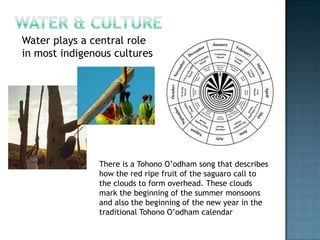
Water & CultureWater plays a central role in most indigenous culturesThere is a Tohono O’odham song that describes how the red ripe fruit of the saguaro call to the clouds to form overhead. These clouds mark the beginning of the summer monsoons and also the beginning of the new year in the traditional Tohono O’odham calendar
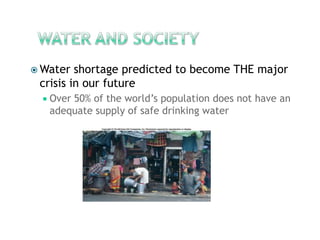
Water and societyWater shortage predicted to become THE major crisis in our futureOver 50% of the world’s population does not have an adequate supply of safe drinking water
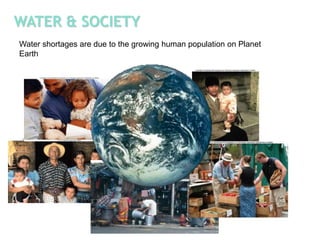
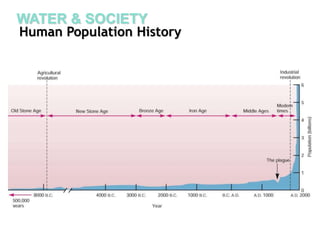
WATER & SOCIETYWater shortages are due to the growing human population on Planet Earth
Human Population HistoryWATER & SOCIETY
Part II: HYDROLOGIC CYCLE
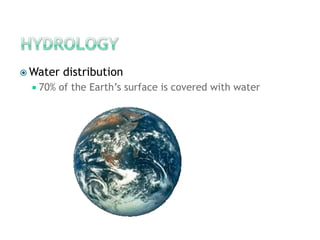
HydrologyWater distribution70% of the Earth’s surface is covered with water
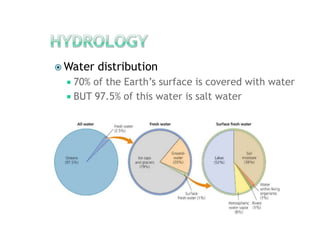
HydrologyWater distribution70% of the Earth’s surface is covered with waterBUT 97.5% of this water is salt water
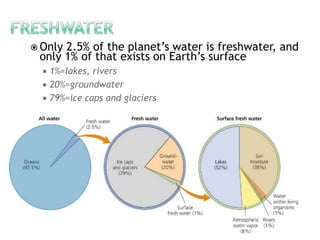
FreshwaterOnly 2.5% of the planet’s water is freshwater, and only 1% of that exists on Earth’s surface
1%=lakes, rivers
20%=groundwater
79%=ice caps and glaciersMatter Recycling in EcosystemsLaw of Conservation of Matter:  matter is neither created nor destroyed.Just moved around and transformed.Biogeochemical cycles:  the movement of chemicals through the components of the Earth system.These components are also called “biogeochemical reservoirs”.13
components of the Earth SYSTEMLithosphere:  the solid Earth; land
components of the Earth SYSTEMLithosphere:  the solid Earth; landHydrosphere:  the liquid Earth; water
components of the Earth SYSTEMLithosphere:  the solid Earth; landHydrosphere:  the liquid Earth; waterAtmosphere:  the gaseous Earth; air
components of the Earth SYSTEMLithosphere:  the solid Earth; landHydrosphere:  the liquid Earth; waterAtmosphere:  the gaseous Earth; airBiosphere:  living things (organisms)and the parts of the lithosphere, hydrosphere, and atmosphere in which things live
components of the Earth SYSTEMLithosphere:  the solid Earth; landHydrosphere:  the liquid Earth; waterAtmosphere:  the gaseous Earth; airOrganisms:  living thingsCryosphere:  frozen or solid water such as ice caps, glaciers, snow and permafrost
HYDROLOGIC CYCLEHydrologic cycleCycling of water in and out of atmosphere and between all the earth’s components. All of the water on our planet is recycled and a given molecule of water is used over and over throughout time.Water is the primary medium by which energy and matter move are circulated through the Earth system components.19
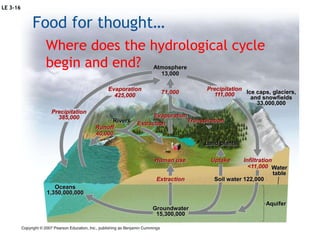
The hydrologic cycleWater enters the atmosphere by evaporation and by transpiration from leaves.
It condenses and falls from the atmosphere as precipitation.
When water falls as precipitation on land, it has two possible pathways:Returns to the hydrosphere by flowing as runoff from the land surface into streams, rivers, lakes, and eventually the ocean.  Returns to the lithosphere by infiltration into the ground becoming soil water or ground water.
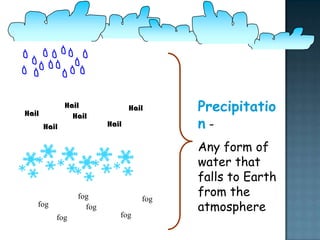
HailfogHailfogHailfogHailfogHailfogHailfogPrecipitation - Any form of water that falls to Earth from the atmosphere
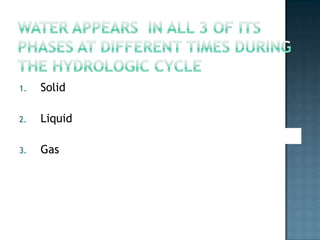
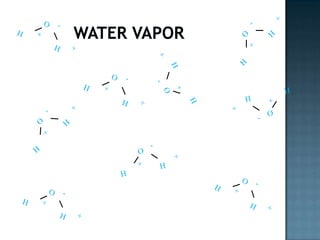
Water appears  in all 3 of its phases at different times during the hydrologic cycleSolidIce, hail, snow, glaciers, ice caps etc.LiquidWater droplets, including clouds, lakes, streams etc.GasWater vapor---------OOOOOOOOO++++++++++++++++++HHHHHHHHHHHHHHHHHHWater Vapor
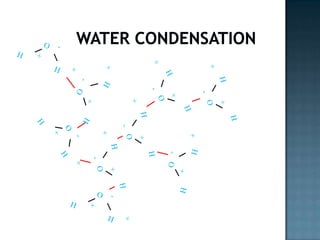
---------OOOOOOOOO++++++++++++++++++HHHHHHHHHHHHHHHHHHWater Condensation
FIVE PROCESSES OF THE HYDROLOGIC CYClePrecipitation:  Any form of water falling from the atmosphere to the ground.Condensation:  The process of changing from a gas to a liquidEvapotranspiration:Evaporation: the transformation of water from liquid to gas phases as it moves from the ground or bodies of water into the overlying atmosphere.The source of energy for evaporation is primarily solar radiationTranspiration:  the release of water vapor from plants into the atmosphere.  Evaporation + transpiration=evapotranspiration
Infiltration and run-offRun-off: variety of ways water moves across the landSnowmelt:  run off from melting of snow on mountain tops
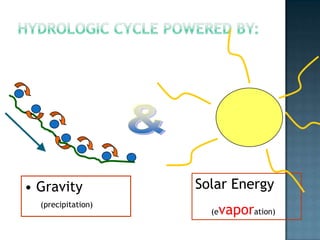
Water can flow to rivers, lakes, reservoirs, oceans or infiltrate into soilInfiltration:  flow of water from surface into the groundOnce in ground can become soil water or ground waterHydrologic Cycle Powered By:&Solar Energy(evaporation) Gravity(precipitation)
So, where does water go when it falls on earth?about 76% lost to evaporation 32% run-off small percent infiltrates into groundwater
LE 3-16Food for thought…Where does the hydrological cycle begin and end?Atmosphere13,000Evaporation425,000Precipitation111,00071,000Ice caps, glaciers,and snowfields33,000,000Precipitation385,000EvaporationTranspirationRiversExtractionRunoff40,000Land plantsUptakeHuman useInfiltration<11,000WatertableExtractionSoil water 122,000Oceans1,350,000,000AquiferGroundwater15,300,000
QUESTION: Testing Your ComprehensionWater enters the atmosphere through the process of…?a.	Precipitationb.	Transpirationc.	Infiltrationd.	Runoff
QUESTION: Testing Your ComprehensionWater enters the atmosphere through the process of…?a.	Precipitationb.	Evaporationc.	Infiltrationd.	Runoff
QUESTION: Testing Your ComprehensionWater enters the lithosphere through the process of…?a.	Precipitationb.	Transpirationc.	Infiltrationd.	Runoff
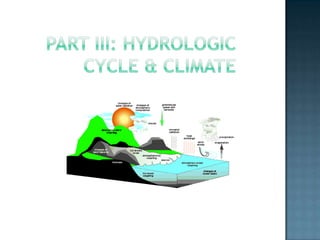
Part IiI: HYDROLOGIC CYCLE & climate
Climate Concepts:  rise or sinkWarm air risesOpen the oven, you feel the heat on your faceCold air sinksOpen the freezer, you feel the cold at your feet
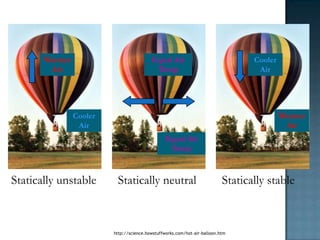
Warmer AirCooler AirEqual Air TempCooler AirWarmer AirEqual Air TempStatically unstableStatically neutralStatically stablehttp://science.howstuffworks.com/hot-air-balloon.htm
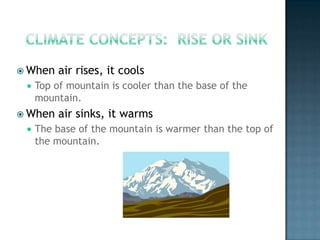
Climate Concepts:  rise or sinkWhen air rises, it coolsTop of mountain is cooler than the base of the mountain. When air sinks, it warmsThe base of the mountain is warmer than the top of the mountain.
Climate Concepts:  warm or coldWarm air holds more waterCold air holds less water
Climate Concepts:  water in airAs air rises, it coolsCooler air holds less water vapor. If it gets even cooler, then it rainsRISING AIRRAIN
Climate Concepts:  water in airAs air descends, it drieswarmer air holds more water vapor. As air dries, it is less likely to rainDESCENDING AIRDRY
Climate Concepts:  water in airThe temperature to which the air had to cool to become totally saturated is called:Dew point:  the temperature at which the relative humidity = 100%
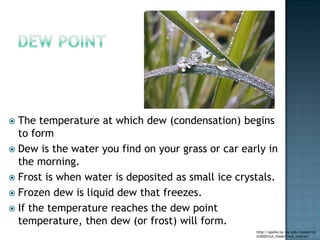
Dew Point	The temperature at which dew (condensation) begins to formDew is the water you find on your grass or car early in the morning.Frost is when water is deposited as small ice crystals.Frozen dew is liquid dew that freezes.If the temperature reaches the dew point temperature, then dew (or frost) will form.http://apollo.lsc.vsc.edu/classes/idm3020/tut_folder/nick_tutorial/
Climate Concepts:  ReviewWarm air holds (more or less?) water vapor; cold air holds (more or less?) water vapor.As air cools down, the chance of rain increases or decreases?As air rises, the chance of rain increases or decreases?
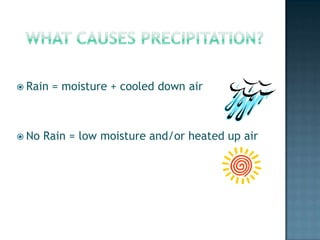
What causes Precipitation?Rain = moisture + cooled down air
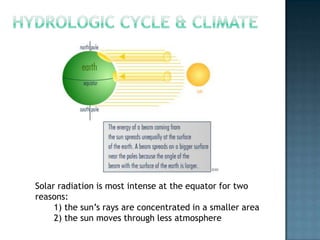
No Rain = low moisture and/or heated up airHydrologic cycle & climateSolar radiation is most intense at the equator for two reasons: 1) the sun’s rays are concentrated in a smaller area  2) the sun moves through less atmosphere
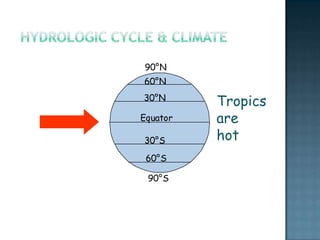
Hydrologic cycle & climateTropics arehot
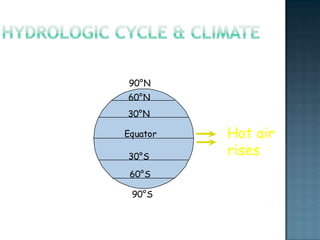
Hydrologic cycle & climateHot airrises
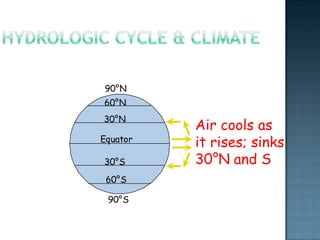
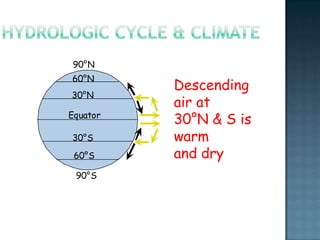
Hydrologic cycle & climateAir cools asit rises; sinks30°N and S
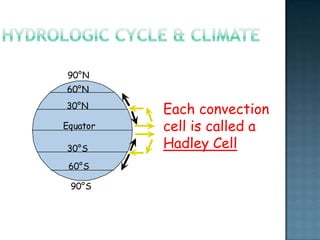
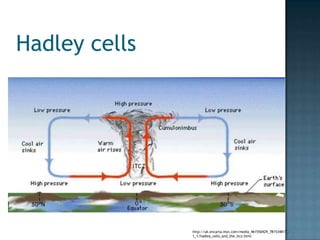
Hydrologic cycle & climateEach convectioncell is called aHadley Cell
Hadley cellshttp://uk.encarta.msn.com/media_461550429_781534817_-1_1/hadley_cells_and_the_itcz.html
Hydrologic cycle & climateDescending air at30°N & S is warmand dry
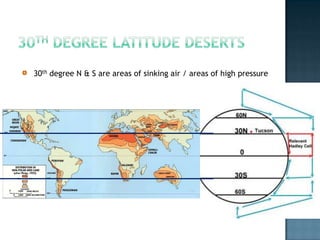
30th Degree Latitude Deserts30th degree N & S are areas of sinking air / areas of high pressure

Hydrologic Cycle

  • 1.
  • 2.
  • 3.
    Water is lifeYOUare 60% water and can only live a few days without drinking water
  • 4.
    Water & CultureIndigenouscultures “recognize, honor and respect water as sacred and sustains all life”www.indigenouswater.org/user/IPKyotoWaterDeclarationFINAL.pdfWater is the blood of mother earth, the giver of lifeWater is worthy of reverence and great respect
  • 5.
    Water & CultureWaterplays a central role in most indigenous culturesThere is a Tohono O’odham song that describes how the red ripe fruit of the saguaro call to the clouds to form overhead. These clouds mark the beginning of the summer monsoons and also the beginning of the new year in the traditional Tohono O’odham calendar
  • 6.
    Water and societyWatershortage predicted to become THE major crisis in our futureOver 50% of the world’s population does not have an adequate supply of safe drinking water
  • 7.
    WATER & SOCIETYWatershortages are due to the growing human population on Planet Earth
  • 8.
  • 9.
  • 10.
    HydrologyWater distribution70% ofthe Earth’s surface is covered with water
  • 11.
    HydrologyWater distribution70% ofthe Earth’s surface is covered with waterBUT 97.5% of this water is salt water
  • 12.
    FreshwaterOnly 2.5% ofthe planet’s water is freshwater, and only 1% of that exists on Earth’s surface
  • 13.
  • 14.
  • 15.
    79%=ice caps andglaciersMatter Recycling in EcosystemsLaw of Conservation of Matter: matter is neither created nor destroyed.Just moved around and transformed.Biogeochemical cycles: the movement of chemicals through the components of the Earth system.These components are also called “biogeochemical reservoirs”.13
  • 16.
    components of theEarth SYSTEMLithosphere: the solid Earth; land
  • 17.
    components of theEarth SYSTEMLithosphere: the solid Earth; landHydrosphere: the liquid Earth; water
  • 18.
    components of theEarth SYSTEMLithosphere: the solid Earth; landHydrosphere: the liquid Earth; waterAtmosphere: the gaseous Earth; air
  • 19.
    components of theEarth SYSTEMLithosphere: the solid Earth; landHydrosphere: the liquid Earth; waterAtmosphere: the gaseous Earth; airBiosphere: living things (organisms)and the parts of the lithosphere, hydrosphere, and atmosphere in which things live
  • 20.
    components of theEarth SYSTEMLithosphere: the solid Earth; landHydrosphere: the liquid Earth; waterAtmosphere: the gaseous Earth; airOrganisms: living thingsCryosphere: frozen or solid water such as ice caps, glaciers, snow and permafrost
  • 21.
    HYDROLOGIC CYCLEHydrologic cycleCyclingof water in and out of atmosphere and between all the earth’s components. All of the water on our planet is recycled and a given molecule of water is used over and over throughout time.Water is the primary medium by which energy and matter move are circulated through the Earth system components.19
  • 23.
    The hydrologic cycleWaterenters the atmosphere by evaporation and by transpiration from leaves.
  • 24.
    It condenses andfalls from the atmosphere as precipitation.
  • 25.
    When water fallsas precipitation on land, it has two possible pathways:Returns to the hydrosphere by flowing as runoff from the land surface into streams, rivers, lakes, and eventually the ocean. Returns to the lithosphere by infiltration into the ground becoming soil water or ground water.
  • 26.
    HailfogHailfogHailfogHailfogHailfogHailfogPrecipitation - Anyform of water that falls to Earth from the atmosphere
  • 27.
    Water appears in all 3 of its phases at different times during the hydrologic cycleSolidIce, hail, snow, glaciers, ice caps etc.LiquidWater droplets, including clouds, lakes, streams etc.GasWater vapor---------OOOOOOOOO++++++++++++++++++HHHHHHHHHHHHHHHHHHWater Vapor
  • 28.
  • 29.
    FIVE PROCESSES OFTHE HYDROLOGIC CYClePrecipitation: Any form of water falling from the atmosphere to the ground.Condensation: The process of changing from a gas to a liquidEvapotranspiration:Evaporation: the transformation of water from liquid to gas phases as it moves from the ground or bodies of water into the overlying atmosphere.The source of energy for evaporation is primarily solar radiationTranspiration: the release of water vapor from plants into the atmosphere. Evaporation + transpiration=evapotranspiration
  • 30.
    Infiltration and run-offRun-off:variety of ways water moves across the landSnowmelt: run off from melting of snow on mountain tops
  • 31.
    Water can flowto rivers, lakes, reservoirs, oceans or infiltrate into soilInfiltration: flow of water from surface into the groundOnce in ground can become soil water or ground waterHydrologic Cycle Powered By:&Solar Energy(evaporation) Gravity(precipitation)
  • 32.
    So, where doeswater go when it falls on earth?about 76% lost to evaporation 32% run-off small percent infiltrates into groundwater
  • 33.
    LE 3-16Food forthought…Where does the hydrological cycle begin and end?Atmosphere13,000Evaporation425,000Precipitation111,00071,000Ice caps, glaciers,and snowfields33,000,000Precipitation385,000EvaporationTranspirationRiversExtractionRunoff40,000Land plantsUptakeHuman useInfiltration<11,000WatertableExtractionSoil water 122,000Oceans1,350,000,000AquiferGroundwater15,300,000
  • 34.
    QUESTION: Testing YourComprehensionWater enters the atmosphere through the process of…?a. Precipitationb. Transpirationc. Infiltrationd. Runoff
  • 35.
    QUESTION: Testing YourComprehensionWater enters the atmosphere through the process of…?a. Precipitationb. Evaporationc. Infiltrationd. Runoff
  • 36.
    QUESTION: Testing YourComprehensionWater enters the lithosphere through the process of…?a. Precipitationb. Transpirationc. Infiltrationd. Runoff
  • 37.
    Part IiI: HYDROLOGICCYCLE & climate
  • 38.
    Climate Concepts: rise or sinkWarm air risesOpen the oven, you feel the heat on your faceCold air sinksOpen the freezer, you feel the cold at your feet
  • 39.
    Warmer AirCooler AirEqualAir TempCooler AirWarmer AirEqual Air TempStatically unstableStatically neutralStatically stablehttp://science.howstuffworks.com/hot-air-balloon.htm
  • 40.
    Climate Concepts: rise or sinkWhen air rises, it coolsTop of mountain is cooler than the base of the mountain. When air sinks, it warmsThe base of the mountain is warmer than the top of the mountain.
  • 41.
    Climate Concepts: warm or coldWarm air holds more waterCold air holds less water
  • 42.
    Climate Concepts: water in airAs air rises, it coolsCooler air holds less water vapor. If it gets even cooler, then it rainsRISING AIRRAIN
  • 43.
    Climate Concepts: water in airAs air descends, it drieswarmer air holds more water vapor. As air dries, it is less likely to rainDESCENDING AIRDRY
  • 44.
    Climate Concepts: water in airThe temperature to which the air had to cool to become totally saturated is called:Dew point: the temperature at which the relative humidity = 100%
  • 45.
    Dew Point The temperatureat which dew (condensation) begins to formDew is the water you find on your grass or car early in the morning.Frost is when water is deposited as small ice crystals.Frozen dew is liquid dew that freezes.If the temperature reaches the dew point temperature, then dew (or frost) will form.http://apollo.lsc.vsc.edu/classes/idm3020/tut_folder/nick_tutorial/
  • 46.
    Climate Concepts: ReviewWarm air holds (more or less?) water vapor; cold air holds (more or less?) water vapor.As air cools down, the chance of rain increases or decreases?As air rises, the chance of rain increases or decreases?
  • 47.
    What causes Precipitation?Rain= moisture + cooled down air
  • 48.
    No Rain =low moisture and/or heated up airHydrologic cycle & climateSolar radiation is most intense at the equator for two reasons: 1) the sun’s rays are concentrated in a smaller area 2) the sun moves through less atmosphere
  • 49.
    Hydrologic cycle &climateTropics arehot
  • 50.
    Hydrologic cycle &climateHot airrises
  • 51.
    Hydrologic cycle &climateAir cools asit rises; sinks30°N and S
  • 52.
    Hydrologic cycle &climateEach convectioncell is called aHadley Cell
  • 53.
  • 54.
    Hydrologic cycle &climateDescending air at30°N & S is warmand dry
  • 55.
    30th Degree LatitudeDeserts30th degree N & S are areas of sinking air / areas of high pressure